

STEROIDS
Presenter DR SABA RAZZAK
1
INTRODUCTION
SAR OF STEROIDS
MECHANISM OF ACTION
CLASSIFICATION
STEROLS
STEROID HORMONES
BILE ACIDS
CONCLUSION 2
• The steroids form a group of structurally related compounds, which are widely
distributed in plants and animals.
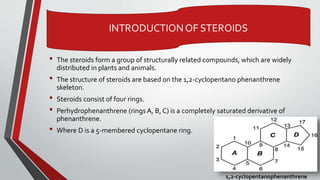
• The structure of steroids are based on the 1,2-cyclopentano phenanthrene
skeleton.
• Steroids consist of four rings.
• Perhydrophenanthrene (rings A, B, C) is a completely saturated derivative of
phenanthrene.
• Where D is a 5-membered cyclopentane ring.
3
1,2-cyclopentanophenanthrene
SAR OF STEROIDS
4
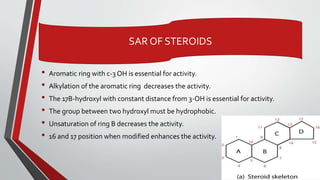
• Aromatic ring with c-3 OH is essential for activity.
• Alkylation of the aromatic ring decreases the activity.
• The 17B-hydroxyl with constant distance from 3-OH is essential for activity.
• The group between two hydroxyl must be hydrophobic.
• Unsaturation of ring B decreases the activity.
• 16 and 17 position when modified enhances the activity.
5
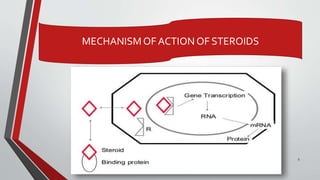
MECHANISM OF ACTION OF STEROIDS
• Classified intoThree classes
On the basis of site of release
On the basis of therapeutic class
On the basis of type of substituent group attached( depending upon the type of substituent
group at C-17)
CLASSIFICATIONOF STEROIDS
6
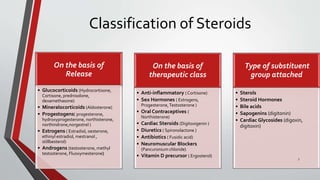
Classification of Steroids
On the basis of
Release
• Glucocorticoids (Hydrocortisone,
Cortisone, prednisolone,
dexamethasone)
• Mineralocorticoids (Aldosterone)
• Progestogens( progesterone,
hydroxyprogesterone, northisterone,
northindrone,norgestrel )
• Estrogens ( Estradiol, oesterone,
ethinyl estradiol, mestranol ,
stillbesterol)
• Androgens (testosterone, methyl
testosterone, Fluoxymesterone)
On the basis of
therapeutic class
• Anti-inflammatory ( Cortisone)
• Sex Hormones ( Estrogens,
Progesterone,Testosterone )
• Oral Contraceptives (
Northisterone)
• Cardiac Steroids (Digitoxigenin )
• Diuretics ( Spironolactone )
• Antibiotics ( Fusidic acid)
• Neuromuscular Blockers
(Pancuronium chloride)
• Vitamin D precursor ( Ergosterol)
Type of substituent
group attached
• Sterols
• Steroid Hormones
• Bile acids
• Sapogenins (digitonin)
• Cardiac Glycosides (digoxin,
digitoxin)
7
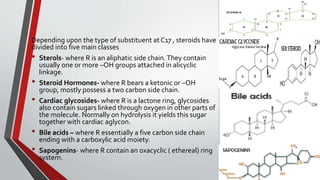
Depending upon the type of substituent at C17 , steroids have
divided into five main classes
• Sterols- where R is an aliphatic side chain.They contain
usually one or more –OH groups attached in alicyclic
linkage.
• Steroid Hormones- where R bears a ketonic or –OH
group, mostly possess a two carbon side chain.
• Cardiac glycosides- where R is a lactone ring, glycosides
also contain sugars linked through oxygen in other parts of
the molecule. Normally on hydrolysis it yields this sugar
together with cardiac aglycon.
• Bile acids – where R essentially a five carbon side chain
ending with a carboxylic acid moiety.
• Sapogenins- where R contain an oxacyclic ( ethereal) ring
system. 8
STEROLS
9
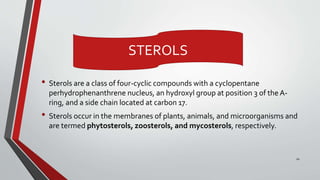
• Sterols are a class of four-cyclic compounds with a cyclopentane
perhydrophenanthrene nucleus, an hydroxyl group at position 3 of the A-
ring, and a side chain located at carbon 17.
• Sterols occur in the membranes of plants, animals, and microorganisms and
are termed phytosterols, zoosterols, and mycosterols, respectively.
STEROLS
10
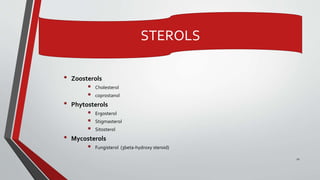
• Zoosterols
 Cholesterol
 coprostanol
• Phytosterols
 Ergosterol
 Stigmasterol
 Sitosterol
• Mycosterols
 Fungisterol (3beta-hydroxy steroid)
11
STEROLS
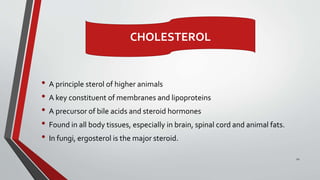
• A principle sterol of higher animals
• A key constituent of membranes and lipoproteins
• A precursor of bile acids and steroid hormones
• Found in all body tissues, especially in brain, spinal cord and animal fats.
• In fungi, ergosterol is the major steroid.
12
CHOLESTEROL
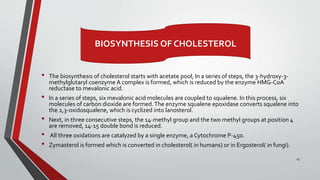
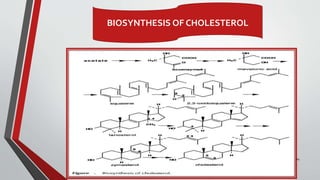
• The biosynthesis of cholesterol starts with acetate pool, In a series of steps, the 3-hydroxy-3-
methylglutaryl coenzyme A complex is formed, which is reduced by the enzyme HMG-CoA
reductase to mevalonic acid.
• In a series of steps, six mevalonic acid molecules are coupled to squalene. In this process, six
molecules of carbon dioxide are formed.The enzyme squalene epoxidase converts squalene into
the 2,3-oxidosqualene, which is cyclized into lanosterol.
• Next, in three consecutive steps, the 14-methyl group and the two methyl groups at position 4
are removed, 14-15 double bond is reduced.
• All three oxidations are catalyzed by a single enzyme, a Cytochrome P-450.
• Zymasterol is formed which is converted in cholesterol( in humans) or in Ergosterol( in fungi).
13
BIOSYNTHESIS OF CHOLESTEROL
14
BIOSYNTHESIS OF CHOLESTEROL
15
STEROID HORMONES
16
STEROID HORMONES
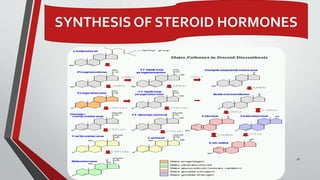
Hormones are chemical messengers of the body.
One group of hormones is known as steroid hormones because these hormones are synthesized
from cholesterol, which is also a steroid.
As steroid hormones are derivatives of cholesterol, they are synthesized by variety of tissues, most
prominently the adrenal gland and gonads.
Typically, endocrinologists classify steroid hormones into Five groups of molecules, based primarily
on the receptor to which they bind:
• Glucocorticoids; cortisol is the major representative in most mammals
• Mineralocorticoids; aldosterone being most prominent
• Androgens such as testosterone
• Estrogens, including estradiol and estrone
• Progestogens (also known a progestins) such as progesterone
17
SYNTHESIS OF STEROID HORMONES
18
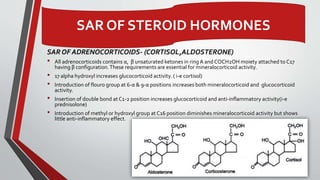
SAR OF ADRENOCORTICOIDS- (CORTISOL,ALDOSTERONE)
• All adrenocorticoids contains α, β unsaturated ketones in ring A and COCH2OH moiety attached to C17
having β configuration.These requirements are essential for mineralocorticoid activity.
• 17 alpha hydroxyl increases glucocorticoid activity. ( i-e cortisol)
• Introduction of flouro group at 6-α & 9-α positions increases both mineralocorticoid and glucocorticoid
activity.
• Insertion of double bond at C1-2 position increases glucocorticoid and anti-inflammatory activity(i-e
prednisolone)
• Introduction of methyl or hydroxyl group at C16 position diminishes mineralocorticoid activity but shows
little anti-inflammatory effect.
SAR OF STEROID HORMONES
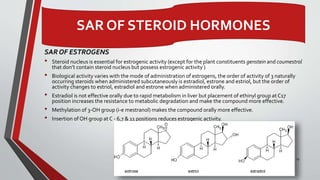
SAR OF ESTROGENS
• Steroid nucleus is essential for estrogenic activity (except for the plant constituents genstein and coumestrol
that don’t contain steroid nucleus but possess estrogenic activity )
• Biological activity varies with the mode of administration of estrogens, the order of activity of 3 naturally
occurring steroids when administered subcutaneously is estradiol, estrone and estriol, but the order of
activity changes to estriol, estradiol and estrone when administered orally.
• Estradiol is not effective orally due to rapid metabolism in liver but placement of ethinyl group at C17
position increases the resistance to metabolic degradation and make the compound more effective.
• Methylation of 3-OH group (i-e mestranol) makes the compound orally more effective.
• Insertion of OH group at C - 6,7 & 11 positions reduces estrogenic activity.
19
SAR OF STEROID HORMONES
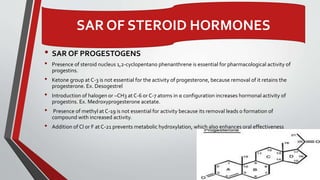
• SAR OF PROGESTOGENS
• Presence of steroid nucleus 1,2-cyclopentano phenanthrene is essential for pharmacological activity of
progestins.
• Ketone group at C-3 is not essential for the activity of progesterone, because removal of it retains the
progesterone. Ex. Desogestrel
• Introduction of halogen or –CH3 at C-6 or C-7 atoms in α configuration increases hormonal activity of
progestins. Ex. Medroxyprogesterone acetate.
• Presence of methyl at C-19 is not essential for activity because its removal leads o formation of
compound with increased activity.
• Addition of Cl or F at C-21 prevents metabolic hydroxylation, which also enhances oral effectiveness
20
SAR OF STEROID HORMONES
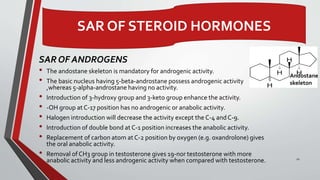
SAR OF ANDROGENS
• The andostane skeleton is mandatory for androgenic activity.
• The basic nucleus having 5-beta-androstane possess androgenic activity
,whereas 5-alpha-androstane having no activity.
• Introduction of 3-hydroxy group and 3-keto group enhance the activity.
• -OH group at C-17 position has no androgenic or anabolic activity.
• Halogen introduction will decrease the activity except the C-4 and C-9.
• Introduction of double bond at C-1 position increases the anabolic activity.
• Replacement of carbon atom at C-2 position by oxygen (e.g. oxandrolone) gives
the oral anabolic activity.
• Removal of CH3 group in testosterone gives 19-nor testosterone with more
anabolic activity and less androgenic activity when compared with testosterone. 21
Andostane
skeleton
SAR OF STEROID HORMONES
22
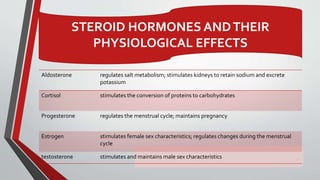
STEROID HORMONES ANDTHEIR
PHYSIOLOGICAL EFFECTS
Aldosterone regulates salt metabolism; stimulates kidneys to retain sodium and excrete
potassium
Cortisol stimulates the conversion of proteins to carbohydrates
Progesterone regulates the menstrual cycle; maintains pregnancy
Estrogen stimulates female sex characteristics; regulates changes during the menstrual
cycle
testosterone stimulates and maintains male sex characteristics
23
BILE ACIDS
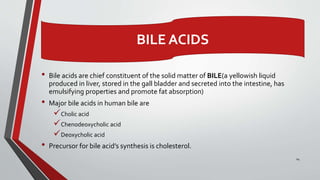
• Bile acids are chief constituent of the solid matter of BILE(a yellowish liquid
produced in liver, stored in the gall bladder and secreted into the intestine, has
emulsifying properties and promote fat absorption)
• Major bile acids in human bile are
Cholic acid
Chenodeoxycholic acid
Deoxycholic acid
• Precursor for bile acid’s synthesis is cholesterol.
24
BILE ACIDS
25
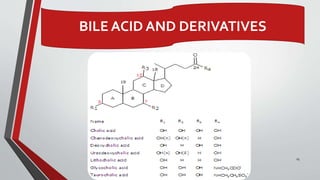
BILE ACID AND DERIVATIVES
• The steroids widely distributed in plants and animals.
• The structure of steroids are based on the 1,2-cyclopentano phenanthrene skeleton.
• Classified into three main classes 1)On the basis of site of release,2) therapeutic class and 3)
type of substituent group attached.
• On the basis of chemistry substitution, further into 5 groups 1) Sterols, 2)Sex steroids, 3)
CardiacGlycosides, 3) Bile acids, 5) Sapogenins .
• Cholesterol is a principle sterol of higher animals, and a precursor for all the main steroids
including adrenal hormones, sex hormones and bile acids.
• Aglycon part of cardiac glycoside structurally related to steroid.
• Saponins are natural products having structural similarities with steroids.
26
CONCLUSION
27

STEROIDS - MEDICINAL CHEMISTRY

  • 1.
  • 2.
    INTRODUCTION SAR OF STEROIDS MECHANISMOF ACTION CLASSIFICATION STEROLS STEROID HORMONES BILE ACIDS CONCLUSION 2
  • 3.
    • The steroidsform a group of structurally related compounds, which are widely distributed in plants and animals. • The structure of steroids are based on the 1,2-cyclopentano phenanthrene skeleton. • Steroids consist of four rings. • Perhydrophenanthrene (rings A, B, C) is a completely saturated derivative of phenanthrene. • Where D is a 5-membered cyclopentane ring. 3 1,2-cyclopentanophenanthrene
  • 4.
    SAR OF STEROIDS 4 •Aromatic ring with c-3 OH is essential for activity. • Alkylation of the aromatic ring decreases the activity. • The 17B-hydroxyl with constant distance from 3-OH is essential for activity. • The group between two hydroxyl must be hydrophobic. • Unsaturation of ring B decreases the activity. • 16 and 17 position when modified enhances the activity.
  • 5.
  • 6.
    • Classified intoThreeclasses On the basis of site of release On the basis of therapeutic class On the basis of type of substituent group attached( depending upon the type of substituent group at C-17) CLASSIFICATIONOF STEROIDS 6
  • 7.
    Classification of Steroids Onthe basis of Release • Glucocorticoids (Hydrocortisone, Cortisone, prednisolone, dexamethasone) • Mineralocorticoids (Aldosterone) • Progestogens( progesterone, hydroxyprogesterone, northisterone, northindrone,norgestrel ) • Estrogens ( Estradiol, oesterone, ethinyl estradiol, mestranol , stillbesterol) • Androgens (testosterone, methyl testosterone, Fluoxymesterone) On the basis of therapeutic class • Anti-inflammatory ( Cortisone) • Sex Hormones ( Estrogens, Progesterone,Testosterone ) • Oral Contraceptives ( Northisterone) • Cardiac Steroids (Digitoxigenin ) • Diuretics ( Spironolactone ) • Antibiotics ( Fusidic acid) • Neuromuscular Blockers (Pancuronium chloride) • Vitamin D precursor ( Ergosterol) Type of substituent group attached • Sterols • Steroid Hormones • Bile acids • Sapogenins (digitonin) • Cardiac Glycosides (digoxin, digitoxin) 7
  • 8.
    Depending upon thetype of substituent at C17 , steroids have divided into five main classes • Sterols- where R is an aliphatic side chain.They contain usually one or more –OH groups attached in alicyclic linkage. • Steroid Hormones- where R bears a ketonic or –OH group, mostly possess a two carbon side chain. • Cardiac glycosides- where R is a lactone ring, glycosides also contain sugars linked through oxygen in other parts of the molecule. Normally on hydrolysis it yields this sugar together with cardiac aglycon. • Bile acids – where R essentially a five carbon side chain ending with a carboxylic acid moiety. • Sapogenins- where R contain an oxacyclic ( ethereal) ring system. 8
  • 9.
  • 10.
    • Sterols area class of four-cyclic compounds with a cyclopentane perhydrophenanthrene nucleus, an hydroxyl group at position 3 of the A- ring, and a side chain located at carbon 17. • Sterols occur in the membranes of plants, animals, and microorganisms and are termed phytosterols, zoosterols, and mycosterols, respectively. STEROLS 10
  • 11.
    • Zoosterols  Cholesterol coprostanol • Phytosterols  Ergosterol  Stigmasterol  Sitosterol • Mycosterols  Fungisterol (3beta-hydroxy steroid) 11 STEROLS
  • 12.
    • A principlesterol of higher animals • A key constituent of membranes and lipoproteins • A precursor of bile acids and steroid hormones • Found in all body tissues, especially in brain, spinal cord and animal fats. • In fungi, ergosterol is the major steroid. 12 CHOLESTEROL
  • 13.
    • The biosynthesisof cholesterol starts with acetate pool, In a series of steps, the 3-hydroxy-3- methylglutaryl coenzyme A complex is formed, which is reduced by the enzyme HMG-CoA reductase to mevalonic acid. • In a series of steps, six mevalonic acid molecules are coupled to squalene. In this process, six molecules of carbon dioxide are formed.The enzyme squalene epoxidase converts squalene into the 2,3-oxidosqualene, which is cyclized into lanosterol. • Next, in three consecutive steps, the 14-methyl group and the two methyl groups at position 4 are removed, 14-15 double bond is reduced. • All three oxidations are catalyzed by a single enzyme, a Cytochrome P-450. • Zymasterol is formed which is converted in cholesterol( in humans) or in Ergosterol( in fungi). 13 BIOSYNTHESIS OF CHOLESTEROL
  • 14.
  • 15.
  • 16.
    16 STEROID HORMONES Hormones arechemical messengers of the body. One group of hormones is known as steroid hormones because these hormones are synthesized from cholesterol, which is also a steroid. As steroid hormones are derivatives of cholesterol, they are synthesized by variety of tissues, most prominently the adrenal gland and gonads. Typically, endocrinologists classify steroid hormones into Five groups of molecules, based primarily on the receptor to which they bind: • Glucocorticoids; cortisol is the major representative in most mammals • Mineralocorticoids; aldosterone being most prominent • Androgens such as testosterone • Estrogens, including estradiol and estrone • Progestogens (also known a progestins) such as progesterone
  • 17.
  • 18.
    18 SAR OF ADRENOCORTICOIDS-(CORTISOL,ALDOSTERONE) • All adrenocorticoids contains α, β unsaturated ketones in ring A and COCH2OH moiety attached to C17 having β configuration.These requirements are essential for mineralocorticoid activity. • 17 alpha hydroxyl increases glucocorticoid activity. ( i-e cortisol) • Introduction of flouro group at 6-α & 9-α positions increases both mineralocorticoid and glucocorticoid activity. • Insertion of double bond at C1-2 position increases glucocorticoid and anti-inflammatory activity(i-e prednisolone) • Introduction of methyl or hydroxyl group at C16 position diminishes mineralocorticoid activity but shows little anti-inflammatory effect. SAR OF STEROID HORMONES
  • 19.
    SAR OF ESTROGENS •Steroid nucleus is essential for estrogenic activity (except for the plant constituents genstein and coumestrol that don’t contain steroid nucleus but possess estrogenic activity ) • Biological activity varies with the mode of administration of estrogens, the order of activity of 3 naturally occurring steroids when administered subcutaneously is estradiol, estrone and estriol, but the order of activity changes to estriol, estradiol and estrone when administered orally. • Estradiol is not effective orally due to rapid metabolism in liver but placement of ethinyl group at C17 position increases the resistance to metabolic degradation and make the compound more effective. • Methylation of 3-OH group (i-e mestranol) makes the compound orally more effective. • Insertion of OH group at C - 6,7 & 11 positions reduces estrogenic activity. 19 SAR OF STEROID HORMONES
  • 20.
    • SAR OFPROGESTOGENS • Presence of steroid nucleus 1,2-cyclopentano phenanthrene is essential for pharmacological activity of progestins. • Ketone group at C-3 is not essential for the activity of progesterone, because removal of it retains the progesterone. Ex. Desogestrel • Introduction of halogen or –CH3 at C-6 or C-7 atoms in α configuration increases hormonal activity of progestins. Ex. Medroxyprogesterone acetate. • Presence of methyl at C-19 is not essential for activity because its removal leads o formation of compound with increased activity. • Addition of Cl or F at C-21 prevents metabolic hydroxylation, which also enhances oral effectiveness 20 SAR OF STEROID HORMONES
  • 21.
    SAR OF ANDROGENS •The andostane skeleton is mandatory for androgenic activity. • The basic nucleus having 5-beta-androstane possess androgenic activity ,whereas 5-alpha-androstane having no activity. • Introduction of 3-hydroxy group and 3-keto group enhance the activity. • -OH group at C-17 position has no androgenic or anabolic activity. • Halogen introduction will decrease the activity except the C-4 and C-9. • Introduction of double bond at C-1 position increases the anabolic activity. • Replacement of carbon atom at C-2 position by oxygen (e.g. oxandrolone) gives the oral anabolic activity. • Removal of CH3 group in testosterone gives 19-nor testosterone with more anabolic activity and less androgenic activity when compared with testosterone. 21 Andostane skeleton SAR OF STEROID HORMONES
  • 22.
    22 STEROID HORMONES ANDTHEIR PHYSIOLOGICALEFFECTS Aldosterone regulates salt metabolism; stimulates kidneys to retain sodium and excrete potassium Cortisol stimulates the conversion of proteins to carbohydrates Progesterone regulates the menstrual cycle; maintains pregnancy Estrogen stimulates female sex characteristics; regulates changes during the menstrual cycle testosterone stimulates and maintains male sex characteristics
  • 23.
  • 24.
    • Bile acidsare chief constituent of the solid matter of BILE(a yellowish liquid produced in liver, stored in the gall bladder and secreted into the intestine, has emulsifying properties and promote fat absorption) • Major bile acids in human bile are Cholic acid Chenodeoxycholic acid Deoxycholic acid • Precursor for bile acid’s synthesis is cholesterol. 24 BILE ACIDS
  • 25.
    25 BILE ACID ANDDERIVATIVES
  • 26.
    • The steroidswidely distributed in plants and animals. • The structure of steroids are based on the 1,2-cyclopentano phenanthrene skeleton. • Classified into three main classes 1)On the basis of site of release,2) therapeutic class and 3) type of substituent group attached. • On the basis of chemistry substitution, further into 5 groups 1) Sterols, 2)Sex steroids, 3) CardiacGlycosides, 3) Bile acids, 5) Sapogenins . • Cholesterol is a principle sterol of higher animals, and a precursor for all the main steroids including adrenal hormones, sex hormones and bile acids. • Aglycon part of cardiac glycoside structurally related to steroid. • Saponins are natural products having structural similarities with steroids. 26 CONCLUSION
  • 27.