CRITICAL ANALYSIS OF
ZULFIQAR GHOSE’S POETRY
BY
BY
MADIHA HABIB
National University of Modern Languages
 The expatriate Zulfiqar Ghose , originally Khwaja
Zulfiqar Ahmed
 the Novelist, Poet, Story Writer, Autobiographer,
Journalist, Educationalist, Essayist and Literary
Critic
 born on 13 March 1935 at Sialkot (a city in East
Punjab which later on became West Pakistan after
the partition of Subcontinent in 1947).
 His father Khwaja Mohammad Ghose moved his
extended Muslim family to the bustling city of
Bombay after World War 2 in 1942 for business
opportunities.
 Ghose was deeply affected by communal tension
and the horrific Partition riots.
 in1952 moved to London
 educated at Sloane School, London,
 at Keele University he received his BA
in English and Philosophy
 in London he worked as a cricket and
hockey reporter for The Observer
 wrote book reviews for the TLS and The
Spectator
 contributed to the Arts page of The
Western Daily Press in Bristol
 worked as a school teacher
 Got married to the Brazilian artist
Helena de la Fontaine.
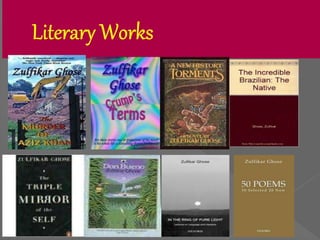
 The Murder of Aziz Khan (1967)
 A New History of Torments (1982)
 Crump Term’s (1975)
 The Incredible Brazilian: The Native
(1972)
 The Incredible Brazilian: The Beautiful
Empire (1975)
 The Incredible Brazilian: A Different
World (1978)
 The Triple Mirror of Self (1992)
“Redbrick Ritual”
 “School Days in Bombay”
Confessionsof NativeAlien(1965)
The Loss of India (1964)
 Jets From Orange (1967)
The Violent West (1972)
 A Memory of Asia (1984)
 Statement against Corpses (1964)
 Veronica and the Gongora Passion:
Stories, Fictions, Tales, and One Fable
(1998)
Critical Volumes
 Hamlet, Prufrock, and Language (1978),
 The Fiction of Reality (1984)
 The Art of Creating Fiction (1991)
 Shakespeare's Mortal Knowledge (1993)
profound sense of alienation and
homelessness.
how politics and historical events
damaged individual’s life.
persons who are searching for
identity, home and belonging,
people affected by colonialism and
post-colonialism.
Ghose’s style is diverse and varied ,use stream
of consciousness technique to capture the
feelings of his alienated protagonist Often
experimental in form, Ghose's works are
infused with realism, magic realism, metaphor,
symbolism, and allegory to create a
metaphysical reality. He frequently employs
mimetic strategies within his writing to force
the reader to re-examine the purpose of the text.
Use simple language to convey his message.
 Many reviewers praise Ghose's careful
construction and attention to technique.
 Commentators praise Ghose's manipulation of
technique to achieve his effects.
 Some commentators find that Ghose's
experimental style detracts from the story and
frustrates the reader, while others applaud
these techniques because they engage the
reader to become active in the search for reality
in the text.
 Some critics believe that Ghose's writing is at its
best when he relaxes his form, and when he
writes from a more personal point of view
 Rizwan Akhtar a PhD fellow at the University of Essex, UK has
written about Zulfiqar Ghose in his column “Always Alien” in The
News “Zulfiqar Ghose is the only writer from the sub-continent
whose work is a conscientious depiction of different cultures, but,
in the literary sense, he has never shown any concern to claim his
roots and the place of his origin.”
 The anonymous reviewer of The Times Literary Supplement
said about Ghose “when Ghose describes the formidable
problems that he has had to face in finding a realistic identity, he
is at once touching and interesting”.
 Waqas Ahmed Khwaja views about Ghose: “Whether he is
writing fiction, novels, poetry, stories or autobiographies, Ghose is
regarded as a writer who is constantly experimenting with
language and form”
 Marginalization and social
responsibility
 Concern for other human
beings
Preservation of Nature
 Hostility of Mankind
Identity crisis
Nostalgia

Zulfiqar ghose ppt

  • 1.
    CRITICAL ANALYSIS OF ZULFIQARGHOSE’S POETRY BY BY MADIHA HABIB National University of Modern Languages
  • 2.
     The expatriateZulfiqar Ghose , originally Khwaja Zulfiqar Ahmed  the Novelist, Poet, Story Writer, Autobiographer, Journalist, Educationalist, Essayist and Literary Critic  born on 13 March 1935 at Sialkot (a city in East Punjab which later on became West Pakistan after the partition of Subcontinent in 1947).  His father Khwaja Mohammad Ghose moved his extended Muslim family to the bustling city of Bombay after World War 2 in 1942 for business opportunities.  Ghose was deeply affected by communal tension and the horrific Partition riots.
  • 3.
     in1952 movedto London  educated at Sloane School, London,  at Keele University he received his BA in English and Philosophy  in London he worked as a cricket and hockey reporter for The Observer  wrote book reviews for the TLS and The Spectator  contributed to the Arts page of The Western Daily Press in Bristol  worked as a school teacher  Got married to the Brazilian artist Helena de la Fontaine.
  • 5.
     The Murderof Aziz Khan (1967)  A New History of Torments (1982)  Crump Term’s (1975)  The Incredible Brazilian: The Native (1972)  The Incredible Brazilian: The Beautiful Empire (1975)  The Incredible Brazilian: A Different World (1978)  The Triple Mirror of Self (1992)
  • 6.
    “Redbrick Ritual”  “SchoolDays in Bombay” Confessionsof NativeAlien(1965)
  • 7.
    The Loss ofIndia (1964)  Jets From Orange (1967) The Violent West (1972)  A Memory of Asia (1984)
  • 8.
     Statement againstCorpses (1964)  Veronica and the Gongora Passion: Stories, Fictions, Tales, and One Fable (1998) Critical Volumes  Hamlet, Prufrock, and Language (1978),  The Fiction of Reality (1984)  The Art of Creating Fiction (1991)  Shakespeare's Mortal Knowledge (1993)
  • 9.
    profound sense ofalienation and homelessness. how politics and historical events damaged individual’s life. persons who are searching for identity, home and belonging, people affected by colonialism and post-colonialism.
  • 10.
    Ghose’s style isdiverse and varied ,use stream of consciousness technique to capture the feelings of his alienated protagonist Often experimental in form, Ghose's works are infused with realism, magic realism, metaphor, symbolism, and allegory to create a metaphysical reality. He frequently employs mimetic strategies within his writing to force the reader to re-examine the purpose of the text. Use simple language to convey his message.
  • 11.
     Many reviewerspraise Ghose's careful construction and attention to technique.  Commentators praise Ghose's manipulation of technique to achieve his effects.  Some commentators find that Ghose's experimental style detracts from the story and frustrates the reader, while others applaud these techniques because they engage the reader to become active in the search for reality in the text.  Some critics believe that Ghose's writing is at its best when he relaxes his form, and when he writes from a more personal point of view
  • 12.
     Rizwan Akhtara PhD fellow at the University of Essex, UK has written about Zulfiqar Ghose in his column “Always Alien” in The News “Zulfiqar Ghose is the only writer from the sub-continent whose work is a conscientious depiction of different cultures, but, in the literary sense, he has never shown any concern to claim his roots and the place of his origin.”  The anonymous reviewer of The Times Literary Supplement said about Ghose “when Ghose describes the formidable problems that he has had to face in finding a realistic identity, he is at once touching and interesting”.  Waqas Ahmed Khwaja views about Ghose: “Whether he is writing fiction, novels, poetry, stories or autobiographies, Ghose is regarded as a writer who is constantly experimenting with language and form”
  • 14.
     Marginalization andsocial responsibility  Concern for other human beings
  • 16.
    Preservation of Nature Hostility of Mankind
  • 18.