Structuralism
F E R D I N A N D D E S A U S S U R E
Born: N o v 26, 1857
Died: F e b 22, 1913
History
 1960s-- Swiss linguist Ferdinand de Saussure
influenced this theory through examination of
language as a system of signs, called
semiology.
STRUCTURALISM is about finding the fundamental basic
UNITS or ELEMENTS that make up any system, and
discovering the RULES that govern how these units can
be combined.
Structuralism - Key takeaways
•Structuralism is a way of understanding culture
and meaning in the arts by relating the individual
piece of art (a novel, a painting, a symphony) to
something larger.
•Structuralism comes from a branch of language
study called ‘structural linguistics’.
•Structuralism is explicitly anti-individual.
•Structuralism is about a shared structure of
meaning.
•Binary oppositions are key to understanding a
text.
STRUCTURALISM AS A PHILOSOPHICAL STANCE
4
● Structuralists areinterestedintheinterrelationshipbetween:
UNITS(also called “surfacephenomena”)
and
RULES(theways in whichunitscanbeputtogether)
● IN LANGUAGE:
Units are words and rules which are the forms of grammar which order words. In
different languages, the grammar rules are different, as are the words, but the
structure is still the same in all languages; words are put together within a
grammaticalsystemtomakemeaning.
STRUCTURALIST NOTIONS ON UNITS AND RULES
5
● Structuralists believe that the underlying structures which organize
UNITS and RULES into meaningful systems are generated by the
humanminditself,andnotbysenseperception.
● As such, the mind is itself a structuring mechanism which looks through
unitsandfilesthemaccordingtorules.
● So, Structuralism sees itself as a science of humankind, and works to
uncover all the structures that underlie all the things that humans do,
think,perceive,andfeel.
STRUCTURALIST ANALYSIS POSITSTHESE
SYSTEMS AS UNIVERSAL
6
● Every human mind in every culture at every point in history has used some sort of structuring
principle to organizeandunderstand cultural phenomena.
● Every human culture has some sort of language, which has the basic structure of all languages;
words /phonemesare combinedaccordingto grammaticalrulestoproducemeaning.
● Every humanculturesimilarlyhassomesortofsocialorganization.
● All of these organizations are governed, according to structuralists’ analyses, by structures which
areuniversal.
 A sign consists of two parts
 Signifier
 Signified
 People know when they see
It means they must stop.
 If we think of this linguistically…
Implications
 'The French word mouton may have the same
meaning as the English word sheep; but it does
not have the same value. There are various
reasons for this, but in particular the fact that the
English word for the meat of this animal, as
prepared and served for a meal, is not sheep but
mutton. The difference in value between sheep
and mouton hinges on the fact that in English
there is also another word mutton for the meat,
whereas mouton in French covers both'.
Different kinds of SIGNS
Iconic
representation -
here the car is an
image which directly
resembles the real
thing
Indexical
representation –
the image
suggests the
presence of a
car
Symbolic – a
sign that bears
no obvious
relation to the
thing that is
signified
The signifier does not resemble the
signified. It is arbitrary - so that the
relationship must be learnt: e.g.
language in general (alphabetical
letters, punctuation marks, words,
phrases and sentences), numbers,
morse code, traffic lights, national
flags.
Symbol/symbolic
The signifier is perceived
as resembling or imitating the
signified (recognizably looking,
sounding, feeling, tasting or smelling
like it) e.g. a portrait, a cartoon, a
scale-model, onomatopoeia,
metaphors.
Icon/Iconic
The signifier is not arbitrary but is
directly connected in some way
(physically or causally) to the
signified - this link can be observed
or inferred.
Index/Indexical
Structure and System


The idea of structure presupposes the
reduction or breaking down of linguistic
segments or features.
A structure presupposes a notion of unity
existing above particular segments or
features; of a whole above the composing
and functioning elements.
Three basic principles of
Saussure
Saussure stated that the meanings we give to
words are arbitrary. The physicality, or
structure of a word, holds no bearing to its
connotation or denotation.
2. Saussure stated that the meanings of words
are relational. "No word can be defined in
isolation from other words" (Barry). It is
necessary to have other words frame a
context to understand one word.
3. According to Saussure, there are no
intrinsic, or fixed meanings in words. If a
group of people were asked to think of
"dog," some people may mentally conjure
a border collie, others a beagle, and others
a Labrador, etc. While these are all dogs,
and would correctly fit under the category
of "dog," this word would not accomplish
simultaneous thought, or a fixed meaning.
 Diachronic study (meaning a study of how
languages change over time—a historical
examination of the influences of culture,
travel, etc. on the way languages “work”—
how they form rules, how they change
forms (morphology), how they grow and
how they become “old”, etc

Synchronic (axis of simultaneities)


Synchronic comparisons of languages
(meaning how languages compare to each
other at any given point in time)
A synchronic study or analysis, in contrast,
limits its concern to a particular moment of
time. Thus, synchronic linguistics takes a
language as a working system at a
particular point in time without concern for
how it has developed to its present state.
Synchronic
 Language as a system of
signs be studied as a
complete system at any
given point in time.
 E.g. Modern American
English and British English
have a synchronic relation.
Diachronic



Change in the meaning of
words over time.
Visible changes in usage.
It is based in the dictionary
meaning of words.
 12thcentury English and 21st
century English (where
related things exist
separated by time).
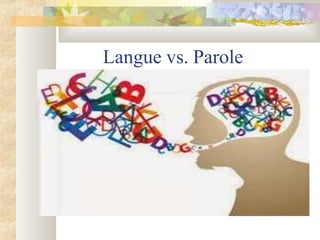
Langue vs. Parole
Langue
 “langue” – the whole set of linguistic signs
and habits ‘deposited’ within each
individual in form, and determining the use
of grammar, phonology and vocabulary.
Parole
 “parole: seen as speech-utterances, i.e., as
the actualization of “langue” at a precise
moment by a particular individual.
Langue
 Langue is the abstract
system of principle
language out of which acts
of speech (parole) occur.
e.g. Consider the analogy that
the game of chess is
langue and the individual
moves of chess itself
comprise the parole.
Parole


The individual language
acts which occur when
anyone audibly voices
letters, words, sentences,
etc.
Parole is the physical
manifestation of speech.
In Literature
 This theory does focus on the author’s
intent, and does focus on an objective
interpretation without clouding the text with
a subjective or emotional interpretation
BINARY OPPOSITIONS
 Levi-Strauss wrote Structural Anthropology in 1950s.
 He closely examined paired opposites (binary
oppositions) that creep into works – sometimes
intentionally, and sometime unintentionally.
 He also closely examined double entendres, statements
that could be interpreted in two different ways.
 Example: In “Young Goodman Brown,” Brown laments, “My
Faith is gone!” This can be interpreted as his wife (note the
capital letter for Faith), or it can be interpreted as his religious
faith.
 Searching texts for binary oppositions, or paired
opposites, is a practical method of applying structuralist
analysis to a literary work.
STRUCTURALISTS ANALYZE OTHER STRUCTURES:
 The sequence of events from beginning to
end
 The rearrangement of the narrative to build
suspense or for aesthetic effects (The death
of Tessie in “The Lottery”)
 Flashbacks
 Unequal treatment of time
 Shifts in viewpoints or speakers
A CHECKLIST OF STRUCTURALIST CRITICAL
QUESTIONS
1. What are the elements of the work – words, stanzas, chapters,
parts, for example – and how can these be seen as revealing
“difference”?
2. How do the characters, narrators, speakers, or other voices
heard in the work reveal difference?
3. How do the elements of the work’s plot or overall action suggest
a meaningful pattern? What changes, adjustments,
transformations, shifts of tone, attitude, behavior, or feeling do
you find?
4. How are the work’s primary images and events related to one
another? What elements of differentiation exist, and what do they
signify?
5. What system of relations could be used to link this work with
others of its kind?
6. What system of relations could be used to link this work with
others of its kind? What system of relations could be used to link
this work with different kinds of things with which it shared some
similarities?
 When we examine the poems “To My Wife”
by Phillip Larkin, “Sonnets are full of love…”
by Christian Rossetti and “Not at the first
sight…” by Sir Phillip Sidney using
Structuralism, the individual meaning and
authorial intention of each of these sonnets
are not taken into account much. For a
structuralist critic, these are sonnets and
sonnets have structures and system of their
own which contributes meaning for the
EXAMPLE
 We can expect that all sonnets have fourteen
lines and give rhythmic effect which pleases
the reader. In addition, sonnets are expected
to have certain repeating rhyme scheme
which we understand contributes to the
beauty of the overall sonnets. "To My Wife”
for instance has the rhyme scheme of a-b-a-
b-c-d-c-d -e-f-g-h-f-e, “Not at the first sight…”
has a-b-b-a-a-b-b-a-c-d-c-e-f-f and “Sonnets
are full of love…” has a-b-b-a-b-a-b-a-c-d-a-
 Next, all three sonnets from a structuralist
point of view have love as their underlying
theme. Therefore these sonnets then have
similarities in their tones. Emotional words
can be found throughout these sonnets
which then contribute to the sentimental tone
for love sonnets. Words such as love, bleed,
suffer and wound are some of the examples
that are found within all of the three sonnets,
“To My Wife”, “Sonnets are full of love…” and
“Not at the first sight…”.
 Therefore when a reader is given a love
sonnet for example, he or she will know what
to expect. However, structuralists do not
bother about the individual meaning of the
sonnets. Structuralist theory also forgoes the
author and historical background of each
sonnets. All that matters to a structuralist is
that the similarities and the bottom line
theme of love which governs these sonnets. ”
Meaning is no longer determined by the
individual but by the system which governs
the individual” ( Selden 69).
Thank
You

Structuralism.pptx

  • 1.
    Structuralism F E RD I N A N D D E S A U S S U R E Born: N o v 26, 1857 Died: F e b 22, 1913
  • 2.
    History  1960s-- Swisslinguist Ferdinand de Saussure influenced this theory through examination of language as a system of signs, called semiology. STRUCTURALISM is about finding the fundamental basic UNITS or ELEMENTS that make up any system, and discovering the RULES that govern how these units can be combined.
  • 3.
    Structuralism - Keytakeaways •Structuralism is a way of understanding culture and meaning in the arts by relating the individual piece of art (a novel, a painting, a symphony) to something larger. •Structuralism comes from a branch of language study called ‘structural linguistics’. •Structuralism is explicitly anti-individual. •Structuralism is about a shared structure of meaning. •Binary oppositions are key to understanding a text.
  • 4.
    STRUCTURALISM AS APHILOSOPHICAL STANCE 4 ● Structuralists areinterestedintheinterrelationshipbetween: UNITS(also called “surfacephenomena”) and RULES(theways in whichunitscanbeputtogether) ● IN LANGUAGE: Units are words and rules which are the forms of grammar which order words. In different languages, the grammar rules are different, as are the words, but the structure is still the same in all languages; words are put together within a grammaticalsystemtomakemeaning.
  • 5.
    STRUCTURALIST NOTIONS ONUNITS AND RULES 5 ● Structuralists believe that the underlying structures which organize UNITS and RULES into meaningful systems are generated by the humanminditself,andnotbysenseperception. ● As such, the mind is itself a structuring mechanism which looks through unitsandfilesthemaccordingtorules. ● So, Structuralism sees itself as a science of humankind, and works to uncover all the structures that underlie all the things that humans do, think,perceive,andfeel.
  • 6.
    STRUCTURALIST ANALYSIS POSITSTHESE SYSTEMSAS UNIVERSAL 6 ● Every human mind in every culture at every point in history has used some sort of structuring principle to organizeandunderstand cultural phenomena. ● Every human culture has some sort of language, which has the basic structure of all languages; words /phonemesare combinedaccordingto grammaticalrulestoproducemeaning. ● Every humanculturesimilarlyhassomesortofsocialorganization. ● All of these organizations are governed, according to structuralists’ analyses, by structures which areuniversal.
  • 7.
     A signconsists of two parts  Signifier  Signified
  • 8.
     People knowwhen they see It means they must stop.
  • 9.
     If wethink of this linguistically…
  • 10.
    Implications  'The Frenchword mouton may have the same meaning as the English word sheep; but it does not have the same value. There are various reasons for this, but in particular the fact that the English word for the meat of this animal, as prepared and served for a meal, is not sheep but mutton. The difference in value between sheep and mouton hinges on the fact that in English there is also another word mutton for the meat, whereas mouton in French covers both'.
  • 11.
    Different kinds ofSIGNS Iconic representation - here the car is an image which directly resembles the real thing Indexical representation – the image suggests the presence of a car Symbolic – a sign that bears no obvious relation to the thing that is signified
  • 12.
    The signifier doesnot resemble the signified. It is arbitrary - so that the relationship must be learnt: e.g. language in general (alphabetical letters, punctuation marks, words, phrases and sentences), numbers, morse code, traffic lights, national flags. Symbol/symbolic
  • 13.
    The signifier isperceived as resembling or imitating the signified (recognizably looking, sounding, feeling, tasting or smelling like it) e.g. a portrait, a cartoon, a scale-model, onomatopoeia, metaphors. Icon/Iconic
  • 14.
    The signifier isnot arbitrary but is directly connected in some way (physically or causally) to the signified - this link can be observed or inferred. Index/Indexical
  • 16.
    Structure and System   Theidea of structure presupposes the reduction or breaking down of linguistic segments or features. A structure presupposes a notion of unity existing above particular segments or features; of a whole above the composing and functioning elements.
  • 17.
    Three basic principlesof Saussure Saussure stated that the meanings we give to words are arbitrary. The physicality, or structure of a word, holds no bearing to its connotation or denotation.
  • 18.
    2. Saussure statedthat the meanings of words are relational. "No word can be defined in isolation from other words" (Barry). It is necessary to have other words frame a context to understand one word.
  • 19.
    3. According toSaussure, there are no intrinsic, or fixed meanings in words. If a group of people were asked to think of "dog," some people may mentally conjure a border collie, others a beagle, and others a Labrador, etc. While these are all dogs, and would correctly fit under the category of "dog," this word would not accomplish simultaneous thought, or a fixed meaning.
  • 21.
     Diachronic study(meaning a study of how languages change over time—a historical examination of the influences of culture, travel, etc. on the way languages “work”— how they form rules, how they change forms (morphology), how they grow and how they become “old”, etc 
  • 22.
    Synchronic (axis ofsimultaneities)   Synchronic comparisons of languages (meaning how languages compare to each other at any given point in time) A synchronic study or analysis, in contrast, limits its concern to a particular moment of time. Thus, synchronic linguistics takes a language as a working system at a particular point in time without concern for how it has developed to its present state.
  • 24.
    Synchronic  Language asa system of signs be studied as a complete system at any given point in time.  E.g. Modern American English and British English have a synchronic relation. Diachronic    Change in the meaning of words over time. Visible changes in usage. It is based in the dictionary meaning of words.  12thcentury English and 21st century English (where related things exist separated by time).
  • 25.
  • 26.
    Langue  “langue” –the whole set of linguistic signs and habits ‘deposited’ within each individual in form, and determining the use of grammar, phonology and vocabulary.
  • 27.
    Parole  “parole: seenas speech-utterances, i.e., as the actualization of “langue” at a precise moment by a particular individual.
  • 29.
    Langue  Langue isthe abstract system of principle language out of which acts of speech (parole) occur. e.g. Consider the analogy that the game of chess is langue and the individual moves of chess itself comprise the parole. Parole   The individual language acts which occur when anyone audibly voices letters, words, sentences, etc. Parole is the physical manifestation of speech.
  • 30.
    In Literature  Thistheory does focus on the author’s intent, and does focus on an objective interpretation without clouding the text with a subjective or emotional interpretation
  • 31.
    BINARY OPPOSITIONS  Levi-Strausswrote Structural Anthropology in 1950s.  He closely examined paired opposites (binary oppositions) that creep into works – sometimes intentionally, and sometime unintentionally.  He also closely examined double entendres, statements that could be interpreted in two different ways.  Example: In “Young Goodman Brown,” Brown laments, “My Faith is gone!” This can be interpreted as his wife (note the capital letter for Faith), or it can be interpreted as his religious faith.  Searching texts for binary oppositions, or paired opposites, is a practical method of applying structuralist analysis to a literary work.
  • 32.
    STRUCTURALISTS ANALYZE OTHERSTRUCTURES:  The sequence of events from beginning to end  The rearrangement of the narrative to build suspense or for aesthetic effects (The death of Tessie in “The Lottery”)  Flashbacks  Unequal treatment of time  Shifts in viewpoints or speakers
  • 33.
    A CHECKLIST OFSTRUCTURALIST CRITICAL QUESTIONS 1. What are the elements of the work – words, stanzas, chapters, parts, for example – and how can these be seen as revealing “difference”? 2. How do the characters, narrators, speakers, or other voices heard in the work reveal difference? 3. How do the elements of the work’s plot or overall action suggest a meaningful pattern? What changes, adjustments, transformations, shifts of tone, attitude, behavior, or feeling do you find? 4. How are the work’s primary images and events related to one another? What elements of differentiation exist, and what do they signify? 5. What system of relations could be used to link this work with others of its kind? 6. What system of relations could be used to link this work with others of its kind? What system of relations could be used to link this work with different kinds of things with which it shared some similarities?
  • 34.
     When weexamine the poems “To My Wife” by Phillip Larkin, “Sonnets are full of love…” by Christian Rossetti and “Not at the first sight…” by Sir Phillip Sidney using Structuralism, the individual meaning and authorial intention of each of these sonnets are not taken into account much. For a structuralist critic, these are sonnets and sonnets have structures and system of their own which contributes meaning for the
  • 35.
    EXAMPLE  We canexpect that all sonnets have fourteen lines and give rhythmic effect which pleases the reader. In addition, sonnets are expected to have certain repeating rhyme scheme which we understand contributes to the beauty of the overall sonnets. "To My Wife” for instance has the rhyme scheme of a-b-a- b-c-d-c-d -e-f-g-h-f-e, “Not at the first sight…” has a-b-b-a-a-b-b-a-c-d-c-e-f-f and “Sonnets are full of love…” has a-b-b-a-b-a-b-a-c-d-a-
  • 36.
     Next, allthree sonnets from a structuralist point of view have love as their underlying theme. Therefore these sonnets then have similarities in their tones. Emotional words can be found throughout these sonnets which then contribute to the sentimental tone for love sonnets. Words such as love, bleed, suffer and wound are some of the examples that are found within all of the three sonnets, “To My Wife”, “Sonnets are full of love…” and “Not at the first sight…”.
  • 37.
     Therefore whena reader is given a love sonnet for example, he or she will know what to expect. However, structuralists do not bother about the individual meaning of the sonnets. Structuralist theory also forgoes the author and historical background of each sonnets. All that matters to a structuralist is that the similarities and the bottom line theme of love which governs these sonnets. ” Meaning is no longer determined by the individual but by the system which governs the individual” ( Selden 69).
  • 38.