University of Management & TechnologyDepartment of Applied linguisticsMphill in Applied LinguisticsTHE ICE CANDY MANPresented by: Roll no. 100884006
The AuthorTitlePlotCharacters and characterizationThemes: major and minorLiterary Review
The Author: Bapsi SidhwaBorn on August 11th, 1938 in Karachi.
Belongs to the Parsi community, Zoroaserian, a distinctive minority who left Iran  for South Asia to avoid the religious persecution.
A polio victim at the age of 2, that is why she was educated at home till the age of 15 by an Anglo-Indian lady
She was married at the age of 19 with a Bombay businessman but got divorce.
Later she got married to a businessman of Lahore.
 Afterwards she graduated from Kinnaird College, Lahore.The Author: credentialsAn active social worker with great concern for the women aroundPart of women’s delegation to Iran and Turkey in 1970Volunteer  for many social work organizationsSidhwa started writing in the 1970s when she was inspired by the story of a young girl who ran away from home and was killed by her husband in the Hindukush mountains. This story was published in the form of her 2nd novel: the Bride.Currently she is teaching at the University of Texas, Houston.
The Author: publicationsSome of the notable novels of Sidhwa are: The Crow Eaters(1978)story about the life and fortunes of Parsi junglewalla family in British India.The Pakistani Bride (1983) the story of a Pakistani girl adopted by a pathan during partitionThe Ice Candy Man(1988)story about the change in the lives of the ordinary people before and after the partition.An American Brat (1993)the story about the conflicts of value systems and cultures  on personal and social plane
AcknowledgementsNumerous awards have been conferred upon her, these include:The PatrasBokhari award for the Bride in 1985The Sitara-e-Imtiaz in 1991The German Literaturepreisaward for Cracking IndiaA Bunting Fellowship from HarvardHer most famous novel Ice Candy Man has been turned into a film called ‘Earth 1947’
The Ice Candy ManThis is the first novel by a woman novelist from Pakistan in which she describes about the fate of people in Lahore and entrancing partition of India through the eyes of a precocious 8 years handicapped Parsi girl.
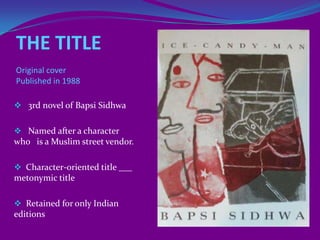
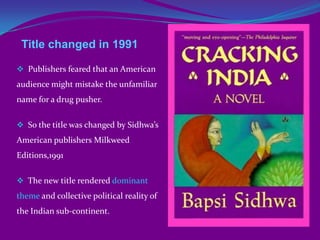
THE TITLEOriginal cover Published in 1988   3rd novel of Bapsi Sidhwa
   Named after a character who   is a Muslim street vendor.
  Character-oriented title ___ metonymic title
  Retained for only Indian editionsTitle changed in 1991  Publishers feared that an American audience might mistake the unfamiliar name for a drug pusher.
  So the title was changed by Sidhwa’s American publishers Milkweed Editions,1991
  The new title rendered dominant theme and collective political reality of the Indian sub-continent.PlotLenny is an eight year old Parsi girl who leads a comfortable life with the four members of her family before the Partition of India in Lahore. Lenny  regularly goes for walks with her Hindu Ayah Shanta. Sidhwa introduces the readers to characters like Shanta the Ayah, Imamdin the cook, the Ice-Candy-Man Dilnawaz and Hassan Ali, his cousin brother. At the moment, people in undivided India are seen engaged in the Quit-India Movement, and on the other hand, the Muslim League motivates the Muslim Community to raise a demand for a separate nation for the Muslims. Often the slogans of 'Pakistan Zindabad' are heard in the streets but the communal harmony is intact. One day, riots break out in Lahore in a locality far away from Lenny's house. This leads to the killing of innocent people on both the sides.
The news of bloodshed spreads like wild fire. The All India Radio also reports about cases of violence from different parts of India. Soon the entire Punjab province is seen burning in the fire of hatred and communal violence. Dilnawaz, the Ice-Candy-Man waits for his sisters on Lahore railway station. When the trian arrives from Gurdaspur, everyone on the plateform is shocked to see the ghastly sight. The Train is loaded with mutilated bodies of Muslim passengers. This shocks everyone and the friendly Dilnawaz turns into a person possessed with a frenzy and a desire to kill the Hindus. He also abducts his friend Shanta, the Ayah of Lenny and later takes her to low market of Lahore, a locality of bad women. Ice-Candy-Man loved Shanta from the core of his heart but now she is a Hindu for him. Vengeance has transformed him into a killer and a beast. Later with the belp of Lenny's relatives, Shanta is rescued and she reaches the relief camp at Amritsar. The ice candy man also follows her there.
CharactersMajor characters:Lenny, the narratorShanta, her Hindu AyahDilnawaz, the Ice Candy Man, A MuslimGodmother, the grandmother of LennyMinor characters:Imamdin, the cookHassan Ali, his cousin brotherLenny’s motherPapoo, the daughter of Mucho, the sweeperesRanna, the friend of LennyAdmirer’s of AyahHari, the high-caste HinduMoti, the out-caste GardnerMasseur, beloved of ayahIce candy man
CharacterizationCharacterization in Ice Candy Man is perfect with astute insight into human behavior and human nature.
Most of the characters are round characters.
Reality based character who show their aspirations, emotions, moods, frustrations and nonetheless their attitude to life influenced by social and personal turmoil.Lenny: the narratorthe child-narrator Lenny is introduced through the verses of Iqbal from his 'Complaint to God'Lenny lives on Warris Road. And she is lame, introvert and helpless.Her narration starts in her 5th year and ends after her 8th birthday.It is to note that Bapse was 9 years old at the time of the Partition of India (1947) and at the age of 2 she encountered polio which affected her throughout his lifeLenny is like the persona, voicing the urge of the author, that CHAUCER has adopted in his Prologue to Canterbury Tales.This persona acts being the part of the reader’s consciousness.
Lenny as an observer and commenterLenny sees change and partition as ‘ blood dimmed anarchy’‘the whole world is burning. The air on my face is so hot…I start screaming: hysterically sobbing. How long does Lahore burn? Weeks? Months?‘The moonlight settles like a layer of ashes over Lahore’.“Can the soul be extracted from the body?” commented on Ayah’s vacant eyes.One man’s religion is another man’s poison“India is going to be broken. Can one break a country?”
THE ICE CANDY MAN, DilnawazThe story of the novel revolves around this central character. He belongs to bad market of Lahore,. His mother had been one of them and his early years shaped his personality according to his tastes. He is a jolly and friendly person. He is a gifted poet, rather poetic in his interaction with others. He would recite a couplet from Urdu poetry whenever required. He is an ardent lover of the Hindu Ayah of Lenny. He is a regular visitor of Lenny's house for Ayah's sake.In summers, he sells ice-candy and in winters, he becomes a birds-man who sells sparrows and birds.The first half of the novel presents the Ice-Candy-Man as a jovial and life-loving person. He is known for his warmth and good-nature but one incident transforms the peace-loving ice-candy man into a selfish man and a savage.
The Ice Candy Mana keen popsicle vendor a pretentious Sufi, with copper wiring wound around his neck and chest, who claims he is Allah’s telephonethe fanatic leader of a mob, who deceivingly betrays his love a poet, reciting Urdu verses to woo the AyahA bird-seller
The GodmotherA social worker having al latest news and info about everyoneInfluential lady who helps everyoneAccounts for Bapsi’s own social persona as a social worker.Helps Ayah in the same way as Bapsi once helped a girl in realSymbolizes the feministic supremacy and strong influential status of women in British Indian society.Sidhwa presented her as a fascinating personality with a one-and-a-half-room adobe, covered from head to toe in khaddar attire, a shelter for Lenny and many othersPossess a penchant for Sharp wit
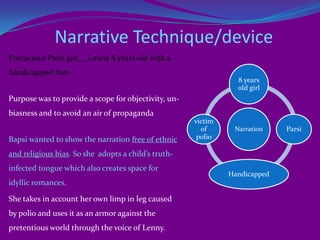
Narrative Technique/devicePrecocious Parsi girl__ Lenny 8 years old with a handicapped footPurpose was to provide a scope for objectivity, un-biasness and to avoid an air of propagandaBapsi wanted to show the narration free of ethnic and religious bias. So she  adopts a child’s truth-infected tongue which also creates space for idyllic romances.She takes in account her own limp in leg caused by polio and uses it as an armor against the pretentious world through the voice of Lenny.
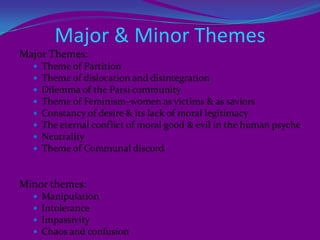
ThemesSidhwa's novels themes diverge from traditional to contemporaneity.Overview:It is a story about love lost, trust deceived and the subjugation of the mind by deliberately subjugating the body. It is also a story about manipulation, redemption, and shrugging off passivity and rising to help those who most need it.

Mine the ice candy man

  • 1.
    University of Management& TechnologyDepartment of Applied linguisticsMphill in Applied LinguisticsTHE ICE CANDY MANPresented by: Roll no. 100884006
  • 2.
    The AuthorTitlePlotCharacters andcharacterizationThemes: major and minorLiterary Review
  • 3.
    The Author: BapsiSidhwaBorn on August 11th, 1938 in Karachi.
  • 4.
    Belongs to theParsi community, Zoroaserian, a distinctive minority who left Iran for South Asia to avoid the religious persecution.
  • 5.
    A polio victimat the age of 2, that is why she was educated at home till the age of 15 by an Anglo-Indian lady
  • 6.
    She was marriedat the age of 19 with a Bombay businessman but got divorce.
  • 7.
    Later she gotmarried to a businessman of Lahore.
  • 8.
    Afterwards shegraduated from Kinnaird College, Lahore.The Author: credentialsAn active social worker with great concern for the women aroundPart of women’s delegation to Iran and Turkey in 1970Volunteer for many social work organizationsSidhwa started writing in the 1970s when she was inspired by the story of a young girl who ran away from home and was killed by her husband in the Hindukush mountains. This story was published in the form of her 2nd novel: the Bride.Currently she is teaching at the University of Texas, Houston.
  • 9.
    The Author: publicationsSomeof the notable novels of Sidhwa are: The Crow Eaters(1978)story about the life and fortunes of Parsi junglewalla family in British India.The Pakistani Bride (1983) the story of a Pakistani girl adopted by a pathan during partitionThe Ice Candy Man(1988)story about the change in the lives of the ordinary people before and after the partition.An American Brat (1993)the story about the conflicts of value systems and cultures on personal and social plane
  • 10.
    AcknowledgementsNumerous awards havebeen conferred upon her, these include:The PatrasBokhari award for the Bride in 1985The Sitara-e-Imtiaz in 1991The German Literaturepreisaward for Cracking IndiaA Bunting Fellowship from HarvardHer most famous novel Ice Candy Man has been turned into a film called ‘Earth 1947’
  • 11.
    The Ice CandyManThis is the first novel by a woman novelist from Pakistan in which she describes about the fate of people in Lahore and entrancing partition of India through the eyes of a precocious 8 years handicapped Parsi girl.
  • 12.
    THE TITLEOriginal coverPublished in 1988 3rd novel of Bapsi Sidhwa
  • 13.
    Named after a character who is a Muslim street vendor.
  • 14.
    Character-orientedtitle ___ metonymic title
  • 15.
    Retainedfor only Indian editionsTitle changed in 1991 Publishers feared that an American audience might mistake the unfamiliar name for a drug pusher.
  • 16.
    Sothe title was changed by Sidhwa’s American publishers Milkweed Editions,1991
  • 17.
    Thenew title rendered dominant theme and collective political reality of the Indian sub-continent.PlotLenny is an eight year old Parsi girl who leads a comfortable life with the four members of her family before the Partition of India in Lahore. Lenny regularly goes for walks with her Hindu Ayah Shanta. Sidhwa introduces the readers to characters like Shanta the Ayah, Imamdin the cook, the Ice-Candy-Man Dilnawaz and Hassan Ali, his cousin brother. At the moment, people in undivided India are seen engaged in the Quit-India Movement, and on the other hand, the Muslim League motivates the Muslim Community to raise a demand for a separate nation for the Muslims. Often the slogans of 'Pakistan Zindabad' are heard in the streets but the communal harmony is intact. One day, riots break out in Lahore in a locality far away from Lenny's house. This leads to the killing of innocent people on both the sides.
  • 18.
    The news ofbloodshed spreads like wild fire. The All India Radio also reports about cases of violence from different parts of India. Soon the entire Punjab province is seen burning in the fire of hatred and communal violence. Dilnawaz, the Ice-Candy-Man waits for his sisters on Lahore railway station. When the trian arrives from Gurdaspur, everyone on the plateform is shocked to see the ghastly sight. The Train is loaded with mutilated bodies of Muslim passengers. This shocks everyone and the friendly Dilnawaz turns into a person possessed with a frenzy and a desire to kill the Hindus. He also abducts his friend Shanta, the Ayah of Lenny and later takes her to low market of Lahore, a locality of bad women. Ice-Candy-Man loved Shanta from the core of his heart but now she is a Hindu for him. Vengeance has transformed him into a killer and a beast. Later with the belp of Lenny's relatives, Shanta is rescued and she reaches the relief camp at Amritsar. The ice candy man also follows her there.
  • 19.
    CharactersMajor characters:Lenny, thenarratorShanta, her Hindu AyahDilnawaz, the Ice Candy Man, A MuslimGodmother, the grandmother of LennyMinor characters:Imamdin, the cookHassan Ali, his cousin brotherLenny’s motherPapoo, the daughter of Mucho, the sweeperesRanna, the friend of LennyAdmirer’s of AyahHari, the high-caste HinduMoti, the out-caste GardnerMasseur, beloved of ayahIce candy man
  • 20.
    CharacterizationCharacterization in IceCandy Man is perfect with astute insight into human behavior and human nature.
  • 21.
    Most of thecharacters are round characters.
  • 22.
    Reality based characterwho show their aspirations, emotions, moods, frustrations and nonetheless their attitude to life influenced by social and personal turmoil.Lenny: the narratorthe child-narrator Lenny is introduced through the verses of Iqbal from his 'Complaint to God'Lenny lives on Warris Road. And she is lame, introvert and helpless.Her narration starts in her 5th year and ends after her 8th birthday.It is to note that Bapse was 9 years old at the time of the Partition of India (1947) and at the age of 2 she encountered polio which affected her throughout his lifeLenny is like the persona, voicing the urge of the author, that CHAUCER has adopted in his Prologue to Canterbury Tales.This persona acts being the part of the reader’s consciousness.
  • 23.
    Lenny as anobserver and commenterLenny sees change and partition as ‘ blood dimmed anarchy’‘the whole world is burning. The air on my face is so hot…I start screaming: hysterically sobbing. How long does Lahore burn? Weeks? Months?‘The moonlight settles like a layer of ashes over Lahore’.“Can the soul be extracted from the body?” commented on Ayah’s vacant eyes.One man’s religion is another man’s poison“India is going to be broken. Can one break a country?”
  • 24.
    THE ICE CANDYMAN, DilnawazThe story of the novel revolves around this central character. He belongs to bad market of Lahore,. His mother had been one of them and his early years shaped his personality according to his tastes. He is a jolly and friendly person. He is a gifted poet, rather poetic in his interaction with others. He would recite a couplet from Urdu poetry whenever required. He is an ardent lover of the Hindu Ayah of Lenny. He is a regular visitor of Lenny's house for Ayah's sake.In summers, he sells ice-candy and in winters, he becomes a birds-man who sells sparrows and birds.The first half of the novel presents the Ice-Candy-Man as a jovial and life-loving person. He is known for his warmth and good-nature but one incident transforms the peace-loving ice-candy man into a selfish man and a savage.
  • 25.
    The Ice CandyMana keen popsicle vendor a pretentious Sufi, with copper wiring wound around his neck and chest, who claims he is Allah’s telephonethe fanatic leader of a mob, who deceivingly betrays his love a poet, reciting Urdu verses to woo the AyahA bird-seller
  • 26.
    The GodmotherA socialworker having al latest news and info about everyoneInfluential lady who helps everyoneAccounts for Bapsi’s own social persona as a social worker.Helps Ayah in the same way as Bapsi once helped a girl in realSymbolizes the feministic supremacy and strong influential status of women in British Indian society.Sidhwa presented her as a fascinating personality with a one-and-a-half-room adobe, covered from head to toe in khaddar attire, a shelter for Lenny and many othersPossess a penchant for Sharp wit
  • 27.
    Narrative Technique/devicePrecocious Parsigirl__ Lenny 8 years old with a handicapped footPurpose was to provide a scope for objectivity, un-biasness and to avoid an air of propagandaBapsi wanted to show the narration free of ethnic and religious bias. So she adopts a child’s truth-infected tongue which also creates space for idyllic romances.She takes in account her own limp in leg caused by polio and uses it as an armor against the pretentious world through the voice of Lenny.
  • 28.
    ThemesSidhwa's novels themesdiverge from traditional to contemporaneity.Overview:It is a story about love lost, trust deceived and the subjugation of the mind by deliberately subjugating the body. It is also a story about manipulation, redemption, and shrugging off passivity and rising to help those who most need it.