Presented by:
Myra Sarmiento-Candol
English 303
Literary Cristicsm
Structuralism
Objectives:
Define Structuralism
Know the Founding Fathers of
Structuralism
Overview Semiotics
Discussed Signs, Syntagms and
Associative
What is Structuralism
 Structuralism is a 20th Century intellectual movement
and approach to the human sciences (it has had a
profound effect on linguistics, sociology, anthropology
and other fields in addition to philosophy) that
attempts to analyze a specific field as a complex
system of interrelated parts.
 A system in which each element in a group can only be
understood by its relation to other elements as part of
a larger structure.
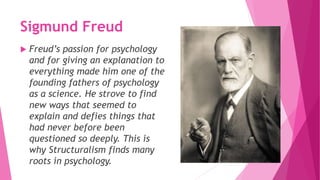
Sigmund Freud
 Freud’s passion for psychology
and for giving an explanation to
everything made him one of the
founding fathers of psychology
as a science. He strove to find
new ways that seemed to
explain and defies things that
had never before been
questioned so deeply. This is
why Structuralism finds many
roots in psychology.
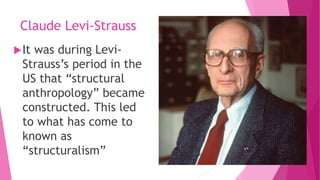
Claude Levi-Strauss
It was during Levi-
Strauss’s period in the
US that “structural
anthropology” became
constructed. This led
to what has come to
known as
“structuralism”
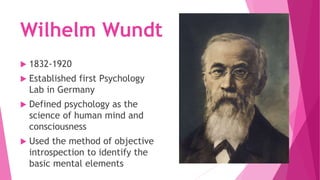
Wilhelm Wundt
 1832-1920
 Established first Psychology
Lab in Germany
 Defined psychology as the
science of human mind and
consciousness
 Used the method of objective
introspection to identify the
basic mental elements
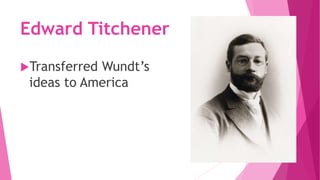
Edward Titchener
Transferred Wundt’s
ideas to America
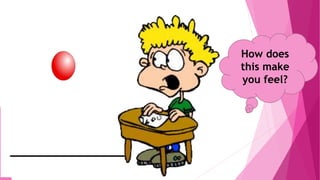
How does
this make
you feel?
Ferdinand de Saussure
Swiss Linguist 1857-1913
Father of Structuralism
Credited for founding
Semiotics (he called it
Semiology)
Semiology
is the study of meaning-
making, the study of sign
processes and meaningful
communication
three branches
Semantics: relation between signs and the
things to which they refer; their
signified denotata, or meaning
Syntactics: relations among or between signs in
formal structures
Pragmatics: relation between signs and sign-
using agents or interpreters
For Saussure
Language was generally
seen as a way to name
things
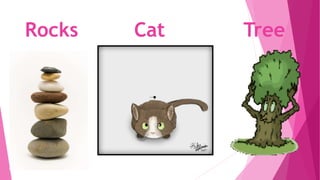
Rocks Cat Tree
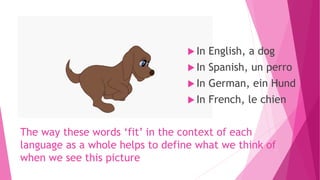
The way these words ‘fit’ in the context of each
language as a whole helps to define what we think of
when we see this picture
 In English, a dog
 In Spanish, un perro
 In German, ein Hund
 In French, le chien
Saussure’s Definition of Language
All language is made of signs
By putting together signs it is possible to
create complex messages
Each sign has two parts: signifier and
signified
Sign Part 1: Signifier
“ The psychological imprint of the
sound, the impression it makes on our
senses”
(how we think of something in our
head)
“sound-image”
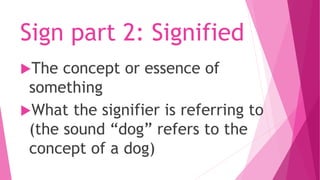
Sign part 2: Signified
The concept or essence of
something
What the signifier is referring to
(the sound “dog” refers to the
concept of a dog)
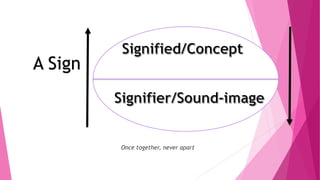
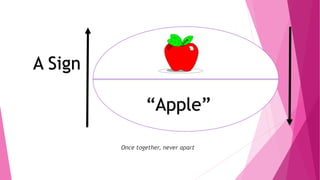
Once together, never apart
A Sign
Once together, never apart
A Sign
“Apple”
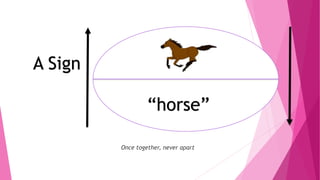
Once together, never apart
A Sign
“horse”
The nature of signs
Arbitrary- meaning there is
no natural connection
between signifier and
signified
But what about….
Onomatopoeia and Interjections
Still arbitrary, since each language
has a slightly different version of
them
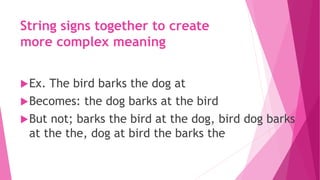
String signs together to create
more complex meaning
Ex. The bird barks the dog at
Becomes: the dog barks at the bird
But not; barks the bird at the dog, bird dog barks
at the the, dog at bird the barks the
Syntagm
An ordered series of signs that
make sense.
The signs make sense because of
their relation to other signs
Associations
Words related to a word (through
meaning, letter, composition,
sound, etc)
Unlike in syntagms, order does
not matter
ASSOCIATIVE
 Signs are stored in your memory, for example, not in syntagmatic
links or sentences, but in ASSOCIATIVE groups.
 "Education" "-tion":education, relation, association
 Similar associations: education, teacher, textbook, college,
expensive.
Random set of linkages: education, baseball, computer games,
psychoanalysis
 ASSOCIATIVE relations are only in your head, not in the
structure of language itself, whereas SYNTAGMATIC relations
are a product of linguistic structure.
LINGUISTICVALUE
 Thought is a shapeless mass, which is only ordered by language.
One of the questions philosophers have puzzled over for
centuries is whether ideas can exist at all without language. No
ideas preexist language; language itself gives shape to ideas and
makes them expressible.
 The VALUE of a sign is determined, however, not by what
signifiers get linked to what particular signified, but rather by the
whole system of signs used within a community. VALUE is the
product of a system or structure (LANGUE), not the result of
individual relations (PAROLE).
 Langue: The structure of the language that is
mastered and shared by its speakers. It refers
about all the rules of the language (grammar,
syntax…)
 Parole: It is the individual’s actual speech
utterances and writing. It refers about colloquial
(popular) language.
Structuralism as a philosophical
stance
Structuralists are interested in the interrelationship between
UNITS ( also called "surface phenomena," )
and RULES (the ways that units can be put together. )
In language: units are words and the rules are the forms of
grammar which order words. In different languages, the grammar rules
are different, as are the words, but the structure is still the same in all
languages: words are put together within a grammatical system to
make meaning.
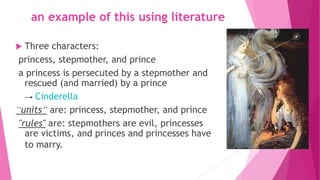
an example of this using literature
 Three characters:
princess, stepmother, and prince
a princess is persecuted by a stepmother and
rescued (and married) by a prince
Cinderella
“units” are: princess, stepmother, and prince
"rules" are: stepmothers are evil, princesses
are victims, and princes and princesses have
to marry.
A more formal definition:
a structure is any conceptual system that has the following
three properties:
 Wholeness. This means that the system functions as a whole, not just as a
collection of independent parts.
 Transformation. This means that the system is not static, but capable of
change. New units can enter the system, but when they do they're
governed by the rules of the system.
 Self-Regulation. This is related to the idea of transformation. You can add
elements to the system, but you can't change the basic structure of the
system no matter what you add to it. The transformations of a system
never lead to anything outside the system.
Conclusion: Saussure's structuralism is based
upon three assumptions
 the systematic nature of language, where
the whole is greater than the sum of its
parts
 the relational conception of the elements
of language, where linguistic "entities" are
defined in relationships of combination and
contrast to one another
 the arbitrary nature of linguistic elements,
where they are defined in terms of the
function and purpose they serve rather than
in terms of their inherent qualities
Thank you!
 References:
 www. slideshare.net
 yalepress.yale.edu
 Google.com.ph

Structuralism part 1

  • 1.
    Presented by: Myra Sarmiento-Candol English303 Literary Cristicsm Structuralism
  • 2.
    Objectives: Define Structuralism Know theFounding Fathers of Structuralism Overview Semiotics Discussed Signs, Syntagms and Associative
  • 3.
    What is Structuralism Structuralism is a 20th Century intellectual movement and approach to the human sciences (it has had a profound effect on linguistics, sociology, anthropology and other fields in addition to philosophy) that attempts to analyze a specific field as a complex system of interrelated parts.  A system in which each element in a group can only be understood by its relation to other elements as part of a larger structure.
  • 4.
    Sigmund Freud  Freud’spassion for psychology and for giving an explanation to everything made him one of the founding fathers of psychology as a science. He strove to find new ways that seemed to explain and defies things that had never before been questioned so deeply. This is why Structuralism finds many roots in psychology.
  • 5.
    Claude Levi-Strauss It wasduring Levi- Strauss’s period in the US that “structural anthropology” became constructed. This led to what has come to known as “structuralism”
  • 6.
    Wilhelm Wundt  1832-1920 Established first Psychology Lab in Germany  Defined psychology as the science of human mind and consciousness  Used the method of objective introspection to identify the basic mental elements
  • 7.
  • 8.
  • 9.
    Ferdinand de Saussure SwissLinguist 1857-1913 Father of Structuralism Credited for founding Semiotics (he called it Semiology)
  • 10.
    Semiology is the studyof meaning- making, the study of sign processes and meaningful communication
  • 11.
    three branches Semantics: relationbetween signs and the things to which they refer; their signified denotata, or meaning Syntactics: relations among or between signs in formal structures Pragmatics: relation between signs and sign- using agents or interpreters
  • 12.
    For Saussure Language wasgenerally seen as a way to name things
  • 13.
  • 14.
    The way thesewords ‘fit’ in the context of each language as a whole helps to define what we think of when we see this picture  In English, a dog  In Spanish, un perro  In German, ein Hund  In French, le chien
  • 15.
    Saussure’s Definition ofLanguage All language is made of signs By putting together signs it is possible to create complex messages Each sign has two parts: signifier and signified
  • 16.
    Sign Part 1:Signifier “ The psychological imprint of the sound, the impression it makes on our senses” (how we think of something in our head) “sound-image”
  • 17.
    Sign part 2:Signified The concept or essence of something What the signifier is referring to (the sound “dog” refers to the concept of a dog)
  • 18.
  • 19.
    Once together, neverapart A Sign “Apple”
  • 20.
    Once together, neverapart A Sign “horse”
  • 21.
    The nature ofsigns Arbitrary- meaning there is no natural connection between signifier and signified
  • 22.
    But what about…. Onomatopoeiaand Interjections Still arbitrary, since each language has a slightly different version of them
  • 23.
    String signs togetherto create more complex meaning Ex. The bird barks the dog at Becomes: the dog barks at the bird But not; barks the bird at the dog, bird dog barks at the the, dog at bird the barks the
  • 24.
    Syntagm An ordered seriesof signs that make sense. The signs make sense because of their relation to other signs
  • 25.
    Associations Words related toa word (through meaning, letter, composition, sound, etc) Unlike in syntagms, order does not matter
  • 26.
    ASSOCIATIVE  Signs arestored in your memory, for example, not in syntagmatic links or sentences, but in ASSOCIATIVE groups.  "Education" "-tion":education, relation, association  Similar associations: education, teacher, textbook, college, expensive. Random set of linkages: education, baseball, computer games, psychoanalysis  ASSOCIATIVE relations are only in your head, not in the structure of language itself, whereas SYNTAGMATIC relations are a product of linguistic structure.
  • 27.
    LINGUISTICVALUE  Thought isa shapeless mass, which is only ordered by language. One of the questions philosophers have puzzled over for centuries is whether ideas can exist at all without language. No ideas preexist language; language itself gives shape to ideas and makes them expressible.  The VALUE of a sign is determined, however, not by what signifiers get linked to what particular signified, but rather by the whole system of signs used within a community. VALUE is the product of a system or structure (LANGUE), not the result of individual relations (PAROLE).
  • 28.
     Langue: Thestructure of the language that is mastered and shared by its speakers. It refers about all the rules of the language (grammar, syntax…)  Parole: It is the individual’s actual speech utterances and writing. It refers about colloquial (popular) language.
  • 29.
    Structuralism as aphilosophical stance Structuralists are interested in the interrelationship between UNITS ( also called "surface phenomena," ) and RULES (the ways that units can be put together. ) In language: units are words and the rules are the forms of grammar which order words. In different languages, the grammar rules are different, as are the words, but the structure is still the same in all languages: words are put together within a grammatical system to make meaning.
  • 30.
    an example ofthis using literature  Three characters: princess, stepmother, and prince a princess is persecuted by a stepmother and rescued (and married) by a prince Cinderella “units” are: princess, stepmother, and prince "rules" are: stepmothers are evil, princesses are victims, and princes and princesses have to marry.
  • 31.
    A more formaldefinition: a structure is any conceptual system that has the following three properties:  Wholeness. This means that the system functions as a whole, not just as a collection of independent parts.  Transformation. This means that the system is not static, but capable of change. New units can enter the system, but when they do they're governed by the rules of the system.  Self-Regulation. This is related to the idea of transformation. You can add elements to the system, but you can't change the basic structure of the system no matter what you add to it. The transformations of a system never lead to anything outside the system.
  • 32.
    Conclusion: Saussure's structuralismis based upon three assumptions  the systematic nature of language, where the whole is greater than the sum of its parts  the relational conception of the elements of language, where linguistic "entities" are defined in relationships of combination and contrast to one another  the arbitrary nature of linguistic elements, where they are defined in terms of the function and purpose they serve rather than in terms of their inherent qualities
  • 33.
    Thank you!  References: www. slideshare.net  yalepress.yale.edu  Google.com.ph

Editor's Notes

  • #13 The linguistic SIGN (a key word) is made of the union of a concept and a sound image. A more common way to define a linguistic SIGN is that a SIGN is the combination of a SIGNIFIER and a SIGNIFIED. Saussure says the sound image is the SIGNIFIER and the concept the SIGNIFIED.
  • #19 The SIGN, as union of a SIGNIFIER and a SIGNIFIED, has two main characteristics. This principle dominates all ideas about the STRUCTURE of language. It makes it possible to separate the signifier and signified, or to change the relation between them. The second characteristic of the SIGN is that the signifier exists in TIME, and that time can be measured as LINEAR.