FERDINAND DE SAUSSURE STRUCTURALISM AND
ITS PARADAIGMS
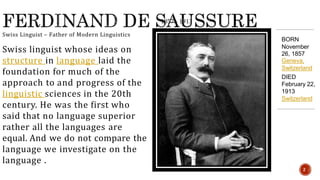
Swiss Linguist – Father of Modern Linguistics
Swiss linguist whose ideas on
structure in language laid the
foundation for much of the
approach to and progress of the
linguistic sciences in the 20th
century. He was the first who
said that no language superior
rather all the languages are
equal. And we do not compare the
language we investigate on the
language .
1857 - 1913
BORN
November
26, 1857
Geneva,
Switzerland
DIED
February 22,
1913
Switzerland
2
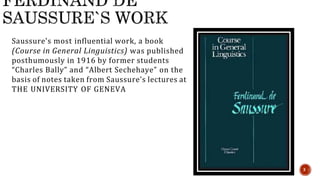
Saussure's most influential work, a book
(Course in General Linguistics) was published
posthumously in 1916 by former students
“Charles Bally” and “Albert Sechehaye” on the
basis of notes taken from Saussure's lectures at
THE UNIVERSITY OF GENEVA
3
• Linguistics is a Scientific Study.
• Descriptive (“containing a full information”) Study of Language.
• Primary importance will be given to the spoken medium of
language.
• Autonomous Body /Linguistics is an authoritative
study – It is not a part of study but it is it self a complete
study
• Synchronic Study
4
• Language comes from society
i. Langue ii. Parole
• Synchronic view of language is studied rather than diachronic one.
• The semiotic theory of “Signifier” and “Signified”.
• Paradigmatic v/s syntagmatic relation of language.
5
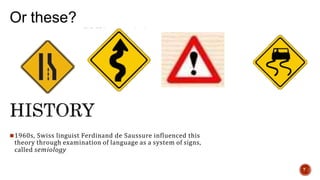
As discussed earlier that Saussure`s ideas on structure in language laid
the foundation for much of the approach to and progress of the linguistic
sciences in the 20th century. Saussure believed that language is made up
with certain structures .
For example :
What does this mean?
6
Or these?
1960s, Swiss linguist Ferdinand de Saussure influenced this
theory through examination of language as a system of signs,
called semiology
7
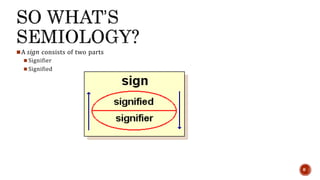
A sign consists of two parts
 Signifier
 Signified
8
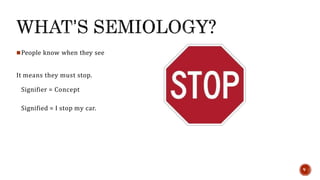
People know when they see
It means they must stop.
Signifier = Concept
Signified = I stop my car.
9
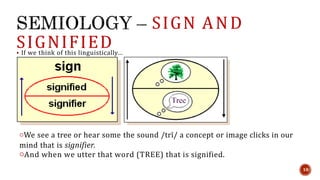
SIGNIFIED
 If we think of this linguistically…
SIGN AND
○We see a tree or hear some the sound /trī/ a concept or image clicks in our
mind that is signifier.
○And when we utter that word (TREE) that is signified.
10
Sounds or signs are the vehicles through which we
conceptualize things
So what does this say about the relationship between
language and thought?
Can you have think without language?
The answer to this is “NO” . Because even for an idea we
need a SOUND / SIGN . And according to Saussure these are
structural parts of language.
11
Saussure believed that:
• We study language by the help of structures.
• Language is a broader system made up with certain sub-systems.
• We start understanding or studying language through SOUND. (Semiotics)
• Language is like a Game of Chess.
• We study language through society. (sociolinguistics)
• Langue and Parole.
• Syntagmatic V/S Paradigmatic.
12
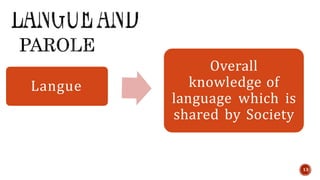
Langue
Overall
knowledge of
language which is
shared by Society
13
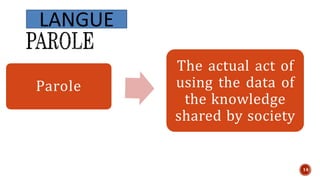
Parole
The actual act of
using the data of
the knowledge
shared by society
14
LANGUE
Relationship of language
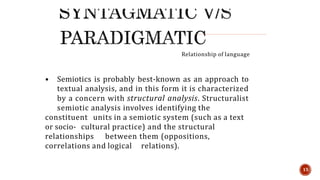
• Semiotics is probably best-known as an approach to
textual analysis, and in this form it is characterized
by a concern with structural analysis. Structuralist
semiotic analysis involves identifying the
constituent units in a semiotic system (such as a text
or socio- cultural practice) and the structural
relationships between them (oppositions,
correlations and logical relations).
15
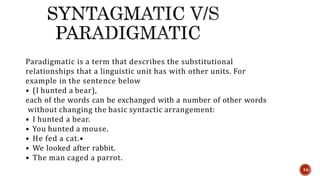
Paradigmatic is a term that describes the substitutional
relationships that a linguistic unit has with other units. For
example in the sentence below
• (I hunted a bear),
each of the words can be exchanged with a number of other words
without changing the basic syntactic arrangement:
• I hunted a bear.
• You hunted a mouse.
• He fed a cat.•
• We looked after rabbit.
• The man caged a parrot.
16
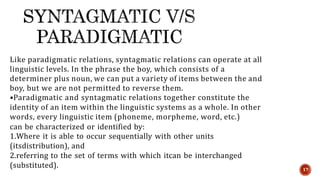
Like paradigmatic relations, syntagmatic relations can operate at all
linguistic levels. In the phrase the boy, which consists of a
determiner plus noun, we can put a variety of items between the and
boy, but we are not permitted to reverse them.
•Paradigmatic and syntagmatic relations together constitute the
identity of an item within the linguistic systems as a whole. In other
words, every linguistic item (phoneme, morpheme, word, etc.)
can be characterized or identified by:
1.Where it is able to occur sequentially with other units
(itsdistribution), and
2.referring to the set of terms with which itcan be interchanged
(substituted). 17
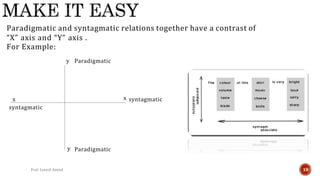
Paradigmatic and syntagmatic relations together have a contrast of
“X” axis and “Y” axis .
For Example:
y Paradigmatic
x
syntagmatic
y Paradigmatic
x syntagmatic
18
Prof. Junaid Amjed
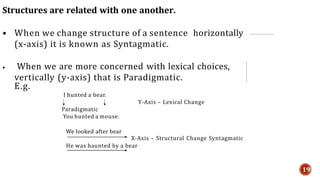
Structures are related with one another.
• When we change structure of a sentence horizontally
(x-axis) it is known as Syntagmatic.
• When we are more concerned with lexical choices,
vertically (y-axis) that is Paradigmatic.
E.g.
I hunted a bear.
Y-Axis – Lexical Change
Paradigmatic
You hunted a mouse.
We looked after bear
X-Axis – Structural Change Syntagmatic
He was haunted by a bear
19

FEDINAND DE SAUSSURE STRUCTURALISM.pptx

  • 1.
    FERDINAND DE SAUSSURESTRUCTURALISM AND ITS PARADAIGMS
  • 2.
    Swiss Linguist –Father of Modern Linguistics Swiss linguist whose ideas on structure in language laid the foundation for much of the approach to and progress of the linguistic sciences in the 20th century. He was the first who said that no language superior rather all the languages are equal. And we do not compare the language we investigate on the language . 1857 - 1913 BORN November 26, 1857 Geneva, Switzerland DIED February 22, 1913 Switzerland 2
  • 3.
    Saussure's most influentialwork, a book (Course in General Linguistics) was published posthumously in 1916 by former students “Charles Bally” and “Albert Sechehaye” on the basis of notes taken from Saussure's lectures at THE UNIVERSITY OF GENEVA 3
  • 4.
    • Linguistics isa Scientific Study. • Descriptive (“containing a full information”) Study of Language. • Primary importance will be given to the spoken medium of language. • Autonomous Body /Linguistics is an authoritative study – It is not a part of study but it is it self a complete study • Synchronic Study 4
  • 5.
    • Language comesfrom society i. Langue ii. Parole • Synchronic view of language is studied rather than diachronic one. • The semiotic theory of “Signifier” and “Signified”. • Paradigmatic v/s syntagmatic relation of language. 5
  • 6.
    As discussed earlierthat Saussure`s ideas on structure in language laid the foundation for much of the approach to and progress of the linguistic sciences in the 20th century. Saussure believed that language is made up with certain structures . For example : What does this mean? 6
  • 7.
    Or these? 1960s, Swisslinguist Ferdinand de Saussure influenced this theory through examination of language as a system of signs, called semiology 7
  • 8.
    A sign consistsof two parts  Signifier  Signified 8
  • 9.
    People know whenthey see It means they must stop. Signifier = Concept Signified = I stop my car. 9
  • 10.
    SIGNIFIED  If wethink of this linguistically… SIGN AND ○We see a tree or hear some the sound /trī/ a concept or image clicks in our mind that is signifier. ○And when we utter that word (TREE) that is signified. 10
  • 11.
    Sounds or signsare the vehicles through which we conceptualize things So what does this say about the relationship between language and thought? Can you have think without language? The answer to this is “NO” . Because even for an idea we need a SOUND / SIGN . And according to Saussure these are structural parts of language. 11
  • 12.
    Saussure believed that: •We study language by the help of structures. • Language is a broader system made up with certain sub-systems. • We start understanding or studying language through SOUND. (Semiotics) • Language is like a Game of Chess. • We study language through society. (sociolinguistics) • Langue and Parole. • Syntagmatic V/S Paradigmatic. 12
  • 13.
  • 14.
    Parole The actual actof using the data of the knowledge shared by society 14 LANGUE
  • 15.
    Relationship of language •Semiotics is probably best-known as an approach to textual analysis, and in this form it is characterized by a concern with structural analysis. Structuralist semiotic analysis involves identifying the constituent units in a semiotic system (such as a text or socio- cultural practice) and the structural relationships between them (oppositions, correlations and logical relations). 15
  • 16.
    Paradigmatic is aterm that describes the substitutional relationships that a linguistic unit has with other units. For example in the sentence below • (I hunted a bear), each of the words can be exchanged with a number of other words without changing the basic syntactic arrangement: • I hunted a bear. • You hunted a mouse. • He fed a cat.• • We looked after rabbit. • The man caged a parrot. 16
  • 17.
    Like paradigmatic relations,syntagmatic relations can operate at all linguistic levels. In the phrase the boy, which consists of a determiner plus noun, we can put a variety of items between the and boy, but we are not permitted to reverse them. •Paradigmatic and syntagmatic relations together constitute the identity of an item within the linguistic systems as a whole. In other words, every linguistic item (phoneme, morpheme, word, etc.) can be characterized or identified by: 1.Where it is able to occur sequentially with other units (itsdistribution), and 2.referring to the set of terms with which itcan be interchanged (substituted). 17
  • 18.
    Paradigmatic and syntagmaticrelations together have a contrast of “X” axis and “Y” axis . For Example: y Paradigmatic x syntagmatic y Paradigmatic x syntagmatic 18 Prof. Junaid Amjed
  • 19.
    Structures are relatedwith one another. • When we change structure of a sentence horizontally (x-axis) it is known as Syntagmatic. • When we are more concerned with lexical choices, vertically (y-axis) that is Paradigmatic. E.g. I hunted a bear. Y-Axis – Lexical Change Paradigmatic You hunted a mouse. We looked after bear X-Axis – Structural Change Syntagmatic He was haunted by a bear 19