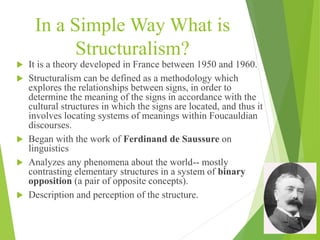
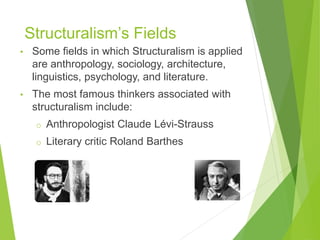
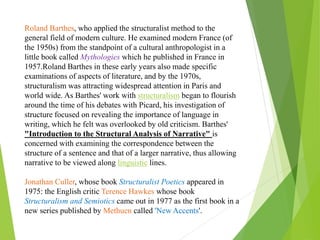
Structuralism emerged in France in the 1950s through the work of Claude Levi-Strauss and Roland Barthes. It believes that phenomena can only be understood in the context of larger structures. Structuralism analyzes relationships between signs and seeks to locate systems of meaning within cultural structures. It was applied to fields like anthropology, sociology, and literature. Key thinkers were Levi-Strauss, who applied structural linguistics concepts to anthropology, and Barthes, who examined aspects of modern culture from a structural perspective.






![Claude Lévi-Strauss (/klɔːd ˈleɪvi ˈstraʊs/;[2] French: [klod levi stʁos]; 28 November
1908 – 30 October 2009)[3][4][5] was a Belgian-born
French anthropologist and ethnologist whose work was key in the development of the
theory of structuralism and structural anthropology.[6] He held the chair of Social
Anthropology at the Collège de France between 1959 and 1982 and was elected a
member of the Académie française in 1973. He received numerous honors from
universities and institutions throughout the world and has been called,
alongside James George Frazer and Franz Boas,[7] the "father of modern
anthropology".
Lévi-Strauss argued that the "savage" mind had the same structures as the "civilized"
mind and that human characteristics are the same everywhere.[9][10] These
observations culminated in his famous book Tristes tropiques that established his
position as one of the central figures in the structuralist school of thought. As well
as sociology, his ideas reached into many fields in the humanities,
including philosophy. Structuralism has been defined as "the search for the
underlying patterns of thought in all forms of human activity."
The Elementary Structures of Kinship was published the next year and quickly came
to be regarded as one of the most important anthropological works on kinship. It was
even reviewed favorably by Simone de Beauvoir, who viewed it as an important
statement of the position of women in non-Western cultures. Lévi-Strauss was named
to a chair in social anthropology at the Collège de France in 1959. At roughly the
same time he published Structural Anthropology, a collection of his essays which
provided both examples and programmatic statements about
structuralism. Lévi-Strauss sought to apply the structural linguistics](https://image.slidesharecdn.com/structuralism-200629154806/85/Structuralism-10-320.jpg)















![How Big Brands are Taking Your Traffic in Alberta [Data Inside].pptx](https://cdn.slidesharecdn.com/ss_thumbnails/howbigbrandsaretakingyourtrafficinalbertadatainside-260123180142-42d276f3-thumbnail.jpg?width=640&height=640&fit=bounds)


