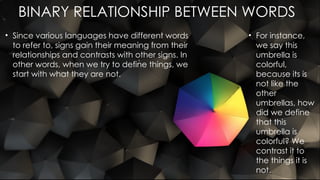
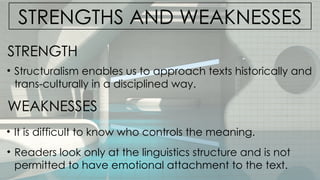
Structuralism, as articulated by Ferdinand de Saussure, is a theory that analyzes phenomena through their interconnections, positing that meaning is relative and culturally constructed rather than fixed. It emphasizes the distinction between 'langue' (abstract language) and 'parole' (actual use), with signs composed of signifiers (words) and signifieds (mental concepts) that vary based on cultural context. While structuralism offers a disciplined approach to texts historically and cross-culturally, it encounters limitations in understanding who controls meaning and may restrict emotional engagement with the text.