Structuralism
Grythce Arn Bation
Michael Bana-ay
Overview
DEFINITION AND BACKGROUND
BASIC TENET OF
STRUCTURALISM
STRUCTURALISM APPLIED TO
1
2
3
Structuralism
Structuralism is a way of understanding culture
and meaning in the arts by connecting particular
works of art (a novel, a painting, or a symphony)
to something greater.
The link between cultural phenomena, according
to structuralist theory, is a web, network, or
structure that lies beneath the way we think,
behave, and create art.
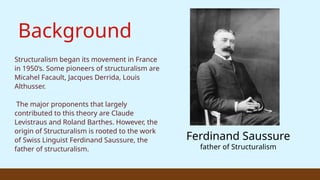
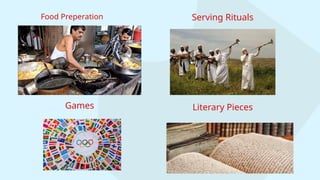
Background
Structuralism began its movement in France
in 1950’s. Some pioneers of structuralism are
Micahel Facault, Jacques Derrida, Louis
Althusser.
The major proponents that largely
contributed to this theory are Claude
Levistraus and Roland Barthes. However, the
origin of Structuralism is rooted to the work
of Swiss Linguist Ferdinand Saussure, the
father of structuralism.
Ferdinand Saussure
father of Structuralism
Furthermore, this theory evolved from language and linguistic
theories in which it examines the underlying aspects and structures in
culture and literature that may be utilized as a means to further
analyze the surface meaning of the text or concept.
A structuralist approach to criticism
examines patterns, narrative
operations, and rules of operation to
evaluate the text and the culture from
which it arises, examining underlying
structures which allow the formation
of meaning.
In literary theory, structuralist critics
examined underlying structures,
such as characterization or plot, and
attempted to demonstrate how these
patterns were universal and could
thus be used to develop general
conclusions about individual works
as well as the systems from which
they emerged.
Basic Tenet #1
Structuralist believe that in order to fully understand a concept or
idea, one must look on its underlying elements and structures and
see the common patterns involved.
To grasp a notion or idea according to structuralism, one must
look at the larger structure that underpins it and observe how it
links to the other things found in the same structure.
Language, according to Saussure, is a complex
system of signs. All of our words, actions,
perceptions, and thoughts are constructed, and they
are not natural. Therefore, in structuralism, there is
no such thing as innate or natural, it is all a product
of human mind. Through language, we provide
meaning in all the things around us. Therefore,
language according to Saussure is arbitrary.
Therefore, we can conclude that people who use
language decide what the words mean based on their
culture or the place where he/she lives in. Thus,
language is arbitrary.
Basic Tenet #2
Language is relational, it cannot
be understood in isolation.
The language will then conceptualize the idea and
generate names to label that object through human
thought processes. As previously stated, language is
arbitrary because there is no innate reason why things
are named the way they are. Everything is an outcome
of the human mind.
When we talk about meanings, we can also relate
this through binary opposition, and paradigmatic
chain.
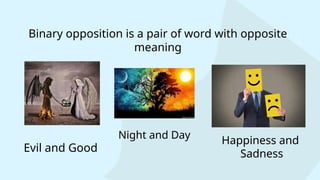
Binary opposition is a pair of word with opposite
meaning
Evil and Good
Night and Day
Happiness and
Sadness
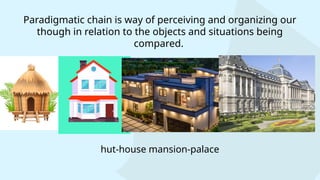
Paradigmatic chain is way of perceiving and organizing our
though in relation to the objects and situations being
compared.
hut-house mansion-palace
Basic Tenet #3
Language is constitutive
it means that language constitutes or set
the world we live in or in simpler terms it
directs our view and understanding of the
world.
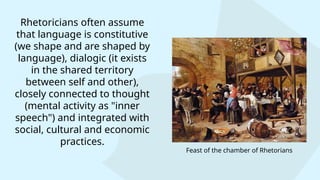
Rhetoricians often assume
that language is constitutive
(we shape and are shaped by
language), dialogic (it exists
in the shared territory
between self and other),
closely connected to thought
(mental activity as "inner
speech") and integrated with
social, cultural and economic
practices.
Feast of the chamber of Rhetorians
Some fields in which Structuralism is applied are
anthropology, sociology, architecture, linguistics,
psychology, and literature. •
• The meaning is produced and reproduced within a
culture through various phenomena that serve as
systems of signification.
• Diverse forms of entertainment are studied (as food
preparation and serving rituals, religious rites, games,
literary and non-literary texts).
ANTHROPOLOGY AND SOCIOLOGY
Food Preperation Serving Rituals
Literary Pieces
Games
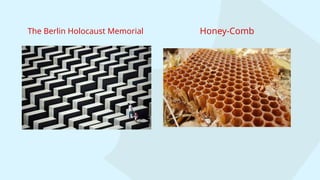
• The design is a process of searching for the relationship
between elements, interested in the social structures
and mental processes that contributed to the design.
• Great complexity within a highly structured construction.
• For example, a design may consist of cell-like honeycomb
shapes, intersecting planes, cubed grids, or densely
clustered spaces with connecting courtyards.
ARCHITECTURE
The Berlin Holocaust Memorial Honey-Comb
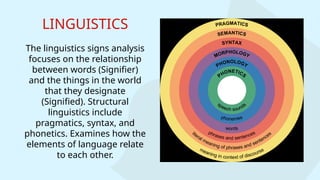
The linguistics signs analysis
focuses on the relationship
between words (Signifier)
and the things in the world
that they designate
(Signified). Structural
linguistics include
pragmatics, syntax, and
phonetics. Examines how the
elements of language relate
to each other.
LINGUISTICS
Structuralism have the goal to describe the structure of the
mind in terms of mental experience.
This theory focused on three things:
• The individual elements of consciousness.
• How they organized into more complex experiences
• How these mental phenomena correlated with physical
events.
PSYCHOLOGY
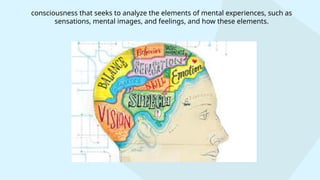
consciousness that seeks to analyze the elements of mental experiences, such as
sensations, mental images, and feelings, and how these elements.
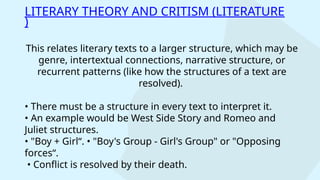
This relates literary texts to a larger structure, which may be
genre, intertextual connections, narrative structure, or
recurrent patterns (like how the structures of a text are
resolved).
• There must be a structure in every text to interpret it.
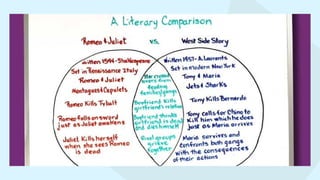
• An example would be West Side Story and Romeo and
Juliet structures.
• "Boy + Girl“. • "Boy's Group - Girl's Group" or "Opposing
forces“.
• Conflict is resolved by their death.
LITERARY THEORY AND CRITISM (LITERATURE
)
• Structuralist ideas continue to influence contemporary
thought and research in fields like cultural studies,
literary theory, and linguistics.
CONTEMPORARY RELEVANCE
Siegel, K. (n.d.). Introduction to Modern Literary Theory .Kristi Siegel.
Retrieved March 3, 2011, from www.kristisiegel.com/theory.htm • The
American Heritage dictionary of the English language(4th ed.). (2000).
Boston: Houghton Mifflin. • Perez, R. (2011, February 13). Psychology
Aldebaran: Later Psychology Developments (Classic Psychology).Psychology
Aldebaran. Retrieved March 14, 2011, from
http://psychologyaldebaran.blogspot.com/2011/02/lae r- psychology-
developments-classic.html • Structuralism. (2011, February 3). In Wikipedia,
The Free Encyclopedia. Retrieved 07:20, March 14, 2011,
fromhttp://en.wikipedia.org/w/index.php?title=Structuralism
&oldid=411716678
References:
Structuralism theory in literary critism

  • 1.
  • 2.
    Overview DEFINITION AND BACKGROUND BASICTENET OF STRUCTURALISM STRUCTURALISM APPLIED TO 1 2 3
  • 3.
    Structuralism Structuralism is away of understanding culture and meaning in the arts by connecting particular works of art (a novel, a painting, or a symphony) to something greater. The link between cultural phenomena, according to structuralist theory, is a web, network, or structure that lies beneath the way we think, behave, and create art.
  • 4.
    Background Structuralism began itsmovement in France in 1950’s. Some pioneers of structuralism are Micahel Facault, Jacques Derrida, Louis Althusser. The major proponents that largely contributed to this theory are Claude Levistraus and Roland Barthes. However, the origin of Structuralism is rooted to the work of Swiss Linguist Ferdinand Saussure, the father of structuralism. Ferdinand Saussure father of Structuralism
  • 5.
    Furthermore, this theoryevolved from language and linguistic theories in which it examines the underlying aspects and structures in culture and literature that may be utilized as a means to further analyze the surface meaning of the text or concept.
  • 6.
    A structuralist approachto criticism examines patterns, narrative operations, and rules of operation to evaluate the text and the culture from which it arises, examining underlying structures which allow the formation of meaning.
  • 7.
    In literary theory,structuralist critics examined underlying structures, such as characterization or plot, and attempted to demonstrate how these patterns were universal and could thus be used to develop general conclusions about individual works as well as the systems from which they emerged.
  • 8.
    Basic Tenet #1 Structuralistbelieve that in order to fully understand a concept or idea, one must look on its underlying elements and structures and see the common patterns involved. To grasp a notion or idea according to structuralism, one must look at the larger structure that underpins it and observe how it links to the other things found in the same structure.
  • 9.
    Language, according toSaussure, is a complex system of signs. All of our words, actions, perceptions, and thoughts are constructed, and they are not natural. Therefore, in structuralism, there is no such thing as innate or natural, it is all a product of human mind. Through language, we provide meaning in all the things around us. Therefore, language according to Saussure is arbitrary.
  • 10.
    Therefore, we canconclude that people who use language decide what the words mean based on their culture or the place where he/she lives in. Thus, language is arbitrary.
  • 11.
    Basic Tenet #2 Languageis relational, it cannot be understood in isolation.
  • 12.
    The language willthen conceptualize the idea and generate names to label that object through human thought processes. As previously stated, language is arbitrary because there is no innate reason why things are named the way they are. Everything is an outcome of the human mind.
  • 13.
    When we talkabout meanings, we can also relate this through binary opposition, and paradigmatic chain.
  • 14.
    Binary opposition isa pair of word with opposite meaning Evil and Good Night and Day Happiness and Sadness
  • 15.
    Paradigmatic chain isway of perceiving and organizing our though in relation to the objects and situations being compared. hut-house mansion-palace
  • 16.
    Basic Tenet #3 Languageis constitutive it means that language constitutes or set the world we live in or in simpler terms it directs our view and understanding of the world.
  • 17.
    Rhetoricians often assume thatlanguage is constitutive (we shape and are shaped by language), dialogic (it exists in the shared territory between self and other), closely connected to thought (mental activity as "inner speech") and integrated with social, cultural and economic practices. Feast of the chamber of Rhetorians
  • 18.
    Some fields inwhich Structuralism is applied are anthropology, sociology, architecture, linguistics, psychology, and literature. •
  • 19.
    • The meaningis produced and reproduced within a culture through various phenomena that serve as systems of signification. • Diverse forms of entertainment are studied (as food preparation and serving rituals, religious rites, games, literary and non-literary texts). ANTHROPOLOGY AND SOCIOLOGY
  • 20.
    Food Preperation ServingRituals Literary Pieces Games
  • 21.
    • The designis a process of searching for the relationship between elements, interested in the social structures and mental processes that contributed to the design. • Great complexity within a highly structured construction. • For example, a design may consist of cell-like honeycomb shapes, intersecting planes, cubed grids, or densely clustered spaces with connecting courtyards. ARCHITECTURE
  • 22.
    The Berlin HolocaustMemorial Honey-Comb
  • 23.
    The linguistics signsanalysis focuses on the relationship between words (Signifier) and the things in the world that they designate (Signified). Structural linguistics include pragmatics, syntax, and phonetics. Examines how the elements of language relate to each other. LINGUISTICS
  • 24.
    Structuralism have thegoal to describe the structure of the mind in terms of mental experience. This theory focused on three things: • The individual elements of consciousness. • How they organized into more complex experiences • How these mental phenomena correlated with physical events. PSYCHOLOGY
  • 25.
    consciousness that seeksto analyze the elements of mental experiences, such as sensations, mental images, and feelings, and how these elements.
  • 26.
    This relates literarytexts to a larger structure, which may be genre, intertextual connections, narrative structure, or recurrent patterns (like how the structures of a text are resolved). • There must be a structure in every text to interpret it. • An example would be West Side Story and Romeo and Juliet structures. • "Boy + Girl“. • "Boy's Group - Girl's Group" or "Opposing forces“. • Conflict is resolved by their death. LITERARY THEORY AND CRITISM (LITERATURE )
  • 28.
    • Structuralist ideascontinue to influence contemporary thought and research in fields like cultural studies, literary theory, and linguistics. CONTEMPORARY RELEVANCE
  • 29.
    Siegel, K. (n.d.).Introduction to Modern Literary Theory .Kristi Siegel. Retrieved March 3, 2011, from www.kristisiegel.com/theory.htm • The American Heritage dictionary of the English language(4th ed.). (2000). Boston: Houghton Mifflin. • Perez, R. (2011, February 13). Psychology Aldebaran: Later Psychology Developments (Classic Psychology).Psychology Aldebaran. Retrieved March 14, 2011, from http://psychologyaldebaran.blogspot.com/2011/02/lae r- psychology- developments-classic.html • Structuralism. (2011, February 3). In Wikipedia, The Free Encyclopedia. Retrieved 07:20, March 14, 2011, fromhttp://en.wikipedia.org/w/index.php?title=Structuralism &oldid=411716678 References: