Cerebellar
Infarction
Ade Wijaya, MD – April 2018
Outline:
• Introduction
• Patient history
• Symptoms and signs
• Etiology and pathogenesis
• Imaging
• Differential diagnosis
• Complication
• Management
• Summary
Introduction
• 2-3% of all strokes.
• Cerebellar strokes can cause
serious complications because of
their location.
Macdonell RA, Kalnins RM, Donnan GA. Cerebellar infarction: natural history, prognosis, and pathology. Stroke 1987;18(5):849–55.
Tohgi H, Takahashi S, Chiba K, et al. Cerebellar infarction. Clinical and neuroimaging analysis in 293 patients. The Tohoku Cerebellar Infarction Study Group. Stroke 1993;24(11):1697–701.
Bogousslavsky J, Van Melle G, Regli F. The Lausanne Stroke Registry: analysis of 1,000 consecutive patients with first stroke. Stroke 1988;19(9):1083–92.
Koh MG, Phan TG, Atkinson JL, et al. Neuroimaging in deteriorating patients with cerebellar infarcts and mass effect. Stroke 2000;31(9):2062–7.
Kase CS, Norrving B, Levine SR, et al. Cerebellar infarction. Clinical and anatomic observations in 66 cases. Stroke 1993;24(1):76–83.
Patient History
• Abrupt onset
• Temporal association with head or neck trauma
• Accompanying acute onset neck pain (due to vertebral dissection)
• Presence of stroke risk factors (diabetes mellitus, hypertension,
hypercholesterolemia, cigarette smoking, advanced age, atrial
fibrillation)
• History of TIAs or strokes
• Gait or limb incoordination out of proportion to nausea and vomiting
Datar S, Rabinstein AA. Cerebellar infarction. Neurologic clinics. 2014 Nov 1;32(4):979-91.
Symptoms and Signs
a Direction changing or vertical, not inhibited by visual fixation and without any associated
tinnitus suggests central rather than peripheral cause.
b When muscles are contracted against resistance and the resistance is then suddenly removed, the
antagonists fail to check the movement and the limb continues to move in the direction of the
muscle contraction.
c Sometimes seen with AICA territory infarction.
d Seen sometimes with PICA territory infarction with simultaneous involvement of the medulla.
e Oscillating motion of the extremity after a reflex is elicited.
Datar S, Rabinstein AA. Cerebellar infarction. Neurologic clinics. 2014 Nov 1;32(4):979-91.
Brainstem Signs
• Diplopia or skew deviation
• Cranial nerve deficits
• Horner syndrome
• Long tract signs (hemimotor or hemisensory deficits)
• Abnormal pupillary reaction
• Reduced level of consciousness
Datar S, Rabinstein AA. Cerebellar infarction. Neurologic clinics. 2014 Nov 1;32(4):979-91.
Etiology and Pathogenesis
Cardiac embolism
• Atrial fibrillation
• Patent foramen ovale (paradoxic embolism)
• Valvular thrombi or vegetations
• Severe cardiomyopathy with heart failure
Atherosclerosis
• Vertebrobasilar atherosclerosis
• Aortic arch atherosclerosis with artery-to-artery embolism
Vertebral or basilar arterial dissection
• Head or neck trauma
• Nontraumatic spontaneous dissection
• Connective tissue disorders (eg, fibromuscular dysplasia)
Datar S, Rabinstein AA. Cerebellar infarction. Neurologic clinics. 2014 Nov 1;32(4):979-91.
Etiology and Pathogenesis
Hypercoagulable states
• Hereditary (such as protein C deficiency, protein S deficiency, or factor V
• Leiden mutation)
• Oral contraceptives
Vasculitis/vasculopathy
• Infectious (eg, syphilis, Lyme neuroborreliosis)
• Inflammatory (eg, central nervous system vasculitis)
• Drug induced (eg, cocaine or methamphetamines)
Migraine
Cryptogenic
Datar S, Rabinstein AA. Cerebellar infarction. Neurologic clinics. 2014 Nov 1;32(4):979-91.
Umashankar G, Gupta V, Harik SI. Acute bilateral inferior cerebellar infarction in a patient with neurosyphilis. Arch Neurol 2004;61(6):953–6.
Topakian R, Stieglbauer K, Nussbaumer K, et al. Cerebral vasculitis and stroke in Lyme neuroborreliosis. Two case reports and review of current knowledge. Cerebrovasc Dis 2008;26(5):455–61.
Aggarwal S, Byrne BD. Massive ischemic cerebellar infarction due to cocaine use. Neuroradiology 1991;33(5):449–50.
Kruit MC, Launer LJ, Ferrari MD, et al. Infarcts in the posterior circulation territory in migraine. The population-basedMRICAMERAstudy.Brain 2005;128(Pt 9):2068–77.
Imaging
Hwang DY, Silva GS, Furie KL, et al. Comparative sensitivity of computed tomography vs.
magnetic resonance imaging for detecting acute posterior fossa infarct. J Emerg Med
2012;42(5):559–65.
Koh MG, Phan TG, Atkinson JL, et al. Neuroimaging in deteriorating patients with
cerebellar infarcts and mass effect. Stroke 2000;31(9):2062–7.
Hirai T, Korogi Y, Ono K, et al. Prospective evaluation of suspected stenoocclusive disease
of the intracranial artery: combined MR angiography and CT angiography compared with
digital subtraction angiography. AJNR Am J Neuroradiol 2002;23(1):93–101.
Latchaw RE, Alberts MJ, Lev MH, et al. Recommendations for imaging of acute ischemic
stroke: a scientific statement from the American Heart Association. Stroke
2009;40(11):3646–78.
Datar S, Rabinstein AA. Cerebellar infarction. Neurologic clinics. 2014 Nov 1;32(4):979-91.
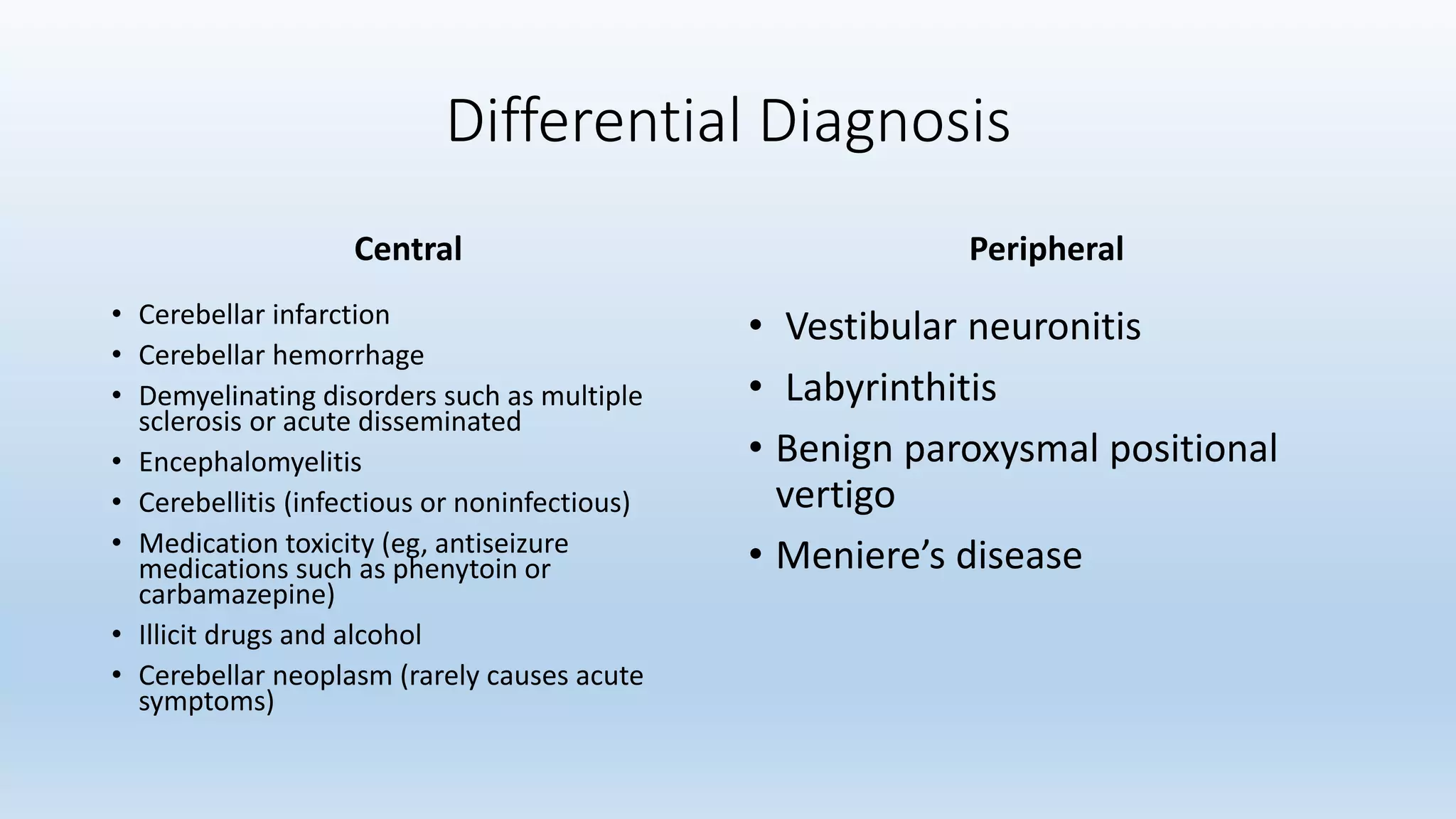
Differential Diagnosis
Central
• Cerebellar infarction
• Cerebellar hemorrhage
• Demyelinating disorders such as multiple
sclerosis or acute disseminated
• Encephalomyelitis
• Cerebellitis (infectious or noninfectious)
• Medication toxicity (eg, antiseizure
medications such as phenytoin or
carbamazepine)
• Illicit drugs and alcohol
• Cerebellar neoplasm (rarely causes acute
symptoms)
Peripheral
• Vestibular neuronitis
• Labyrinthitis
• Benign paroxysmal positional
vertigo
• Meniere’s disease
Complication
• Swelling and mass effect resulting in brain stem compression.
• Compression of the fourth ventricle resulting into obstructive
hydrocephalus.
• Hemorrhagic conversion of ischemic infarction.
Datar S, Rabinstein AA. Cerebellar infarction. Neurologic clinics. 2014 Nov 1;32(4):979-91.
Management
Datar S, Rabinstein AA. Cerebellar infarction. Neurologic clinics. 2014 Nov 1;32(4):979-91.
Management
• Airway management and mechanical ventilation
• Blood pressure management
• Temperature management
• Glucose management
• Fluid and electrolyte management
• Antiplatelet (aspirin)
• Treat the risk factors
Datar S, Rabinstein AA. Cerebellar infarction. Neurologic clinics. 2014 Nov 1;32(4):979-91.
Management
• Hyperosmolar Therapy
- Mannitol
- Hypertonic saline
• Surgery
Videen TO, Zazulia AR, Manno EM, et al. Mannitol bolus preferentially shrinks non-infarcted brain in patients with ischemic stroke. Neurology 2001;57(11): 2120–2.
Surgical Treatment
• Are considered when there is clinical deterioration attributed to mass
effect from tissue swelling or hemorrhagic conversion.
• Suboccipital decompressive craniectomy (SDC) with dural expansion is
the procedure of choice.
• Should be reserved for patients who fail medical management and
those who deteriorate rapidly.
• Ventriculostomy to treat obstructive hydrocephalus may be
performed in isolation or it may be combined with SDC.
Raco A, Caroli E, Isidori A, et al. Management of acute cerebellar infarction: one institution’s experience. Neurosurgery 2003;53(5):1061–5.
Wijdicks EF, Sheth KN, Carter BS, et al. Recommendations for the management of cerebral and cerebellar infarction with swelling: a statement for healthcare professionals
from the American Heart Association/American Stroke Association. Stroke 2014;45(4):1222–38.
Hornig CR, Rust DS, Busse O, et al. Space-occupying cerebellar infarction. Clinical course and prognosis. Stroke 1994;25(2):372–4.
Datar S, Rabinstein AA. Cerebellar infarction. Neurologic clinics. 2014 Nov 1;32(4):979-91.
Signs of Deterioration
• Decrease in the level of consciousness,
• Downward displacement of conjugate gaze (sunset eyes),
• Gaze paresis,
• Cranial nerve deficits,
• Long tract signs. (spasticity, hyperreflexia, and pathological reflexes)
Datar S, Rabinstein AA. Cerebellar infarction. Neurologic clinics. 2014 Nov 1;32(4):979-91.
Prognosis
• Outcome can be good if managed appropriately and in the absence of
additional brain stem infarction.
• Older patients seem to do worse than younger patients
Datar S, Rabinstein AA. Cerebellar infarction. Neurologic clinics. 2014 Nov 1;32(4):979-91.
Summary
• Uncommon. Nonspecific symptoms such as nausea, vomiting,headache,
and dizziness.
• Cardioembolism, large artery atherosclerosis, and basilar or vertebral
artery dissection are important causes.
• Complications such as tissue swelling and mass effect can be life
threatening because of brain stem compression and/or obstructive
hydrocephalus.
• Close monitoring is essential in the acute phase for timely recognition and
treatment of these complications.
• Patients can have a good outcome if managed appropriately.
• Decompressive suboccipital craniectomy is necessary in the most severe
cases.
Cerebellar Infarction

Cerebellar Infarction

  • 1.
  • 2.
    Outline: • Introduction • Patienthistory • Symptoms and signs • Etiology and pathogenesis • Imaging • Differential diagnosis • Complication • Management • Summary
  • 3.
    Introduction • 2-3% ofall strokes. • Cerebellar strokes can cause serious complications because of their location. Macdonell RA, Kalnins RM, Donnan GA. Cerebellar infarction: natural history, prognosis, and pathology. Stroke 1987;18(5):849–55. Tohgi H, Takahashi S, Chiba K, et al. Cerebellar infarction. Clinical and neuroimaging analysis in 293 patients. The Tohoku Cerebellar Infarction Study Group. Stroke 1993;24(11):1697–701. Bogousslavsky J, Van Melle G, Regli F. The Lausanne Stroke Registry: analysis of 1,000 consecutive patients with first stroke. Stroke 1988;19(9):1083–92. Koh MG, Phan TG, Atkinson JL, et al. Neuroimaging in deteriorating patients with cerebellar infarcts and mass effect. Stroke 2000;31(9):2062–7. Kase CS, Norrving B, Levine SR, et al. Cerebellar infarction. Clinical and anatomic observations in 66 cases. Stroke 1993;24(1):76–83.
  • 4.
    Patient History • Abruptonset • Temporal association with head or neck trauma • Accompanying acute onset neck pain (due to vertebral dissection) • Presence of stroke risk factors (diabetes mellitus, hypertension, hypercholesterolemia, cigarette smoking, advanced age, atrial fibrillation) • History of TIAs or strokes • Gait or limb incoordination out of proportion to nausea and vomiting Datar S, Rabinstein AA. Cerebellar infarction. Neurologic clinics. 2014 Nov 1;32(4):979-91.
  • 5.
    Symptoms and Signs aDirection changing or vertical, not inhibited by visual fixation and without any associated tinnitus suggests central rather than peripheral cause. b When muscles are contracted against resistance and the resistance is then suddenly removed, the antagonists fail to check the movement and the limb continues to move in the direction of the muscle contraction. c Sometimes seen with AICA territory infarction. d Seen sometimes with PICA territory infarction with simultaneous involvement of the medulla. e Oscillating motion of the extremity after a reflex is elicited. Datar S, Rabinstein AA. Cerebellar infarction. Neurologic clinics. 2014 Nov 1;32(4):979-91.
  • 6.
    Brainstem Signs • Diplopiaor skew deviation • Cranial nerve deficits • Horner syndrome • Long tract signs (hemimotor or hemisensory deficits) • Abnormal pupillary reaction • Reduced level of consciousness Datar S, Rabinstein AA. Cerebellar infarction. Neurologic clinics. 2014 Nov 1;32(4):979-91.
  • 7.
    Etiology and Pathogenesis Cardiacembolism • Atrial fibrillation • Patent foramen ovale (paradoxic embolism) • Valvular thrombi or vegetations • Severe cardiomyopathy with heart failure Atherosclerosis • Vertebrobasilar atherosclerosis • Aortic arch atherosclerosis with artery-to-artery embolism Vertebral or basilar arterial dissection • Head or neck trauma • Nontraumatic spontaneous dissection • Connective tissue disorders (eg, fibromuscular dysplasia) Datar S, Rabinstein AA. Cerebellar infarction. Neurologic clinics. 2014 Nov 1;32(4):979-91.
  • 8.
    Etiology and Pathogenesis Hypercoagulablestates • Hereditary (such as protein C deficiency, protein S deficiency, or factor V • Leiden mutation) • Oral contraceptives Vasculitis/vasculopathy • Infectious (eg, syphilis, Lyme neuroborreliosis) • Inflammatory (eg, central nervous system vasculitis) • Drug induced (eg, cocaine or methamphetamines) Migraine Cryptogenic Datar S, Rabinstein AA. Cerebellar infarction. Neurologic clinics. 2014 Nov 1;32(4):979-91. Umashankar G, Gupta V, Harik SI. Acute bilateral inferior cerebellar infarction in a patient with neurosyphilis. Arch Neurol 2004;61(6):953–6. Topakian R, Stieglbauer K, Nussbaumer K, et al. Cerebral vasculitis and stroke in Lyme neuroborreliosis. Two case reports and review of current knowledge. Cerebrovasc Dis 2008;26(5):455–61. Aggarwal S, Byrne BD. Massive ischemic cerebellar infarction due to cocaine use. Neuroradiology 1991;33(5):449–50. Kruit MC, Launer LJ, Ferrari MD, et al. Infarcts in the posterior circulation territory in migraine. The population-basedMRICAMERAstudy.Brain 2005;128(Pt 9):2068–77.
  • 9.
    Imaging Hwang DY, SilvaGS, Furie KL, et al. Comparative sensitivity of computed tomography vs. magnetic resonance imaging for detecting acute posterior fossa infarct. J Emerg Med 2012;42(5):559–65. Koh MG, Phan TG, Atkinson JL, et al. Neuroimaging in deteriorating patients with cerebellar infarcts and mass effect. Stroke 2000;31(9):2062–7. Hirai T, Korogi Y, Ono K, et al. Prospective evaluation of suspected stenoocclusive disease of the intracranial artery: combined MR angiography and CT angiography compared with digital subtraction angiography. AJNR Am J Neuroradiol 2002;23(1):93–101. Latchaw RE, Alberts MJ, Lev MH, et al. Recommendations for imaging of acute ischemic stroke: a scientific statement from the American Heart Association. Stroke 2009;40(11):3646–78. Datar S, Rabinstein AA. Cerebellar infarction. Neurologic clinics. 2014 Nov 1;32(4):979-91.
  • 10.
    Differential Diagnosis Central • Cerebellarinfarction • Cerebellar hemorrhage • Demyelinating disorders such as multiple sclerosis or acute disseminated • Encephalomyelitis • Cerebellitis (infectious or noninfectious) • Medication toxicity (eg, antiseizure medications such as phenytoin or carbamazepine) • Illicit drugs and alcohol • Cerebellar neoplasm (rarely causes acute symptoms) Peripheral • Vestibular neuronitis • Labyrinthitis • Benign paroxysmal positional vertigo • Meniere’s disease
  • 11.
    Complication • Swelling andmass effect resulting in brain stem compression. • Compression of the fourth ventricle resulting into obstructive hydrocephalus. • Hemorrhagic conversion of ischemic infarction. Datar S, Rabinstein AA. Cerebellar infarction. Neurologic clinics. 2014 Nov 1;32(4):979-91.
  • 12.
    Management Datar S, RabinsteinAA. Cerebellar infarction. Neurologic clinics. 2014 Nov 1;32(4):979-91.
  • 13.
    Management • Airway managementand mechanical ventilation • Blood pressure management • Temperature management • Glucose management • Fluid and electrolyte management • Antiplatelet (aspirin) • Treat the risk factors Datar S, Rabinstein AA. Cerebellar infarction. Neurologic clinics. 2014 Nov 1;32(4):979-91.
  • 14.
    Management • Hyperosmolar Therapy -Mannitol - Hypertonic saline • Surgery Videen TO, Zazulia AR, Manno EM, et al. Mannitol bolus preferentially shrinks non-infarcted brain in patients with ischemic stroke. Neurology 2001;57(11): 2120–2.
  • 15.
    Surgical Treatment • Areconsidered when there is clinical deterioration attributed to mass effect from tissue swelling or hemorrhagic conversion. • Suboccipital decompressive craniectomy (SDC) with dural expansion is the procedure of choice. • Should be reserved for patients who fail medical management and those who deteriorate rapidly. • Ventriculostomy to treat obstructive hydrocephalus may be performed in isolation or it may be combined with SDC. Raco A, Caroli E, Isidori A, et al. Management of acute cerebellar infarction: one institution’s experience. Neurosurgery 2003;53(5):1061–5. Wijdicks EF, Sheth KN, Carter BS, et al. Recommendations for the management of cerebral and cerebellar infarction with swelling: a statement for healthcare professionals from the American Heart Association/American Stroke Association. Stroke 2014;45(4):1222–38. Hornig CR, Rust DS, Busse O, et al. Space-occupying cerebellar infarction. Clinical course and prognosis. Stroke 1994;25(2):372–4. Datar S, Rabinstein AA. Cerebellar infarction. Neurologic clinics. 2014 Nov 1;32(4):979-91.
  • 16.
    Signs of Deterioration •Decrease in the level of consciousness, • Downward displacement of conjugate gaze (sunset eyes), • Gaze paresis, • Cranial nerve deficits, • Long tract signs. (spasticity, hyperreflexia, and pathological reflexes) Datar S, Rabinstein AA. Cerebellar infarction. Neurologic clinics. 2014 Nov 1;32(4):979-91.
  • 17.
    Prognosis • Outcome canbe good if managed appropriately and in the absence of additional brain stem infarction. • Older patients seem to do worse than younger patients Datar S, Rabinstein AA. Cerebellar infarction. Neurologic clinics. 2014 Nov 1;32(4):979-91.
  • 18.
    Summary • Uncommon. Nonspecificsymptoms such as nausea, vomiting,headache, and dizziness. • Cardioembolism, large artery atherosclerosis, and basilar or vertebral artery dissection are important causes. • Complications such as tissue swelling and mass effect can be life threatening because of brain stem compression and/or obstructive hydrocephalus. • Close monitoring is essential in the acute phase for timely recognition and treatment of these complications. • Patients can have a good outcome if managed appropriately. • Decompressive suboccipital craniectomy is necessary in the most severe cases.