Management &
Complications of stroke
Mr.Abdulaziz R. Alanzi
Medical Student, Al-Imam University
Riyadh – Saudi Arabia
References
 UpToDate Electronic Medical Database
 Harrison's Principles of Internal
Medicine Book,18e, Dan L. Longo,
Anthony S. Fauci, Dennis L. Kasper,
Stephen L. Hauser, J. Larry Jameson,
Joseph Loscalzo, Eds.
Management
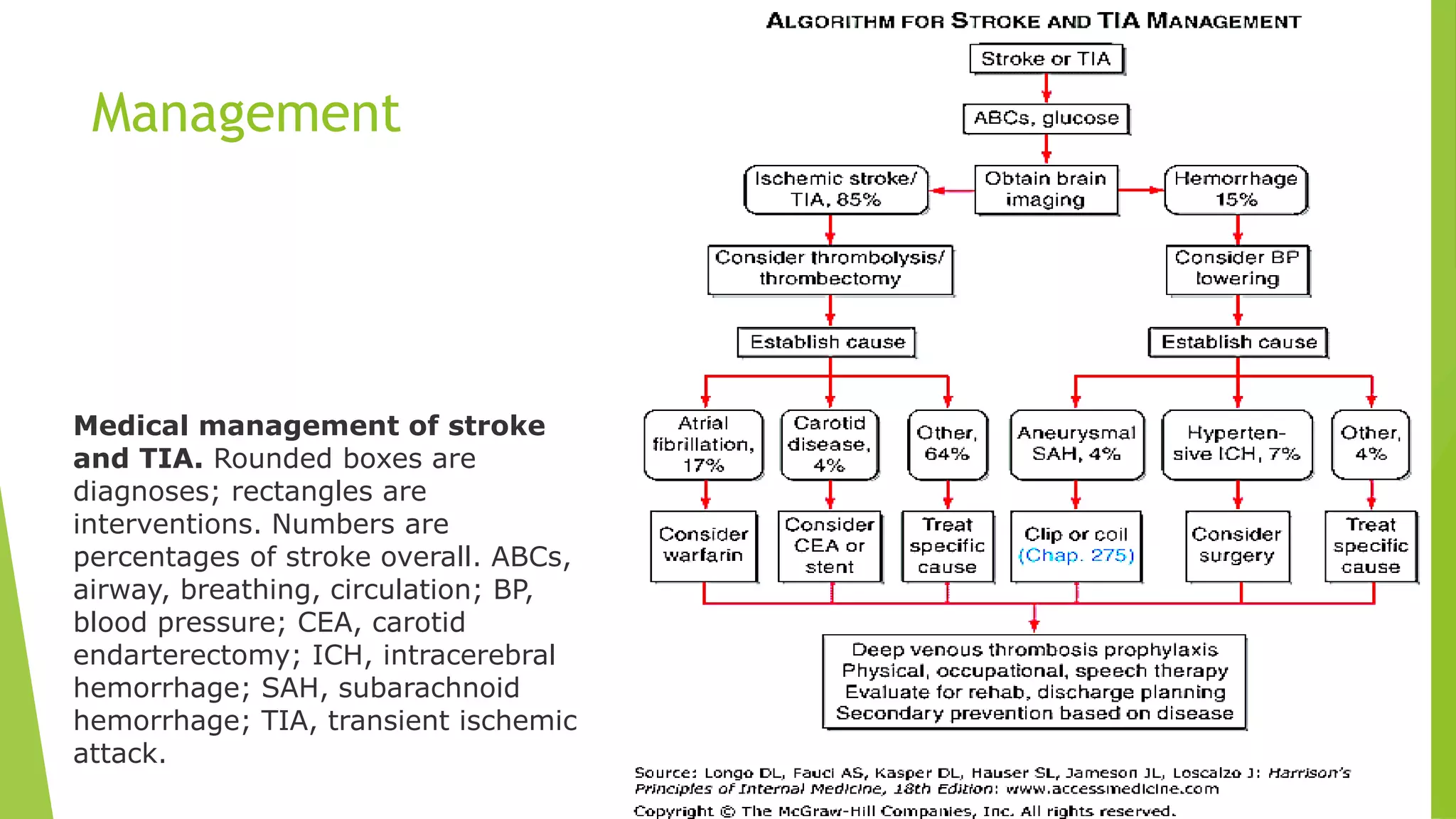
Medical management of stroke
and TIA. Rounded boxes are
diagnoses; rectangles are
interventions. Numbers are
percentages of stroke overall. ABCs,
airway, breathing, circulation; BP,
blood pressure; CEA, carotid
endarterectomy; ICH, intracerebral
hemorrhage; SAH, subarachnoid
hemorrhage; TIA, transient ischemic
attack.
Management: Acute Ischemic Stroke
falls within six categories
(1) Medical support: optimize cerebral perfusion in the surrounding ischemic penumbra
(2) IV thrombolysis: recombinant tPA
(3) Endovascular techniques: Intraarterial administration of a thrombolytic agent
(4) Antithrombotic treatment: Platelet Inhibition & Anticoagulation
(5) Neuroprotection: providing a treatment that prolongs the brain's tolerance to ischemia
(6) Stroke centers and rehabilitation
Management: Acute Ischemic Stroke
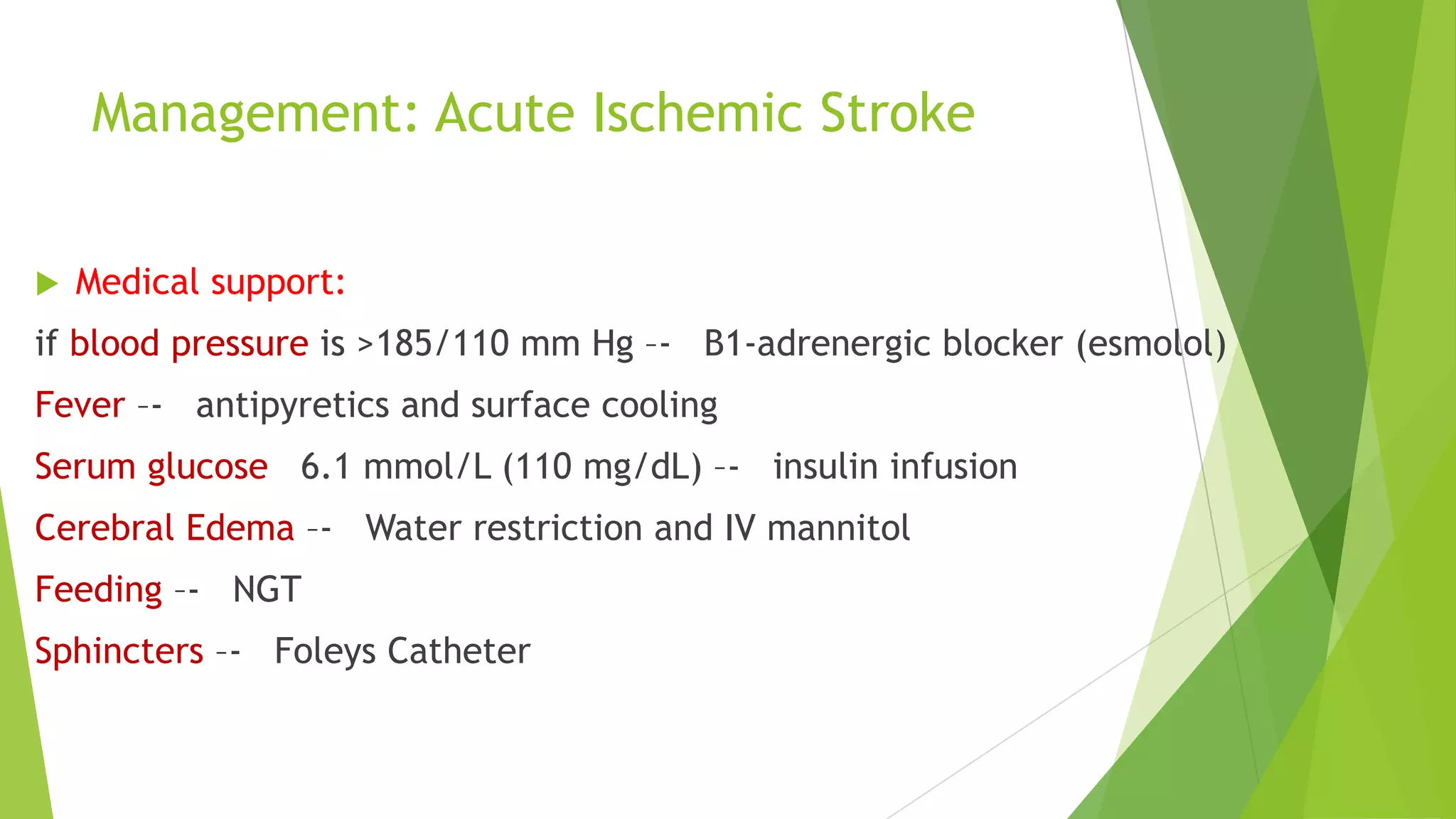
 Medical support:
if blood pressure is >185/110 mm Hg –- B1-adrenergic blocker (esmolol)
Fever –- antipyretics and surface cooling
Serum glucose 6.1 mmol/L (110 mg/dL) –- insulin infusion
Cerebral Edema –- Water restriction and IV mannitol
Feeding –- NGT
Sphincters –- Foleys Catheter
Management: Acute Ischemic Stroke
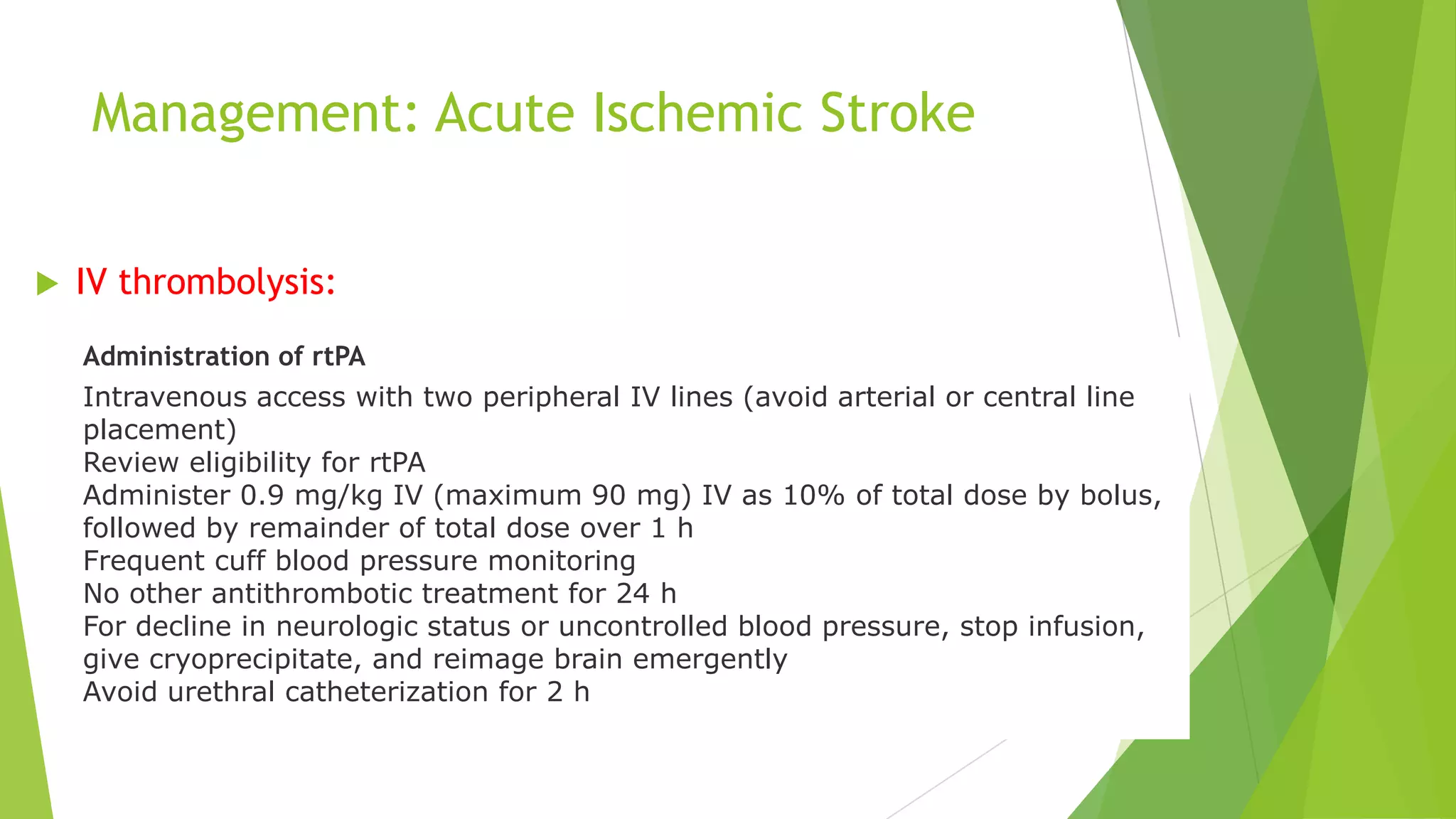
 IV thrombolysis:
Administration of rtPA
Intravenous access with two peripheral IV lines (avoid arterial or central line
placement)
Review eligibility for rtPA
Administer 0.9 mg/kg IV (maximum 90 mg) IV as 10% of total dose by bolus,
followed by remainder of total dose over 1 h
Frequent cuff blood pressure monitoring
No other antithrombotic treatment for 24 h
For decline in neurologic status or uncontrolled blood pressure, stop infusion,
give cryoprecipitate, and reimage brain emergently
Avoid urethral catheterization for 2 h
Management: Acute Ischemic Stroke
 Endovascular techniques :
Management: Acute Ischemic Stroke
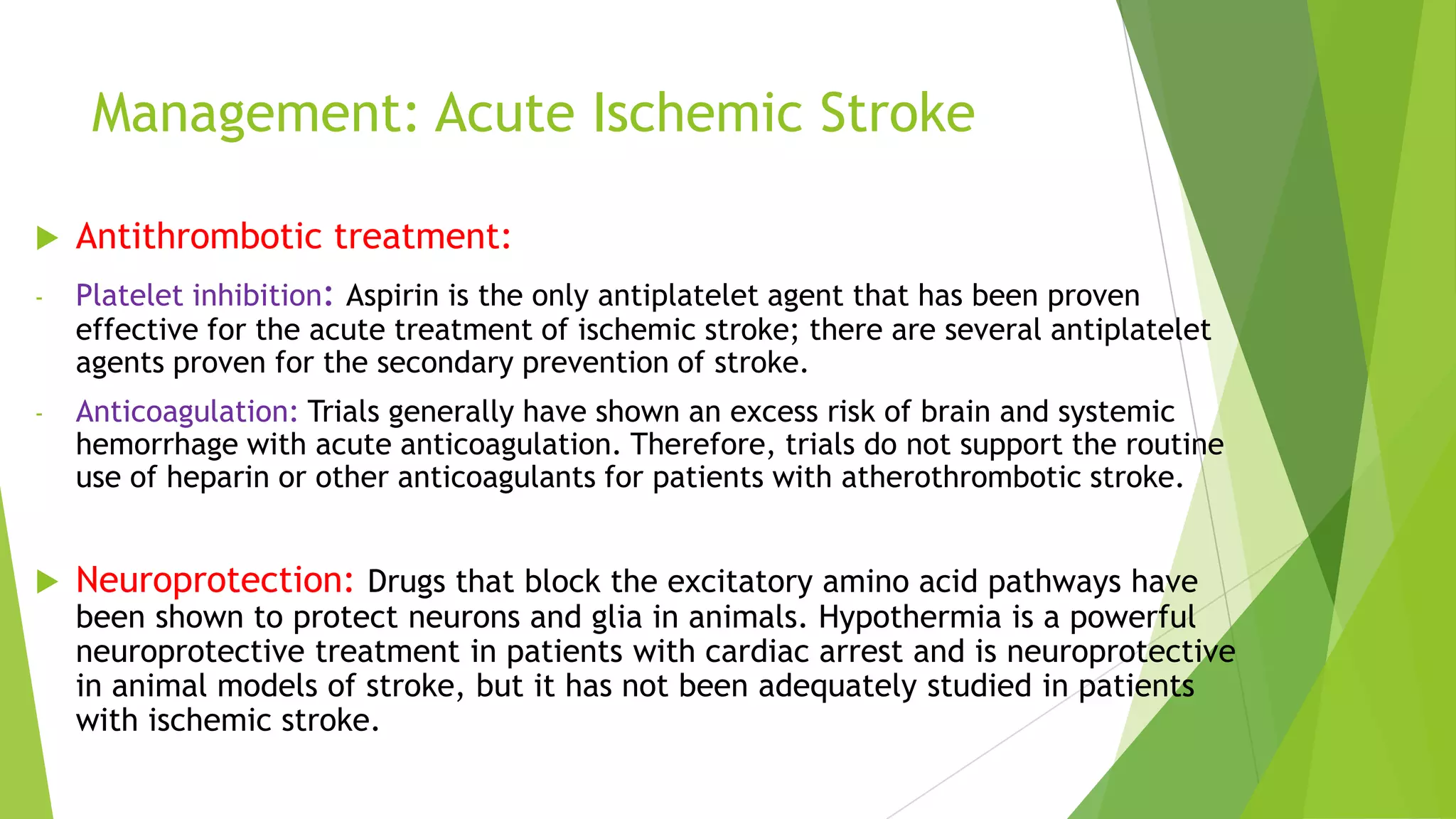
 Antithrombotic treatment:
- Platelet inhibition: Aspirin is the only antiplatelet agent that has been proven
effective for the acute treatment of ischemic stroke; there are several antiplatelet
agents proven for the secondary prevention of stroke.
- Anticoagulation: Trials generally have shown an excess risk of brain and systemic
hemorrhage with acute anticoagulation. Therefore, trials do not support the routine
use of heparin or other anticoagulants for patients with atherothrombotic stroke.
 Neuroprotection: Drugs that block the excitatory amino acid pathways have
been shown to protect neurons and glia in animals. Hypothermia is a powerful
neuroprotective treatment in patients with cardiac arrest and is neuroprotective
in animal models of stroke, but it has not been adequately studied in patients
with ischemic stroke.
Management: Acute Ischemic Stroke
 Stroke centers and rehabilitation:
Proper rehabilitation of the stroke patient includes early physical, occupational, and
speech therapy. It is directed toward educating the patient and family about the
patient's neurologic deficit, preventing the complications of immobility (e.g.,
pneumonia, DVT and pulmonary embolism, pressure sores of the skin, and muscle
contractures).
The goal of rehabilitation is to return the patient to home and to maximize recovery by
providing a safe, progressive regimen suited to the individual patient. Additionally, the
use of restraint therapy (immobilizing the unaffected side) has been shown to improve
hemiparesis following stroke.
Complication Percent
Falls
Urinary tract infection
Chest infection
Pressure sores
Depression
Shoulder pain
Deep venous thrombosis
Pulmonary embolism
Medical complications of stroke were frequent in a prospective multicenter study of 311 patients followed
weekly through hospital discharge and again at 6, 18, and 30 months after stroke.
Data from: Langhorne, P, Stott, DJ, Robertson, L, et al. Medical complications after stroke: a multicenter
study. Stroke 2000; 31:1223.
Complications of stroke
Common medical complications of stroke
Complications of stroke
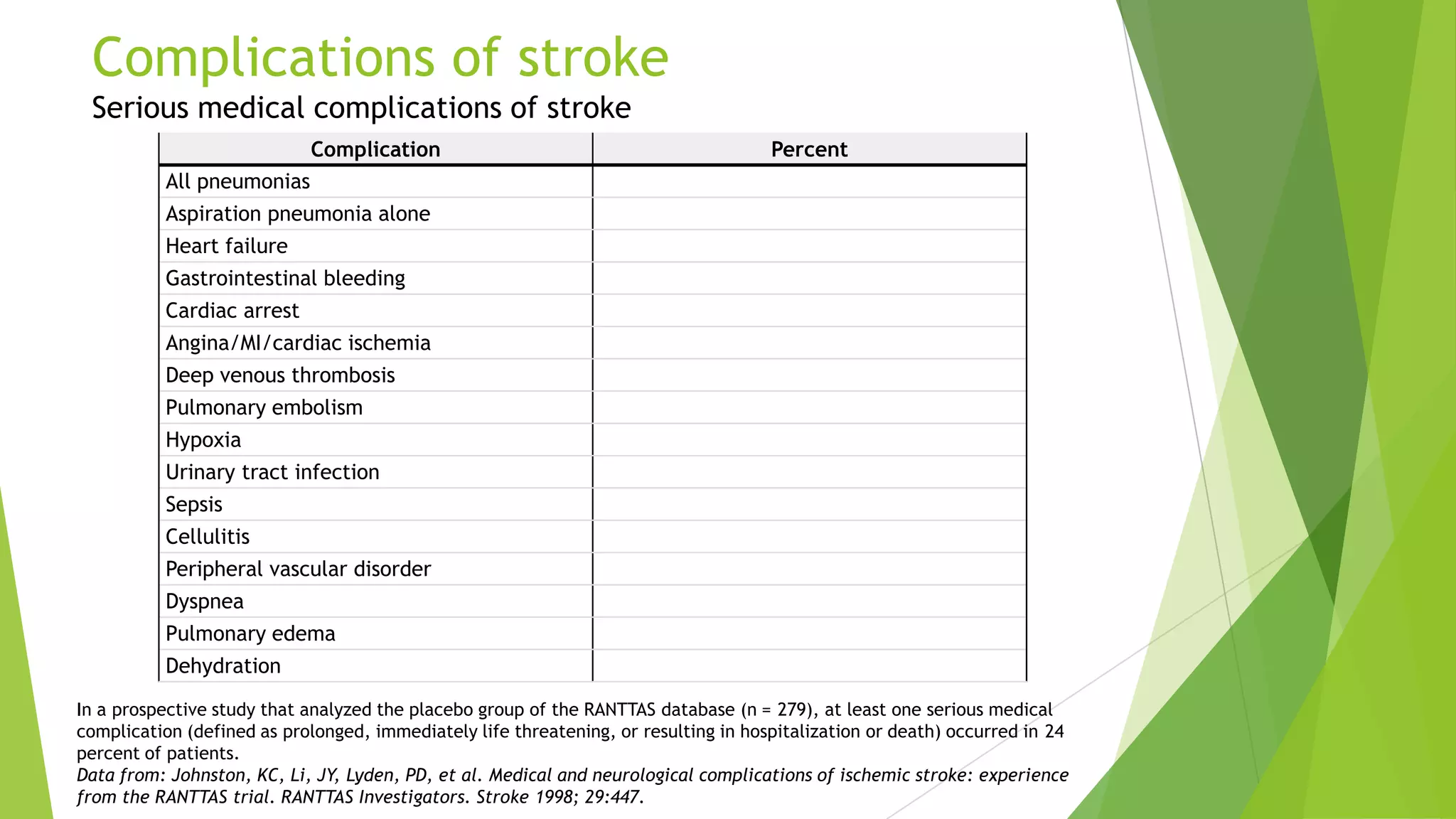
Serious medical complications of stroke
In a prospective study that analyzed the placebo group of the RANTTAS database (n = 279), at least one serious medical
complication (defined as prolonged, immediately life threatening, or resulting in hospitalization or death) occurred in 24
percent of patients.
Data from: Johnston, KC, Li, JY, Lyden, PD, et al. Medical and neurological complications of ischemic stroke: experience
from the RANTTAS trial. RANTTAS Investigators. Stroke 1998; 29:447.
Complication Percent
All pneumonias
Aspiration pneumonia alone
Heart failure
Gastrointestinal bleeding
Cardiac arrest
Angina/MI/cardiac ischemia
Deep venous thrombosis
Pulmonary embolism
Hypoxia
Urinary tract infection
Sepsis
Cellulitis
Peripheral vascular disorder
Dyspnea
Pulmonary edema
Dehydration
Thank You
d0pa@hotmail.com
@AbdulazizEnazi
http://imamu.academia.edu/AbdulazizAlanzi

Management & Complications of Stroke

  • 1.
    Management & Complications ofstroke Mr.Abdulaziz R. Alanzi Medical Student, Al-Imam University Riyadh – Saudi Arabia
  • 2.
    References  UpToDate ElectronicMedical Database  Harrison's Principles of Internal Medicine Book,18e, Dan L. Longo, Anthony S. Fauci, Dennis L. Kasper, Stephen L. Hauser, J. Larry Jameson, Joseph Loscalzo, Eds.
  • 3.
    Management Medical management ofstroke and TIA. Rounded boxes are diagnoses; rectangles are interventions. Numbers are percentages of stroke overall. ABCs, airway, breathing, circulation; BP, blood pressure; CEA, carotid endarterectomy; ICH, intracerebral hemorrhage; SAH, subarachnoid hemorrhage; TIA, transient ischemic attack.
  • 4.
    Management: Acute IschemicStroke falls within six categories (1) Medical support: optimize cerebral perfusion in the surrounding ischemic penumbra (2) IV thrombolysis: recombinant tPA (3) Endovascular techniques: Intraarterial administration of a thrombolytic agent (4) Antithrombotic treatment: Platelet Inhibition & Anticoagulation (5) Neuroprotection: providing a treatment that prolongs the brain's tolerance to ischemia (6) Stroke centers and rehabilitation
  • 5.
    Management: Acute IschemicStroke  Medical support: if blood pressure is >185/110 mm Hg –- B1-adrenergic blocker (esmolol) Fever –- antipyretics and surface cooling Serum glucose 6.1 mmol/L (110 mg/dL) –- insulin infusion Cerebral Edema –- Water restriction and IV mannitol Feeding –- NGT Sphincters –- Foleys Catheter
  • 6.
    Management: Acute IschemicStroke  IV thrombolysis: Administration of rtPA Intravenous access with two peripheral IV lines (avoid arterial or central line placement) Review eligibility for rtPA Administer 0.9 mg/kg IV (maximum 90 mg) IV as 10% of total dose by bolus, followed by remainder of total dose over 1 h Frequent cuff blood pressure monitoring No other antithrombotic treatment for 24 h For decline in neurologic status or uncontrolled blood pressure, stop infusion, give cryoprecipitate, and reimage brain emergently Avoid urethral catheterization for 2 h
  • 8.
    Management: Acute IschemicStroke  Endovascular techniques :
  • 9.
    Management: Acute IschemicStroke  Antithrombotic treatment: - Platelet inhibition: Aspirin is the only antiplatelet agent that has been proven effective for the acute treatment of ischemic stroke; there are several antiplatelet agents proven for the secondary prevention of stroke. - Anticoagulation: Trials generally have shown an excess risk of brain and systemic hemorrhage with acute anticoagulation. Therefore, trials do not support the routine use of heparin or other anticoagulants for patients with atherothrombotic stroke.  Neuroprotection: Drugs that block the excitatory amino acid pathways have been shown to protect neurons and glia in animals. Hypothermia is a powerful neuroprotective treatment in patients with cardiac arrest and is neuroprotective in animal models of stroke, but it has not been adequately studied in patients with ischemic stroke.
  • 10.
    Management: Acute IschemicStroke  Stroke centers and rehabilitation: Proper rehabilitation of the stroke patient includes early physical, occupational, and speech therapy. It is directed toward educating the patient and family about the patient's neurologic deficit, preventing the complications of immobility (e.g., pneumonia, DVT and pulmonary embolism, pressure sores of the skin, and muscle contractures). The goal of rehabilitation is to return the patient to home and to maximize recovery by providing a safe, progressive regimen suited to the individual patient. Additionally, the use of restraint therapy (immobilizing the unaffected side) has been shown to improve hemiparesis following stroke.
  • 11.
    Complication Percent Falls Urinary tractinfection Chest infection Pressure sores Depression Shoulder pain Deep venous thrombosis Pulmonary embolism Medical complications of stroke were frequent in a prospective multicenter study of 311 patients followed weekly through hospital discharge and again at 6, 18, and 30 months after stroke. Data from: Langhorne, P, Stott, DJ, Robertson, L, et al. Medical complications after stroke: a multicenter study. Stroke 2000; 31:1223. Complications of stroke Common medical complications of stroke
  • 12.
    Complications of stroke Seriousmedical complications of stroke In a prospective study that analyzed the placebo group of the RANTTAS database (n = 279), at least one serious medical complication (defined as prolonged, immediately life threatening, or resulting in hospitalization or death) occurred in 24 percent of patients. Data from: Johnston, KC, Li, JY, Lyden, PD, et al. Medical and neurological complications of ischemic stroke: experience from the RANTTAS trial. RANTTAS Investigators. Stroke 1998; 29:447. Complication Percent All pneumonias Aspiration pneumonia alone Heart failure Gastrointestinal bleeding Cardiac arrest Angina/MI/cardiac ischemia Deep venous thrombosis Pulmonary embolism Hypoxia Urinary tract infection Sepsis Cellulitis Peripheral vascular disorder Dyspnea Pulmonary edema Dehydration
  • 13.

Editor's Notes

  • #4 SAH- subarachnoid hemorrhagingICH- IntracerebralHemorrageCEA - carotid endarterectomy
  • #5 tPA - Tissue plasminogen activator
  • #6 NGT – Nasogastric tube