NAME: SABA ARIF
PHARMD, SUCP, HYD
GUIDED BY: SRINIVAS NAYAK SIR
SULTAN UL ULOOM COLLEGE OF
PHARMACY
PRESENTATION ON STROKE
DEFINITION
 A stroke occurs when the blood supply to part
of your brain is interrupted or severely
reduced, depriving brain tissue of oxygen and
food.
• Within minutes, brain cells begin to die.
• Stroke can be either ischemic or
hemorrhagic.
SUCP Dr. SP NAYAK
2
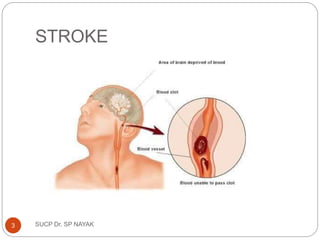
STROKE
SUCP Dr. SP NAYAK
3
RISK FACTORS:
LIFESTYLE RISK FACTORS: being
overweight or obese, physical inactivity, use of
illicit drugs like cocaine & methamphetamines,
high BP, cigarette smoking, diabetes, high
cholesterol.
OTHERS: Personal or family history
 AGE: 55 years or older
RACE: African-Americans have higher risk
GENDER- Men have higher risk.
SUCP Dr. SP NAYAK
4
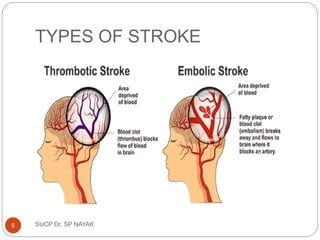
TYPES OF STROKE
SUCP Dr. SP NAYAK
5
TYPES OF STROKE
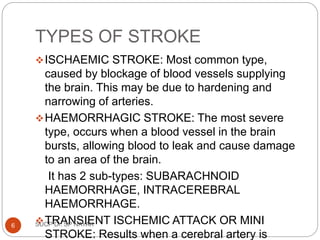
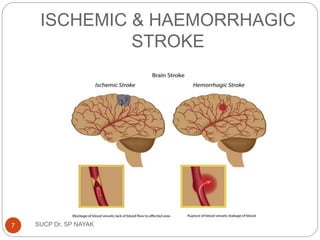
ISCHAEMIC STROKE: Most common type,
caused by blockage of blood vessels supplying
the brain. This may be due to hardening and
narrowing of arteries.
HAEMORRHAGIC STROKE: The most severe
type, occurs when a blood vessel in the brain
bursts, allowing blood to leak and cause damage
to an area of the brain.
It has 2 sub-types: SUBARACHNOID
HAEMORRHAGE, INTRACEREBRAL
HAEMORRHAGE.
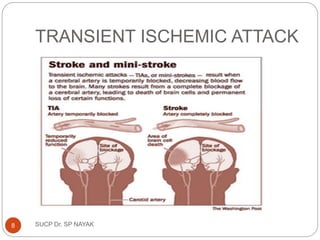
TRANSIENT ISCHEMIC ATTACK OR MINI
STROKE: Results when a cerebral artery is
SUCP Dr. SP NAYAK
6
ISCHEMIC & HAEMORRHAGIC
STROKE
SUCP Dr. SP NAYAK
7
TRANSIENT ISCHEMIC ATTACK
SUCP Dr. SP NAYAK
8
PATHOPHYSIOLOGY
 ISCHEMIC STROKE: Are due to an
interruption in the blood supply to certain
areas of brain which leads to Ischemia,
infarction & eventual necrosis of tissue.
Ischemic stroke is further divided into focal &
global stroke.
• HAEMORRHAGIC STROKE: Are due to
rupture of a blood vessel leading to
compression of brain tissue from an
expanding haematoma. In addition, the
pressure may lead to a loss of blood supply to
affected tissue with resulting infarction.
SUCP Dr. SP NAYAK
9
INTRACEREBRAL
HAEMORRHAGE
 It is the accumulation of blood anywhere in
the brain.
 This will form gradually enlarging haematoma.
 Intra-cerebral haemorrhages can be caused
by local vessel abnormalities (Hypertension ,
Vasculitis ) or Systemic factors (drugs,
trauma, tumours & sickle cell anaemia)
 Haemorrhaging directly damages brain tissue
& raises intracranial pressure giving
headaches, vomiting, nausea and eventually
coma and death.
SUCP Dr. SP NAYAK
10
SUBARACHNOID
HAEMORRHAGE
 It is the gradual collection of blood in the
subarachnoid space of the Dura.
 These can be traumatic or spontaneous.
Spontaneous haemorrhages occur through
saccular aneurysms and through extensions
of intracranial haemorrhaging or due to similar
causes.
 Approximately 1/3rd of those who suffers
subarachnoid haemorrhage die.
SUCP Dr. SP NAYAK
11
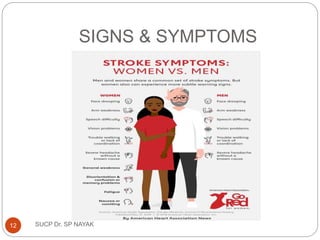
SIGNS & SYMPTOMS
SUCP Dr. SP NAYAK
12
CLINICAL PRESENTATION
 Patients may be unable to provide a reliable
history because of neurologic deficits.
 SYMPTOMS include unilateral weakness,
inability to speak, loss of vision, vertigo, or
falling.
 ISCHEMIC stroke is not usually painful, but
headache may occur in HAEMORRHAGIC
stroke.
 Patients with posterior circulation involvement
may have vertigo and diplopia.
 Anterior circulation strokes may commonly
result in aphasia.
SUCP Dr. SP NAYAK
13
COMPLICATIONS
Paralysis or loss of muscle movement
Difficulty in talking and swallowing
Memory loss or thinking difficulties
Pain
Changes in behaviour and self-care.
SUCP Dr. SP NAYAK
14
DIAGNOSIS
 Laboratory tests for hyper-coagulable states
should be done only when the cause cannot be
determined based on presence of risk factors.
 Computed Tomography (CT) & Magnetic
resonance imaging (MRI) head scans can
reveal areas of haemorrhage and infarction.
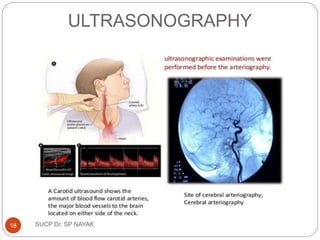
 Carotid Doppler (CD), Electrocardiogram
(ECG), Trans-thoracic Echocardiogram(TTE),
studies can provide valuable diagnostic
information.
SUCP Dr. SP NAYAK
15
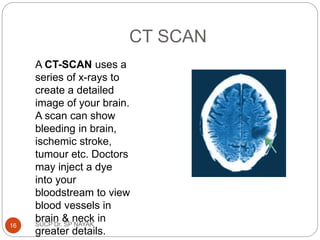
CT SCAN
A CT-SCAN uses a
series of x-rays to
create a detailed
image of your brain.
A scan can show
bleeding in brain,
ischemic stroke,
tumour etc. Doctors
may inject a dye
into your
bloodstream to view
blood vessels in
brain & neck in
greater details.
SUCP Dr. SP NAYAK
16
MRI SCAN
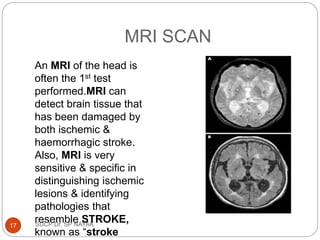
An MRI of the head is
often the 1st test
performed.MRI can
detect brain tissue that
has been damaged by
both ischemic &
haemorrhagic stroke.
Also, MRI is very
sensitive & specific in
distinguishing ischemic
lesions & identifying
pathologies that
resemble STROKE,
known as “stroke
SUCP Dr. SP NAYAK
17
ULTRASONOGRAPHY
SUCP Dr. SP NAYAK
18
TREATMENT
 GOALS OF TREATMENT: The goals are
1. Reduce ongoing neurologic injury and
decrease mortality and long term disability.
2. Prevent complications secondary to
immobility and neurologic dysfunction.
3. Prevent stroke recurrence.
SUCP Dr. SP NAYAK
19
NONPHARMACOLOGIC
THERAPY
 Acute Ischemic stroke: Endovascular
thrombectomy with a stent retriever improves
outcomes in select patients with proximal
large artery occlusion.
 Haemorrhagic stroke: In SAH from ruptured
intracranial aneurysm, surgical intervention to
clip or ablate the vascular abnormality
reduces mortality from re-bleeding. After
primary intra-cerebral haemorrhage, surgical
evacuation may be beneficial in some
situation.
SUCP Dr. SP NAYAK
20
PHARMACOLOGIC THERAPY
 FOR ISCHEMIC STROKE:
ANTICOAGULANT DRUGS: They are also called
as blood thinners. This medicine group keeps
clots from forming in the blood.
Example: low molecular weight heparin or un-
fractionated heparin(5000 units 3 times daily)
ANTIPLATELET DRUGS: These drugs interact
with platelets to prevent blood clots from forming.
Example: Aspirin in the dose of 160-325 mg/day
started between 24-48 hrs after completion of
alteplase reduces long term death & disability.
SUCP Dr. SP NAYAK
21
PHARMACOLOGIC THERAPY
THROMBOLYTICS: They are used in stroke
caused by a clot in blood vessel.
Thrombolytics break apart clots and restore
blood flow.
Example: Alteplase (tissue plasminogen
activator) is initiated within 4.5 hours of
symptom onset reduces disability from
ischemic stroke.
STATINS: patients experiencing ischemic
stroke & who have low density lipoprotein
cholesterol above100mg/dl should be treated
with high intensity statin therapy for secndary
SUCP Dr. SP NAYAK
22
PHARMACOLOGIC THERAY
 FOR HAEMORRHAGIC STROKE:
o There are no standard strategies for treating
intra-cerebral haemorrhage.
o All patients with warfarin-associated ICH
should receive intravenous vitamin k therapy .
o The calcium channel blocker nimodipine
60mg every 4 hours for 21 days, along with
maintenance of intravascular volume with
presssor therapy is recommended to reduce
the incidence & severity of neurologic deficits.
SUCP Dr. SP NAYAK
23
PATIENT COUNCELLING
 Family members help the person regain lost
skills by encouraging them to use the affected
arm or leg, helping them with their speech or
teaching them how to do tasks which may
have been forgotten, such as combing their
hair using a comb or using a cup, knife and
fork.
SUCP Dr. SP NAYAK
24
PREVENTION
Take your high blood pressure medicine
regularly.
Do not smoke or drink too much of alcohol.
If you have atrial fibrillation (irregular or fast
heart beat) you may need to take anti-
thrombotic medicines.
Keep your blood cholesterol level in a normal
range. Eat food low in fats to decrease the
risk of developing plaque (fatty deposits) in
your blood vessels.
Monitor and control your blood sugar level if
you have diabetes.
SUCP Dr. SP NAYAK
25
THANK YOU
SUCP Dr. SP NAYAK
26

Stroke presentation By Saba Arif

  • 1.
    NAME: SABA ARIF PHARMD,SUCP, HYD GUIDED BY: SRINIVAS NAYAK SIR SULTAN UL ULOOM COLLEGE OF PHARMACY PRESENTATION ON STROKE
  • 2.
    DEFINITION  A strokeoccurs when the blood supply to part of your brain is interrupted or severely reduced, depriving brain tissue of oxygen and food. • Within minutes, brain cells begin to die. • Stroke can be either ischemic or hemorrhagic. SUCP Dr. SP NAYAK 2
  • 3.
  • 4.
    RISK FACTORS: LIFESTYLE RISKFACTORS: being overweight or obese, physical inactivity, use of illicit drugs like cocaine & methamphetamines, high BP, cigarette smoking, diabetes, high cholesterol. OTHERS: Personal or family history  AGE: 55 years or older RACE: African-Americans have higher risk GENDER- Men have higher risk. SUCP Dr. SP NAYAK 4
  • 5.
    TYPES OF STROKE SUCPDr. SP NAYAK 5
  • 6.
    TYPES OF STROKE ISCHAEMICSTROKE: Most common type, caused by blockage of blood vessels supplying the brain. This may be due to hardening and narrowing of arteries. HAEMORRHAGIC STROKE: The most severe type, occurs when a blood vessel in the brain bursts, allowing blood to leak and cause damage to an area of the brain. It has 2 sub-types: SUBARACHNOID HAEMORRHAGE, INTRACEREBRAL HAEMORRHAGE. TRANSIENT ISCHEMIC ATTACK OR MINI STROKE: Results when a cerebral artery is SUCP Dr. SP NAYAK 6
  • 7.
  • 8.
  • 9.
    PATHOPHYSIOLOGY  ISCHEMIC STROKE:Are due to an interruption in the blood supply to certain areas of brain which leads to Ischemia, infarction & eventual necrosis of tissue. Ischemic stroke is further divided into focal & global stroke. • HAEMORRHAGIC STROKE: Are due to rupture of a blood vessel leading to compression of brain tissue from an expanding haematoma. In addition, the pressure may lead to a loss of blood supply to affected tissue with resulting infarction. SUCP Dr. SP NAYAK 9
  • 10.
    INTRACEREBRAL HAEMORRHAGE  It isthe accumulation of blood anywhere in the brain.  This will form gradually enlarging haematoma.  Intra-cerebral haemorrhages can be caused by local vessel abnormalities (Hypertension , Vasculitis ) or Systemic factors (drugs, trauma, tumours & sickle cell anaemia)  Haemorrhaging directly damages brain tissue & raises intracranial pressure giving headaches, vomiting, nausea and eventually coma and death. SUCP Dr. SP NAYAK 10
  • 11.
    SUBARACHNOID HAEMORRHAGE  It isthe gradual collection of blood in the subarachnoid space of the Dura.  These can be traumatic or spontaneous. Spontaneous haemorrhages occur through saccular aneurysms and through extensions of intracranial haemorrhaging or due to similar causes.  Approximately 1/3rd of those who suffers subarachnoid haemorrhage die. SUCP Dr. SP NAYAK 11
  • 12.
    SIGNS & SYMPTOMS SUCPDr. SP NAYAK 12
  • 13.
    CLINICAL PRESENTATION  Patientsmay be unable to provide a reliable history because of neurologic deficits.  SYMPTOMS include unilateral weakness, inability to speak, loss of vision, vertigo, or falling.  ISCHEMIC stroke is not usually painful, but headache may occur in HAEMORRHAGIC stroke.  Patients with posterior circulation involvement may have vertigo and diplopia.  Anterior circulation strokes may commonly result in aphasia. SUCP Dr. SP NAYAK 13
  • 14.
    COMPLICATIONS Paralysis or lossof muscle movement Difficulty in talking and swallowing Memory loss or thinking difficulties Pain Changes in behaviour and self-care. SUCP Dr. SP NAYAK 14
  • 15.
    DIAGNOSIS  Laboratory testsfor hyper-coagulable states should be done only when the cause cannot be determined based on presence of risk factors.  Computed Tomography (CT) & Magnetic resonance imaging (MRI) head scans can reveal areas of haemorrhage and infarction.  Carotid Doppler (CD), Electrocardiogram (ECG), Trans-thoracic Echocardiogram(TTE), studies can provide valuable diagnostic information. SUCP Dr. SP NAYAK 15
  • 16.
    CT SCAN A CT-SCANuses a series of x-rays to create a detailed image of your brain. A scan can show bleeding in brain, ischemic stroke, tumour etc. Doctors may inject a dye into your bloodstream to view blood vessels in brain & neck in greater details. SUCP Dr. SP NAYAK 16
  • 17.
    MRI SCAN An MRIof the head is often the 1st test performed.MRI can detect brain tissue that has been damaged by both ischemic & haemorrhagic stroke. Also, MRI is very sensitive & specific in distinguishing ischemic lesions & identifying pathologies that resemble STROKE, known as “stroke SUCP Dr. SP NAYAK 17
  • 18.
  • 19.
    TREATMENT  GOALS OFTREATMENT: The goals are 1. Reduce ongoing neurologic injury and decrease mortality and long term disability. 2. Prevent complications secondary to immobility and neurologic dysfunction. 3. Prevent stroke recurrence. SUCP Dr. SP NAYAK 19
  • 20.
    NONPHARMACOLOGIC THERAPY  Acute Ischemicstroke: Endovascular thrombectomy with a stent retriever improves outcomes in select patients with proximal large artery occlusion.  Haemorrhagic stroke: In SAH from ruptured intracranial aneurysm, surgical intervention to clip or ablate the vascular abnormality reduces mortality from re-bleeding. After primary intra-cerebral haemorrhage, surgical evacuation may be beneficial in some situation. SUCP Dr. SP NAYAK 20
  • 21.
    PHARMACOLOGIC THERAPY  FORISCHEMIC STROKE: ANTICOAGULANT DRUGS: They are also called as blood thinners. This medicine group keeps clots from forming in the blood. Example: low molecular weight heparin or un- fractionated heparin(5000 units 3 times daily) ANTIPLATELET DRUGS: These drugs interact with platelets to prevent blood clots from forming. Example: Aspirin in the dose of 160-325 mg/day started between 24-48 hrs after completion of alteplase reduces long term death & disability. SUCP Dr. SP NAYAK 21
  • 22.
    PHARMACOLOGIC THERAPY THROMBOLYTICS: Theyare used in stroke caused by a clot in blood vessel. Thrombolytics break apart clots and restore blood flow. Example: Alteplase (tissue plasminogen activator) is initiated within 4.5 hours of symptom onset reduces disability from ischemic stroke. STATINS: patients experiencing ischemic stroke & who have low density lipoprotein cholesterol above100mg/dl should be treated with high intensity statin therapy for secndary SUCP Dr. SP NAYAK 22
  • 23.
    PHARMACOLOGIC THERAY  FORHAEMORRHAGIC STROKE: o There are no standard strategies for treating intra-cerebral haemorrhage. o All patients with warfarin-associated ICH should receive intravenous vitamin k therapy . o The calcium channel blocker nimodipine 60mg every 4 hours for 21 days, along with maintenance of intravascular volume with presssor therapy is recommended to reduce the incidence & severity of neurologic deficits. SUCP Dr. SP NAYAK 23
  • 24.
    PATIENT COUNCELLING  Familymembers help the person regain lost skills by encouraging them to use the affected arm or leg, helping them with their speech or teaching them how to do tasks which may have been forgotten, such as combing their hair using a comb or using a cup, knife and fork. SUCP Dr. SP NAYAK 24
  • 25.
    PREVENTION Take your highblood pressure medicine regularly. Do not smoke or drink too much of alcohol. If you have atrial fibrillation (irregular or fast heart beat) you may need to take anti- thrombotic medicines. Keep your blood cholesterol level in a normal range. Eat food low in fats to decrease the risk of developing plaque (fatty deposits) in your blood vessels. Monitor and control your blood sugar level if you have diabetes. SUCP Dr. SP NAYAK 25
  • 26.
    THANK YOU SUCP Dr.SP NAYAK 26