By- Payal Chhabra
}    Stress is defined as an adaptive response to
      an external situation that results in physical,
      psychological and/or behavioral deviations
      for organizational participants.

}    Stress is the body’s general response to
      environmental situations.
1.    Stress is a neutral word- Stress itself is
      not bad in itself.
        Ø  Distress
        Ø  Eustress


2.    Stress is associated with constrain & Demand-
              Ø  Constrain prevents individual from doing what he or
                  she desires.
              Ø  Demands refer to the loss of something desired.
3. Two conditions are necessary for potential
 stress to become actual stress-
      i.     Uncertainty over the outcome,&
      ii.    Outcome must be important.
4.Stress is not simply anxiety –Stress may be
 accompanied by anxiety, but two are not
 synonymous.
 Ø  Anxiety is psychological & emotional whereas
   stress operates in the physiological sphere also
   along with psychological sphere.
5. Stress is not necessarily damaging, bad or to
 be avoided.
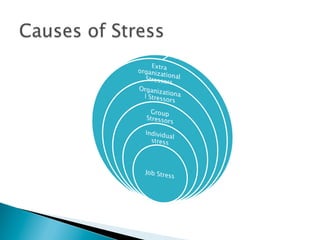
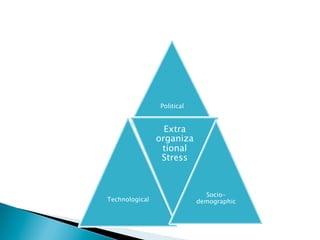
Political


                  Extra
                organiza
                 tional
                 Stress


                              Socio-
Technological               demographic
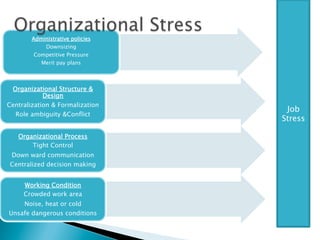
Administrative policies
            Downsizing
         Competitive Pressure
           Merit pay plans


 Organizational Structure &
            Design
Centralization & Formalization
                                   Job
  Role ambiguity &Conflict
                                  Stress

   Organizational Process
       Tight Control
Down ward communication
Centralized decision making


     Working Condition
     Crowded work area
    Noise, heat or cold
Unsafe dangerous conditions
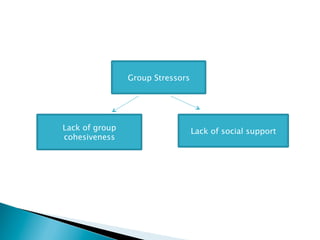
Group Stressors


Lack of group                     Lack of social support
cohesiveness
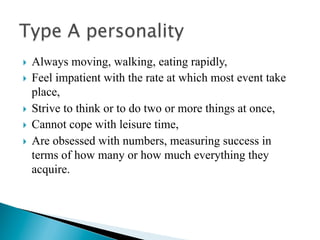
}  Always moving, walking, eating rapidly,
}  Feel impatient with the rate at which most event take
    place,
}  Strive to think or to do two or more things at once,
}  Cannot cope with leisure time,

}  Are obsessed with numbers, measuring success in
    terms of how many or how much everything they
    acquire.
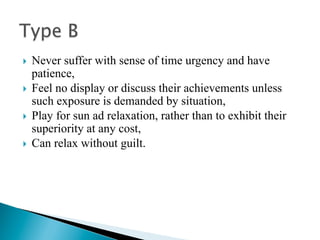
}  Never suffer with sense of time urgency and have
    patience,
}  Feel no display or discuss their achievements unless
    such exposure is demanded by situation,
}  Play for sun ad relaxation, rather than to exhibit their
    superiority at any cost,
}  Can relax without guilt.
}  Type A can operate under moderate to high level stress
}  They like time pressure working,
}  They are fast workers and believe in quantity over
    quality,
}  They are rarely creative,
}  They are more likely to be selected in an interview due
    to their attitude, competence, aggressiveness, success
    desires etc.
}  Role overload.
}  Role conflict.
}  Inter role conflict.

}  Task characteristics.
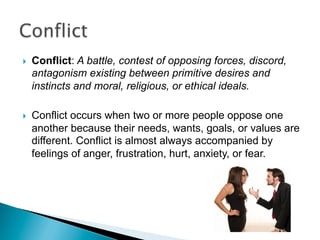
}    Conflict: A battle, contest of opposing forces, discord,
      antagonism existing between primitive desires and
      instincts and moral, religious, or ethical ideals.

}    Conflict occurs when two or more people oppose one
      another because their needs, wants, goals, or values are
      different. Conflict is almost always accompanied by
      feelings of anger, frustration, hurt, anxiety, or fear.
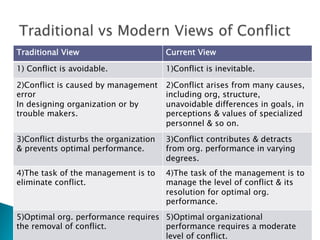
Traditional View                       Current View

1) Conflict is avoidable.              1)Conflict is inevitable.

2)Conflict is caused by management     2)Conflict arises from many causes,
error                                  including org, structure,
In designing organization or by        unavoidable differences in goals, in
trouble makers.                        perceptions & values of specialized
                                       personnel & so on.
3)Conflict disturbs the organization   3)Conflict contributes & detracts
& prevents optimal performance.        from org. performance in varying
                                       degrees.
4)The task of the management is to     4)The task of the management is to
eliminate conflict.                    manage the level of conflict & its
                                       resolution for optimal org.
                                       performance.
5)Optimal org. performance requires 5)Optimal organizational
the removal of conflict.            performance requires a moderate
                                    level of conflict.
}  Intrapersonal Conflict
}  Interpersonal Conflict
}  Organizational Conflict

}  Constructive Conflict
}  Destructive Conflict
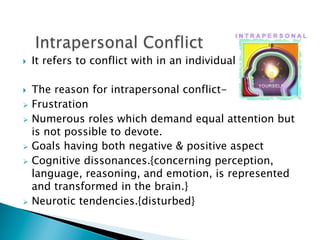
}    It refers to conflict with in an individual.

}  The reason for intrapersonal conflict-
Ø  Frustration

Ø  Numerous roles which demand equal attention but
    is not possible to devote.
Ø  Goals having both negative & positive aspect

Ø  Cognitive dissonances.{concerning perception,
    language, reasoning, and emotion, is represented
    and transformed in the brain.}
Ø  Neurotic tendencies.{disturbed}
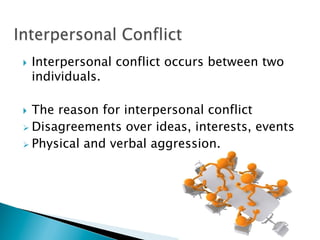
}    Interpersonal conflict occurs between two
      individuals.

}  The reason for interpersonal conflict
Ø  Disagreements over ideas, interests, events
Ø  Physical and verbal aggression.
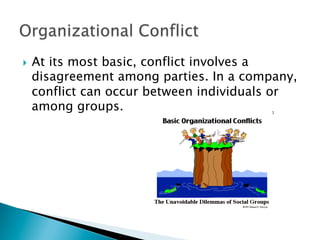
}    At its most basic, conflict involves a
      disagreement among parties. In a company,
      conflict can occur between individuals or
      among groups.
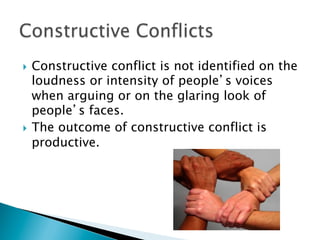
}  Constructive conflict is not identified on the
    loudness or intensity of people’s voices
    when arguing or on the glaring look of
    people’s faces.
}  The outcome of constructive conflict is
    productive.
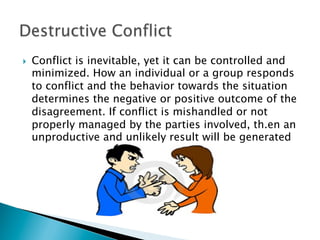
}    Conflict is inevitable, yet it can be controlled and
      minimized. How an individual or a group responds
      to conflict and the behavior towards the situation
      determines the negative or positive outcome of the
      disagreement. If conflict is mishandled or not
      properly managed by the parties involved, th.en an
      unproductive and unlikely result will be generated
}    Conflict management is the practice of
      identifying and handling conflict in a
      sensible, fair, and efficient manner. Conflict
      management requires such skills as effective
      communicating, problem solving, and
      negotiating with a focus on interests
}  Meditation
}  Cognitive restructuring
}  Muscle relaxation

}  Biofeedback
}  Time Mangement
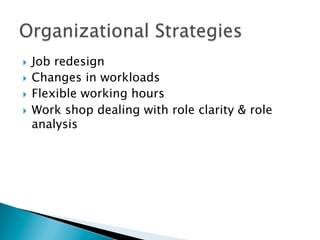
}  Job redesign
}  Changes in workloads
}  Flexible working hours

}  Work shop dealing with role clarity & role
    analysis
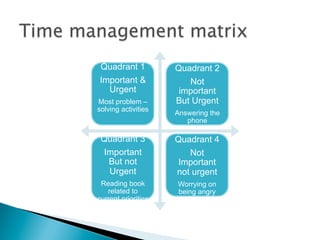
Quadrant 1           Quadrant 2
Important &             Not
  Urgent              important
Most problem –       But Urgent
solving activities
                     Answering the
                        phone

 Quadrant 3          Quadrant 4
  Important             Not
   But not            Important
   Urgent            not urgent
 Reading book        Worrying on
   related to        being angry
current priorities

Stress & conflict management

  • 1.
  • 2.
    }  Stress is defined as an adaptive response to an external situation that results in physical, psychological and/or behavioral deviations for organizational participants. }  Stress is the body’s general response to environmental situations.
  • 3.
    1.  Stress is a neutral word- Stress itself is not bad in itself. Ø  Distress Ø  Eustress 2.  Stress is associated with constrain & Demand- Ø  Constrain prevents individual from doing what he or she desires. Ø  Demands refer to the loss of something desired.
  • 4.
    3. Two conditionsare necessary for potential stress to become actual stress- i.  Uncertainty over the outcome,& ii.  Outcome must be important.
  • 5.
    4.Stress is notsimply anxiety –Stress may be accompanied by anxiety, but two are not synonymous. Ø  Anxiety is psychological & emotional whereas stress operates in the physiological sphere also along with psychological sphere.
  • 6.
    5. Stress isnot necessarily damaging, bad or to be avoided.
  • 8.
    Political Extra organiza tional Stress Socio- Technological demographic
  • 9.
    Administrative policies Downsizing Competitive Pressure Merit pay plans Organizational Structure & Design Centralization & Formalization Job Role ambiguity &Conflict Stress Organizational Process Tight Control Down ward communication Centralized decision making Working Condition Crowded work area Noise, heat or cold Unsafe dangerous conditions
  • 10.
    Group Stressors Lack ofgroup Lack of social support cohesiveness
  • 11.
    }  Always moving,walking, eating rapidly, }  Feel impatient with the rate at which most event take place, }  Strive to think or to do two or more things at once, }  Cannot cope with leisure time, }  Are obsessed with numbers, measuring success in terms of how many or how much everything they acquire.
  • 12.
    }  Never sufferwith sense of time urgency and have patience, }  Feel no display or discuss their achievements unless such exposure is demanded by situation, }  Play for sun ad relaxation, rather than to exhibit their superiority at any cost, }  Can relax without guilt.
  • 13.
    }  Type Acan operate under moderate to high level stress }  They like time pressure working, }  They are fast workers and believe in quantity over quality, }  They are rarely creative, }  They are more likely to be selected in an interview due to their attitude, competence, aggressiveness, success desires etc.
  • 14.
    }  Role overload. } Role conflict. }  Inter role conflict. }  Task characteristics.
  • 15.
    }  Conflict: A battle, contest of opposing forces, discord, antagonism existing between primitive desires and instincts and moral, religious, or ethical ideals. }  Conflict occurs when two or more people oppose one another because their needs, wants, goals, or values are different. Conflict is almost always accompanied by feelings of anger, frustration, hurt, anxiety, or fear.
  • 16.
    Traditional View Current View 1) Conflict is avoidable. 1)Conflict is inevitable. 2)Conflict is caused by management 2)Conflict arises from many causes, error including org, structure, In designing organization or by unavoidable differences in goals, in trouble makers. perceptions & values of specialized personnel & so on. 3)Conflict disturbs the organization 3)Conflict contributes & detracts & prevents optimal performance. from org. performance in varying degrees. 4)The task of the management is to 4)The task of the management is to eliminate conflict. manage the level of conflict & its resolution for optimal org. performance. 5)Optimal org. performance requires 5)Optimal organizational the removal of conflict. performance requires a moderate level of conflict.
  • 17.
    }  Intrapersonal Conflict } Interpersonal Conflict }  Organizational Conflict }  Constructive Conflict }  Destructive Conflict
  • 18.
    }  It refers to conflict with in an individual. }  The reason for intrapersonal conflict- Ø  Frustration Ø  Numerous roles which demand equal attention but is not possible to devote. Ø  Goals having both negative & positive aspect Ø  Cognitive dissonances.{concerning perception, language, reasoning, and emotion, is represented and transformed in the brain.} Ø  Neurotic tendencies.{disturbed}
  • 19.
    }  Interpersonal conflict occurs between two individuals. }  The reason for interpersonal conflict Ø  Disagreements over ideas, interests, events Ø  Physical and verbal aggression.
  • 20.
    }  At its most basic, conflict involves a disagreement among parties. In a company, conflict can occur between individuals or among groups.
  • 21.
    }  Constructive conflictis not identified on the loudness or intensity of people’s voices when arguing or on the glaring look of people’s faces. }  The outcome of constructive conflict is productive.
  • 22.
    }  Conflict is inevitable, yet it can be controlled and minimized. How an individual or a group responds to conflict and the behavior towards the situation determines the negative or positive outcome of the disagreement. If conflict is mishandled or not properly managed by the parties involved, th.en an unproductive and unlikely result will be generated
  • 23.
    }  Conflict management is the practice of identifying and handling conflict in a sensible, fair, and efficient manner. Conflict management requires such skills as effective communicating, problem solving, and negotiating with a focus on interests
  • 24.
    }  Meditation }  Cognitiverestructuring }  Muscle relaxation }  Biofeedback }  Time Mangement
  • 25.
    }  Job redesign } Changes in workloads }  Flexible working hours }  Work shop dealing with role clarity & role analysis
  • 26.
    Quadrant 1 Quadrant 2 Important & Not Urgent important Most problem – But Urgent solving activities Answering the phone Quadrant 3 Quadrant 4 Important Not But not Important Urgent not urgent Reading book Worrying on related to being angry current priorities