CSF STUDY
The cerebrospinal Fluid [CSF] is a clear, colourless
transparent fluid
Present in the cerebral ventricles, spinal canal,
and subarachnoid spaces.
What is CSF?
1. Largely formed by the choroid plexus of the lateral
ventricle
2. Third and fourth ventricles.
3. Small amount by ependymal cells lining the ventricles
and other brain capillaries.
CSF is a selective ultrafiltrate of plasma.
How CSF formed?
Rate of formation:
About 20 ml/hour ( 0.3 – 0.4 ml/min)
500 ml/day in adults. Turns over 3.7 times a day
Total quantity: 90 - 150 ml in adults
Physiology of CSF
Lateral ventricle
Foramen of Monroe
[Interventricular foramen]
Third ventricle:
Subarachnoid space of Brain and Spinal cord
Fourth ventricle:
Cerebral aqueduct
Foramen of magendie and
formen of Luschka
Circulation of CSF
 The arachnoid villi (walls into venous sinuses)
 Villi form arachnoid granulations protruding into
the sinuses.
Absorption of CSF
Nature :
Color - Clear, transparent fluid
Specific gravity - 1.004-1.007
Reaction - Alkaline and does not coagulate
Cells - Adults : 0-5 cells/cumm
Infants : 0-30 cells/cumm
1-4 years : 0-20 cells/cumm
5-18 years : 0-10 cells/cumm
Pressure - 60-180 mm of H2O (adult)
10-100 mm of H2O (newborn)
Characteristics of CSF
Composition of CSF
1. Infections: meningitis, encephalitis.
2. Inflammatory conditions: Sarcoidosis, Neurosyphilis, SLE.
3. Infiltrative conditions: Leukemia, lymphoma
4. Administration of drugs in CSF (Therapeutic aim):
 Antibiotics
 Anticancer drugs
 Anesthetic drugs
Indication of CSF examination
 A lumbar puncture also called a spinal tap (L3-L4)
 CSF leaks back through the needle and is collected in
three tubes. (1-microbiology, 2-Hematology, 3-
chemistry)
 Generally up to 6-7 ml can be taken from an adult, if
pressure is normal (50-180 mm H2O).
CSF Collection
 Post lumbar puncture headache
 Introduction of infection in the spinal canal
 Subdural hematoma
 Failure to obtain CSF (dry tap)
 Herniation of brain
 Subarachnoidal epidermal cyst
Complication of LP
Routine
 Gross examination
 Cell Counts +
Differential
 Glucose [60-70%
plasma]
 Protein [15 - 40
mg/dL]
When Indicated
•Cultures
•Stains [Gram, Acid
Fast]
•Cytology
•Electrophoresis
•VDRL
CSF Examinations
Normal CSF - crystal clear and colourless
Abnormal - cloudy, turbid, bloody, viscous, or
clotted.
A large number of cells can be present
without affecting the clarity.
CSF Examinations- Physical
1. Blood Mixed. (Pink-red)
2. Xanthochromic.
3. Thick Viscous.
4. Clot/ Cob web.
CSF Examinations – Physical (Appearence)
Xanthochromia
• Subarachnoid and intracerebral
hemorrhage.
• Traumatic tap.
• Jaundice.
• Elevated protein level (>150 mg/dl)
• Premature infants (with immature blood-
CSF barrier & elevated bilirubin.
• Hypercarotenemia.
• Meningeal malignant melanoma.
CSF finding Traumatic LP Subarachnoid HMG
Gross
appearance
Blood more in initial
tubes, clot on standing
Blood uniform in all
tubes, does not clot on
standing
Centrifugatio
n
Clear supernatant Pink or yellow
supernatent
Microscopy Progrresive decrease in
RBC count in later tubes
RBC count uniform in all
tubes
Traumatic LP VS SAH
Thick viscous CSF.
 Severe meningitis.
 Cryptococcal meningitis.
 Metastatic mucinous
adenocarcinoma.
CSF Examinations – Physical (Appearence)
Clot formation:(cob web)
 Increased proteins( >150 mg)
 Tuberculous meningitis.
 Spinal block
Differentiation on the basis of type of clot
•Delicate and fine clot - Tuberculous meningitis.
•Large clot - Purulent meningitis
•Complete and spontaneous clot – Spinal constriction.
CSF Examinations – Physical (Appearence)
0- 6 months - Group B streptococcus, E. coli.
Listeria monocytogens.
6months- 6 years –
Streptococcus pneumonia,
Neisseria meningitid
Haemophilus influenzae ty
6-60 years - Neisseria meningitidis,
Herpes simplex.
>60 years - Streptococcus pneumoniae ,
Listeria monocytogenes.
Meningitis (Age wise causative organisms)
0-6 months Group B streptococcus, E. coli,
Listeria monocytogens.
6 months to 6 years Streptococcus pneumonia,
Neisseria meningitidis,
Haemophilus influenzae type-b.
6 years – 60 years Neisseria meningitidis, Herpes
simplex.
>60 Years Streptococcus pneumoniae,
Listeria monocytogenes.
Meningitis (Age wise causative organisms)
• Cell counts (0-5 cells/ml, mostly
lymphocytes)
oTotal – Leukocyte, RBC
oDifferential
• Cytology
http://www.neuropat.dote.hu/jpeg/liquor/kmcarc1.jpg
CSF Examination- Microscopic
Calculation: Number of cells counted x 10
9
Causes of increased cell count
Meningitis.
Intracranial hemorrhage.
Meningeal infiltration by malignancy.
Multiple sclerosis.
CSF Examination- Microscopic
Predominant Neutrophils-
• Meningitis (bacterial, early viral ,early
tubercular and fungal.
• Sub arachnoid hemorrhage.
• Metastasis.
CSF Examination – Microscopic (Differential Count)
Predominant Lymphocytes-
• Meningitis (viral or tubercular)
• Incompletely treated bacterial meningitis.
• Toxoplasmosis and cysticercosis.
CSF Examination – Microscopic (Differential Count)
Predominant Eosinophils-
• Parasitic and fungal infections.
• Reaction to foreign material.
CSF Examination – Microscopic (Differential Count)
Mixed cell pattern-
• Tubercular meningitis.
• Chronic bacterial meningitis.
CSF Examination – Microscopic (Differential Count)
CSF Examination – Cells
PMNs, and Lymphocytes
Monocytes
Lymphocytes
Protein(15-45mg/dl)
 80% plasma derived
 20% intrathecal synthesis.
CSF Examination – Chemical analysis
False elevation of protein occurs if CSF is contaminated with
blood, this can be corrected by deducing 1 mg/ dl of protein for
every 1000 RBC’s.
Causes of raised CSF proteins -
 Lysis of contaminated blood from traumatic tap (each 1000
RBC/mm3 raise the CSF protein by 1mg/dl).
Increased Permeability of epithelial membrane (Blood Brain
Barrier)
• Meningitis (Bacterial and fungal)
• Cerebral Hemorrhages
Increased production by CNS tissue as in –
• Multiple Sclerosis,
• Neurosyphilis (Increased production of local immunoglobulin)
• Subacute sclerosing panencephalitis (SSPE)
• Guillain Barre syndrome.
 Obstruction as in cases of – Tumors or abscess.
CSF Examination – Chemistry
Glucose(45-80 mg/dl)
• Need to know plasma value (2/3rd
of plasma)
• Increased - Hyperglycemia and Traumatic tap
• Decreased
o Hypoglycemia
o Meningitis (bacterial, tuberculous &
fungal)
o Tumors(meningeal carcinomatous)
CSF glucose normal in viral meningitis.
CSF Examination – Chemical analysis
CSF glucose levels normalize before protein level and
cell counts during recovery from meningitis,
making it an useful parameter in assessing the
response to the treatment.
CSF Examination – Chemical analysis
1. Mononuclear cell pleocytosis.
2. Increased intrathecal production of IgG.
3. IgG index: ratio of IgG and albumin in the CSF to the ratio
of IgG and albumin in the serum.
4. Measurement of oligoclonal band.
5. Paired serum samples studied to exclude peripheral i.e.,
non CSF production of oligoclonal bands.
6. Pleocytosis of >75 cells /microlt.with presence of
neutrophils and protein >1 mg/dl excludes the diagnosis.
Multiple sclerosis
• Albumin – neither
synthesized, nor
metabolized in CNS.
• ALB used to address
blood-brain barrier
integrity
• Evaluate CSF/serum ALB
index
• Index < 9 = normal
• 9 – 14 minimal
impairment
• > 100 = not intact barrier
IgG sourced from inside
and outside.
CSF IgG index = ratio
IgGCSF/IgGserum X ALB
serum/ALBCSF
Reference range 0.3 –
0.7
> 0.7 = CNS sourced
< 0.3 = compromised
BBB
Albumin IgG
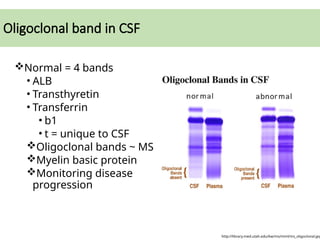
Normal = 4 bands
• ALB
• Transthyretin
• Transferrin
• b1
• t = unique to CSF
Oligoclonal bands ~ MS
Myelin basic protein
Monitoring disease
progression
http://library.med.utah.edu/kw/ms/mml/ms_oligoclonal.jpg
Oligoclonal band in CSF
1. Albumino cytological dissociation.
2. A sustained CSF pleocytosis suggestive of an alternative
diagnosis i.e., viral myelitis.
GBS
Direct wet mount- candida, crytococcus infection,
amoebic encephalitis.
Indian ink preparation- a drop of CSF and Indian ink is
placed on a slide and covered with cover slip and
observe it under 40x – crytococcus appears as
budding yeast surrounded by unstained capsule.
CSF – Analysis (Microbiological)
crytococcus
Gram’s Stain-
observe it under oil immersion.
•Streptococcus pneumococci – Diplococci, gram positive,
lying end to end.
•Neisseria meningitides - Diplococci gram negative, lying
side by side.
•Haemophilus influenza - coccobacilli gram negative
CSF – Analysis (Microbiological)
Ziehl- Neelsen stain:
AFB smears are negative in 70% of cases however
florescent auramine stain have better sensitivity.
Serologic test for Neurosyphilis :
Combination of VDRL test in CSF and FTA-ABS test in
serum is diagnostic.
CSF – Analysis (Microbiological)
CSF CULTURE- Gold standard
1. Appearance of bacteria on gram stained smears.
2. Increased proteins or cell count.
3. Inoculated on chocolate agar.
4. Sensitivity -90%.
PCR :- Viral infection of CNS.
Requires only a drop of CSF.
CSF – Analysis (Microbiological)- culture
•Multiplex PCR can be done
•Syndromic approach
•To diagnose bacterial, viral and fungal meningitis
CSF – Analysis (Microbiological)- PCR
Thank you

CSF Study - microbiology, microscopic examination

  • 1.
  • 2.
    The cerebrospinal Fluid[CSF] is a clear, colourless transparent fluid Present in the cerebral ventricles, spinal canal, and subarachnoid spaces. What is CSF?
  • 3.
    1. Largely formedby the choroid plexus of the lateral ventricle 2. Third and fourth ventricles. 3. Small amount by ependymal cells lining the ventricles and other brain capillaries. CSF is a selective ultrafiltrate of plasma. How CSF formed?
  • 4.
    Rate of formation: About20 ml/hour ( 0.3 – 0.4 ml/min) 500 ml/day in adults. Turns over 3.7 times a day Total quantity: 90 - 150 ml in adults Physiology of CSF
  • 5.
    Lateral ventricle Foramen ofMonroe [Interventricular foramen] Third ventricle: Subarachnoid space of Brain and Spinal cord Fourth ventricle: Cerebral aqueduct Foramen of magendie and formen of Luschka Circulation of CSF
  • 6.
     The arachnoidvilli (walls into venous sinuses)  Villi form arachnoid granulations protruding into the sinuses. Absorption of CSF
  • 7.
    Nature : Color -Clear, transparent fluid Specific gravity - 1.004-1.007 Reaction - Alkaline and does not coagulate Cells - Adults : 0-5 cells/cumm Infants : 0-30 cells/cumm 1-4 years : 0-20 cells/cumm 5-18 years : 0-10 cells/cumm Pressure - 60-180 mm of H2O (adult) 10-100 mm of H2O (newborn) Characteristics of CSF
  • 8.
  • 9.
    1. Infections: meningitis,encephalitis. 2. Inflammatory conditions: Sarcoidosis, Neurosyphilis, SLE. 3. Infiltrative conditions: Leukemia, lymphoma 4. Administration of drugs in CSF (Therapeutic aim):  Antibiotics  Anticancer drugs  Anesthetic drugs Indication of CSF examination
  • 10.
     A lumbarpuncture also called a spinal tap (L3-L4)  CSF leaks back through the needle and is collected in three tubes. (1-microbiology, 2-Hematology, 3- chemistry)  Generally up to 6-7 ml can be taken from an adult, if pressure is normal (50-180 mm H2O). CSF Collection
  • 11.
     Post lumbarpuncture headache  Introduction of infection in the spinal canal  Subdural hematoma  Failure to obtain CSF (dry tap)  Herniation of brain  Subarachnoidal epidermal cyst Complication of LP
  • 12.
    Routine  Gross examination Cell Counts + Differential  Glucose [60-70% plasma]  Protein [15 - 40 mg/dL] When Indicated •Cultures •Stains [Gram, Acid Fast] •Cytology •Electrophoresis •VDRL CSF Examinations
  • 13.
    Normal CSF -crystal clear and colourless Abnormal - cloudy, turbid, bloody, viscous, or clotted. A large number of cells can be present without affecting the clarity. CSF Examinations- Physical
  • 14.
    1. Blood Mixed.(Pink-red) 2. Xanthochromic. 3. Thick Viscous. 4. Clot/ Cob web. CSF Examinations – Physical (Appearence) Xanthochromia • Subarachnoid and intracerebral hemorrhage. • Traumatic tap. • Jaundice. • Elevated protein level (>150 mg/dl) • Premature infants (with immature blood- CSF barrier & elevated bilirubin. • Hypercarotenemia. • Meningeal malignant melanoma.
  • 15.
    CSF finding TraumaticLP Subarachnoid HMG Gross appearance Blood more in initial tubes, clot on standing Blood uniform in all tubes, does not clot on standing Centrifugatio n Clear supernatant Pink or yellow supernatent Microscopy Progrresive decrease in RBC count in later tubes RBC count uniform in all tubes Traumatic LP VS SAH
  • 16.
    Thick viscous CSF. Severe meningitis.  Cryptococcal meningitis.  Metastatic mucinous adenocarcinoma. CSF Examinations – Physical (Appearence) Clot formation:(cob web)  Increased proteins( >150 mg)  Tuberculous meningitis.  Spinal block
  • 17.
    Differentiation on thebasis of type of clot •Delicate and fine clot - Tuberculous meningitis. •Large clot - Purulent meningitis •Complete and spontaneous clot – Spinal constriction. CSF Examinations – Physical (Appearence)
  • 18.
    0- 6 months- Group B streptococcus, E. coli. Listeria monocytogens. 6months- 6 years – Streptococcus pneumonia, Neisseria meningitid Haemophilus influenzae ty 6-60 years - Neisseria meningitidis, Herpes simplex. >60 years - Streptococcus pneumoniae , Listeria monocytogenes. Meningitis (Age wise causative organisms)
  • 19.
    0-6 months GroupB streptococcus, E. coli, Listeria monocytogens. 6 months to 6 years Streptococcus pneumonia, Neisseria meningitidis, Haemophilus influenzae type-b. 6 years – 60 years Neisseria meningitidis, Herpes simplex. >60 Years Streptococcus pneumoniae, Listeria monocytogenes. Meningitis (Age wise causative organisms)
  • 21.
    • Cell counts(0-5 cells/ml, mostly lymphocytes) oTotal – Leukocyte, RBC oDifferential • Cytology http://www.neuropat.dote.hu/jpeg/liquor/kmcarc1.jpg CSF Examination- Microscopic Calculation: Number of cells counted x 10 9
  • 22.
    Causes of increasedcell count Meningitis. Intracranial hemorrhage. Meningeal infiltration by malignancy. Multiple sclerosis. CSF Examination- Microscopic
  • 23.
    Predominant Neutrophils- • Meningitis(bacterial, early viral ,early tubercular and fungal. • Sub arachnoid hemorrhage. • Metastasis. CSF Examination – Microscopic (Differential Count)
  • 24.
    Predominant Lymphocytes- • Meningitis(viral or tubercular) • Incompletely treated bacterial meningitis. • Toxoplasmosis and cysticercosis. CSF Examination – Microscopic (Differential Count)
  • 25.
    Predominant Eosinophils- • Parasiticand fungal infections. • Reaction to foreign material. CSF Examination – Microscopic (Differential Count)
  • 26.
    Mixed cell pattern- •Tubercular meningitis. • Chronic bacterial meningitis. CSF Examination – Microscopic (Differential Count)
  • 27.
    CSF Examination –Cells PMNs, and Lymphocytes Monocytes Lymphocytes
  • 28.
    Protein(15-45mg/dl)  80% plasmaderived  20% intrathecal synthesis. CSF Examination – Chemical analysis False elevation of protein occurs if CSF is contaminated with blood, this can be corrected by deducing 1 mg/ dl of protein for every 1000 RBC’s.
  • 29.
    Causes of raisedCSF proteins -  Lysis of contaminated blood from traumatic tap (each 1000 RBC/mm3 raise the CSF protein by 1mg/dl). Increased Permeability of epithelial membrane (Blood Brain Barrier) • Meningitis (Bacterial and fungal) • Cerebral Hemorrhages Increased production by CNS tissue as in – • Multiple Sclerosis, • Neurosyphilis (Increased production of local immunoglobulin) • Subacute sclerosing panencephalitis (SSPE) • Guillain Barre syndrome.  Obstruction as in cases of – Tumors or abscess. CSF Examination – Chemistry
  • 30.
    Glucose(45-80 mg/dl) • Needto know plasma value (2/3rd of plasma) • Increased - Hyperglycemia and Traumatic tap • Decreased o Hypoglycemia o Meningitis (bacterial, tuberculous & fungal) o Tumors(meningeal carcinomatous) CSF glucose normal in viral meningitis. CSF Examination – Chemical analysis
  • 31.
    CSF glucose levelsnormalize before protein level and cell counts during recovery from meningitis, making it an useful parameter in assessing the response to the treatment. CSF Examination – Chemical analysis
  • 32.
    1. Mononuclear cellpleocytosis. 2. Increased intrathecal production of IgG. 3. IgG index: ratio of IgG and albumin in the CSF to the ratio of IgG and albumin in the serum. 4. Measurement of oligoclonal band. 5. Paired serum samples studied to exclude peripheral i.e., non CSF production of oligoclonal bands. 6. Pleocytosis of >75 cells /microlt.with presence of neutrophils and protein >1 mg/dl excludes the diagnosis. Multiple sclerosis
  • 33.
    • Albumin –neither synthesized, nor metabolized in CNS. • ALB used to address blood-brain barrier integrity • Evaluate CSF/serum ALB index • Index < 9 = normal • 9 – 14 minimal impairment • > 100 = not intact barrier IgG sourced from inside and outside. CSF IgG index = ratio IgGCSF/IgGserum X ALB serum/ALBCSF Reference range 0.3 – 0.7 > 0.7 = CNS sourced < 0.3 = compromised BBB Albumin IgG
  • 34.
    Normal = 4bands • ALB • Transthyretin • Transferrin • b1 • t = unique to CSF Oligoclonal bands ~ MS Myelin basic protein Monitoring disease progression http://library.med.utah.edu/kw/ms/mml/ms_oligoclonal.jpg Oligoclonal band in CSF
  • 35.
    1. Albumino cytologicaldissociation. 2. A sustained CSF pleocytosis suggestive of an alternative diagnosis i.e., viral myelitis. GBS
  • 36.
    Direct wet mount-candida, crytococcus infection, amoebic encephalitis. Indian ink preparation- a drop of CSF and Indian ink is placed on a slide and covered with cover slip and observe it under 40x – crytococcus appears as budding yeast surrounded by unstained capsule. CSF – Analysis (Microbiological)
  • 37.
  • 38.
    Gram’s Stain- observe itunder oil immersion. •Streptococcus pneumococci – Diplococci, gram positive, lying end to end. •Neisseria meningitides - Diplococci gram negative, lying side by side. •Haemophilus influenza - coccobacilli gram negative CSF – Analysis (Microbiological)
  • 39.
    Ziehl- Neelsen stain: AFBsmears are negative in 70% of cases however florescent auramine stain have better sensitivity. Serologic test for Neurosyphilis : Combination of VDRL test in CSF and FTA-ABS test in serum is diagnostic. CSF – Analysis (Microbiological)
  • 40.
    CSF CULTURE- Goldstandard 1. Appearance of bacteria on gram stained smears. 2. Increased proteins or cell count. 3. Inoculated on chocolate agar. 4. Sensitivity -90%. PCR :- Viral infection of CNS. Requires only a drop of CSF. CSF – Analysis (Microbiological)- culture
  • 41.
    •Multiplex PCR canbe done •Syndromic approach •To diagnose bacterial, viral and fungal meningitis CSF – Analysis (Microbiological)- PCR
  • 43.