Building Resourcing Capability 2012
        Workforce Planning
              Grant Weinberg
     Director EMEA Talent Acquisition
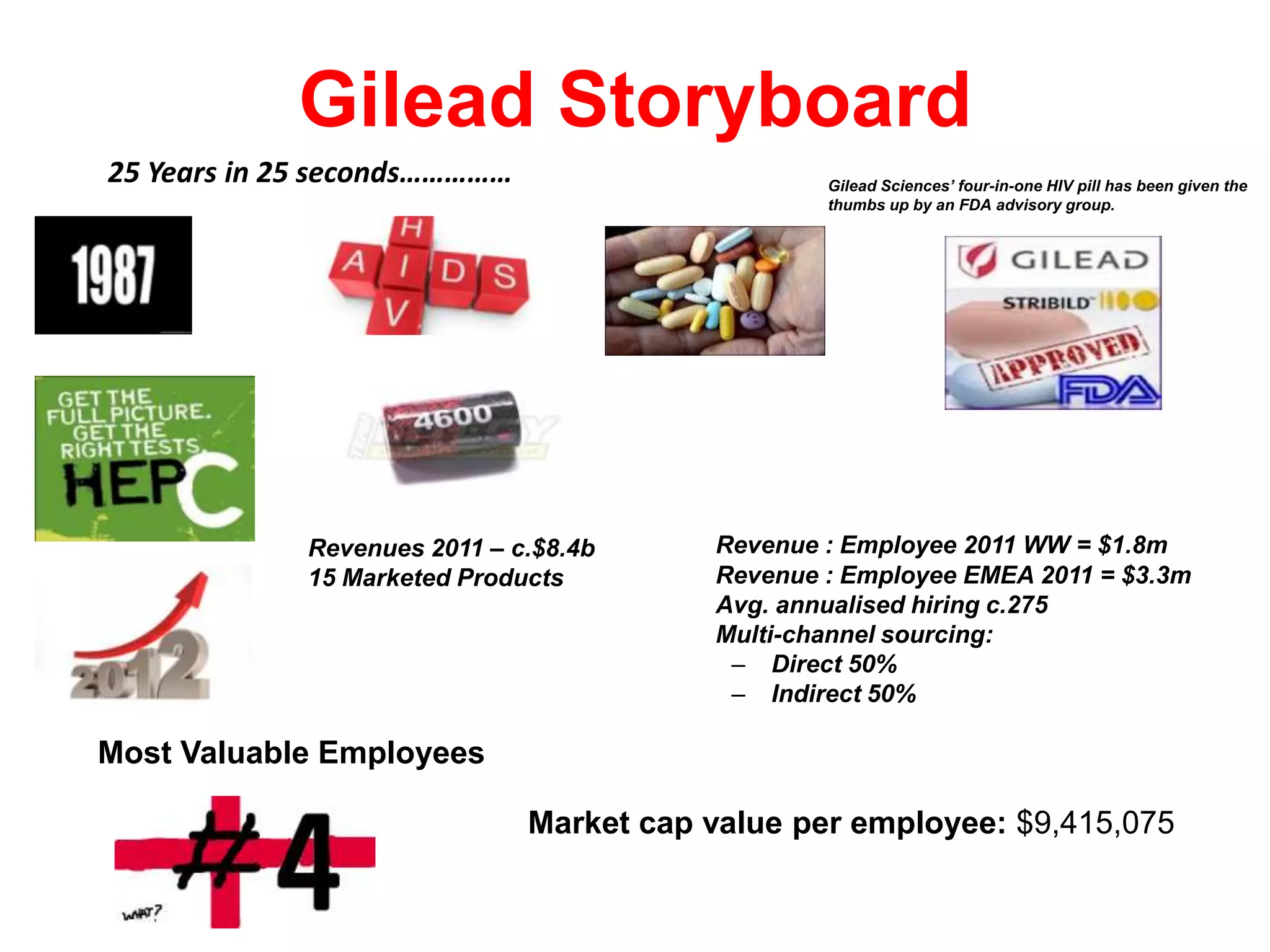
Gilead Storyboard
25 Years in 25 seconds……………                      Gilead Sciences’ four-in-one HIV pill has been given the
                                                 thumbs up by an FDA advisory group.


             Revenues 2011 – c.$8.4b     Revenue : Employee 2011 WW = $1.8m
             15 Marketed Products        Revenue : Employee EMEA 2011 = $3.3m
                                         Avg. annualised hiring c.275
                                         Multi-channel sourcing:
                                          – Direct 50%
                                          – Indirect 50%

Most Valuable Employees

                              Market cap value per employee: $9,415,075
How we used to plan Headcount…….
Evolution to Workforce Planning
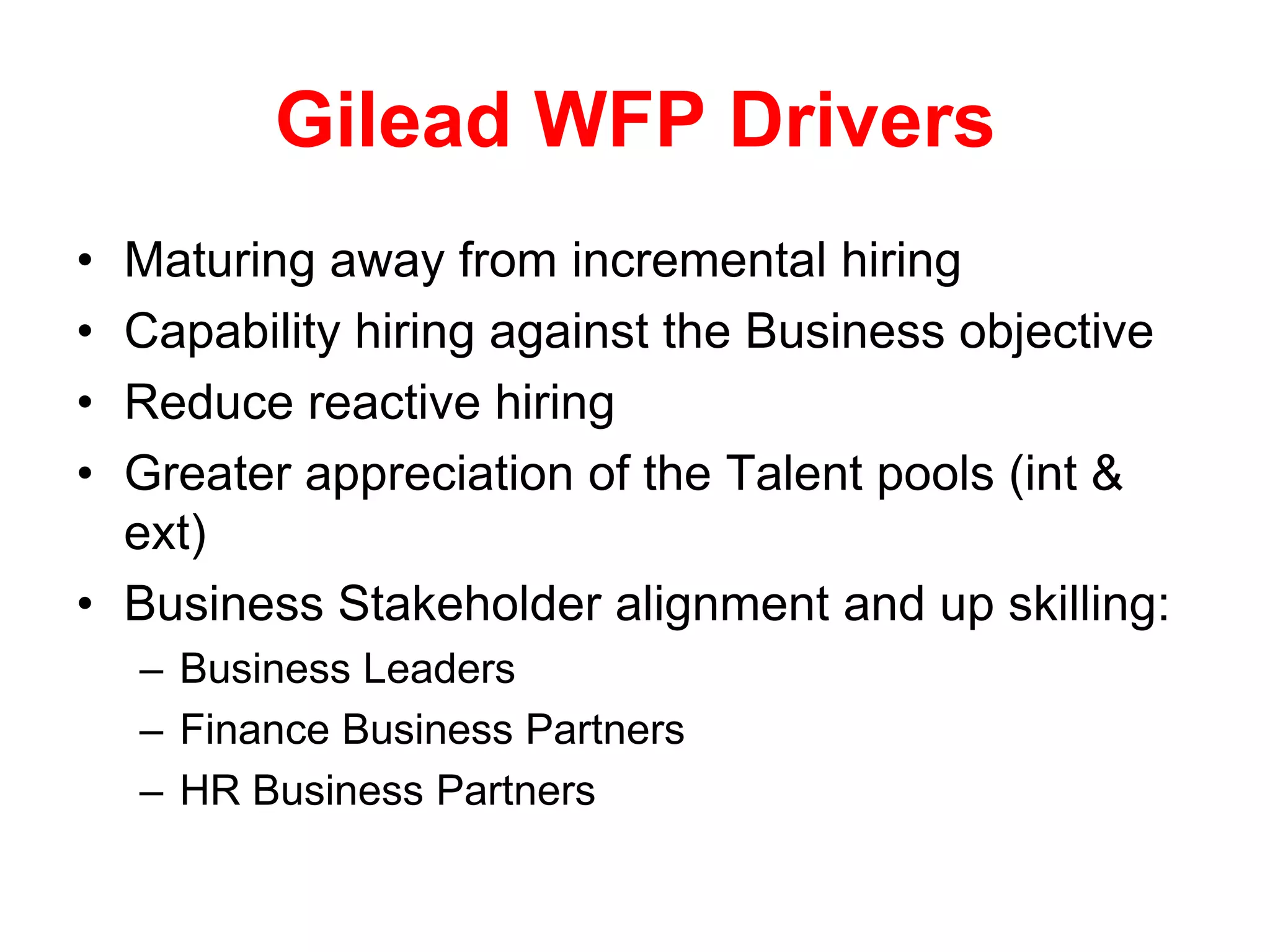
Gilead WFP Drivers
• Maturing away from incremental hiring
• Capability hiring against the Business objective
• Reduce reactive hiring
• Greater appreciation of the Talent pools (int &
  ext)
• Business Stakeholder alignment and up skilling:
    – Business Leaders
    – Finance Business Partners
    – HR Business Partners
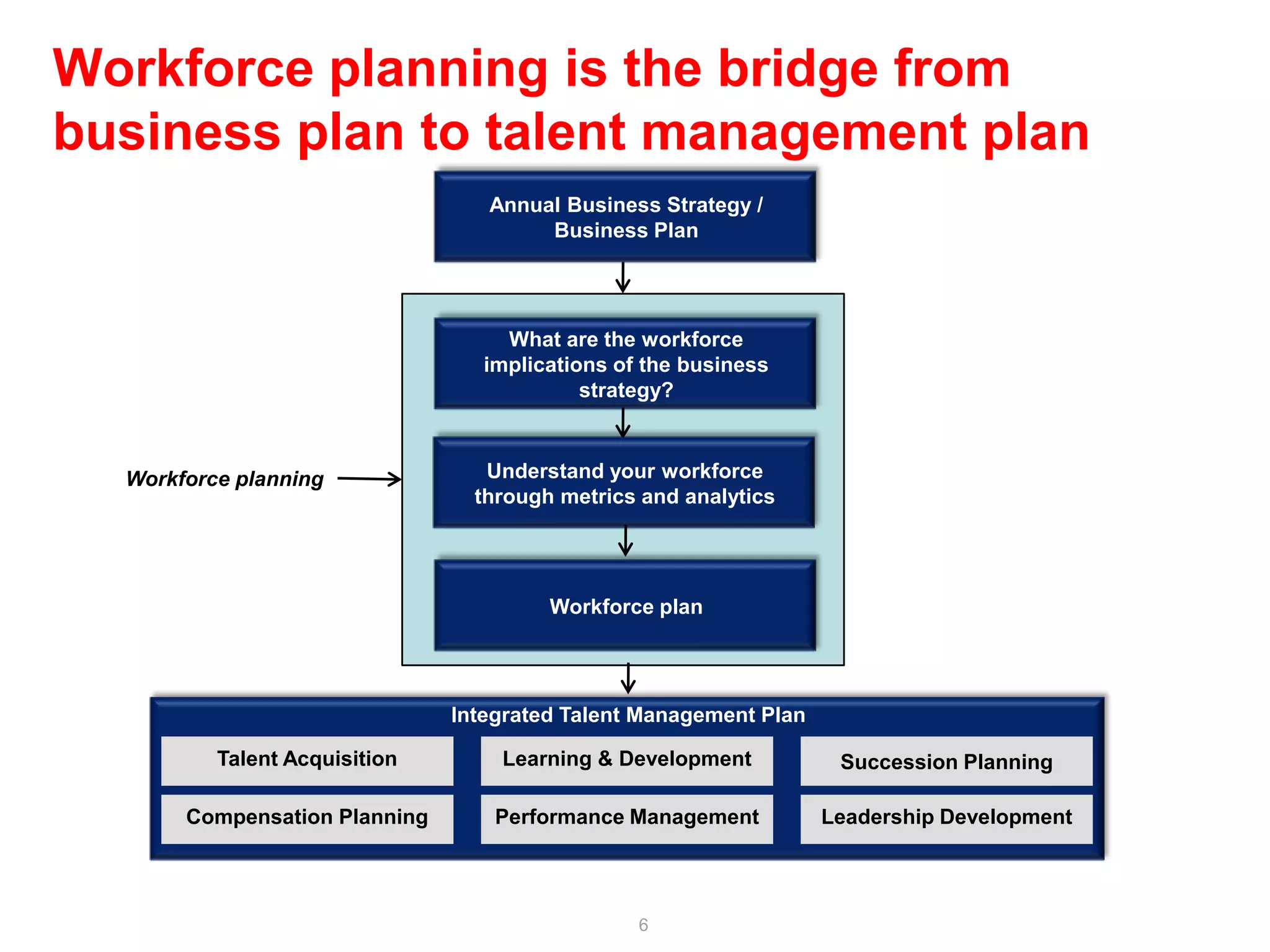
Workforce planning is the bridge from
business plan to talent management plan
                                  Annual Business Strategy /
                                       Business Plan


                                    What are the workforce
                                  implications of the business
                                            strategy?


  Workforce planning              Understand your workforce
                                 through metrics and analytics


                                        Workforce plan


                               Integrated Talent Management Plan

          Talent Acquisition       Learning & Development           Succession Planning

       Compensation Planning       Performance Management          Leadership Development


                                                 6
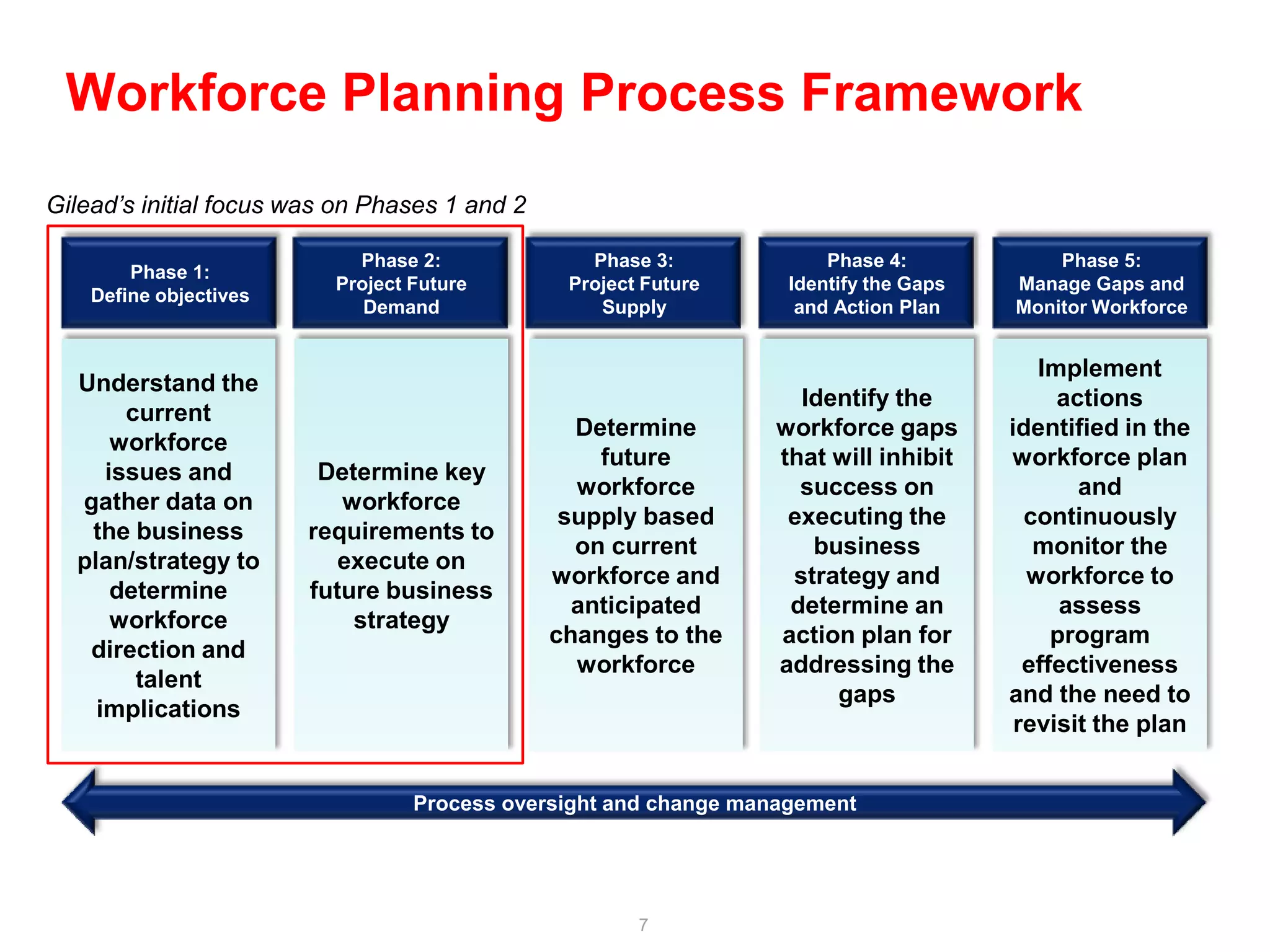
Workforce Planning Process Framework
Gilead’s initial focus was on Phases 1 and 2

                            Phase 2:              Phase 3:             Phase 4:            Phase 5:
        Phase 1:
                          Project Future        Project Future     Identify the Gaps   Manage Gaps and
    Define objectives
                             Demand                Supply           and Action Plan    Monitor Workforce


                                                                                          Implement
  Understand the
                                                                   Identify the             actions
       current
                                                 Determine       workforce gaps        identified in the
      workforce
                                                   future        that will inhibit     workforce plan
     issues and          Determine key
                                                 workforce         success on                 and
  gather data on           workforce
                                                supply based      executing the          continuously
   the business         requirements to
                                                 on current         business              monitor the
  plan/strategy to         execute on
                                               workforce and      strategy and           workforce to
      determine         future business
                                                 anticipated      determine an               assess
      workforce             strategy
                                               changes to the    action plan for            program
   direction and
                                                 workforce       addressing the          effectiveness
        talent
                                                                      gaps             and the need to
    implications
                                                                                        revisit the plan


                                  Process oversight and change management


                                                       7
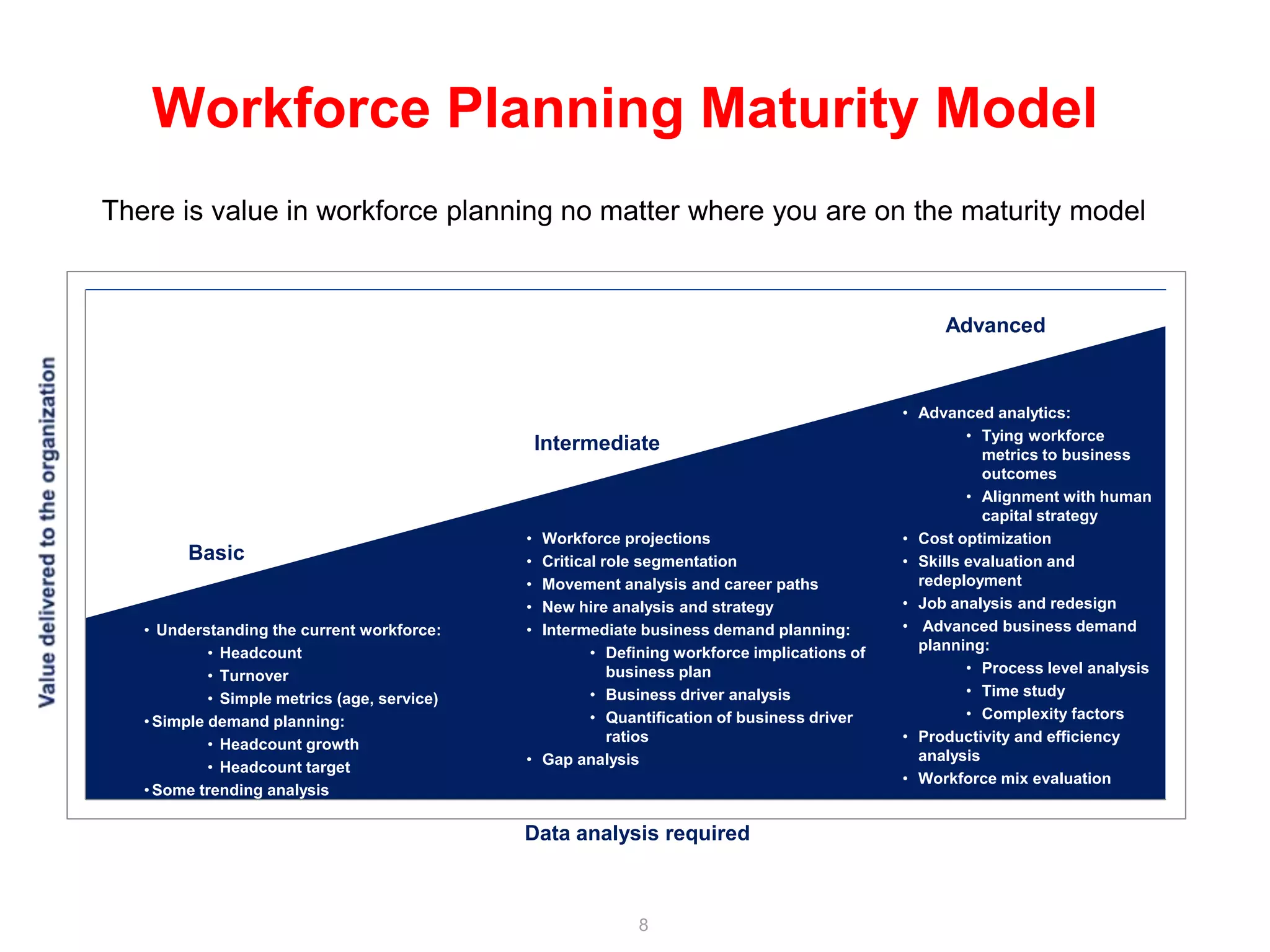
Workforce Planning Maturity Model
There is value in workforce planning no matter where you are on the maturity model


                                                                                                   Advanced


                                                                                              • Advanced analytics:
                                                                                                       • Tying workforce
                                                  Intermediate                                           metrics to business
                                                                                                         outcomes
                                                                                                       • Alignment with human
                                                                                                         capital strategy
                                              • Workforce projections                         • Cost optimization
        Basic                                 • Critical role segmentation                    • Skills evaluation and
                                              • Movement analysis and career paths              redeployment
                                              • New hire analysis and strategy                • Job analysis and redesign
   • Understanding the current workforce:     • Intermediate business demand planning:        • Advanced business demand
            • Headcount                                • Defining workforce implications of     planning:
            • Turnover                                    business plan                                • Process level analysis
            • Simple metrics (age, service)            • Business driver analysis                      • Time study
   • Simple demand planning:                           • Quantification of business driver             • Complexity factors
            • Headcount growth                            ratios                              • Productivity and efficiency
                                              • Gap analysis                                    analysis
            • Headcount target
                                                                                              • Workforce mix evaluation
   • Some trending analysis

                                              Data analysis required


                                                            8
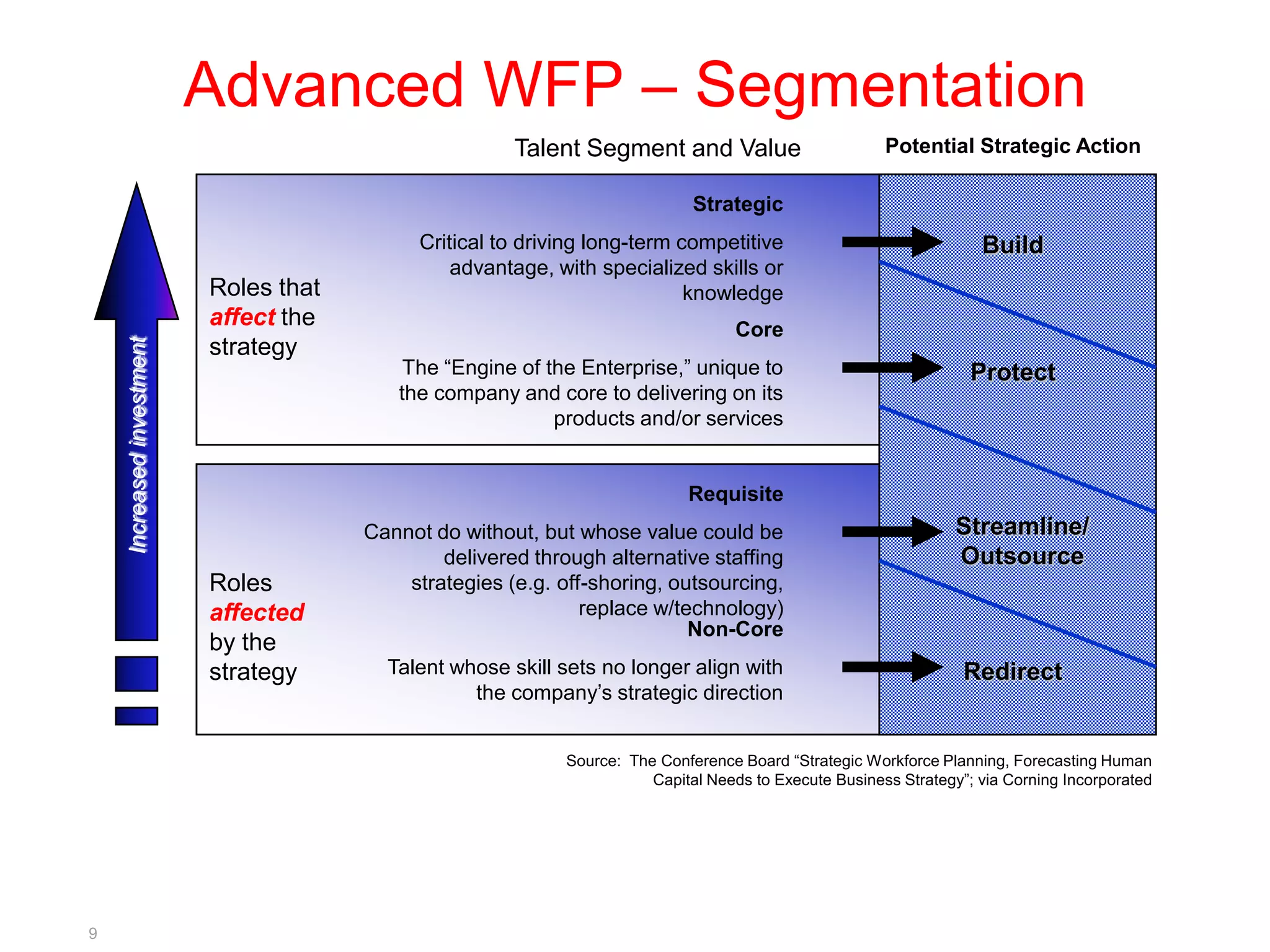
Advanced WFP – Segmentation
                                                        Talent Segment and Value                         Potential Strategic Action

                                                                               Strategic
                                              Critical to driving long-term competitive                               Build
                                                  advantage, with specialized skills or
                           Roles that                                        knowledge
                           affect the                                                Core
                           strategy
    Increased investment


                                            The “Engine of the Enterprise,” unique to                                Protect
                                           the company and core to delivering on its
                                                            products and/or services


                                                                              Requisite
                                        Cannot do without, but whose value could be                                Streamline/
                                                delivered through alternative staffing                             Outsource
                           Roles            strategies (e.g. off-shoring, outsourcing,
                           affected                             replace w/technology)
                                                                            Non-Core
                           by the
                           strategy       Talent whose skill sets no longer align with                              Redirect
                                                   the company’s strategic direction


                                                              Source: The Conference Board “Strategic Workforce Planning, Forecasting Human
                                                                         Capital Needs to Execute Business Strategy”; via Corning Incorporated


9
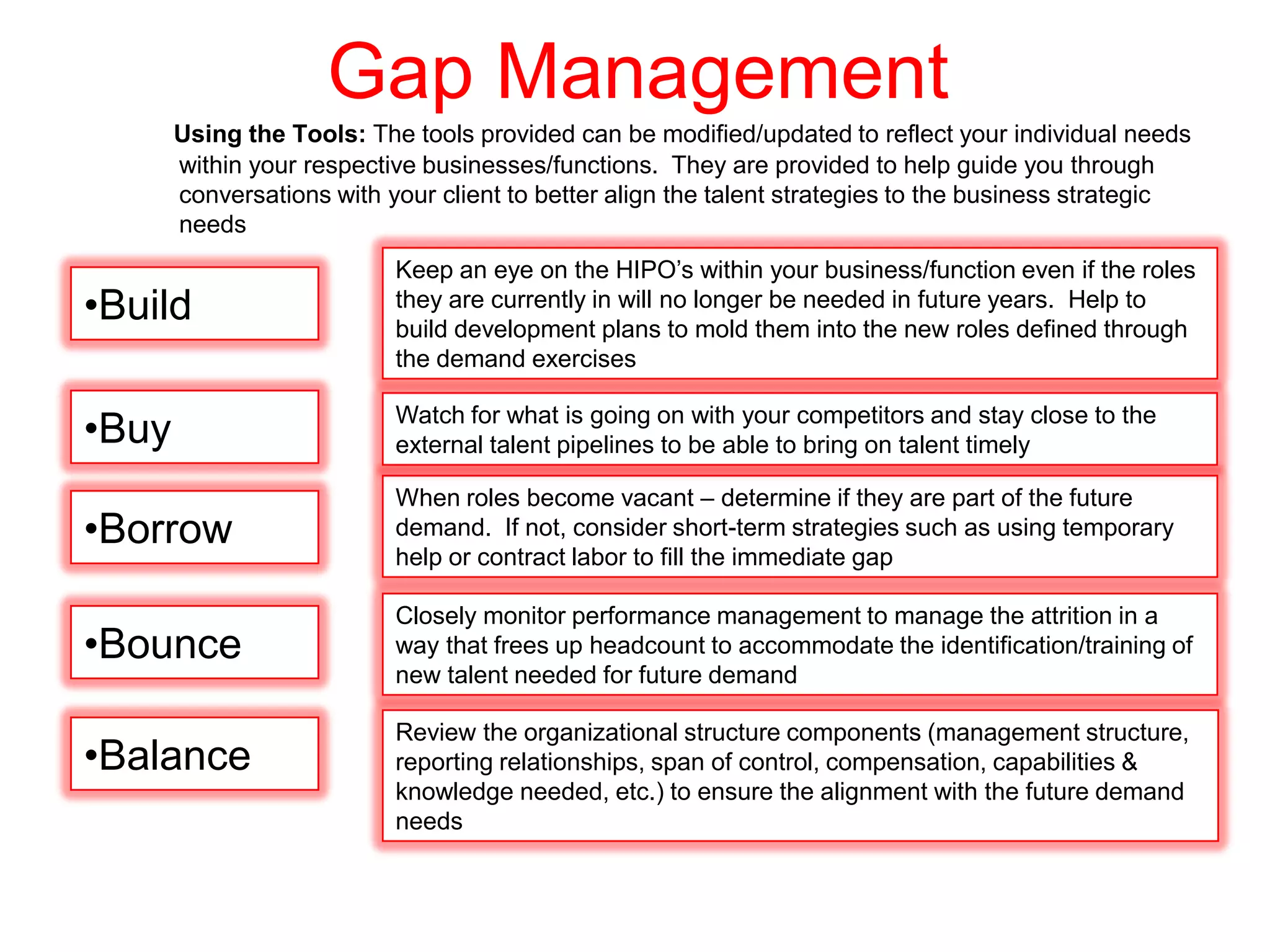
Gap Management
       Using the Tools: The tools provided can be modified/updated to reflect your individual needs
       within your respective businesses/functions. They are provided to help guide you through
       conversations with your client to better align the talent strategies to the business strategic
       needs
                           Keep an eye on the HIPO’s within your business/function even if the roles
•Build                     they are currently in will no longer be needed in future years. Help to
                           build development plans to mold them into the new roles defined through
                           the demand exercises


•Buy                       Watch for what is going on with your competitors and stay close to the
                           external talent pipelines to be able to bring on talent timely

                           When roles become vacant – determine if they are part of the future
•Borrow                    demand. If not, consider short-term strategies such as using temporary
                           help or contract labor to fill the immediate gap

                           Closely monitor performance management to manage the attrition in a
•Bounce                    way that frees up headcount to accommodate the identification/training of
                           new talent needed for future demand

                           Review the organizational structure components (management structure,
•Balance                   reporting relationships, span of control, compensation, capabilities &
                           knowledge needed, etc.) to ensure the alignment with the future demand
                           needs
Appendix
Discussion Framework
   Metrics Overview
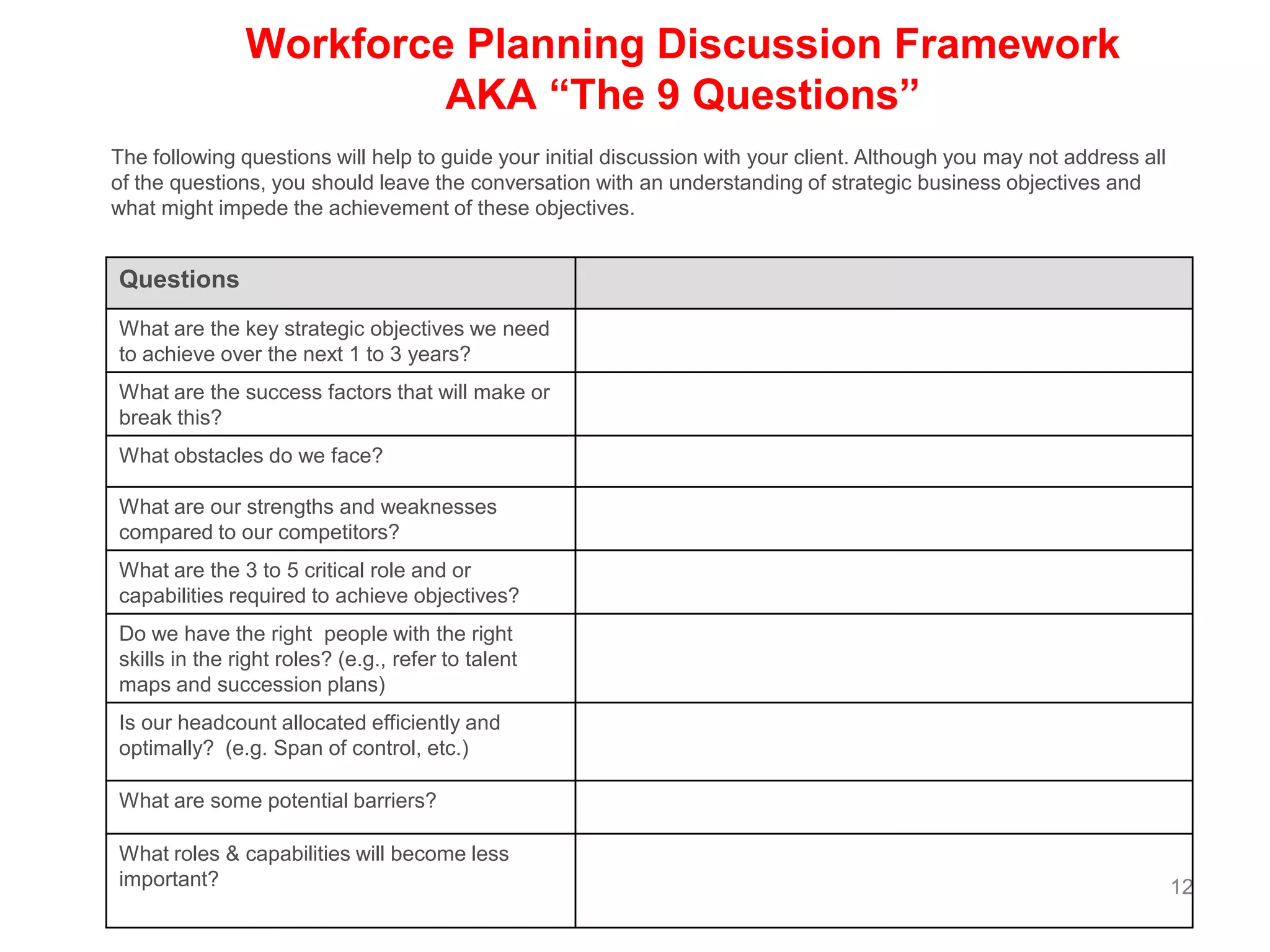
Workforce Planning Discussion Framework
                        AKA “The 9 Questions”
The following questions will help to guide your initial discussion with your client. Although you may not address all
of the questions, you should leave the conversation with an understanding of strategic business objectives and
what might impede the achievement of these objectives.


Questions
What are the key strategic objectives we need
to achieve over the next 1 to 3 years?
What are the success factors that will make or
break this?
What obstacles do we face?

What are our strengths and weaknesses
compared to our competitors?
What are the 3 to 5 critical role and or
capabilities required to achieve objectives?
Do we have the right people with the right
skills in the right roles? (e.g., refer to talent
maps and succession plans)
Is our headcount allocated efficiently and
optimally? (e.g. Span of control, etc.)

What are some potential barriers?

What roles & capabilities will become less
important?                                                                                                              12
HR Metrics
                 Labor                            [Organization]                                  Departing
                 Market                     Headcount: #
                                            Turnover:
                                                                                                  Employees
                                                                     Org     Dept
             Hired: #                                                                            Termed: #
                                                  Overall
             Time to Hire: #                      Voluntary                                      Primary reasons for
             days (versus # days                  Involuntary                                    departure:
             for rest of company)           Open and Filled Requisitions: #                      -Reason #1
                                                                                                 -Reason #2
                                            Budgeted Headcount: #


                                    WHERE TO PULL THE METRICS
                                                   System Folder
Report Description                  Owner                                  Report Name
                                                   Selection

                                                   Employment
Hiring YTD                          HRBP                                   Time Trend of Headcount by Location , Job Family, Department Tree
                                                   Demographics

                                                   Provided by Talent
Time to Hire                        TA                                     N/A
                                                   Acquisition

                                                   Employment
Headcount                           HRBP                                   Time Trend of Headcount by Location , Job Family, Department Tree
                                                   Demographics

Turnover number year-to-date (top                  Employment
                                    HRBP                                   Turnover by Dept Tree, Length of Service
2-3 reasons)                                       Demographics

Turnover % (voluntary and                          Employment
                                    HRBP                                   Time Trend of Headcount by Location , Job Family, Department Tree
involuntary %)                                     Demographics

                                                                           Current Requisitions - Number of Current Requisitions by
Open requisitions                   HRBP           Talent Acquisition
                                                                           Dept/Location/Grade

                                                                           Current Requisitions - Number of Current Requisitions by     13
Filled requisitions                 HRBP           Talent Acquisition
                                                                           Dept/Location/Grade

Budgeted Headcount vs Actual        HRBP           Total Workforce         Total Workforce Actual Vs Forecast
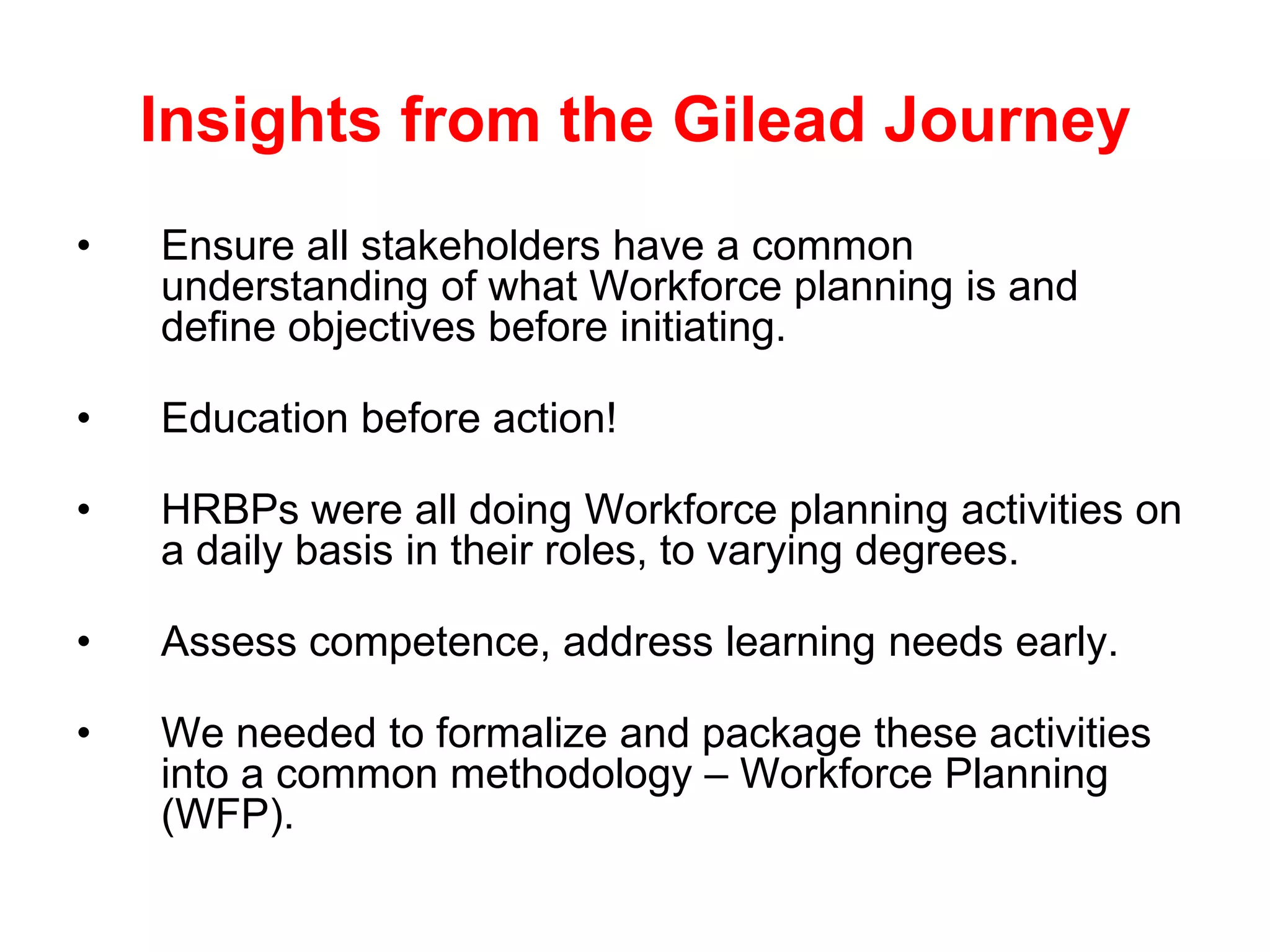
Insights from the Gilead Journey
•   Ensure all stakeholders have a common
    understanding of what Workforce planning is and
    define objectives before initiating.

•   Education before action!

•   HRBPs were all doing Workforce planning activities on
    a daily basis in their roles, to varying degrees.

•   Assess competence, address learning needs early.

•   We needed to formalize and package these activities
    into a common methodology – Workforce Planning
    (WFP).
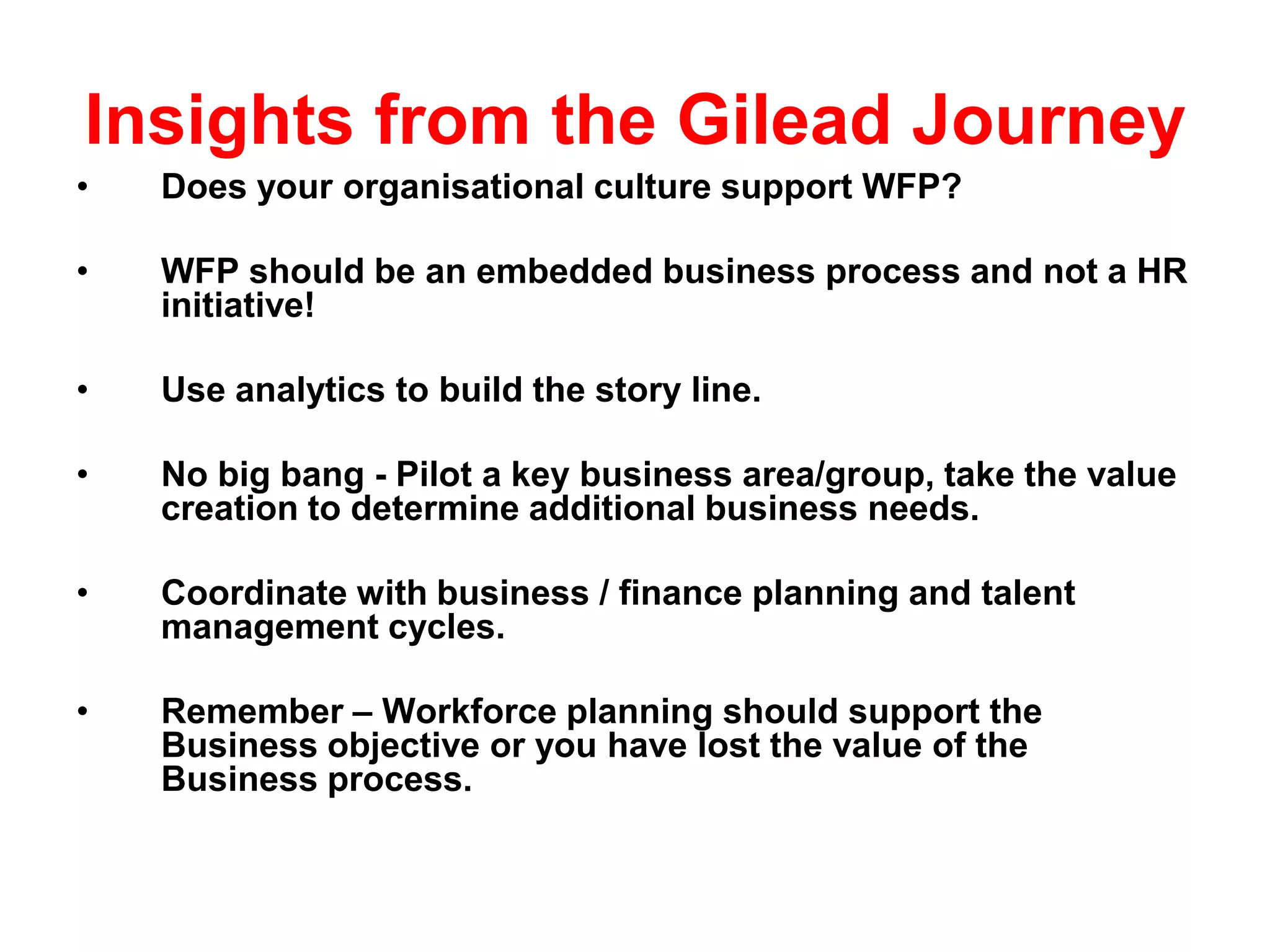
Insights from the Gilead Journey
•   Does your organisational culture support WFP?

•   WFP should be an embedded business process and not a HR
    initiative!

•   Use analytics to build the story line.

•   No big bang - Pilot a key business area/group, take the value
    creation to determine additional business needs.

•   Coordinate with business / finance planning and talent
    management cycles.

•   Remember – Workforce planning should support the
    Business objective or you have lost the value of the
    Business process.
Building Capability 2012 - Workforce Planning

Building Capability 2012 - Workforce Planning

  • 1.
    Building Resourcing Capability2012 Workforce Planning Grant Weinberg Director EMEA Talent Acquisition
  • 2.
    Gilead Storyboard 25 Yearsin 25 seconds…………… Gilead Sciences’ four-in-one HIV pill has been given the thumbs up by an FDA advisory group. Revenues 2011 – c.$8.4b Revenue : Employee 2011 WW = $1.8m 15 Marketed Products Revenue : Employee EMEA 2011 = $3.3m Avg. annualised hiring c.275 Multi-channel sourcing: – Direct 50% – Indirect 50% Most Valuable Employees Market cap value per employee: $9,415,075
  • 3.
    How we usedto plan Headcount…….
  • 4.
  • 5.
    Gilead WFP Drivers •Maturing away from incremental hiring • Capability hiring against the Business objective • Reduce reactive hiring • Greater appreciation of the Talent pools (int & ext) • Business Stakeholder alignment and up skilling: – Business Leaders – Finance Business Partners – HR Business Partners
  • 6.
    Workforce planning isthe bridge from business plan to talent management plan Annual Business Strategy / Business Plan What are the workforce implications of the business strategy? Workforce planning Understand your workforce through metrics and analytics Workforce plan Integrated Talent Management Plan Talent Acquisition Learning & Development Succession Planning Compensation Planning Performance Management Leadership Development 6
  • 7.
    Workforce Planning ProcessFramework Gilead’s initial focus was on Phases 1 and 2 Phase 2: Phase 3: Phase 4: Phase 5: Phase 1: Project Future Project Future Identify the Gaps Manage Gaps and Define objectives Demand Supply and Action Plan Monitor Workforce Implement Understand the Identify the actions current Determine workforce gaps identified in the workforce future that will inhibit workforce plan issues and Determine key workforce success on and gather data on workforce supply based executing the continuously the business requirements to on current business monitor the plan/strategy to execute on workforce and strategy and workforce to determine future business anticipated determine an assess workforce strategy changes to the action plan for program direction and workforce addressing the effectiveness talent gaps and the need to implications revisit the plan Process oversight and change management 7
  • 8.
    Workforce Planning MaturityModel There is value in workforce planning no matter where you are on the maturity model Advanced • Advanced analytics: • Tying workforce Intermediate metrics to business outcomes • Alignment with human capital strategy • Workforce projections • Cost optimization Basic • Critical role segmentation • Skills evaluation and • Movement analysis and career paths redeployment • New hire analysis and strategy • Job analysis and redesign • Understanding the current workforce: • Intermediate business demand planning: • Advanced business demand • Headcount • Defining workforce implications of planning: • Turnover business plan • Process level analysis • Simple metrics (age, service) • Business driver analysis • Time study • Simple demand planning: • Quantification of business driver • Complexity factors • Headcount growth ratios • Productivity and efficiency • Gap analysis analysis • Headcount target • Workforce mix evaluation • Some trending analysis Data analysis required 8
  • 9.
    Advanced WFP –Segmentation Talent Segment and Value Potential Strategic Action Strategic Critical to driving long-term competitive Build advantage, with specialized skills or Roles that knowledge affect the Core strategy Increased investment The “Engine of the Enterprise,” unique to Protect the company and core to delivering on its products and/or services Requisite Cannot do without, but whose value could be Streamline/ delivered through alternative staffing Outsource Roles strategies (e.g. off-shoring, outsourcing, affected replace w/technology) Non-Core by the strategy Talent whose skill sets no longer align with Redirect the company’s strategic direction Source: The Conference Board “Strategic Workforce Planning, Forecasting Human Capital Needs to Execute Business Strategy”; via Corning Incorporated 9
  • 10.
    Gap Management Using the Tools: The tools provided can be modified/updated to reflect your individual needs within your respective businesses/functions. They are provided to help guide you through conversations with your client to better align the talent strategies to the business strategic needs Keep an eye on the HIPO’s within your business/function even if the roles •Build they are currently in will no longer be needed in future years. Help to build development plans to mold them into the new roles defined through the demand exercises •Buy Watch for what is going on with your competitors and stay close to the external talent pipelines to be able to bring on talent timely When roles become vacant – determine if they are part of the future •Borrow demand. If not, consider short-term strategies such as using temporary help or contract labor to fill the immediate gap Closely monitor performance management to manage the attrition in a •Bounce way that frees up headcount to accommodate the identification/training of new talent needed for future demand Review the organizational structure components (management structure, •Balance reporting relationships, span of control, compensation, capabilities & knowledge needed, etc.) to ensure the alignment with the future demand needs
  • 11.
  • 12.
    Workforce Planning DiscussionFramework AKA “The 9 Questions” The following questions will help to guide your initial discussion with your client. Although you may not address all of the questions, you should leave the conversation with an understanding of strategic business objectives and what might impede the achievement of these objectives. Questions What are the key strategic objectives we need to achieve over the next 1 to 3 years? What are the success factors that will make or break this? What obstacles do we face? What are our strengths and weaknesses compared to our competitors? What are the 3 to 5 critical role and or capabilities required to achieve objectives? Do we have the right people with the right skills in the right roles? (e.g., refer to talent maps and succession plans) Is our headcount allocated efficiently and optimally? (e.g. Span of control, etc.) What are some potential barriers? What roles & capabilities will become less important? 12
  • 13.
    HR Metrics Labor [Organization] Departing Market Headcount: # Turnover: Employees Org Dept Hired: # Termed: # Overall Time to Hire: # Voluntary Primary reasons for days (versus # days Involuntary departure: for rest of company) Open and Filled Requisitions: # -Reason #1 -Reason #2 Budgeted Headcount: # WHERE TO PULL THE METRICS System Folder Report Description Owner Report Name Selection Employment Hiring YTD HRBP Time Trend of Headcount by Location , Job Family, Department Tree Demographics Provided by Talent Time to Hire TA N/A Acquisition Employment Headcount HRBP Time Trend of Headcount by Location , Job Family, Department Tree Demographics Turnover number year-to-date (top Employment HRBP Turnover by Dept Tree, Length of Service 2-3 reasons) Demographics Turnover % (voluntary and Employment HRBP Time Trend of Headcount by Location , Job Family, Department Tree involuntary %) Demographics Current Requisitions - Number of Current Requisitions by Open requisitions HRBP Talent Acquisition Dept/Location/Grade Current Requisitions - Number of Current Requisitions by 13 Filled requisitions HRBP Talent Acquisition Dept/Location/Grade Budgeted Headcount vs Actual HRBP Total Workforce Total Workforce Actual Vs Forecast
  • 14.
    Insights from theGilead Journey • Ensure all stakeholders have a common understanding of what Workforce planning is and define objectives before initiating. • Education before action! • HRBPs were all doing Workforce planning activities on a daily basis in their roles, to varying degrees. • Assess competence, address learning needs early. • We needed to formalize and package these activities into a common methodology – Workforce Planning (WFP).
  • 15.
    Insights from theGilead Journey • Does your organisational culture support WFP? • WFP should be an embedded business process and not a HR initiative! • Use analytics to build the story line. • No big bang - Pilot a key business area/group, take the value creation to determine additional business needs. • Coordinate with business / finance planning and talent management cycles. • Remember – Workforce planning should support the Business objective or you have lost the value of the Business process.