GARY DESSLER
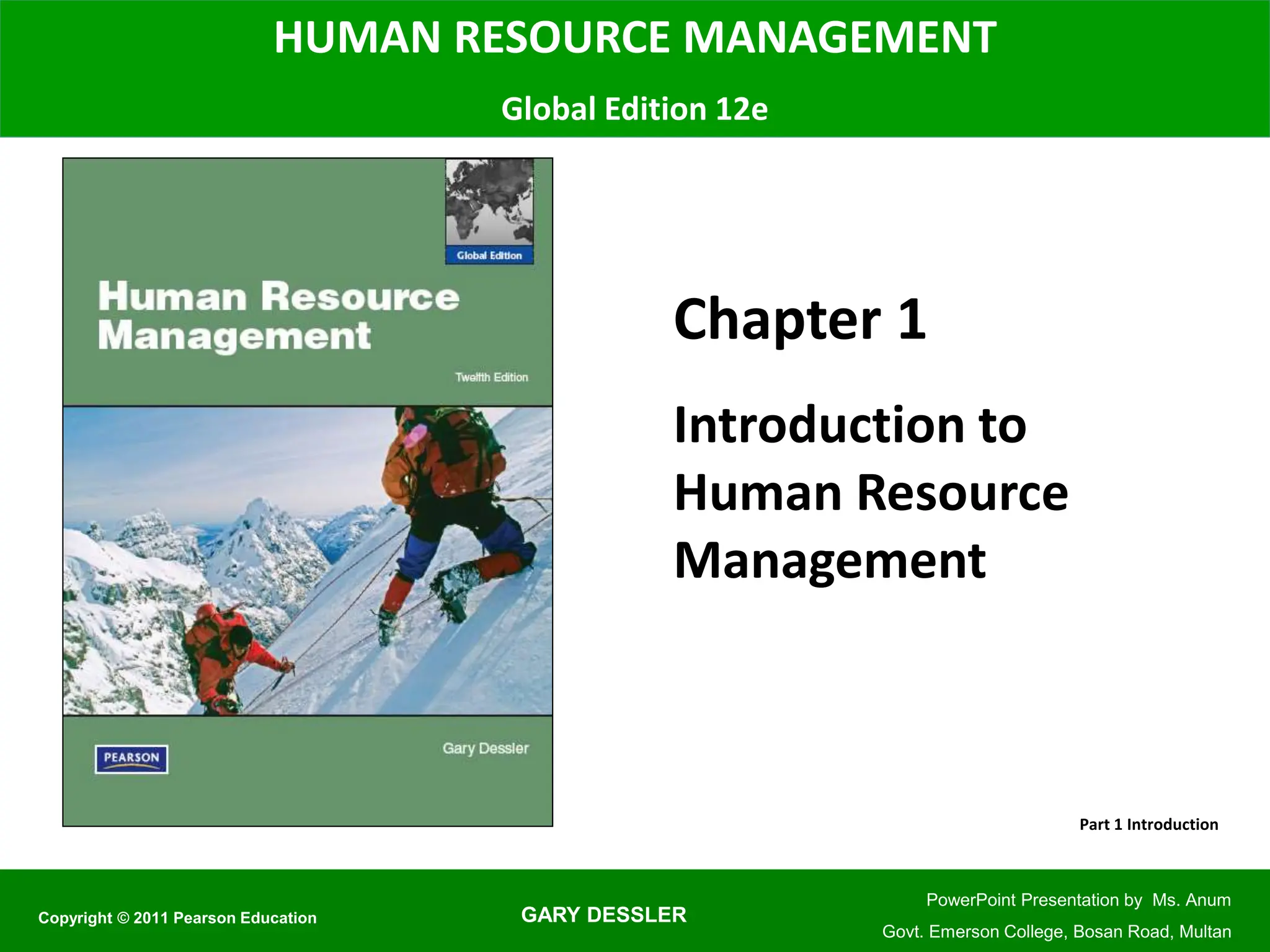
HUMAN RESOURCE MANAGEMENT
Global Edition 12e
Chapter 1
Introduction to
Human Resource
Management
PowerPoint Presentation by Ms. Anum
Govt. Emerson College, Bosan Road, Multan
Copyright © 2011 Pearson Education
Part 1 Introduction
Copyright © 2011 Pearson Education 1–2
Human Resource Management at Work
• What Is Human Resource Management (HRM)?
 The process of acquiring, training, appraising, and compensating
employees, and of attending to their labor relations, health and
safety, and fairness concerns.
• Organization
 People with formally assigned roles who work together to
achieve the organization’s goals.
• Manager
 The person responsible for accomplishing the organization’s
goals, and who does so by managing the efforts of the
organization’s people.
Performance appraisal
A performance appraisal is a systematic and periodic process that
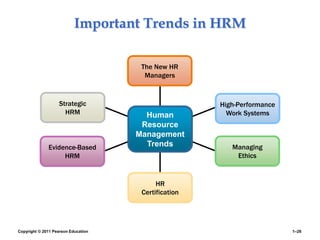
assesses an individual employee’s job performance and productivity.
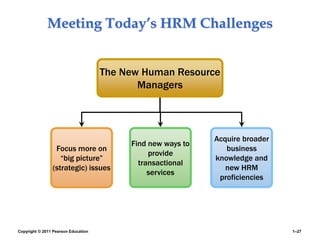
Compensation
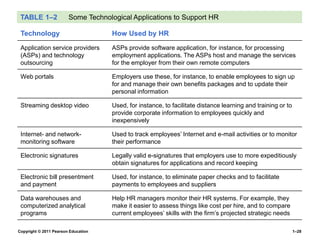
Compensation is the total amount of the monetary and non-monetary
pay provided to an employee by an employer in return for work
performed as required.
Copyright © 2011 Pearson Education 1–3
Management process
1)Planning
Establishing goals and standards.
2)Organizing
Assigning subordinates(juniors) their duties and
tasks.
3)Staffing
Determining what type of people you should be
hired, recruiting, selecting employees; training and
compensating them etc.
4)Leading
Getting others to get the job done and motivating
subordinates.
5)Controlling
Setting standards and checking the performance by
comparing with standard.
Copyright © 2011 Pearson Education 1–4
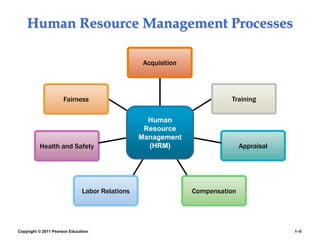
Copyright © 2011 Pearson Education 1–5
Human Resource Management Processes
Acquisition
Training
Appraisal
Compensation
Labor Relations
Health and Safety
Fairness
Human
Resource
Management
(HRM)
Copyright © 2011 Pearson Education 1–6
Personnel Aspects of a Manager’s Job
• Conducting job analyses
• Planning labor needs and recruiting job candidates
• Selecting job candidates
• Orienting and training new employees
• Managing wages and salaries
• Providing incentives and benefits
• Appraising performance
• Communicating
• Training and developing managers
• Building employee commitment
Copyright © 2011 Pearson Education 1–7
Personnel Mistakes
• Hire the wrong person for the job
• Experience high turnover
• Have your people not doing their best
• Waste time with useless interviews
• Have your firm in court because of discriminatory actions
• Have your firm cited by OSHA for unsafe practices
• Have some employees think their salaries are unfair and
inequitable relative to others in the organization
• Allow a lack of training to undermine your department’s
effectiveness
• Commit any unfair labor practices
Copyright © 2011 Pearson Education 1–8
Basic HR Concepts
• The bottom line of managing:
Getting results
• HR creates value by engaging in activities
that produce the employee behaviors that
the organization needs to achieve its
strategic goals.
• Looking ahead: Using evidence-based
HRM to measure the value of HR activities
in achieving those goals.
Copyright © 2011 Pearson Education 1–9
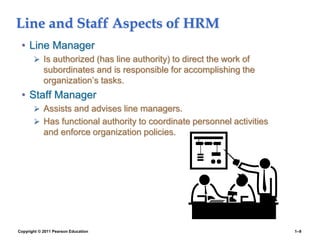
Line and Staff Aspects of HRM
• Line Manager
 Is authorized (has line authority) to direct the work of
subordinates and is responsible for accomplishing the
organization’s tasks.
• Staff Manager
 Assists and advises line managers.
 Has functional authority to coordinate personnel activities
and enforce organization policies.
Copyright © 2011 Pearson Education 1–10
Line Managers’ HRM Responsibilities
1. Placing the right person on the right job
2. Starting new employees in the organization (orientation)
3. Training employees for jobs that are new to them
4. Improving the job performance of each person
5. Gaining creative cooperation and developing smooth
working relationships
6. Interpreting the firm’s policies and procedures
7. Controlling labor costs
8. Developing the abilities of each person
9. Creating and maintaining department morale
10. Protecting employees’ health and physical condition
Copyright © 2011 Pearson Education 1–11
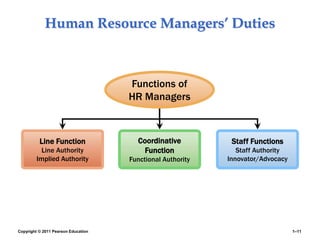
Human Resource Managers’ Duties
Line Function
Line Authority
Implied Authority
Staff Functions
Staff Authority
Innovator/Advocacy
Functions of
HR Managers
Coordinative
Function
Functional Authority
Copyright © 2011 Pearson Education 1–12
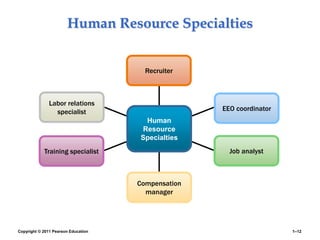
Human Resource Specialties
Recruiter
EEO coordinator
Labor relations
specialist
Training specialist Job analyst
Compensation
manager
Human
Resource
Specialties
Copyright © 2011 Pearson Education 1–13
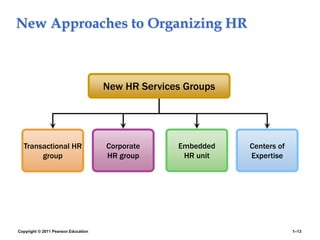
New Approaches to Organizing HR
Transactional HR
group
Corporate
HR group
Embedded
HR unit
New HR Services Groups
Centers of
Expertise
Copyright © 2011 Pearson Education 1–14
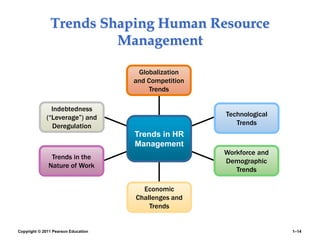
Trends Shaping Human Resource
Management
Globalization
and Competition
Trends
Technological
Trends
Indebtedness
(“Leverage”) and
Deregulation
Trends in the
Nature of Work
Workforce and
Demographic
Trends
Economic
Challenges and
Trends
Trends in HR
Management
Copyright © 2011 Pearson Education 1–15
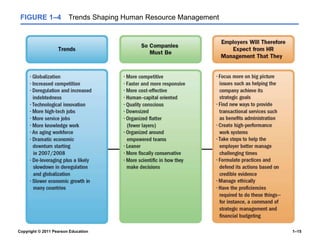
FIGURE 1–4 Trends Shaping Human Resource Management
Copyright © 2011 Pearson Education 1–16
Trends Shaping Human Resource Management
Globalization
The tendency of firms to extend their
sales, ownership, and/or manufacturing
to new markets abroad is globalization.
Companies expand abroad for several
reasons.Some companies wants to
increase their sales and some wants to
cut labor costs.because of globalization
companies are facing more
competetion.So to compete
successfully,companies and employees
need to work harder.
Copyright © 2011 Pearson Education 1–17
Indebtedness ( Leverage ) and
Deregulation
As economies boomed, more businesses
and consumers went deeply into
debt(loan).Homebuyers bought homes,
often with little money with the help of
debt. Deregulation plays important role in
economical progress. the rules that
prevented commercial banks from
expanding were relaxed.because of
relaxation of rules economy make
progress.
Copyright © 2011 Pearson Education 1–18
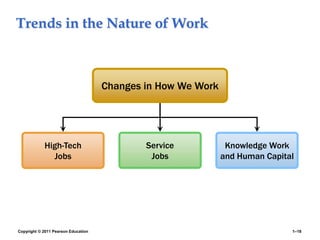
Trends in the Nature of Work
High-Tech
Jobs
Service
Jobs
Changes in How We Work
Knowledge Work
and Human Capital
Copyright © 2011 Pearson Education 1–19
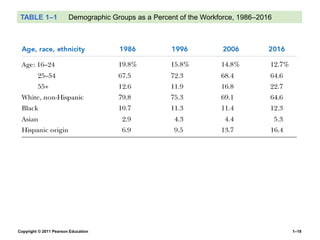
TABLE 1–1 Demographic Groups as a Percent of the Workforce, 1986–2016
Copyright © 2011 Pearson Education 1–20
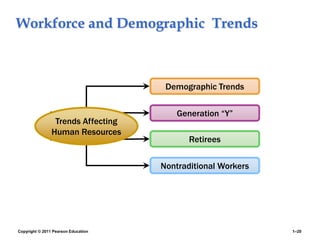
Workforce and Demographic Trends
Demographic Trends
Generation “Y”
Retirees
Nontraditional Workers
Trends Affecting
Human Resources
Workforce and demographic trends
demographics trends are those which are related to
age, gender and population of workforce. the U.S.
workforce is becoming older and more
multiethnic.34 Table 1-1 provides a bird s-eye view.
For example, between 1998 and 2018, the percent of
the workforce that it classifies as white, non-
Hispanic will drop from 83.8% to 79.4%. At the
same time, the percent of the workforce that is black
will rise from 11.6% to 12.1%,those classified Asian
will rise from 4.6% to 5.6%, an The percentages of
younger workers will fall. At the same time,
demographic trends are making finding and hiring
employees more challenging.
Copyright © 2011 Pearson Education 1–21
Generation y(1977-2000)
Gen Y employees are different. According to one expert,
they are show high-performance and they high-
maintenance workforce.they are more creative and
challenging workforce.so employers should be
competentent to deal with them.
Retirees
Many human resource professionals call the aging
workforce the biggest demographic trend affecting
employers.The basic problem is that there are not enough
younger workers to replace the older-worker retirees
Employers are dealing with this challenge in various ways.
some are offering employment options designed to attract
and retain semiretired workers.
Copyright © 2011 Pearson Education 1–22
Non traditional workers
Part time workers
two individuals sharing one job
Copyright © 2011 Pearson Education 1–23
Copyright © 2011 Pearson Education 1–24
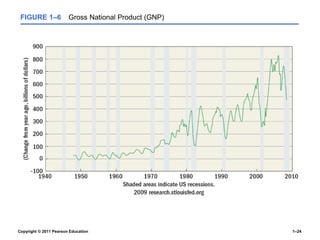
FIGURE 1–6 Gross National Product (GNP)
Economic challenges and trends
As shown in Figure 1-5, gross national product (GNP) a
measure of U.S. total output boomed between 2001 and 2008.
During this period, home prices leaped as much as 20% per
year. (See Figure 1-6.) Unemployment remained at about
4.7%.45 Then, around 2007 2008, all these measures
seemingly fell down. GNP fell. Home prices dropped by 20%
or more (depending on city). Unemployment nationwide rose
to more than 9.1%. Why did all this happen? That is a
complicated question, but for one thing, all this is because of
excessive debt(loan).so because of these challenges,
employers will have to be more active and creative in
managing their human resources than perhaps they
have been in the past.
Copyright © 2011 Pearson Education 1–25
Copyright © 2011 Pearson Education 1–26
Important Trends in HRM
The New HR
Managers
High-Performance
Work Systems
Strategic
HRM
Evidence-Based
HRM
Managing
Ethics
HR
Certification
Human
Resource
Management
Trends
Copyright © 2011 Pearson Education 1–27
Meeting Today’s HRM Challenges
Focus more on
“big picture”
(strategic) issues
Find new ways to
provide
transactional
services
The New Human Resource
Managers
Acquire broader
business
knowledge and
new HRM
proficiencies
Copyright © 2011 Pearson Education 1–28
TABLE 1–2 Some Technological Applications to Support HR
Technology How Used by HR
Application service providers
(ASPs) and technology
outsourcing
ASPs provide software application, for instance, for processing
employment applications. The ASPs host and manage the services
for the employer from their own remote computers
Web portals Employers use these, for instance, to enable employees to sign up
for and manage their own benefits packages and to update their
personal information
Streaming desktop video Used, for instance, to facilitate distance learning and training or to
provide corporate information to employees quickly and
inexpensively
Internet- and network-
monitoring software
Used to track employees’ Internet and e-mail activities or to monitor
their performance
Electronic signatures Legally valid e-signatures that employers use to more expeditiously
obtain signatures for applications and record keeping
Electronic bill presentment
and payment
Used, for instance, to eliminate paper checks and to facilitate
payments to employees and suppliers
Data warehouses and
computerized analytical
programs
Help HR managers monitor their HR systems. For example, they
make it easier to assess things like cost per hire, and to compare
current employees’ skills with the firm’s projected strategic needs
Copyright © 2011 Pearson Education 1–29
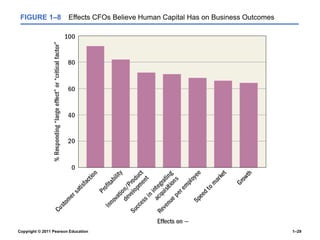
FIGURE 1–8 Effects CFOs Believe Human Capital Has on Business Outcomes
Copyright © 2011 Pearson Education 1–30
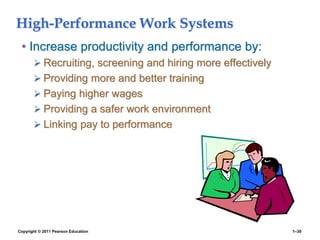
High-Performance Work Systems
• Increase productivity and performance by:
 Recruiting, screening and hiring more effectively
 Providing more and better training
 Paying higher wages
 Providing a safer work environment
 Linking pay to performance
Evidence based HRM
this is the use of data, facts, analytics, s critical
evaluation, and critically evaluated research/case
studies to support human resource management
proposals, decisions, practices, and conclusions.
Measuring the performance of hrm activities for
example to measure whether the new testing program
reduce employee turnover.whether training increases
productivity or not.(measuring performance in terms of
numbers(figures) and facts)
Copyright © 2011 Pearson Education 1–31
Copyright © 2011 Pearson Education 1–32
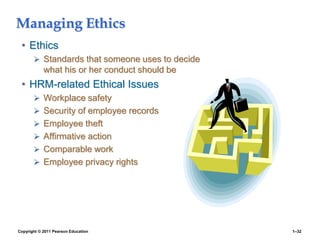
Managing Ethics
• Ethics
 Standards that someone uses to decide
what his or her conduct should be
• HRM-related Ethical Issues
 Workplace safety
 Security of employee records
 Employee theft
 Affirmative action
 Comparable work
 Employee privacy rights
Copyright © 2011 Pearson Education 1–33
HR Certification
• HR is becoming more professionalized.
• SHRM is an professional (SHRM) Institute offers
exams.in which it tests the professional knowledge of
all aspects of human resource management, including
ethics, management practices, staffing, development,
compensation, labor relations, and health and safety.
Those who successfully complete all requirements
earn the SPHR (Senior Professional in HR), GPHR
(Global Professional in HR), or PHR (Professional in
HR) certificate.

Chapter 1 Introduction to Human Resource Management

  • 1.
    GARY DESSLER HUMAN RESOURCEMANAGEMENT Global Edition 12e Chapter 1 Introduction to Human Resource Management PowerPoint Presentation by Ms. Anum Govt. Emerson College, Bosan Road, Multan Copyright © 2011 Pearson Education Part 1 Introduction
  • 2.
    Copyright © 2011Pearson Education 1–2 Human Resource Management at Work • What Is Human Resource Management (HRM)?  The process of acquiring, training, appraising, and compensating employees, and of attending to their labor relations, health and safety, and fairness concerns. • Organization  People with formally assigned roles who work together to achieve the organization’s goals. • Manager  The person responsible for accomplishing the organization’s goals, and who does so by managing the efforts of the organization’s people.
  • 3.
    Performance appraisal A performanceappraisal is a systematic and periodic process that assesses an individual employee’s job performance and productivity. Compensation Compensation is the total amount of the monetary and non-monetary pay provided to an employee by an employer in return for work performed as required. Copyright © 2011 Pearson Education 1–3
  • 4.
    Management process 1)Planning Establishing goalsand standards. 2)Organizing Assigning subordinates(juniors) their duties and tasks. 3)Staffing Determining what type of people you should be hired, recruiting, selecting employees; training and compensating them etc. 4)Leading Getting others to get the job done and motivating subordinates. 5)Controlling Setting standards and checking the performance by comparing with standard. Copyright © 2011 Pearson Education 1–4
  • 5.
    Copyright © 2011Pearson Education 1–5 Human Resource Management Processes Acquisition Training Appraisal Compensation Labor Relations Health and Safety Fairness Human Resource Management (HRM)
  • 6.
    Copyright © 2011Pearson Education 1–6 Personnel Aspects of a Manager’s Job • Conducting job analyses • Planning labor needs and recruiting job candidates • Selecting job candidates • Orienting and training new employees • Managing wages and salaries • Providing incentives and benefits • Appraising performance • Communicating • Training and developing managers • Building employee commitment
  • 7.
    Copyright © 2011Pearson Education 1–7 Personnel Mistakes • Hire the wrong person for the job • Experience high turnover • Have your people not doing their best • Waste time with useless interviews • Have your firm in court because of discriminatory actions • Have your firm cited by OSHA for unsafe practices • Have some employees think their salaries are unfair and inequitable relative to others in the organization • Allow a lack of training to undermine your department’s effectiveness • Commit any unfair labor practices
  • 8.
    Copyright © 2011Pearson Education 1–8 Basic HR Concepts • The bottom line of managing: Getting results • HR creates value by engaging in activities that produce the employee behaviors that the organization needs to achieve its strategic goals. • Looking ahead: Using evidence-based HRM to measure the value of HR activities in achieving those goals.
  • 9.
    Copyright © 2011Pearson Education 1–9 Line and Staff Aspects of HRM • Line Manager  Is authorized (has line authority) to direct the work of subordinates and is responsible for accomplishing the organization’s tasks. • Staff Manager  Assists and advises line managers.  Has functional authority to coordinate personnel activities and enforce organization policies.
  • 10.
    Copyright © 2011Pearson Education 1–10 Line Managers’ HRM Responsibilities 1. Placing the right person on the right job 2. Starting new employees in the organization (orientation) 3. Training employees for jobs that are new to them 4. Improving the job performance of each person 5. Gaining creative cooperation and developing smooth working relationships 6. Interpreting the firm’s policies and procedures 7. Controlling labor costs 8. Developing the abilities of each person 9. Creating and maintaining department morale 10. Protecting employees’ health and physical condition
  • 11.
    Copyright © 2011Pearson Education 1–11 Human Resource Managers’ Duties Line Function Line Authority Implied Authority Staff Functions Staff Authority Innovator/Advocacy Functions of HR Managers Coordinative Function Functional Authority
  • 12.
    Copyright © 2011Pearson Education 1–12 Human Resource Specialties Recruiter EEO coordinator Labor relations specialist Training specialist Job analyst Compensation manager Human Resource Specialties
  • 13.
    Copyright © 2011Pearson Education 1–13 New Approaches to Organizing HR Transactional HR group Corporate HR group Embedded HR unit New HR Services Groups Centers of Expertise
  • 14.
    Copyright © 2011Pearson Education 1–14 Trends Shaping Human Resource Management Globalization and Competition Trends Technological Trends Indebtedness (“Leverage”) and Deregulation Trends in the Nature of Work Workforce and Demographic Trends Economic Challenges and Trends Trends in HR Management
  • 15.
    Copyright © 2011Pearson Education 1–15 FIGURE 1–4 Trends Shaping Human Resource Management
  • 16.
    Copyright © 2011Pearson Education 1–16 Trends Shaping Human Resource Management Globalization The tendency of firms to extend their sales, ownership, and/or manufacturing to new markets abroad is globalization. Companies expand abroad for several reasons.Some companies wants to increase their sales and some wants to cut labor costs.because of globalization companies are facing more competetion.So to compete successfully,companies and employees need to work harder.
  • 17.
    Copyright © 2011Pearson Education 1–17 Indebtedness ( Leverage ) and Deregulation As economies boomed, more businesses and consumers went deeply into debt(loan).Homebuyers bought homes, often with little money with the help of debt. Deregulation plays important role in economical progress. the rules that prevented commercial banks from expanding were relaxed.because of relaxation of rules economy make progress.
  • 18.
    Copyright © 2011Pearson Education 1–18 Trends in the Nature of Work High-Tech Jobs Service Jobs Changes in How We Work Knowledge Work and Human Capital
  • 19.
    Copyright © 2011Pearson Education 1–19 TABLE 1–1 Demographic Groups as a Percent of the Workforce, 1986–2016
  • 20.
    Copyright © 2011Pearson Education 1–20 Workforce and Demographic Trends Demographic Trends Generation “Y” Retirees Nontraditional Workers Trends Affecting Human Resources
  • 21.
    Workforce and demographictrends demographics trends are those which are related to age, gender and population of workforce. the U.S. workforce is becoming older and more multiethnic.34 Table 1-1 provides a bird s-eye view. For example, between 1998 and 2018, the percent of the workforce that it classifies as white, non- Hispanic will drop from 83.8% to 79.4%. At the same time, the percent of the workforce that is black will rise from 11.6% to 12.1%,those classified Asian will rise from 4.6% to 5.6%, an The percentages of younger workers will fall. At the same time, demographic trends are making finding and hiring employees more challenging. Copyright © 2011 Pearson Education 1–21
  • 22.
    Generation y(1977-2000) Gen Yemployees are different. According to one expert, they are show high-performance and they high- maintenance workforce.they are more creative and challenging workforce.so employers should be competentent to deal with them. Retirees Many human resource professionals call the aging workforce the biggest demographic trend affecting employers.The basic problem is that there are not enough younger workers to replace the older-worker retirees Employers are dealing with this challenge in various ways. some are offering employment options designed to attract and retain semiretired workers. Copyright © 2011 Pearson Education 1–22
  • 23.
    Non traditional workers Parttime workers two individuals sharing one job Copyright © 2011 Pearson Education 1–23
  • 24.
    Copyright © 2011Pearson Education 1–24 FIGURE 1–6 Gross National Product (GNP)
  • 25.
    Economic challenges andtrends As shown in Figure 1-5, gross national product (GNP) a measure of U.S. total output boomed between 2001 and 2008. During this period, home prices leaped as much as 20% per year. (See Figure 1-6.) Unemployment remained at about 4.7%.45 Then, around 2007 2008, all these measures seemingly fell down. GNP fell. Home prices dropped by 20% or more (depending on city). Unemployment nationwide rose to more than 9.1%. Why did all this happen? That is a complicated question, but for one thing, all this is because of excessive debt(loan).so because of these challenges, employers will have to be more active and creative in managing their human resources than perhaps they have been in the past. Copyright © 2011 Pearson Education 1–25
  • 26.
    Copyright © 2011Pearson Education 1–26 Important Trends in HRM The New HR Managers High-Performance Work Systems Strategic HRM Evidence-Based HRM Managing Ethics HR Certification Human Resource Management Trends
  • 27.
    Copyright © 2011Pearson Education 1–27 Meeting Today’s HRM Challenges Focus more on “big picture” (strategic) issues Find new ways to provide transactional services The New Human Resource Managers Acquire broader business knowledge and new HRM proficiencies
  • 28.
    Copyright © 2011Pearson Education 1–28 TABLE 1–2 Some Technological Applications to Support HR Technology How Used by HR Application service providers (ASPs) and technology outsourcing ASPs provide software application, for instance, for processing employment applications. The ASPs host and manage the services for the employer from their own remote computers Web portals Employers use these, for instance, to enable employees to sign up for and manage their own benefits packages and to update their personal information Streaming desktop video Used, for instance, to facilitate distance learning and training or to provide corporate information to employees quickly and inexpensively Internet- and network- monitoring software Used to track employees’ Internet and e-mail activities or to monitor their performance Electronic signatures Legally valid e-signatures that employers use to more expeditiously obtain signatures for applications and record keeping Electronic bill presentment and payment Used, for instance, to eliminate paper checks and to facilitate payments to employees and suppliers Data warehouses and computerized analytical programs Help HR managers monitor their HR systems. For example, they make it easier to assess things like cost per hire, and to compare current employees’ skills with the firm’s projected strategic needs
  • 29.
    Copyright © 2011Pearson Education 1–29 FIGURE 1–8 Effects CFOs Believe Human Capital Has on Business Outcomes
  • 30.
    Copyright © 2011Pearson Education 1–30 High-Performance Work Systems • Increase productivity and performance by:  Recruiting, screening and hiring more effectively  Providing more and better training  Paying higher wages  Providing a safer work environment  Linking pay to performance
  • 31.
    Evidence based HRM thisis the use of data, facts, analytics, s critical evaluation, and critically evaluated research/case studies to support human resource management proposals, decisions, practices, and conclusions. Measuring the performance of hrm activities for example to measure whether the new testing program reduce employee turnover.whether training increases productivity or not.(measuring performance in terms of numbers(figures) and facts) Copyright © 2011 Pearson Education 1–31
  • 32.
    Copyright © 2011Pearson Education 1–32 Managing Ethics • Ethics  Standards that someone uses to decide what his or her conduct should be • HRM-related Ethical Issues  Workplace safety  Security of employee records  Employee theft  Affirmative action  Comparable work  Employee privacy rights
  • 33.
    Copyright © 2011Pearson Education 1–33 HR Certification • HR is becoming more professionalized. • SHRM is an professional (SHRM) Institute offers exams.in which it tests the professional knowledge of all aspects of human resource management, including ethics, management practices, staffing, development, compensation, labor relations, and health and safety. Those who successfully complete all requirements earn the SPHR (Senior Professional in HR), GPHR (Global Professional in HR), or PHR (Professional in HR) certificate.

Editor's Notes

  • #2 Copyright © 2011 Pearson Education
  • #3 Copyright © 2011 Pearson Education
  • #6 Copyright © 2011 Pearson Education
  • #7 Copyright © 2011 Pearson Education
  • #8 Copyright © 2011 Pearson Education
  • #9 Copyright © 2011 Pearson Education
  • #10 Copyright © 2011 Pearson Education
  • #11 Copyright © 2011 Pearson Education
  • #12 Copyright © 2011 Pearson Education
  • #13 Copyright © 2011 Pearson Education
  • #14 Copyright © 2011 Pearson Education
  • #15 Copyright © 2011 Pearson Education
  • #16 Copyright © 2011 Pearson Education
  • #19 Copyright © 2011 Pearson Education
  • #20 Copyright © 2011 Pearson Education
  • #21 Copyright © 2011 Pearson Education
  • #25 Copyright © 2011 Pearson Education
  • #27 Copyright © 2011 Pearson Education
  • #28 Copyright © 2011 Pearson Education
  • #29 Copyright © 2011 Pearson Education
  • #30 Copyright © 2011 Pearson Education
  • #31 Copyright © 2011 Pearson Education
  • #33 Copyright © 2011 Pearson Education
  • #34 Copyright © 2011 Pearson Education