1/40
ZBrain March 25, 2025
AI for HR planning and strategy: Scope, integration, use
cases, challenges and future outlook
zbrain.ai/ai-for-hr-planning-and-strategy
← All Insights
AI is redefining HR planning and strategy, offering solutions to long-standing challenges in
workforce management, talent acquisition, and employee engagement. Traditional HR
practices often rely on manual processes, siloed data, and reactive decision-making,
leading to inefficiencies in talent forecasting, workforce allocation, and strategic alignment.
HR teams frequently struggle with optimizing hiring processes, retaining top talent, and
ensuring equitable compensation structures, all while navigating evolving labor laws and
compliance requirements. Additionally, organizations face increasing pressure to enhance
employee experience, foster engagement, and build agile workforce strategies that align
with business objectives. As the workforce becomes more diverse and dynamic, these
challenges necessitate the adoption of intelligent, data-driven solutions.
AI adoption in HR is steadily growing, with 42% of HR teams already leveraging AI-
powered tools for functions such as recruitment, workforce planning, and engagement. The
increasing use of AI highlights its potential to streamline operations, improve decision-
making, and enhance workforce agility. HR departments are also recognizing the
importance of technology adoption, with organizations focusing on upskilling HR teams to
bridge the gap in digital proficiency. While generative AI is transforming industries such as
marketing—where 34% of teams have embraced it—it is gradually making its way into HR,
with 12% of departments integrating generative AI tools (AIHR, 2024). This presents a
significant opportunity for HR leaders to explore AI-driven applications that enhance
efficiency, personalization, and strategic workforce planning.
2/40
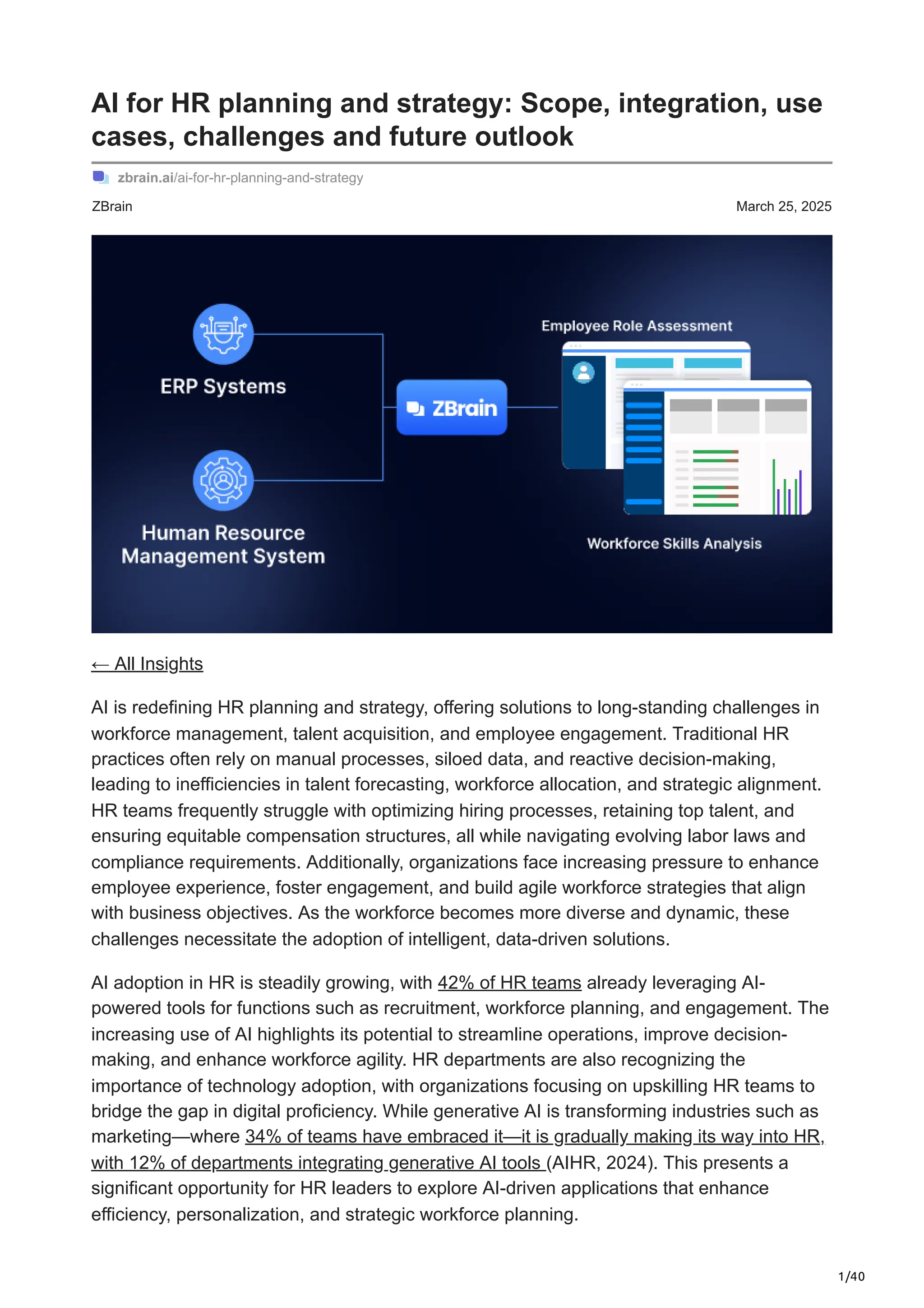
As AI becomes a cornerstone of modern HR functions, platforms like are equipping
organizations with advanced capabilities to optimize workforce planning, enhance talent
strategies, and drive data-backed decision-making. By automating administrative tasks,
analyzing workforce patterns, and generating predictive insights, ZBrain enables HR teams
to transition from reactive operations to proactive strategy execution. Beyond automation,
ZBrain facilitates AI readiness assessments, supports seamless AI integration, and aligns
HR strategies with evolving business needs.
This article explores how AI is transforming HR planning and strategy, fostering efficiency,
and enabling data-driven workforce management. It also highlights how platforms like
ZBrain empower organizations to harness AI-powered insights, ensuring agility,
competitiveness, and long-term workforce success.
What is HR planning and strategy?
HR planning and strategy is a structured approach to managing an organization’s
workforce to align with business objectives, ensuring optimal talent acquisition,
development, and retention. It involves analyzing workforce needs, forecasting future talent
requirements, developing HR policies, and implementing initiatives to enhance employee
engagement, productivity, and compliance. By integrating workforce planning with strategic
goals, businesses can maintain a competitive edge while fostering a resilient and adaptable
workforce.
Key components of HR planning and strategy include workforce analysis, succession
planning, talent acquisition, performance management, employee development, and
compliance monitoring. A comprehensive HR strategy ensures that organizations can
anticipate talent gaps, optimize resource allocation, and enhance overall workforce
efficiency.
While HR planning is traditionally a manual and process-driven function, adopting AI and
automation has significantly enhanced its effectiveness. AI-driven platforms help
organizations optimize workforce analytics, automate talent acquisition, and enhance
decision-making in areas such as employee engagement and skills development. By
leveraging AI-driven insights and automation, HR teams can improve efficiency, reduce
bias in hiring, and foster a data-driven approach to workforce management.
Effective HR planning and strategy enable businesses to maintain workforce stability,
improve employee experience, and align HR initiatives with long-term business goals.
Organizations can create a future-ready HR function that drives growth and resilience by
integrating technology, data-driven insights, and strategic workforce management.
Why is HR planning and strategy important?
HR planning and strategy are crucial in ensuring that businesses can attract, retain, and
develop the right talent to support their objectives. It provides a structured approach to
workforce management, allowing organizations to proactively address talent shortages,
succession planning, and skill development.
3/40
One key benefit of HR planning is its ability to align workforce capabilities with business
needs. HR teams can develop targeted hiring and training programs that drive
organizational success by assessing current talent pools, forecasting future workforce
demands, and identifying skills gaps. This proactive approach reduces turnover, enhances
employee satisfaction, and ensures business continuity.
A well-executed HR strategy also strengthens compliance with labor laws and industry
regulations. Organizations can minimize legal risks, ensure fair employment practices, and
maintain a transparent work environment by implementing standardized HR processes.
Additionally, leveraging workforce analytics helps businesses optimize employee
engagement, monitor performance trends, and refine HR policies to foster a culture of
continuous improvement.
Ultimately, HR planning and strategy drive workforce efficiency, enhance employee
experience and support long-term business sustainability. By integrating AI-driven
analytics, automation, and strategic workforce planning, organizations can navigate
evolving workforce challenges, build a resilient HR function, and maintain a competitive
advantage in the modern business landscape.
Understanding the HR planning and strategy stages
Effective HR planning and strategy are crucial for aligning workforce management with an
organization’s overall objectives. HR planning and strategy encompass multiple stages that
focus on aligning HR functions with business goals, ensuring that an organization’s
workforce is equipped to meet both current and future challenges. The following section
provides a clear set of HR planning and strategy stages.
4/40
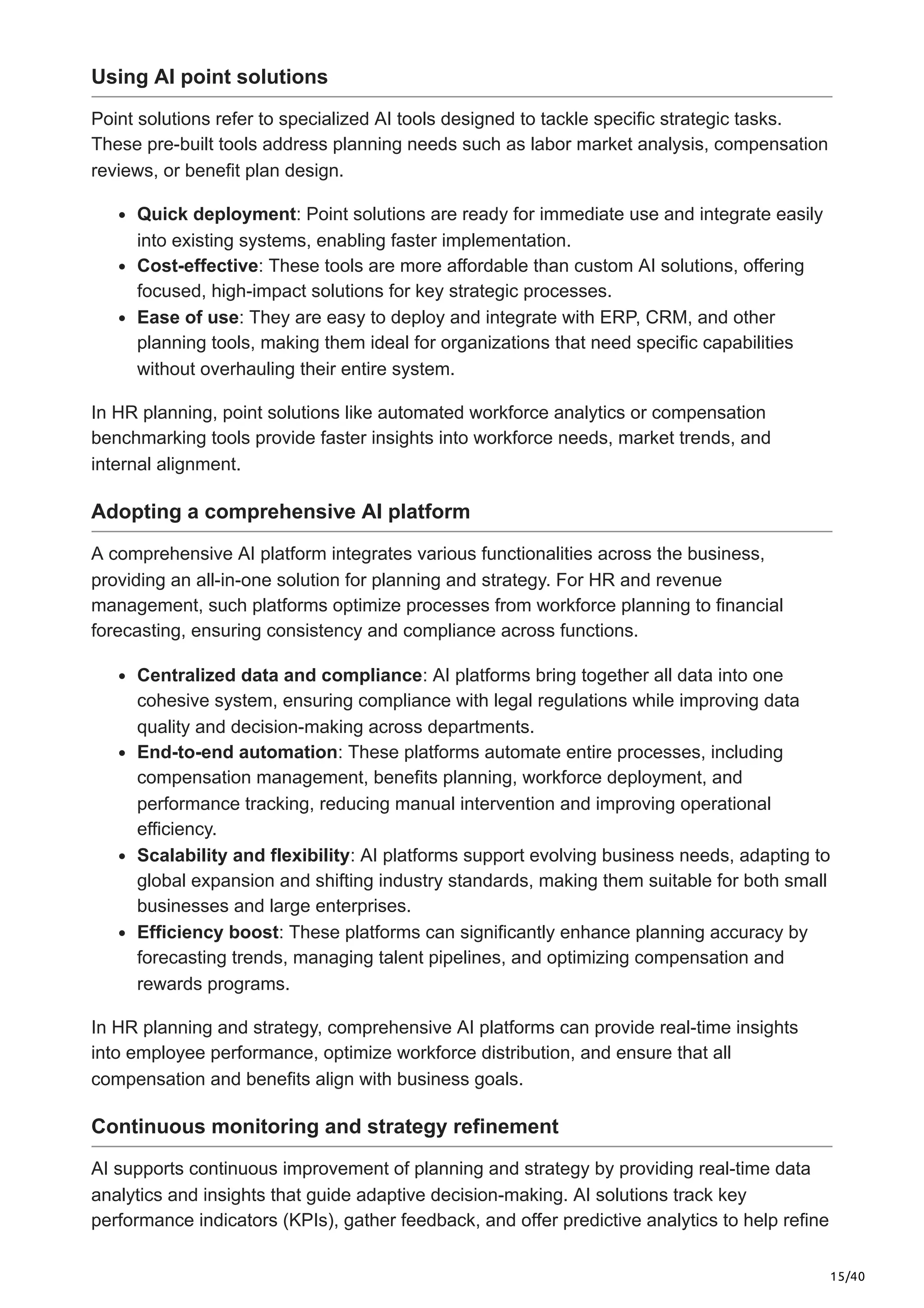
Stages of HR planning and strategies
Transformative
human resources
function
management
Strategic
workforce
planning (SW)
Total rewards
planning
(BP & CP)
Continuous
monitoring and
strategy
refinement
HR policy
development &
alignment
Workforce
strategy
formulation
Organizational
design
Compliance and
risk management
Workforce
environment
analysis
Strategic resource
planning
Operational
resource planning
Competencies to
support integrated
talent development
Benefit planning
(BP)
Compensation
planning (CP)
Performance
tracking and
analytics
Feedback loops
and surveys
Benchmarking and
industry
comparison
Real-time
adjustments
1. Transformative human resources function management
This stage emphasizes restructuring HR functions to make them more efficient, compliant,
and strategically aligned with the organization’s goals. The associated processes include:
HR policy development and alignment: Establishing policies that reflect
organizational goals, regulatory requirements, and cultural values. Regular updates to
policies ensure they stay relevant in a changing workforce environment.
Workforce strategy formulation: Defining the long-term vision for the workforce and
aligning it with organizational objectives. This includes developing a roadmap for HR
transformation, focusing on people, technology, and processes.
Organizational design: Structuring roles and responsibilities to ensure that HR
capabilities support business growth, ensuring each function has clear objectives and
measurable outcomes.
5/40
Compliance and risk management: Ensuring that HR practices comply with
relevant laws and regulations while proactively addressing any potential risks related
to labor laws, health and safety, and employee relations.
Change management: Implementing processes to help the organization transition
smoothly when making HR strategy shifts or adopting new technology, ensuring
minimal disruption.
2. Strategic workforce planning (SW)
Strategic workforce planning ensures that organizations have the right people in the right
roles at the right time. This stage involves aligning HR strategies with business goals to
meet both short-term and long-term needs, guiding decisions on staffing levels, skill
development, and workforce distribution.
Workforce environment analysis: This stage involves analyzing both internal and
external workforce trends to understand the evolving labor market conditions, identify
skill gaps, and assess industry benchmarks. Understanding the broader workforce
landscape helps organizations prepare for future workforce needs by making data-
driven decisions.
Strategic resource planning: Long-term resource planning aligns staffing levels with
business growth strategies. By forecasting the workforce needs that align with the
company’s long-term goals, businesses ensure they have the right resources in place
for sustained success. This stage is crucial for identifying future talent shortages or
surpluses and taking proactive steps to manage them.
Operational resource planning: In this stage, short-term workforce needs are
addressed by improving decision-making related to staffing, scheduling, and
deployment. Operational resource planning focuses on optimizing the immediate use
of available workforce resources to handle fluctuations in business demands or
project-specific needs.
Competencies to support integrated talent development: This stage ensures that
employees have the skills necessary to meet the evolving demands of the
organization. Talent development strategies align training programs with the
competencies required for various roles, ensuring a continuous pipeline of skilled
workers ready to contribute to the organization’s growth.
Position management and position control: Position management ensures that
job roles and responsibilities are structured in alignment with organizational needs.
This stage focuses on job classifications, reporting structures, and ensuring that each
position is filled appropriately to meet current and future workforce demands.
Succession planning with talent pools: Succession planning is vital for ensuring
that an organization can maintain continuity, especially in leadership roles. Identifying
and developing internal talent pools for leadership positions allows organizations to
prepare for key transitions and minimize disruptions when leadership changes occur.
6/40
Job planning and design: Job planning and design ensure that roles and
responsibilities are clearly defined and aligned with organizational goals. Effective job
design enhances job satisfaction, ensures resource optimization, and supports overall
organizational performance. This stage involves creating roles that maximize
employee potential and contribute to business success.
3. Total rewards planning (BP & CP)
Total rewards planning focuses on offering competitive compensation and benefits to
attract and retain top talent. A well-structured total rewards strategy aligns employee
benefits with organizational goals, contributing to higher employee satisfaction and
retention rates.
3.1 Benefit planning (BP)
Benefit planning ensures that compensation and benefits offerings are aligned with both
employee needs and the company’s goals. The associated processes include:
Conduct an external benefit plan survey: This process involves collecting data on
industry benchmarks for benefits packages to compare and ensure competitiveness
with external market trends.
Conduct an internal benefit plan survey: Gathering employee feedback on existing
benefits to ensure alignment with employee needs, preferences, and satisfaction
levels.
Develop/adjust benefit objectives and strategies: Based on feedback and market
analysis, this stage focuses on refining and adjusting benefit offerings to ensure they
are attractive and aligned with business goals.
Design/redesign benefit plan: This process includes designing or redesigning the
benefit plan to ensure that it is comprehensive, cost-effective, and meets the needs of
the employees while aligning with the organization’s objectives.
Consolidate benefit plans: Consolidate multiple benefit offerings into a cohesive,
streamlined plan to optimize administrative efficiency and employee satisfaction.
Evaluate benefit plans and carriers/providers: Regular evaluation of benefit plans
and the performance of carriers/providers to ensure they are delivering value for
money and meeting organizational and employee expectations.
3.2 Compensation planning (CP)
Compensation planning ensures fair and equitable pay structures, motivating employees
while aligning with the business’s broader objectives. The associated processes include:
Labor market surveys: Conducting surveys to assess competitive pay scales within
the labor market, ensuring the organization offers compensation that is competitive
within the industry.
7/40
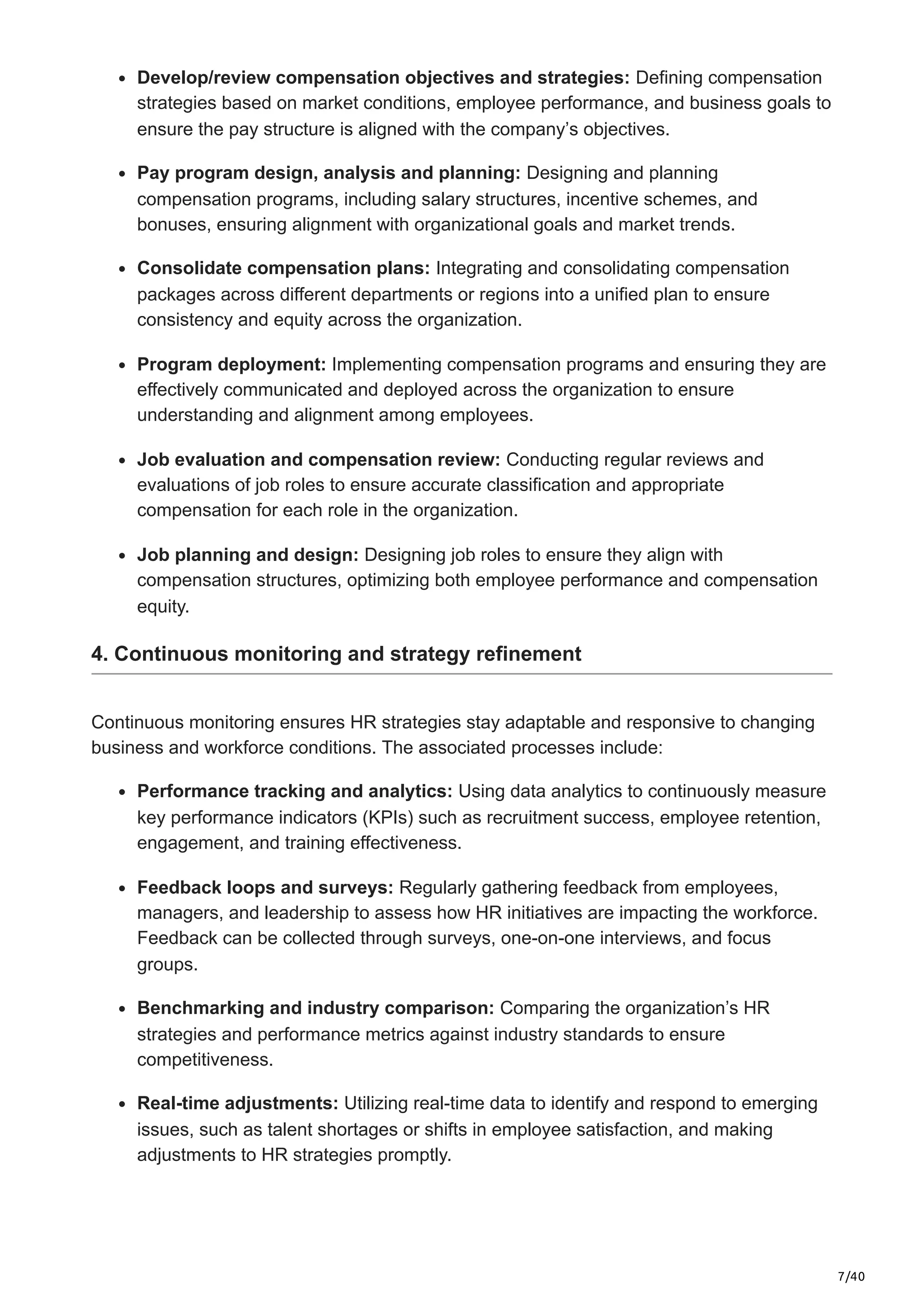
Develop/review compensation objectives and strategies: Defining compensation
strategies based on market conditions, employee performance, and business goals to
ensure the pay structure is aligned with the company’s objectives.
Pay program design, analysis and planning: Designing and planning
compensation programs, including salary structures, incentive schemes, and
bonuses, ensuring alignment with organizational goals and market trends.
Consolidate compensation plans: Integrating and consolidating compensation
packages across different departments or regions into a unified plan to ensure
consistency and equity across the organization.
Program deployment: Implementing compensation programs and ensuring they are
effectively communicated and deployed across the organization to ensure
understanding and alignment among employees.
Job evaluation and compensation review: Conducting regular reviews and
evaluations of job roles to ensure accurate classification and appropriate
compensation for each role in the organization.
Job planning and design: Designing job roles to ensure they align with
compensation structures, optimizing both employee performance and compensation
equity.
4. Continuous monitoring and strategy refinement
Continuous monitoring ensures HR strategies stay adaptable and responsive to changing
business and workforce conditions. The associated processes include:
Performance tracking and analytics: Using data analytics to continuously measure
key performance indicators (KPIs) such as recruitment success, employee retention,
engagement, and training effectiveness.
Feedback loops and surveys: Regularly gathering feedback from employees,
managers, and leadership to assess how HR initiatives are impacting the workforce.
Feedback can be collected through surveys, one-on-one interviews, and focus
groups.
Benchmarking and industry comparison: Comparing the organization’s HR
strategies and performance metrics against industry standards to ensure
competitiveness.
Real-time adjustments: Utilizing real-time data to identify and respond to emerging
issues, such as talent shortages or shifts in employee satisfaction, and making
adjustments to HR strategies promptly.
8/40
Predictive analysis for workforce trends: Using predictive models to anticipate
future workforce needs, including skill shortages, staffing levels, and turnover rates,
to ensure proactive action.
By integrating these processes into the stages of HR planning and strategy, organizations
can maintain a structured approach while remaining agile to meet both present and future
needs. This comprehensive planning ensures that HR functions effectively support
business goals, enhance employee satisfaction, and drive long-term success.
Optimize Your Operations With AI Agents
Our AI agents streamline your workflows, unlocking new levels of business efficiency!
Explore Our AI Agents
Transforming HR planning and strategy processes: How AI solves
traditional challenges
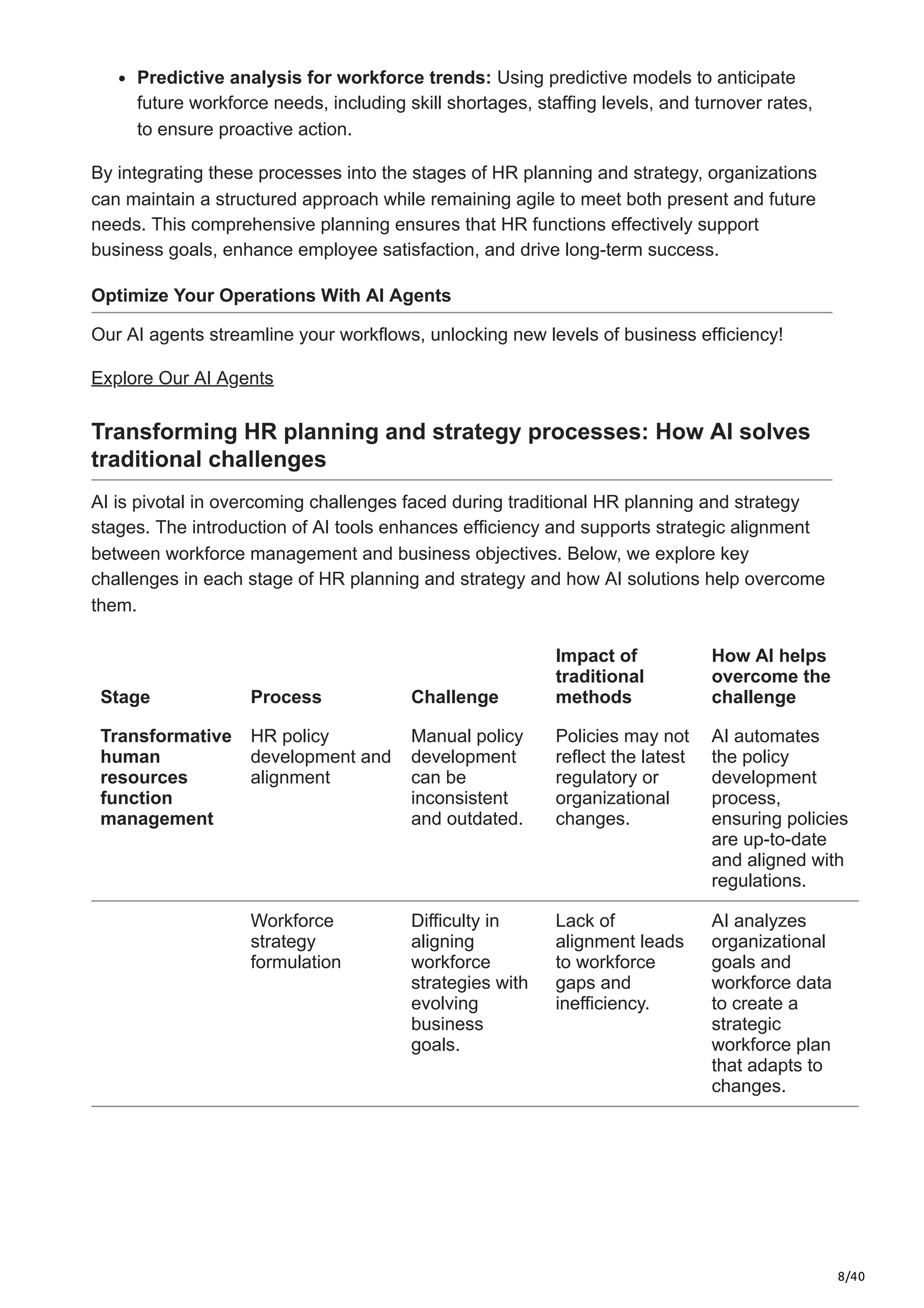
AI is pivotal in overcoming challenges faced during traditional HR planning and strategy
stages. The introduction of AI tools enhances efficiency and supports strategic alignment
between workforce management and business objectives. Below, we explore key
challenges in each stage of HR planning and strategy and how AI solutions help overcome
them.
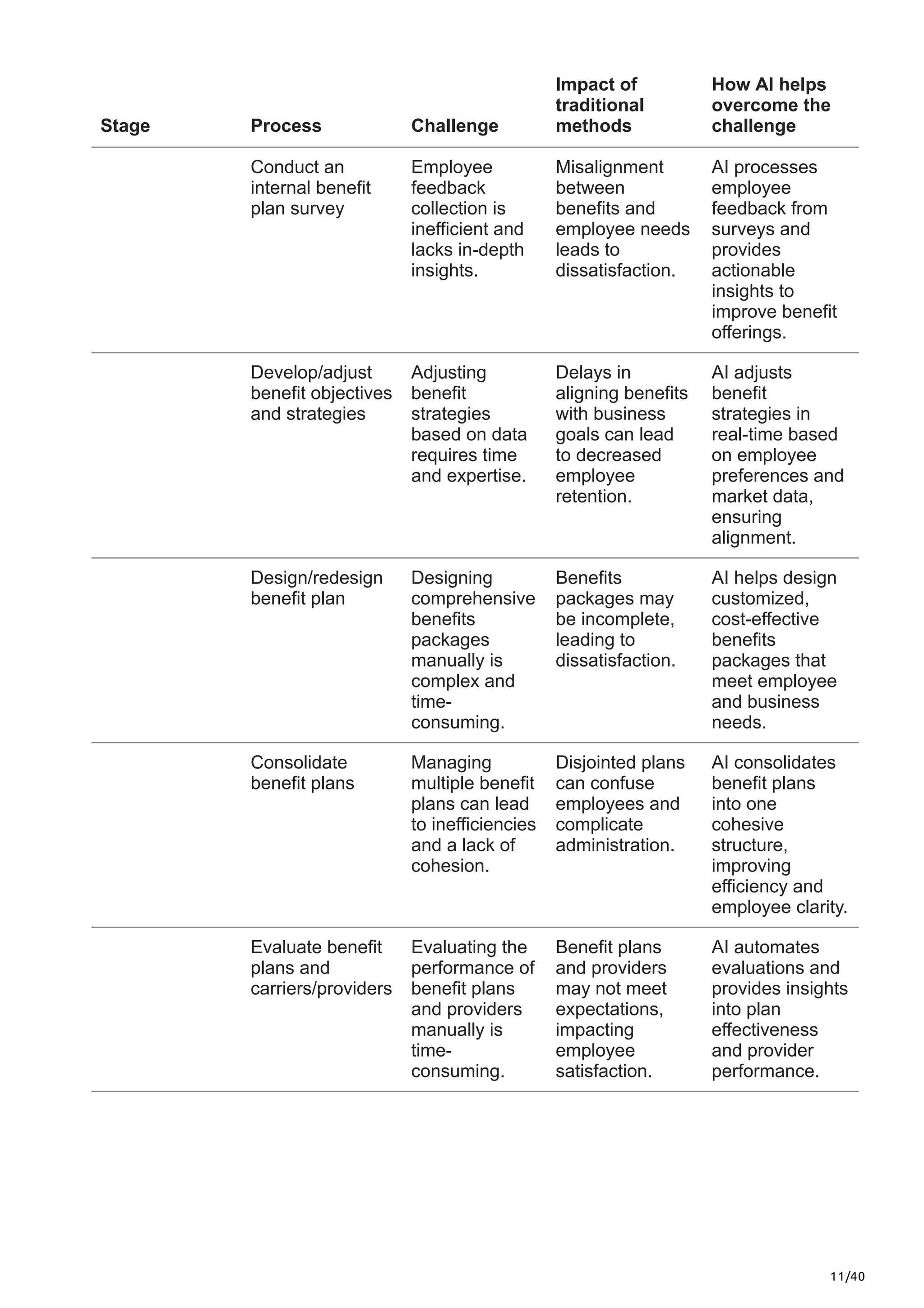
Stage Process Challenge
Impact of
traditional
methods
How AI helps
overcome the
challenge
Transformative
human
resources
function
management
HR policy
development and
alignment
Manual policy
development
can be
inconsistent
and outdated.
Policies may not
reflect the latest
regulatory or
organizational
changes.
AI automates
the policy
development
process,
ensuring policies
are up-to-date
and aligned with
regulations.
Workforce
strategy
formulation
Difficulty in
aligning
workforce
strategies with
evolving
business
goals.
Lack of
alignment leads
to workforce
gaps and
inefficiency.
AI analyzes
organizational
goals and
workforce data
to create a
strategic
workforce plan
that adapts to
changes.
9/40
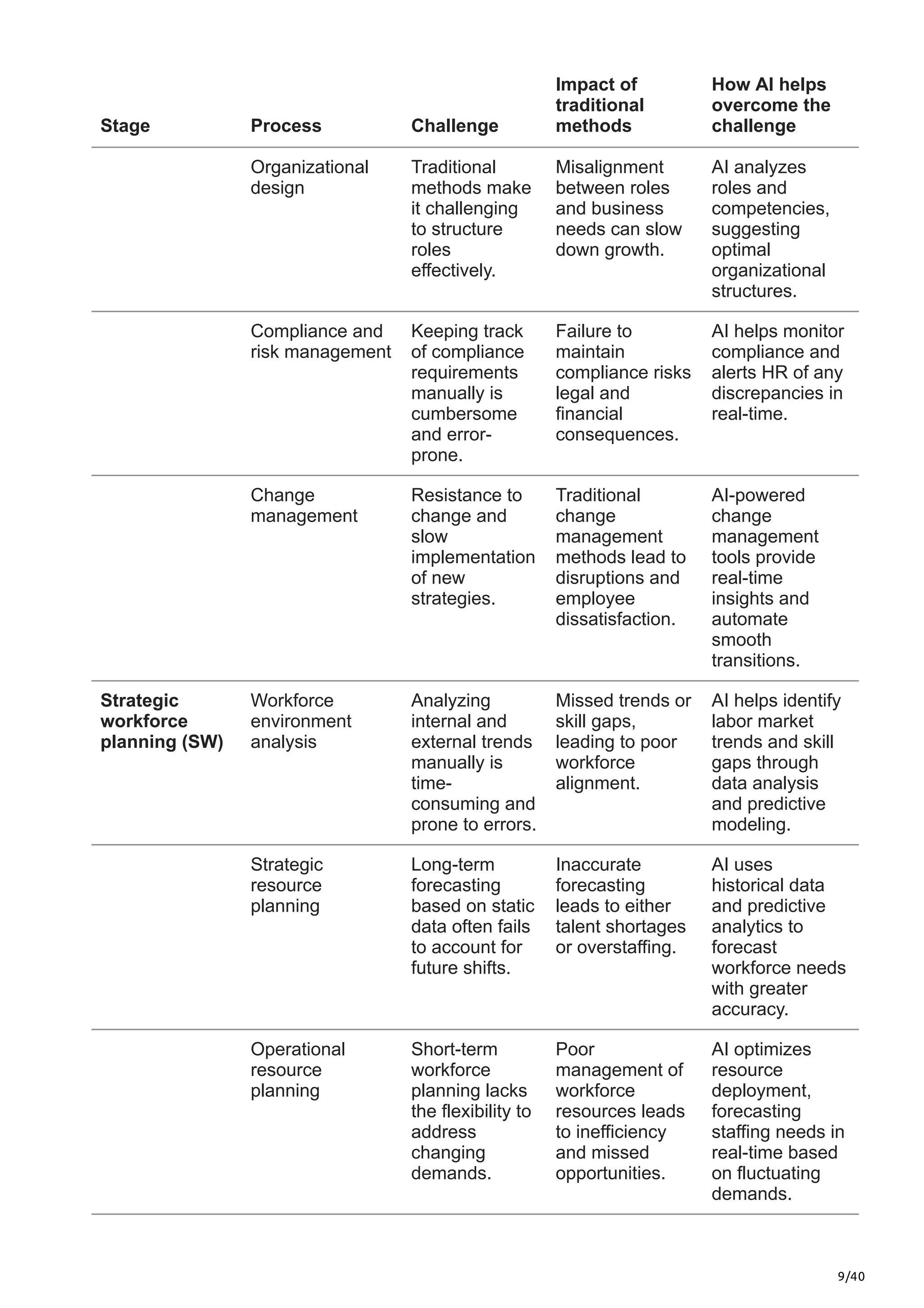
Stage Process Challenge
Impact of
traditional
methods
How AI helps
overcome the
challenge
Organizational
design
Traditional
methods make
it challenging
to structure
roles
effectively.
Misalignment
between roles
and business
needs can slow
down growth.
AI analyzes
roles and
competencies,
suggesting
optimal
organizational
structures.
Compliance and
risk management
Keeping track
of compliance
requirements
manually is
cumbersome
and error-
prone.
Failure to
maintain
compliance risks
legal and
financial
consequences.
AI helps monitor
compliance and
alerts HR of any
discrepancies in
real-time.
Change
management
Resistance to
change and
slow
implementation
of new
strategies.
Traditional
change
management
methods lead to
disruptions and
employee
dissatisfaction.
AI-powered
change
management
tools provide
real-time
insights and
automate
smooth
transitions.
Strategic
workforce
planning (SW)
Workforce
environment
analysis
Analyzing
internal and
external trends
manually is
time-
consuming and
prone to errors.
Missed trends or
skill gaps,
leading to poor
workforce
alignment.
AI helps identify
labor market
trends and skill
gaps through
data analysis
and predictive
modeling.
Strategic
resource
planning
Long-term
forecasting
based on static
data often fails
to account for
future shifts.
Inaccurate
forecasting
leads to either
talent shortages
or overstaffing.
AI uses
historical data
and predictive
analytics to
forecast
workforce needs
with greater
accuracy.
Operational
resource
planning
Short-term
workforce
planning lacks
the flexibility to
address
changing
demands.
Poor
management of
workforce
resources leads
to inefficiency
and missed
opportunities.
AI optimizes
resource
deployment,
forecasting
staffing needs in
real-time based
on fluctuating
demands.
10/40
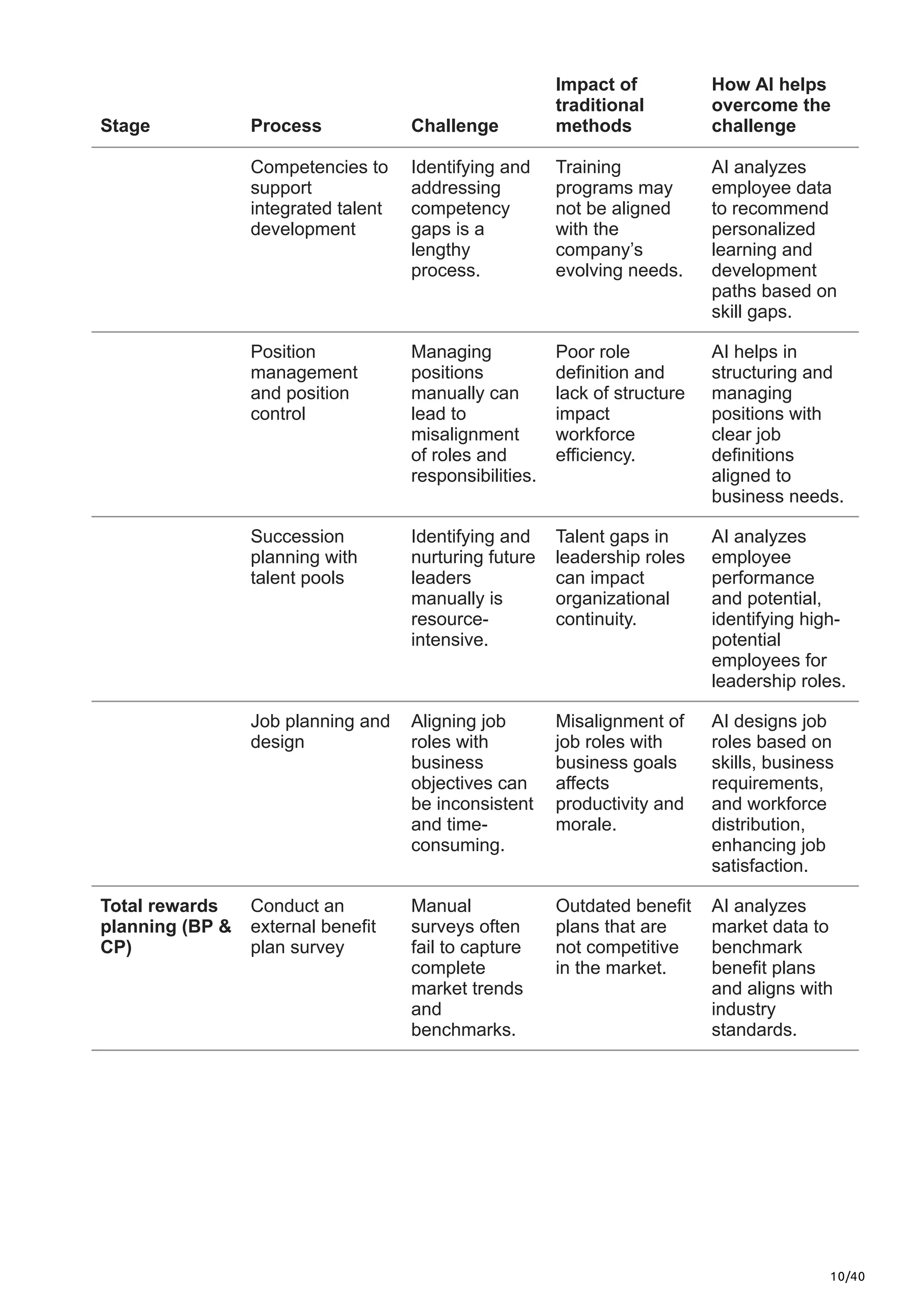
Stage Process Challenge
Impact of
traditional
methods
How AI helps
overcome the
challenge
Competencies to
support
integrated talent
development
Identifying and
addressing
competency
gaps is a
lengthy
process.
Training
programs may
not be aligned
with the
company’s
evolving needs.
AI analyzes
employee data
to recommend
personalized
learning and
development
paths based on
skill gaps.
Position
management
and position
control
Managing
positions
manually can
lead to
misalignment
of roles and
responsibilities.
Poor role
definition and
lack of structure
impact
workforce
efficiency.
AI helps in
structuring and
managing
positions with
clear job
definitions
aligned to
business needs.
Succession
planning with
talent pools
Identifying and
nurturing future
leaders
manually is
resource-
intensive.
Talent gaps in
leadership roles
can impact
organizational
continuity.
AI analyzes
employee
performance
and potential,
identifying high-
potential
employees for
leadership roles.
Job planning and
design
Aligning job
roles with
business
objectives can
be inconsistent
and time-
consuming.
Misalignment of
job roles with
business goals
affects
productivity and
morale.
AI designs job
roles based on
skills, business
requirements,
and workforce
distribution,
enhancing job
satisfaction.
Total rewards
planning (BP &
CP)
Conduct an
external benefit
plan survey
Manual
surveys often
fail to capture
complete
market trends
and
benchmarks.
Outdated benefit
plans that are
not competitive
in the market.
AI analyzes
market data to
benchmark
benefit plans
and aligns with
industry
standards.
11/40
Stage Process Challenge
Impact of
traditional
methods
How AI helps
overcome the
challenge
Conduct an
internal benefit
plan survey
Employee
feedback
collection is
inefficient and
lacks in-depth
insights.
Misalignment
between
benefits and
employee needs
leads to
dissatisfaction.
AI processes
employee
feedback from
surveys and
provides
actionable
insights to
improve benefit
offerings.
Develop/adjust
benefit objectives
and strategies
Adjusting
benefit
strategies
based on data
requires time
and expertise.
Delays in
aligning benefits
with business
goals can lead
to decreased
employee
retention.
AI adjusts
benefit
strategies in
real-time based
on employee
preferences and
market data,
ensuring
alignment.
Design/redesign
benefit plan
Designing
comprehensive
benefits
packages
manually is
complex and
time-
consuming.
Benefits
packages may
be incomplete,
leading to
dissatisfaction.
AI helps design
customized,
cost-effective
benefits
packages that
meet employee
and business
needs.
Consolidate
benefit plans
Managing
multiple benefit
plans can lead
to inefficiencies
and a lack of
cohesion.
Disjointed plans
can confuse
employees and
complicate
administration.
AI consolidates
benefit plans
into one
cohesive
structure,
improving
efficiency and
employee clarity.
Evaluate benefit
plans and
carriers/providers
Evaluating the
performance of
benefit plans
and providers
manually is
time-
consuming.
Benefit plans
and providers
may not meet
expectations,
impacting
employee
satisfaction.
AI automates
evaluations and
provides insights
into plan
effectiveness
and provider
performance.
12/40
Stage Process Challenge
Impact of
traditional
methods
How AI helps
overcome the
challenge
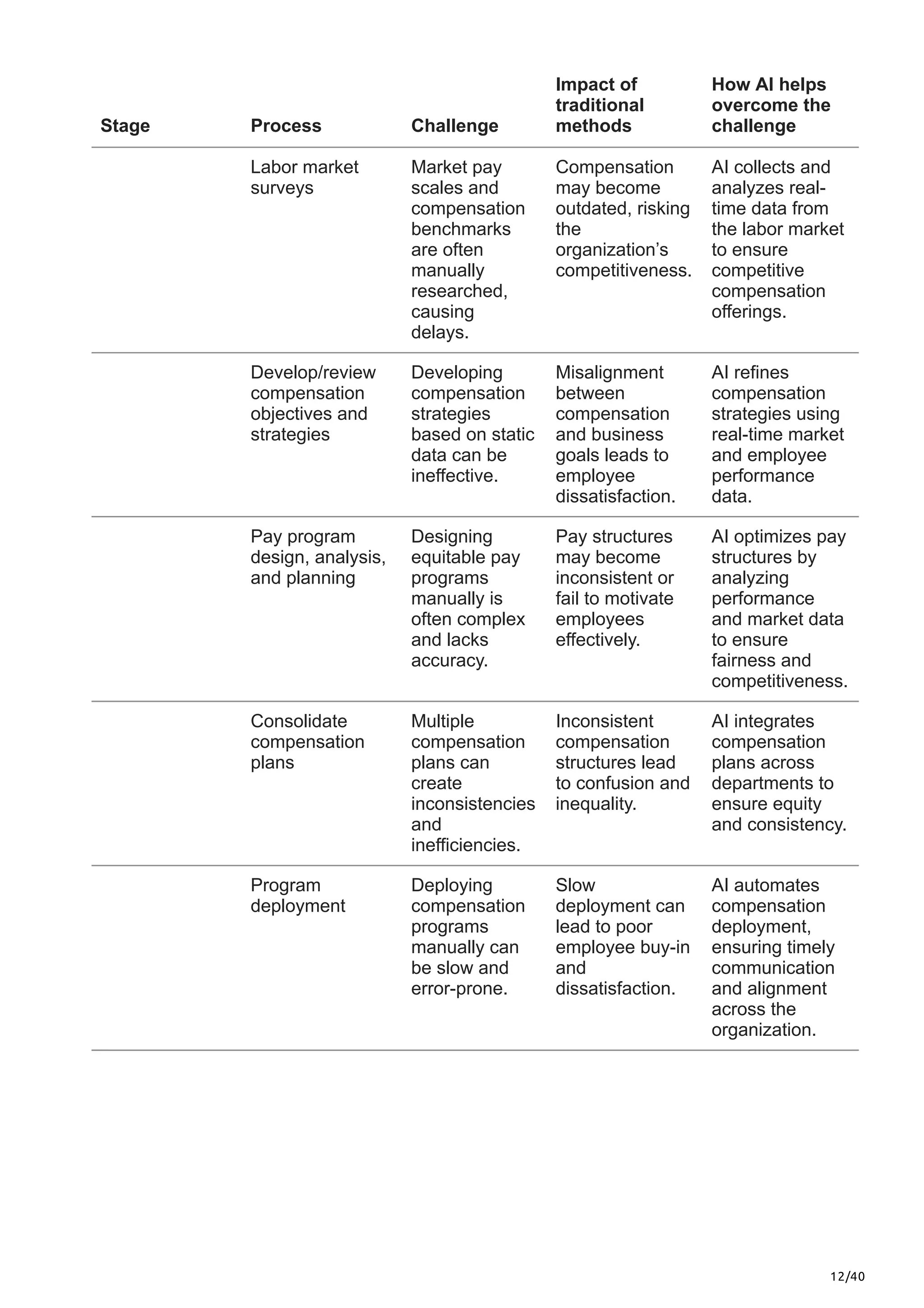
Labor market
surveys
Market pay
scales and
compensation
benchmarks
are often
manually
researched,
causing
delays.
Compensation
may become
outdated, risking
the
organization’s
competitiveness.
AI collects and
analyzes real-
time data from
the labor market
to ensure
competitive
compensation
offerings.
Develop/review
compensation
objectives and
strategies
Developing
compensation
strategies
based on static
data can be
ineffective.
Misalignment
between
compensation
and business
goals leads to
employee
dissatisfaction.
AI refines
compensation
strategies using
real-time market
and employee
performance
data.
Pay program
design, analysis,
and planning
Designing
equitable pay
programs
manually is
often complex
and lacks
accuracy.
Pay structures
may become
inconsistent or
fail to motivate
employees
effectively.
AI optimizes pay
structures by
analyzing
performance
and market data
to ensure
fairness and
competitiveness.
Consolidate
compensation
plans
Multiple
compensation
plans can
create
inconsistencies
and
inefficiencies.
Inconsistent
compensation
structures lead
to confusion and
inequality.
AI integrates
compensation
plans across
departments to
ensure equity
and consistency.
Program
deployment
Deploying
compensation
programs
manually can
be slow and
error-prone.
Slow
deployment can
lead to poor
employee buy-in
and
dissatisfaction.
AI automates
compensation
deployment,
ensuring timely
communication
and alignment
across the
organization.
13/40
Stage Process Challenge
Impact of
traditional
methods
How AI helps
overcome the
challenge
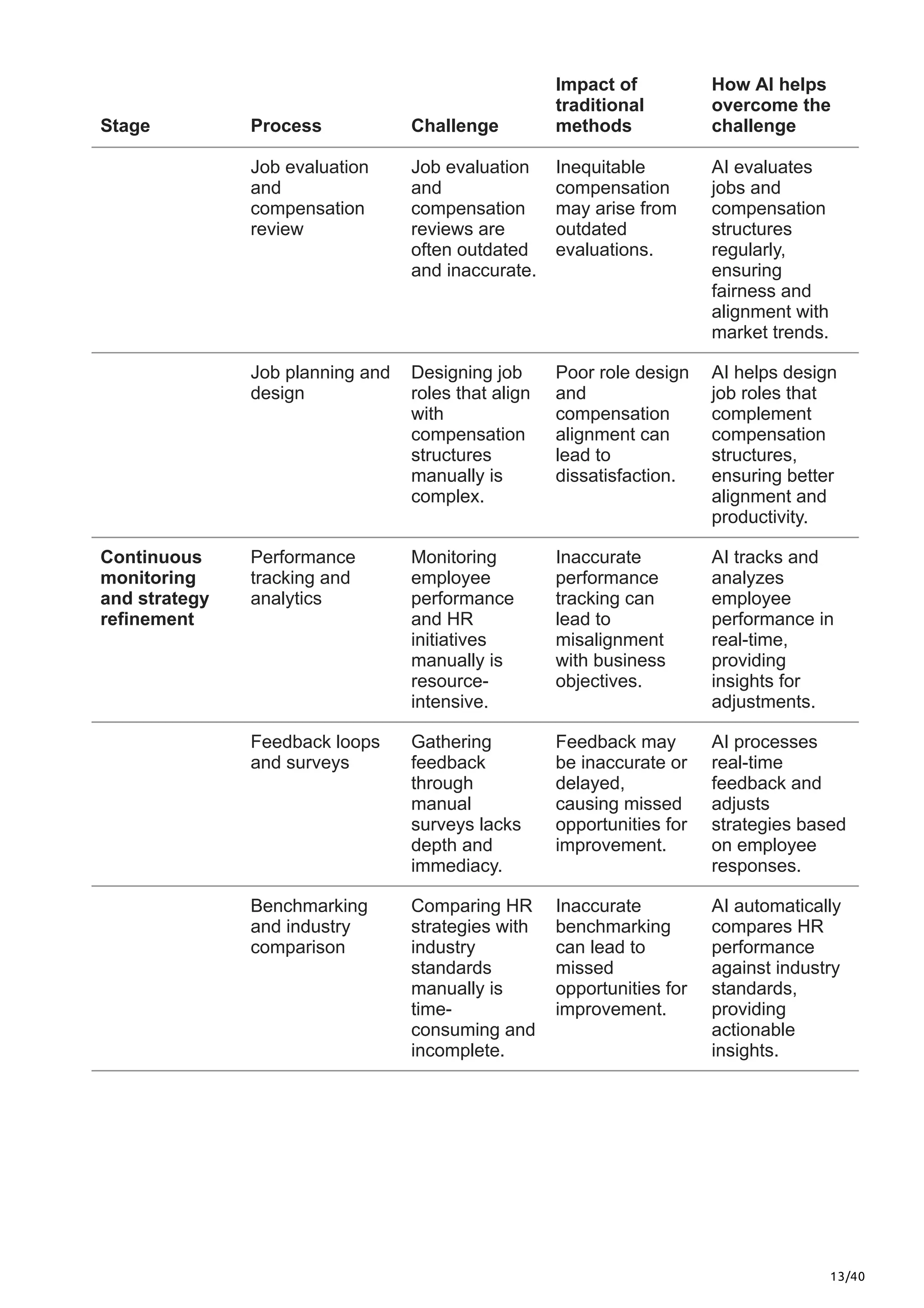
Job evaluation
and
compensation
review
Job evaluation
and
compensation
reviews are
often outdated
and inaccurate.
Inequitable
compensation
may arise from
outdated
evaluations.
AI evaluates
jobs and
compensation
structures
regularly,
ensuring
fairness and
alignment with
market trends.
Job planning and
design
Designing job
roles that align
with
compensation
structures
manually is
complex.
Poor role design
and
compensation
alignment can
lead to
dissatisfaction.
AI helps design
job roles that
complement
compensation
structures,
ensuring better
alignment and
productivity.
Continuous
monitoring
and strategy
refinement
Performance
tracking and
analytics
Monitoring
employee
performance
and HR
initiatives
manually is
resource-
intensive.
Inaccurate
performance
tracking can
lead to
misalignment
with business
objectives.
AI tracks and
analyzes
employee
performance in
real-time,
providing
insights for
adjustments.
Feedback loops
and surveys
Gathering
feedback
through
manual
surveys lacks
depth and
immediacy.
Feedback may
be inaccurate or
delayed,
causing missed
opportunities for
improvement.
AI processes
real-time
feedback and
adjusts
strategies based
on employee
responses.
Benchmarking
and industry
comparison
Comparing HR
strategies with
industry
standards
manually is
time-
consuming and
incomplete.
Inaccurate
benchmarking
can lead to
missed
opportunities for
improvement.
AI automatically
compares HR
performance
against industry
standards,
providing
actionable
insights.
14/40
Stage Process Challenge
Impact of
traditional
methods
How AI helps
overcome the
challenge
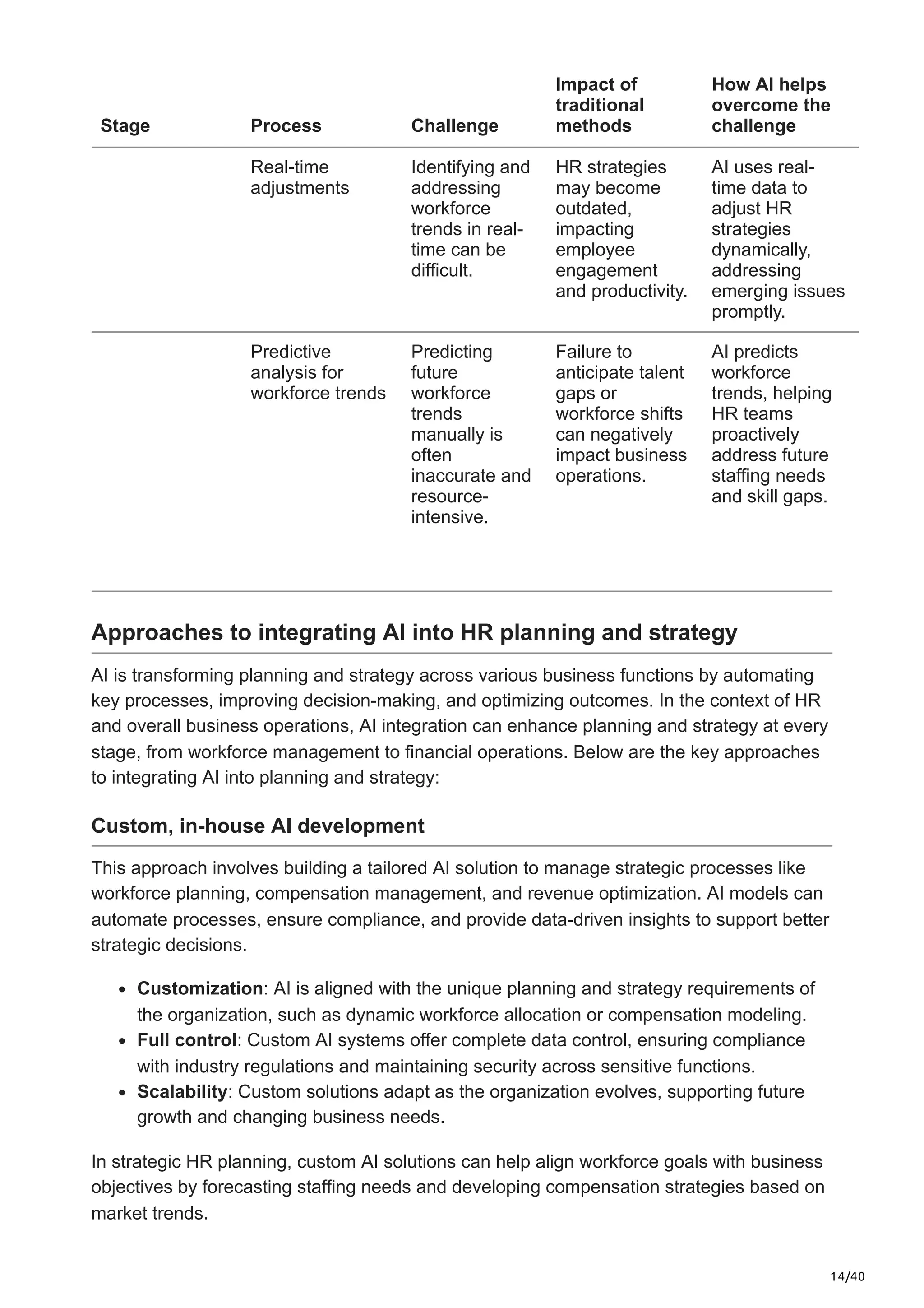
Real-time
adjustments
Identifying and
addressing
workforce
trends in real-
time can be
difficult.
HR strategies
may become
outdated,
impacting
employee
engagement
and productivity.
AI uses real-
time data to
adjust HR
strategies
dynamically,
addressing
emerging issues
promptly.
Predictive
analysis for
workforce trends
Predicting
future
workforce
trends
manually is
often
inaccurate and
resource-
intensive.
Failure to
anticipate talent
gaps or
workforce shifts
can negatively
impact business
operations.
AI predicts
workforce
trends, helping
HR teams
proactively
address future
staffing needs
and skill gaps.
Approaches to integrating AI into HR planning and strategy
AI is transforming planning and strategy across various business functions by automating
key processes, improving decision-making, and optimizing outcomes. In the context of HR
and overall business operations, AI integration can enhance planning and strategy at every
stage, from workforce management to financial operations. Below are the key approaches
to integrating AI into planning and strategy:
Custom, in-house AI development
This approach involves building a tailored AI solution to manage strategic processes like
workforce planning, compensation management, and revenue optimization. AI models can
automate processes, ensure compliance, and provide data-driven insights to support better
strategic decisions.
Customization: AI is aligned with the unique planning and strategy requirements of
the organization, such as dynamic workforce allocation or compensation modeling.
Full control: Custom AI systems offer complete data control, ensuring compliance
with industry regulations and maintaining security across sensitive functions.
Scalability: Custom solutions adapt as the organization evolves, supporting future
growth and changing business needs.
In strategic HR planning, custom AI solutions can help align workforce goals with business
objectives by forecasting staffing needs and developing compensation strategies based on
market trends.
15/40
Using AI point solutions
Point solutions refer to specialized AI tools designed to tackle specific strategic tasks.
These pre-built tools address planning needs such as labor market analysis, compensation
reviews, or benefit plan design.
Quick deployment: Point solutions are ready for immediate use and integrate easily
into existing systems, enabling faster implementation.
Cost-effective: These tools are more affordable than custom AI solutions, offering
focused, high-impact solutions for key strategic processes.
Ease of use: They are easy to deploy and integrate with ERP, CRM, and other
planning tools, making them ideal for organizations that need specific capabilities
without overhauling their entire system.
In HR planning, point solutions like automated workforce analytics or compensation
benchmarking tools provide faster insights into workforce needs, market trends, and
internal alignment.
Adopting a comprehensive AI platform
A comprehensive AI platform integrates various functionalities across the business,
providing an all-in-one solution for planning and strategy. For HR and revenue
management, such platforms optimize processes from workforce planning to financial
forecasting, ensuring consistency and compliance across functions.
Centralized data and compliance: AI platforms bring together all data into one
cohesive system, ensuring compliance with legal regulations while improving data
quality and decision-making across departments.
End-to-end automation: These platforms automate entire processes, including
compensation management, benefits planning, workforce deployment, and
performance tracking, reducing manual intervention and improving operational
efficiency.
Scalability and flexibility: AI platforms support evolving business needs, adapting to
global expansion and shifting industry standards, making them suitable for both small
businesses and large enterprises.
Efficiency boost: These platforms can significantly enhance planning accuracy by
forecasting trends, managing talent pipelines, and optimizing compensation and
rewards programs.
In HR planning and strategy, comprehensive AI platforms can provide real-time insights
into employee performance, optimize workforce distribution, and ensure that all
compensation and benefits align with business goals.
Continuous monitoring and strategy refinement
AI supports continuous improvement of planning and strategy by providing real-time data
analytics and insights that guide adaptive decision-making. AI solutions track key
performance indicators (KPIs), gather feedback, and offer predictive analytics to help refine
16/40
strategies and processes as conditions evolve.
Real-time adjustments: AI tools enable businesses to monitor changes in market
trends or workforce dynamics and make adjustments, ensuring that strategies remain
aligned with business goals.
Predictive analytics: AI-driven predictive models help anticipate changes in labor
market conditions, workforce needs, and revenue projections, enabling proactive
planning.
Feedback loops: Continuous feedback from both internal and external stakeholders
helps refine planning processes and strategies, ensuring that they remain relevant
and effective.
In the context of HR planning, continuous monitoring allows organizations to stay agile,
refine talent management practices, and adjust compensation strategies to meet market
demands.
By integrating AI into planning and strategy, businesses can streamline key processes,
enhance operational efficiency, and support data-driven decision-making. Whether through
custom AI development, point solutions, comprehensive platforms, or continuous
monitoring, AI helps organizations refine their strategies and remain agile in an increasingly
complex and competitive business environment.
AI applications transforming the HR planning and strategy
processes
AI is reshaping HR planning and strategy by automating key processes, optimizing
workforce management, and enhancing decision-making. AI-driven solutions improve
efficiency, accuracy, and strategic alignment from workforce planning to compensation
management. Below is a breakdown of AI applications across critical HR planning and
strategy stages.
17/40
Automated policy updates
Sentiment analysis
Trend analysis
Scenario modeling
Role alignment analysis
AI-driven labor market analytics
Skill gap detection
Competency-based talent matching
Attrition risk assessment
Intelligent career pathing
Transformative HR
function management
Strategic workforce
planning
Total rewards
planning
Continuous monitoring
and strategy refinement
HR performance analytics
Employee sentimen analysis
Industry benchmarking insights
Real-time workforce monitoring
External benefits benchmarking
Internal benefits sentiment analysis
AI-driven benefits optimization
Compensation strategy refinement
Pay equity assessment
Applications of AI in HR planing and strategies
Transformative HR function management
AI is revolutionizing HR function management by automating key processes, ensuring
compliance, and optimizing workforce strategies. From policy development to change
management, AI-driven solutions enhance efficiency, accuracy, and decision-making.
Below is a breakdown of AI applications across core HR function management processes.
HR policy development and alignment
AI streamlines policy creation and ensures alignment with organizational goals and
compliance requirements.
Automated policy updates: AI monitors regulatory changes and recommends policy
revisions.
Sentiment analysis: AI analyzes employee feedback to refine HR policies based on
workforce needs.
Compliance tracking: AI flags potential policy gaps and ensures adherence to
industry standards.
Workforce strategy formulation
18/40
AI enhances workforce planning by providing data-driven insights for long-term HR strategy
development.
Trend analysis: AI identifies workforce trends and predicts future HR needs.
Scenario modeling: AI evaluates different workforce strategies based on business
goals.
Resource optimization: AI suggests staffing levels and workforce distribution
strategies.
Organizational design
AI helps structure roles and responsibilities for optimal workforce efficiency.
Role alignment analysis: AI assesses job structures and suggests improvements.
Organizational modeling: AI simulates different role structures for business
scalability.
Competency mapping: AI identifies skill gaps and aligns talent with business needs.
Compliance and risk management
AI automates compliance monitoring and risk mitigation in HR operations.
Regulatory compliance monitoring: AI scans legal databases to flag policy risks.
Fraud detection: AI identifies anomalies in payroll and HR transactions.
Workforce risk assessment: AI evaluates employee data to predict compliance
issues.
Change management
AI supports smooth transitions when implementing HR strategy shifts or new technologies.
Employee sentiment tracking: AI measures workforce response to changes and
suggests engagement strategies.
Predictive impact analysis: AI assesses potential disruptions before implementing
changes.
Automated communication: AI personalizes change management communication
to enhance adoption.
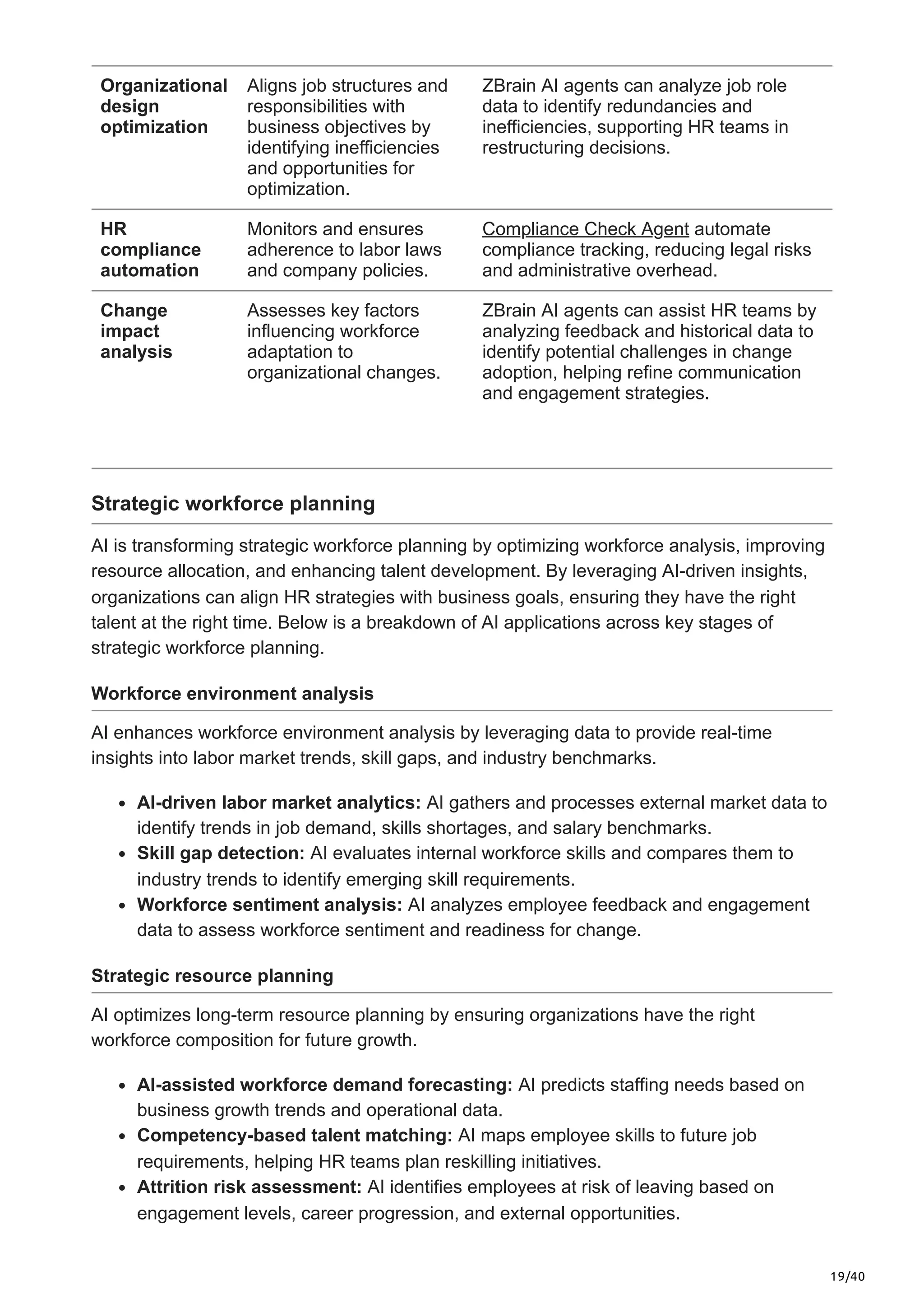
AI-driven
policy
alignment
Supports HR teams in
maintaining updated and
compliant policies.
Compliance Improvement Agent can
assist in reviewing internal policies by
identifying inconsistencies and
summarizing legal updates, helping HR
teams assess compliance risks more
efficiently.
Strategic
workforce
planning
Develops a roadmap for
HR transformation by
assessing workforce
demographics, skills
distribution, and
operational needs.
Resource Assignment Agent can analyze
workforce data to identify gaps, optimize
resource allocation, and support data-
driven HR planning.
19/40
Organizational
design
optimization
Aligns job structures and
responsibilities with
business objectives by
identifying inefficiencies
and opportunities for
optimization.
ZBrain AI agents can analyze job role
data to identify redundancies and
inefficiencies, supporting HR teams in
restructuring decisions.
HR
compliance
automation
Monitors and ensures
adherence to labor laws
and company policies.
Compliance Check Agent automate
compliance tracking, reducing legal risks
and administrative overhead.
Change
impact
analysis
Assesses key factors
influencing workforce
adaptation to
organizational changes.
ZBrain AI agents can assist HR teams by
analyzing feedback and historical data to
identify potential challenges in change
adoption, helping refine communication
and engagement strategies.
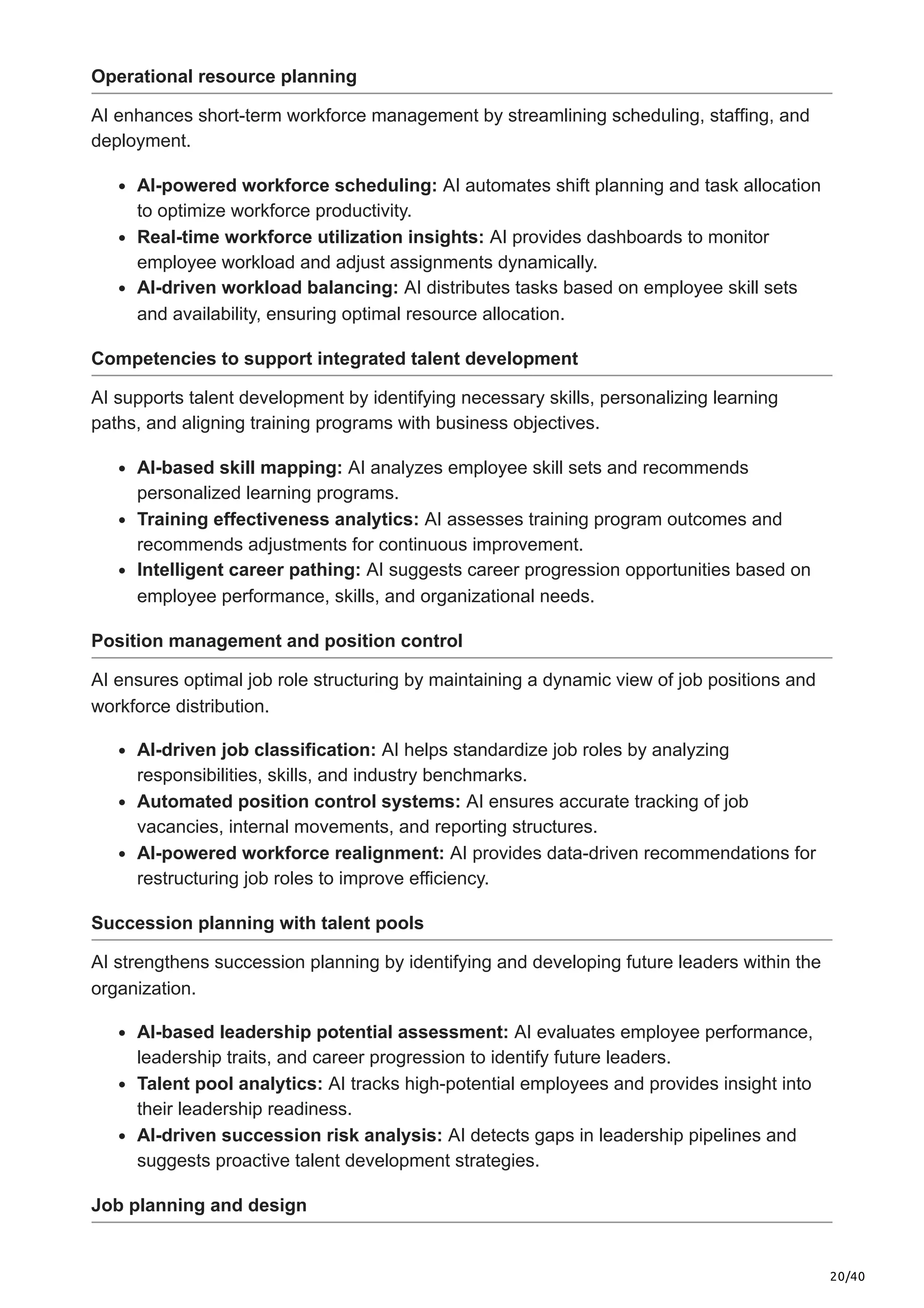
Strategic workforce planning
AI is transforming strategic workforce planning by optimizing workforce analysis, improving
resource allocation, and enhancing talent development. By leveraging AI-driven insights,
organizations can align HR strategies with business goals, ensuring they have the right
talent at the right time. Below is a breakdown of AI applications across key stages of
strategic workforce planning.
Workforce environment analysis
AI enhances workforce environment analysis by leveraging data to provide real-time
insights into labor market trends, skill gaps, and industry benchmarks.
AI-driven labor market analytics: AI gathers and processes external market data to
identify trends in job demand, skills shortages, and salary benchmarks.
Skill gap detection: AI evaluates internal workforce skills and compares them to
industry trends to identify emerging skill requirements.
Workforce sentiment analysis: AI analyzes employee feedback and engagement
data to assess workforce sentiment and readiness for change.
Strategic resource planning
AI optimizes long-term resource planning by ensuring organizations have the right
workforce composition for future growth.
AI-assisted workforce demand forecasting: AI predicts staffing needs based on
business growth trends and operational data.
Competency-based talent matching: AI maps employee skills to future job
requirements, helping HR teams plan reskilling initiatives.
Attrition risk assessment: AI identifies employees at risk of leaving based on
engagement levels, career progression, and external opportunities.
20/40
Operational resource planning
AI enhances short-term workforce management by streamlining scheduling, staffing, and
deployment.
AI-powered workforce scheduling: AI automates shift planning and task allocation
to optimize workforce productivity.
Real-time workforce utilization insights: AI provides dashboards to monitor
employee workload and adjust assignments dynamically.
AI-driven workload balancing: AI distributes tasks based on employee skill sets
and availability, ensuring optimal resource allocation.
Competencies to support integrated talent development
AI supports talent development by identifying necessary skills, personalizing learning
paths, and aligning training programs with business objectives.
AI-based skill mapping: AI analyzes employee skill sets and recommends
personalized learning programs.
Training effectiveness analytics: AI assesses training program outcomes and
recommends adjustments for continuous improvement.
Intelligent career pathing: AI suggests career progression opportunities based on
employee performance, skills, and organizational needs.
Position management and position control
AI ensures optimal job role structuring by maintaining a dynamic view of job positions and
workforce distribution.
AI-driven job classification: AI helps standardize job roles by analyzing
responsibilities, skills, and industry benchmarks.
Automated position control systems: AI ensures accurate tracking of job
vacancies, internal movements, and reporting structures.
AI-powered workforce realignment: AI provides data-driven recommendations for
restructuring job roles to improve efficiency.
Succession planning with talent pools
AI strengthens succession planning by identifying and developing future leaders within the
organization.
AI-based leadership potential assessment: AI evaluates employee performance,
leadership traits, and career progression to identify future leaders.
Talent pool analytics: AI tracks high-potential employees and provides insight into
their leadership readiness.
AI-driven succession risk analysis: AI detects gaps in leadership pipelines and
suggests proactive talent development strategies.
Job planning and design
21/40
AI enhances job planning by ensuring roles are designed to maximize productivity and
employee engagement.
AI-powered job role recommendations: AI suggests job structure improvements
based on workflow analysis.
Workload optimization analytics: AI evaluates task distribution to prevent
employee burnout and enhance job satisfaction.
AI-driven job enrichment strategies: AI identifies ways to enhance job roles for
improved employee engagement and performance.
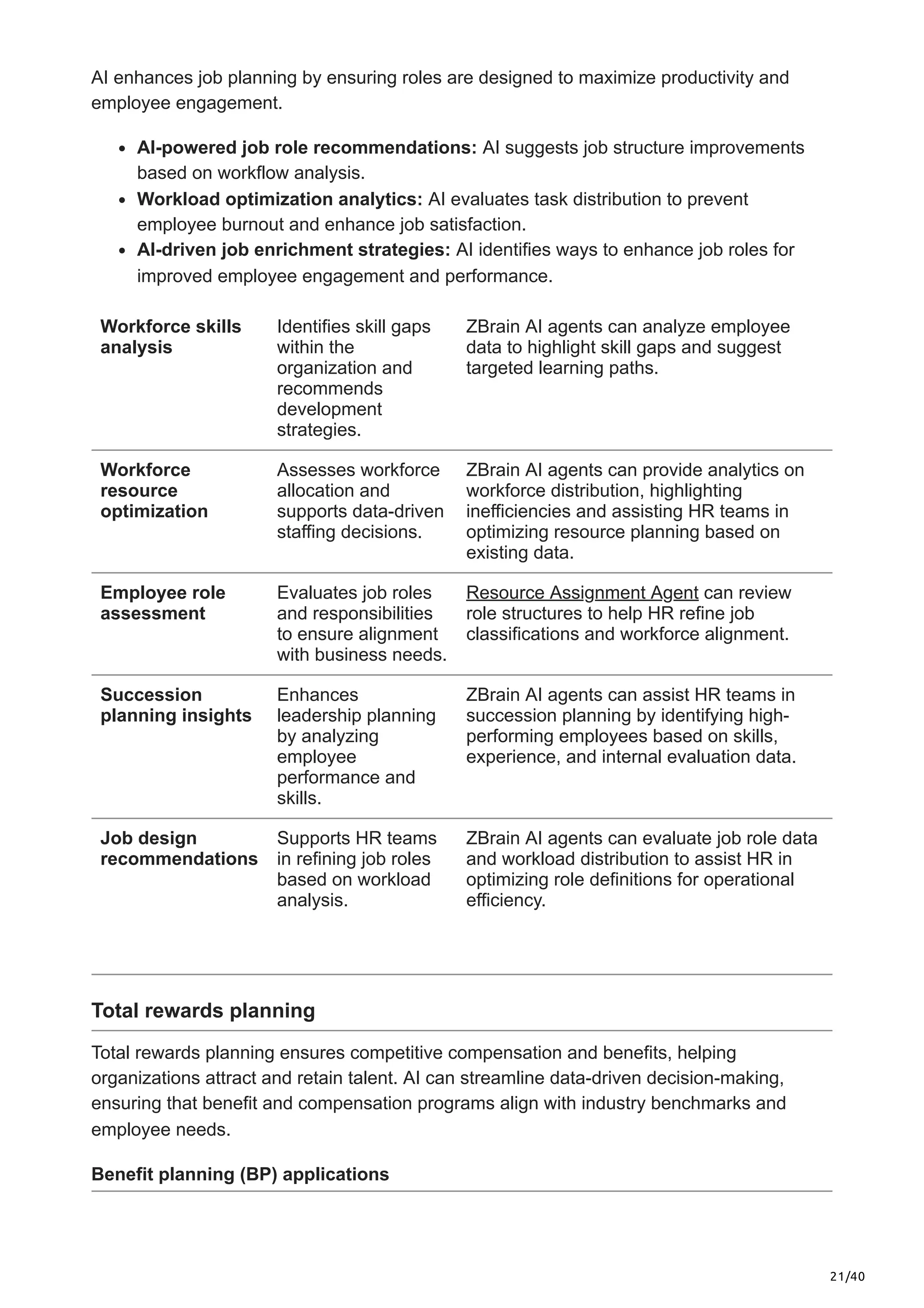
Workforce skills
analysis
Identifies skill gaps
within the
organization and
recommends
development
strategies.
ZBrain AI agents can analyze employee
data to highlight skill gaps and suggest
targeted learning paths.
Workforce
resource
optimization
Assesses workforce
allocation and
supports data-driven
staffing decisions.
ZBrain AI agents can provide analytics on
workforce distribution, highlighting
inefficiencies and assisting HR teams in
optimizing resource planning based on
existing data.
Employee role
assessment
Evaluates job roles
and responsibilities
to ensure alignment
with business needs.
Resource Assignment Agent can review
role structures to help HR refine job
classifications and workforce alignment.
Succession
planning insights
Enhances
leadership planning
by analyzing
employee
performance and
skills.
ZBrain AI agents can assist HR teams in
succession planning by identifying high-
performing employees based on skills,
experience, and internal evaluation data.
Job design
recommendations
Supports HR teams
in refining job roles
based on workload
analysis.
ZBrain AI agents can evaluate job role data
and workload distribution to assist HR in
optimizing role definitions for operational
efficiency.
Total rewards planning
Total rewards planning ensures competitive compensation and benefits, helping
organizations attract and retain talent. AI can streamline data-driven decision-making,
ensuring that benefit and compensation programs align with industry benchmarks and
employee needs.
Benefit planning (BP) applications
22/40
External benefits benchmarking – Compares benefits with industry standards for
competitive positioning.
Internal benefits sentiment analysis – Analyzes employee feedback to align
benefits with employee needs.
AI-driven benefits optimization – Recommends adjustments to improve cost
efficiency and satisfaction.
Provider evaluation automation – Assesses benefit providers’ effectiveness and
cost-efficiency.
Benefits plan consolidation insights – Identifies overlaps or inefficiencies in benefit
offerings.
Compensation planning (CP) applications
Labor market compensation analysis – Compares pay structures with external
labor market data.
Compensation strategy refinement – Recommends adjustments based on market
trends and workforce data.
Pay equity assessment – Identifies disparities and suggests corrections for fair pay
distribution.
Automated salary structuring – Assists in designing optimal salary bands and
incentive structures.
Compensation program deployment insights – Analyzes compensation rollout
effectiveness and employee response.
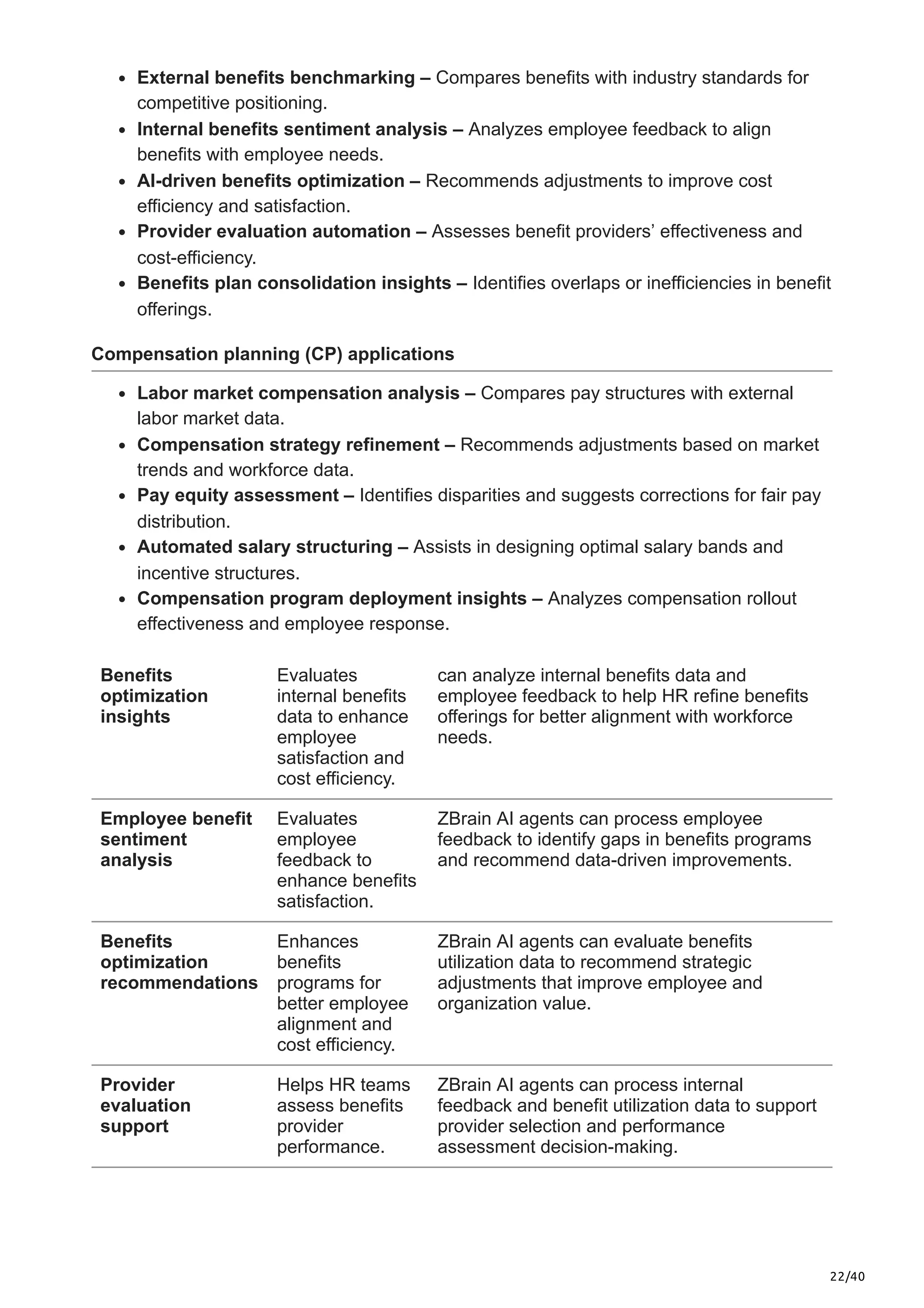
Benefits
optimization
insights
Evaluates
internal benefits
data to enhance
employee
satisfaction and
cost efficiency.
can analyze internal benefits data and
employee feedback to help HR refine benefits
offerings for better alignment with workforce
needs.
Employee benefit
sentiment
analysis
Evaluates
employee
feedback to
enhance benefits
satisfaction.
ZBrain AI agents can process employee
feedback to identify gaps in benefits programs
and recommend data-driven improvements.
Benefits
optimization
recommendations
Enhances
benefits
programs for
better employee
alignment and
cost efficiency.
ZBrain AI agents can evaluate benefits
utilization data to recommend strategic
adjustments that improve employee and
organization value.
Provider
evaluation
support
Helps HR teams
assess benefits
provider
performance.
ZBrain AI agents can process internal
feedback and benefit utilization data to support
provider selection and performance
assessment decision-making.
23/40
Benefits
consolidation
insights
Supports HR in
streamlining
benefit offerings.
ZBrain AI agents can analyze benefits data to
identify potential overlaps and assist in
optimizing plan structures.
Labor market
compensation
analysis
Supports
compensation
benchmarking
within the
organization.
ZBrain AI agents can help HR compare internal
pay structures with available compensation
data to ensure alignment with industry
standards.
Pay structure and
equity
assessment
Ensures fair and
consistent
compensation
across roles.
Salary Data Validation Agent can evaluate
internal compensation data to identify
inconsistencies and support equitable pay
decisions.
Compensation
program insights
Supports HR in
refining salary
structures and
incentives.
ZBrain AI agents can analyze workforce and
compensation data to help HR assess and
optimize pay programs.
Compensation
deployment
insights
Evaluates the
impact of new
pay structures.
ZBrain AI agents can analyze payroll data and
employee feedback to assess the effectiveness
of implemented compensation changes,
helping HR teams refine pay structures for
better alignment with workforce needs.
Continuous monitoring and strategy refinement
Organizations must continuously track performance, gather insights, and refine their
approach based on real-time data to maintain an adaptive and effective HR strategy. AI-
driven monitoring enables HR teams to assess workforce dynamics, benchmark against
industry standards, and make data-driven decisions to optimize talent management. By
leveraging AI, HR teams can proactively identify risks, enhance employee satisfaction, and
ensure that HR initiatives align with business objectives.
HR performance analytics: Tracks key workforce metrics to evaluate HR strategy
effectiveness.
Employee sentiment analysis: Collects and processes employee feedback to
gauge engagement and satisfaction.
Industry benchmarking insights: Compares HR metrics with external standards for
competitiveness.
Real-time workforce monitoring: Identifies emerging workforce challenges and
opportunities.
HR
performance
analytics
Monitors HR KPIs such
as recruitment success,
retention rates, and
training impact.
ZBrain AI agents can analyze HR data to
provide insights into key workforce
performance metrics.
24/40
Employee
sentiment
insights
Assesses employee
satisfaction and
engagement levels.
ZBrain AI agents can process employee
feedback to detect patterns and areas for
improvement.
Benchmarking
insights
Compares HR
performance with industry
standards.
ZBrain AI agents can provide analytics on
how HR strategies align with industry
benchmarks.
Workforce
issue
detection
Identifies workforce
challenges such as
declining engagement or
rising attrition.
ZBrain AI agents can analyze workforce
data to highlight patterns indicating
emerging HR concerns, enabling
proactive intervention.
With AI-powered insights, HR teams can continuously refine their strategies, ensuring they
remain agile and aligned with organizational needs.
Why ZBrain is the ideal platform for HR planning and strategy
operations
ZBrain’s AI-driven platform offers a comprehensive solution for optimizing planning and
strategy processes across various business functions. With advanced automation, data-
driven insights, and seamless integration, ZBrain helps organizations align their HR,
workforce, and operational strategies with business goals.
AI readiness assessment
, enables organizations to assess their preparedness for AI adoption in strategic planning.
By providing actionable insights into current capabilities and areas for improvement, ZBrain
ensures a smooth implementation process, maximizing the impact and ROI of AI-driven
strategies.
Low-code development
intuitive low-code interface allows business users to create customized AI solutions that
align with their planning and strategy needs. This empowers teams to develop and deploy
solutions without deep technical expertise, enabling rapid adoption and enhancing
operational efficiency across departments.
Proprietary data utilization
ZBrain leverages organizations’ proprietary data to build AI models specifically tailored to
unique planning and strategy requirements. By incorporating internal insights, ZBrain
ensures that the AI solutions provide highly relevant and actionable recommendations,
helping businesses make more informed strategic decisions.
Enterprise-ready
25/40
Designed with scalability and security in mind, ZBrain is ideal for enterprise environments.
It integrates seamlessly with existing systems and workflows, supporting large-scale
operations and ensuring that strategic planning and execution can be optimized across the
organization with minimal disruption.
End-to-end support
ZBrain supports the full lifecycle of AI applications for planning and strategy, from
development to deployment and ongoing optimization. This ensures continuous
improvement across various stages of the planning process, including workforce allocation,
compensation management, and resource planning.
Flexible data ingestion
ZBrain Builder seamlessly integrates data from multiple sources in real-time, enabling
businesses to make data-driven decisions based on accurate, up-to-date insights. This
flexibility ensures that the strategic planning process is informed by comprehensive, real-
time data, which is crucial for effective decision-making.
Intelligent agent creation
With ZBrain Builder’s intelligent agents, businesses can automate key tasks in strategic
planning, such as resource allocation, budget forecasting, and performance tracking. This
reduces manual effort, minimizes human error, and ensures alignment with organizational
goals, all while enhancing efficiency and consistency across planning processes.
These capabilities position ZBrain as an ideal platform for businesses looking to optimize
their planning and strategy efforts. By automating key processes, providing real-time
insights, and enabling continuous improvement, ZBrain empowers organizations to refine
their strategies, enhance workforce management, and achieve long-term success.
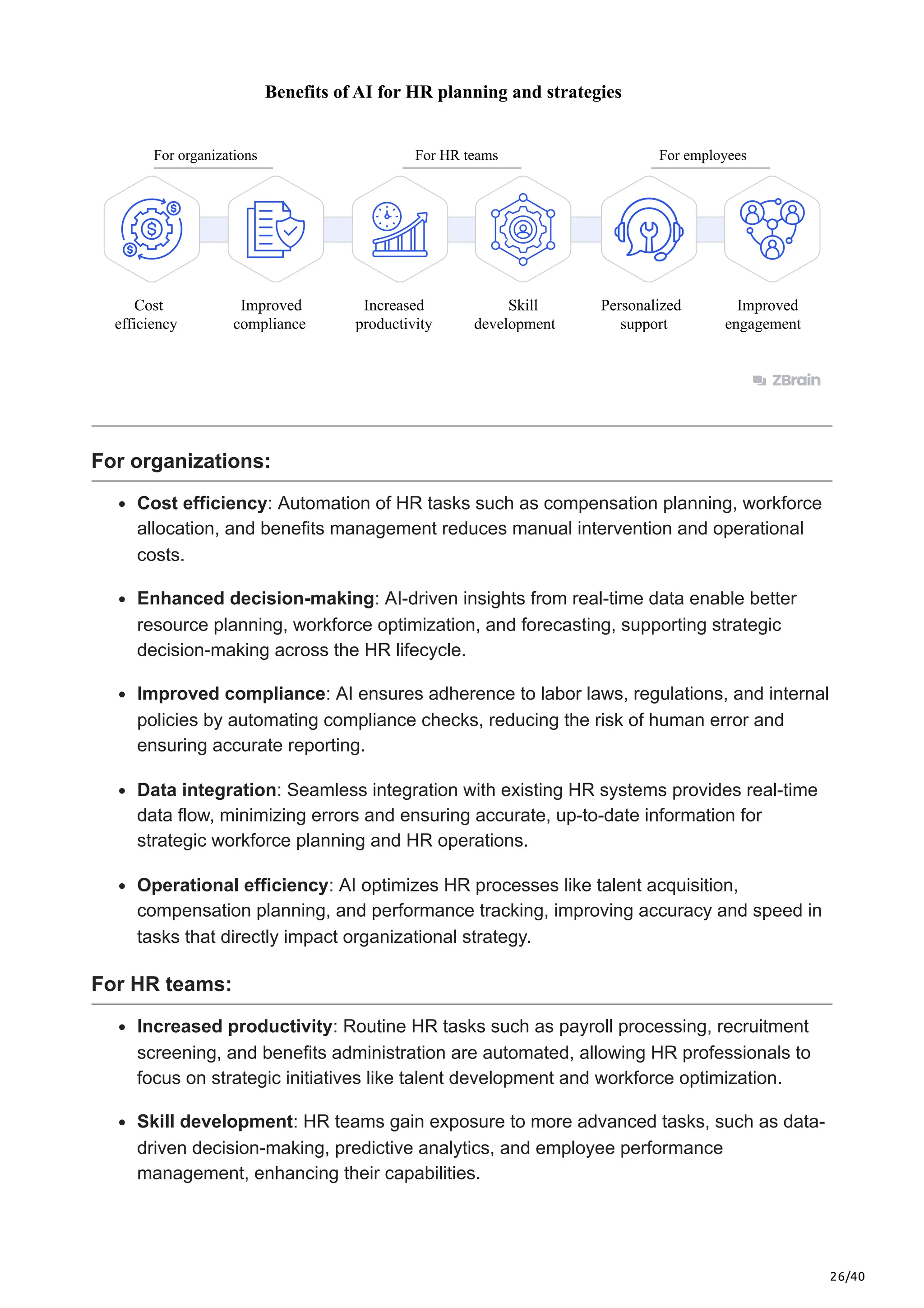
Benefits of implementing AI for HR planning and strategy
Integrating AI into HR operations related to planning and strategy brings transformative
advantages for organizations, HR teams, and employees. Here’s a breakdown of how AI
enhances HR planning and strategy:
26/40
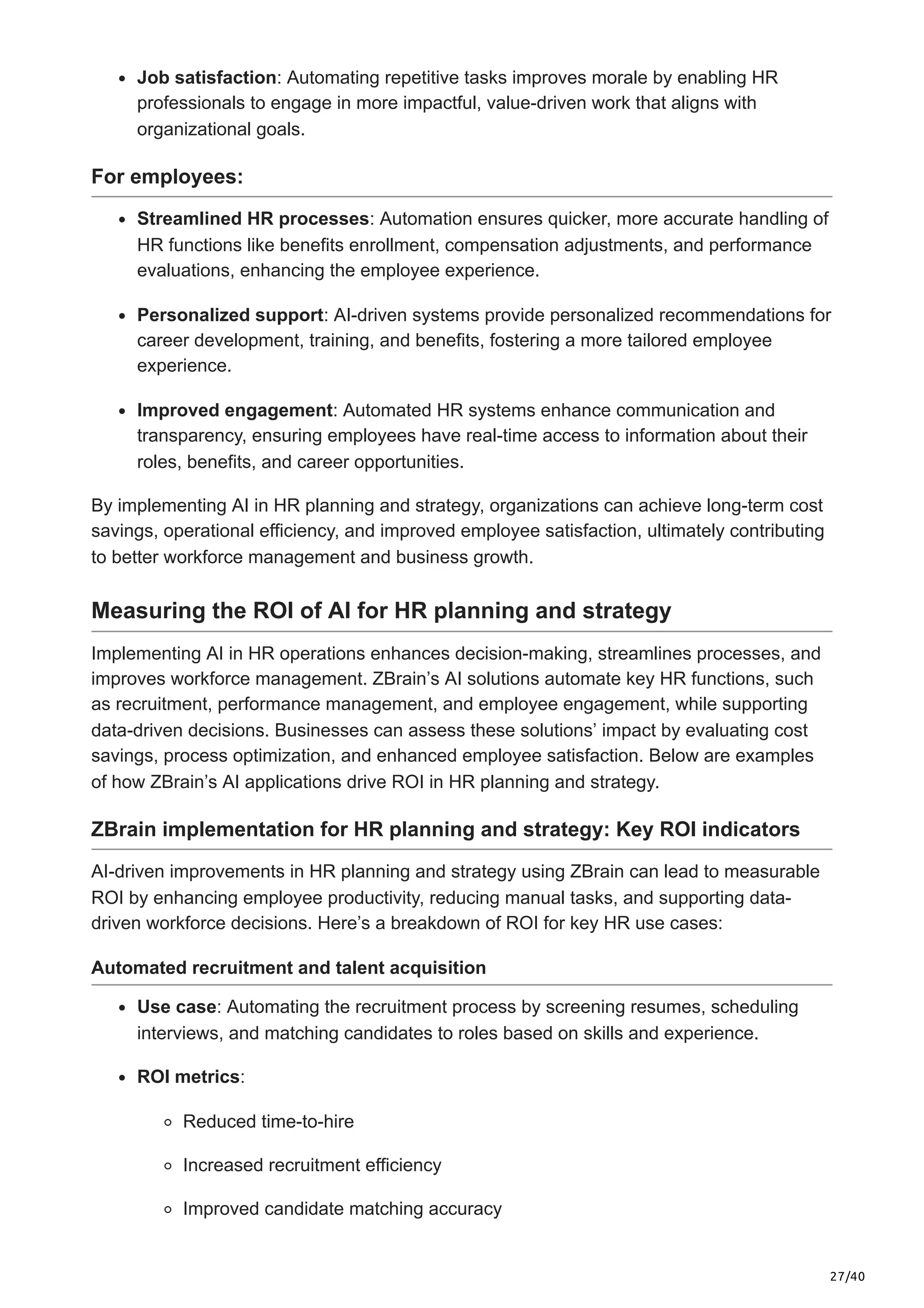
For organizations
Cost
efficiency
Improved
compliance
Benefits of AI for HR planning and strategies
Increased
productivity
Skill
development
Personalized
support
Improved
engagement
For HR teams For employees
For organizations:
Cost efficiency: Automation of HR tasks such as compensation planning, workforce
allocation, and benefits management reduces manual intervention and operational
costs.
Enhanced decision-making: AI-driven insights from real-time data enable better
resource planning, workforce optimization, and forecasting, supporting strategic
decision-making across the HR lifecycle.
Improved compliance: AI ensures adherence to labor laws, regulations, and internal
policies by automating compliance checks, reducing the risk of human error and
ensuring accurate reporting.
Data integration: Seamless integration with existing HR systems provides real-time
data flow, minimizing errors and ensuring accurate, up-to-date information for
strategic workforce planning and HR operations.
Operational efficiency: AI optimizes HR processes like talent acquisition,
compensation planning, and performance tracking, improving accuracy and speed in
tasks that directly impact organizational strategy.
For HR teams:
Increased productivity: Routine HR tasks such as payroll processing, recruitment
screening, and benefits administration are automated, allowing HR professionals to
focus on strategic initiatives like talent development and workforce optimization.
Skill development: HR teams gain exposure to more advanced tasks, such as data-
driven decision-making, predictive analytics, and employee performance
management, enhancing their capabilities.
27/40
Job satisfaction: Automating repetitive tasks improves morale by enabling HR
professionals to engage in more impactful, value-driven work that aligns with
organizational goals.
For employees:
Streamlined HR processes: Automation ensures quicker, more accurate handling of
HR functions like benefits enrollment, compensation adjustments, and performance
evaluations, enhancing the employee experience.
Personalized support: AI-driven systems provide personalized recommendations for
career development, training, and benefits, fostering a more tailored employee
experience.
Improved engagement: Automated HR systems enhance communication and
transparency, ensuring employees have real-time access to information about their
roles, benefits, and career opportunities.
By implementing AI in HR planning and strategy, organizations can achieve long-term cost
savings, operational efficiency, and improved employee satisfaction, ultimately contributing
to better workforce management and business growth.
Measuring the ROI of AI for HR planning and strategy
Implementing AI in HR operations enhances decision-making, streamlines processes, and
improves workforce management. ZBrain’s AI solutions automate key HR functions, such
as recruitment, performance management, and employee engagement, while supporting
data-driven decisions. Businesses can assess these solutions’ impact by evaluating cost
savings, process optimization, and enhanced employee satisfaction. Below are examples
of how ZBrain’s AI applications drive ROI in HR planning and strategy.
ZBrain implementation for HR planning and strategy: Key ROI indicators
AI-driven improvements in HR planning and strategy using ZBrain can lead to measurable
ROI by enhancing employee productivity, reducing manual tasks, and supporting data-
driven workforce decisions. Here’s a breakdown of ROI for key HR use cases:
Automated recruitment and talent acquisition
Use case: Automating the recruitment process by screening resumes, scheduling
interviews, and matching candidates to roles based on skills and experience.
ROI metrics:
Reduced time-to-hire
Increased recruitment efficiency
Improved candidate matching accuracy
28/40
Example: ZBrain AI agents can screen and rank candidates based on job
descriptions, ensuring faster and more accurate hiring and freeing up HR teams for
strategic engagement.
Employee performance tracking and optimization
Use case: Automating performance tracking, feedback collection, and performance
appraisals to ensure employee growth and alignment with organizational goals.
ROI metrics:
Improved employee productivity
Higher employee retention
Enhanced alignment with strategic objectives
Example: ZBrain AI agents can monitor performance metrics, generate feedback
reports, and recommend personalized development plans, helping HR teams
optimize workforce performance.
Predictive workforce planning
Use case: Using AI to asses future workforce needs, skill gaps, and talent retention
challenges, allowing HR teams to plan strategically.
ROI metrics:
Improved workforce planning accuracy
Reduced turnover rates
Better alignment of talent with business needs
Example: ZBrain AI agents can analyze historical data to asses future talent
requirements, ensuring HR teams can proactively address skill gaps and reduce
hiring costs.
Employee engagement and satisfaction monitoring
Use case: Automating the collection and analysis of employee feedback, surveys,
and sentiment to drive engagement initiatives.
ROI metrics:
Increased employee engagement
Improved job satisfaction
Reduced attrition rates
29/40
Example: ZBrain AI agents can track employee engagement levels through
sentiment analysis and real-time feedback, allowing HR teams to take corrective
actions before issues lead to turnover.
Compliance and regulatory management
Use case: Automating compliance monitoring for HR policies, labor laws, and
employee contracts to ensure adherence to regulations.
ROI metrics:
Reduced risk of non-compliance
Improved adherence to regulatory standards
Reduced legal and audit costs
Example: ZBrain AI agents can monitor employee contracts and HR practices to
ensure compliance with local and international regulations, reducing the risk of costly
fines.
Learning and development (L&D) optimization
Use case: Personalizing employee training programs based on AI analysis of skill
gaps and career goals to drive growth and development.
ROI metrics:
Improved employee skills and competencies
Higher training ROI
Reduced learning and development costs
Example: ZBrain AI agents can recommend customized training programs based on
individual employee performance data, enhancing L&D effectiveness and reducing
unnecessary training expenses.
Real-time workforce performance insights
Use case: Automating the generation of reports on workforce performance, training
progress, and engagement levels to provide real-time insights.
ROI metrics:
Increased visibility into HR performance metrics
Faster, data-driven decision-making
Reduced time spent on manual reporting
30/40
Example: ZBrain AI agents can generate real-time reports on workforce trends,
providing HR teams with actionable insights to optimize strategic decision-making
and resource allocation.
These examples demonstrate the transformative impact of AI in HR planning and strategy,
improving efficiency, reducing errors, and enhancing decision-making. Organizations can
measure the effectiveness of AI investments by tracking key ROI metrics such as improved
recruitment outcomes, optimized performance management, and enhanced employee
satisfaction. ZBrain offers tools that support automation, real-time insights, and continuous
optimization, enabling HR teams to focus on strategic improvements and organizational
growth.
Optimize Your Operations With AI Agents
Our AI agents streamline your workflows, unlocking new levels of business efficiency!
Explore Our AI Agents
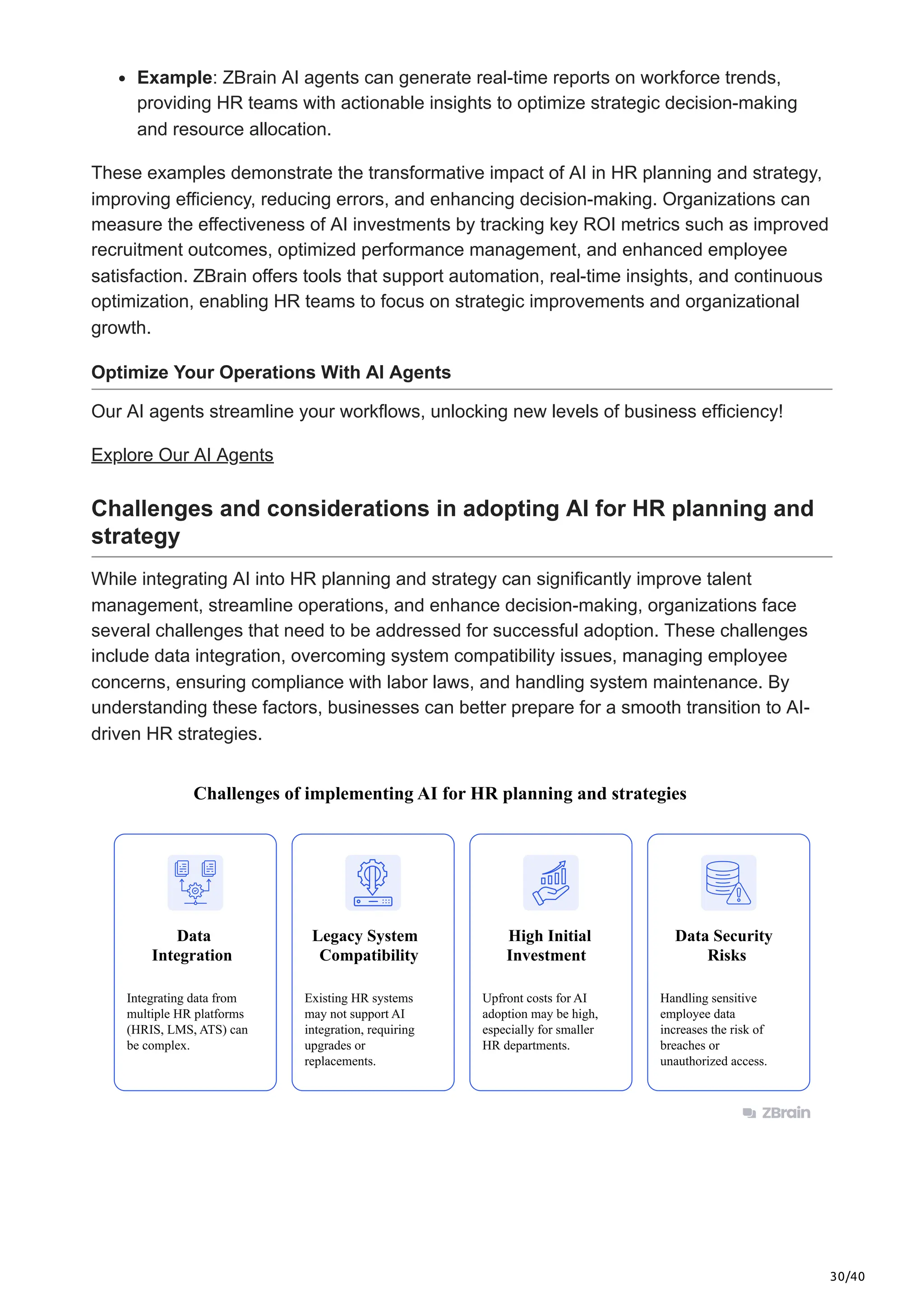
Challenges and considerations in adopting AI for HR planning and
strategy
While integrating AI into HR planning and strategy can significantly improve talent
management, streamline operations, and enhance decision-making, organizations face
several challenges that need to be addressed for successful adoption. These challenges
include data integration, overcoming system compatibility issues, managing employee
concerns, ensuring compliance with labor laws, and handling system maintenance. By
understanding these factors, businesses can better prepare for a smooth transition to AI-
driven HR strategies.
Data
Integration
Challenges of implementing AI for HR planning and strategies
Integrating data from
multiple HR platforms
(HRIS, LMS, ATS) can
be complex.
Existing HR systems
may not support AI
integration, requiring
upgrades or
replacements.
Upfront costs for AI
adoption may be high,
especially for smaller
HR departments.
Handling sensitive
employee data
increases the risk of
breaches or
unauthorized access.
Legacy System
Compatibility
High Initial
Investment
Data Security
Risks
31/40
Data
integration
Integrating data from
multiple HR platforms
(HRIS, LMS, ATS) can be
complex.
ZBrain Builder ensures seamless data
integration across various HR systems,
ensuring consistent, real-time data flow for
accurate insights and planning.
Legacy
system
compatibility
Existing HR systems may
not support AI integration,
requiring upgrades or
replacements.
ZBrain XPLR provides AI readiness
assessments to evaluate legacy system
compatibility and prepare for seamless AI
integration.
High initial
investment
Upfront costs for AI
adoption may be high,
especially for smaller HR
departments.
ZBrain offers phased implementation,
allowing businesses to evaluate ROI and
manage costs, ensuring a smoother
transition to AI adoption.
Data
security
risks
Handling sensitive
employee data increases
the risk of breaches or
unauthorized access.
ZBrain ensures robust data security with
protocols such as role-based access and
compliance checks, mitigating data security
risks.
Data privacy
compliance
Adhering to data privacy
regulations can be
challenging, especially
with employee data.
ZBrain ensures compliance with global
frameworks ISO 27001:2022 and SOC 2
Type II, adapting to regulatory changes
through AI-driven automation.
Lack of
skilled
personnel
A shortage of AI expertise
may slow down adoption
and hinder performance.
ZBrain Builder’s low-code platform allows
HR teams to deploy AI solutions without
needing deep technical expertise, speeding
up adoption.
Employee
resistance
Employees may resist AI
adoption due to concerns
about job displacement or
unfamiliarity.
ZBrain Builder’s intuitive interface and
customizable solutions make AI integration
easier, promoting user acceptance and
minimizing resistance.
Inaccurate
or
incomplete
data
Poor data quality can lead
to incorrect insights and
suboptimal decision-
making.
ZBrain Builder’s data normalization tools
improve data accuracy, ensuring reliable
data for AI-driven HR insights and decision-
making.
Scalability
issues
Scaling AI solutions
across regions or
departments may be
challenging without proper
planning.
ZBrain Builder’s cloud-native architecture
and modular design support scalable AI
deployment, enabling the gradual
expansion of AI-driven HR capabilities.
By addressing these challenges and leveraging ZBrain’s AI capabilities, organizations can
navigate the complexities of HR planning and strategy, enabling improved talent
management, operational efficiency, and strategic decision-making.
Best practices for implementing AI for HR planning and strategy
32/40
Implementing AI in HR planning and strategy can enhance talent management, streamline
HR operations, and improve decision-making. However, successful AI adoption requires
careful planning, strategic execution, and collaboration across HR teams. Below are key
best practices for implementing AI in HR planning and strategy:
Assess process readiness for AI integration
Before adopting AI, evaluate your HR workflows to identify areas for optimization and
improvement.
Map existing workflows: Conduct a thorough process discovery to understand
bottlenecks and identify tasks that can benefit from automation, such as recruitment,
performance management, and employee engagement.
Assess data quality and infrastructure: Ensure access to clean, structured
employee data and a robust IT infrastructure that supports AI tools for accurate
workforce tracking and reporting.
Gauge change readiness: Involve stakeholders early, including HR leaders and
employees, to align expectations and address concerns about AI integration.
Define clear goals: Set measurable objectives such as improving recruitment
efficiency, enhancing employee retention, or optimizing performance management.
Leverage the right AI technologies
Choosing the right AI technologies ensures maximum impact on HR planning and strategy
processes.
Machine learning for talent forecasting: Predict future talent needs, workforce
trends, and skill gaps based on historical data, current workforce analytics, and
market conditions, ensuring proactive workforce planning.
Natural language processing (NLP) for resume screening: Automate the
extraction and analysis of key skills and qualifications from resumes and job
applications to streamline recruitment and improve candidate matching.
AI-driven analytics for employee engagement: Use AI-powered dashboards and
insights to monitor employee engagement metrics, turnover rates, and satisfaction
levels, enabling data-driven decision-making in talent management.
Engage stakeholders and manage change effectively
AI adoption success depends on strong stakeholder engagement and effective change
management within HR teams and across the organization.
Communicate the strategy: Highlight the benefits of AI, such as enhanced decision-
making, improved HR processes, and increased efficiency, while addressing
concerns about job displacement and role changes.
Provide training and upskilling: Equip HR teams and employees with the
knowledge and skills needed to effectively use AI tools in recruitment, performance
management, and strategic workforce planning.
33/40
Involve stakeholders early: Secure buy-in from key stakeholders across HR, IT, and
leadership teams to ensure smooth AI integration and foster collaboration across
departments.
Pilot and phased rollouts: Start with smaller AI implementations, such as
automating candidate screening or predicting employee turnover, before expanding
AI applications across the entire HR strategy.
Ensure scalability and flexibility
AI solutions should be scalable and adaptable to evolving business needs and workforce
growth.
Scalability: Choose AI systems that can handle increasing volumes of HR data and
more complex workforce operations as the organization grows.
Continuous improvement: Regularly evaluate AI models and systems to ensure
they are optimized based on new data, employee feedback, and evolving business
goals.
Interoperability: Select AI tools that seamlessly integrate with existing HR
management systems, employee engagement platforms, and performance
management tools for a unified approach to HR strategy.
By following these best practices, organizations can leverage AI to optimize HR planning,
enhance operational efficiency, and make informed decisions that support long-term
employee engagement, productivity, and organizational growth.
The future of AI for HR planning and strategy
The future of HR planning and strategy is poised for transformation with advancements in
AI-driven automation, predictive analytics, and emerging technologies such as generative
AI, wearable devices, and blockchain. These innovations will optimize talent management,
streamline HR operations, enhance employee experiences, and reduce operational costs.
Key trends shaping the future of AI in HR planning and strategy include:
AI and blockchain integration in HR
The integration of AI and blockchain will bring enhanced transparency, security, and
efficiency to HR processes.
Data integrity and security: Blockchain will ensure secure, immutable records for
employee data and transactions, while AI can authenticate and verify HR-related
data, such as contracts and performance metrics, in real-time, reducing errors and
potential fraud.
Automated contract management: Blockchain-powered smart contracts can
automate the execution of employment agreements, salary adjustments, and
performance-based rewards, ensuring compliance and reducing manual intervention.
34/40
Payroll and benefits management: Blockchain can streamline payroll processing
with secure, transparent transactions, while AI ensures that pay, benefits, and
deductions are accurately calculated based on up-to-date data, improving compliance
and cash flow management.
AI-driven talent forecasting and workforce management
AI will revolutionize workforce planning by leveraging data analytics and market insights to
forecast future talent needs.
Dynamic workforce planning: AI will analyze historical workforce data, employee
behavior, and market trends to predict future talent gaps and skill requirements,
enabling proactive talent acquisition and retention strategies.
Automated job matching and recruitment: AI-driven algorithms will automate
candidate screening, matching resumes with job descriptions, and even predicting
cultural fit, leading to more accurate and faster hiring decisions.
Skill gap identification: AI will identify skill gaps across the workforce, guiding HR
teams to design training programs and recruitment strategies aligned with
organizational goals.
Generative AI for personalized employee experience
Generative AI (GenAI) will enable more dynamic, personalized approaches to talent
management and employee engagement.
Personalized learning and development: GenAI can recommend customized
training and career development paths for employees based on their goals,
performance data, and available learning resources, enhancing employee growth and
retention.
AI-driven performance optimization: GenAI can provide real-time
recommendations for performance improvements, helping managers deliver
personalized coaching and feedback to employees.
Employee engagement and well-being: AI-driven sentiment analysis will
continuously monitor employee engagement levels through feedback, surveys, and
interactions, enabling HR to intervene proactively and improve workplace morale.
Wearable technology in HR
Wearable devices will offer new opportunities for HR to monitor employee productivity,
health, and well-being, promoting a more holistic approach to workforce management.
Enhanced productivity tracking: Wearables can track employees’ movements,
work patterns, and activity levels, providing HR teams with data to optimize workflows
and improve productivity.
Employee well-being and health: Wearable technology can monitor employees’
physical and mental health, alerting HR teams to potential well-being issues before
they escalate and fostering a healthier workplace.
35/40
Real-time feedback and performance: Wearables can provide instant feedback to
employees, helping them stay on track with goals and improving their engagement
through performance tracking.
AI-powered employee experience and sentiment analysis
AI will redefine employee experience (EX) by offering personalized support and proactive
insights into employee satisfaction and engagement.
AI-powered chatbots and virtual assistants: These tools will handle routine HR
inquiries, provide real-time updates on HR processes (e.g., leave balances, payroll
inquiries), and assist employees with benefits and policies, streamlining
communication and improving satisfaction.
Sentiment analysis: AI tools will analyze employee feedback, surveys, and
engagement data to identify potential issues or areas for improvement, allowing HR
teams to take immediate action to boost morale and reduce turnover.
Personalized benefits and services: AI will recommend customized benefits
packages based on individual employee needs, preferences, and life stages,
enhancing employee satisfaction and loyalty.
Ethical AI and data security in HR
As AI adoption in HR increases, maintaining ethical AI practices and ensuring data security
will be critical to build trust and meet compliance requirements.
Transparent decision-making: AI models will be designed to provide clear,
explainable decisions regarding hiring, promotions, and performance assessments,
ensuring fairness and transparency.
Bias mitigation: AI models will be trained on diverse datasets to avoid biases in
recruitment, talent management, and performance evaluations, promoting diversity
and inclusion within the organization.
Advanced data privacy: AI-driven security systems will protect sensitive employee
data, adhering to data privacy standards like GDPR and other regulatory frameworks,
minimizing the risk of data breaches.
AI will continue to shape HR planning and strategy, transforming how organizations attract,
retain, and manage talent. By leveraging AI for automation, predictive analytics, and
emerging technologies, HR teams can optimize recruitment, improve employee
engagement, and support a more agile, data-driven workforce. Platforms like ZBrain will
play a crucial role in helping organizations integrate these advanced technologies, enabling
smarter, faster, and more efficient HR processes that foster long-term growth, employee
satisfaction, and organizational success.
ZBrain empowers organizations to revolutionize their HR planning and strategy by
identifying automation opportunities and optimizing long-term workforce planning
processes. As a generative AI platform, ZBrain enhances HR strategy by providing insights
36/40
into workforce optimization, succession planning, and organizational design, helping
businesses make data-driven decisions. It helps businesses improve strategic decision-
making through data-driven insights and automation capabilities.
AI readiness for strategic HR planning by evaluating current workforce models and
identifying areas where AI can improve efficiency and accuracy. This ensures AI strategies
are aligned with organizational growth and talent objectives, facilitating a smooth and
informed transition to AI-enhanced HR strategies.
low-code platform enables HR teams to design bespoke solutions that automate crucial
planning tasks such as talent allocation, succession pipeline management, and strategic
workforce forecasting.
By seamlessly integrating with existing HR systems, offering scalability, and ensuring
robust security, ZBrain helps organizations optimize HR planning processes, enhance
resource allocation, and ensure agility in a rapidly evolving market. It supports strategic
decision-making, empowers leadership, and improves the ability to adapt to future
workforce demands, giving businesses a competitive edge.
Endnote
Integrating AI into HR planning and strategy is revolutionizing how organizations manage
their workforce, optimize talent, and align HR initiatives with business goals. AI enhances
efficiency, improves decision-making, and supports proactive HR management by
automating processes such as workforce analytics, talent forecasting, and employee
engagement insights. As AI continues to evolve, its ability to provide deeper insights and
personalized workforce strategies will enable businesses to stay competitive and agile.
Embracing AI-driven solutions positions organizations to foster innovation, drive workforce
excellence, and ensure long-term success in an evolving HR landscape.
Ready to revolutionize your HR planning and strategy with AI? Leverage to optimize
workforce planning, enhance talent management, and drive data-driven decision-making,
ensuring a more agile and future-ready organization.
Frequently Asked Questions
What is ZBrain, and how can it optimize HR planning and strategy with AI?
ZBrain is an end-to-end AI enablement platform that helps businesses seamlessly integrate
AI into HR functions, driving smarter workforce planning, talent management, and decision-
making. From assessing AI readiness to deploying intelligent solutions, ZBrain empowers
HR teams to enhance efficiency, improve employee experiences, and align HR strategies
with business goals.
37/40
ZBrain XPLR provides a detailed AI readiness assessment, helping HR teams
evaluate their current processes and identify areas for AI-driven optimization. This
ensures a strategic approach to AI adoption, improving workforce planning, talent
retention, and employee engagement.
Seamless data ingestion and integration:
ZBrain Builder integrates with HRIS, payroll, and talent management systems to unify
HR data from multiple sources. This enables real-time workforce analytics, helping
HR teams make data-driven decisions on hiring, compensation, and succession
planning.
Low-code development environment:
ZBrain Builder’s intuitive, low-code interface allows HR professionals to create and
deploy AI-driven solutions with minimal technical expertise. This accelerates
automation in key HR processes, such as recruitment, benefits administration, and
performance management.
Cloud and model flexibility:
ZBrain Builder supports advanced AI models like GPT-4 and LLaMA and integrates
with cloud platforms like AWS, Azure, and GCP. This flexibility allows HR teams to
deploy scalable AI solutions tailored to their organization’s unique needs.
Enhanced compliance and governance:
ZBrain’s AI-driven analytics help HR teams ensure compliance with labor laws, pay
equity regulations, and internal policies. By continuously monitoring workforce data,
ZBrain flags potential risks related to hiring practices, compensation structures, and
workplace diversity.
By combining powerful AI capabilities with seamless data integration, ZBrain enables
organizations to optimize HR strategies, improve workforce efficiency, and create a more
agile, future-ready HR function.
How does ZBrain ensure the security and privacy of sensitive data in HR planning and strategy?
ZBrain is designed with a strong focus on data privacy and security, ensuring that sensitive
HR information—such as employee records, compensation details, and workforce analytics
—is protected at all stages. Here’s how ZBrain safeguards HR data throughout the HR
planning and strategy lifecycle:
Private cloud deployments:
ZBrain agents can be deployed in a private cloud environment, ensuring that critical HR
data, including payroll, performance evaluations, and benefits information, remains
securely stored within the organization’s infrastructure.
Robust security features:
ZBrain incorporates multiple layers of security to protect sensitive HR data, including:
38/40
Access controls: Granular role-based access controls ensure that only authorized
HR personnel can view or manage confidential employee data, such as salary
structures, succession plans, and engagement reports.
Anonymization and compliance monitoring: AI-driven compliance tools help HR
teams anonymize sensitive data where necessary and ensure alignment with labor
laws and data privacy regulations.
Compliance and governance:
ZBrain is built to meet global compliance standards ISO 27001:2022 and SOC 2 Type II,
ensuring that workforce data is managed with confidentiality, integrity, and accountability. It
also supports adherence to employment laws, pay equity regulations, and workplace ethics
policies.
By integrating these security and compliance measures, ZBrain enables HR teams to
leverage AI-driven workforce planning and strategy while ensuring that employee data
remains protected and regulatory requirements are met.
Can ZBrain AI agents be integrated with existing HR systems?
Yes, ZBrain AI agents are designed to integrate seamlessly with existing HR systems,
including HRIS, payroll platforms, talent management software, and workforce analytics
tools. The platform supports various data formats and standards, ensuring smooth
interoperability with both modern and legacy HR technologies.
This integration enables organizations to:
Leverage existing infrastructure: Enhance current HR planning and strategy
processes without the need for a complete overhaul of existing systems.
Enrich data and workflows: Connect ZBrain AI agents with existing tools to
automate workforce planning, compensation analysis, employee engagement
tracking, and compliance monitoring.
Drive AI-driven insights: Utilize AI capabilities to predict workforce trends, optimize
talent strategies, and improve HR decision-making while maintaining compatibility
with current technologies.
By enabling seamless integration, ZBrain ensures that HR teams can modernize their
workforce planning and strategy efforts without disrupting existing HR ecosystems, leading
to improved efficiency, data-driven decision-making, and strategic agility.
What kind of HR planning and strategy AI agents can be built on ZBrain?
ZBrain enables organizations to build genAI-powered HR agents that enhance decision-
making, automate critical HR processes, and optimize workforce strategies. With ZBrain
Builder, businesses can develop AI agents tailored to various HR functions, ensuring
seamless integration with existing HR systems and data sources.
39/40
Workforce planning agent: Provides insights into workforce dynamics, assists in
headcount planning, and supports strategic decision-making for talent management.
Recruitment optimization agent: Enhances job matching, automates candidate
screening, and provides data-driven hiring recommendations.
Compensation and benefits intelligence agent: Benchmarks salary structures,
identifies pay disparities, and suggests benefits optimization strategies.
Employee sentiment analysis agent: Processes feedback from multiple sources to
assess engagement levels and identify workplace improvement areas.
HR compliance monitoring agent: Tracks policy adherence, flags regulatory risks,
and ensures HR strategies align with legal requirements.
By leveraging ZBrain’s AI-driven automation and analytics, organizations can streamline
HR operations, enhance employee experiences, and build more responsive, data-driven
HR strategies.
How does ZBrain cater to diverse HR planning and strategy needs across business operations?
ZBrain’s flexibility enables organizations to build AI-driven solutions tailored to various HR
planning and strategy needs, from workforce planning and talent management to
compensation optimization and compliance. With custom AI agents, HR teams can asses
talent needs, automate recruitment processes, benchmark salaries, analyze employee
sentiment, and ensure regulatory compliance. By leveraging ZBrain’s intelligent automation
and data-driven insights, businesses can create more strategic, agile, and efficient HR
operations, driving better decision-making and workforce outcomes.
How can we measure the ROI of ZBrain in our HR planning and strategy?
Measuring the ROI of ZBrain in HR planning and strategy involves assessing key
performance indicators (KPIs) related to automation, workforce optimization, and strategic
decision-making. Key metrics include-
Reduced manual effort through AI-driven automation in recruitment, compensation
analysis, and compliance tracking, leading to faster processing and fewer errors.
Improved talent retention and engagement can be measured by analyzing employee
sentiment and optimizing career development programs.
Enhanced decision-making is reflected in data-driven insights for workforce planning,
pay equity, and performance management.
Operational efficiency improves through AI-powered benchmarking, automated
reporting, and streamlined HR workflows.
By tracking these KPIs, organizations can quantify ZBrain’s impact on streamlining HR
processes, enhancing workforce strategy, and driving better business outcomes.
How can I get started with ZBrain for HR planning and strategy?
40/40
To leverage ZBrain for optimizing your HR planning and strategy, contact us at or fill out the
inquiry form on our website. Our team will connect with you to discuss how ZBrain can
integrate with your existing HR systems, automate key processes, and enhance workforce
planning, talent management, and compliance strategies.
Insights

AI for HR planning and strategy Scope integration use cases challenges and future outlook.pdf

  • 1.
    1/40 ZBrain March 25,2025 AI for HR planning and strategy: Scope, integration, use cases, challenges and future outlook zbrain.ai/ai-for-hr-planning-and-strategy ← All Insights AI is redefining HR planning and strategy, offering solutions to long-standing challenges in workforce management, talent acquisition, and employee engagement. Traditional HR practices often rely on manual processes, siloed data, and reactive decision-making, leading to inefficiencies in talent forecasting, workforce allocation, and strategic alignment. HR teams frequently struggle with optimizing hiring processes, retaining top talent, and ensuring equitable compensation structures, all while navigating evolving labor laws and compliance requirements. Additionally, organizations face increasing pressure to enhance employee experience, foster engagement, and build agile workforce strategies that align with business objectives. As the workforce becomes more diverse and dynamic, these challenges necessitate the adoption of intelligent, data-driven solutions. AI adoption in HR is steadily growing, with 42% of HR teams already leveraging AI- powered tools for functions such as recruitment, workforce planning, and engagement. The increasing use of AI highlights its potential to streamline operations, improve decision- making, and enhance workforce agility. HR departments are also recognizing the importance of technology adoption, with organizations focusing on upskilling HR teams to bridge the gap in digital proficiency. While generative AI is transforming industries such as marketing—where 34% of teams have embraced it—it is gradually making its way into HR, with 12% of departments integrating generative AI tools (AIHR, 2024). This presents a significant opportunity for HR leaders to explore AI-driven applications that enhance efficiency, personalization, and strategic workforce planning.
  • 2.
    2/40 As AI becomesa cornerstone of modern HR functions, platforms like are equipping organizations with advanced capabilities to optimize workforce planning, enhance talent strategies, and drive data-backed decision-making. By automating administrative tasks, analyzing workforce patterns, and generating predictive insights, ZBrain enables HR teams to transition from reactive operations to proactive strategy execution. Beyond automation, ZBrain facilitates AI readiness assessments, supports seamless AI integration, and aligns HR strategies with evolving business needs. This article explores how AI is transforming HR planning and strategy, fostering efficiency, and enabling data-driven workforce management. It also highlights how platforms like ZBrain empower organizations to harness AI-powered insights, ensuring agility, competitiveness, and long-term workforce success. What is HR planning and strategy? HR planning and strategy is a structured approach to managing an organization’s workforce to align with business objectives, ensuring optimal talent acquisition, development, and retention. It involves analyzing workforce needs, forecasting future talent requirements, developing HR policies, and implementing initiatives to enhance employee engagement, productivity, and compliance. By integrating workforce planning with strategic goals, businesses can maintain a competitive edge while fostering a resilient and adaptable workforce. Key components of HR planning and strategy include workforce analysis, succession planning, talent acquisition, performance management, employee development, and compliance monitoring. A comprehensive HR strategy ensures that organizations can anticipate talent gaps, optimize resource allocation, and enhance overall workforce efficiency. While HR planning is traditionally a manual and process-driven function, adopting AI and automation has significantly enhanced its effectiveness. AI-driven platforms help organizations optimize workforce analytics, automate talent acquisition, and enhance decision-making in areas such as employee engagement and skills development. By leveraging AI-driven insights and automation, HR teams can improve efficiency, reduce bias in hiring, and foster a data-driven approach to workforce management. Effective HR planning and strategy enable businesses to maintain workforce stability, improve employee experience, and align HR initiatives with long-term business goals. Organizations can create a future-ready HR function that drives growth and resilience by integrating technology, data-driven insights, and strategic workforce management. Why is HR planning and strategy important? HR planning and strategy are crucial in ensuring that businesses can attract, retain, and develop the right talent to support their objectives. It provides a structured approach to workforce management, allowing organizations to proactively address talent shortages, succession planning, and skill development.
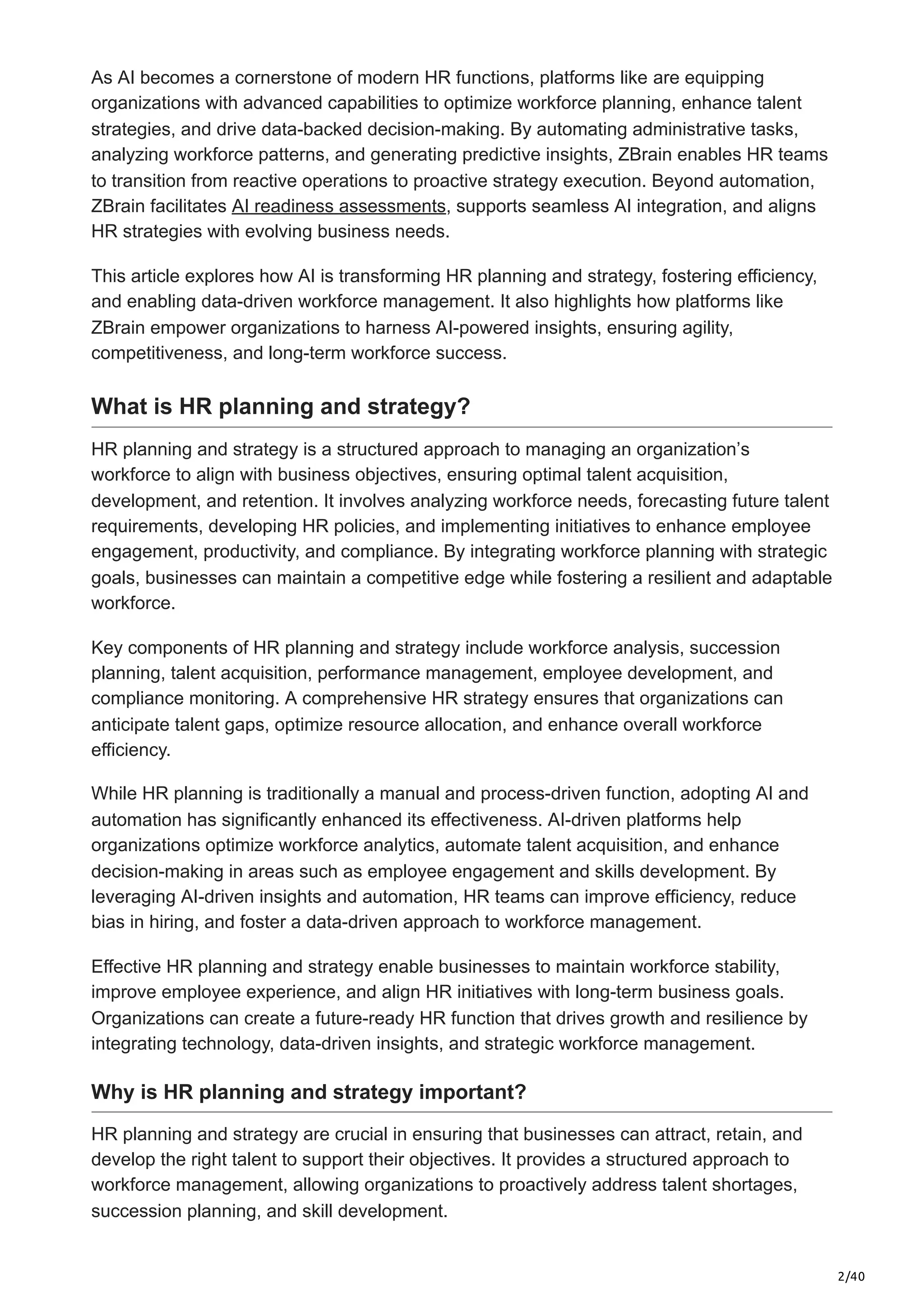
  • 3.
    3/40 One key benefitof HR planning is its ability to align workforce capabilities with business needs. HR teams can develop targeted hiring and training programs that drive organizational success by assessing current talent pools, forecasting future workforce demands, and identifying skills gaps. This proactive approach reduces turnover, enhances employee satisfaction, and ensures business continuity. A well-executed HR strategy also strengthens compliance with labor laws and industry regulations. Organizations can minimize legal risks, ensure fair employment practices, and maintain a transparent work environment by implementing standardized HR processes. Additionally, leveraging workforce analytics helps businesses optimize employee engagement, monitor performance trends, and refine HR policies to foster a culture of continuous improvement. Ultimately, HR planning and strategy drive workforce efficiency, enhance employee experience and support long-term business sustainability. By integrating AI-driven analytics, automation, and strategic workforce planning, organizations can navigate evolving workforce challenges, build a resilient HR function, and maintain a competitive advantage in the modern business landscape. Understanding the HR planning and strategy stages Effective HR planning and strategy are crucial for aligning workforce management with an organization’s overall objectives. HR planning and strategy encompass multiple stages that focus on aligning HR functions with business goals, ensuring that an organization’s workforce is equipped to meet both current and future challenges. The following section provides a clear set of HR planning and strategy stages.
  • 4.
    4/40 Stages of HRplanning and strategies Transformative human resources function management Strategic workforce planning (SW) Total rewards planning (BP & CP) Continuous monitoring and strategy refinement HR policy development & alignment Workforce strategy formulation Organizational design Compliance and risk management Workforce environment analysis Strategic resource planning Operational resource planning Competencies to support integrated talent development Benefit planning (BP) Compensation planning (CP) Performance tracking and analytics Feedback loops and surveys Benchmarking and industry comparison Real-time adjustments 1. Transformative human resources function management This stage emphasizes restructuring HR functions to make them more efficient, compliant, and strategically aligned with the organization’s goals. The associated processes include: HR policy development and alignment: Establishing policies that reflect organizational goals, regulatory requirements, and cultural values. Regular updates to policies ensure they stay relevant in a changing workforce environment. Workforce strategy formulation: Defining the long-term vision for the workforce and aligning it with organizational objectives. This includes developing a roadmap for HR transformation, focusing on people, technology, and processes. Organizational design: Structuring roles and responsibilities to ensure that HR capabilities support business growth, ensuring each function has clear objectives and measurable outcomes.
  • 5.
    5/40 Compliance and riskmanagement: Ensuring that HR practices comply with relevant laws and regulations while proactively addressing any potential risks related to labor laws, health and safety, and employee relations. Change management: Implementing processes to help the organization transition smoothly when making HR strategy shifts or adopting new technology, ensuring minimal disruption. 2. Strategic workforce planning (SW) Strategic workforce planning ensures that organizations have the right people in the right roles at the right time. This stage involves aligning HR strategies with business goals to meet both short-term and long-term needs, guiding decisions on staffing levels, skill development, and workforce distribution. Workforce environment analysis: This stage involves analyzing both internal and external workforce trends to understand the evolving labor market conditions, identify skill gaps, and assess industry benchmarks. Understanding the broader workforce landscape helps organizations prepare for future workforce needs by making data- driven decisions. Strategic resource planning: Long-term resource planning aligns staffing levels with business growth strategies. By forecasting the workforce needs that align with the company’s long-term goals, businesses ensure they have the right resources in place for sustained success. This stage is crucial for identifying future talent shortages or surpluses and taking proactive steps to manage them. Operational resource planning: In this stage, short-term workforce needs are addressed by improving decision-making related to staffing, scheduling, and deployment. Operational resource planning focuses on optimizing the immediate use of available workforce resources to handle fluctuations in business demands or project-specific needs. Competencies to support integrated talent development: This stage ensures that employees have the skills necessary to meet the evolving demands of the organization. Talent development strategies align training programs with the competencies required for various roles, ensuring a continuous pipeline of skilled workers ready to contribute to the organization’s growth. Position management and position control: Position management ensures that job roles and responsibilities are structured in alignment with organizational needs. This stage focuses on job classifications, reporting structures, and ensuring that each position is filled appropriately to meet current and future workforce demands. Succession planning with talent pools: Succession planning is vital for ensuring that an organization can maintain continuity, especially in leadership roles. Identifying and developing internal talent pools for leadership positions allows organizations to prepare for key transitions and minimize disruptions when leadership changes occur.
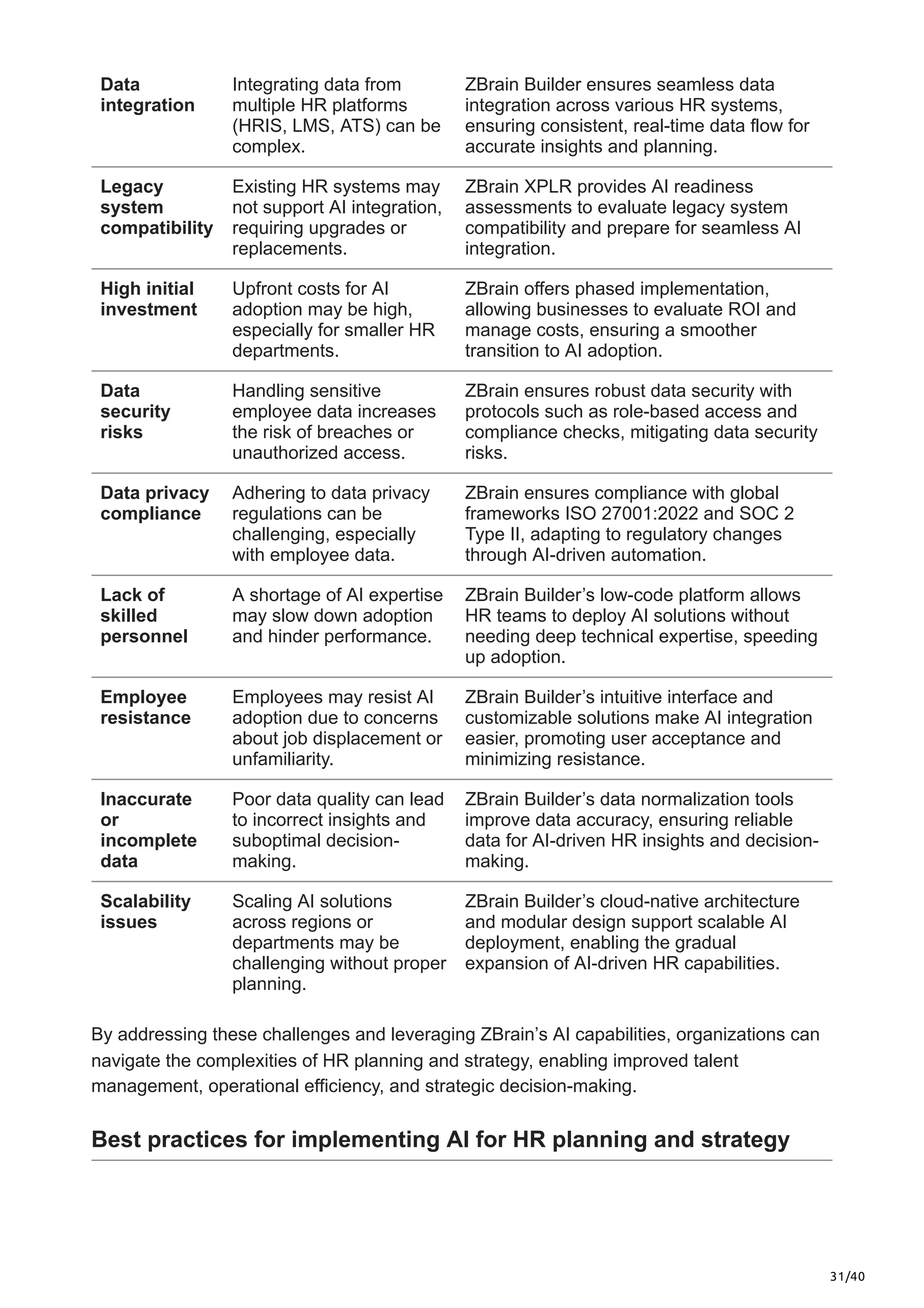
  • 6.
    6/40 Job planning anddesign: Job planning and design ensure that roles and responsibilities are clearly defined and aligned with organizational goals. Effective job design enhances job satisfaction, ensures resource optimization, and supports overall organizational performance. This stage involves creating roles that maximize employee potential and contribute to business success. 3. Total rewards planning (BP & CP) Total rewards planning focuses on offering competitive compensation and benefits to attract and retain top talent. A well-structured total rewards strategy aligns employee benefits with organizational goals, contributing to higher employee satisfaction and retention rates. 3.1 Benefit planning (BP) Benefit planning ensures that compensation and benefits offerings are aligned with both employee needs and the company’s goals. The associated processes include: Conduct an external benefit plan survey: This process involves collecting data on industry benchmarks for benefits packages to compare and ensure competitiveness with external market trends. Conduct an internal benefit plan survey: Gathering employee feedback on existing benefits to ensure alignment with employee needs, preferences, and satisfaction levels. Develop/adjust benefit objectives and strategies: Based on feedback and market analysis, this stage focuses on refining and adjusting benefit offerings to ensure they are attractive and aligned with business goals. Design/redesign benefit plan: This process includes designing or redesigning the benefit plan to ensure that it is comprehensive, cost-effective, and meets the needs of the employees while aligning with the organization’s objectives. Consolidate benefit plans: Consolidate multiple benefit offerings into a cohesive, streamlined plan to optimize administrative efficiency and employee satisfaction. Evaluate benefit plans and carriers/providers: Regular evaluation of benefit plans and the performance of carriers/providers to ensure they are delivering value for money and meeting organizational and employee expectations. 3.2 Compensation planning (CP) Compensation planning ensures fair and equitable pay structures, motivating employees while aligning with the business’s broader objectives. The associated processes include: Labor market surveys: Conducting surveys to assess competitive pay scales within the labor market, ensuring the organization offers compensation that is competitive within the industry.
  • 7.
    7/40 Develop/review compensation objectivesand strategies: Defining compensation strategies based on market conditions, employee performance, and business goals to ensure the pay structure is aligned with the company’s objectives. Pay program design, analysis and planning: Designing and planning compensation programs, including salary structures, incentive schemes, and bonuses, ensuring alignment with organizational goals and market trends. Consolidate compensation plans: Integrating and consolidating compensation packages across different departments or regions into a unified plan to ensure consistency and equity across the organization. Program deployment: Implementing compensation programs and ensuring they are effectively communicated and deployed across the organization to ensure understanding and alignment among employees. Job evaluation and compensation review: Conducting regular reviews and evaluations of job roles to ensure accurate classification and appropriate compensation for each role in the organization. Job planning and design: Designing job roles to ensure they align with compensation structures, optimizing both employee performance and compensation equity. 4. Continuous monitoring and strategy refinement Continuous monitoring ensures HR strategies stay adaptable and responsive to changing business and workforce conditions. The associated processes include: Performance tracking and analytics: Using data analytics to continuously measure key performance indicators (KPIs) such as recruitment success, employee retention, engagement, and training effectiveness. Feedback loops and surveys: Regularly gathering feedback from employees, managers, and leadership to assess how HR initiatives are impacting the workforce. Feedback can be collected through surveys, one-on-one interviews, and focus groups. Benchmarking and industry comparison: Comparing the organization’s HR strategies and performance metrics against industry standards to ensure competitiveness. Real-time adjustments: Utilizing real-time data to identify and respond to emerging issues, such as talent shortages or shifts in employee satisfaction, and making adjustments to HR strategies promptly.
  • 8.
    8/40 Predictive analysis forworkforce trends: Using predictive models to anticipate future workforce needs, including skill shortages, staffing levels, and turnover rates, to ensure proactive action. By integrating these processes into the stages of HR planning and strategy, organizations can maintain a structured approach while remaining agile to meet both present and future needs. This comprehensive planning ensures that HR functions effectively support business goals, enhance employee satisfaction, and drive long-term success. Optimize Your Operations With AI Agents Our AI agents streamline your workflows, unlocking new levels of business efficiency! Explore Our AI Agents Transforming HR planning and strategy processes: How AI solves traditional challenges AI is pivotal in overcoming challenges faced during traditional HR planning and strategy stages. The introduction of AI tools enhances efficiency and supports strategic alignment between workforce management and business objectives. Below, we explore key challenges in each stage of HR planning and strategy and how AI solutions help overcome them. Stage Process Challenge Impact of traditional methods How AI helps overcome the challenge Transformative human resources function management HR policy development and alignment Manual policy development can be inconsistent and outdated. Policies may not reflect the latest regulatory or organizational changes. AI automates the policy development process, ensuring policies are up-to-date and aligned with regulations. Workforce strategy formulation Difficulty in aligning workforce strategies with evolving business goals. Lack of alignment leads to workforce gaps and inefficiency. AI analyzes organizational goals and workforce data to create a strategic workforce plan that adapts to changes.
  • 9.
    9/40 Stage Process Challenge Impactof traditional methods How AI helps overcome the challenge Organizational design Traditional methods make it challenging to structure roles effectively. Misalignment between roles and business needs can slow down growth. AI analyzes roles and competencies, suggesting optimal organizational structures. Compliance and risk management Keeping track of compliance requirements manually is cumbersome and error- prone. Failure to maintain compliance risks legal and financial consequences. AI helps monitor compliance and alerts HR of any discrepancies in real-time. Change management Resistance to change and slow implementation of new strategies. Traditional change management methods lead to disruptions and employee dissatisfaction. AI-powered change management tools provide real-time insights and automate smooth transitions. Strategic workforce planning (SW) Workforce environment analysis Analyzing internal and external trends manually is time- consuming and prone to errors. Missed trends or skill gaps, leading to poor workforce alignment. AI helps identify labor market trends and skill gaps through data analysis and predictive modeling. Strategic resource planning Long-term forecasting based on static data often fails to account for future shifts. Inaccurate forecasting leads to either talent shortages or overstaffing. AI uses historical data and predictive analytics to forecast workforce needs with greater accuracy. Operational resource planning Short-term workforce planning lacks the flexibility to address changing demands. Poor management of workforce resources leads to inefficiency and missed opportunities. AI optimizes resource deployment, forecasting staffing needs in real-time based on fluctuating demands.
  • 10.
    10/40 Stage Process Challenge Impactof traditional methods How AI helps overcome the challenge Competencies to support integrated talent development Identifying and addressing competency gaps is a lengthy process. Training programs may not be aligned with the company’s evolving needs. AI analyzes employee data to recommend personalized learning and development paths based on skill gaps. Position management and position control Managing positions manually can lead to misalignment of roles and responsibilities. Poor role definition and lack of structure impact workforce efficiency. AI helps in structuring and managing positions with clear job definitions aligned to business needs. Succession planning with talent pools Identifying and nurturing future leaders manually is resource- intensive. Talent gaps in leadership roles can impact organizational continuity. AI analyzes employee performance and potential, identifying high- potential employees for leadership roles. Job planning and design Aligning job roles with business objectives can be inconsistent and time- consuming. Misalignment of job roles with business goals affects productivity and morale. AI designs job roles based on skills, business requirements, and workforce distribution, enhancing job satisfaction. Total rewards planning (BP & CP) Conduct an external benefit plan survey Manual surveys often fail to capture complete market trends and benchmarks. Outdated benefit plans that are not competitive in the market. AI analyzes market data to benchmark benefit plans and aligns with industry standards.
  • 11.
    11/40 Stage Process Challenge Impactof traditional methods How AI helps overcome the challenge Conduct an internal benefit plan survey Employee feedback collection is inefficient and lacks in-depth insights. Misalignment between benefits and employee needs leads to dissatisfaction. AI processes employee feedback from surveys and provides actionable insights to improve benefit offerings. Develop/adjust benefit objectives and strategies Adjusting benefit strategies based on data requires time and expertise. Delays in aligning benefits with business goals can lead to decreased employee retention. AI adjusts benefit strategies in real-time based on employee preferences and market data, ensuring alignment. Design/redesign benefit plan Designing comprehensive benefits packages manually is complex and time- consuming. Benefits packages may be incomplete, leading to dissatisfaction. AI helps design customized, cost-effective benefits packages that meet employee and business needs. Consolidate benefit plans Managing multiple benefit plans can lead to inefficiencies and a lack of cohesion. Disjointed plans can confuse employees and complicate administration. AI consolidates benefit plans into one cohesive structure, improving efficiency and employee clarity. Evaluate benefit plans and carriers/providers Evaluating the performance of benefit plans and providers manually is time- consuming. Benefit plans and providers may not meet expectations, impacting employee satisfaction. AI automates evaluations and provides insights into plan effectiveness and provider performance.
  • 12.
    12/40 Stage Process Challenge Impactof traditional methods How AI helps overcome the challenge Labor market surveys Market pay scales and compensation benchmarks are often manually researched, causing delays. Compensation may become outdated, risking the organization’s competitiveness. AI collects and analyzes real- time data from the labor market to ensure competitive compensation offerings. Develop/review compensation objectives and strategies Developing compensation strategies based on static data can be ineffective. Misalignment between compensation and business goals leads to employee dissatisfaction. AI refines compensation strategies using real-time market and employee performance data. Pay program design, analysis, and planning Designing equitable pay programs manually is often complex and lacks accuracy. Pay structures may become inconsistent or fail to motivate employees effectively. AI optimizes pay structures by analyzing performance and market data to ensure fairness and competitiveness. Consolidate compensation plans Multiple compensation plans can create inconsistencies and inefficiencies. Inconsistent compensation structures lead to confusion and inequality. AI integrates compensation plans across departments to ensure equity and consistency. Program deployment Deploying compensation programs manually can be slow and error-prone. Slow deployment can lead to poor employee buy-in and dissatisfaction. AI automates compensation deployment, ensuring timely communication and alignment across the organization.
  • 13.
    13/40 Stage Process Challenge Impactof traditional methods How AI helps overcome the challenge Job evaluation and compensation review Job evaluation and compensation reviews are often outdated and inaccurate. Inequitable compensation may arise from outdated evaluations. AI evaluates jobs and compensation structures regularly, ensuring fairness and alignment with market trends. Job planning and design Designing job roles that align with compensation structures manually is complex. Poor role design and compensation alignment can lead to dissatisfaction. AI helps design job roles that complement compensation structures, ensuring better alignment and productivity. Continuous monitoring and strategy refinement Performance tracking and analytics Monitoring employee performance and HR initiatives manually is resource- intensive. Inaccurate performance tracking can lead to misalignment with business objectives. AI tracks and analyzes employee performance in real-time, providing insights for adjustments. Feedback loops and surveys Gathering feedback through manual surveys lacks depth and immediacy. Feedback may be inaccurate or delayed, causing missed opportunities for improvement. AI processes real-time feedback and adjusts strategies based on employee responses. Benchmarking and industry comparison Comparing HR strategies with industry standards manually is time- consuming and incomplete. Inaccurate benchmarking can lead to missed opportunities for improvement. AI automatically compares HR performance against industry standards, providing actionable insights.
  • 14.
    14/40 Stage Process Challenge Impactof traditional methods How AI helps overcome the challenge Real-time adjustments Identifying and addressing workforce trends in real- time can be difficult. HR strategies may become outdated, impacting employee engagement and productivity. AI uses real- time data to adjust HR strategies dynamically, addressing emerging issues promptly. Predictive analysis for workforce trends Predicting future workforce trends manually is often inaccurate and resource- intensive. Failure to anticipate talent gaps or workforce shifts can negatively impact business operations. AI predicts workforce trends, helping HR teams proactively address future staffing needs and skill gaps. Approaches to integrating AI into HR planning and strategy AI is transforming planning and strategy across various business functions by automating key processes, improving decision-making, and optimizing outcomes. In the context of HR and overall business operations, AI integration can enhance planning and strategy at every stage, from workforce management to financial operations. Below are the key approaches to integrating AI into planning and strategy: Custom, in-house AI development This approach involves building a tailored AI solution to manage strategic processes like workforce planning, compensation management, and revenue optimization. AI models can automate processes, ensure compliance, and provide data-driven insights to support better strategic decisions. Customization: AI is aligned with the unique planning and strategy requirements of the organization, such as dynamic workforce allocation or compensation modeling. Full control: Custom AI systems offer complete data control, ensuring compliance with industry regulations and maintaining security across sensitive functions. Scalability: Custom solutions adapt as the organization evolves, supporting future growth and changing business needs. In strategic HR planning, custom AI solutions can help align workforce goals with business objectives by forecasting staffing needs and developing compensation strategies based on market trends.
  • 15.
    15/40 Using AI pointsolutions Point solutions refer to specialized AI tools designed to tackle specific strategic tasks. These pre-built tools address planning needs such as labor market analysis, compensation reviews, or benefit plan design. Quick deployment: Point solutions are ready for immediate use and integrate easily into existing systems, enabling faster implementation. Cost-effective: These tools are more affordable than custom AI solutions, offering focused, high-impact solutions for key strategic processes. Ease of use: They are easy to deploy and integrate with ERP, CRM, and other planning tools, making them ideal for organizations that need specific capabilities without overhauling their entire system. In HR planning, point solutions like automated workforce analytics or compensation benchmarking tools provide faster insights into workforce needs, market trends, and internal alignment. Adopting a comprehensive AI platform A comprehensive AI platform integrates various functionalities across the business, providing an all-in-one solution for planning and strategy. For HR and revenue management, such platforms optimize processes from workforce planning to financial forecasting, ensuring consistency and compliance across functions. Centralized data and compliance: AI platforms bring together all data into one cohesive system, ensuring compliance with legal regulations while improving data quality and decision-making across departments. End-to-end automation: These platforms automate entire processes, including compensation management, benefits planning, workforce deployment, and performance tracking, reducing manual intervention and improving operational efficiency. Scalability and flexibility: AI platforms support evolving business needs, adapting to global expansion and shifting industry standards, making them suitable for both small businesses and large enterprises. Efficiency boost: These platforms can significantly enhance planning accuracy by forecasting trends, managing talent pipelines, and optimizing compensation and rewards programs. In HR planning and strategy, comprehensive AI platforms can provide real-time insights into employee performance, optimize workforce distribution, and ensure that all compensation and benefits align with business goals. Continuous monitoring and strategy refinement AI supports continuous improvement of planning and strategy by providing real-time data analytics and insights that guide adaptive decision-making. AI solutions track key performance indicators (KPIs), gather feedback, and offer predictive analytics to help refine
  • 16.
    16/40 strategies and processesas conditions evolve. Real-time adjustments: AI tools enable businesses to monitor changes in market trends or workforce dynamics and make adjustments, ensuring that strategies remain aligned with business goals. Predictive analytics: AI-driven predictive models help anticipate changes in labor market conditions, workforce needs, and revenue projections, enabling proactive planning. Feedback loops: Continuous feedback from both internal and external stakeholders helps refine planning processes and strategies, ensuring that they remain relevant and effective. In the context of HR planning, continuous monitoring allows organizations to stay agile, refine talent management practices, and adjust compensation strategies to meet market demands. By integrating AI into planning and strategy, businesses can streamline key processes, enhance operational efficiency, and support data-driven decision-making. Whether through custom AI development, point solutions, comprehensive platforms, or continuous monitoring, AI helps organizations refine their strategies and remain agile in an increasingly complex and competitive business environment. AI applications transforming the HR planning and strategy processes AI is reshaping HR planning and strategy by automating key processes, optimizing workforce management, and enhancing decision-making. AI-driven solutions improve efficiency, accuracy, and strategic alignment from workforce planning to compensation management. Below is a breakdown of AI applications across critical HR planning and strategy stages.
  • 17.
    17/40 Automated policy updates Sentimentanalysis Trend analysis Scenario modeling Role alignment analysis AI-driven labor market analytics Skill gap detection Competency-based talent matching Attrition risk assessment Intelligent career pathing Transformative HR function management Strategic workforce planning Total rewards planning Continuous monitoring and strategy refinement HR performance analytics Employee sentimen analysis Industry benchmarking insights Real-time workforce monitoring External benefits benchmarking Internal benefits sentiment analysis AI-driven benefits optimization Compensation strategy refinement Pay equity assessment Applications of AI in HR planing and strategies Transformative HR function management AI is revolutionizing HR function management by automating key processes, ensuring compliance, and optimizing workforce strategies. From policy development to change management, AI-driven solutions enhance efficiency, accuracy, and decision-making. Below is a breakdown of AI applications across core HR function management processes. HR policy development and alignment AI streamlines policy creation and ensures alignment with organizational goals and compliance requirements. Automated policy updates: AI monitors regulatory changes and recommends policy revisions. Sentiment analysis: AI analyzes employee feedback to refine HR policies based on workforce needs. Compliance tracking: AI flags potential policy gaps and ensures adherence to industry standards. Workforce strategy formulation
  • 18.
    18/40 AI enhances workforceplanning by providing data-driven insights for long-term HR strategy development. Trend analysis: AI identifies workforce trends and predicts future HR needs. Scenario modeling: AI evaluates different workforce strategies based on business goals. Resource optimization: AI suggests staffing levels and workforce distribution strategies. Organizational design AI helps structure roles and responsibilities for optimal workforce efficiency. Role alignment analysis: AI assesses job structures and suggests improvements. Organizational modeling: AI simulates different role structures for business scalability. Competency mapping: AI identifies skill gaps and aligns talent with business needs. Compliance and risk management AI automates compliance monitoring and risk mitigation in HR operations. Regulatory compliance monitoring: AI scans legal databases to flag policy risks. Fraud detection: AI identifies anomalies in payroll and HR transactions. Workforce risk assessment: AI evaluates employee data to predict compliance issues. Change management AI supports smooth transitions when implementing HR strategy shifts or new technologies. Employee sentiment tracking: AI measures workforce response to changes and suggests engagement strategies. Predictive impact analysis: AI assesses potential disruptions before implementing changes. Automated communication: AI personalizes change management communication to enhance adoption. AI-driven policy alignment Supports HR teams in maintaining updated and compliant policies. Compliance Improvement Agent can assist in reviewing internal policies by identifying inconsistencies and summarizing legal updates, helping HR teams assess compliance risks more efficiently. Strategic workforce planning Develops a roadmap for HR transformation by assessing workforce demographics, skills distribution, and operational needs. Resource Assignment Agent can analyze workforce data to identify gaps, optimize resource allocation, and support data- driven HR planning.
  • 19.
    19/40 Organizational design optimization Aligns job structuresand responsibilities with business objectives by identifying inefficiencies and opportunities for optimization. ZBrain AI agents can analyze job role data to identify redundancies and inefficiencies, supporting HR teams in restructuring decisions. HR compliance automation Monitors and ensures adherence to labor laws and company policies. Compliance Check Agent automate compliance tracking, reducing legal risks and administrative overhead. Change impact analysis Assesses key factors influencing workforce adaptation to organizational changes. ZBrain AI agents can assist HR teams by analyzing feedback and historical data to identify potential challenges in change adoption, helping refine communication and engagement strategies. Strategic workforce planning AI is transforming strategic workforce planning by optimizing workforce analysis, improving resource allocation, and enhancing talent development. By leveraging AI-driven insights, organizations can align HR strategies with business goals, ensuring they have the right talent at the right time. Below is a breakdown of AI applications across key stages of strategic workforce planning. Workforce environment analysis AI enhances workforce environment analysis by leveraging data to provide real-time insights into labor market trends, skill gaps, and industry benchmarks. AI-driven labor market analytics: AI gathers and processes external market data to identify trends in job demand, skills shortages, and salary benchmarks. Skill gap detection: AI evaluates internal workforce skills and compares them to industry trends to identify emerging skill requirements. Workforce sentiment analysis: AI analyzes employee feedback and engagement data to assess workforce sentiment and readiness for change. Strategic resource planning AI optimizes long-term resource planning by ensuring organizations have the right workforce composition for future growth. AI-assisted workforce demand forecasting: AI predicts staffing needs based on business growth trends and operational data. Competency-based talent matching: AI maps employee skills to future job requirements, helping HR teams plan reskilling initiatives. Attrition risk assessment: AI identifies employees at risk of leaving based on engagement levels, career progression, and external opportunities.
  • 20.
    20/40 Operational resource planning AIenhances short-term workforce management by streamlining scheduling, staffing, and deployment. AI-powered workforce scheduling: AI automates shift planning and task allocation to optimize workforce productivity. Real-time workforce utilization insights: AI provides dashboards to monitor employee workload and adjust assignments dynamically. AI-driven workload balancing: AI distributes tasks based on employee skill sets and availability, ensuring optimal resource allocation. Competencies to support integrated talent development AI supports talent development by identifying necessary skills, personalizing learning paths, and aligning training programs with business objectives. AI-based skill mapping: AI analyzes employee skill sets and recommends personalized learning programs. Training effectiveness analytics: AI assesses training program outcomes and recommends adjustments for continuous improvement. Intelligent career pathing: AI suggests career progression opportunities based on employee performance, skills, and organizational needs. Position management and position control AI ensures optimal job role structuring by maintaining a dynamic view of job positions and workforce distribution. AI-driven job classification: AI helps standardize job roles by analyzing responsibilities, skills, and industry benchmarks. Automated position control systems: AI ensures accurate tracking of job vacancies, internal movements, and reporting structures. AI-powered workforce realignment: AI provides data-driven recommendations for restructuring job roles to improve efficiency. Succession planning with talent pools AI strengthens succession planning by identifying and developing future leaders within the organization. AI-based leadership potential assessment: AI evaluates employee performance, leadership traits, and career progression to identify future leaders. Talent pool analytics: AI tracks high-potential employees and provides insight into their leadership readiness. AI-driven succession risk analysis: AI detects gaps in leadership pipelines and suggests proactive talent development strategies. Job planning and design
  • 21.
    21/40 AI enhances jobplanning by ensuring roles are designed to maximize productivity and employee engagement. AI-powered job role recommendations: AI suggests job structure improvements based on workflow analysis. Workload optimization analytics: AI evaluates task distribution to prevent employee burnout and enhance job satisfaction. AI-driven job enrichment strategies: AI identifies ways to enhance job roles for improved employee engagement and performance. Workforce skills analysis Identifies skill gaps within the organization and recommends development strategies. ZBrain AI agents can analyze employee data to highlight skill gaps and suggest targeted learning paths. Workforce resource optimization Assesses workforce allocation and supports data-driven staffing decisions. ZBrain AI agents can provide analytics on workforce distribution, highlighting inefficiencies and assisting HR teams in optimizing resource planning based on existing data. Employee role assessment Evaluates job roles and responsibilities to ensure alignment with business needs. Resource Assignment Agent can review role structures to help HR refine job classifications and workforce alignment. Succession planning insights Enhances leadership planning by analyzing employee performance and skills. ZBrain AI agents can assist HR teams in succession planning by identifying high- performing employees based on skills, experience, and internal evaluation data. Job design recommendations Supports HR teams in refining job roles based on workload analysis. ZBrain AI agents can evaluate job role data and workload distribution to assist HR in optimizing role definitions for operational efficiency. Total rewards planning Total rewards planning ensures competitive compensation and benefits, helping organizations attract and retain talent. AI can streamline data-driven decision-making, ensuring that benefit and compensation programs align with industry benchmarks and employee needs. Benefit planning (BP) applications
  • 22.
    22/40 External benefits benchmarking– Compares benefits with industry standards for competitive positioning. Internal benefits sentiment analysis – Analyzes employee feedback to align benefits with employee needs. AI-driven benefits optimization – Recommends adjustments to improve cost efficiency and satisfaction. Provider evaluation automation – Assesses benefit providers’ effectiveness and cost-efficiency. Benefits plan consolidation insights – Identifies overlaps or inefficiencies in benefit offerings. Compensation planning (CP) applications Labor market compensation analysis – Compares pay structures with external labor market data. Compensation strategy refinement – Recommends adjustments based on market trends and workforce data. Pay equity assessment – Identifies disparities and suggests corrections for fair pay distribution. Automated salary structuring – Assists in designing optimal salary bands and incentive structures. Compensation program deployment insights – Analyzes compensation rollout effectiveness and employee response. Benefits optimization insights Evaluates internal benefits data to enhance employee satisfaction and cost efficiency. can analyze internal benefits data and employee feedback to help HR refine benefits offerings for better alignment with workforce needs. Employee benefit sentiment analysis Evaluates employee feedback to enhance benefits satisfaction. ZBrain AI agents can process employee feedback to identify gaps in benefits programs and recommend data-driven improvements. Benefits optimization recommendations Enhances benefits programs for better employee alignment and cost efficiency. ZBrain AI agents can evaluate benefits utilization data to recommend strategic adjustments that improve employee and organization value. Provider evaluation support Helps HR teams assess benefits provider performance. ZBrain AI agents can process internal feedback and benefit utilization data to support provider selection and performance assessment decision-making.
  • 23.
    23/40 Benefits consolidation insights Supports HR in streamlining benefitofferings. ZBrain AI agents can analyze benefits data to identify potential overlaps and assist in optimizing plan structures. Labor market compensation analysis Supports compensation benchmarking within the organization. ZBrain AI agents can help HR compare internal pay structures with available compensation data to ensure alignment with industry standards. Pay structure and equity assessment Ensures fair and consistent compensation across roles. Salary Data Validation Agent can evaluate internal compensation data to identify inconsistencies and support equitable pay decisions. Compensation program insights Supports HR in refining salary structures and incentives. ZBrain AI agents can analyze workforce and compensation data to help HR assess and optimize pay programs. Compensation deployment insights Evaluates the impact of new pay structures. ZBrain AI agents can analyze payroll data and employee feedback to assess the effectiveness of implemented compensation changes, helping HR teams refine pay structures for better alignment with workforce needs. Continuous monitoring and strategy refinement Organizations must continuously track performance, gather insights, and refine their approach based on real-time data to maintain an adaptive and effective HR strategy. AI- driven monitoring enables HR teams to assess workforce dynamics, benchmark against industry standards, and make data-driven decisions to optimize talent management. By leveraging AI, HR teams can proactively identify risks, enhance employee satisfaction, and ensure that HR initiatives align with business objectives. HR performance analytics: Tracks key workforce metrics to evaluate HR strategy effectiveness. Employee sentiment analysis: Collects and processes employee feedback to gauge engagement and satisfaction. Industry benchmarking insights: Compares HR metrics with external standards for competitiveness. Real-time workforce monitoring: Identifies emerging workforce challenges and opportunities. HR performance analytics Monitors HR KPIs such as recruitment success, retention rates, and training impact. ZBrain AI agents can analyze HR data to provide insights into key workforce performance metrics.
  • 24.
    24/40 Employee sentiment insights Assesses employee satisfaction and engagementlevels. ZBrain AI agents can process employee feedback to detect patterns and areas for improvement. Benchmarking insights Compares HR performance with industry standards. ZBrain AI agents can provide analytics on how HR strategies align with industry benchmarks. Workforce issue detection Identifies workforce challenges such as declining engagement or rising attrition. ZBrain AI agents can analyze workforce data to highlight patterns indicating emerging HR concerns, enabling proactive intervention. With AI-powered insights, HR teams can continuously refine their strategies, ensuring they remain agile and aligned with organizational needs. Why ZBrain is the ideal platform for HR planning and strategy operations ZBrain’s AI-driven platform offers a comprehensive solution for optimizing planning and strategy processes across various business functions. With advanced automation, data- driven insights, and seamless integration, ZBrain helps organizations align their HR, workforce, and operational strategies with business goals. AI readiness assessment , enables organizations to assess their preparedness for AI adoption in strategic planning. By providing actionable insights into current capabilities and areas for improvement, ZBrain ensures a smooth implementation process, maximizing the impact and ROI of AI-driven strategies. Low-code development intuitive low-code interface allows business users to create customized AI solutions that align with their planning and strategy needs. This empowers teams to develop and deploy solutions without deep technical expertise, enabling rapid adoption and enhancing operational efficiency across departments. Proprietary data utilization ZBrain leverages organizations’ proprietary data to build AI models specifically tailored to unique planning and strategy requirements. By incorporating internal insights, ZBrain ensures that the AI solutions provide highly relevant and actionable recommendations, helping businesses make more informed strategic decisions. Enterprise-ready
  • 25.
    25/40 Designed with scalabilityand security in mind, ZBrain is ideal for enterprise environments. It integrates seamlessly with existing systems and workflows, supporting large-scale operations and ensuring that strategic planning and execution can be optimized across the organization with minimal disruption. End-to-end support ZBrain supports the full lifecycle of AI applications for planning and strategy, from development to deployment and ongoing optimization. This ensures continuous improvement across various stages of the planning process, including workforce allocation, compensation management, and resource planning. Flexible data ingestion ZBrain Builder seamlessly integrates data from multiple sources in real-time, enabling businesses to make data-driven decisions based on accurate, up-to-date insights. This flexibility ensures that the strategic planning process is informed by comprehensive, real- time data, which is crucial for effective decision-making. Intelligent agent creation With ZBrain Builder’s intelligent agents, businesses can automate key tasks in strategic planning, such as resource allocation, budget forecasting, and performance tracking. This reduces manual effort, minimizes human error, and ensures alignment with organizational goals, all while enhancing efficiency and consistency across planning processes. These capabilities position ZBrain as an ideal platform for businesses looking to optimize their planning and strategy efforts. By automating key processes, providing real-time insights, and enabling continuous improvement, ZBrain empowers organizations to refine their strategies, enhance workforce management, and achieve long-term success. Benefits of implementing AI for HR planning and strategy Integrating AI into HR operations related to planning and strategy brings transformative advantages for organizations, HR teams, and employees. Here’s a breakdown of how AI enhances HR planning and strategy:
  • 26.
    26/40 For organizations Cost efficiency Improved compliance Benefits ofAI for HR planning and strategies Increased productivity Skill development Personalized support Improved engagement For HR teams For employees For organizations: Cost efficiency: Automation of HR tasks such as compensation planning, workforce allocation, and benefits management reduces manual intervention and operational costs. Enhanced decision-making: AI-driven insights from real-time data enable better resource planning, workforce optimization, and forecasting, supporting strategic decision-making across the HR lifecycle. Improved compliance: AI ensures adherence to labor laws, regulations, and internal policies by automating compliance checks, reducing the risk of human error and ensuring accurate reporting. Data integration: Seamless integration with existing HR systems provides real-time data flow, minimizing errors and ensuring accurate, up-to-date information for strategic workforce planning and HR operations. Operational efficiency: AI optimizes HR processes like talent acquisition, compensation planning, and performance tracking, improving accuracy and speed in tasks that directly impact organizational strategy. For HR teams: Increased productivity: Routine HR tasks such as payroll processing, recruitment screening, and benefits administration are automated, allowing HR professionals to focus on strategic initiatives like talent development and workforce optimization. Skill development: HR teams gain exposure to more advanced tasks, such as data- driven decision-making, predictive analytics, and employee performance management, enhancing their capabilities.
  • 27.
    27/40 Job satisfaction: Automatingrepetitive tasks improves morale by enabling HR professionals to engage in more impactful, value-driven work that aligns with organizational goals. For employees: Streamlined HR processes: Automation ensures quicker, more accurate handling of HR functions like benefits enrollment, compensation adjustments, and performance evaluations, enhancing the employee experience. Personalized support: AI-driven systems provide personalized recommendations for career development, training, and benefits, fostering a more tailored employee experience. Improved engagement: Automated HR systems enhance communication and transparency, ensuring employees have real-time access to information about their roles, benefits, and career opportunities. By implementing AI in HR planning and strategy, organizations can achieve long-term cost savings, operational efficiency, and improved employee satisfaction, ultimately contributing to better workforce management and business growth. Measuring the ROI of AI for HR planning and strategy Implementing AI in HR operations enhances decision-making, streamlines processes, and improves workforce management. ZBrain’s AI solutions automate key HR functions, such as recruitment, performance management, and employee engagement, while supporting data-driven decisions. Businesses can assess these solutions’ impact by evaluating cost savings, process optimization, and enhanced employee satisfaction. Below are examples of how ZBrain’s AI applications drive ROI in HR planning and strategy. ZBrain implementation for HR planning and strategy: Key ROI indicators AI-driven improvements in HR planning and strategy using ZBrain can lead to measurable ROI by enhancing employee productivity, reducing manual tasks, and supporting data- driven workforce decisions. Here’s a breakdown of ROI for key HR use cases: Automated recruitment and talent acquisition Use case: Automating the recruitment process by screening resumes, scheduling interviews, and matching candidates to roles based on skills and experience. ROI metrics: Reduced time-to-hire Increased recruitment efficiency Improved candidate matching accuracy
  • 28.
    28/40 Example: ZBrain AIagents can screen and rank candidates based on job descriptions, ensuring faster and more accurate hiring and freeing up HR teams for strategic engagement. Employee performance tracking and optimization Use case: Automating performance tracking, feedback collection, and performance appraisals to ensure employee growth and alignment with organizational goals. ROI metrics: Improved employee productivity Higher employee retention Enhanced alignment with strategic objectives Example: ZBrain AI agents can monitor performance metrics, generate feedback reports, and recommend personalized development plans, helping HR teams optimize workforce performance. Predictive workforce planning Use case: Using AI to asses future workforce needs, skill gaps, and talent retention challenges, allowing HR teams to plan strategically. ROI metrics: Improved workforce planning accuracy Reduced turnover rates Better alignment of talent with business needs Example: ZBrain AI agents can analyze historical data to asses future talent requirements, ensuring HR teams can proactively address skill gaps and reduce hiring costs. Employee engagement and satisfaction monitoring Use case: Automating the collection and analysis of employee feedback, surveys, and sentiment to drive engagement initiatives. ROI metrics: Increased employee engagement Improved job satisfaction Reduced attrition rates
  • 29.
    29/40 Example: ZBrain AIagents can track employee engagement levels through sentiment analysis and real-time feedback, allowing HR teams to take corrective actions before issues lead to turnover. Compliance and regulatory management Use case: Automating compliance monitoring for HR policies, labor laws, and employee contracts to ensure adherence to regulations. ROI metrics: Reduced risk of non-compliance Improved adherence to regulatory standards Reduced legal and audit costs Example: ZBrain AI agents can monitor employee contracts and HR practices to ensure compliance with local and international regulations, reducing the risk of costly fines. Learning and development (L&D) optimization Use case: Personalizing employee training programs based on AI analysis of skill gaps and career goals to drive growth and development. ROI metrics: Improved employee skills and competencies Higher training ROI Reduced learning and development costs Example: ZBrain AI agents can recommend customized training programs based on individual employee performance data, enhancing L&D effectiveness and reducing unnecessary training expenses. Real-time workforce performance insights Use case: Automating the generation of reports on workforce performance, training progress, and engagement levels to provide real-time insights. ROI metrics: Increased visibility into HR performance metrics Faster, data-driven decision-making Reduced time spent on manual reporting
  • 30.
    30/40 Example: ZBrain AIagents can generate real-time reports on workforce trends, providing HR teams with actionable insights to optimize strategic decision-making and resource allocation. These examples demonstrate the transformative impact of AI in HR planning and strategy, improving efficiency, reducing errors, and enhancing decision-making. Organizations can measure the effectiveness of AI investments by tracking key ROI metrics such as improved recruitment outcomes, optimized performance management, and enhanced employee satisfaction. ZBrain offers tools that support automation, real-time insights, and continuous optimization, enabling HR teams to focus on strategic improvements and organizational growth. Optimize Your Operations With AI Agents Our AI agents streamline your workflows, unlocking new levels of business efficiency! Explore Our AI Agents Challenges and considerations in adopting AI for HR planning and strategy While integrating AI into HR planning and strategy can significantly improve talent management, streamline operations, and enhance decision-making, organizations face several challenges that need to be addressed for successful adoption. These challenges include data integration, overcoming system compatibility issues, managing employee concerns, ensuring compliance with labor laws, and handling system maintenance. By understanding these factors, businesses can better prepare for a smooth transition to AI- driven HR strategies. Data Integration Challenges of implementing AI for HR planning and strategies Integrating data from multiple HR platforms (HRIS, LMS, ATS) can be complex. Existing HR systems may not support AI integration, requiring upgrades or replacements. Upfront costs for AI adoption may be high, especially for smaller HR departments. Handling sensitive employee data increases the risk of breaches or unauthorized access. Legacy System Compatibility High Initial Investment Data Security Risks
  • 31.
    31/40 Data integration Integrating data from multipleHR platforms (HRIS, LMS, ATS) can be complex. ZBrain Builder ensures seamless data integration across various HR systems, ensuring consistent, real-time data flow for accurate insights and planning. Legacy system compatibility Existing HR systems may not support AI integration, requiring upgrades or replacements. ZBrain XPLR provides AI readiness assessments to evaluate legacy system compatibility and prepare for seamless AI integration. High initial investment Upfront costs for AI adoption may be high, especially for smaller HR departments. ZBrain offers phased implementation, allowing businesses to evaluate ROI and manage costs, ensuring a smoother transition to AI adoption. Data security risks Handling sensitive employee data increases the risk of breaches or unauthorized access. ZBrain ensures robust data security with protocols such as role-based access and compliance checks, mitigating data security risks. Data privacy compliance Adhering to data privacy regulations can be challenging, especially with employee data. ZBrain ensures compliance with global frameworks ISO 27001:2022 and SOC 2 Type II, adapting to regulatory changes through AI-driven automation. Lack of skilled personnel A shortage of AI expertise may slow down adoption and hinder performance. ZBrain Builder’s low-code platform allows HR teams to deploy AI solutions without needing deep technical expertise, speeding up adoption. Employee resistance Employees may resist AI adoption due to concerns about job displacement or unfamiliarity. ZBrain Builder’s intuitive interface and customizable solutions make AI integration easier, promoting user acceptance and minimizing resistance. Inaccurate or incomplete data Poor data quality can lead to incorrect insights and suboptimal decision- making. ZBrain Builder’s data normalization tools improve data accuracy, ensuring reliable data for AI-driven HR insights and decision- making. Scalability issues Scaling AI solutions across regions or departments may be challenging without proper planning. ZBrain Builder’s cloud-native architecture and modular design support scalable AI deployment, enabling the gradual expansion of AI-driven HR capabilities. By addressing these challenges and leveraging ZBrain’s AI capabilities, organizations can navigate the complexities of HR planning and strategy, enabling improved talent management, operational efficiency, and strategic decision-making. Best practices for implementing AI for HR planning and strategy
  • 32.
    32/40 Implementing AI inHR planning and strategy can enhance talent management, streamline HR operations, and improve decision-making. However, successful AI adoption requires careful planning, strategic execution, and collaboration across HR teams. Below are key best practices for implementing AI in HR planning and strategy: Assess process readiness for AI integration Before adopting AI, evaluate your HR workflows to identify areas for optimization and improvement. Map existing workflows: Conduct a thorough process discovery to understand bottlenecks and identify tasks that can benefit from automation, such as recruitment, performance management, and employee engagement. Assess data quality and infrastructure: Ensure access to clean, structured employee data and a robust IT infrastructure that supports AI tools for accurate workforce tracking and reporting. Gauge change readiness: Involve stakeholders early, including HR leaders and employees, to align expectations and address concerns about AI integration. Define clear goals: Set measurable objectives such as improving recruitment efficiency, enhancing employee retention, or optimizing performance management. Leverage the right AI technologies Choosing the right AI technologies ensures maximum impact on HR planning and strategy processes. Machine learning for talent forecasting: Predict future talent needs, workforce trends, and skill gaps based on historical data, current workforce analytics, and market conditions, ensuring proactive workforce planning. Natural language processing (NLP) for resume screening: Automate the extraction and analysis of key skills and qualifications from resumes and job applications to streamline recruitment and improve candidate matching. AI-driven analytics for employee engagement: Use AI-powered dashboards and insights to monitor employee engagement metrics, turnover rates, and satisfaction levels, enabling data-driven decision-making in talent management. Engage stakeholders and manage change effectively AI adoption success depends on strong stakeholder engagement and effective change management within HR teams and across the organization. Communicate the strategy: Highlight the benefits of AI, such as enhanced decision- making, improved HR processes, and increased efficiency, while addressing concerns about job displacement and role changes. Provide training and upskilling: Equip HR teams and employees with the knowledge and skills needed to effectively use AI tools in recruitment, performance management, and strategic workforce planning.
  • 33.
    33/40 Involve stakeholders early:Secure buy-in from key stakeholders across HR, IT, and leadership teams to ensure smooth AI integration and foster collaboration across departments. Pilot and phased rollouts: Start with smaller AI implementations, such as automating candidate screening or predicting employee turnover, before expanding AI applications across the entire HR strategy. Ensure scalability and flexibility AI solutions should be scalable and adaptable to evolving business needs and workforce growth. Scalability: Choose AI systems that can handle increasing volumes of HR data and more complex workforce operations as the organization grows. Continuous improvement: Regularly evaluate AI models and systems to ensure they are optimized based on new data, employee feedback, and evolving business goals. Interoperability: Select AI tools that seamlessly integrate with existing HR management systems, employee engagement platforms, and performance management tools for a unified approach to HR strategy. By following these best practices, organizations can leverage AI to optimize HR planning, enhance operational efficiency, and make informed decisions that support long-term employee engagement, productivity, and organizational growth. The future of AI for HR planning and strategy The future of HR planning and strategy is poised for transformation with advancements in AI-driven automation, predictive analytics, and emerging technologies such as generative AI, wearable devices, and blockchain. These innovations will optimize talent management, streamline HR operations, enhance employee experiences, and reduce operational costs. Key trends shaping the future of AI in HR planning and strategy include: AI and blockchain integration in HR The integration of AI and blockchain will bring enhanced transparency, security, and efficiency to HR processes. Data integrity and security: Blockchain will ensure secure, immutable records for employee data and transactions, while AI can authenticate and verify HR-related data, such as contracts and performance metrics, in real-time, reducing errors and potential fraud. Automated contract management: Blockchain-powered smart contracts can automate the execution of employment agreements, salary adjustments, and performance-based rewards, ensuring compliance and reducing manual intervention.
  • 34.
    34/40 Payroll and benefitsmanagement: Blockchain can streamline payroll processing with secure, transparent transactions, while AI ensures that pay, benefits, and deductions are accurately calculated based on up-to-date data, improving compliance and cash flow management. AI-driven talent forecasting and workforce management AI will revolutionize workforce planning by leveraging data analytics and market insights to forecast future talent needs. Dynamic workforce planning: AI will analyze historical workforce data, employee behavior, and market trends to predict future talent gaps and skill requirements, enabling proactive talent acquisition and retention strategies. Automated job matching and recruitment: AI-driven algorithms will automate candidate screening, matching resumes with job descriptions, and even predicting cultural fit, leading to more accurate and faster hiring decisions. Skill gap identification: AI will identify skill gaps across the workforce, guiding HR teams to design training programs and recruitment strategies aligned with organizational goals. Generative AI for personalized employee experience Generative AI (GenAI) will enable more dynamic, personalized approaches to talent management and employee engagement. Personalized learning and development: GenAI can recommend customized training and career development paths for employees based on their goals, performance data, and available learning resources, enhancing employee growth and retention. AI-driven performance optimization: GenAI can provide real-time recommendations for performance improvements, helping managers deliver personalized coaching and feedback to employees. Employee engagement and well-being: AI-driven sentiment analysis will continuously monitor employee engagement levels through feedback, surveys, and interactions, enabling HR to intervene proactively and improve workplace morale. Wearable technology in HR Wearable devices will offer new opportunities for HR to monitor employee productivity, health, and well-being, promoting a more holistic approach to workforce management. Enhanced productivity tracking: Wearables can track employees’ movements, work patterns, and activity levels, providing HR teams with data to optimize workflows and improve productivity. Employee well-being and health: Wearable technology can monitor employees’ physical and mental health, alerting HR teams to potential well-being issues before they escalate and fostering a healthier workplace.
  • 35.
    35/40 Real-time feedback andperformance: Wearables can provide instant feedback to employees, helping them stay on track with goals and improving their engagement through performance tracking. AI-powered employee experience and sentiment analysis AI will redefine employee experience (EX) by offering personalized support and proactive insights into employee satisfaction and engagement. AI-powered chatbots and virtual assistants: These tools will handle routine HR inquiries, provide real-time updates on HR processes (e.g., leave balances, payroll inquiries), and assist employees with benefits and policies, streamlining communication and improving satisfaction. Sentiment analysis: AI tools will analyze employee feedback, surveys, and engagement data to identify potential issues or areas for improvement, allowing HR teams to take immediate action to boost morale and reduce turnover. Personalized benefits and services: AI will recommend customized benefits packages based on individual employee needs, preferences, and life stages, enhancing employee satisfaction and loyalty. Ethical AI and data security in HR As AI adoption in HR increases, maintaining ethical AI practices and ensuring data security will be critical to build trust and meet compliance requirements. Transparent decision-making: AI models will be designed to provide clear, explainable decisions regarding hiring, promotions, and performance assessments, ensuring fairness and transparency. Bias mitigation: AI models will be trained on diverse datasets to avoid biases in recruitment, talent management, and performance evaluations, promoting diversity and inclusion within the organization. Advanced data privacy: AI-driven security systems will protect sensitive employee data, adhering to data privacy standards like GDPR and other regulatory frameworks, minimizing the risk of data breaches. AI will continue to shape HR planning and strategy, transforming how organizations attract, retain, and manage talent. By leveraging AI for automation, predictive analytics, and emerging technologies, HR teams can optimize recruitment, improve employee engagement, and support a more agile, data-driven workforce. Platforms like ZBrain will play a crucial role in helping organizations integrate these advanced technologies, enabling smarter, faster, and more efficient HR processes that foster long-term growth, employee satisfaction, and organizational success. ZBrain empowers organizations to revolutionize their HR planning and strategy by identifying automation opportunities and optimizing long-term workforce planning processes. As a generative AI platform, ZBrain enhances HR strategy by providing insights
  • 36.
    36/40 into workforce optimization,succession planning, and organizational design, helping businesses make data-driven decisions. It helps businesses improve strategic decision- making through data-driven insights and automation capabilities. AI readiness for strategic HR planning by evaluating current workforce models and identifying areas where AI can improve efficiency and accuracy. This ensures AI strategies are aligned with organizational growth and talent objectives, facilitating a smooth and informed transition to AI-enhanced HR strategies. low-code platform enables HR teams to design bespoke solutions that automate crucial planning tasks such as talent allocation, succession pipeline management, and strategic workforce forecasting. By seamlessly integrating with existing HR systems, offering scalability, and ensuring robust security, ZBrain helps organizations optimize HR planning processes, enhance resource allocation, and ensure agility in a rapidly evolving market. It supports strategic decision-making, empowers leadership, and improves the ability to adapt to future workforce demands, giving businesses a competitive edge. Endnote Integrating AI into HR planning and strategy is revolutionizing how organizations manage their workforce, optimize talent, and align HR initiatives with business goals. AI enhances efficiency, improves decision-making, and supports proactive HR management by automating processes such as workforce analytics, talent forecasting, and employee engagement insights. As AI continues to evolve, its ability to provide deeper insights and personalized workforce strategies will enable businesses to stay competitive and agile. Embracing AI-driven solutions positions organizations to foster innovation, drive workforce excellence, and ensure long-term success in an evolving HR landscape. Ready to revolutionize your HR planning and strategy with AI? Leverage to optimize workforce planning, enhance talent management, and drive data-driven decision-making, ensuring a more agile and future-ready organization. Frequently Asked Questions What is ZBrain, and how can it optimize HR planning and strategy with AI? ZBrain is an end-to-end AI enablement platform that helps businesses seamlessly integrate AI into HR functions, driving smarter workforce planning, talent management, and decision- making. From assessing AI readiness to deploying intelligent solutions, ZBrain empowers HR teams to enhance efficiency, improve employee experiences, and align HR strategies with business goals.
  • 37.
    37/40 ZBrain XPLR providesa detailed AI readiness assessment, helping HR teams evaluate their current processes and identify areas for AI-driven optimization. This ensures a strategic approach to AI adoption, improving workforce planning, talent retention, and employee engagement. Seamless data ingestion and integration: ZBrain Builder integrates with HRIS, payroll, and talent management systems to unify HR data from multiple sources. This enables real-time workforce analytics, helping HR teams make data-driven decisions on hiring, compensation, and succession planning. Low-code development environment: ZBrain Builder’s intuitive, low-code interface allows HR professionals to create and deploy AI-driven solutions with minimal technical expertise. This accelerates automation in key HR processes, such as recruitment, benefits administration, and performance management. Cloud and model flexibility: ZBrain Builder supports advanced AI models like GPT-4 and LLaMA and integrates with cloud platforms like AWS, Azure, and GCP. This flexibility allows HR teams to deploy scalable AI solutions tailored to their organization’s unique needs. Enhanced compliance and governance: ZBrain’s AI-driven analytics help HR teams ensure compliance with labor laws, pay equity regulations, and internal policies. By continuously monitoring workforce data, ZBrain flags potential risks related to hiring practices, compensation structures, and workplace diversity. By combining powerful AI capabilities with seamless data integration, ZBrain enables organizations to optimize HR strategies, improve workforce efficiency, and create a more agile, future-ready HR function. How does ZBrain ensure the security and privacy of sensitive data in HR planning and strategy? ZBrain is designed with a strong focus on data privacy and security, ensuring that sensitive HR information—such as employee records, compensation details, and workforce analytics —is protected at all stages. Here’s how ZBrain safeguards HR data throughout the HR planning and strategy lifecycle: Private cloud deployments: ZBrain agents can be deployed in a private cloud environment, ensuring that critical HR data, including payroll, performance evaluations, and benefits information, remains securely stored within the organization’s infrastructure. Robust security features: ZBrain incorporates multiple layers of security to protect sensitive HR data, including:
  • 38.
    38/40 Access controls: Granularrole-based access controls ensure that only authorized HR personnel can view or manage confidential employee data, such as salary structures, succession plans, and engagement reports. Anonymization and compliance monitoring: AI-driven compliance tools help HR teams anonymize sensitive data where necessary and ensure alignment with labor laws and data privacy regulations. Compliance and governance: ZBrain is built to meet global compliance standards ISO 27001:2022 and SOC 2 Type II, ensuring that workforce data is managed with confidentiality, integrity, and accountability. It also supports adherence to employment laws, pay equity regulations, and workplace ethics policies. By integrating these security and compliance measures, ZBrain enables HR teams to leverage AI-driven workforce planning and strategy while ensuring that employee data remains protected and regulatory requirements are met. Can ZBrain AI agents be integrated with existing HR systems? Yes, ZBrain AI agents are designed to integrate seamlessly with existing HR systems, including HRIS, payroll platforms, talent management software, and workforce analytics tools. The platform supports various data formats and standards, ensuring smooth interoperability with both modern and legacy HR technologies. This integration enables organizations to: Leverage existing infrastructure: Enhance current HR planning and strategy processes without the need for a complete overhaul of existing systems. Enrich data and workflows: Connect ZBrain AI agents with existing tools to automate workforce planning, compensation analysis, employee engagement tracking, and compliance monitoring. Drive AI-driven insights: Utilize AI capabilities to predict workforce trends, optimize talent strategies, and improve HR decision-making while maintaining compatibility with current technologies. By enabling seamless integration, ZBrain ensures that HR teams can modernize their workforce planning and strategy efforts without disrupting existing HR ecosystems, leading to improved efficiency, data-driven decision-making, and strategic agility. What kind of HR planning and strategy AI agents can be built on ZBrain? ZBrain enables organizations to build genAI-powered HR agents that enhance decision- making, automate critical HR processes, and optimize workforce strategies. With ZBrain Builder, businesses can develop AI agents tailored to various HR functions, ensuring seamless integration with existing HR systems and data sources.
  • 39.
    39/40 Workforce planning agent:Provides insights into workforce dynamics, assists in headcount planning, and supports strategic decision-making for talent management. Recruitment optimization agent: Enhances job matching, automates candidate screening, and provides data-driven hiring recommendations. Compensation and benefits intelligence agent: Benchmarks salary structures, identifies pay disparities, and suggests benefits optimization strategies. Employee sentiment analysis agent: Processes feedback from multiple sources to assess engagement levels and identify workplace improvement areas. HR compliance monitoring agent: Tracks policy adherence, flags regulatory risks, and ensures HR strategies align with legal requirements. By leveraging ZBrain’s AI-driven automation and analytics, organizations can streamline HR operations, enhance employee experiences, and build more responsive, data-driven HR strategies. How does ZBrain cater to diverse HR planning and strategy needs across business operations? ZBrain’s flexibility enables organizations to build AI-driven solutions tailored to various HR planning and strategy needs, from workforce planning and talent management to compensation optimization and compliance. With custom AI agents, HR teams can asses talent needs, automate recruitment processes, benchmark salaries, analyze employee sentiment, and ensure regulatory compliance. By leveraging ZBrain’s intelligent automation and data-driven insights, businesses can create more strategic, agile, and efficient HR operations, driving better decision-making and workforce outcomes. How can we measure the ROI of ZBrain in our HR planning and strategy? Measuring the ROI of ZBrain in HR planning and strategy involves assessing key performance indicators (KPIs) related to automation, workforce optimization, and strategic decision-making. Key metrics include- Reduced manual effort through AI-driven automation in recruitment, compensation analysis, and compliance tracking, leading to faster processing and fewer errors. Improved talent retention and engagement can be measured by analyzing employee sentiment and optimizing career development programs. Enhanced decision-making is reflected in data-driven insights for workforce planning, pay equity, and performance management. Operational efficiency improves through AI-powered benchmarking, automated reporting, and streamlined HR workflows. By tracking these KPIs, organizations can quantify ZBrain’s impact on streamlining HR processes, enhancing workforce strategy, and driving better business outcomes. How can I get started with ZBrain for HR planning and strategy?
  • 40.
    40/40 To leverage ZBrainfor optimizing your HR planning and strategy, contact us at or fill out the inquiry form on our website. Our team will connect with you to discuss how ZBrain can integrate with your existing HR systems, automate key processes, and enhance workforce planning, talent management, and compliance strategies. Insights