STRATEGIC WORKFORCE PLANNING
(SWP)
CHARLES COTTER
28 NOVEMBER 2013
PALAZZO, MONTECASINO
PRESENTATION OVERVIEW
Introduction

Key presentation topics
Summary
Questions
DEFINING STRATEGIC WORKFORCE
PLANNING (SWP)
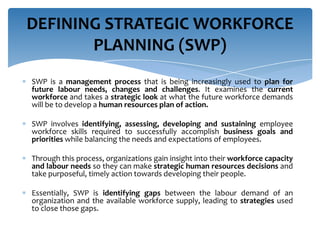
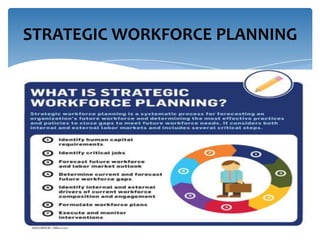
SWP is a management process that is being increasingly used to plan for
future labour needs, changes and challenges. It examines the current
workforce and takes a strategic look at what the future workforce demands
will be to develop a human resources plan of action.
SWP involves identifying, assessing, developing and sustaining employee
workforce skills required to successfully accomplish business goals and
priorities while balancing the needs and expectations of employees.
Through this process, organizations gain insight into their workforce capacity
and labour needs so they can make strategic human resources decisions and
take purposeful, timely action towards developing their people.
Essentially, SWP is identifying gaps between the labour demand of an
organization and the available workforce supply, leading to strategies used
to close those gaps.
STRATEGIC WORKFORCE PLANNING
BEST PRACTICE GUIDELINES FOR
EFFECTIVE SWP
Organized, well coordinated and systematic approach
Future-focused
Aligned with organization’s strategic plans
Collaborative effort (HRM has co-opted business partners to the process)
Work-in-progress (responsive not reactive)
Targeted for success (with a positive ROI)
Measurable outcomes
Integration (bundling) with other HR processes e.g. Succession Planning
THE STRATEGIC IMPERATIVE OF
WORKFORCE PLANNING
“Strategic workforce planning helps organizations understand the
talent required to deliver their strategy – without it, the costs are
significant.” (Hay Group UK)
“A talented and aligned workforce is crucial for bringing strategy
to life and ensuring an organization delivers on its objectives” (Hay
Group UK)
“Bringing together the right information with the right people will
dramatically improve a company’s ability to develop and act on
strategic business opportunities” (Bill Gates)
“CEO’s expect the Human Resources function to play a much more
active role in enabling business strategies.” (Deloitte, 2013)
PURPOSE OF SWP
Ensure adequate human resources to meet the strategic
goals and operational plans of your organization - the right
people with the right skills at the right time
Keep up with social, economic, legislative and
technological trends that impact on human resources in
your area and in the sector
Remain flexible so that your organization can manage
change if the future is different than anticipated
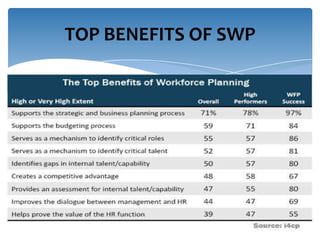
TOP BENEFITS OF SWP
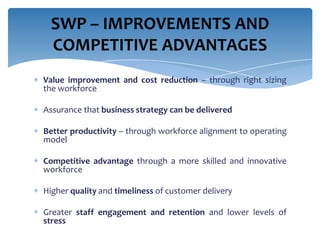
SWP – IMPROVEMENTS AND
COMPETITIVE ADVANTAGES
Value improvement and cost reduction – through right sizing
the workforce
Assurance that business strategy can be delivered
Better productivity – through workforce alignment to operating
model

Competitive advantage through a more skilled and innovative
workforce
Higher quality and timeliness of customer delivery

Greater staff engagement and retention and lower levels of
stress
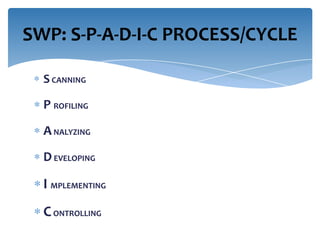
SWP: S-P-A-D-I-C PROCESS/CYCLE
S CANNING

P ROFILING
A NALYZING
D EVELOPING

I MPLEMENTING
C ONTROLLING
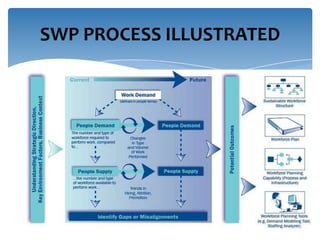
SWP PROCESS ILLUSTRATED
STEP 1: SCANNING – STRATEGIC
ANALYSIS
Review current HR and organizational strategies
(Strategic Intent)

Conduct an environmental scan
Identifying workforce trends and challenges

Benchmarking
Preferred Scanning tools – SWOT and PESTEL
Analyses
STEP 2: PROFILING

Forecasting HR Demand
Measuring Current Supply
FORECASTING HR DEMAND
Forecasting should consider the past and the present
requirements as well as future organizational directions
Number of employees

Type of employees
Skills requirements of these employees
Consider and assess the challenges and constraints
MEASURING CURRENT SUPPLY
Assess the current HR capacity of the organization by means of
the Skill inventories method
The knowledge, skills and abilities of your current staff need to
be identified
Employee experience, education and special skills
Certificates or additional training should also be included
A forecast of the supply of employees projected to join the
organization from outside sources
HR indicators, metrics and indices e.g. turnover rates
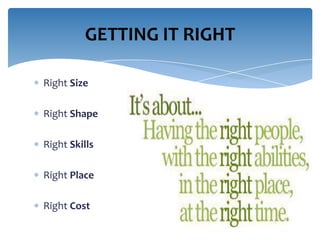
GETTING IT RIGHT
Right Size
Right Shape
Right Skills
Right Place
Right Cost
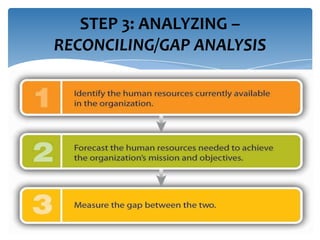
STEP 3: ANALYZING –
RECONCILING/GAP ANALYSIS
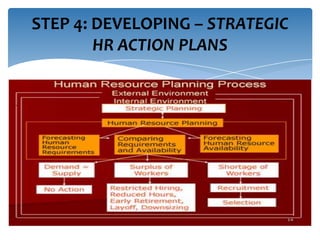
STEP 4: DEVELOPING – STRATEGIC
HR ACTION PLANS
STEP 5: IMPLEMENTING INTERVENTIONS
Restructuring strategies

Training and development strategies
Recruitment strategies
Outsourcing strategies
Collaboration strategies
Integration strategies
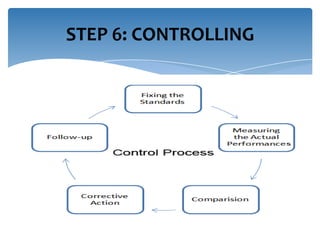
STEP 6: CONTROLLING
SUMMARY
Key points
Questions
Conclusion
Contact details:
 Charles Cotter
 084 562 9446
 charlescot@polka.co.za
 Linked In
 Twitter: @Charles_Cotter

Strategic workforce planning 28 november 2013

  • 1.
    STRATEGIC WORKFORCE PLANNING (SWP) CHARLESCOTTER 28 NOVEMBER 2013 PALAZZO, MONTECASINO
  • 2.
  • 3.
    DEFINING STRATEGIC WORKFORCE PLANNING(SWP) SWP is a management process that is being increasingly used to plan for future labour needs, changes and challenges. It examines the current workforce and takes a strategic look at what the future workforce demands will be to develop a human resources plan of action. SWP involves identifying, assessing, developing and sustaining employee workforce skills required to successfully accomplish business goals and priorities while balancing the needs and expectations of employees. Through this process, organizations gain insight into their workforce capacity and labour needs so they can make strategic human resources decisions and take purposeful, timely action towards developing their people. Essentially, SWP is identifying gaps between the labour demand of an organization and the available workforce supply, leading to strategies used to close those gaps.
  • 4.
  • 5.
    BEST PRACTICE GUIDELINESFOR EFFECTIVE SWP Organized, well coordinated and systematic approach Future-focused Aligned with organization’s strategic plans Collaborative effort (HRM has co-opted business partners to the process) Work-in-progress (responsive not reactive) Targeted for success (with a positive ROI) Measurable outcomes Integration (bundling) with other HR processes e.g. Succession Planning
  • 6.
    THE STRATEGIC IMPERATIVEOF WORKFORCE PLANNING “Strategic workforce planning helps organizations understand the talent required to deliver their strategy – without it, the costs are significant.” (Hay Group UK) “A talented and aligned workforce is crucial for bringing strategy to life and ensuring an organization delivers on its objectives” (Hay Group UK) “Bringing together the right information with the right people will dramatically improve a company’s ability to develop and act on strategic business opportunities” (Bill Gates) “CEO’s expect the Human Resources function to play a much more active role in enabling business strategies.” (Deloitte, 2013)
  • 7.
    PURPOSE OF SWP Ensureadequate human resources to meet the strategic goals and operational plans of your organization - the right people with the right skills at the right time Keep up with social, economic, legislative and technological trends that impact on human resources in your area and in the sector Remain flexible so that your organization can manage change if the future is different than anticipated
  • 8.
  • 9.
    SWP – IMPROVEMENTSAND COMPETITIVE ADVANTAGES Value improvement and cost reduction – through right sizing the workforce Assurance that business strategy can be delivered Better productivity – through workforce alignment to operating model Competitive advantage through a more skilled and innovative workforce Higher quality and timeliness of customer delivery Greater staff engagement and retention and lower levels of stress
  • 10.
    SWP: S-P-A-D-I-C PROCESS/CYCLE SCANNING P ROFILING A NALYZING D EVELOPING I MPLEMENTING C ONTROLLING
  • 11.
  • 12.
    STEP 1: SCANNING– STRATEGIC ANALYSIS Review current HR and organizational strategies (Strategic Intent) Conduct an environmental scan Identifying workforce trends and challenges Benchmarking Preferred Scanning tools – SWOT and PESTEL Analyses
  • 13.
    STEP 2: PROFILING ForecastingHR Demand Measuring Current Supply
  • 14.
    FORECASTING HR DEMAND Forecastingshould consider the past and the present requirements as well as future organizational directions Number of employees Type of employees Skills requirements of these employees Consider and assess the challenges and constraints
  • 15.
    MEASURING CURRENT SUPPLY Assessthe current HR capacity of the organization by means of the Skill inventories method The knowledge, skills and abilities of your current staff need to be identified Employee experience, education and special skills Certificates or additional training should also be included A forecast of the supply of employees projected to join the organization from outside sources HR indicators, metrics and indices e.g. turnover rates
  • 16.
    GETTING IT RIGHT RightSize Right Shape Right Skills Right Place Right Cost
  • 17.
    STEP 3: ANALYZING– RECONCILING/GAP ANALYSIS
  • 18.
    STEP 4: DEVELOPING– STRATEGIC HR ACTION PLANS
  • 19.
    STEP 5: IMPLEMENTINGINTERVENTIONS Restructuring strategies Training and development strategies Recruitment strategies Outsourcing strategies Collaboration strategies Integration strategies
  • 20.
  • 21.
    SUMMARY Key points Questions Conclusion Contact details: Charles Cotter  084 562 9446  charlescot@polka.co.za  Linked In  Twitter: @Charles_Cotter