TALENT PLANNING &
DEPLOYMENT
Overview
• By definition, talent planning is designed to
use an organization’s existing capabilities and
potential to meet current and future business
needs.
• it creates a foundation on which to build and
link critical talent management processes,
including sourcing, succession management,
leadership development and performance
management.
2
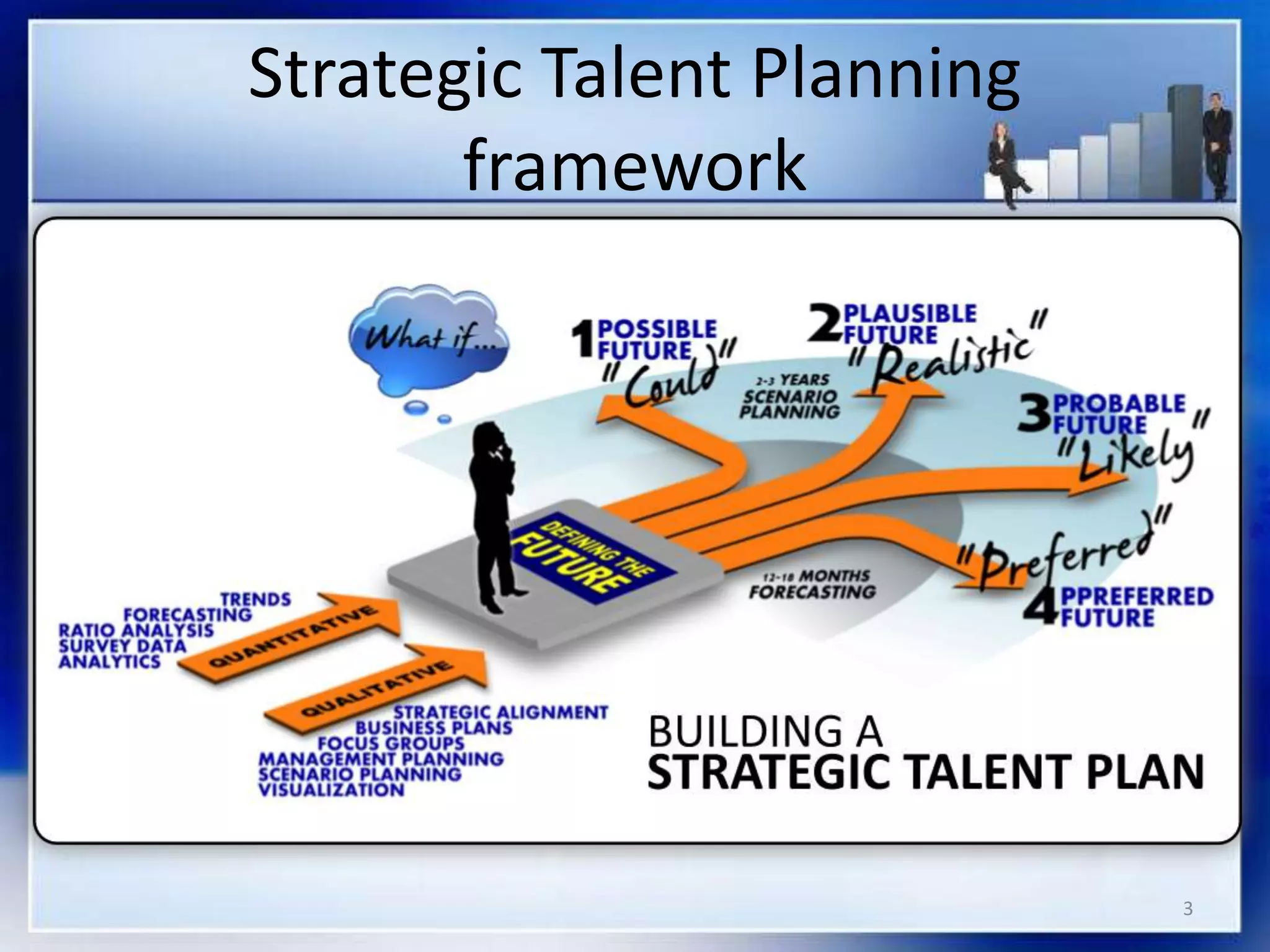
Strategic Talent Planning
framework
3
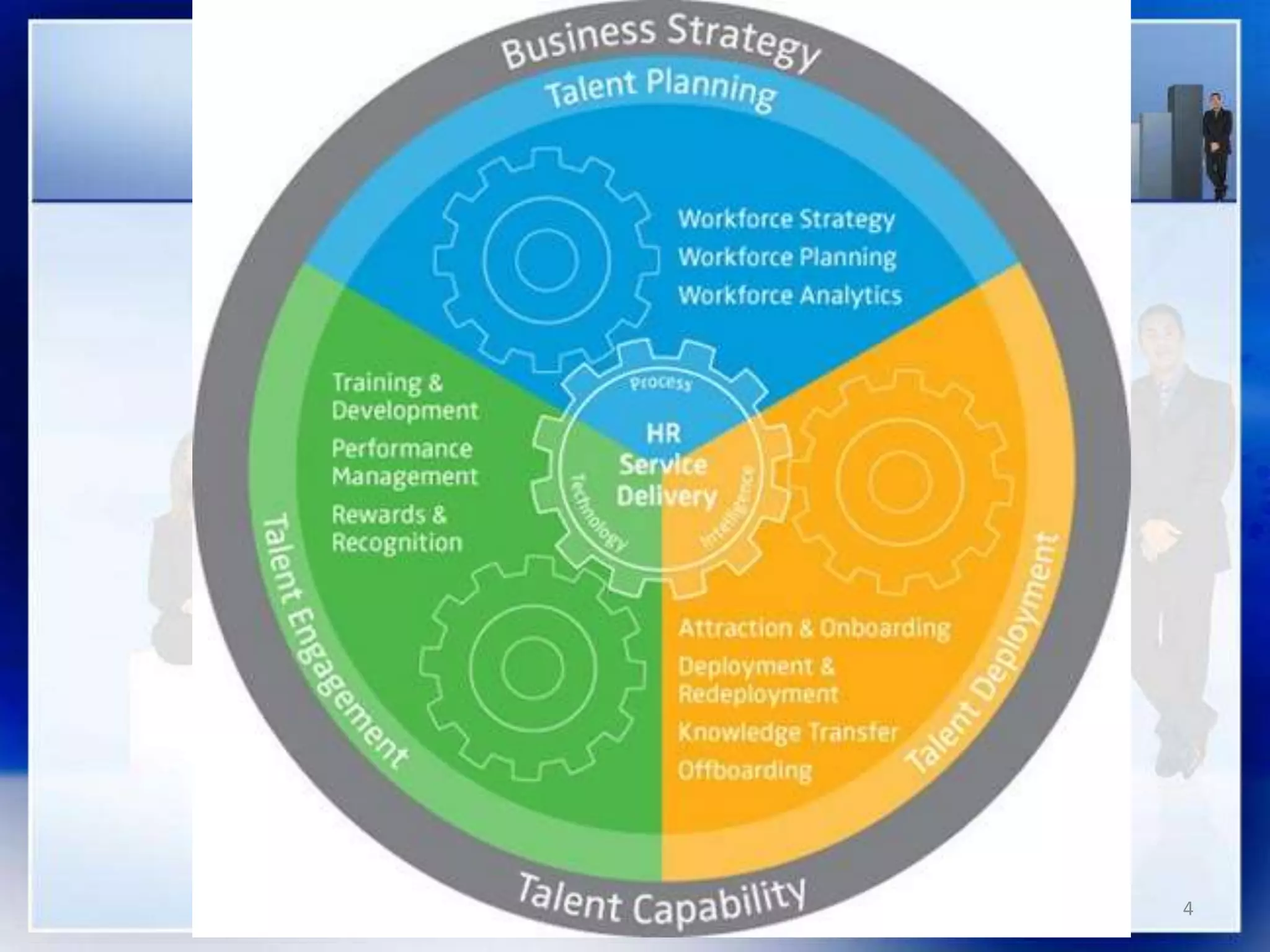
4
5
WORKFORCE PLANNING IN ACTION
Workforce Planning is a systematic process for
identifying and addressing the gaps between the
workforce of today and the workforce of
tomorrow.
The terms workforce planning and succession
planning are often used interchangeably.
Many books and articles also use the terms
human capital plan and talent management.
6
workforce planning:
1. overall process of linking workforce strategies
to desired business outcomes;
2. staffing plans as the specific workforce
strategies for recruiting, retaining, developing,
and managing employees;
3. succession programs as the specific staffing
strategies designed to develop an internal
pool for anticipated vacancies.
7
8
Workforce planning is, simply stated, the
• Right number of people with the
• Right competencies in the
• Right jobs at the
• Right time
to accomplish the agency’s goals and mission.
9
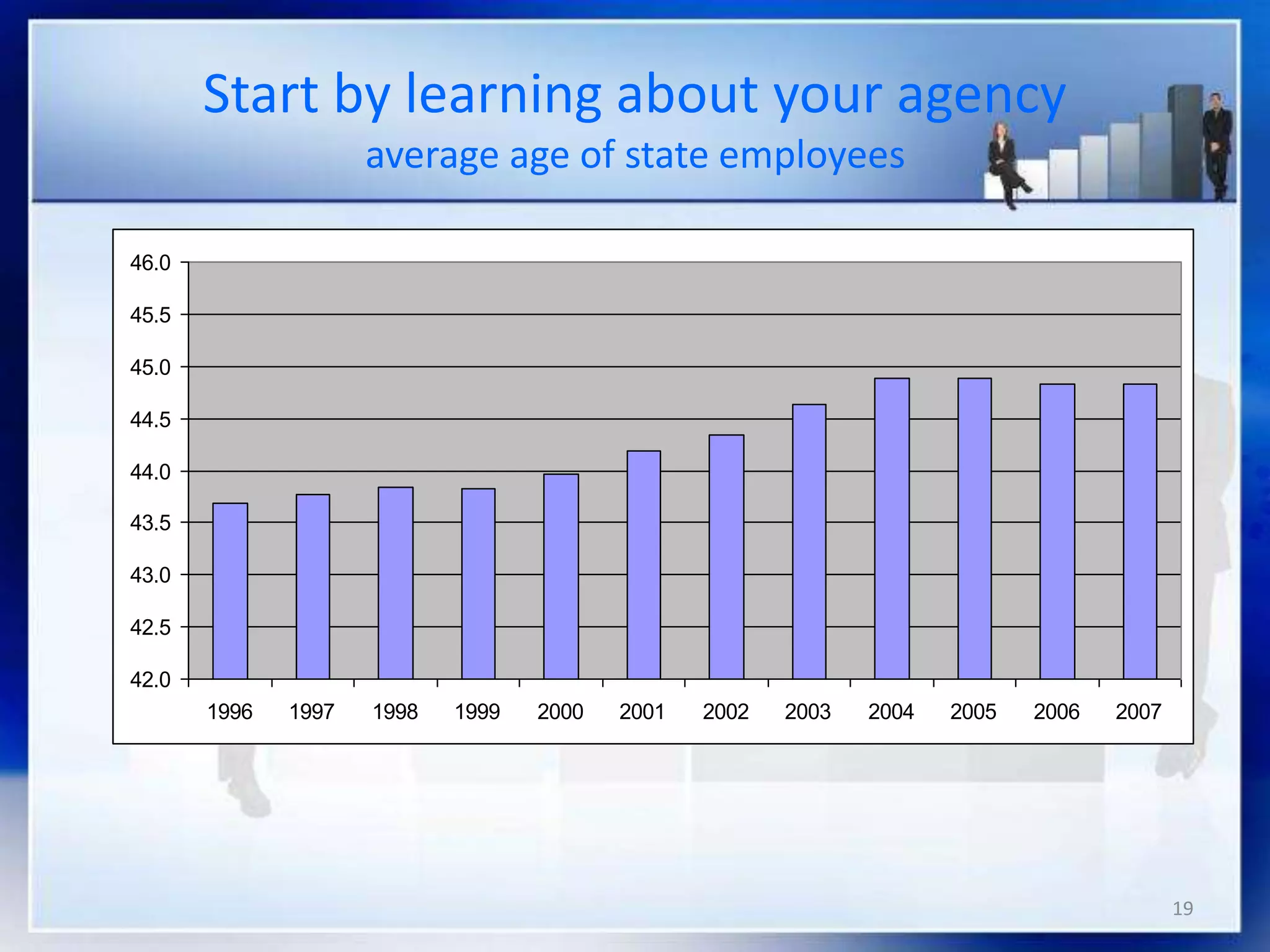
• Nearly 60% of state employees are 45 or older
• Helps the state compete in today’s market
• Allows decision makers to determine the workforce
needed for tomorrow’s success
• Gives managers the human resource information
they need to manage their programs effectively
*) Government’ case
Why do Workforce Planning?*
10
Workforce Planning Steps
Define the Future
Analyze Current Workforce
Close the Gap
Monitor, Evaluate, Revise
11
Step One: Define the Future
• Articulate the agency’s vision, mission,
organizational values, and objectives.
• Have a defined strategic plan for the
agency
• Conduct a SWOT (strengths, weaknesses,
opportunities, and threats) analysis
• Prepare the Demand Forecast
12
Determine Future Workforce Requirements
• Workload changes
• Program initiatives
• Anticipated attrition
• Roles and functions
• Mission/strategy changes
• Distribution
13
• Identify any current or pending statutory, regulatory, or
legislative mandates
• Identify any current skills that are becoming obsolete due to
new technologies
• Identify new skills needed to continue with the business of
the agency
• Identify shifts in changing work tasks
• Identify turnover rates in the current workforce
Prepare the Demand Forecast
14
The Demand Forecast Generates:
• Quantitative and qualitative data on
anticipated workload and workforce changes
during the planning period
• Quantitative and qualitative data on future
competency and skill requirements
15
Step Two: Analyze Current
Workforce
• Skills
• Distribution
• Demographics
• Workload/Productivity
• Staffing levels
• Succession
• Outsourcing
Profile Existing Workforce
16
Supply Projections
• Supply projection examines the current and
future composition of the workforce and
workload.
– Quantitative data on current and projected
workforce
– Quantitative data on current and projected
competencies
17
Supply Projections
• Look at trend data
–Workforce Profile
–Hiring Patterns
–Retirement Patterns
–Turnover statistics
18
Identify Labor Market Influences
• Labor pool decline
• Changes in labor pool
• Downsizing outside State Government
• Changing occupation outlook
19
Start by learning about your agency
average age of state employees
42.0
42.5
43.0
43.5
44.0
44.5
45.0
45.5
46.0
1996 1997 1998 1999 2000 2001 2002 2003 2004 2005 2006 2007
20
Step Three: Close the Gap
• Gap Analysis
• Action Plan
• Implementation Plan
21
Gap Analysis
Use the Demand Forecast and the Supply
Projections to identify differences (gaps)
between where your agency is now and
where it needs to be in the future
22
Gap Analysis
• Identifies situations where future demand will
exceed future supply
• Identifies situations where future supply will
exceed future demand
• In both types of situations, your workforce
plan must address eliminating these gaps
23
Workforce Action Plan
• Develop your plan around the most mission critical gaps
• Define critical job competencies
• Define and redesign jobs
• Define recruiting needs
• Define training and development needs
• Identify restructuring opportunities
• Identify a timeline for making the changes
• Describe how the plan will be measured (objectives)
24
Implementation Plan
• Obtain management leadership and support
• Develop change management strategy
• Communicate
25
Obtain Management Leadership and Support
• Workforce Planning should be viewed as a
significant piece of an agency’s strategic plan
• Senior-level management should lead the
planning process
• Agency’s program managers will gain the most
benefit from the plan
26
Develop Change Management Strategy
• Change must be managed
• Change involves all stakeholders in the agency
• Objective view of the change is needed—
often agencies will contract out for some
portion of the Workforce Planning process.
27
Communicate
• Make the process transparent—let your
employees know what’s going on
• Let your employees know what’s in it for them
• Planning for future workforce needs is an
excellent time to offer career growth and
opportunities to current employees
28
Step Four: Monitor, Evaluate, Revise
Monitor
• Continuously monitor the plan and
consider any internal or external
developments that may affect the action
plan.
– Consider upcoming legislation, budgetary
concerns, and other external developments
– Monitor projections to determine if current
conditions meet projections
29
Evaluate
• Obtain feedback about the action plan
and how it is working
– Meetings
– Surveys
– Interviews
– Focus groups
30
Evaluate
• Measure the results of the plan
– Do the gaps still exist?
– Are skills being developed?
– Are staffing levels adequate to perform the critical
mission of the agency?
– Do new hires possess the needed competencies?
– Celebrate achievements!
31
Revise
• Make necessary revisions
• Communicate changes
• Report on accomplishments
32
Typical Workforce Planning Issues
to Overcome
• No commitment from agency leadership to
provide the necessary staff
• Doing it half-heartedly - Do it right, or not at
all.
• Not including agency employees
• Wanting it too quickly.
• Lack of available data.
Workforce Planning Framework
33
34
35
36
KEY POSITION MAPPING
37
38
“I need a report just like
this, only with everyone’s
previous manager.”
Change Request
Gets Queued
HR & Business Managers
Business Analysts & IT
Time
Understand
HR Source
Build Report
Make Data
Accessible
Rebuild Data
Warehouse
Get Source
Data
Requirements
Definition
Report
Request
Many, Sequential, Very Technical Steps
A Long, Error-Prone Process
WORKFORCES ANALYTICS
Workforce Analytics
• Headcount and Turnover Analysis
– Headcounts, Workforce Demographics, Hires, Transfers, Terminations
– Detailed granularity with Calendar (e.g. weekly) and Fiscal (e.g. monthly)
Snapshot Summaries
– HR Budget
• Compensation and Incentive Analysis
– All Earnings and Withholdings of All Employees
– Regular pay, overtime pay, incentives, bonus, regular hours, overtime
hours
– By Pay Group, Pay Date, Company, Business Unit, Organization, Earnings
Type, Withholding Type, Dates
• Performance Review Analysis
– Employee Reviews, Ratings, Review Points, Total Points
– By Review Type, Employee, Review Status, Review Type, Organization,
Dates,
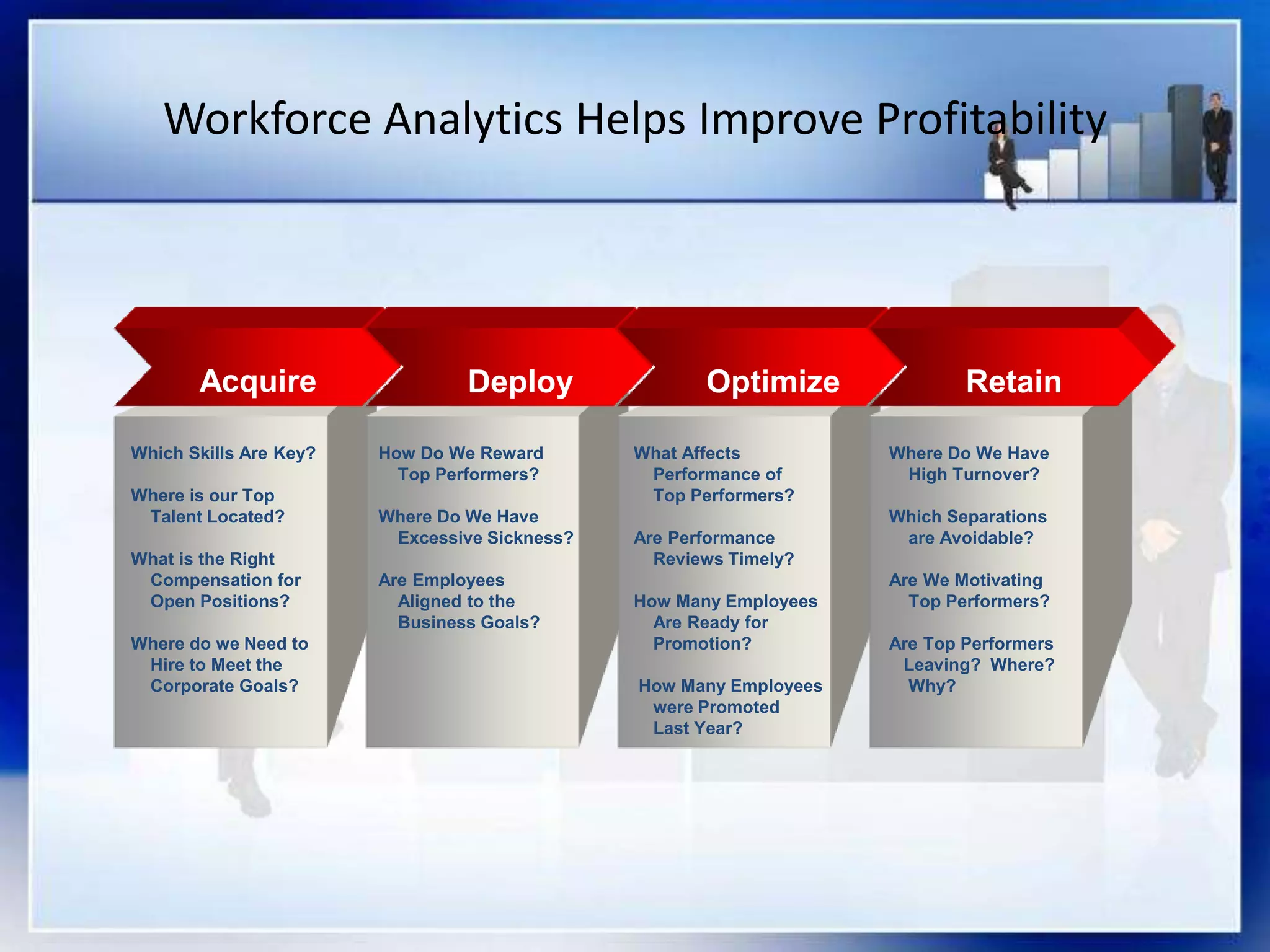
Workforce Analytics Helps Improve Profitability
Acquire Deploy Optimize Retain
Which Skills Are Key?
Where is our Top
Talent Located?
What is the Right
Compensation for
Open Positions?
Where do we Need to
Hire to Meet the
Corporate Goals?
How Do We Reward
Top Performers?
Where Do We Have
Excessive Sickness?
Are Employees
Aligned to the
Business Goals?
What Affects
Performance of
Top Performers?
Are Performance
Reviews Timely?
How Many Employees
Are Ready for
Promotion?
How Many Employees
were Promoted
Last Year?
Where Do We Have
High Turnover?
Which Separations
are Avoidable?
Are We Motivating
Top Performers?
Are Top Performers
Leaving? Where?
Why?
MEASURES MONITOR PLAN OUTCOMES With Supported
Analysis
Completion, attendance ratios
Program, certification expenses
Activity profitability
Performance outcome ratios
Satisfaction ratings
...
Workforce Analytics – Process Flow
ROI per employee
Headcount cost
Headcount variance
Requisition fulfillment cycle time
Termination cost per employee
Termination cost
Turnover rate
Absence rate
Accident rate
Exposure hours
Accept ratio
Agency effectiveness
Cost to hire
Vacation days balance
Vacation days entitlement
Performance review result
Contribution factor
Maintained qualification count
Review result
Scarcity level
Succession percentage
Training % of revenue
….
Company
Organization
Location
Responsibility Center
Job Position
Job Category
Vendor
Assignment
Salary Plan Grade Step
Calendar Month
Fiscal Period
Employee
Hiring Manager
HR agent
Annual compensation
Benefit plan enrollment
Compensation % increase
Increase Variance
]Customer service award variance
Dependant count
Employee, Employer contribution
Employee opt out ratio
Incentive award
Hourly pay rate
….
Absence days count
Accident Severity Rate
Accident Lost time Rate
High Performance ratio
Low Performance ratio
Employee Development cost
Development cost per employee
High Performance turnover rate
Incentive Pool variance
Benefit cost per employee
Merit Pool Variance
increase variance count
termination rate
FTE count
Human capital ROI
Time to hire
Turnover rate
....
Headcount,
Planning
Compensation &
Salary Planning
Improve
Growth
and
Profitability
Headcount & Turnover
Compensation, Incentive
Performance,
Succession
Recruiting , Absence &
Accident Analysis
Learning Management
Benefits Planning
Restructuring
planning
Payroll &
Reconciliation Analysis
Payroll Liability
Planning
Recruitment
Planning
Trained, certified headcount
Investment factors
Training cost factors
Revenue/expense ratios
ENVIRONMENTAL SCANNING
43
SOURCES OF INFORMATION
• Documentary or secondary sources
- Magazines, newspaper, journals, books, trade
&industry Assn. publication, Govt. Publication, Annual
report of competitor company
• Mass media
• Internal sources - employees, files, MIS, documents
SOURCES OF INFORMATION
• EXTERNAL AGENCIES - Customers, marketing
intermediaries, suppliers, trade Assn., Govt. Agencies
• FORMAL STUDIES - Consultants, Educational
Institutions, in-house
• Spying & Surveillance thro’ ex employees of competitor
or planting ‘moles’ in competitor company
COMPETITIVE ENVIRONMENT SCANNING
•ENVIRONMENT TURBULENCE
Hyper competition - Competitive intensity is
high “In hyper competition, the frequency, boldness &
aggressiveness of dynamic movement by the players
accelerates to create a condition of constant
disequilibrium and change.
COMPETITIVE ENVIRONMENT SCANNING
• Market stability is threatened by short product life cycles,
short product design cycles, new technologies, frequent entry
by unexpected outsiders, repositioning by incumbents and
tactical redefinition market boundaries as divers industries
merge.
• The environment escalates toward higher & higher levels of
uncertainty, dynamism, heterogeneity of players & hostility.
COMPETITIVE ENVIRONMENT
SCANNING
•ENVIRONMENTAL THREAT- Challenges posed by an
unfortunate trend - lead to erosion of company’s
position
•ENVIRONMENTAL OPPORTUNITY - an attractive arena -
that company enjoys a competitive advantage
INDUSTRIAL ENVIRONMENT
Firm
Relevant
environment
Micro
environment
Macro
Environment
Internal
Environment
COMPONENTS OF MEGA ENVIRONMENT
Regulatory EconomicPolitical
Technological Social
Mega Environment
CHARACTERISTICS OF VARIOUS ENVIRONMENT
TECHNOLOGICAL
• Transportation capability
• Mastery over energy
• Ability to alter character
of material
• Mechanization of
physical activities
• telecommunication
network
SOCIAL
• Population, demographic
data
• Spread of literacy
• Income distribution
• Social Values
• Ethical standards
• Concern for health
CHARACTERISTICS OF VARIOUS ENVIRONMENT
ECONOMIC
• GDP, Growth rate
• Money supply
• Policies and regulations
POLITICAL
• Regulatory
• Legal provisions
• Stability of Government
Suppliers
Marketing
Intermediaries
Market
Types
Market
demand
Competition
MICRO ENVIRONMENT
Financial
Institutions
Regulatory
Provisions
Industrial
relation
climate
Availability of
skilled
manpower
SWOT CONCEPT
•STRENGTH - Inherent capacity which an organization
an use to gain strategic advantage over it competitors
•WEAKNESS - Inherent limitations or constraint which
creates a strategic disadvantage
•OPPORTUNITY - a favorable condition in the
organization’s environment which enables it to
consolidate and strengthen its position
•THREAT - an unfavorable condition in organization’s
environment which creates a risk or causes damage to
the organization
OPPORTUNITY MATRIX
High Very Moderately
Attractive Attractive
Attractiveness
Moderately Least
Low Attractive Attractive
High Low
Probability of occurrence
THREAT MATRIX
High Major Moderate
Threat Threat
Seriousness
Moderate Minor
Low Threat Threat
High Low
Probability of occurrence
SWOT in Talent Planning
• Application in Workforce Planning
• Developing Talent Needs Analysis
• Aligning Market and Internal Supply &
Demand
57
Talent Gap Analysis & solution
58
59
Identify the Needed Skills
• What is the agency’s mission?
• What are the agency’s business goals?
• What processes and procedures are currently
in place?
• What critical skills are needed to be able to
perform the mission and meet the goals?
60
What is a critical skill?
• A critical skill is one that, if not present, results
in a task not being completed satisfactorily, if
at all.
• The lack of a critical skill causes problems, but
the possession of it allows work to continue.
61
Analysis and data collection
• Develop job profiles and identify critical skills
needed for the job role
• Conduct an inventory of current skills
• Identify employees’ competencies and skill
levels
62
Develop job profiles and identify critical skills
needed for the job role
• Review current position descriptions for future
needs
• Consider the impact of upcoming statutory or
regulatory changes on the work
• Take the time to develop a list of
competencies that most clearly and accurately
describe what is needed to do the work
63
Conduct an inventory of existing skills
• Position descriptions
• Job class specifications
• Performance evaluations and employee assessments
• Interviews/focus group meetings with supervisors,
managers, and employees
64
Identify individual employees’ competencies
and skill levels
• Put information gathered from competency assessments
into one searchable database
– Database of all employees and their existing competencies
– Crosswalk with identified necessary critical skills for now and the
future
• Create agency skills inventories databases
– Interagency cooperation
65
66
Skill Gap Analysis
• Helps you refine and define skills the agency
needs, now and in the future
• Helps your employees know what critical skills
they’ll need to grow
• Helps you in recruiting efforts when current
employees don’t have the skills or the interest

3. talent planning & deployment

  • 1.
  • 2.
    Overview • By definition,talent planning is designed to use an organization’s existing capabilities and potential to meet current and future business needs. • it creates a foundation on which to build and link critical talent management processes, including sourcing, succession management, leadership development and performance management. 2
  • 3.
  • 4.
  • 5.
  • 6.
    WORKFORCE PLANNING INACTION Workforce Planning is a systematic process for identifying and addressing the gaps between the workforce of today and the workforce of tomorrow. The terms workforce planning and succession planning are often used interchangeably. Many books and articles also use the terms human capital plan and talent management. 6
  • 7.
    workforce planning: 1. overallprocess of linking workforce strategies to desired business outcomes; 2. staffing plans as the specific workforce strategies for recruiting, retaining, developing, and managing employees; 3. succession programs as the specific staffing strategies designed to develop an internal pool for anticipated vacancies. 7
  • 8.
    8 Workforce planning is,simply stated, the • Right number of people with the • Right competencies in the • Right jobs at the • Right time to accomplish the agency’s goals and mission.
  • 9.
    9 • Nearly 60%of state employees are 45 or older • Helps the state compete in today’s market • Allows decision makers to determine the workforce needed for tomorrow’s success • Gives managers the human resource information they need to manage their programs effectively *) Government’ case Why do Workforce Planning?*
  • 10.
    10 Workforce Planning Steps Definethe Future Analyze Current Workforce Close the Gap Monitor, Evaluate, Revise
  • 11.
    11 Step One: Definethe Future • Articulate the agency’s vision, mission, organizational values, and objectives. • Have a defined strategic plan for the agency • Conduct a SWOT (strengths, weaknesses, opportunities, and threats) analysis • Prepare the Demand Forecast
  • 12.
    12 Determine Future WorkforceRequirements • Workload changes • Program initiatives • Anticipated attrition • Roles and functions • Mission/strategy changes • Distribution
  • 13.
    13 • Identify anycurrent or pending statutory, regulatory, or legislative mandates • Identify any current skills that are becoming obsolete due to new technologies • Identify new skills needed to continue with the business of the agency • Identify shifts in changing work tasks • Identify turnover rates in the current workforce Prepare the Demand Forecast
  • 14.
    14 The Demand ForecastGenerates: • Quantitative and qualitative data on anticipated workload and workforce changes during the planning period • Quantitative and qualitative data on future competency and skill requirements
  • 15.
    15 Step Two: AnalyzeCurrent Workforce • Skills • Distribution • Demographics • Workload/Productivity • Staffing levels • Succession • Outsourcing Profile Existing Workforce
  • 16.
    16 Supply Projections • Supplyprojection examines the current and future composition of the workforce and workload. – Quantitative data on current and projected workforce – Quantitative data on current and projected competencies
  • 17.
    17 Supply Projections • Lookat trend data –Workforce Profile –Hiring Patterns –Retirement Patterns –Turnover statistics
  • 18.
    18 Identify Labor MarketInfluences • Labor pool decline • Changes in labor pool • Downsizing outside State Government • Changing occupation outlook
  • 19.
    19 Start by learningabout your agency average age of state employees 42.0 42.5 43.0 43.5 44.0 44.5 45.0 45.5 46.0 1996 1997 1998 1999 2000 2001 2002 2003 2004 2005 2006 2007
  • 20.
    20 Step Three: Closethe Gap • Gap Analysis • Action Plan • Implementation Plan
  • 21.
    21 Gap Analysis Use theDemand Forecast and the Supply Projections to identify differences (gaps) between where your agency is now and where it needs to be in the future
  • 22.
    22 Gap Analysis • Identifiessituations where future demand will exceed future supply • Identifies situations where future supply will exceed future demand • In both types of situations, your workforce plan must address eliminating these gaps
  • 23.
    23 Workforce Action Plan •Develop your plan around the most mission critical gaps • Define critical job competencies • Define and redesign jobs • Define recruiting needs • Define training and development needs • Identify restructuring opportunities • Identify a timeline for making the changes • Describe how the plan will be measured (objectives)
  • 24.
    24 Implementation Plan • Obtainmanagement leadership and support • Develop change management strategy • Communicate
  • 25.
    25 Obtain Management Leadershipand Support • Workforce Planning should be viewed as a significant piece of an agency’s strategic plan • Senior-level management should lead the planning process • Agency’s program managers will gain the most benefit from the plan
  • 26.
    26 Develop Change ManagementStrategy • Change must be managed • Change involves all stakeholders in the agency • Objective view of the change is needed— often agencies will contract out for some portion of the Workforce Planning process.
  • 27.
    27 Communicate • Make theprocess transparent—let your employees know what’s going on • Let your employees know what’s in it for them • Planning for future workforce needs is an excellent time to offer career growth and opportunities to current employees
  • 28.
    28 Step Four: Monitor,Evaluate, Revise Monitor • Continuously monitor the plan and consider any internal or external developments that may affect the action plan. – Consider upcoming legislation, budgetary concerns, and other external developments – Monitor projections to determine if current conditions meet projections
  • 29.
    29 Evaluate • Obtain feedbackabout the action plan and how it is working – Meetings – Surveys – Interviews – Focus groups
  • 30.
    30 Evaluate • Measure theresults of the plan – Do the gaps still exist? – Are skills being developed? – Are staffing levels adequate to perform the critical mission of the agency? – Do new hires possess the needed competencies? – Celebrate achievements!
  • 31.
    31 Revise • Make necessaryrevisions • Communicate changes • Report on accomplishments
  • 32.
    32 Typical Workforce PlanningIssues to Overcome • No commitment from agency leadership to provide the necessary staff • Doing it half-heartedly - Do it right, or not at all. • Not including agency employees • Wanting it too quickly. • Lack of available data.
  • 33.
  • 34.
  • 35.
  • 36.
  • 37.
  • 38.
  • 39.
    “I need areport just like this, only with everyone’s previous manager.” Change Request Gets Queued HR & Business Managers Business Analysts & IT Time Understand HR Source Build Report Make Data Accessible Rebuild Data Warehouse Get Source Data Requirements Definition Report Request Many, Sequential, Very Technical Steps A Long, Error-Prone Process WORKFORCES ANALYTICS
  • 40.
    Workforce Analytics • Headcountand Turnover Analysis – Headcounts, Workforce Demographics, Hires, Transfers, Terminations – Detailed granularity with Calendar (e.g. weekly) and Fiscal (e.g. monthly) Snapshot Summaries – HR Budget • Compensation and Incentive Analysis – All Earnings and Withholdings of All Employees – Regular pay, overtime pay, incentives, bonus, regular hours, overtime hours – By Pay Group, Pay Date, Company, Business Unit, Organization, Earnings Type, Withholding Type, Dates • Performance Review Analysis – Employee Reviews, Ratings, Review Points, Total Points – By Review Type, Employee, Review Status, Review Type, Organization, Dates,
  • 41.
    Workforce Analytics HelpsImprove Profitability Acquire Deploy Optimize Retain Which Skills Are Key? Where is our Top Talent Located? What is the Right Compensation for Open Positions? Where do we Need to Hire to Meet the Corporate Goals? How Do We Reward Top Performers? Where Do We Have Excessive Sickness? Are Employees Aligned to the Business Goals? What Affects Performance of Top Performers? Are Performance Reviews Timely? How Many Employees Are Ready for Promotion? How Many Employees were Promoted Last Year? Where Do We Have High Turnover? Which Separations are Avoidable? Are We Motivating Top Performers? Are Top Performers Leaving? Where? Why?
  • 42.
    MEASURES MONITOR PLANOUTCOMES With Supported Analysis Completion, attendance ratios Program, certification expenses Activity profitability Performance outcome ratios Satisfaction ratings ... Workforce Analytics – Process Flow ROI per employee Headcount cost Headcount variance Requisition fulfillment cycle time Termination cost per employee Termination cost Turnover rate Absence rate Accident rate Exposure hours Accept ratio Agency effectiveness Cost to hire Vacation days balance Vacation days entitlement Performance review result Contribution factor Maintained qualification count Review result Scarcity level Succession percentage Training % of revenue …. Company Organization Location Responsibility Center Job Position Job Category Vendor Assignment Salary Plan Grade Step Calendar Month Fiscal Period Employee Hiring Manager HR agent Annual compensation Benefit plan enrollment Compensation % increase Increase Variance ]Customer service award variance Dependant count Employee, Employer contribution Employee opt out ratio Incentive award Hourly pay rate …. Absence days count Accident Severity Rate Accident Lost time Rate High Performance ratio Low Performance ratio Employee Development cost Development cost per employee High Performance turnover rate Incentive Pool variance Benefit cost per employee Merit Pool Variance increase variance count termination rate FTE count Human capital ROI Time to hire Turnover rate .... Headcount, Planning Compensation & Salary Planning Improve Growth and Profitability Headcount & Turnover Compensation, Incentive Performance, Succession Recruiting , Absence & Accident Analysis Learning Management Benefits Planning Restructuring planning Payroll & Reconciliation Analysis Payroll Liability Planning Recruitment Planning Trained, certified headcount Investment factors Training cost factors Revenue/expense ratios
  • 43.
  • 44.
    SOURCES OF INFORMATION •Documentary or secondary sources - Magazines, newspaper, journals, books, trade &industry Assn. publication, Govt. Publication, Annual report of competitor company • Mass media • Internal sources - employees, files, MIS, documents
  • 45.
    SOURCES OF INFORMATION •EXTERNAL AGENCIES - Customers, marketing intermediaries, suppliers, trade Assn., Govt. Agencies • FORMAL STUDIES - Consultants, Educational Institutions, in-house • Spying & Surveillance thro’ ex employees of competitor or planting ‘moles’ in competitor company
  • 46.
    COMPETITIVE ENVIRONMENT SCANNING •ENVIRONMENTTURBULENCE Hyper competition - Competitive intensity is high “In hyper competition, the frequency, boldness & aggressiveness of dynamic movement by the players accelerates to create a condition of constant disequilibrium and change.
  • 47.
    COMPETITIVE ENVIRONMENT SCANNING •Market stability is threatened by short product life cycles, short product design cycles, new technologies, frequent entry by unexpected outsiders, repositioning by incumbents and tactical redefinition market boundaries as divers industries merge. • The environment escalates toward higher & higher levels of uncertainty, dynamism, heterogeneity of players & hostility.
  • 48.
    COMPETITIVE ENVIRONMENT SCANNING •ENVIRONMENTAL THREAT-Challenges posed by an unfortunate trend - lead to erosion of company’s position •ENVIRONMENTAL OPPORTUNITY - an attractive arena - that company enjoys a competitive advantage
  • 49.
  • 50.
    COMPONENTS OF MEGAENVIRONMENT Regulatory EconomicPolitical Technological Social Mega Environment
  • 51.
    CHARACTERISTICS OF VARIOUSENVIRONMENT TECHNOLOGICAL • Transportation capability • Mastery over energy • Ability to alter character of material • Mechanization of physical activities • telecommunication network SOCIAL • Population, demographic data • Spread of literacy • Income distribution • Social Values • Ethical standards • Concern for health
  • 52.
    CHARACTERISTICS OF VARIOUSENVIRONMENT ECONOMIC • GDP, Growth rate • Money supply • Policies and regulations POLITICAL • Regulatory • Legal provisions • Stability of Government
  • 53.
  • 54.
    SWOT CONCEPT •STRENGTH -Inherent capacity which an organization an use to gain strategic advantage over it competitors •WEAKNESS - Inherent limitations or constraint which creates a strategic disadvantage •OPPORTUNITY - a favorable condition in the organization’s environment which enables it to consolidate and strengthen its position •THREAT - an unfavorable condition in organization’s environment which creates a risk or causes damage to the organization
  • 55.
    OPPORTUNITY MATRIX High VeryModerately Attractive Attractive Attractiveness Moderately Least Low Attractive Attractive High Low Probability of occurrence
  • 56.
    THREAT MATRIX High MajorModerate Threat Threat Seriousness Moderate Minor Low Threat Threat High Low Probability of occurrence
  • 57.
    SWOT in TalentPlanning • Application in Workforce Planning • Developing Talent Needs Analysis • Aligning Market and Internal Supply & Demand 57
  • 58.
    Talent Gap Analysis& solution 58
  • 59.
    59 Identify the NeededSkills • What is the agency’s mission? • What are the agency’s business goals? • What processes and procedures are currently in place? • What critical skills are needed to be able to perform the mission and meet the goals?
  • 60.
    60 What is acritical skill? • A critical skill is one that, if not present, results in a task not being completed satisfactorily, if at all. • The lack of a critical skill causes problems, but the possession of it allows work to continue.
  • 61.
    61 Analysis and datacollection • Develop job profiles and identify critical skills needed for the job role • Conduct an inventory of current skills • Identify employees’ competencies and skill levels
  • 62.
    62 Develop job profilesand identify critical skills needed for the job role • Review current position descriptions for future needs • Consider the impact of upcoming statutory or regulatory changes on the work • Take the time to develop a list of competencies that most clearly and accurately describe what is needed to do the work
  • 63.
    63 Conduct an inventoryof existing skills • Position descriptions • Job class specifications • Performance evaluations and employee assessments • Interviews/focus group meetings with supervisors, managers, and employees
  • 64.
    64 Identify individual employees’competencies and skill levels • Put information gathered from competency assessments into one searchable database – Database of all employees and their existing competencies – Crosswalk with identified necessary critical skills for now and the future • Create agency skills inventories databases – Interagency cooperation
  • 65.
  • 66.
    66 Skill Gap Analysis •Helps you refine and define skills the agency needs, now and in the future • Helps your employees know what critical skills they’ll need to grow • Helps you in recruiting efforts when current employees don’t have the skills or the interest