Strategic
Thinking
Be strategic
Thinker
Definition
Strategic thinking: It is a process that defines the
manner in which people think about, assess, view, and create
the future for themselves and others. Strategic thinking is an
extremely effective and valuable tool. One can apply strategic
thinking to arrive at decisions that can be related to your work
or personal life. Strategic thinking involves developing an entire
set of critical skills.
How to develop strategic thinking?
The rudiments of strategic
thinking
1. Be open!
2. Challenging conventional thinking
3. What’s your vision? Seeing possibilities beyond the present
4. Thinking big and broadly
5. Automatic filters that affect your perception of the world and
the way you think
6. Zoom-in, Zoom-out: looking beyond the picture you see from
where you stand
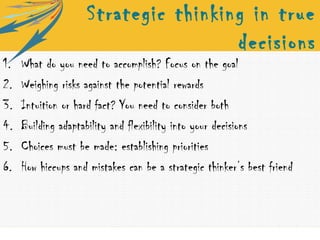
Strategic thinking in true
decisions
1. What do you need to accomplish? Focus on the goal
2. Weighing risks against the potential rewards
3. Intuition or hard fact? You need to consider both
4. Building adaptability and flexibility into your decisions
5. Choices must be made: establishing priorities
6. How hiccups and mistakes can be a strategic thinker’s best friend
Thinking Tools
1. Understanding strengths and vulnerabilities of any situation or business
condition
2. Identifying roadblocks and land mines that can throw you off track
3. Protecting your “thinking time” — it’s hard to be your strategic
best amidst the hustle and bustle of everyday life
4. Questioning strategies: the best answers come from the best questions
5. Articulating your strategies: communicating so everyone understands
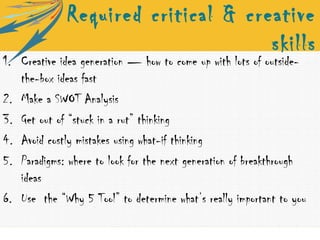
Required critical & creative
skills
1. Creative idea generation — how to come up with lots of outside-
the-box ideas fast
2. Make a SWOT Analysis
3. Get out of “stuck in a rut” thinking
4. Avoid costly mistakes using what-if thinking
5. Paradigms: where to look for the next generation of breakthrough
ideas
6. Use the “Why 5 Tool” to determine what’s really important to you
Do Not Forget
• Aligning strategic decisions with critical goals
• Create your action plan succeeds
• Setting measurable, specific objectives
• Be organized
• Always seek for something new and adjust on it fastly
• Be monitor evaluator
• The strategic planning team
Thank You! 
Thank You! 

Strategic thinking

  • 1.
  • 2.
    Definition Strategic thinking: Itis a process that defines the manner in which people think about, assess, view, and create the future for themselves and others. Strategic thinking is an extremely effective and valuable tool. One can apply strategic thinking to arrive at decisions that can be related to your work or personal life. Strategic thinking involves developing an entire set of critical skills.
  • 3.
    How to developstrategic thinking?
  • 4.
    The rudiments ofstrategic thinking 1. Be open! 2. Challenging conventional thinking 3. What’s your vision? Seeing possibilities beyond the present 4. Thinking big and broadly 5. Automatic filters that affect your perception of the world and the way you think 6. Zoom-in, Zoom-out: looking beyond the picture you see from where you stand
  • 5.
    Strategic thinking intrue decisions 1. What do you need to accomplish? Focus on the goal 2. Weighing risks against the potential rewards 3. Intuition or hard fact? You need to consider both 4. Building adaptability and flexibility into your decisions 5. Choices must be made: establishing priorities 6. How hiccups and mistakes can be a strategic thinker’s best friend
  • 6.
    Thinking Tools 1. Understandingstrengths and vulnerabilities of any situation or business condition 2. Identifying roadblocks and land mines that can throw you off track 3. Protecting your “thinking time” — it’s hard to be your strategic best amidst the hustle and bustle of everyday life 4. Questioning strategies: the best answers come from the best questions 5. Articulating your strategies: communicating so everyone understands
  • 7.
    Required critical &creative skills 1. Creative idea generation — how to come up with lots of outside- the-box ideas fast 2. Make a SWOT Analysis 3. Get out of “stuck in a rut” thinking 4. Avoid costly mistakes using what-if thinking 5. Paradigms: where to look for the next generation of breakthrough ideas 6. Use the “Why 5 Tool” to determine what’s really important to you
  • 8.
    Do Not Forget •Aligning strategic decisions with critical goals • Create your action plan succeeds • Setting measurable, specific objectives • Be organized • Always seek for something new and adjust on it fastly • Be monitor evaluator • The strategic planning team
  • 9.
  • 10.