Analyzingeffectsofcomputation
ComputationalThinking Practices #1:
Analyzing effects of computation
Computation is everywhere. From search engines
that help us find information, to cash registers in
stores, to software used for designing bridges, we
live in a world built on the effects of computation.
Computation is not just another word for
technology. For example, a cellular phone contains
many different technologies: a radio transmitter
and receiver, a processor, memory, and electro-
mechnical parts like buttons and touch screens.
When studying the effects of computation, we
aren’t trying to learn how physics governs these
technologies. Analyzing the effects of computation
means specifically looking at what happens when
we collect, store, and process data.
The computation done by a cell phone involves
recording your voice as data, compressing and
transmitting that data, and interacting with a larger
system that routes your call’s data to its destination.
This same computational process is done in reverse
so your conversation partner can talk back to you.
That sounds like a lot of computational work for
your cell phone to do, but that’s only part of what
happens when you make a call.
All the sending and receiving of data happens
via radio waves. When the technology for radio
communication was first invented by Nikola Tesla,
it could only be used for mass communication in
the form of broadcasts. It takes computation to
transform that raw technological capacity into the
more refined form we use today in our cell phones.
One effect of computation is that radio can now be
used for person-to-person communication, with
many simultaneous conversations happening in the
same physical area.
When we analyze the effects of computation, we
take note and measure how data is transformed.
We look at how information is processed and what
is accomplished by that processing. We can think
about what we might do if such computational
power wasn’t available. That can also help us start
to imagine new things we can strive to accomplish
using computation.
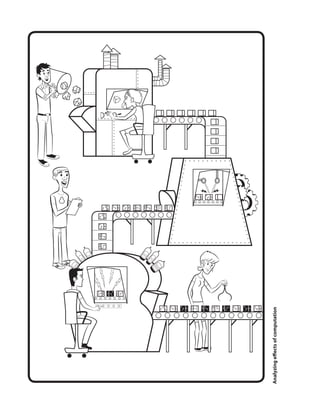
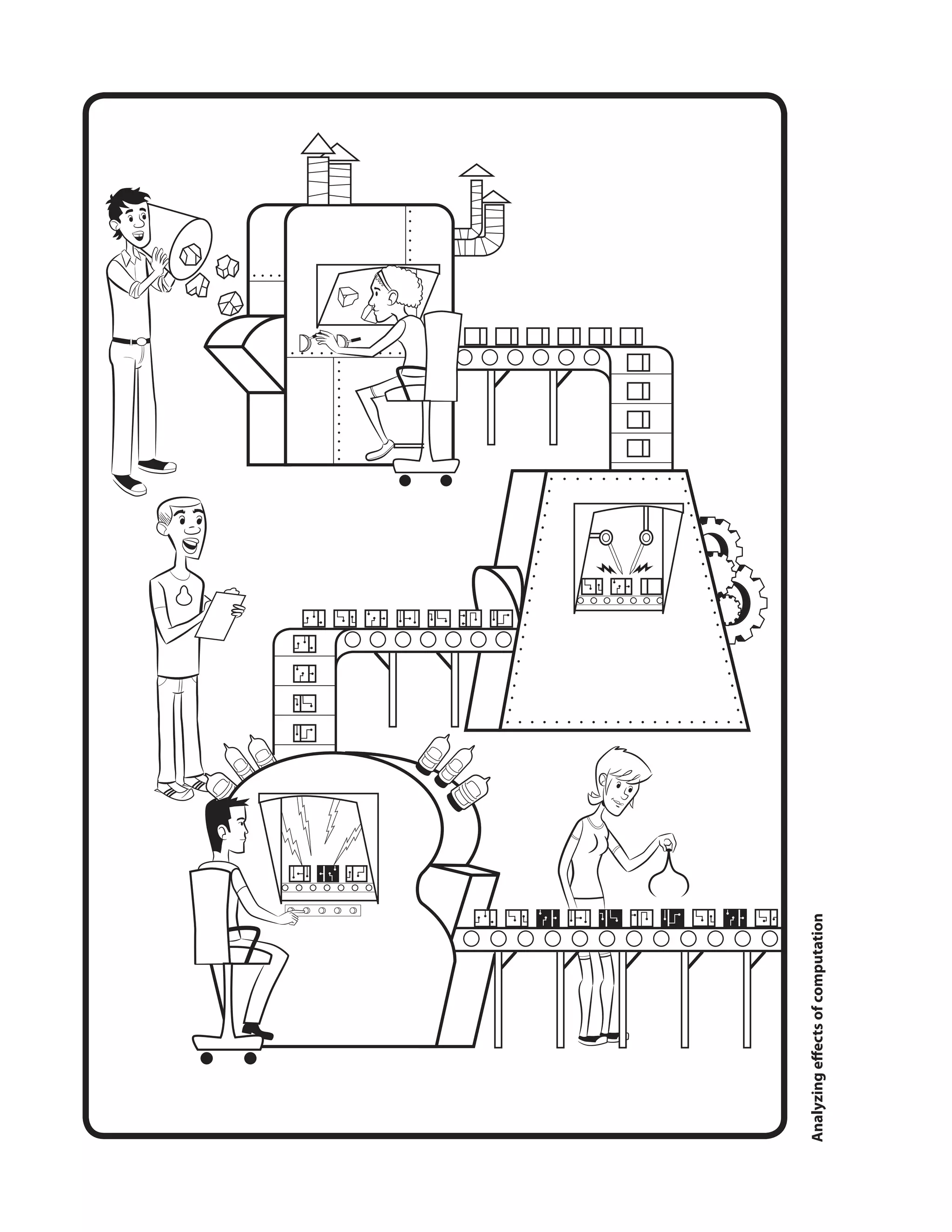
A major part of the work in analyzing the effects
of computation is careful observation, as Blaze,
Ada, Charles, Alan, and Grace are doing in this
illustration. In their world, as in ours, computation is
everywhere. By looking closely, we can start to see
what computation -- not just raw technology -- does
for us.
C/C++DATBITASCII
0000111
Producingcomputationalartifacts
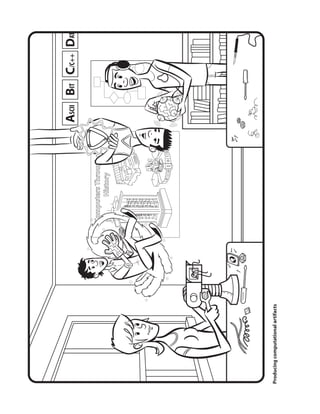
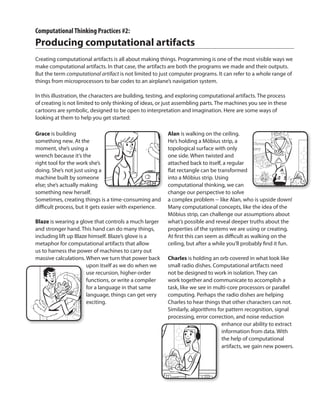
Grace is building
something new. At the
moment, she’s using a
wrench because it’s the
right tool for the work she’s
doing. She’s not just using a
machine built by someone
else; she’s actually making
something new herself.
Sometimes, creating things is a time-consuming and
difficult process, but it gets easier with experience.
Blaze is wearing a glove that controls a much larger
and stronger hand. This hand can do many things,
including lift up Blaze himself. Blaze’s glove is a
metaphor for computational artifacts that allow
us to harness the power of machines to carry out
massive calculations. When we turn that power back
upon itself as we do when we
use recursion, higher-order
functions, or write a compiler
for a language in that same
language, things can get very
exciting.
Alan is walking on the ceiling.
He’s holding a Möbius strip, a
topological surface with only
one side. When twisted and
attached back to itself, a regular
flat rectangle can be transformed
into a Möbius strip. Using
computational thinking, we can
change our perspective to solve
a complex problem -- like Alan, who is upside down!
Many computational concepts, like the idea of the
Möbius strip, can challenge our assumptions about
what’s possible and reveal deeper truths about the
properties of the systems we are using or creating.
At first this can seem as difficult as walking on the
ceiling, but after a while you’ll probably find it fun.
Charles is holding an orb covered in what look like
small radio dishes. Computational artifacts need
not be designed to work in isolation. They can
work together and communicate to accomplish a
task, like we see in multi-core processors or parallel
computing. Perhaps the radio dishes are helping
Charles to hear things that other characters can not.
Similarly, algorithms for pattern recognition, signal
processing, error correction, and noise reduction
enhance our ability to extract
information from data. With
the help of computational
artifacts, we gain new powers.
ComputationalThinking Practices #2:
Producing computational artifacts
Creating computational artifacts is all about making things. Programming is one of the most visible ways we
make computational artifacts. In that case, the artifacts are both the programs we made and their outputs.
But the term computational artifact is not limited to just computer programs. It can refer to a whole range of
things from microprocessors to bar codes to an airplane’s navigation system.
In this illustration, the characters are building, testing, and exploring computational artifacts. The process
of creating is not limited to only thinking of ideas, or just assembling parts. The machines you see in these
cartoons are symbolic, designed to be open to interpretation and imagination. Here are some ways of
looking at them to help you get started:
C/C++ DATBITASCII
0 0 0 01 1 1
C/C++ DATBITASCII
0 0 0 01 1 1
CBITASCII
0 0 0 01 1 1
C/C++ DATBITASCII
0 0 0 01 1 1
Usingabstractionandmodels
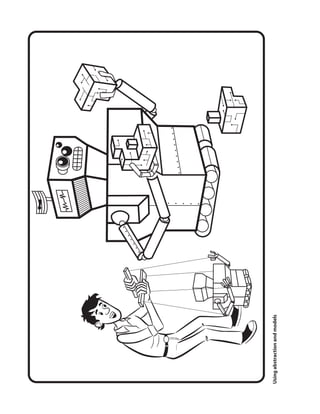
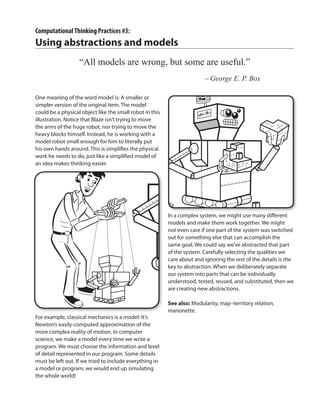
One meaning of the word model is: A smaller or
simpler version of the original item. The model
could be a physical object like the small robot in this
illustration. Notice that Blaze isn’t trying to move
the arms of the huge robot, nor trying to move the
heavy blocks himself. Instead, he is working with a
model robot small enough for him to literally put
his own hands around. This is simplifies the physical
work he needs to do, just like a simplified model of
an idea makes thinking easier.
For example, classical mechanics is a model: It’s
Newton’s easily-computed approximation of the
more complex reality of motion. In computer
science, we make a model every time we write a
program. We must choose the information and level
of detail represented in our program. Some details
must be left out. If we tried to include everything in
a model or program, we would end up simulating
the whole world!
In a complex system, we might use many different
models and make them work together. We might
not even care if one part of the system was switched
out for something else that can accomplish the
same goal. We could say we’ve abstracted that part
of the system. Carefully selecting the qualities we
care about and ignoring the rest of the details is the
key to abstraction. When we deliberately separate
our system into parts that can be individually
understood, tested, reused, and substituted, then we
are creating new abstractions.
See also: Modularity, map–territory relation,
marionette.
ComputationalThinking Practices #3:
Using abstractions and models
“All models are wrong, but some are useful.”
	 – George E. P. Box
Analyzingproblemsandartifacts
ComputationalThinking Practices #4:
Analyzing problems and artifacts
Wikipedia says,“Analysis is the process of breaking
a complex topic or substance into smaller parts to
gain a better understanding of it.”
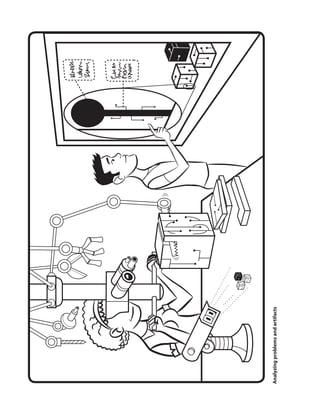
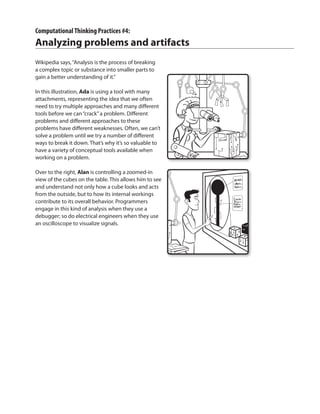
In this illustration, Ada is using a tool with many
attachments, representing the idea that we often
need to try multiple approaches and many different
tools before we can“crack”a problem. Different
problems and different approaches to these
problems have different weaknesses. Often, we can’t
solve a problem until we try a number of different
ways to break it down. That’s why it’s so valuable to
have a variety of conceptual tools available when
working on a problem.
Over to the right, Alan is controlling a zoomed-in
view of the cubes on the table. This allows him to see
and understand not only how a cube looks and acts
from the outside, but to how its internal workings
contribute to its overall behavior. Programmers
engage in this kind of analysis when they use a
debugger; so do electrical engineers when they use
an oscilloscope to visualize signals.
MIGRATION PATTERNS
PARROT
Communicatingprocessesandresults
ComputationalThinking Practices #5:
Communicating processes and results
Very rarely is a computational artifact self-
explanatory. A CPU made of microscopic transistors
on silicon or a compiled binary program of 1’s and
0’s are both quite difficult to understand. Their forms
are optimized for computational performance, not
human comprehension. The design plan for the
CPU or the source code of the program are more
easily understood. But even these precursors don’t
necessarily explain how they were made or why
they work.
Computational thinking requires us to discuss
processes for both people and machines to follow,
and how these processes are intended to lead to
specific results. For example, when a programmer
is learning how to write programs, they need to be
taught to debug by printing the value of a variable.
When you discover a new mathematical technique
for manipulating 3d shapes efficiently, you have to
write it up so other people can understand and use
it. Communication is the way we bring the things we
know into the world.
When we use computation to
solve a problem, the answer
we get isn’t automatically
meaningful to others. We have
to communicate this result
in a way that reveals both its
importance and its origin.
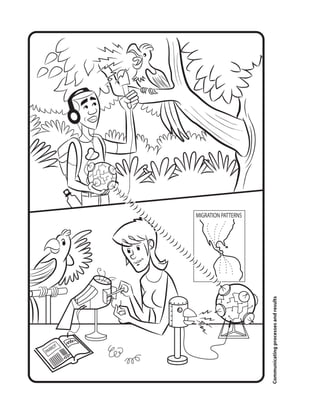
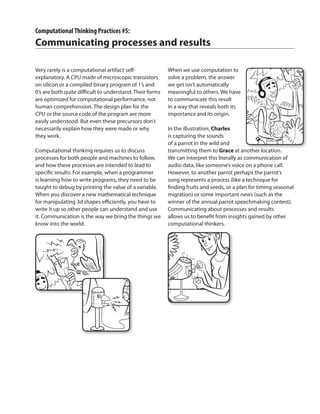
In the illustration, Charles
is capturing the sounds
of a parrot in the wild and
transmitting them to Grace at another location.
We can interpret this literally as communication of
audio data, like someone’s voice on a phone call.
However, to another parrot perhaps the parrot’s
song represents a process (like a technique for
finding fruits and seeds, or a plan for timing seasonal
migration) or some important news (such as the
winner of the annual parrot speechmaking contest).
Communicating about processes and results
allows us to benefit from insights gained by other
computational thinkers.
MIGRATION PATTERNS
MIGRATION PATTERNS
PARROT
PARROT
MIGRATION PATTERNS
PARROT
Workingeffectivelyinteams
ComputationalThinking Practices #6:
Working effectively in teams
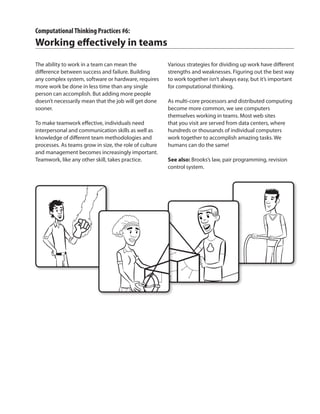
The ability to work in a team can mean the
difference between success and failure. Building
any complex system, software or hardware, requires
more work be done in less time than any single
person can accomplish. But adding more people
doesn’t necessarily mean that the job will get done
sooner.
To make teamwork effective, individuals need
interpersonal and communication skills as well as
knowledge of different team methodologies and
processes. As teams grow in size, the role of culture
and management becomes increasingly important.
Teamwork, like any other skill, takes practice.
Various strategies for dividing up work have different
strengths and weaknesses. Figuring out the best way
to work together isn’t always easy, but it’s important
for computational thinking.
As multi-core processors and distributed computing
become more common, we see computers
themselves working in teams. Most web sites
that you visit are served from data centers, where
hundreds or thousands of individual computers
work together to accomplish amazing tasks. We
humans can do the same!
See also: Brooks’s law, pair programming, revision
control system.
Decomposition
Exploring ComputationalThinking #1:
Decomposition
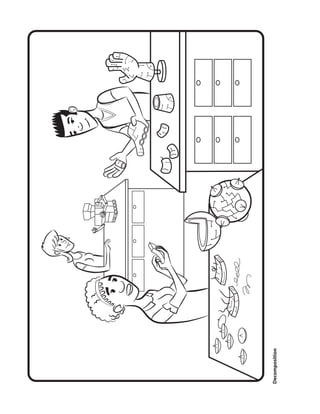
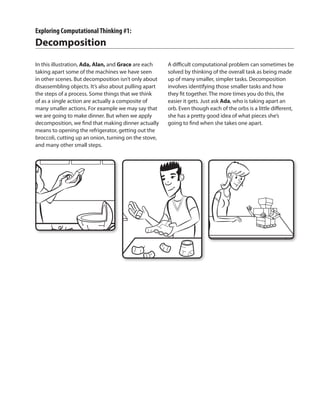
In this illustration, Ada, Alan, and Grace are each
taking apart some of the machines we have seen
in other scenes. But decomposition isn’t only about
disassembling objects. It’s also about pulling apart
the steps of a process. Some things that we think
of as a single action are actually a composite of
many smaller actions. For example we may say that
we are going to make dinner. But when we apply
decomposition, we find that making dinner actually
means to opening the refrigerator, getting out the
broccoli, cutting up an onion, turning on the stove,
and many other small steps.
A difficult computational problem can sometimes be
solved by thinking of the overall task as being made
up of many smaller, simpler tasks. Decomposition
involves identifying those smaller tasks and how
they fit together. The more times you do this, the
easier it gets. Just ask Ada, who is taking apart an
orb. Even though each of the orbs is a little different,
she has a pretty good idea of what pieces she’s
going to find when she takes one apart.
Decomposition
Exploring ComputationalThinking #2:
Pattern Recognition
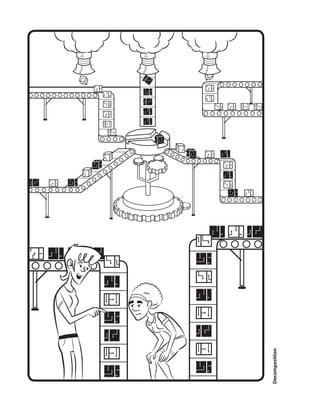
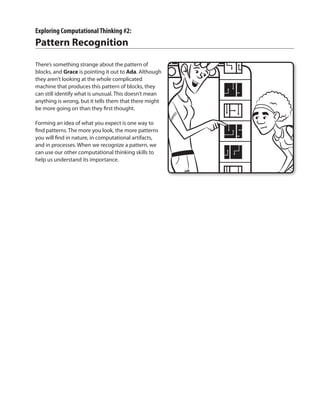
There’s something strange about the pattern of
blocks, and Grace is pointing it out to Ada. Although
they aren’t looking at the whole complicated
machine that produces this pattern of blocks, they
can still identify what is unusual. This doesn’t mean
anything is wrong, but it tells them that there might
be more going on than they first thought.
Forming an idea of what you expect is one way to
find patterns. The more you look, the more patterns
you will find in nature, in computational artifacts,
and in processes. When we recognize a pattern, we
can use our other computational thinking skills to
help us understand its importance.
PatternGeneralizationandAbstraction
Exploring ComputationalThinking #3:
Pattern Generalization and Abstraction
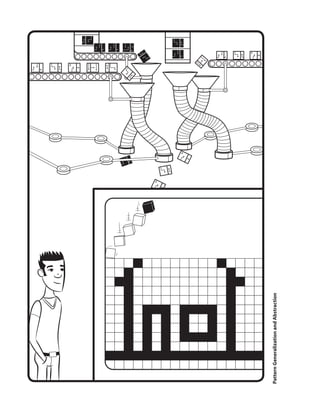
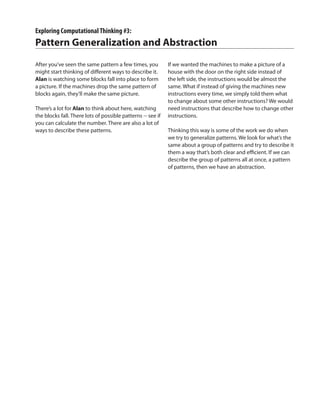
After you’ve seen the same pattern a few times, you
might start thinking of different ways to describe it.
Alan is watching some blocks fall into place to form
a picture. If the machines drop the same pattern of
blocks again, they’ll make the same picture.
There’s a lot for Alan to think about here, watching
the blocks fall. There lots of possible patterns -- see if
you can calculate the number. There are also a lot of
ways to describe these patterns.
If we wanted the machines to make a picture of a
house with the door on the right side instead of
the left side, the instructions would be almost the
same. What if instead of giving the machines new
instructions every time, we simply told them what
to change about some other instructions? We would
need instructions that describe how to change other
instructions.
Thinking this way is some of the work we do when
we try to generalize patterns. We look for what’s the
same about a group of patterns and try to describe it
them a way that’s both clear and efficient. If we can
describe the group of patterns all at once, a pattern
of patterns, then we have an abstraction.
AlgorithDesign
Exploring ComputationalThinking #4:
Algorithm Design
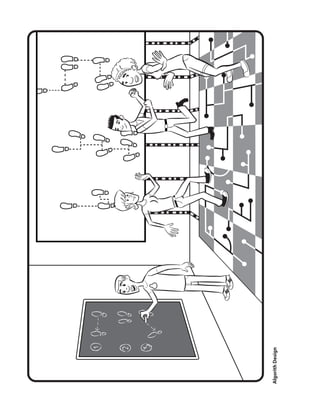
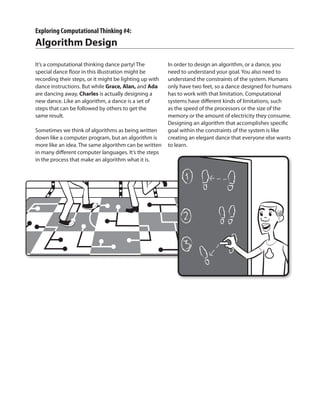
It’s a computational thinking dance party! The
special dance floor in this illustration might be
recording their steps, or it might be lighting up with
dance instructions. But while Grace, Alan, and Ada
are dancing away, Charles is actually designing a
new dance. Like an algorithm, a dance is a set of
steps that can be followed by others to get the
same result.
Sometimes we think of algorithms as being written
down like a computer program, but an algorithm is
more like an idea. The same algorithm can be written
in many different computer languages. It’s the steps
in the process that make an algorithm what it is.
In order to design an algorithm, or a dance, you
need to understand your goal. You also need to
understand the constraints of the system. Humans
only have two feet, so a dance designed for humans
has to work with that limitation. Computational
systems have different kinds of limitations, such
as the speed of the processors or the size of the
memory or the amount of electricity they consume.
Designing an algorithm that accomplishes specific
goal within the constraints of the system is like
creating an elegant dance that everyone else wants
to learn.

Computational thinking-illustrated

  • 1.
  • 2.
    ComputationalThinking Practices #1: Analyzingeffects of computation Computation is everywhere. From search engines that help us find information, to cash registers in stores, to software used for designing bridges, we live in a world built on the effects of computation. Computation is not just another word for technology. For example, a cellular phone contains many different technologies: a radio transmitter and receiver, a processor, memory, and electro- mechnical parts like buttons and touch screens. When studying the effects of computation, we aren’t trying to learn how physics governs these technologies. Analyzing the effects of computation means specifically looking at what happens when we collect, store, and process data. The computation done by a cell phone involves recording your voice as data, compressing and transmitting that data, and interacting with a larger system that routes your call’s data to its destination. This same computational process is done in reverse so your conversation partner can talk back to you. That sounds like a lot of computational work for your cell phone to do, but that’s only part of what happens when you make a call. All the sending and receiving of data happens via radio waves. When the technology for radio communication was first invented by Nikola Tesla, it could only be used for mass communication in the form of broadcasts. It takes computation to transform that raw technological capacity into the more refined form we use today in our cell phones. One effect of computation is that radio can now be used for person-to-person communication, with many simultaneous conversations happening in the same physical area. When we analyze the effects of computation, we take note and measure how data is transformed. We look at how information is processed and what is accomplished by that processing. We can think about what we might do if such computational power wasn’t available. That can also help us start to imagine new things we can strive to accomplish using computation. A major part of the work in analyzing the effects of computation is careful observation, as Blaze, Ada, Charles, Alan, and Grace are doing in this illustration. In their world, as in ours, computation is everywhere. By looking closely, we can start to see what computation -- not just raw technology -- does for us.
  • 3.
  • 4.
    Grace is building somethingnew. At the moment, she’s using a wrench because it’s the right tool for the work she’s doing. She’s not just using a machine built by someone else; she’s actually making something new herself. Sometimes, creating things is a time-consuming and difficult process, but it gets easier with experience. Blaze is wearing a glove that controls a much larger and stronger hand. This hand can do many things, including lift up Blaze himself. Blaze’s glove is a metaphor for computational artifacts that allow us to harness the power of machines to carry out massive calculations. When we turn that power back upon itself as we do when we use recursion, higher-order functions, or write a compiler for a language in that same language, things can get very exciting. Alan is walking on the ceiling. He’s holding a Möbius strip, a topological surface with only one side. When twisted and attached back to itself, a regular flat rectangle can be transformed into a Möbius strip. Using computational thinking, we can change our perspective to solve a complex problem -- like Alan, who is upside down! Many computational concepts, like the idea of the Möbius strip, can challenge our assumptions about what’s possible and reveal deeper truths about the properties of the systems we are using or creating. At first this can seem as difficult as walking on the ceiling, but after a while you’ll probably find it fun. Charles is holding an orb covered in what look like small radio dishes. Computational artifacts need not be designed to work in isolation. They can work together and communicate to accomplish a task, like we see in multi-core processors or parallel computing. Perhaps the radio dishes are helping Charles to hear things that other characters can not. Similarly, algorithms for pattern recognition, signal processing, error correction, and noise reduction enhance our ability to extract information from data. With the help of computational artifacts, we gain new powers. ComputationalThinking Practices #2: Producing computational artifacts Creating computational artifacts is all about making things. Programming is one of the most visible ways we make computational artifacts. In that case, the artifacts are both the programs we made and their outputs. But the term computational artifact is not limited to just computer programs. It can refer to a whole range of things from microprocessors to bar codes to an airplane’s navigation system. In this illustration, the characters are building, testing, and exploring computational artifacts. The process of creating is not limited to only thinking of ideas, or just assembling parts. The machines you see in these cartoons are symbolic, designed to be open to interpretation and imagination. Here are some ways of looking at them to help you get started: C/C++ DATBITASCII 0 0 0 01 1 1 C/C++ DATBITASCII 0 0 0 01 1 1 CBITASCII 0 0 0 01 1 1 C/C++ DATBITASCII 0 0 0 01 1 1
  • 5.
  • 6.
    One meaning ofthe word model is: A smaller or simpler version of the original item. The model could be a physical object like the small robot in this illustration. Notice that Blaze isn’t trying to move the arms of the huge robot, nor trying to move the heavy blocks himself. Instead, he is working with a model robot small enough for him to literally put his own hands around. This is simplifies the physical work he needs to do, just like a simplified model of an idea makes thinking easier. For example, classical mechanics is a model: It’s Newton’s easily-computed approximation of the more complex reality of motion. In computer science, we make a model every time we write a program. We must choose the information and level of detail represented in our program. Some details must be left out. If we tried to include everything in a model or program, we would end up simulating the whole world! In a complex system, we might use many different models and make them work together. We might not even care if one part of the system was switched out for something else that can accomplish the same goal. We could say we’ve abstracted that part of the system. Carefully selecting the qualities we care about and ignoring the rest of the details is the key to abstraction. When we deliberately separate our system into parts that can be individually understood, tested, reused, and substituted, then we are creating new abstractions. See also: Modularity, map–territory relation, marionette. ComputationalThinking Practices #3: Using abstractions and models “All models are wrong, but some are useful.” – George E. P. Box
  • 7.
  • 8.
    ComputationalThinking Practices #4: Analyzingproblems and artifacts Wikipedia says,“Analysis is the process of breaking a complex topic or substance into smaller parts to gain a better understanding of it.” In this illustration, Ada is using a tool with many attachments, representing the idea that we often need to try multiple approaches and many different tools before we can“crack”a problem. Different problems and different approaches to these problems have different weaknesses. Often, we can’t solve a problem until we try a number of different ways to break it down. That’s why it’s so valuable to have a variety of conceptual tools available when working on a problem. Over to the right, Alan is controlling a zoomed-in view of the cubes on the table. This allows him to see and understand not only how a cube looks and acts from the outside, but to how its internal workings contribute to its overall behavior. Programmers engage in this kind of analysis when they use a debugger; so do electrical engineers when they use an oscilloscope to visualize signals.
  • 9.
  • 10.
    ComputationalThinking Practices #5: Communicatingprocesses and results Very rarely is a computational artifact self- explanatory. A CPU made of microscopic transistors on silicon or a compiled binary program of 1’s and 0’s are both quite difficult to understand. Their forms are optimized for computational performance, not human comprehension. The design plan for the CPU or the source code of the program are more easily understood. But even these precursors don’t necessarily explain how they were made or why they work. Computational thinking requires us to discuss processes for both people and machines to follow, and how these processes are intended to lead to specific results. For example, when a programmer is learning how to write programs, they need to be taught to debug by printing the value of a variable. When you discover a new mathematical technique for manipulating 3d shapes efficiently, you have to write it up so other people can understand and use it. Communication is the way we bring the things we know into the world. When we use computation to solve a problem, the answer we get isn’t automatically meaningful to others. We have to communicate this result in a way that reveals both its importance and its origin. In the illustration, Charles is capturing the sounds of a parrot in the wild and transmitting them to Grace at another location. We can interpret this literally as communication of audio data, like someone’s voice on a phone call. However, to another parrot perhaps the parrot’s song represents a process (like a technique for finding fruits and seeds, or a plan for timing seasonal migration) or some important news (such as the winner of the annual parrot speechmaking contest). Communicating about processes and results allows us to benefit from insights gained by other computational thinkers. MIGRATION PATTERNS MIGRATION PATTERNS PARROT PARROT MIGRATION PATTERNS PARROT
  • 11.
  • 12.
    ComputationalThinking Practices #6: Workingeffectively in teams The ability to work in a team can mean the difference between success and failure. Building any complex system, software or hardware, requires more work be done in less time than any single person can accomplish. But adding more people doesn’t necessarily mean that the job will get done sooner. To make teamwork effective, individuals need interpersonal and communication skills as well as knowledge of different team methodologies and processes. As teams grow in size, the role of culture and management becomes increasingly important. Teamwork, like any other skill, takes practice. Various strategies for dividing up work have different strengths and weaknesses. Figuring out the best way to work together isn’t always easy, but it’s important for computational thinking. As multi-core processors and distributed computing become more common, we see computers themselves working in teams. Most web sites that you visit are served from data centers, where hundreds or thousands of individual computers work together to accomplish amazing tasks. We humans can do the same! See also: Brooks’s law, pair programming, revision control system.
  • 13.
  • 14.
    Exploring ComputationalThinking #1: Decomposition Inthis illustration, Ada, Alan, and Grace are each taking apart some of the machines we have seen in other scenes. But decomposition isn’t only about disassembling objects. It’s also about pulling apart the steps of a process. Some things that we think of as a single action are actually a composite of many smaller actions. For example we may say that we are going to make dinner. But when we apply decomposition, we find that making dinner actually means to opening the refrigerator, getting out the broccoli, cutting up an onion, turning on the stove, and many other small steps. A difficult computational problem can sometimes be solved by thinking of the overall task as being made up of many smaller, simpler tasks. Decomposition involves identifying those smaller tasks and how they fit together. The more times you do this, the easier it gets. Just ask Ada, who is taking apart an orb. Even though each of the orbs is a little different, she has a pretty good idea of what pieces she’s going to find when she takes one apart.
  • 15.
  • 16.
    Exploring ComputationalThinking #2: PatternRecognition There’s something strange about the pattern of blocks, and Grace is pointing it out to Ada. Although they aren’t looking at the whole complicated machine that produces this pattern of blocks, they can still identify what is unusual. This doesn’t mean anything is wrong, but it tells them that there might be more going on than they first thought. Forming an idea of what you expect is one way to find patterns. The more you look, the more patterns you will find in nature, in computational artifacts, and in processes. When we recognize a pattern, we can use our other computational thinking skills to help us understand its importance.
  • 17.
  • 18.
    Exploring ComputationalThinking #3: PatternGeneralization and Abstraction After you’ve seen the same pattern a few times, you might start thinking of different ways to describe it. Alan is watching some blocks fall into place to form a picture. If the machines drop the same pattern of blocks again, they’ll make the same picture. There’s a lot for Alan to think about here, watching the blocks fall. There lots of possible patterns -- see if you can calculate the number. There are also a lot of ways to describe these patterns. If we wanted the machines to make a picture of a house with the door on the right side instead of the left side, the instructions would be almost the same. What if instead of giving the machines new instructions every time, we simply told them what to change about some other instructions? We would need instructions that describe how to change other instructions. Thinking this way is some of the work we do when we try to generalize patterns. We look for what’s the same about a group of patterns and try to describe it them a way that’s both clear and efficient. If we can describe the group of patterns all at once, a pattern of patterns, then we have an abstraction.
  • 19.
  • 20.
    Exploring ComputationalThinking #4: AlgorithmDesign It’s a computational thinking dance party! The special dance floor in this illustration might be recording their steps, or it might be lighting up with dance instructions. But while Grace, Alan, and Ada are dancing away, Charles is actually designing a new dance. Like an algorithm, a dance is a set of steps that can be followed by others to get the same result. Sometimes we think of algorithms as being written down like a computer program, but an algorithm is more like an idea. The same algorithm can be written in many different computer languages. It’s the steps in the process that make an algorithm what it is. In order to design an algorithm, or a dance, you need to understand your goal. You also need to understand the constraints of the system. Humans only have two feet, so a dance designed for humans has to work with that limitation. Computational systems have different kinds of limitations, such as the speed of the processors or the size of the memory or the amount of electricity they consume. Designing an algorithm that accomplishes specific goal within the constraints of the system is like creating an elegant dance that everyone else wants to learn.