Design Th!nking
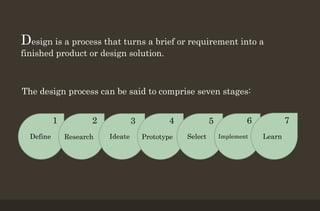
Design is a process that turns a brief or requirement into a 
finished product or design solution. 
The design process can be said to comprise seven stages: 
1 2 3 4 5 6 7 
Define Research Ideate Prototype Select Implement Learn
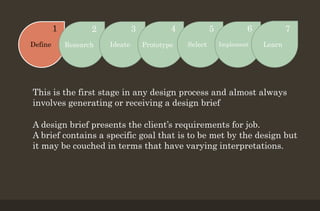
1 2 3 4 5 6 7 
Define Research Ideate Prototype Select Implement Learn 
This is the first stage in any design process and almost always 
involves generating or receiving a design brief 
A design brief presents the client’s requirements for job. 
A brief contains a specific goal that is to be met by the design but 
it may be couched in terms that have varying interpretations.
Who What 
where Why 
When 
How 
The Five Ws ? 
WHO is the client 
and target audience? 
WHAT design solution is the 
client thinking of? 
WHEN will be the 
design be needed 
and for how long? 
WHERE will the 
design be used? 
Why does the client think 
a design solution is 
required? 
HOW will the solution be implemented?
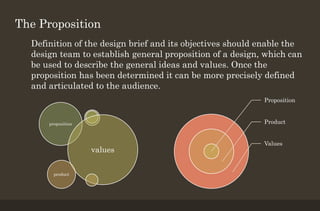
Definition of the design brief and its objectives should enable the 
design team to establish general proposition of a design, which can 
be used to describe the general ideas and values. Once the 
proposition has been determined it can be more precisely defined 
and articulated to the audience. 
proposition 
values 
product 
Proposition 
Product 
Values 
The Proposition
1 2 3 4 5 6 7 
Define Research Ideate Prototype Select Implement Learn 
Collecting background information. 
Once the brief has been defined and agreed , a designer starts to 
search for information that can be fed into the creative process at the 
ideate stage.
Primary 
Research 
• A primary source of research is the feedback generated during 
the learning phase of projects undertaken with the same or 
similar client’s. 
Secondary 
research 
• Secondary research is the information obtained from general 
secondary sources such as consumer market research reports.
Identifying drivers. 
The research stage aims to identify the drivers that stimulate the 
target group and barriers in order to prevent work from being 
undertaken in a direction that has a little chance of being 
implemented for technical, legal or market reasons. 
Drivers 
Barriers
Information Gathering 
When conducting research, information can be classified in to two 
categories: Quantitative and Qualitative. 
Quantitative information is numerical or statistical 
information that enables a design team to put 
physical dimensions to a target market. 
Quantitative 
Qualitative
1 2 3 4 5 6 7 
Define Research Ideate Prototype Select Implement Learn 
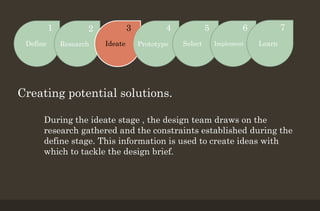
Creating potential solutions. 
During the ideate stage , the design team draws on the 
research gathered and the constraints established during the 
define stage. This information is used to create ideas with 
which to tackle the design brief.
Different methods to Ideate: 
Brainstorming, 
Sketching ideas, 
Adapting a tried-and-tested design that already exist. 
As the ideate stage progresses, it will become clear whether there 
are any misunderstandings or shortcomings in the definition stage 
and whether sufficient levels of research were carried out.
Brainstorming 
It is a creative group approach to developing ideas and originating 
solutions during the ideate stage. 
Brainstorming rules: 
• Do not criticize, 
• Keep the process manager-free, 
• Avoid resolve, 
• Work to a target, 
• Clock watch, 
• Let go, 
• Be inclusive.
1 2 3 4 5 6 7 
Define Research Ideate Prototype Select Implement Learn 
Resolving solutions. 
A prototype gives the design team and client the ability to 
visualize and handle a design concept, to get an idea of its 
physical presence and tactile qualities. 
A prototype can be used to test the technical feasibility of a 
design to idea to see if it works as a physical object.
Communicate your vision in an impactful and 
meaningful way by creating experiences, using 
illustrative visuals, and telling good stories. 
This will allow particular aspects to be tested and will provide 
a better basis for comparison at the selection stage.
1 2 3 4 5 6 7 
Define Research Ideate Prototype Select Implement Learn 
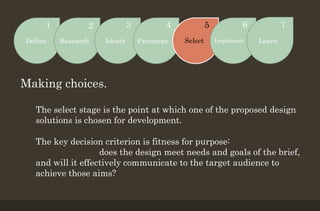
Making choices. 
The select stage is the point at which one of the proposed design 
solutions is chosen for development. 
The key decision criterion is fitness for purpose: 
does the design meet needs and goals of the brief, 
and will it effectively communicate to the target audience to 
achieve those aims?
1 2 3 4 5 6 7 
Define Research Ideate Prototype Select Implement Learn 
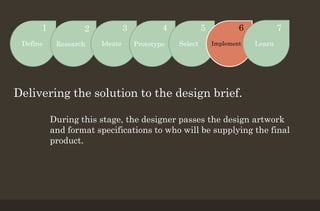
Delivering the solution to the design brief. 
During this stage, the designer passes the design artwork 
and format specifications to who will be supplying the final 
product.
1 2 3 4 5 6 7 
Define Research Ideate Prototype Select Implement Learn 
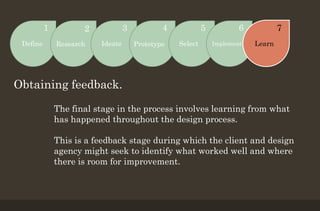
Obtaining feedback. 
The final stage in the process involves learning from what 
has happened throughout the design process. 
This is a feedback stage during which the client and design 
agency might seek to identify what worked well and where 
there is room for improvement.

Design thinking

  • 1.
  • 2.
    Design is aprocess that turns a brief or requirement into a finished product or design solution. The design process can be said to comprise seven stages: 1 2 3 4 5 6 7 Define Research Ideate Prototype Select Implement Learn
  • 3.
    1 2 34 5 6 7 Define Research Ideate Prototype Select Implement Learn This is the first stage in any design process and almost always involves generating or receiving a design brief A design brief presents the client’s requirements for job. A brief contains a specific goal that is to be met by the design but it may be couched in terms that have varying interpretations.
  • 4.
    Who What whereWhy When How The Five Ws ? WHO is the client and target audience? WHAT design solution is the client thinking of? WHEN will be the design be needed and for how long? WHERE will the design be used? Why does the client think a design solution is required? HOW will the solution be implemented?
  • 5.
    Definition of thedesign brief and its objectives should enable the design team to establish general proposition of a design, which can be used to describe the general ideas and values. Once the proposition has been determined it can be more precisely defined and articulated to the audience. proposition values product Proposition Product Values The Proposition
  • 6.
    1 2 34 5 6 7 Define Research Ideate Prototype Select Implement Learn Collecting background information. Once the brief has been defined and agreed , a designer starts to search for information that can be fed into the creative process at the ideate stage.
  • 7.
    Primary Research •A primary source of research is the feedback generated during the learning phase of projects undertaken with the same or similar client’s. Secondary research • Secondary research is the information obtained from general secondary sources such as consumer market research reports.
  • 8.
    Identifying drivers. Theresearch stage aims to identify the drivers that stimulate the target group and barriers in order to prevent work from being undertaken in a direction that has a little chance of being implemented for technical, legal or market reasons. Drivers Barriers
  • 9.
    Information Gathering Whenconducting research, information can be classified in to two categories: Quantitative and Qualitative. Quantitative information is numerical or statistical information that enables a design team to put physical dimensions to a target market. Quantitative Qualitative
  • 10.
    1 2 34 5 6 7 Define Research Ideate Prototype Select Implement Learn Creating potential solutions. During the ideate stage , the design team draws on the research gathered and the constraints established during the define stage. This information is used to create ideas with which to tackle the design brief.
  • 11.
    Different methods toIdeate: Brainstorming, Sketching ideas, Adapting a tried-and-tested design that already exist. As the ideate stage progresses, it will become clear whether there are any misunderstandings or shortcomings in the definition stage and whether sufficient levels of research were carried out.
  • 12.
    Brainstorming It isa creative group approach to developing ideas and originating solutions during the ideate stage. Brainstorming rules: • Do not criticize, • Keep the process manager-free, • Avoid resolve, • Work to a target, • Clock watch, • Let go, • Be inclusive.
  • 13.
    1 2 34 5 6 7 Define Research Ideate Prototype Select Implement Learn Resolving solutions. A prototype gives the design team and client the ability to visualize and handle a design concept, to get an idea of its physical presence and tactile qualities. A prototype can be used to test the technical feasibility of a design to idea to see if it works as a physical object.
  • 14.
    Communicate your visionin an impactful and meaningful way by creating experiences, using illustrative visuals, and telling good stories. This will allow particular aspects to be tested and will provide a better basis for comparison at the selection stage.
  • 15.
    1 2 34 5 6 7 Define Research Ideate Prototype Select Implement Learn Making choices. The select stage is the point at which one of the proposed design solutions is chosen for development. The key decision criterion is fitness for purpose: does the design meet needs and goals of the brief, and will it effectively communicate to the target audience to achieve those aims?
  • 16.
    1 2 34 5 6 7 Define Research Ideate Prototype Select Implement Learn Delivering the solution to the design brief. During this stage, the designer passes the design artwork and format specifications to who will be supplying the final product.
  • 17.
    1 2 34 5 6 7 Define Research Ideate Prototype Select Implement Learn Obtaining feedback. The final stage in the process involves learning from what has happened throughout the design process. This is a feedback stage during which the client and design agency might seek to identify what worked well and where there is room for improvement.