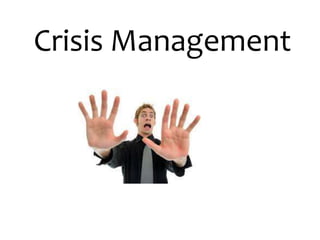
Crisis Management
Step One :Assess
• Take a reasonable amount of time to
accurately assess the situation. Fight every
instinct to react or overreact. First, take a step
back; take a few deep breaths; whatever it
takes to restore your calm so you can think
clearly. Then get all the facts, get objective
guidance, and develop a clear picture of the
situation.
Step Two: Engage
• Engage all key stakeholders. Trust the insiders
you should trust. Involve key insiders who
either have a stake, have knowledge that will
help in analysis or planning, or will be
significantly impacted. That will make
decision-making and internal communications
far more effective. Moreover, those with a
vested interest won't feel like they were kept
out of the loop.
Step Three: Plan
• Once you have all the data and a team of key
stakeholders, develop best, typical, and worst
case scenarios and plans based on key
variables and assumptions. You know, like if x
happens, then you do y. Planning enables you
to act quickly, confidently, and effectively
when the time comes to act.
Step Four :Act
• Be proactive, not reactive--obvious in theory
but difficult in practice. That's because the line
between proactive and reactive isn't always
clear. If you follow the above steps, however,
you should be able to tell the difference.
Objective assessment and planning leads to
calm and confidence. You'll know when you're
ready to act. Then it's all about execution.
Step Five: Communicate
• Communicate transparently and honestly, or
at least appear to. I know that sounds
squirrelly, but it's absolutely critical that you
appear honest and transparent. Perception is
everything, and you need to consider and
respect your audience to know how best to
tell them what they need to know, when they
need to know it.
Step Six: Bottom line
• In a crisis, your instincts may be to react, keep
things close to your vest, or even do nothing.
You need to fight those instincts. Instead, take
a deep breath, get the right people involved,
plan, then act decisively and communicate
openly.
Crisis is over

Crisis Management

  • 1.
  • 2.
    Step One :Assess •Take a reasonable amount of time to accurately assess the situation. Fight every instinct to react or overreact. First, take a step back; take a few deep breaths; whatever it takes to restore your calm so you can think clearly. Then get all the facts, get objective guidance, and develop a clear picture of the situation.
  • 3.
    Step Two: Engage •Engage all key stakeholders. Trust the insiders you should trust. Involve key insiders who either have a stake, have knowledge that will help in analysis or planning, or will be significantly impacted. That will make decision-making and internal communications far more effective. Moreover, those with a vested interest won't feel like they were kept out of the loop.
  • 4.
    Step Three: Plan •Once you have all the data and a team of key stakeholders, develop best, typical, and worst case scenarios and plans based on key variables and assumptions. You know, like if x happens, then you do y. Planning enables you to act quickly, confidently, and effectively when the time comes to act.
  • 5.
    Step Four :Act •Be proactive, not reactive--obvious in theory but difficult in practice. That's because the line between proactive and reactive isn't always clear. If you follow the above steps, however, you should be able to tell the difference. Objective assessment and planning leads to calm and confidence. You'll know when you're ready to act. Then it's all about execution.
  • 6.
    Step Five: Communicate •Communicate transparently and honestly, or at least appear to. I know that sounds squirrelly, but it's absolutely critical that you appear honest and transparent. Perception is everything, and you need to consider and respect your audience to know how best to tell them what they need to know, when they need to know it.
  • 7.
    Step Six: Bottomline • In a crisis, your instincts may be to react, keep things close to your vest, or even do nothing. You need to fight those instincts. Instead, take a deep breath, get the right people involved, plan, then act decisively and communicate openly.
  • 8.