CHAPTER 1
THE NATURE OF STRATEGIC MANAGEMENT


      Strategic Management:
          Concepts & Cases
            13th Edition
          Global Edition
            Fred David


                                     Ch 1 -1
JILL MITCHELL
• Email: jmitchell@pkrush.com website: www.jillmitchell.net
Background
• BSc(Hons) Chemical Engineering
• Chartered/Professional Engineer
• MBA – Bristol Business School, UK
• Currently studying for a PhD in Entrepreneurship at Pretoria University
• 25 years+ industry experience, specifically brewing , food & packaging
  industry
• 12 years+ small business management experience, UK & RSA:-
  setting up and running businesses


                                                                     Ch 1 -2
ADMINISTRATION

• Form 4 groups of 3 people. Keep these groups for
  the rest of the course. Help each other during the
  week with all tasks and assignments. Work in these
  groups on group assignments in class
• EMAIL addresses – please input into my
  spreadsheet. I will communicate with you this way
  and send any specific instructions via email
• Keep checking www.jmitchell.net. I post the course
  slides and any other relevant information to this
  website – bear in mind there are other courses here
  – just look for strategic management


                                                      Ch 1 -3
LECTURE NOTES
www.jillmitchell.net


                       Ch 1 -4
DID YOU KNOW?
Show video


                Ch 1 -5
Strategic Management –Defined


  Art & science of formulating,
  implementing, and evaluating, cross-
  functional decisions that enable an
  organisation to achieve its objectives


                                           Ch 1 -6
PURPOSE OF STRATEGIC MANAGEMENT


To exploit and create new and different
opportunities for tomorrow


                                          Ch 1 -7
Strategic Management


In essence, the strategic plan is a company’s
game plan


                                           Ch 1 -8
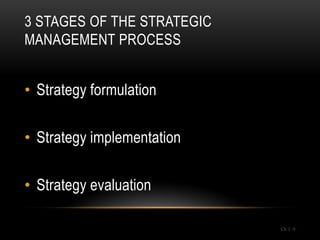
3 STAGES OF THE STRATEGIC
MANAGEMENT PROCESS


• Strategy formulation

• Strategy implementation

• Strategy evaluation

                            Ch 1 -9
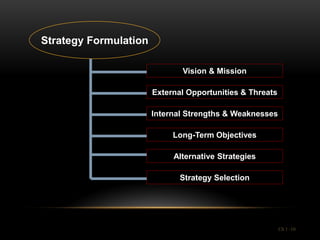
Strategy Formulation

                              Vision & Mission

                       External Opportunities & Threats

                       Internal Strengths & Weaknesses

                            Long-Term Objectives

                            Alternative Strategies

                              Strategy Selection


                                                          Ch 1 -10
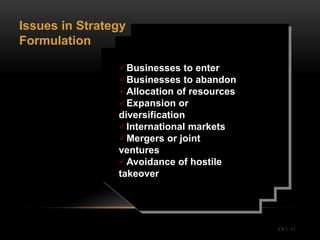
Issues in Strategy
Formulation

                Businesses to enter
                Businesses to abandon
                Allocation of resources
                Expansion or
                diversification
                International markets
                Mergers or joint
                ventures
                Avoidance of hostile
                takeover


                                           Ch 1 -11
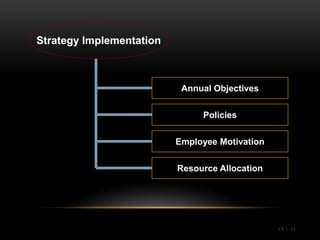
Strategy Implementation


                           Annual Objectives

                               Policies

                          Employee Motivation

                          Resource Allocation


                                                Ch 1 -12
STRATEGY IMPLEMENTATION STEPS
• Developing a strategy-supportive culture
• Creating an effective organisational structure
• Redirecting marketing efforts
• Preparing budgets
• Developing and utilising information systems
• Linking employee compensation to
  organisational performance


                                              Ch 1 -13
Issues in Strategy
Implementation

                     Action Stage of Strategic
                     Management

                     Mobilisation of employees
                     & managers

                     Most difficult stage

                     Interpersonal skills
                     critical


                                                  Ch 1 -14
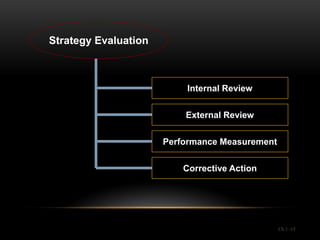
Strategy Evaluation


                          Internal Review

                          External Review

                      Performance Measurement

                          Corrective Action


                                                Ch 1 -15
Prime Task of
Strategic Management


  Peter Drucker: Think through the overall
  mission of a business. Ask the key
  question:
     “What is our Business?”


                                             Ch 1 -16
Integrating Intuition & Analysis


  The strategic management process attempts to
  organise quantitative and qualitative information
  under conditions of uncertainty


                                                      Ch 1 -17
Integrating Intuition & Analysis

  Intuition is based on:
   • Past experiences
   • Judgment
   • Feelings


  Intuition is useful for decision making in
  conditions of:
    Great uncertainty

    Little precedent
    Highly interrelated variables

    Several plausible alternatives


                                               Ch 1 -18
Integrating Intuition & Analysis


   Intuition & Judgment


         Involve management at all levels


              Influence all analyses


                                            Ch 1 -19
Adapting to Change


  Organisations should continually monitor
  internal and external events and trends
  so that timely changes can be made as
  needed


                                        Ch 1 -20
KEY TERMS IN STRATEGIC
MANAGEMENT
•   Competitive advantage
•   Strategists
•   Vision and mission statements
•   External opportunities and threats
•   Internal strengths and weaknesses
•   Long-term objectives
•   Strategies
•   Annual objectives
•   Policies


                                         Ch 1 -21
Strategic Management is
Gaining and Maintaining
Competitive Advantage


  Anything that a firm does especially well
  compared to rival firms


                                              Ch 1 -22
Achieving Sustained Competitive
Advantage

  1. Continually adapting to changes in external trends
  and events and internal capabilities, competencies,
  and resources


  2. Effectively formulating, implementing, and
  evaluating strategies that capitalize on those
  factors


                                                      Ch 1 -23
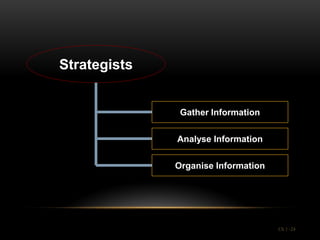
Strategists


               Gather Information

              Analyse Information

              Organise Information


                                     Ch 1 -24
Vision and Mission Statements


  Vision Statement –
    What do we want to become?


  Mission Statement –
    What is our business?


                                 Ch 1 -25
External Opportunities and Threats

       Analysis of Trends
         • Economic
         • Social
         • Cultural
         • Demographic/Environmental
         • Political, Legal, Governmental
         • Technological
         • Competitors

                                            Ch 1 -26
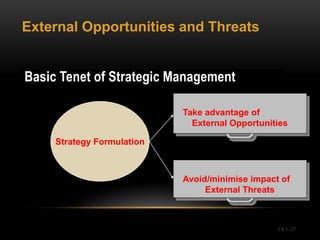
External Opportunities and Threats


Basic Tenet of Strategic Management

                            Take advantage of
                              External Opportunities

     Strategy Formulation


                            Avoid/minimise impact of
                                 External Threats


                                                 Ch 1 -27
Internal Strengths and Weaknesses


 Controllable activities performed
  especially well or poorly

 Determined relative to competitors


                                       Ch 1 -28
Internal Strengths and Weaknesses

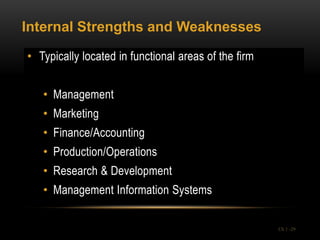
• Typically located in functional areas of the firm


   • Management
   • Marketing
   • Finance/Accounting
   • Production/Operations
   • Research & Development
   • Management Information Systems

                                                      Ch 1 -29
Internal Strengths and Weaknesses

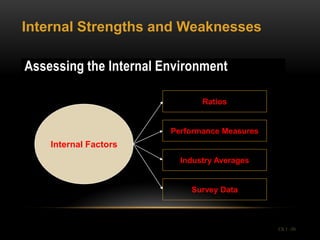
Assessing the Internal Environment

                               Ratios


                        Performance Measures
    Internal Factors
                          Industry Averages


                            Survey Data


                                               Ch 1 -30
Long-Term Objectives


 Specific results that an organisation seeks to
  achieve in pursuing its basic mission

 Long-term means more than one year


                                               Ch 1 -31
Long-Term Objectives

• Essential for ensuring the firm’s success
   • Provide direction
   • Aid in evaluation
   • Create synergy
   • Reveal priorities
   • Focus coordination
   • Provide basis for planning, organizing, motivating,
     and controlling

                                                    Ch 1 -32
Strategies


  Means by which long-term objectives are
  achieved


                                            Ch 1 -33
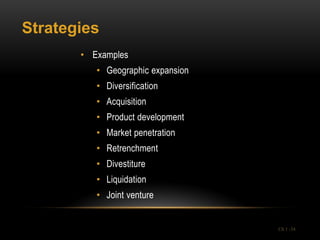
Strategies
       • Examples
          • Geographic expansion
          • Diversification
          • Acquisition
          • Product development
          • Market penetration
          • Retrenchment
          • Divestiture
          • Liquidation
          • Joint venture


                                   Ch 1 -34
Sample Strategies
  • Table 1-1


    • Best Buy


    • Levi Strauss


    • New York Times Company

                               Ch 1 -35
Annual Objectives


  Short-term milestones that firms must achieve
  to reach long-term objectives


                                             Ch 1 -36
Policies


  Means by which annual objectives will be
  achieved


                                             Ch 1 -37
COPYRIGHT © 2011 PEARSON
                           Ch 1 -38
EDUCATION
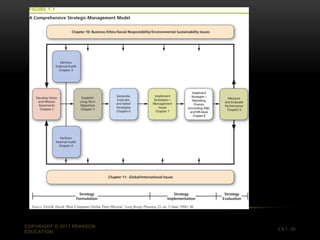
Strategic Management Model


 Strategic Management Process
  • Dynamic & continuous
  • More formal in larger organizations


                                          Ch 1 -39
STRATEGIC MANAGEMENT


• Communication is a key to successful
  strategic management


                                         Ch 1 -40
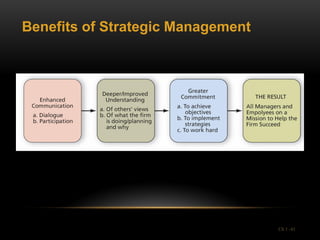
Benefits of Strategic Management


                                   Ch 1 -41
BENEFITS OF STRATEGIC
 MANAGEMENT
• Nonfinancial Benefits
   • Enhanced awareness of threats
   • Improved understanding of competitors’ strategies
   • Increased employee productivity
   • Reduced resistance to change
   • Clearer understanding of performance-reward
     relationship
   • Enhanced problem-prevention capabilities


                                                    Ch 1 -42
WHY SOME FIRMS DO NO STRATEGIC
 PLANNING
• Lack of knowledge of strategic planning
• Poor reward structures
• Fire fighting
• Waste of time
• Too expensive
• Laziness
• Content with success


                                            Ch 1 -43
WHY SOME FIRMS DO NO STRATEGIC
 PLANNING (CONTINUED)
• Fear of failure
• Overconfidence
• Prior bad experience
• Self-interest
• Fear of the unknown
• Honest difference of opinion
• Suspicion


                                 Ch 1 -44
PITFALLS IN STRATEGIC PLANNING


 Strategic planning is an involved, intricate, and
 complex process that takes an organisation into
 uncharted territory


                                                Ch 1 -45
EFFECTIVE STRATEGIC PLANNING IS:
• A people process more than a paper process
• A learning process
• Words supported by numbers
• Simple and non - routine
• Varying assignments, team membership,
  meeting formats, and planning calendars
• Challenging assumptions underlying
  corporate strategy

                                            Ch 1 -46
EFFECTIVE STRATEGIC PLANNING
 CONTINUED
• Welcomes bad news
• Requires open-mindedness and a spirit of
  enquiry
• Is not a bureaucratic mechanism
• Is not ritualistic or stilted
• Is not too formal, predictable, or rigid
• Does not contain jargon or arcane language


                                             Ch 1 -47
EFFECTIVE STRATEGIC PLANNING
CONTINUED
• Is not a formal system for control
• Does not disregard qualitative information
• Is not controlled by “technicians”
• Does not pursue too many strategies at once
• Continually strengthens the “good ethics is
  good business” policy


                                                Ch 1 -48
COMPARING BUSINESS AND MILITARY
 STRATEGY
• Strategic planning started in the military
• Similarity
   • Both business and military organisations must adapt to
     change and constantly improve
• Difference
   • Business strategy assumes competition
   • Military strategy assumes conflict

                                                      Ch 1 -49
INDIVIDUAL EXERCISE


• Read Turbulent Flight Plan
• Complete Exercise 4.2


                               Ch 1 -50
FOR NEXT WEEK
• Assurance of learning exercise 1d: strategic planning at
  Nestlé (p 70) - Table 1-3 page 53
• Readings 1 & 2 from Strategic Management supplement for
  Southern Africa
• Steps 1, 3, 4, of gathering strategy information on Adidas
  AG. I will email you step 2. Step 5 will be done in class next
  week
• Read Business report 2010, www.busrep.co.za
• Read CNBC 2010, www,cnbc.com
• Read news for South Africa and the world 2010,
  www.iol.co.za
• Read Knowledge to power your business,
  www.quickmba.com , specifically The Strategic Planning
  Process and Business Vision & Mission Statements

                                                           Ch 1 -51

Strategic Management - Lecture 1

  • 1.
    CHAPTER 1 THE NATUREOF STRATEGIC MANAGEMENT Strategic Management: Concepts & Cases 13th Edition Global Edition Fred David Ch 1 -1
  • 2.
    JILL MITCHELL • Email:jmitchell@pkrush.com website: www.jillmitchell.net Background • BSc(Hons) Chemical Engineering • Chartered/Professional Engineer • MBA – Bristol Business School, UK • Currently studying for a PhD in Entrepreneurship at Pretoria University • 25 years+ industry experience, specifically brewing , food & packaging industry • 12 years+ small business management experience, UK & RSA:- setting up and running businesses Ch 1 -2
  • 3.
    ADMINISTRATION • Form 4groups of 3 people. Keep these groups for the rest of the course. Help each other during the week with all tasks and assignments. Work in these groups on group assignments in class • EMAIL addresses – please input into my spreadsheet. I will communicate with you this way and send any specific instructions via email • Keep checking www.jmitchell.net. I post the course slides and any other relevant information to this website – bear in mind there are other courses here – just look for strategic management Ch 1 -3
  • 4.
  • 5.
    DID YOU KNOW? Showvideo Ch 1 -5
  • 6.
    Strategic Management –Defined Art & science of formulating, implementing, and evaluating, cross- functional decisions that enable an organisation to achieve its objectives Ch 1 -6
  • 7.
    PURPOSE OF STRATEGICMANAGEMENT To exploit and create new and different opportunities for tomorrow Ch 1 -7
  • 8.
    Strategic Management In essence,the strategic plan is a company’s game plan Ch 1 -8
  • 9.
    3 STAGES OFTHE STRATEGIC MANAGEMENT PROCESS • Strategy formulation • Strategy implementation • Strategy evaluation Ch 1 -9
  • 10.
    Strategy Formulation Vision & Mission External Opportunities & Threats Internal Strengths & Weaknesses Long-Term Objectives Alternative Strategies Strategy Selection Ch 1 -10
  • 11.
    Issues in Strategy Formulation Businesses to enter Businesses to abandon Allocation of resources Expansion or diversification International markets Mergers or joint ventures Avoidance of hostile takeover Ch 1 -11
  • 12.
    Strategy Implementation Annual Objectives Policies Employee Motivation Resource Allocation Ch 1 -12
  • 13.
    STRATEGY IMPLEMENTATION STEPS •Developing a strategy-supportive culture • Creating an effective organisational structure • Redirecting marketing efforts • Preparing budgets • Developing and utilising information systems • Linking employee compensation to organisational performance Ch 1 -13
  • 14.
    Issues in Strategy Implementation Action Stage of Strategic Management Mobilisation of employees & managers Most difficult stage Interpersonal skills critical Ch 1 -14
  • 15.
    Strategy Evaluation Internal Review External Review Performance Measurement Corrective Action Ch 1 -15
  • 16.
    Prime Task of StrategicManagement Peter Drucker: Think through the overall mission of a business. Ask the key question: “What is our Business?” Ch 1 -16
  • 17.
    Integrating Intuition &Analysis The strategic management process attempts to organise quantitative and qualitative information under conditions of uncertainty Ch 1 -17
  • 18.
    Integrating Intuition &Analysis Intuition is based on: • Past experiences • Judgment • Feelings Intuition is useful for decision making in conditions of:  Great uncertainty  Little precedent  Highly interrelated variables  Several plausible alternatives Ch 1 -18
  • 19.
    Integrating Intuition &Analysis Intuition & Judgment Involve management at all levels Influence all analyses Ch 1 -19
  • 20.
    Adapting to Change Organisations should continually monitor internal and external events and trends so that timely changes can be made as needed Ch 1 -20
  • 21.
    KEY TERMS INSTRATEGIC MANAGEMENT • Competitive advantage • Strategists • Vision and mission statements • External opportunities and threats • Internal strengths and weaknesses • Long-term objectives • Strategies • Annual objectives • Policies Ch 1 -21
  • 22.
    Strategic Management is Gainingand Maintaining Competitive Advantage Anything that a firm does especially well compared to rival firms Ch 1 -22
  • 23.
    Achieving Sustained Competitive Advantage 1. Continually adapting to changes in external trends and events and internal capabilities, competencies, and resources 2. Effectively formulating, implementing, and evaluating strategies that capitalize on those factors Ch 1 -23
  • 24.
    Strategists Gather Information Analyse Information Organise Information Ch 1 -24
  • 25.
    Vision and MissionStatements Vision Statement – What do we want to become? Mission Statement – What is our business? Ch 1 -25
  • 26.
    External Opportunities andThreats Analysis of Trends • Economic • Social • Cultural • Demographic/Environmental • Political, Legal, Governmental • Technological • Competitors Ch 1 -26
  • 27.
    External Opportunities andThreats Basic Tenet of Strategic Management Take advantage of External Opportunities Strategy Formulation Avoid/minimise impact of External Threats Ch 1 -27
  • 28.
    Internal Strengths andWeaknesses Controllable activities performed especially well or poorly Determined relative to competitors Ch 1 -28
  • 29.
    Internal Strengths andWeaknesses • Typically located in functional areas of the firm • Management • Marketing • Finance/Accounting • Production/Operations • Research & Development • Management Information Systems Ch 1 -29
  • 30.
    Internal Strengths andWeaknesses Assessing the Internal Environment Ratios Performance Measures Internal Factors Industry Averages Survey Data Ch 1 -30
  • 31.
    Long-Term Objectives Specificresults that an organisation seeks to achieve in pursuing its basic mission Long-term means more than one year Ch 1 -31
  • 32.
    Long-Term Objectives • Essentialfor ensuring the firm’s success • Provide direction • Aid in evaluation • Create synergy • Reveal priorities • Focus coordination • Provide basis for planning, organizing, motivating, and controlling Ch 1 -32
  • 33.
    Strategies Meansby which long-term objectives are achieved Ch 1 -33
  • 34.
    Strategies • Examples • Geographic expansion • Diversification • Acquisition • Product development • Market penetration • Retrenchment • Divestiture • Liquidation • Joint venture Ch 1 -34
  • 35.
    Sample Strategies • Table 1-1 • Best Buy • Levi Strauss • New York Times Company Ch 1 -35
  • 36.
    Annual Objectives Short-term milestones that firms must achieve to reach long-term objectives Ch 1 -36
  • 37.
    Policies Meansby which annual objectives will be achieved Ch 1 -37
  • 38.
    COPYRIGHT © 2011PEARSON Ch 1 -38 EDUCATION
  • 39.
    Strategic Management Model Strategic Management Process • Dynamic & continuous • More formal in larger organizations Ch 1 -39
  • 40.
    STRATEGIC MANAGEMENT • Communicationis a key to successful strategic management Ch 1 -40
  • 41.
    Benefits of StrategicManagement Ch 1 -41
  • 42.
    BENEFITS OF STRATEGIC MANAGEMENT • Nonfinancial Benefits • Enhanced awareness of threats • Improved understanding of competitors’ strategies • Increased employee productivity • Reduced resistance to change • Clearer understanding of performance-reward relationship • Enhanced problem-prevention capabilities Ch 1 -42
  • 43.
    WHY SOME FIRMSDO NO STRATEGIC PLANNING • Lack of knowledge of strategic planning • Poor reward structures • Fire fighting • Waste of time • Too expensive • Laziness • Content with success Ch 1 -43
  • 44.
    WHY SOME FIRMSDO NO STRATEGIC PLANNING (CONTINUED) • Fear of failure • Overconfidence • Prior bad experience • Self-interest • Fear of the unknown • Honest difference of opinion • Suspicion Ch 1 -44
  • 45.
    PITFALLS IN STRATEGICPLANNING Strategic planning is an involved, intricate, and complex process that takes an organisation into uncharted territory Ch 1 -45
  • 46.
    EFFECTIVE STRATEGIC PLANNINGIS: • A people process more than a paper process • A learning process • Words supported by numbers • Simple and non - routine • Varying assignments, team membership, meeting formats, and planning calendars • Challenging assumptions underlying corporate strategy Ch 1 -46
  • 47.
    EFFECTIVE STRATEGIC PLANNING CONTINUED • Welcomes bad news • Requires open-mindedness and a spirit of enquiry • Is not a bureaucratic mechanism • Is not ritualistic or stilted • Is not too formal, predictable, or rigid • Does not contain jargon or arcane language Ch 1 -47
  • 48.
    EFFECTIVE STRATEGIC PLANNING CONTINUED •Is not a formal system for control • Does not disregard qualitative information • Is not controlled by “technicians” • Does not pursue too many strategies at once • Continually strengthens the “good ethics is good business” policy Ch 1 -48
  • 49.
    COMPARING BUSINESS ANDMILITARY STRATEGY • Strategic planning started in the military • Similarity • Both business and military organisations must adapt to change and constantly improve • Difference • Business strategy assumes competition • Military strategy assumes conflict Ch 1 -49
  • 50.
    INDIVIDUAL EXERCISE • ReadTurbulent Flight Plan • Complete Exercise 4.2 Ch 1 -50
  • 51.
    FOR NEXT WEEK •Assurance of learning exercise 1d: strategic planning at Nestlé (p 70) - Table 1-3 page 53 • Readings 1 & 2 from Strategic Management supplement for Southern Africa • Steps 1, 3, 4, of gathering strategy information on Adidas AG. I will email you step 2. Step 5 will be done in class next week • Read Business report 2010, www.busrep.co.za • Read CNBC 2010, www,cnbc.com • Read news for South Africa and the world 2010, www.iol.co.za • Read Knowledge to power your business, www.quickmba.com , specifically The Strategic Planning Process and Business Vision & Mission Statements Ch 1 -51