Ch 1: Introduction to
Strategic Management
2

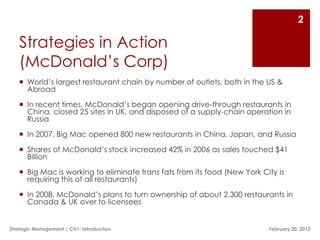
   Strategies in Action
   (McDonald‟s Corp)
    World‟s largest restaurant chain by number of outlets, both in the US &
     Abroad

    In recent times, McDonald‟s began opening drive-through restaurants in
     China, closed 25 sites in UK, and disposed of a supply-chain operation in
     Russia

    In 2007, Big Mac opened 800 new restaurants in China, Japan, and Russia

    Shares of McDonald‟s stock increased 42% in 2006 as sales touched $41
     Billion

    Big Mac is working to eliminate trans fats from its food (New York City is
     requiring this of all restaurants)

    In 2008, McDonald‟s plans to turn ownership of about 2,300 restaurants in
     Canada & UK over to licensees


Strategic Management | CH1: Introduction                                  February 20, 2012
3

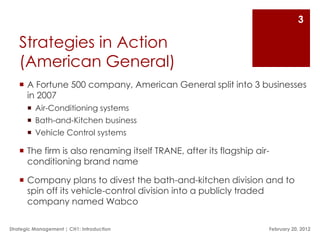
   Strategies in Action
   (American General)
    A Fortune 500 company, American General split into 3 businesses
     in 2007
        Air-Conditioning systems
        Bath-and-Kitchen business
        Vehicle Control systems

    The firm is also renaming itself TRANE, after its flagship air-
     conditioning brand name

    Company plans to divest the bath-and-kitchen division and to
     spin off its vehicle-control division into a publicly traded
     company named Wabco

Strategic Management | CH1: Introduction                           February 20, 2012
4

   What is Strategic
   Management?
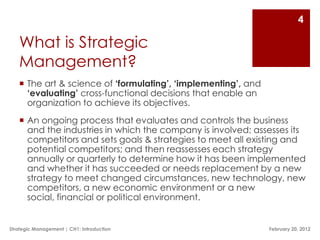
    The art & science of ‘formulating’, ‘implementing’, and
     ‘evaluating’ cross-functional decisions that enable an
     organization to achieve its objectives.
    An ongoing process that evaluates and controls the business
     and the industries in which the company is involved; assesses its
     competitors and sets goals & strategies to meet all existing and
     potential competitors; and then reassesses each strategy
     annually or quarterly to determine how it has been implemented
     and whether it has succeeded or needs replacement by a new
     strategy to meet changed circumstances, new technology, new
     competitors, a new economic environment or a new
     social, financial or political environment.


Strategic Management | CH1: Introduction                       February 20, 2012
5

   Strategic Management
   Model
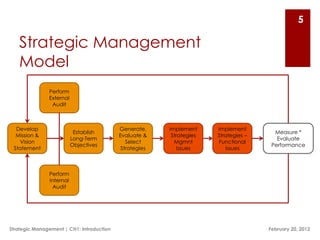
               Perform
               External
                Audit


  Develop                                  Generate,     Implement     Implement
                           Establish                                                    Measure *
  Mission &                                Evaluate &     Strategies   Strategies –
                          Long-Term                                                      Evaluate
   Vision                                     Select       Mgmnt       Functional
                          Objectives                                                   Performance
 Statement                                  Strategies       Issues       Issues


               Perform
               Internal
                Audit


Strategic Management | CH1: Introduction                                              February 20, 2012
6


   Stage 1: Strategy Formulation
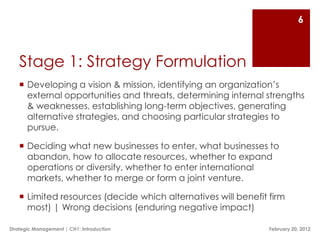
    Developing a vision & mission, identifying an organization‟s
     external opportunities and threats, determining internal strengths
     & weaknesses, establishing long-term objectives, generating
     alternative strategies, and choosing particular strategies to
     pursue.

    Deciding what new businesses to enter, what businesses to
     abandon, how to allocate resources, whether to expand
     operations or diversify, whether to enter international
     markets, whether to merge or form a joint venture.

    Limited resources (decide which alternatives will benefit firm
     most) | Wrong decisions (enduring negative impact)

Strategic Management | CH1: Introduction                       February 20, 2012
7

   Stage 2: Strategy
   Implementation
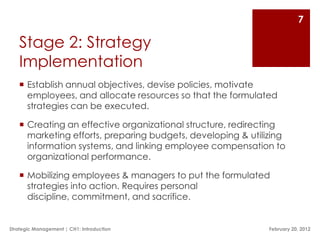
    Establish annual objectives, devise policies, motivate
     employees, and allocate resources so that the formulated
     strategies can be executed.

    Creating an effective organizational structure, redirecting
     marketing efforts, preparing budgets, developing & utilizing
     information systems, and linking employee compensation to
     organizational performance.

    Mobilizing employees & managers to put the formulated
     strategies into action. Requires personal
     discipline, commitment, and sacrifice.


Strategic Management | CH1: Introduction                     February 20, 2012
8


   Stage 3: Strategy Evaluation
    Three fundamental activities
       1. Reviewing external & internal factors that are the bases of current
          strategies
       2. Measuring performance
       3. Taking corrective actions

    Success today is no guarantee of success tomorrow. Success
     creates new & different problems; complacent organizations
     experience demise.


Strategic Management | CH1: Introduction                              February 20, 2012
9

   Key Terms in Strategic
   Management (1/6)
    Competitive Advantage
        “Anything that a firm does especially well compared to rival firms.”
        Sustainable competitive advantage
           Continually adapting to changes in external trends & events and
            internal capabilities, competencies & resources
           Effectively formulating, implementing and evaluating strategies that
            capitalize upon the above factors
        Example: Internet for direct selling and communication with suppliers
         & customers dispersed globally


Strategic Management | CH1: Introduction                              February 20, 2012
10

   Key Terms in Strategic
   Management (2/6)
    Strategists
        Individuals who are responsible for the success or failure of an
         organization (CXO)
        Help organizations gather, analyze & organize information.
        Track industry & competitive trends, develop forecasting
         models, evaluate corporate & divisional performance, spot emerging
         market opportunities, identify business threats, and develop creative
         action plans


Strategic Management | CH1: Introduction                               February 20, 2012
11

   Key Terms in Strategic
   Management (3/6)
    Vision & Mission Statements
        Vision Statement answers the question “What do we want to
         become?”
           First step in strategy planning; precedes development of mission
            statement
           Example, vision statement of Institute of Management Accountants
            is “Global leadership in education, certification, and practice of
            management accounting & financial management.”
        Mission statement address the basic question “What is our business?”
           Enduring statements of purpose that distinguish one business from
            other similar firms.


Strategic Management | CH1: Introduction                              February 20, 2012
12


   FedEx: Vision Statement
    "FedEx is committed to providing outstanding customer
     experience, to being a great place to work, a thoughtful steward
     of the environment and a caring citizen in the communities
     where we live and work. At FedEx, we are passionate about
     sustainably connecting people and places and improving the
     quality of life around the world.”


Strategic Management | CH1: Introduction                    February 20, 2012
13

   FedEx:
   Mission, Strategy, Values (1/3)
    Mission
        FedEx Corporation will produce superior financial returns for its
         shareowners by providing high value-added logistics, transportation
         and related business services through focused operating companies.
         Customer requirements will be met in the highest quality manner
         appropriate to each market segment served. FedEx will strive to
         develop mutually rewarding relationships with its employees, partners
         and suppliers. Safety will be the first consideration in all operations.
         Corporate activities will be conducted to the highest ethical and
         professional standards.


Strategic Management | CH1: Introduction                               February 20, 2012
14

   FedEx:
   Mission, Strategy, Values (2/3)
    Strategy
        The unique FedEx operating strategy works seamlessly - and
         simultaneously - on three levels.
           Compete collectively by standing as one brand worldwide and
            speaking with one voice.
           Operate independently by focusing on our independent networks
            to meet distinct customer needs.
           Manage collaboratively by working together to sustain loyal
            relationships with our workforce, customers and investors.


Strategic Management | CH1: Introduction                              February 20, 2012
15

   FedEx:
   Mission, Strategy, Values (3/3)
    Values
        People: We value our people and promote diversity in our workplace
         and in our thinking.
        Service: Our absolutely, positively spirit puts our customers at the heart
         of everything we do.
        Innovation: We invent and inspire the services and technologies that
         improve the way we work and live.
        Integrity: We manage our operations, finances and services with
         honesty, efficiency and reliability.
        Responsibility: We champion safe and healthy environments for the
         communities in which we live and work.
        Loyalty: We earn the respect and confidence of our FedEx
         people, customers and investors every day, in everything we do.


Strategic Management | CH1: Introduction                                February 20, 2012
16

   Key Terms in Strategic
   Management (4/6)
    External Opportunities & Threats
        Refer to the economic, social, cultural, demographic, legal, etc. that
         could significantly benefit or harm an organization in the future.
        Largely, beyond the control of a single organization
        Examples, wireless revolution, biotechnology, population shifts, high
         gas prices, changing work values & attitudes, increased competition
         from foreign companies, natural catastrophe, declining value of
         dollar
        Organizations need to constantly identify, monitor and evaluate
         external opportunities & threats for success (environmental scanning)
        Some organizations use lobbying to influence external opportunities &
         threats

Strategic Management | CH1: Introduction                              February 20, 2012
17

   Key Terms in Strategic
   Management (5/6)
    Internal Strengths & Weaknesses
        Organization‟s controllable activities that are performed especially
         well or poorly
        Functions such as
         Management, Marketing, Finance/Accounting, Production/Operatio
         ns, Research & Development, Management Information System (MIS)
        Usually assessed „relative to competitors‟
        Example, Ownership of Natural Resources or a historic reputation for
         quality


Strategic Management | CH1: Introduction                              February 20, 2012
18

   Key Terms in Strategic
   Management (6/6)
    Long-Term Objectives & Annual Objectives
        Objectives are specific results that an organization seeks to achieve in
         pursuing its basic mission
        Objectives are essential for organizational success because they state
         direction, aid in evaluation, reveal priorities, basis for effective
         planning, organizing, motivating & controlling activities
        Objectives should be
         challenging, measurable, consistent, reasonable & clear
        Long-Term means more than one year
        Annual means short term milestones that organizations must achieve
         to reach long-term objectives


Strategic Management | CH1: Introduction                               February 20, 2012
19

   Why Companies Do No
   Strategic Planning?
    Poor Reward Structures (penalized for failures, individuals prefer to
     play safe)

    Fire-Fighting, too busy with crisis management so no time to plan

    Waste of Time, time spent on planning is an investment

    Too Expensive, organizations culturally opposed to spending
     resources

    Content with success (success today doesn‟t guarantee success
     tomorrow)

    Overconfidence, as individuals gain experience they rely less on
     formal planning

Strategic Management | CH1: Introduction                           February 20, 2012
20


                                           Thank You
                                                               Hardy Alexander

                                              Founder & Director | Triune Global

                                            “Partners in Employee Development”

                                                  halexander@triuneglobal.com


Strategic Management | CH1: Introduction                      February 20, 2012

Strategic Management: Ch 1 Introduction

  • 1.
    Ch 1: Introductionto Strategic Management
  • 2.
    2 Strategies in Action (McDonald‟s Corp)  World‟s largest restaurant chain by number of outlets, both in the US & Abroad  In recent times, McDonald‟s began opening drive-through restaurants in China, closed 25 sites in UK, and disposed of a supply-chain operation in Russia  In 2007, Big Mac opened 800 new restaurants in China, Japan, and Russia  Shares of McDonald‟s stock increased 42% in 2006 as sales touched $41 Billion  Big Mac is working to eliminate trans fats from its food (New York City is requiring this of all restaurants)  In 2008, McDonald‟s plans to turn ownership of about 2,300 restaurants in Canada & UK over to licensees Strategic Management | CH1: Introduction February 20, 2012
  • 3.
    3 Strategies in Action (American General)  A Fortune 500 company, American General split into 3 businesses in 2007  Air-Conditioning systems  Bath-and-Kitchen business  Vehicle Control systems  The firm is also renaming itself TRANE, after its flagship air- conditioning brand name  Company plans to divest the bath-and-kitchen division and to spin off its vehicle-control division into a publicly traded company named Wabco Strategic Management | CH1: Introduction February 20, 2012
  • 4.
    4 What is Strategic Management?  The art & science of ‘formulating’, ‘implementing’, and ‘evaluating’ cross-functional decisions that enable an organization to achieve its objectives.  An ongoing process that evaluates and controls the business and the industries in which the company is involved; assesses its competitors and sets goals & strategies to meet all existing and potential competitors; and then reassesses each strategy annually or quarterly to determine how it has been implemented and whether it has succeeded or needs replacement by a new strategy to meet changed circumstances, new technology, new competitors, a new economic environment or a new social, financial or political environment. Strategic Management | CH1: Introduction February 20, 2012
  • 5.
    5 Strategic Management Model Perform External Audit Develop Generate, Implement Implement Establish Measure * Mission & Evaluate & Strategies Strategies – Long-Term Evaluate Vision Select Mgmnt Functional Objectives Performance Statement Strategies Issues Issues Perform Internal Audit Strategic Management | CH1: Introduction February 20, 2012
  • 6.
    6 Stage 1: Strategy Formulation  Developing a vision & mission, identifying an organization‟s external opportunities and threats, determining internal strengths & weaknesses, establishing long-term objectives, generating alternative strategies, and choosing particular strategies to pursue.  Deciding what new businesses to enter, what businesses to abandon, how to allocate resources, whether to expand operations or diversify, whether to enter international markets, whether to merge or form a joint venture.  Limited resources (decide which alternatives will benefit firm most) | Wrong decisions (enduring negative impact) Strategic Management | CH1: Introduction February 20, 2012
  • 7.
    7 Stage 2: Strategy Implementation  Establish annual objectives, devise policies, motivate employees, and allocate resources so that the formulated strategies can be executed.  Creating an effective organizational structure, redirecting marketing efforts, preparing budgets, developing & utilizing information systems, and linking employee compensation to organizational performance.  Mobilizing employees & managers to put the formulated strategies into action. Requires personal discipline, commitment, and sacrifice. Strategic Management | CH1: Introduction February 20, 2012
  • 8.
    8 Stage 3: Strategy Evaluation  Three fundamental activities 1. Reviewing external & internal factors that are the bases of current strategies 2. Measuring performance 3. Taking corrective actions  Success today is no guarantee of success tomorrow. Success creates new & different problems; complacent organizations experience demise. Strategic Management | CH1: Introduction February 20, 2012
  • 9.
    9 Key Terms in Strategic Management (1/6)  Competitive Advantage  “Anything that a firm does especially well compared to rival firms.”  Sustainable competitive advantage  Continually adapting to changes in external trends & events and internal capabilities, competencies & resources  Effectively formulating, implementing and evaluating strategies that capitalize upon the above factors  Example: Internet for direct selling and communication with suppliers & customers dispersed globally Strategic Management | CH1: Introduction February 20, 2012
  • 10.
    10 Key Terms in Strategic Management (2/6)  Strategists  Individuals who are responsible for the success or failure of an organization (CXO)  Help organizations gather, analyze & organize information.  Track industry & competitive trends, develop forecasting models, evaluate corporate & divisional performance, spot emerging market opportunities, identify business threats, and develop creative action plans Strategic Management | CH1: Introduction February 20, 2012
  • 11.
    11 Key Terms in Strategic Management (3/6)  Vision & Mission Statements  Vision Statement answers the question “What do we want to become?”  First step in strategy planning; precedes development of mission statement  Example, vision statement of Institute of Management Accountants is “Global leadership in education, certification, and practice of management accounting & financial management.”  Mission statement address the basic question “What is our business?”  Enduring statements of purpose that distinguish one business from other similar firms. Strategic Management | CH1: Introduction February 20, 2012
  • 12.
    12 FedEx: Vision Statement  "FedEx is committed to providing outstanding customer experience, to being a great place to work, a thoughtful steward of the environment and a caring citizen in the communities where we live and work. At FedEx, we are passionate about sustainably connecting people and places and improving the quality of life around the world.” Strategic Management | CH1: Introduction February 20, 2012
  • 13.
    13 FedEx: Mission, Strategy, Values (1/3)  Mission  FedEx Corporation will produce superior financial returns for its shareowners by providing high value-added logistics, transportation and related business services through focused operating companies. Customer requirements will be met in the highest quality manner appropriate to each market segment served. FedEx will strive to develop mutually rewarding relationships with its employees, partners and suppliers. Safety will be the first consideration in all operations. Corporate activities will be conducted to the highest ethical and professional standards. Strategic Management | CH1: Introduction February 20, 2012
  • 14.
    14 FedEx: Mission, Strategy, Values (2/3)  Strategy  The unique FedEx operating strategy works seamlessly - and simultaneously - on three levels.  Compete collectively by standing as one brand worldwide and speaking with one voice.  Operate independently by focusing on our independent networks to meet distinct customer needs.  Manage collaboratively by working together to sustain loyal relationships with our workforce, customers and investors. Strategic Management | CH1: Introduction February 20, 2012
  • 15.
    15 FedEx: Mission, Strategy, Values (3/3)  Values  People: We value our people and promote diversity in our workplace and in our thinking.  Service: Our absolutely, positively spirit puts our customers at the heart of everything we do.  Innovation: We invent and inspire the services and technologies that improve the way we work and live.  Integrity: We manage our operations, finances and services with honesty, efficiency and reliability.  Responsibility: We champion safe and healthy environments for the communities in which we live and work.  Loyalty: We earn the respect and confidence of our FedEx people, customers and investors every day, in everything we do. Strategic Management | CH1: Introduction February 20, 2012
  • 16.
    16 Key Terms in Strategic Management (4/6)  External Opportunities & Threats  Refer to the economic, social, cultural, demographic, legal, etc. that could significantly benefit or harm an organization in the future.  Largely, beyond the control of a single organization  Examples, wireless revolution, biotechnology, population shifts, high gas prices, changing work values & attitudes, increased competition from foreign companies, natural catastrophe, declining value of dollar  Organizations need to constantly identify, monitor and evaluate external opportunities & threats for success (environmental scanning)  Some organizations use lobbying to influence external opportunities & threats Strategic Management | CH1: Introduction February 20, 2012
  • 17.
    17 Key Terms in Strategic Management (5/6)  Internal Strengths & Weaknesses  Organization‟s controllable activities that are performed especially well or poorly  Functions such as Management, Marketing, Finance/Accounting, Production/Operatio ns, Research & Development, Management Information System (MIS)  Usually assessed „relative to competitors‟  Example, Ownership of Natural Resources or a historic reputation for quality Strategic Management | CH1: Introduction February 20, 2012
  • 18.
    18 Key Terms in Strategic Management (6/6)  Long-Term Objectives & Annual Objectives  Objectives are specific results that an organization seeks to achieve in pursuing its basic mission  Objectives are essential for organizational success because they state direction, aid in evaluation, reveal priorities, basis for effective planning, organizing, motivating & controlling activities  Objectives should be challenging, measurable, consistent, reasonable & clear  Long-Term means more than one year  Annual means short term milestones that organizations must achieve to reach long-term objectives Strategic Management | CH1: Introduction February 20, 2012
  • 19.
    19 Why Companies Do No Strategic Planning?  Poor Reward Structures (penalized for failures, individuals prefer to play safe)  Fire-Fighting, too busy with crisis management so no time to plan  Waste of Time, time spent on planning is an investment  Too Expensive, organizations culturally opposed to spending resources  Content with success (success today doesn‟t guarantee success tomorrow)  Overconfidence, as individuals gain experience they rely less on formal planning Strategic Management | CH1: Introduction February 20, 2012
  • 20.
    20 Thank You Hardy Alexander Founder & Director | Triune Global “Partners in Employee Development” halexander@triuneglobal.com Strategic Management | CH1: Introduction February 20, 2012