Fred R. David
Prentice Hall
Ch 4-1
Chapter 4Chapter 4
The Internal AssessmentThe Internal Assessment
Strategic Management:
Concepts and Cases. 9th
edition
Fred R. David
PowerPoint Slides by
Anthony F. Chelte
Western New England College
Fred R. David
Prentice Hall
Ch 4-2
Chapter OutlineChapter Outline
• The Nature of an Internal Audit
• Integrating Strategy and Culture
• Management
Fred R. David
Prentice Hall
Ch 4-3
Chapter OutlineChapter Outline
• Marketing
• Finance/Accounting
• Production/Operations
Fred R. David
Prentice Hall
Ch 4-4
Chapter OutlineChapter Outline
• Research and Development
• Management Information Systems
• The Internal Factor Evaluation
Matrix (IFE)
Fred R. David
Prentice Hall
Ch 4-5
The Internal AssessmentThe Internal Assessment
Great spirits have always encountered
violent opposition from mediocre minds.
-- Albert Einstein
Fred R. David
Prentice Hall
Ch 4-6
Nature of an Internal AuditNature of an Internal Audit
All organizations –All organizations –
• Strengths
• Weaknesses
Fred R. David
Prentice Hall
Ch 4-7
Key Internal ForcesKey Internal Forces
Distinctive Competencies
• A firm’s strengths that cannot be easily
matched or imitated by competitors
• Building competitive advantage involves
taking advantage of distinctive competencies
• Strategies designed in part to improve on a
firm’s weaknesses and turn to strengths
Fred R. David
Prentice Hall
Ch 4-8
Internal AuditInternal Audit
Involvement in performing an internal
strategic-management audit provides
vehicle for understanding nature and
effect of decisions in other functional
business areas of the firm.
Fred R. David
Prentice Hall
Ch 4-9
Internal AuditInternal Audit
Key to organizational success:
– Coordination and understanding among
managers from all functional areas
Fred R. David
Prentice Hall
Ch 4-10
Internal AuditInternal Audit
Functional relationships:
– Number and complexity increases relative
to organization size
Fred R. David
Prentice Hall
Ch 4-11
Internal AuditInternal Audit
Financial Ratio Analysis:
– Exemplifies complexity of relationships
among functional areas of the business
Fred R. David
Prentice Hall
Ch 4-12
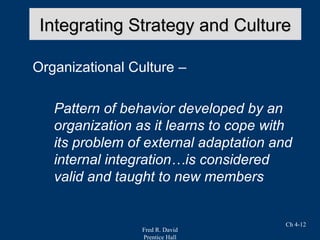
Integrating Strategy and CultureIntegrating Strategy and Culture
Organizational Culture –
Pattern of behavior developed by an
organization as it learns to cope with
its problem of external adaptation and
internal integration…is considered
valid and taught to new members
Fred R. David
Prentice Hall
Ch 4-13
Integrating Strategy and CultureIntegrating Strategy and Culture
Organizational Culture --
• Resistant to change
• May represent a strength or weakness
of the firm
Fred R. David
Prentice Hall
Ch 4-14
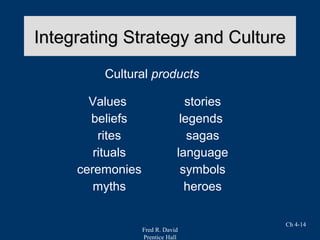
Integrating Strategy and CultureIntegrating Strategy and Culture
Cultural products
Values
beliefs
rites
rituals
ceremonies
myths
stories
legends
sagas
language
symbols
heroes
Fred R. David
Prentice Hall
Ch 4-15
Integrating Strategy and CultureIntegrating Strategy and Culture
Culture can inhibit strategic management:
– Miss changes in external environment
because they are blinded by strongly held
beliefs
– When a culture has been effective in the
past, natural tendency to stick with it in
future, even during times of major strategic
change
Fred R. David
Prentice Hall
Ch 4-16
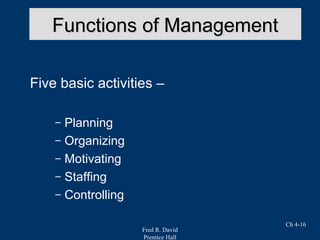
Functions of ManagementFunctions of Management
Five basic activities –
– Planning
– Organizing
– Motivating
– Staffing
– Controlling
Fred R. David
Prentice Hall
Ch 4-17
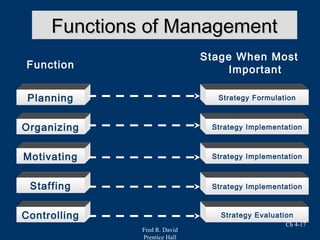
Functions of ManagementFunctions of Management
Planning
Stage When Most
ImportantFunction
Strategy Formulation
Organizing Strategy Implementation
Motivating Strategy Implementation
Staffing
Controlling
Strategy Implementation
Strategy Evaluation
Fred R. David
Prentice Hall
Ch 4-18
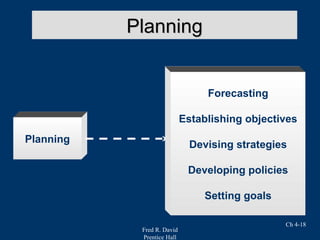
PlanningPlanning
Planning
Forecasting
Establishing objectives
Devising strategies
Developing policies
Setting goals
Fred R. David
Prentice Hall
Ch 4-19
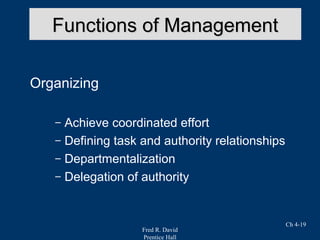
Functions of ManagementFunctions of Management
Organizing
– Achieve coordinated effort
– Defining task and authority relationships
– Departmentalization
– Delegation of authority
Fred R. David
Prentice Hall
Ch 4-20
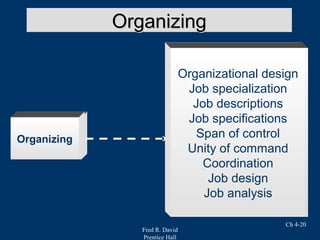
OrganizingOrganizing
Organizing
Organizational design
Job specialization
Job descriptions
Job specifications
Span of control
Unity of command
Coordination
Job design
Job analysis
Organizing
Organizational design
Job specialization
Job descriptions
Job specifications
Span of control
Unity of command
Coordination
Job design
Job analysis
Organizing
Organizational design
Job specialization
Job descriptions
Job specifications
Span of control
Unity of command
Coordination
Job design
Job analysis
Fred R. David
Prentice Hall
Ch 4-21
Functions of ManagementFunctions of Management
Motivating
– Influencing people to accomplish specific
objectives
– Communication is a major component
Fred R. David
Prentice Hall
Ch 4-22
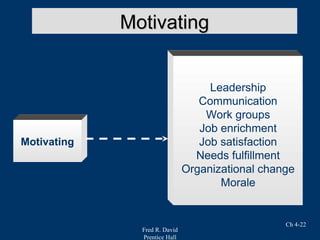
MotivatingMotivating
Motivating
Leadership
Communication
Work groups
Job enrichment
Job satisfaction
Needs fulfillment
Organizational change
Morale
Fred R. David
Prentice Hall
Ch 4-23
Functions of ManagementFunctions of Management
Staffing
– Personnel management
– Human resources management
Fred R. David
Prentice Hall
Ch 4-24
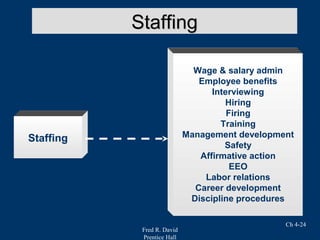
StaffingStaffing
Staffing
Wage & salary admin
Employee benefits
Interviewing
Hiring
Firing
Training
Management development
Safety
Affirmative action
EEO
Labor relations
Career development
Discipline procedures
Management
Fred R. David
Prentice Hall
Ch 4-25
Functions of ManagementFunctions of Management
Controlling
– Ensure actual operations conform to
planned operations
Fred R. David
Prentice Hall
Ch 4-26
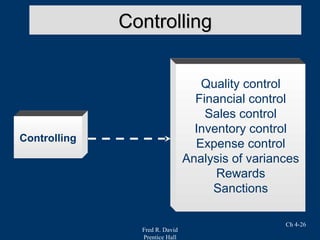
ControllingControlling
Controlling
Quality control
Financial control
Sales control
Inventory control
Expense control
Analysis of variances
Rewards
Sanctions
Management
Fred R. David
Prentice Hall
Ch 4-27
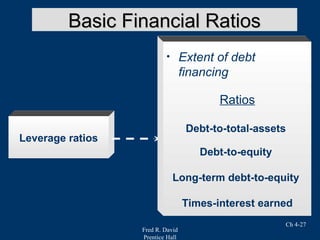
Leverage ratios
• Extent of debt
financing
Ratios
Debt-to-total-assets
Debt-to-equity
Long-term debt-to-equity
Times-interest earned
Basic Financial RatiosBasic Financial Ratios
Fred R. David
Prentice Hall
Ch 4-28
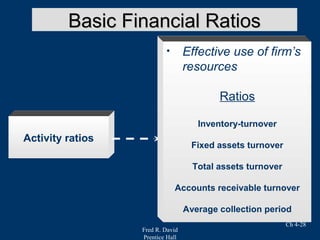
Activity ratios
• Effective use of firm’s
resources
Ratios
Inventory-turnover
Fixed assets turnover
Total assets turnover
Accounts receivable turnover
Average collection period
Basic Financial RatiosBasic Financial Ratios
Fred R. David
Prentice Hall
Ch 4-29
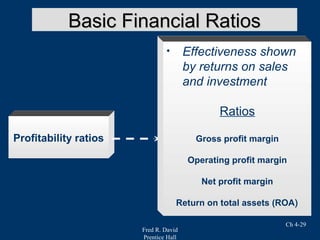
Profitability ratios
• Effectiveness shown
by returns on sales
and investment
Ratios
Gross profit margin
Operating profit margin
Net profit margin
Return on total assets (ROA)
Basic Financial RatiosBasic Financial Ratios
Fred R. David
Prentice Hall
Ch 4-30
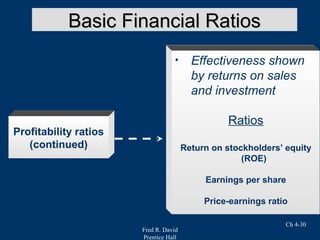
Profitability ratios
(continued)
• Effectiveness shown
by returns on sales
and investment
Ratios
Return on stockholders’ equity
(ROE)
Earnings per share
Price-earnings ratio
Basic Financial RatiosBasic Financial Ratios
Fred R. David
Prentice Hall
Ch 4-31
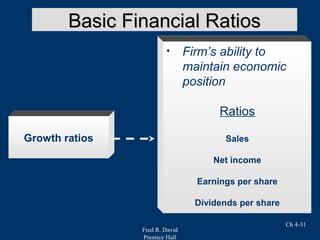
Growth ratios
• Firm’s ability to
maintain economic
position
Ratios
Sales
Net income
Earnings per share
Dividends per share
Basic Financial RatiosBasic Financial Ratios
Fred R. David
Prentice Hall
Ch 4-32
• Are dividend payout policies reasonable?
• Does the firm have good relations with its
investors and stockholders?
• Are the firm’s financial managers experienced
and well trained?
Finance/Accounting AuditFinance/Accounting Audit

Strategic Management Slides - Chapter 4 "the Internal Assessment"

  • 1.
    Fred R. David PrenticeHall Ch 4-1 Chapter 4Chapter 4 The Internal AssessmentThe Internal Assessment Strategic Management: Concepts and Cases. 9th edition Fred R. David PowerPoint Slides by Anthony F. Chelte Western New England College
  • 2.
    Fred R. David PrenticeHall Ch 4-2 Chapter OutlineChapter Outline • The Nature of an Internal Audit • Integrating Strategy and Culture • Management
  • 3.
    Fred R. David PrenticeHall Ch 4-3 Chapter OutlineChapter Outline • Marketing • Finance/Accounting • Production/Operations
  • 4.
    Fred R. David PrenticeHall Ch 4-4 Chapter OutlineChapter Outline • Research and Development • Management Information Systems • The Internal Factor Evaluation Matrix (IFE)
  • 5.
    Fred R. David PrenticeHall Ch 4-5 The Internal AssessmentThe Internal Assessment Great spirits have always encountered violent opposition from mediocre minds. -- Albert Einstein
  • 6.
    Fred R. David PrenticeHall Ch 4-6 Nature of an Internal AuditNature of an Internal Audit All organizations –All organizations – • Strengths • Weaknesses
  • 7.
    Fred R. David PrenticeHall Ch 4-7 Key Internal ForcesKey Internal Forces Distinctive Competencies • A firm’s strengths that cannot be easily matched or imitated by competitors • Building competitive advantage involves taking advantage of distinctive competencies • Strategies designed in part to improve on a firm’s weaknesses and turn to strengths
  • 8.
    Fred R. David PrenticeHall Ch 4-8 Internal AuditInternal Audit Involvement in performing an internal strategic-management audit provides vehicle for understanding nature and effect of decisions in other functional business areas of the firm.
  • 9.
    Fred R. David PrenticeHall Ch 4-9 Internal AuditInternal Audit Key to organizational success: – Coordination and understanding among managers from all functional areas
  • 10.
    Fred R. David PrenticeHall Ch 4-10 Internal AuditInternal Audit Functional relationships: – Number and complexity increases relative to organization size
  • 11.
    Fred R. David PrenticeHall Ch 4-11 Internal AuditInternal Audit Financial Ratio Analysis: – Exemplifies complexity of relationships among functional areas of the business
  • 12.
    Fred R. David PrenticeHall Ch 4-12 Integrating Strategy and CultureIntegrating Strategy and Culture Organizational Culture – Pattern of behavior developed by an organization as it learns to cope with its problem of external adaptation and internal integration…is considered valid and taught to new members
  • 13.
    Fred R. David PrenticeHall Ch 4-13 Integrating Strategy and CultureIntegrating Strategy and Culture Organizational Culture -- • Resistant to change • May represent a strength or weakness of the firm
  • 14.
    Fred R. David PrenticeHall Ch 4-14 Integrating Strategy and CultureIntegrating Strategy and Culture Cultural products Values beliefs rites rituals ceremonies myths stories legends sagas language symbols heroes
  • 15.
    Fred R. David PrenticeHall Ch 4-15 Integrating Strategy and CultureIntegrating Strategy and Culture Culture can inhibit strategic management: – Miss changes in external environment because they are blinded by strongly held beliefs – When a culture has been effective in the past, natural tendency to stick with it in future, even during times of major strategic change
  • 16.
    Fred R. David PrenticeHall Ch 4-16 Functions of ManagementFunctions of Management Five basic activities – – Planning – Organizing – Motivating – Staffing – Controlling
  • 17.
    Fred R. David PrenticeHall Ch 4-17 Functions of ManagementFunctions of Management Planning Stage When Most ImportantFunction Strategy Formulation Organizing Strategy Implementation Motivating Strategy Implementation Staffing Controlling Strategy Implementation Strategy Evaluation
  • 18.
    Fred R. David PrenticeHall Ch 4-18 PlanningPlanning Planning Forecasting Establishing objectives Devising strategies Developing policies Setting goals
  • 19.
    Fred R. David PrenticeHall Ch 4-19 Functions of ManagementFunctions of Management Organizing – Achieve coordinated effort – Defining task and authority relationships – Departmentalization – Delegation of authority
  • 20.
    Fred R. David PrenticeHall Ch 4-20 OrganizingOrganizing Organizing Organizational design Job specialization Job descriptions Job specifications Span of control Unity of command Coordination Job design Job analysis Organizing Organizational design Job specialization Job descriptions Job specifications Span of control Unity of command Coordination Job design Job analysis Organizing Organizational design Job specialization Job descriptions Job specifications Span of control Unity of command Coordination Job design Job analysis
  • 21.
    Fred R. David PrenticeHall Ch 4-21 Functions of ManagementFunctions of Management Motivating – Influencing people to accomplish specific objectives – Communication is a major component
  • 22.
    Fred R. David PrenticeHall Ch 4-22 MotivatingMotivating Motivating Leadership Communication Work groups Job enrichment Job satisfaction Needs fulfillment Organizational change Morale
  • 23.
    Fred R. David PrenticeHall Ch 4-23 Functions of ManagementFunctions of Management Staffing – Personnel management – Human resources management
  • 24.
    Fred R. David PrenticeHall Ch 4-24 StaffingStaffing Staffing Wage & salary admin Employee benefits Interviewing Hiring Firing Training Management development Safety Affirmative action EEO Labor relations Career development Discipline procedures Management
  • 25.
    Fred R. David PrenticeHall Ch 4-25 Functions of ManagementFunctions of Management Controlling – Ensure actual operations conform to planned operations
  • 26.
    Fred R. David PrenticeHall Ch 4-26 ControllingControlling Controlling Quality control Financial control Sales control Inventory control Expense control Analysis of variances Rewards Sanctions Management
  • 27.
    Fred R. David PrenticeHall Ch 4-27 Leverage ratios • Extent of debt financing Ratios Debt-to-total-assets Debt-to-equity Long-term debt-to-equity Times-interest earned Basic Financial RatiosBasic Financial Ratios
  • 28.
    Fred R. David PrenticeHall Ch 4-28 Activity ratios • Effective use of firm’s resources Ratios Inventory-turnover Fixed assets turnover Total assets turnover Accounts receivable turnover Average collection period Basic Financial RatiosBasic Financial Ratios
  • 29.
    Fred R. David PrenticeHall Ch 4-29 Profitability ratios • Effectiveness shown by returns on sales and investment Ratios Gross profit margin Operating profit margin Net profit margin Return on total assets (ROA) Basic Financial RatiosBasic Financial Ratios
  • 30.
    Fred R. David PrenticeHall Ch 4-30 Profitability ratios (continued) • Effectiveness shown by returns on sales and investment Ratios Return on stockholders’ equity (ROE) Earnings per share Price-earnings ratio Basic Financial RatiosBasic Financial Ratios
  • 31.
    Fred R. David PrenticeHall Ch 4-31 Growth ratios • Firm’s ability to maintain economic position Ratios Sales Net income Earnings per share Dividends per share Basic Financial RatiosBasic Financial Ratios
  • 32.
    Fred R. David PrenticeHall Ch 4-32 • Are dividend payout policies reasonable? • Does the firm have good relations with its investors and stockholders? • Are the firm’s financial managers experienced and well trained? Finance/Accounting AuditFinance/Accounting Audit