+


    Ch 4: The Internal
    Assessment
+                                                                                       2

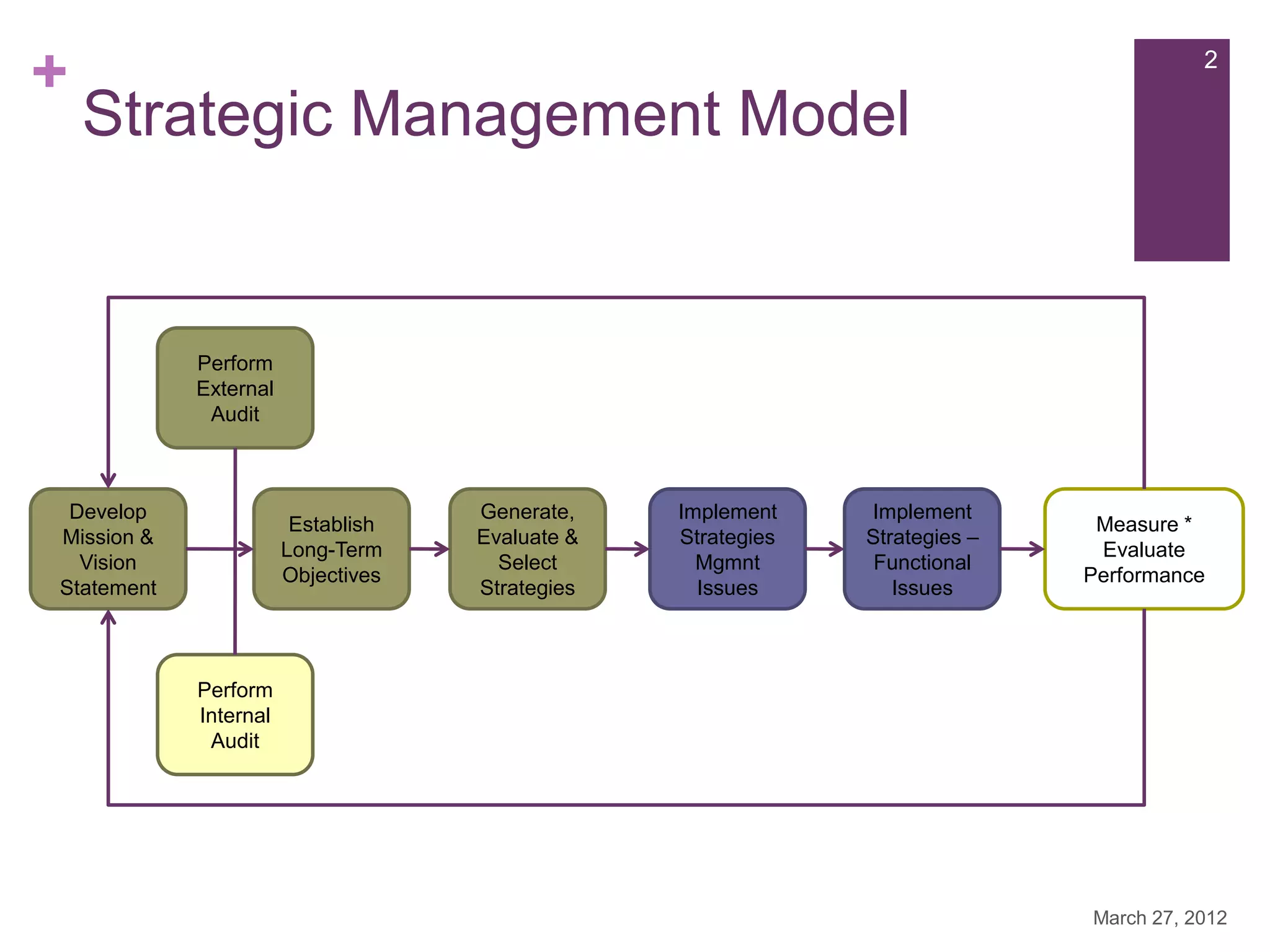
    Strategic Management Model


            Perform
            External
             Audit


 Develop                            Generate,    Implement    Implement
                        Establish                                             Measure *
Mission &                           Evaluate &   Strategies   Strategies –
                       Long-Term                                              Evaluate
  Vision                              Select       Mgmnt       Functional
                       Objectives                                            Performance
Statement                           Strategies     Issues        Issues


            Perform
            Internal
             Audit


                                                                             March 27, 2012
+                                                                               3

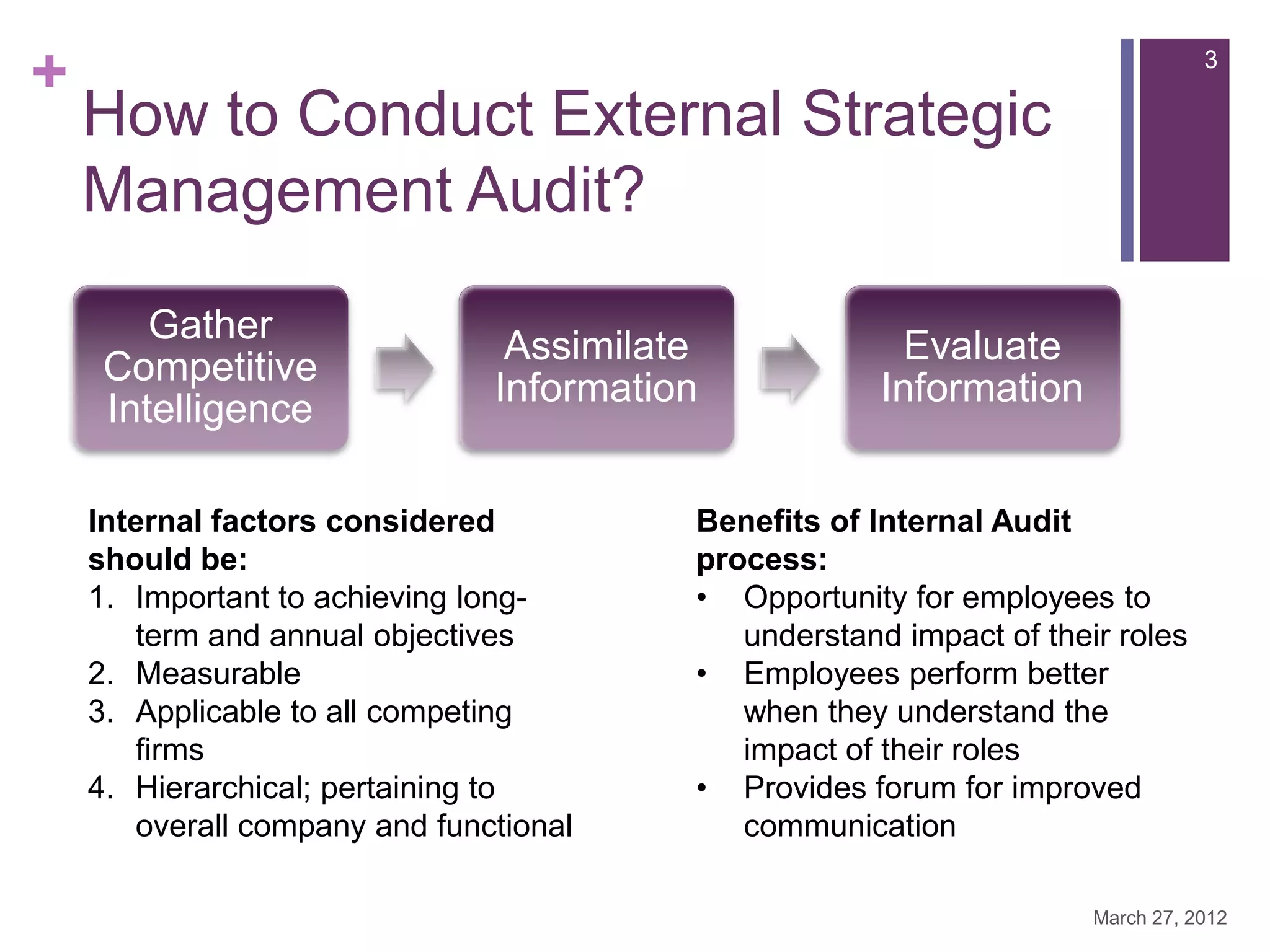
    How to Conduct External Strategic
    Management Audit?
        Gather
                                Assimilate              Evaluate
     Competitive
                               Information            Information
     Intelligence

    Internal factors considered          Benefits of Internal Audit
    should be:                           process:
    1. Important to achieving long-      • Opportunity for employees to
       term and annual objectives           understand impact of their roles
    2. Measurable                        • Employees perform better
    3. Applicable to all competing          when they understand the
       firms                                impact of their roles
    4. Hierarchical; pertaining to       • Provides forum for improved
       overall company and functional       communication

                                                                     March 27, 2012
+                                                                                  4

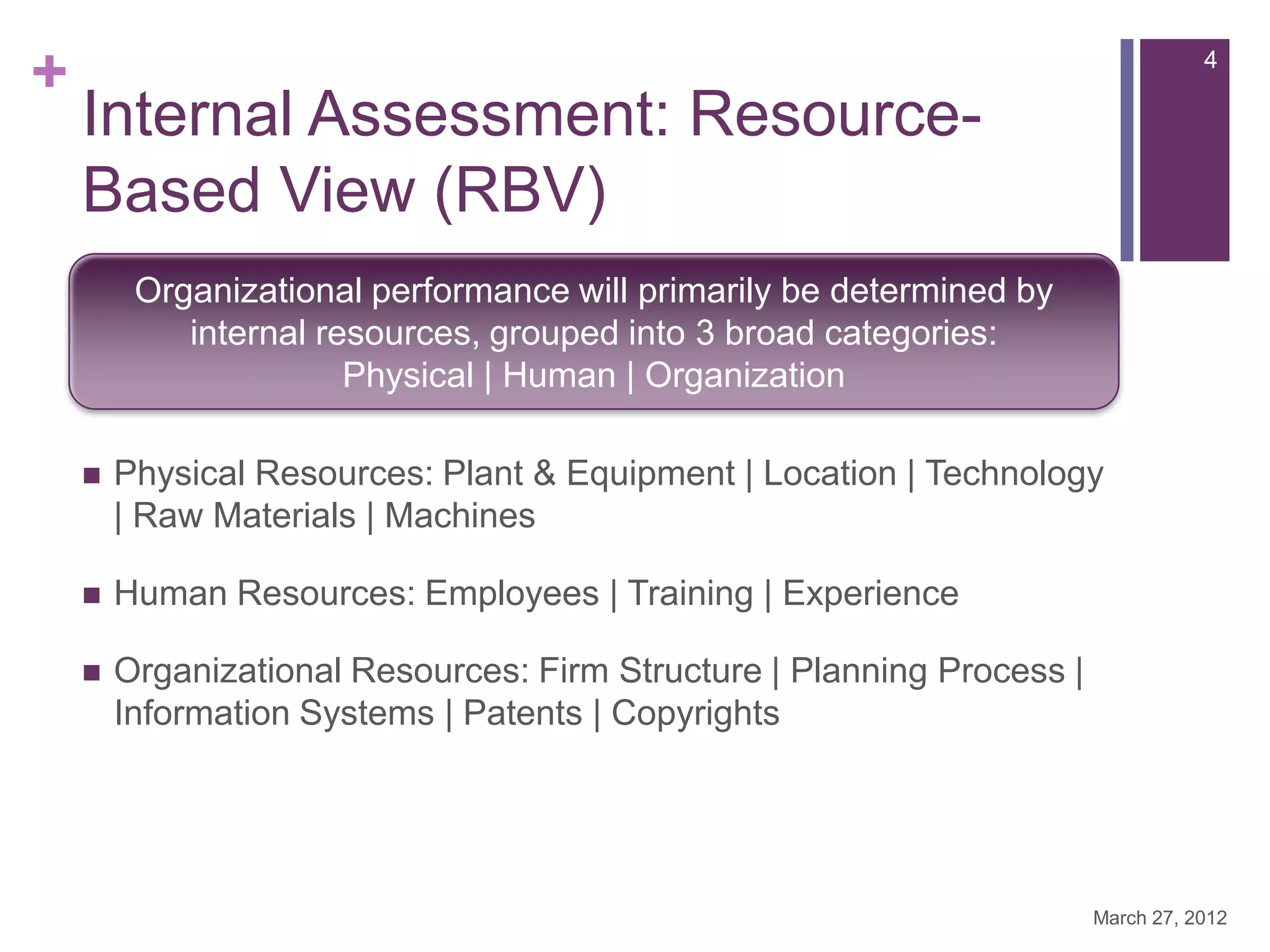
    Internal Assessment: Resource-
    Based View (RBV)
         Organizational performance will primarily be determined by
            internal resources, grouped into 3 broad categories:
                       Physical | Human | Organization

       Physical Resources: Plant & Equipment | Location | Technology
        | Raw Materials | Machines

       Human Resources: Employees | Training | Experience

       Organizational Resources: Firm Structure | Planning Process |
        Information Systems | Patents | Copyrights


                                                                        March 27, 2012
+
                     #1: Does Culture impact
                     Organizational Strategy?


March 27, 2012                                  5
+                                                                                   6

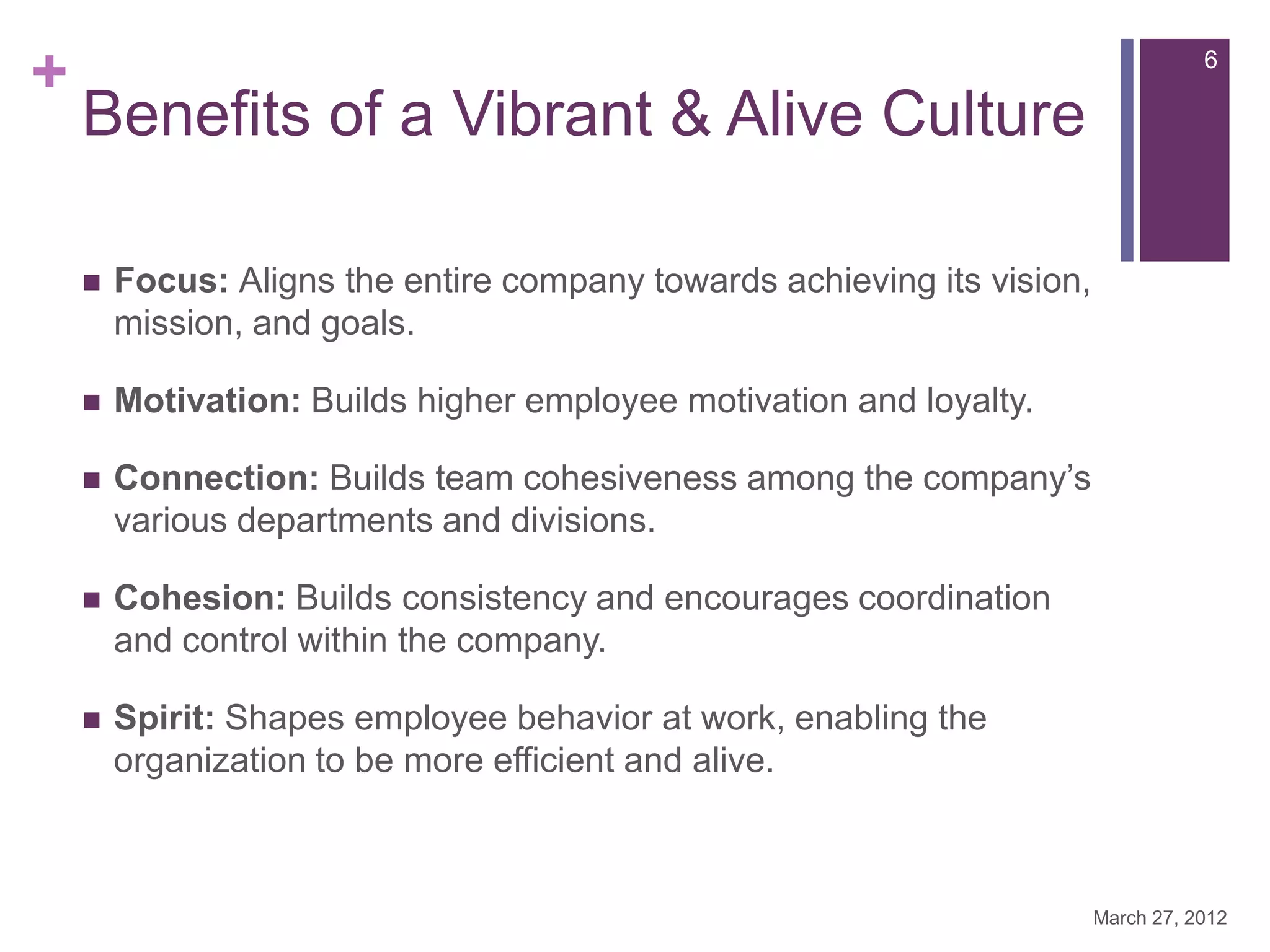
    Benefits of a Vibrant & Alive Culture

       Focus: Aligns the entire company towards achieving its vision,
        mission, and goals.

       Motivation: Builds higher employee motivation and loyalty.

       Connection: Builds team cohesiveness among the company’s
        various departments and divisions.

       Cohesion: Builds consistency and encourages coordination
        and control within the company.

       Spirit: Shapes employee behavior at work, enabling the
        organization to be more efficient and alive.


                                                                         March 27, 2012
+                                                                                      7

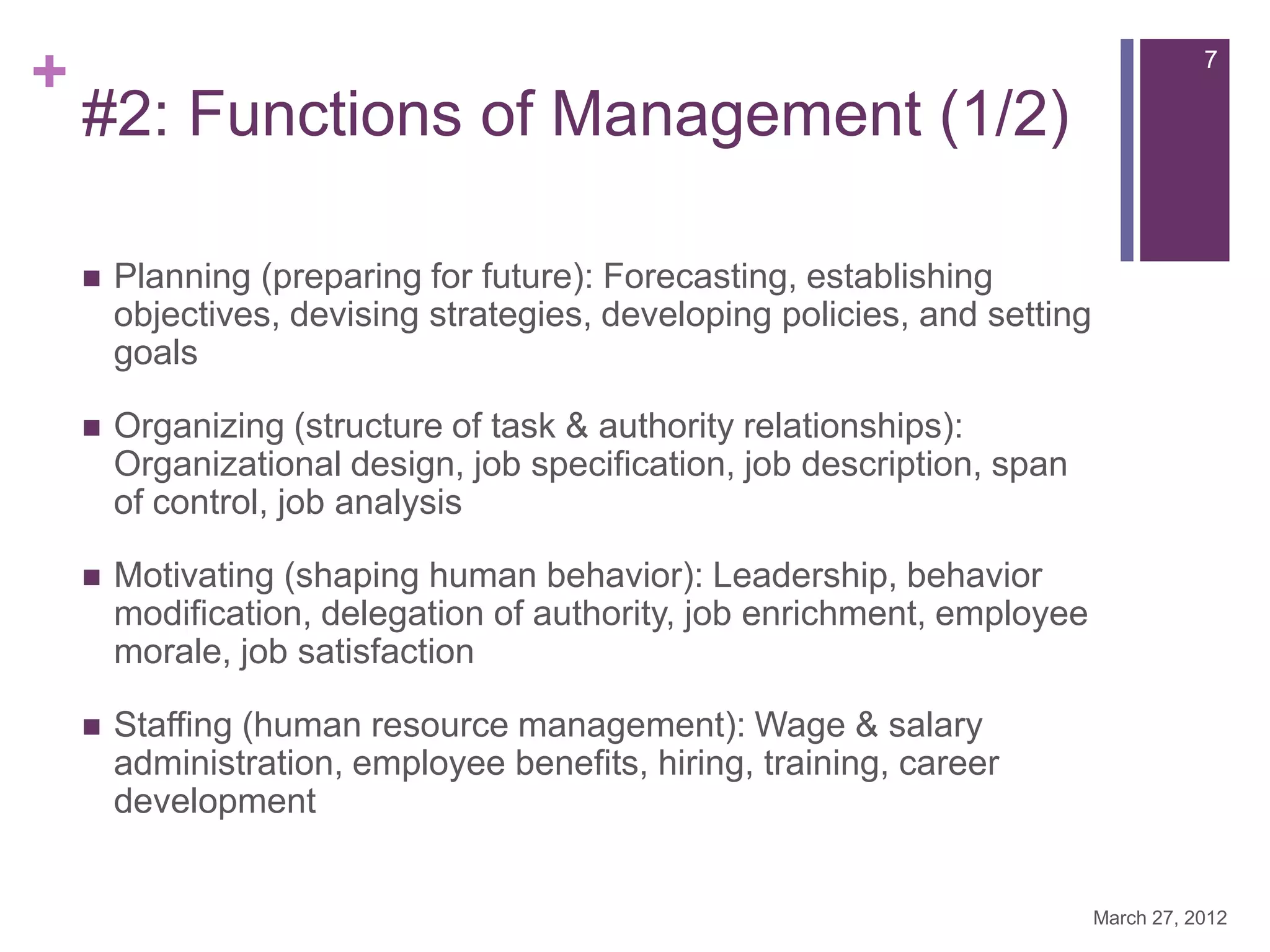
    #2: Functions of Management (1/2)

       Planning (preparing for future): Forecasting, establishing
        objectives, devising strategies, developing policies, and setting
        goals

       Organizing (structure of task & authority relationships):
        Organizational design, job specification, job description, span
        of control, job analysis

       Motivating (shaping human behavior): Leadership, behavior
        modification, delegation of authority, job enrichment, employee
        morale, job satisfaction

       Staffing (human resource management): Wage & salary
        administration, employee benefits, hiring, training, career
        development


                                                                            March 27, 2012
+                                                                                   8

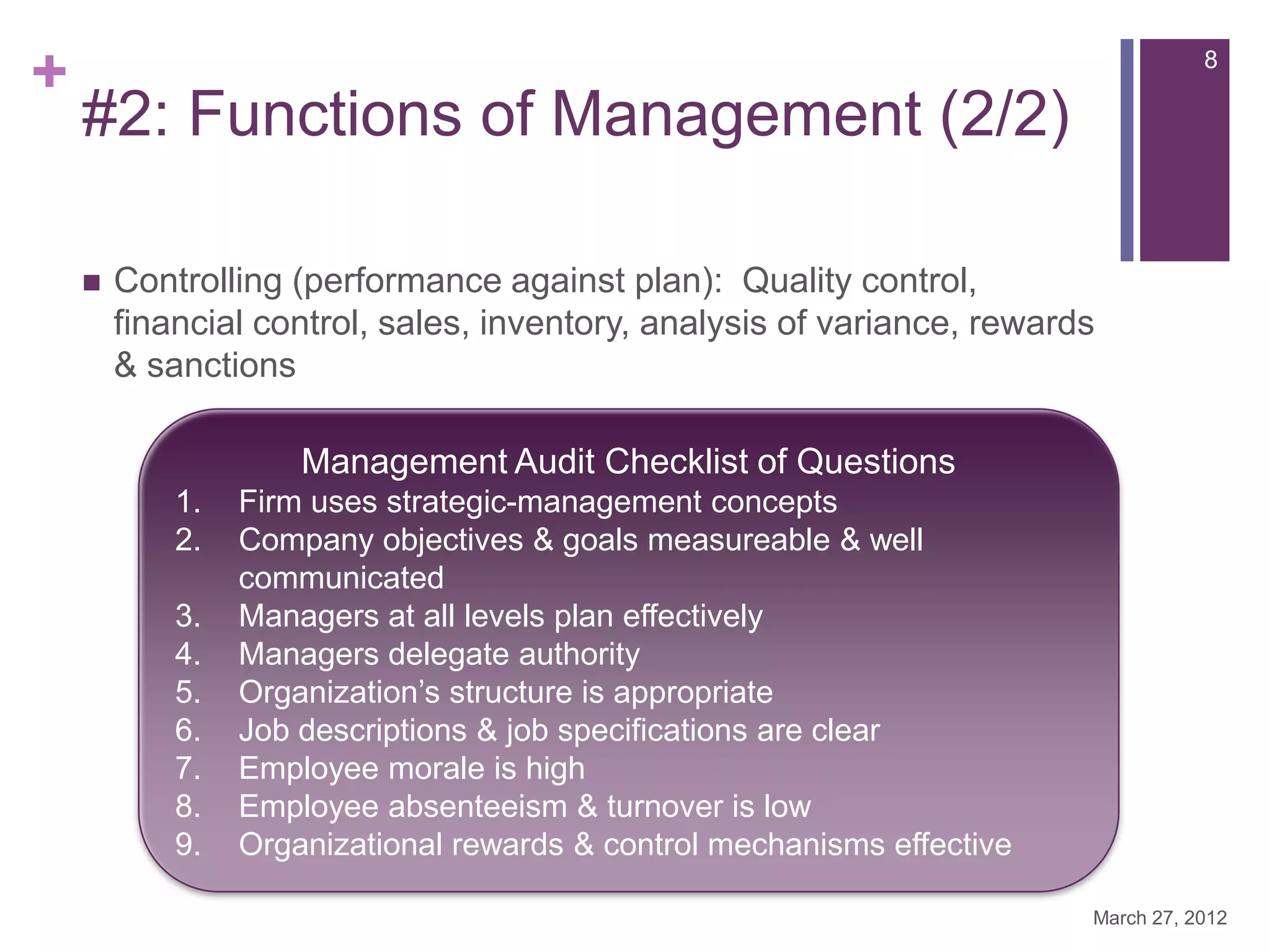
    #2: Functions of Management (2/2)

       Controlling (performance against plan): Quality control,
        financial control, sales, inventory, analysis of variance, rewards
        & sanctions

                     Management Audit Checklist of Questions
            1.   Firm uses strategic-management concepts
            2.   Company objectives & goals measureable & well
                 communicated
            3.   Managers at all levels plan effectively
            4.   Managers delegate authority
            5.   Organization’s structure is appropriate
            6.   Job descriptions & job specifications are clear
            7.   Employee morale is high
            8.   Employee absenteeism & turnover is low
            9.   Organizational rewards & control mechanisms effective

                                                                         March 27, 2012
+                                                                          9

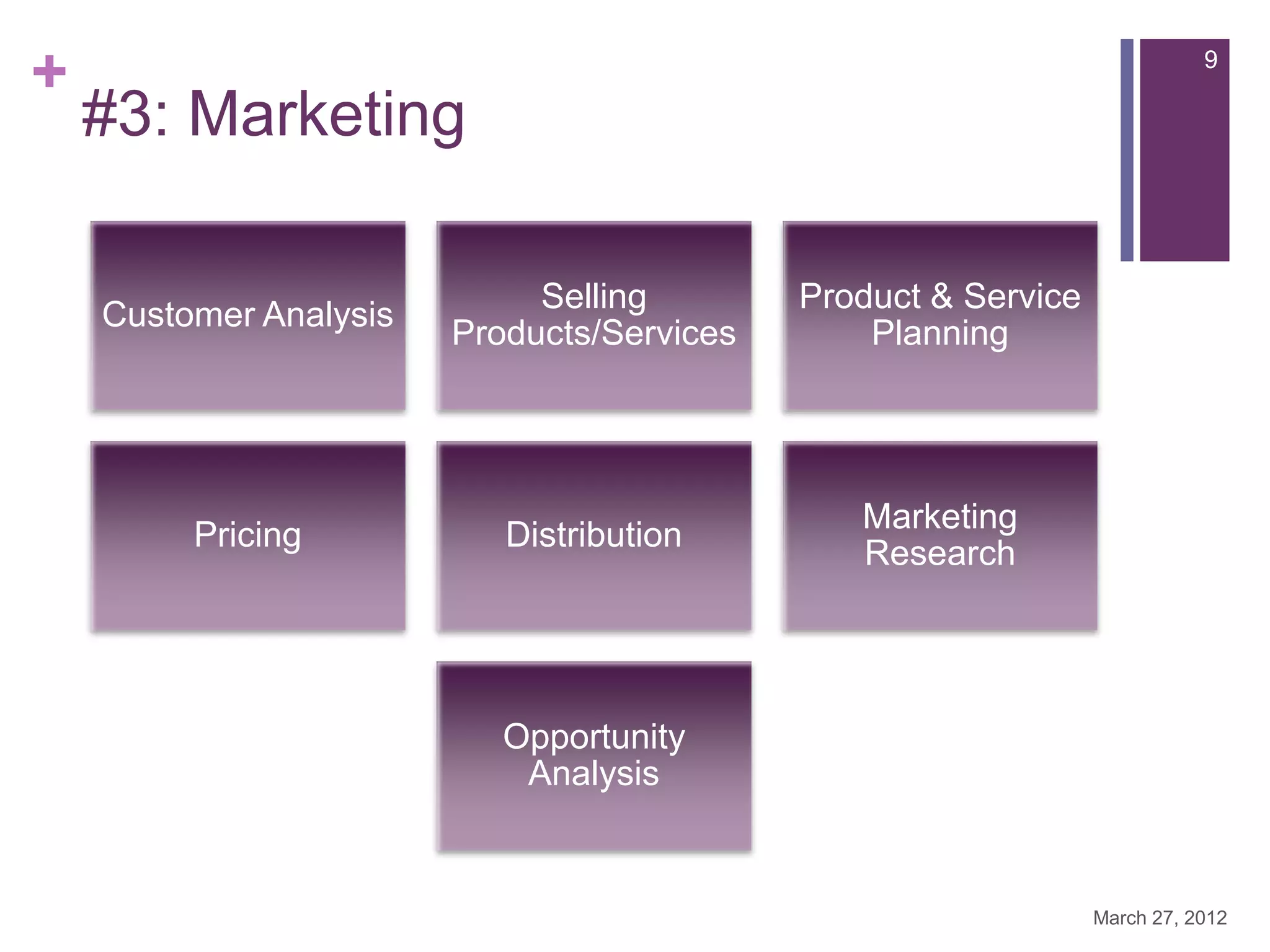
    #3: Marketing

                             Selling        Product & Service
    Customer Analysis
                        Products/Services       Planning


                                               Marketing
         Pricing           Distribution
                                               Research


                           Opportunity
                            Analysis


                                                                March 27, 2012
+                                                                                     10

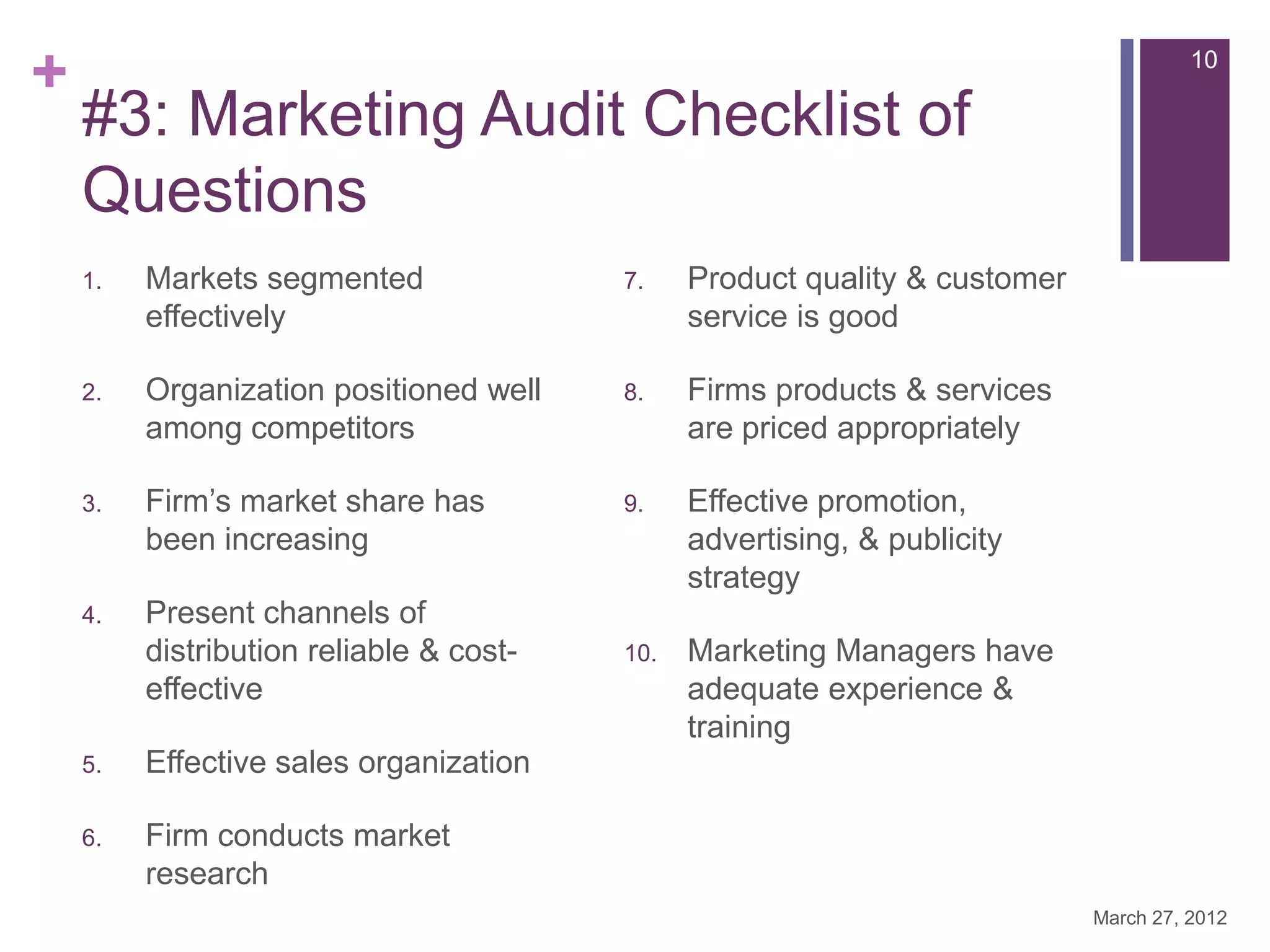
    #3: Marketing Audit Checklist of
    Questions
    1.   Markets segmented               7.    Product quality & customer
         effectively                           service is good

    2.   Organization positioned well    8.    Firms products & services
         among competitors                     are priced appropriately

    3.   Firm’s market share has         9.    Effective promotion,
         been increasing                       advertising, & publicity
                                               strategy
    4.   Present channels of
         distribution reliable & cost-   10.   Marketing Managers have
         effective                             adequate experience &
                                               training
    5.   Effective sales organization

    6.   Firm conducts market
         research
                                                                            March 27, 2012
+                                                                     11

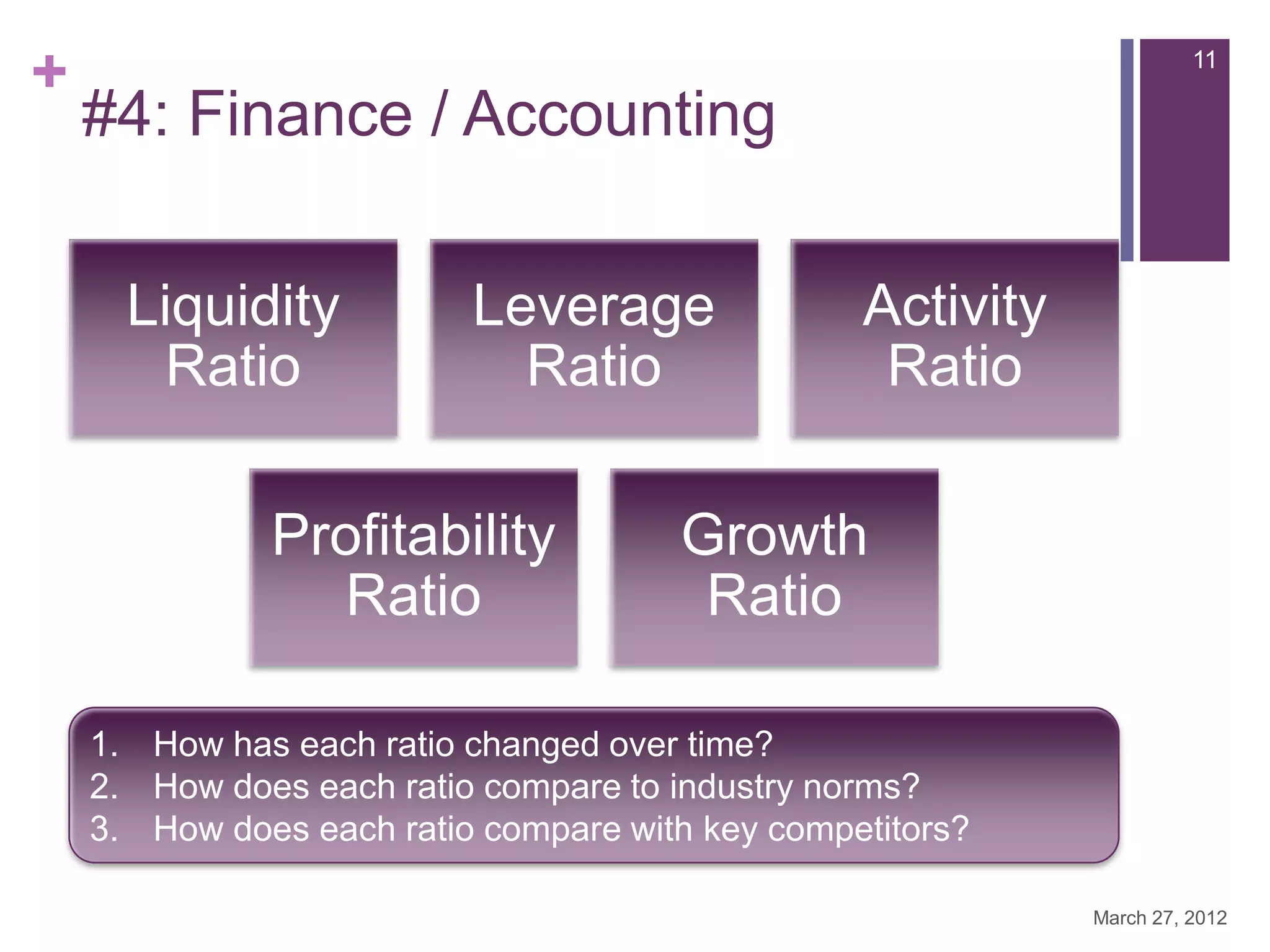
    #4: Finance / Accounting

      Liquidity           Leverage               Activity
       Ratio                Ratio                 Ratio

              Profitability           Growth
                Ratio                  Ratio

    1. How has each ratio changed over time?
    2. How does each ratio compare to industry norms?
    3. How does each ratio compare with key competitors?

                                                            March 27, 2012
+                                                                                  12

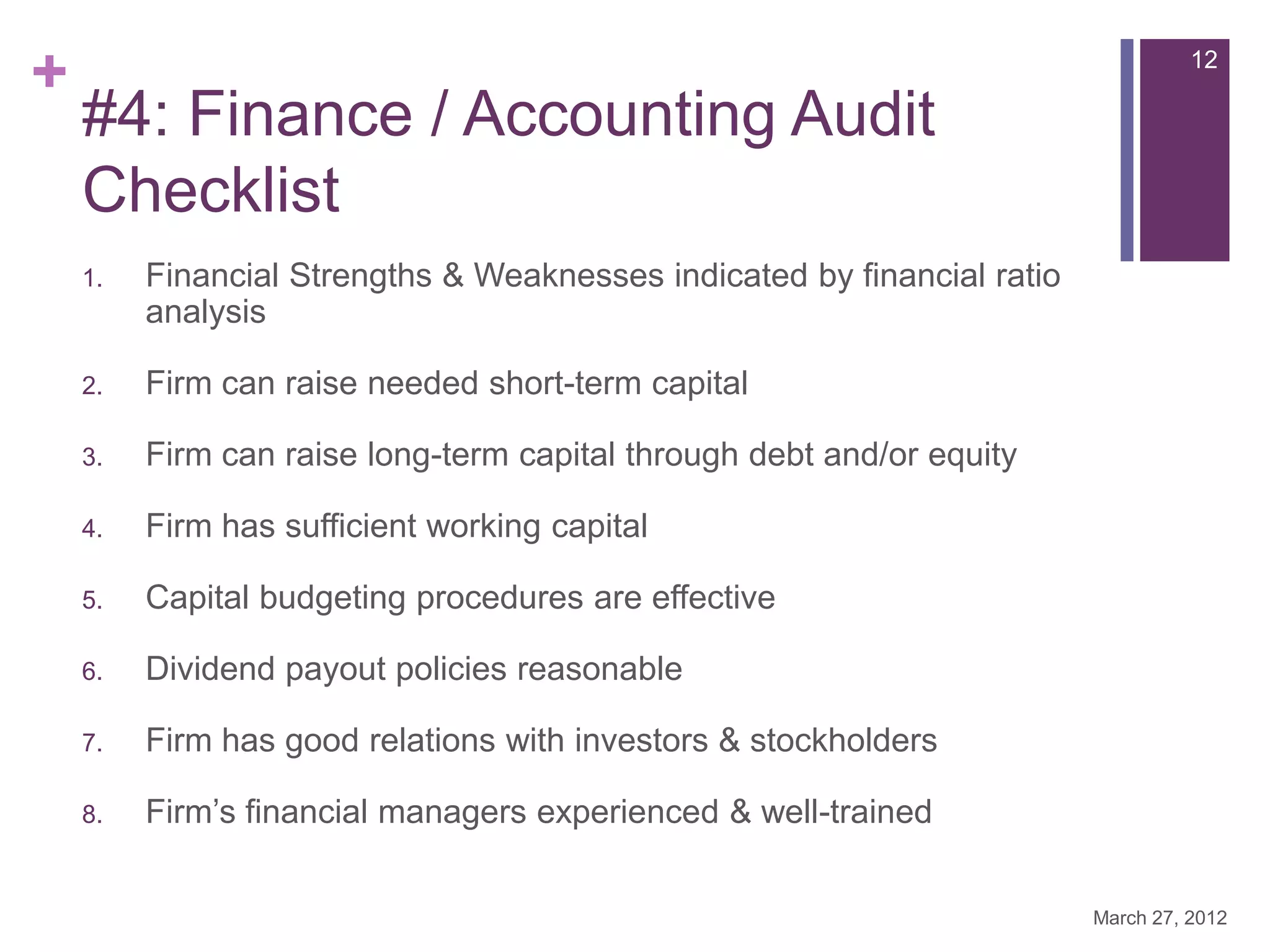
    #4: Finance / Accounting Audit
    Checklist
    1.   Financial Strengths & Weaknesses indicated by financial ratio
         analysis

    2.   Firm can raise needed short-term capital

    3.   Firm can raise long-term capital through debt and/or equity

    4.   Firm has sufficient working capital

    5.   Capital budgeting procedures are effective

    6.   Dividend payout policies reasonable

    7.   Firm has good relations with investors & stockholders

    8.   Firm’s financial managers experienced & well-trained


                                                                         March 27, 2012
+                                                                                    13

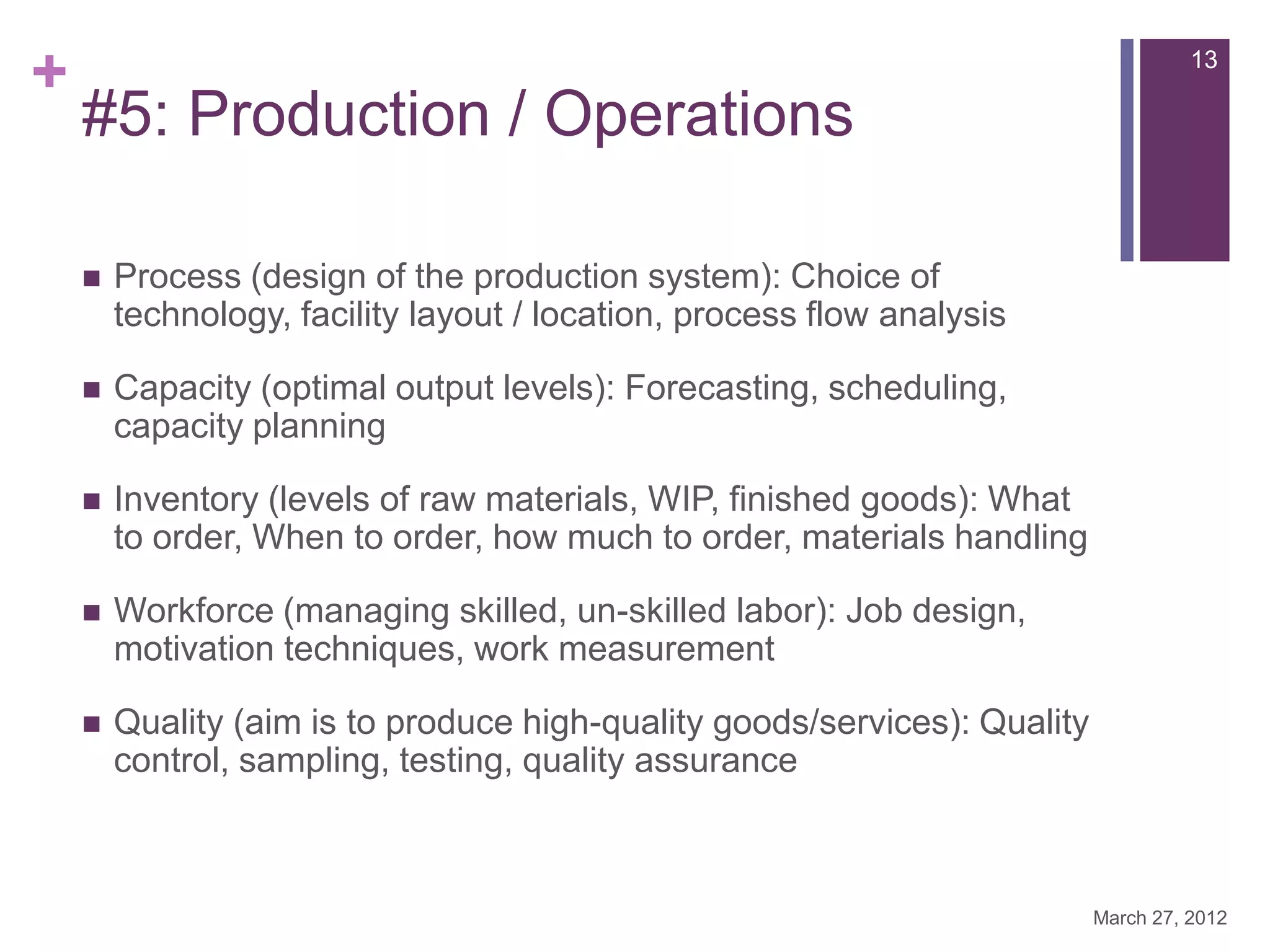
    #5: Production / Operations

       Process (design of the production system): Choice of
        technology, facility layout / location, process flow analysis

       Capacity (optimal output levels): Forecasting, scheduling,
        capacity planning

       Inventory (levels of raw materials, WIP, finished goods): What
        to order, When to order, how much to order, materials handling

       Workforce (managing skilled, un-skilled labor): Job design,
        motivation techniques, work measurement

       Quality (aim is to produce high-quality goods/services): Quality
        control, sampling, testing, quality assurance


                                                                           March 27, 2012
+                                                             14

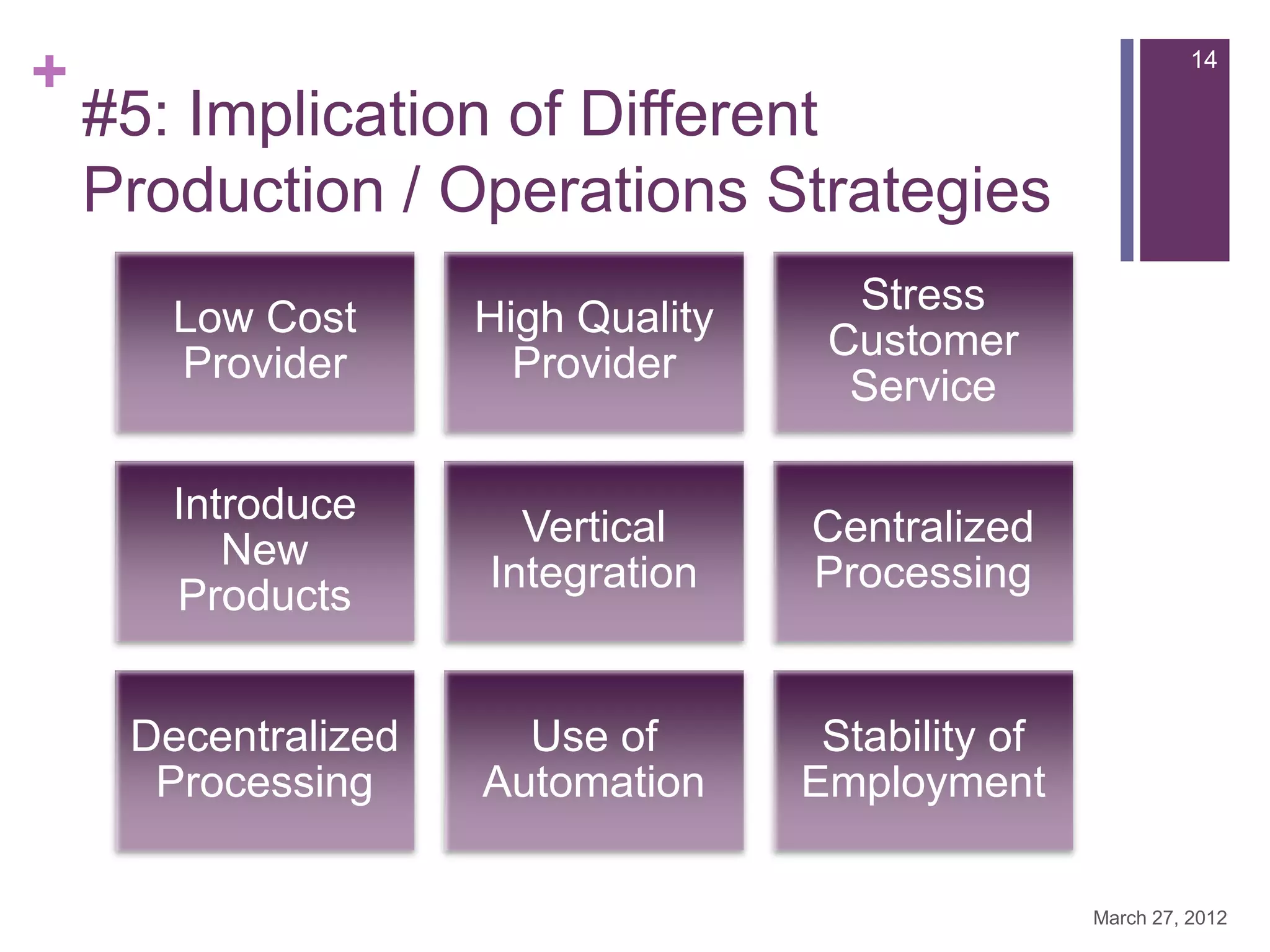
    #5: Implication of Different
    Production / Operations Strategies
                                      Stress
       Low Cost      High Quality
                                     Customer
       Provider        Provider
                                      Service

       Introduce
                       Vertical     Centralized
          New
                     Integration    Processing
       Products


     Decentralized     Use of        Stability of
      Processing     Automation     Employment

                                                    March 27, 2012
+                                                                                  15

    #5: Production / Operations Audit
    Checklist
    1.   Are supplies of raw materials and parts reliable &
         reasonable?

    2.   Are facilities, equipment, machinery, and offices in good
         condition?

    3.   Are inventory-control policies & procedures effective?

    4.   Are quality-control policies & procedures effective?

    5.   Are facilities, resources, and markets strategically located?

    6.   Does the firm have technological competencies?


                                                                         March 27, 2012
+                                                 16

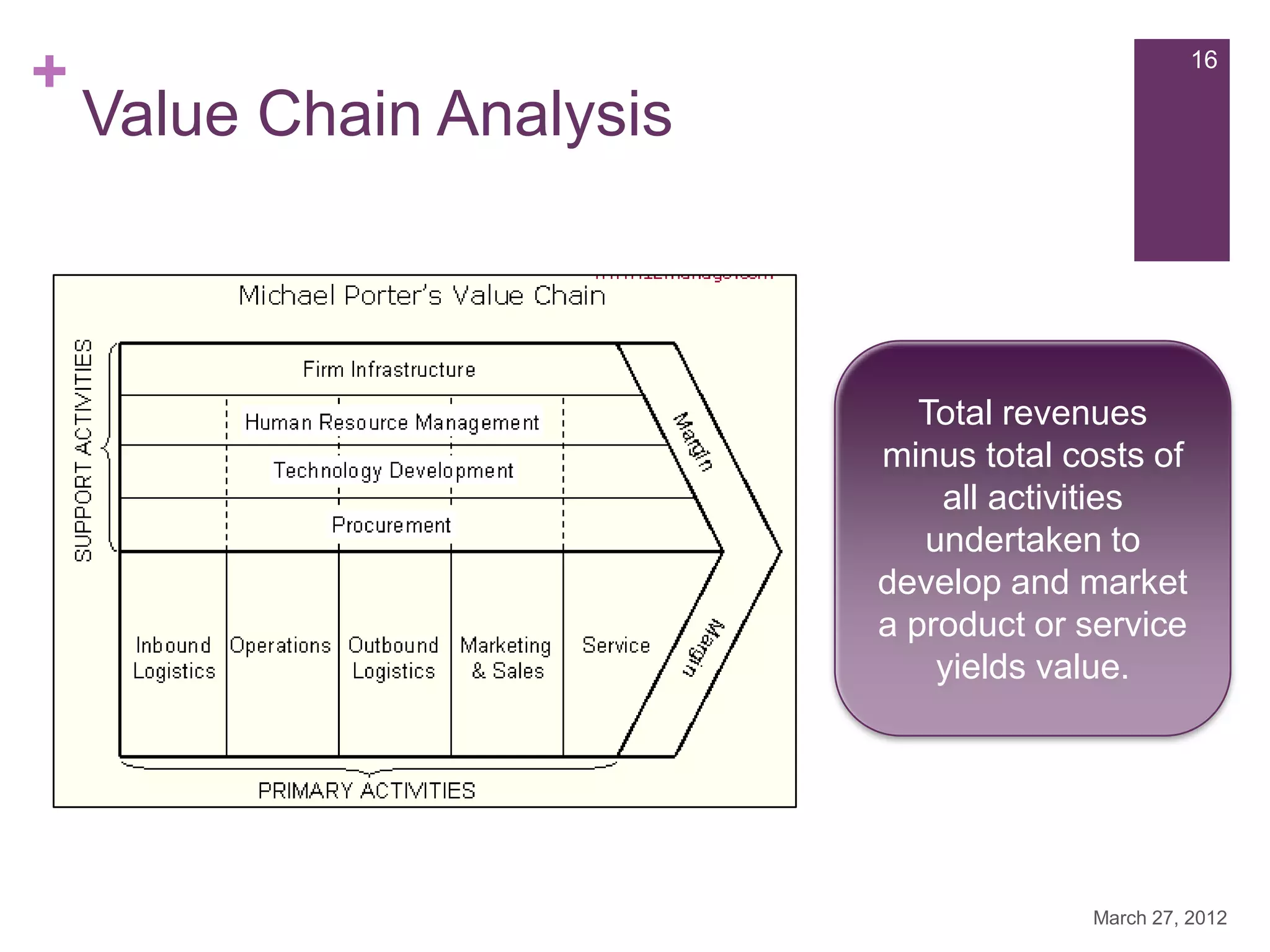
    Value Chain Analysis


                              Total revenues
                           minus total costs of
                               all activities
                              undertaken to
                           develop and market
                           a product or service
                               yields value.


                                        March 27, 2012
+                                                            17

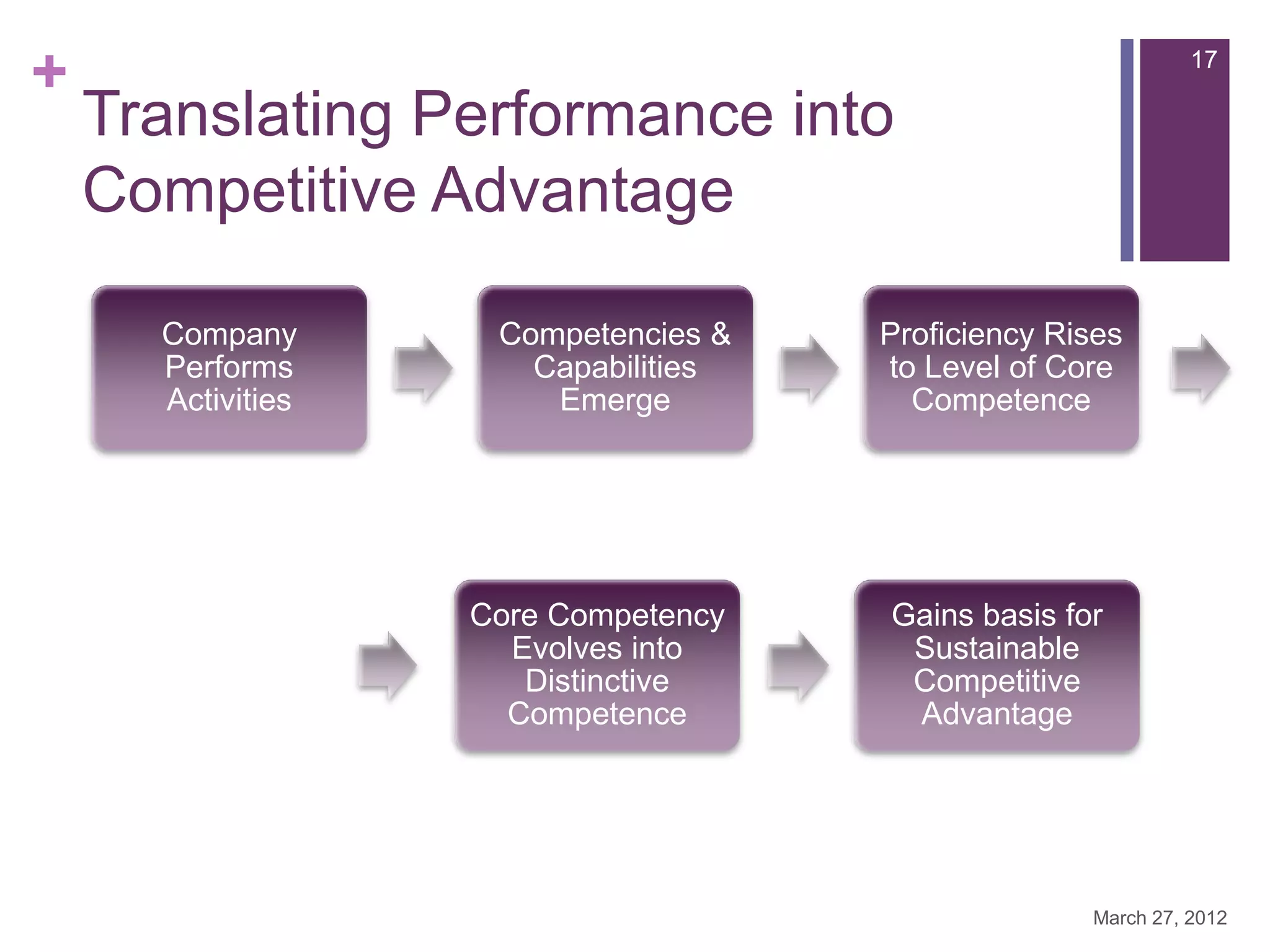
    Translating Performance into
    Competitive Advantage

      Company       Competencies &   Proficiency Rises
      Performs        Capabilities   to Level of Core
      Activities       Emerge          Competence


                   Core Competency   Gains basis for
                     Evolves into     Sustainable
                      Distinctive     Competitive
                     Competence       Advantage


                                                   March 27, 2012
+                                                 18

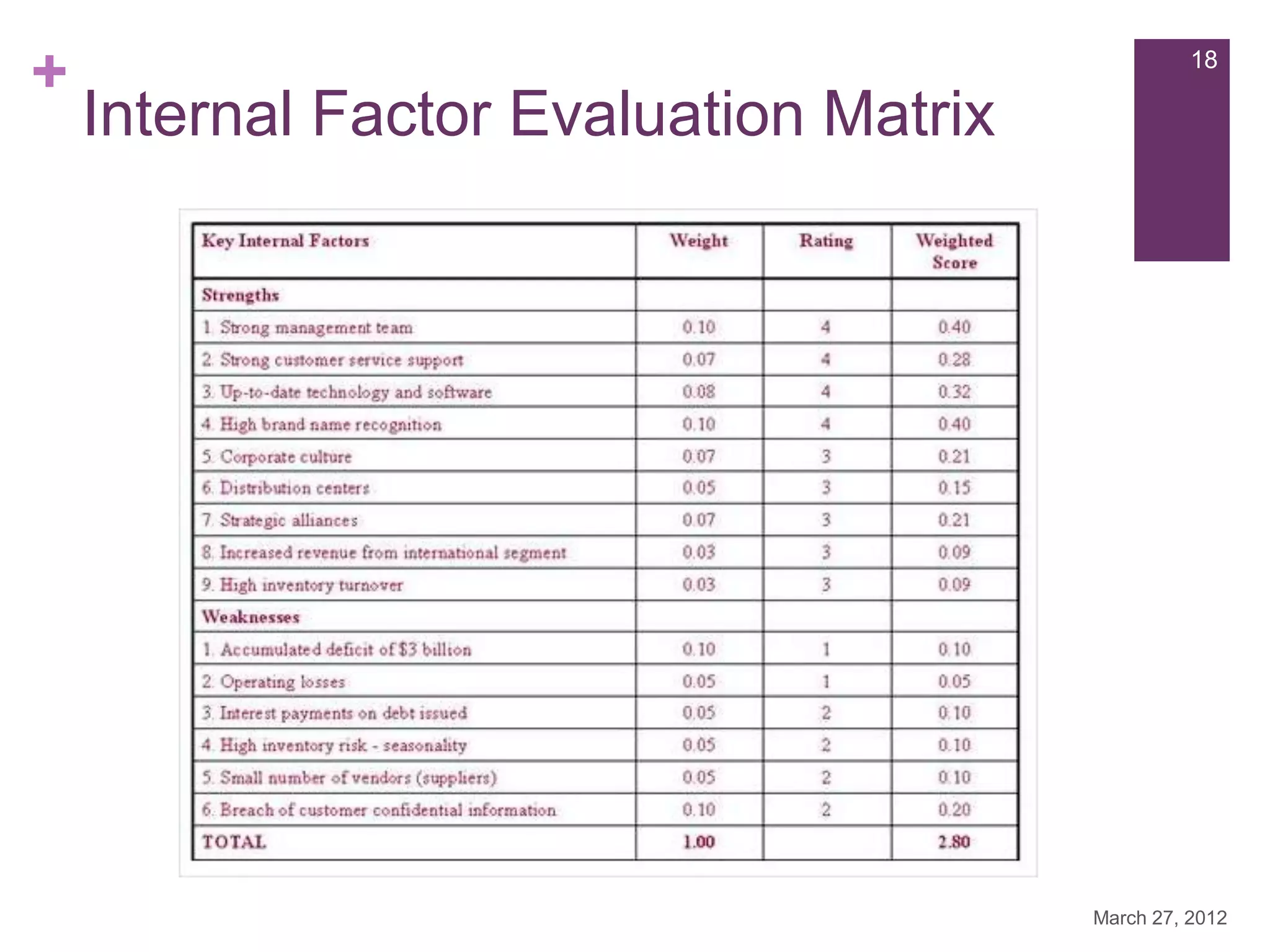
    Internal Factor Evaluation Matrix


                                        March 27, 2012
Hardy Alexander
 Founder & Director | Triune Global
 Bangalore – 560077
 Contact: +91 96864 48698
 Email: halexander@triuneglobal.com
 My Blog: dayscore.wordpress.com
                     +


Thank you
    March 27, 2012                    19

Ch4 Internal Assessment: Strategic Management

  • 1.
    + Ch 4: The Internal Assessment
  • 2.
    + 2 Strategic Management Model Perform External Audit Develop Generate, Implement Implement Establish Measure * Mission & Evaluate & Strategies Strategies – Long-Term Evaluate Vision Select Mgmnt Functional Objectives Performance Statement Strategies Issues Issues Perform Internal Audit March 27, 2012
  • 3.
    + 3 How to Conduct External Strategic Management Audit? Gather Assimilate Evaluate Competitive Information Information Intelligence Internal factors considered Benefits of Internal Audit should be: process: 1. Important to achieving long- • Opportunity for employees to term and annual objectives understand impact of their roles 2. Measurable • Employees perform better 3. Applicable to all competing when they understand the firms impact of their roles 4. Hierarchical; pertaining to • Provides forum for improved overall company and functional communication March 27, 2012
  • 4.
    + 4 Internal Assessment: Resource- Based View (RBV) Organizational performance will primarily be determined by internal resources, grouped into 3 broad categories: Physical | Human | Organization  Physical Resources: Plant & Equipment | Location | Technology | Raw Materials | Machines  Human Resources: Employees | Training | Experience  Organizational Resources: Firm Structure | Planning Process | Information Systems | Patents | Copyrights March 27, 2012
  • 5.
    + #1: Does Culture impact Organizational Strategy? March 27, 2012 5
  • 6.
    + 6 Benefits of a Vibrant & Alive Culture  Focus: Aligns the entire company towards achieving its vision, mission, and goals.  Motivation: Builds higher employee motivation and loyalty.  Connection: Builds team cohesiveness among the company’s various departments and divisions.  Cohesion: Builds consistency and encourages coordination and control within the company.  Spirit: Shapes employee behavior at work, enabling the organization to be more efficient and alive. March 27, 2012
  • 7.
    + 7 #2: Functions of Management (1/2)  Planning (preparing for future): Forecasting, establishing objectives, devising strategies, developing policies, and setting goals  Organizing (structure of task & authority relationships): Organizational design, job specification, job description, span of control, job analysis  Motivating (shaping human behavior): Leadership, behavior modification, delegation of authority, job enrichment, employee morale, job satisfaction  Staffing (human resource management): Wage & salary administration, employee benefits, hiring, training, career development March 27, 2012
  • 8.
    + 8 #2: Functions of Management (2/2)  Controlling (performance against plan): Quality control, financial control, sales, inventory, analysis of variance, rewards & sanctions Management Audit Checklist of Questions 1. Firm uses strategic-management concepts 2. Company objectives & goals measureable & well communicated 3. Managers at all levels plan effectively 4. Managers delegate authority 5. Organization’s structure is appropriate 6. Job descriptions & job specifications are clear 7. Employee morale is high 8. Employee absenteeism & turnover is low 9. Organizational rewards & control mechanisms effective March 27, 2012
  • 9.
    + 9 #3: Marketing Selling Product & Service Customer Analysis Products/Services Planning Marketing Pricing Distribution Research Opportunity Analysis March 27, 2012
  • 10.
    + 10 #3: Marketing Audit Checklist of Questions 1. Markets segmented 7. Product quality & customer effectively service is good 2. Organization positioned well 8. Firms products & services among competitors are priced appropriately 3. Firm’s market share has 9. Effective promotion, been increasing advertising, & publicity strategy 4. Present channels of distribution reliable & cost- 10. Marketing Managers have effective adequate experience & training 5. Effective sales organization 6. Firm conducts market research March 27, 2012
  • 11.
    + 11 #4: Finance / Accounting Liquidity Leverage Activity Ratio Ratio Ratio Profitability Growth Ratio Ratio 1. How has each ratio changed over time? 2. How does each ratio compare to industry norms? 3. How does each ratio compare with key competitors? March 27, 2012
  • 12.
    + 12 #4: Finance / Accounting Audit Checklist 1. Financial Strengths & Weaknesses indicated by financial ratio analysis 2. Firm can raise needed short-term capital 3. Firm can raise long-term capital through debt and/or equity 4. Firm has sufficient working capital 5. Capital budgeting procedures are effective 6. Dividend payout policies reasonable 7. Firm has good relations with investors & stockholders 8. Firm’s financial managers experienced & well-trained March 27, 2012
  • 13.
    + 13 #5: Production / Operations  Process (design of the production system): Choice of technology, facility layout / location, process flow analysis  Capacity (optimal output levels): Forecasting, scheduling, capacity planning  Inventory (levels of raw materials, WIP, finished goods): What to order, When to order, how much to order, materials handling  Workforce (managing skilled, un-skilled labor): Job design, motivation techniques, work measurement  Quality (aim is to produce high-quality goods/services): Quality control, sampling, testing, quality assurance March 27, 2012
  • 14.
    + 14 #5: Implication of Different Production / Operations Strategies Stress Low Cost High Quality Customer Provider Provider Service Introduce Vertical Centralized New Integration Processing Products Decentralized Use of Stability of Processing Automation Employment March 27, 2012
  • 15.
    + 15 #5: Production / Operations Audit Checklist 1. Are supplies of raw materials and parts reliable & reasonable? 2. Are facilities, equipment, machinery, and offices in good condition? 3. Are inventory-control policies & procedures effective? 4. Are quality-control policies & procedures effective? 5. Are facilities, resources, and markets strategically located? 6. Does the firm have technological competencies? March 27, 2012
  • 16.
    + 16 Value Chain Analysis Total revenues minus total costs of all activities undertaken to develop and market a product or service yields value. March 27, 2012
  • 17.
    + 17 Translating Performance into Competitive Advantage Company Competencies & Proficiency Rises Performs Capabilities to Level of Core Activities Emerge Competence Core Competency Gains basis for Evolves into Sustainable Distinctive Competitive Competence Advantage March 27, 2012
  • 18.
    + 18 Internal Factor Evaluation Matrix March 27, 2012
  • 19.
    Hardy Alexander Founder& Director | Triune Global Bangalore – 560077 Contact: +91 96864 48698 Email: halexander@triuneglobal.com My Blog: dayscore.wordpress.com + Thank you March 27, 2012 19