Chapter 3  The External Assessment Strategic Management:  Concepts & Cases 10 th  Edition Fred David PowerPoint Slides by Anthony F. Chelte Western New England College
Chapter Outline The Nature of the External Audit The Industrial Organization (I/O) View Social, Cultural, Demographic &  Environmental  Forces
Chapter Outline ( cont’d ) Political, Governmental, and Legal Forces Technological Forces Competitive Forces
Chapter Outline ( cont’d ) Porter’s Five-Forces Model Sources of External Information Forecasting Tools & Techniques
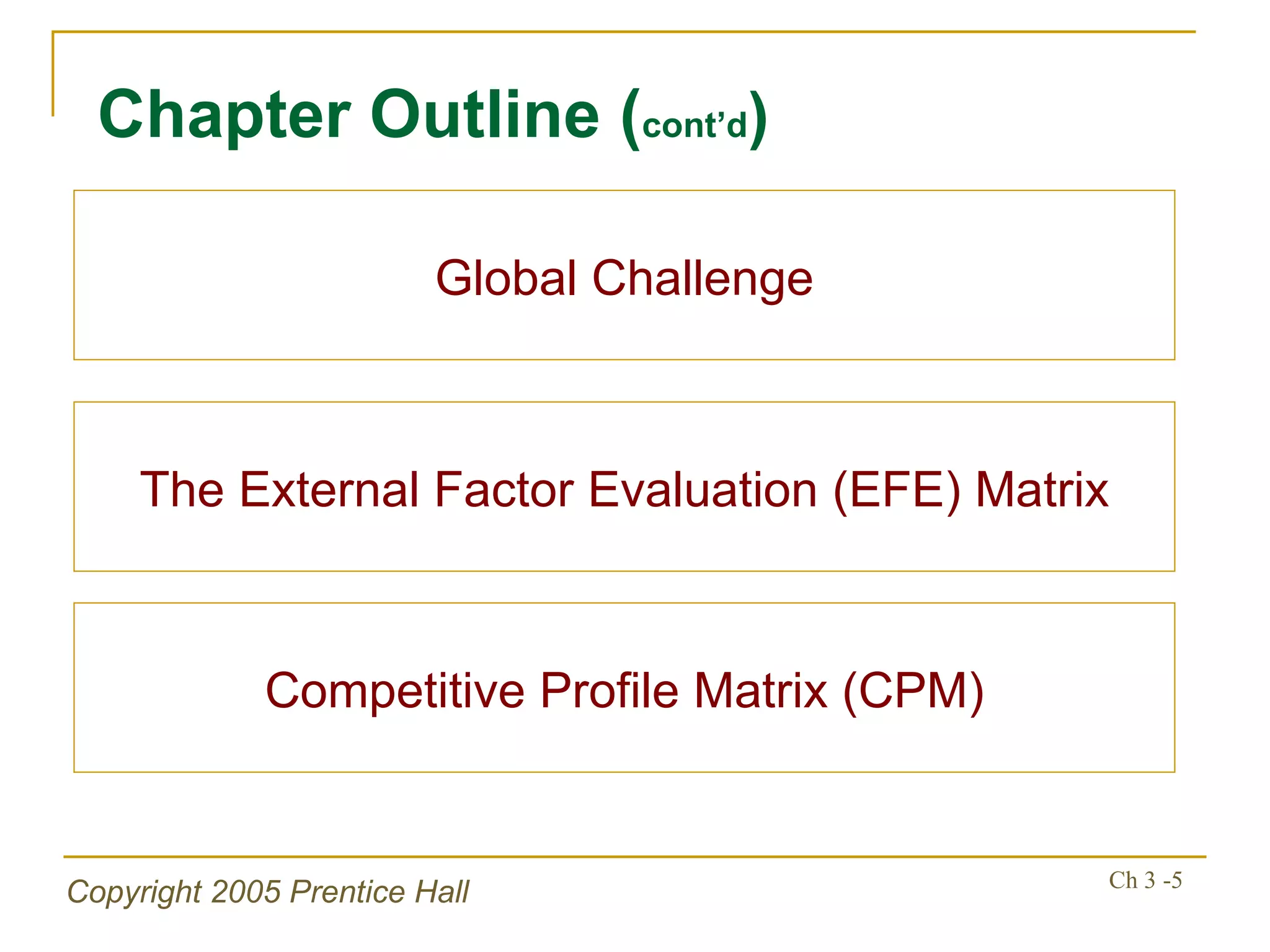
Chapter Outline ( cont’d ) Global Challenge The External Factor Evaluation (EFE) Matrix Competitive Profile Matrix (CPM)
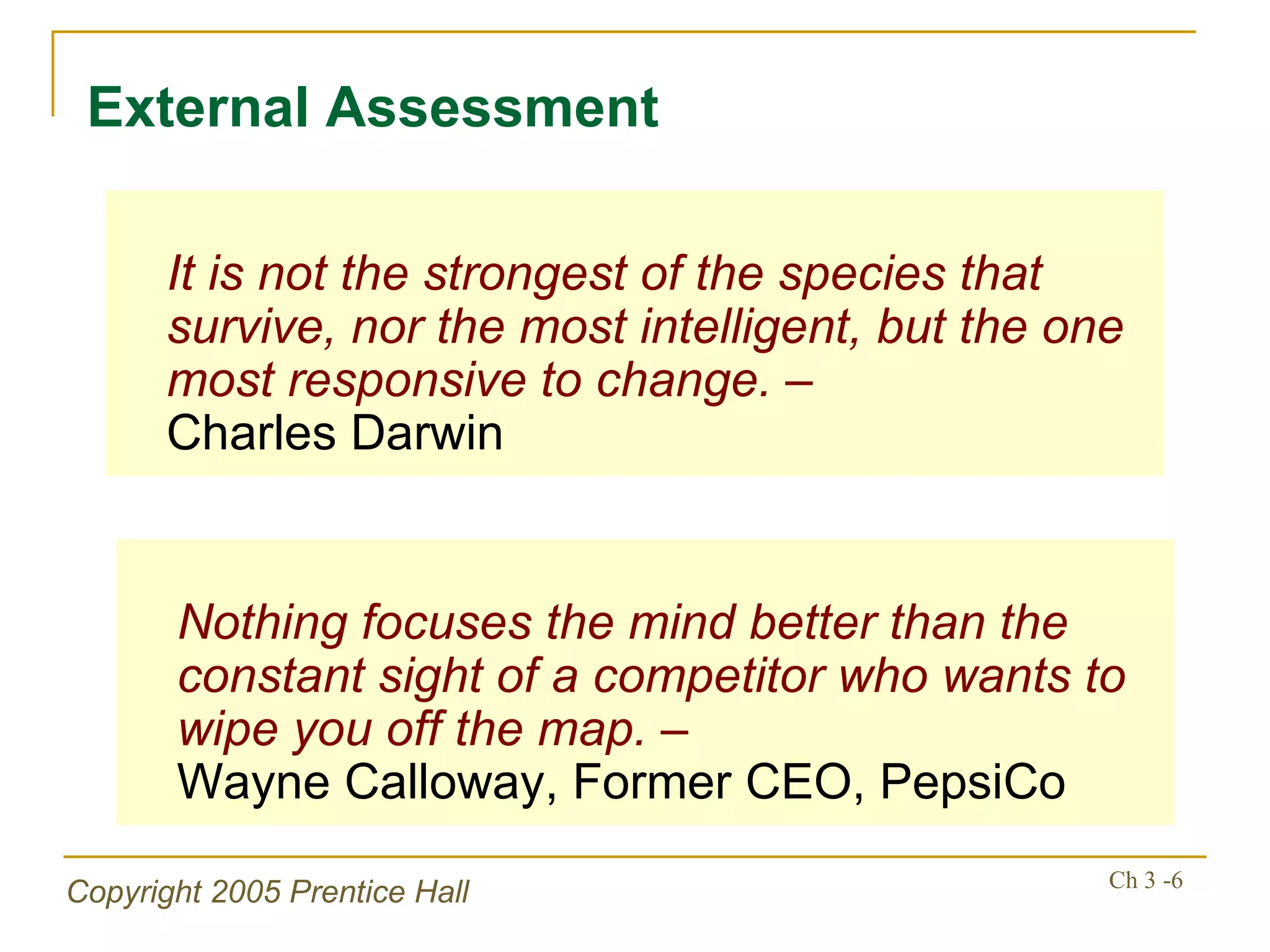
It is not the strongest of the species that survive, nor the most intelligent, but the one most responsive to change. – Charles Darwin External Assessment Nothing focuses the mind better than the constant sight of a competitor who wants to wipe you off the map. –  Wayne Calloway, Former CEO, PepsiCo
-- Environmental Scanning -- Industry Analysis External Strategic Management Audit
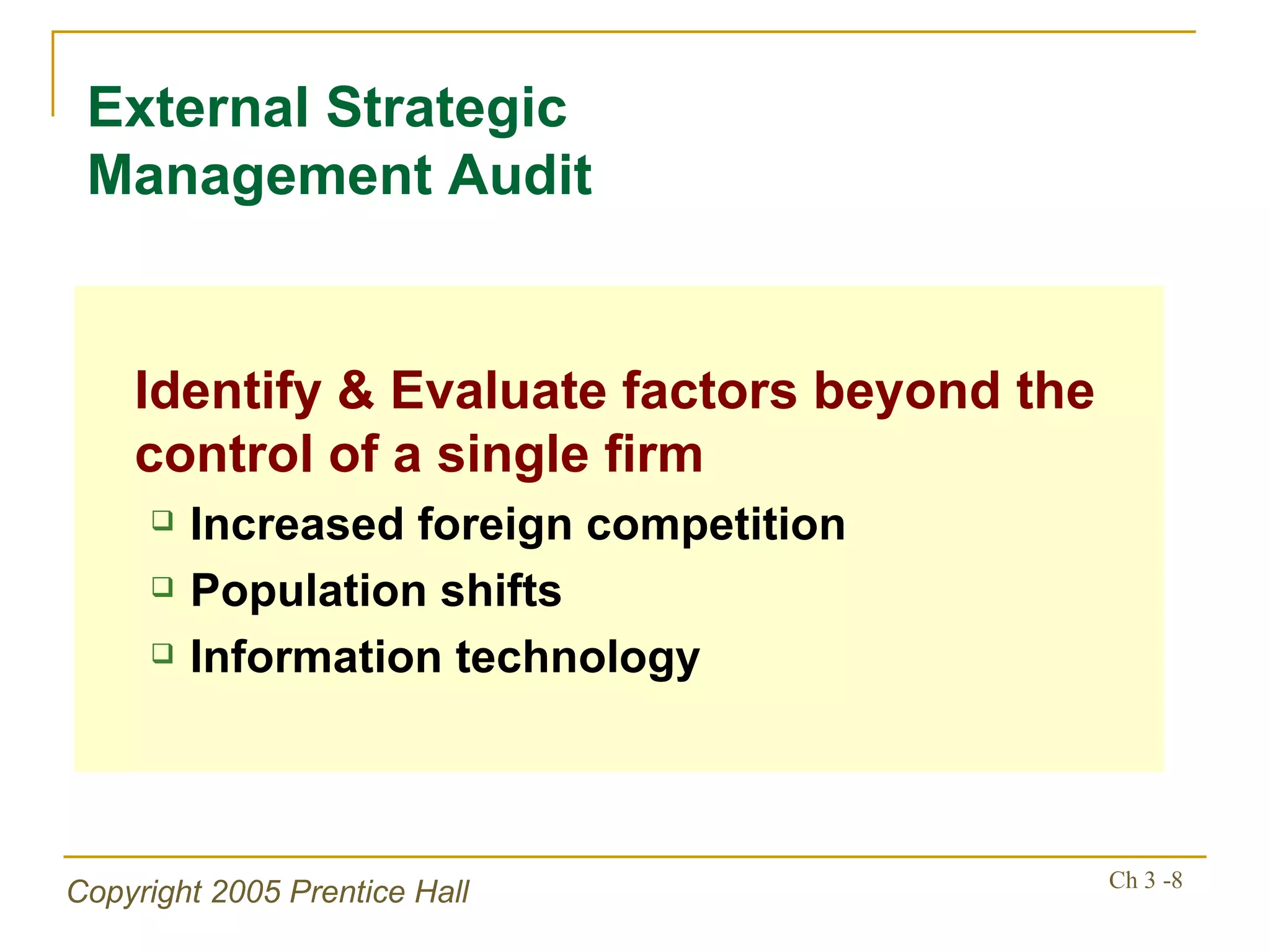
Identify & Evaluate factors beyond the control of a single firm Increased foreign competition Population shifts Information technology External Strategic Management Audit
Purpose of External Audit Identify Opportunities Threats External Strategic Management Audit
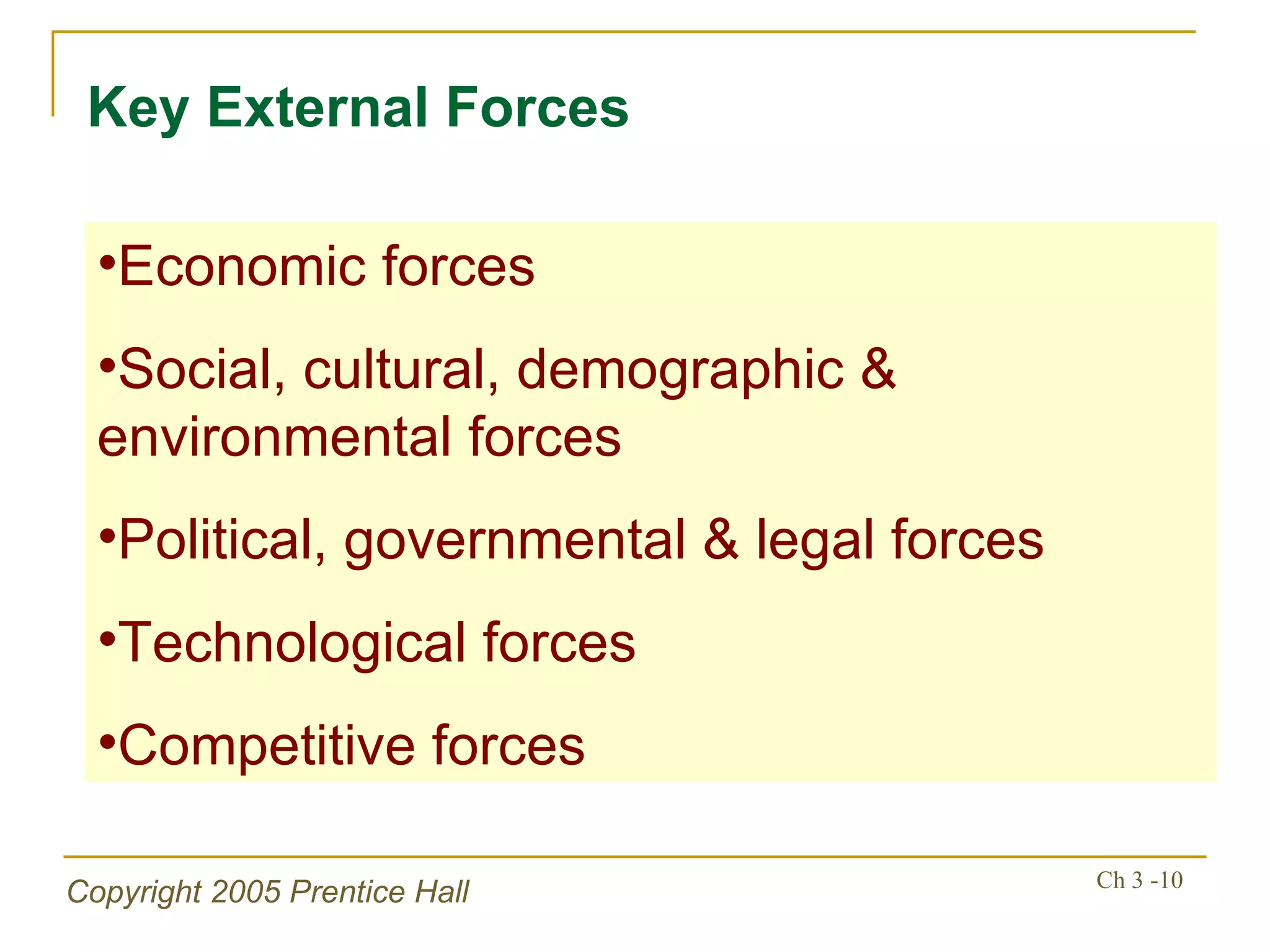
Key External Forces Economic forces Social, cultural, demographic & environmental forces Political, governmental & legal forces Technological forces Competitive forces
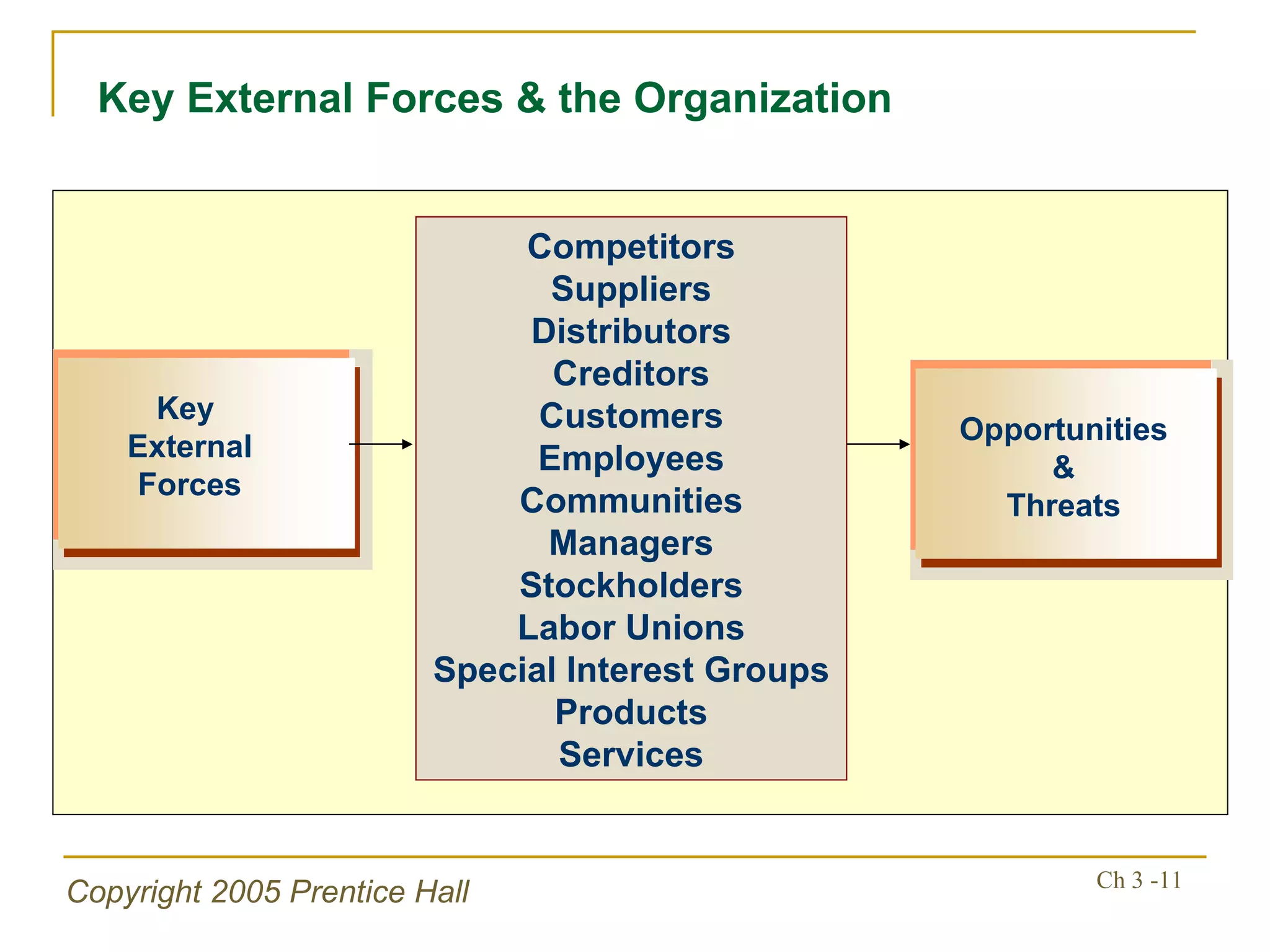
Competitors Suppliers Distributors Creditors Customers Employees Communities Managers Stockholders Labor Unions Special Interest Groups Products Services Key External Forces Opportunities & Threats Key External Forces & the Organization
Gather competitive intelligence – Social Cultural Demographic Environmental Economic Political, legal governmental  Technological External Audit
External Audit – Sources of Information Internet Libraries Suppliers Distributors Customers Competition
-- Key Factors Vary over time Vary by industry Performing External Audit
Performing External Audit -- Variables Market share Breadth of competing products World economies Foreign affiliates Proprietary account advantages
Performing External Audit -- Variables Price competitiveness Technological advancements Interest rates Pollution abatement
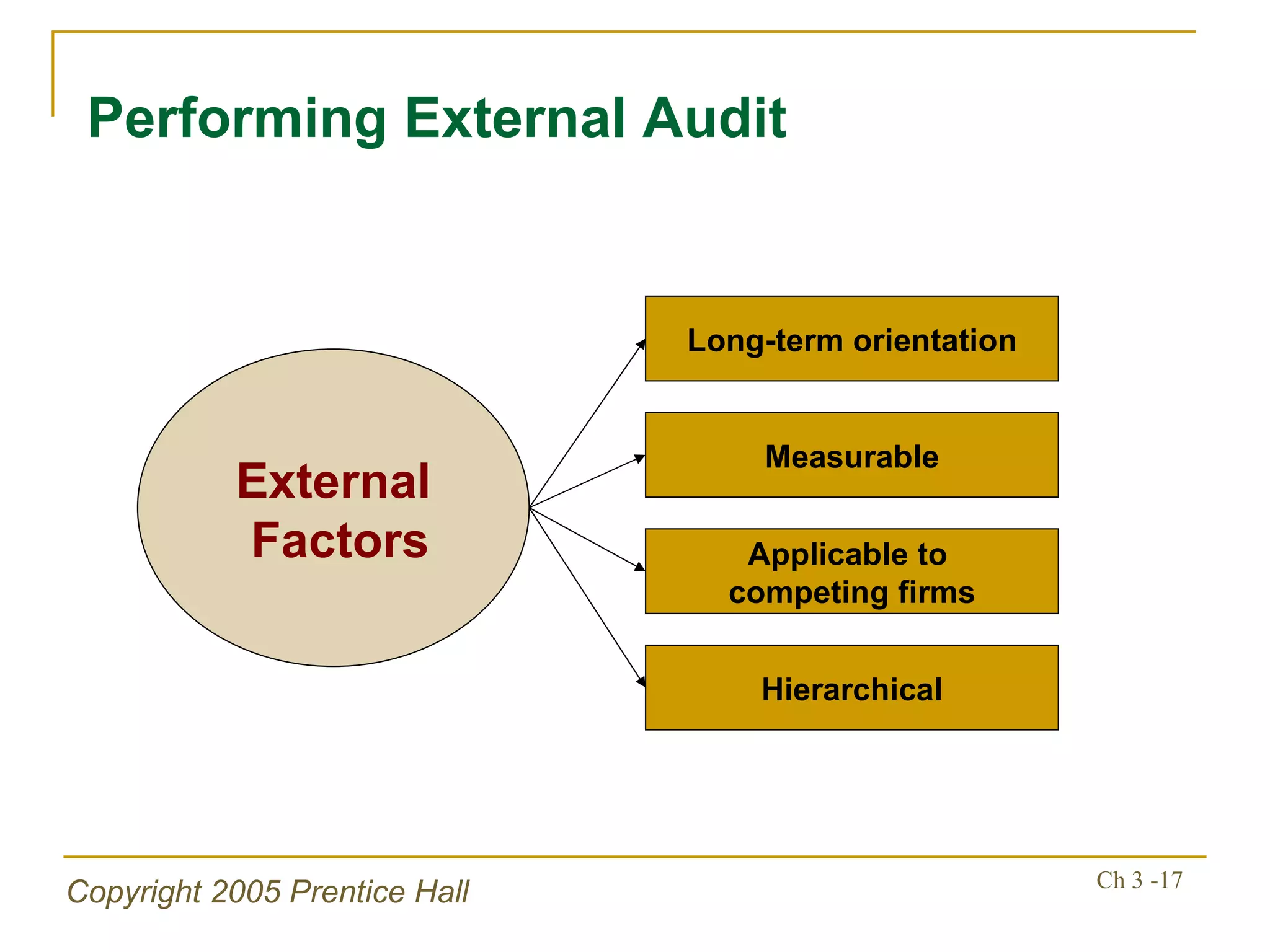
Performing External Audit External  Factors Measurable Long-term orientation Applicable to  competing firms Hierarchical
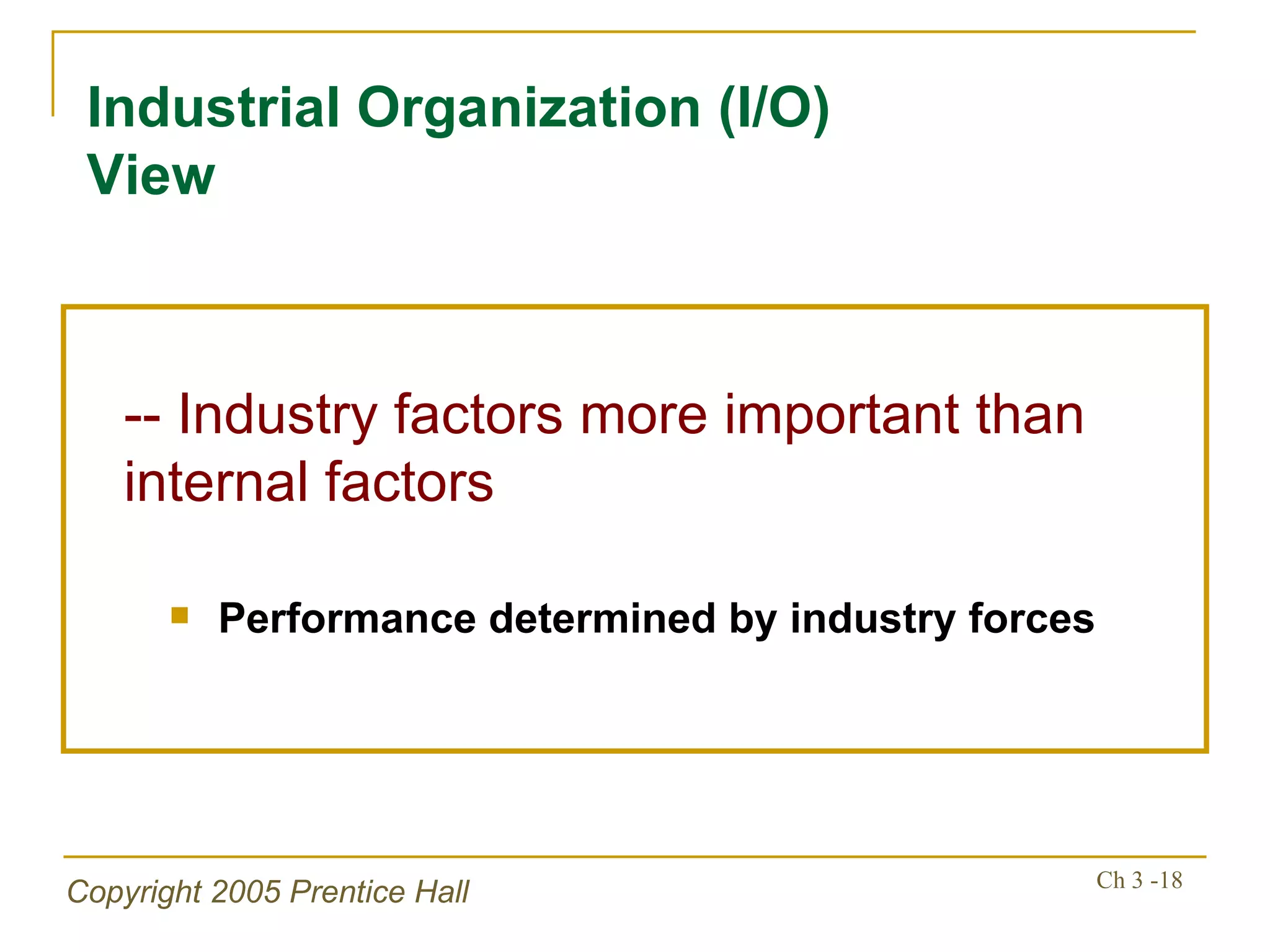
Industrial Organization (I/O) View -- Industry factors more important than internal factors Performance determined by industry forces
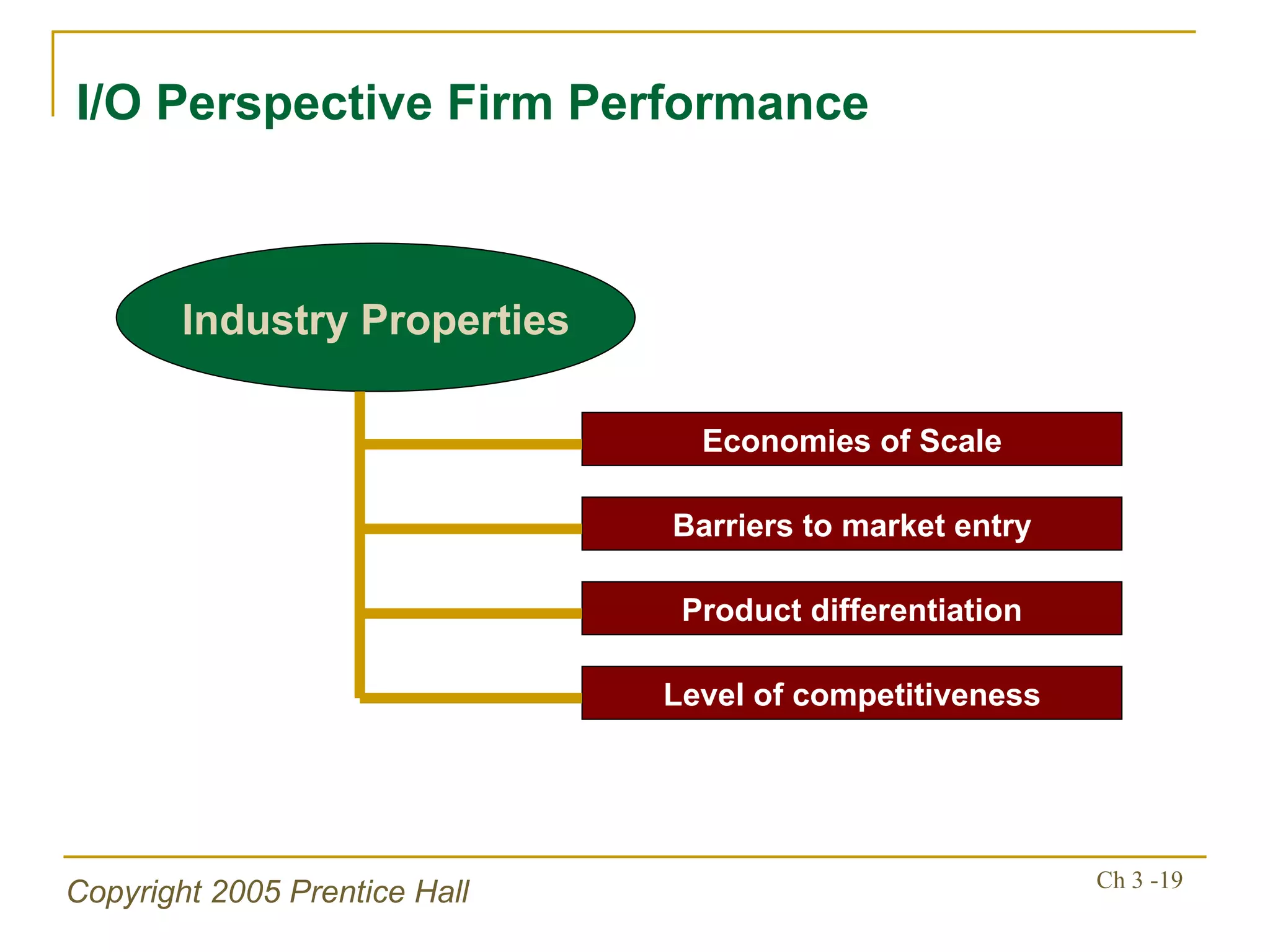
Economies of Scale Industry Properties Barriers to market entry Product differentiation Level of competitiveness I/O Perspective Firm Performance
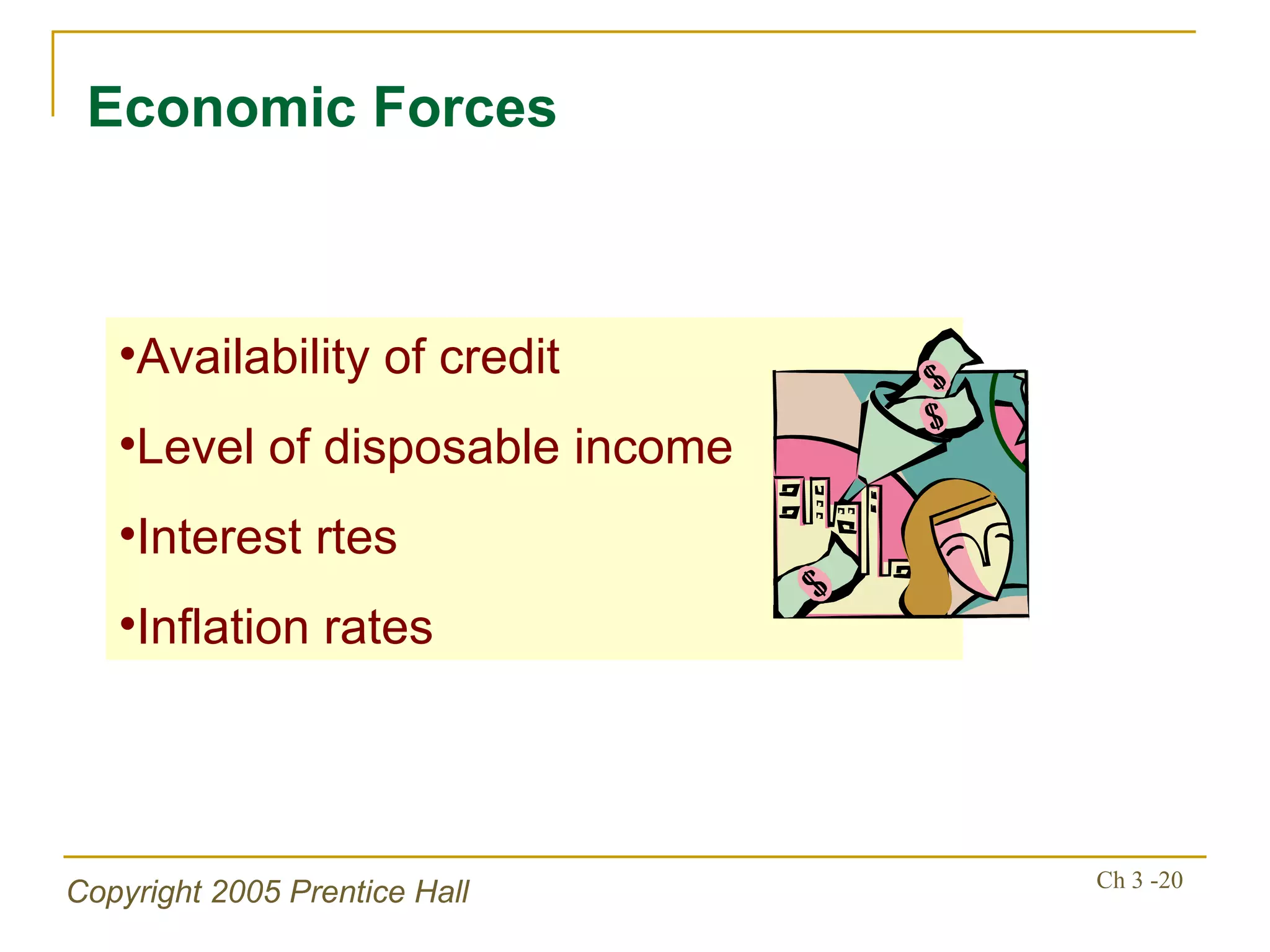
Economic Forces Availability of credit Level of disposable income Interest rtes Inflation rates
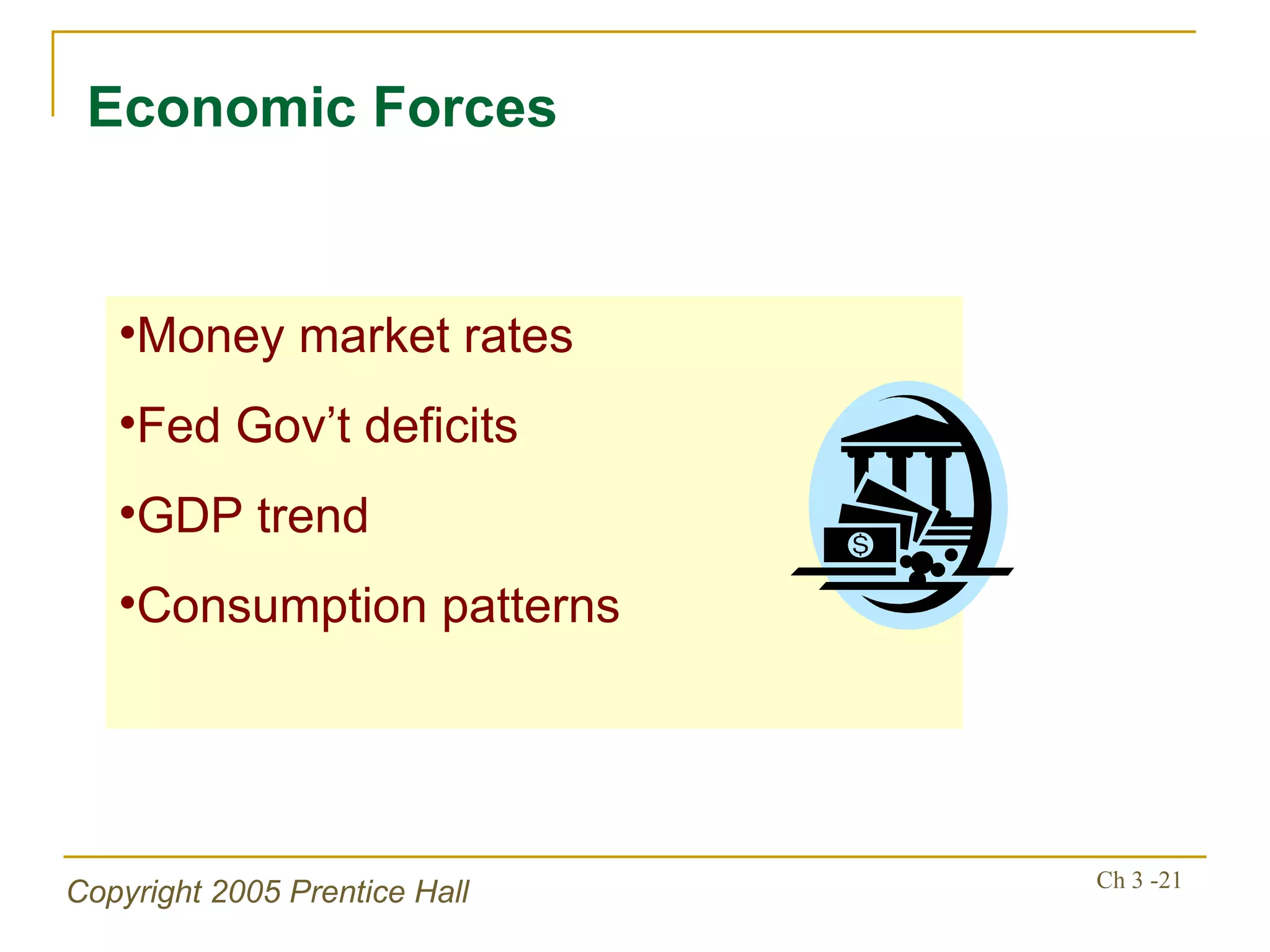
Economic Forces Money market rates Fed Gov’t deficits GDP trend Consumption patterns
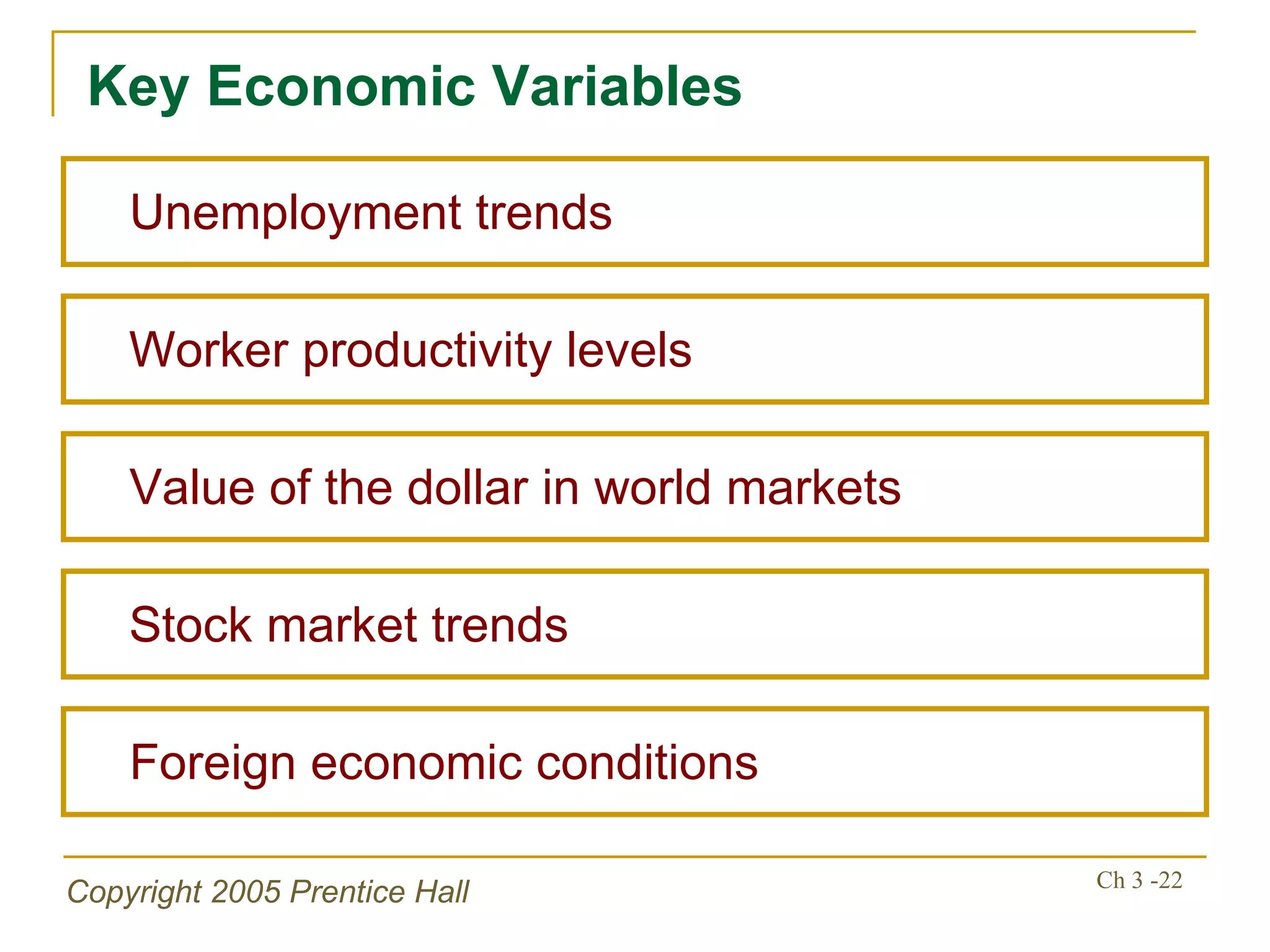
Key Economic Variables Value of the dollar in world markets Worker productivity levels Stock market trends Foreign economic conditions Unemployment trends
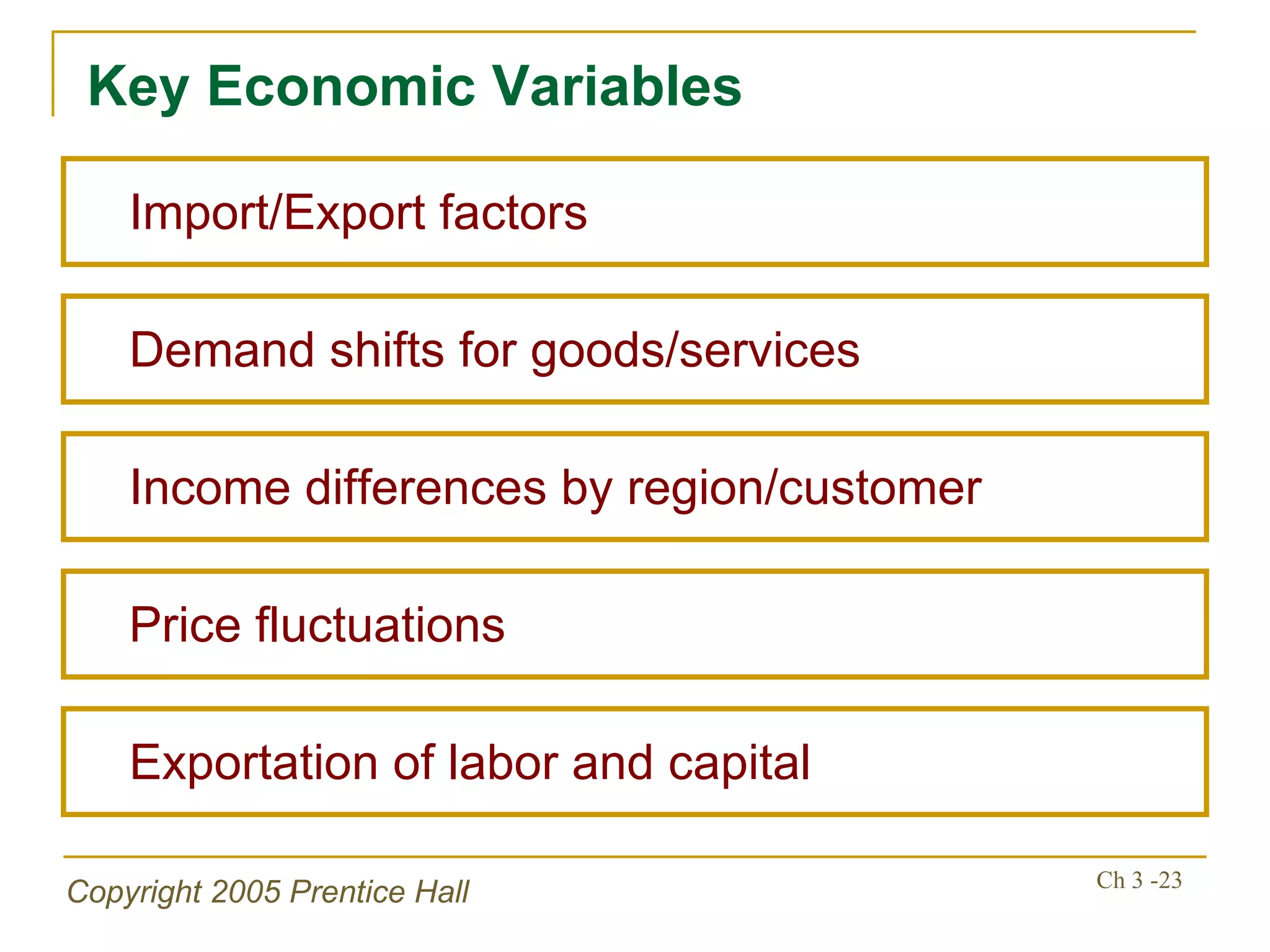
Key Economic Variables Income differences by region/customer Demand shifts for goods/services Price fluctuations Exportation of labor and capital Import/Export factors
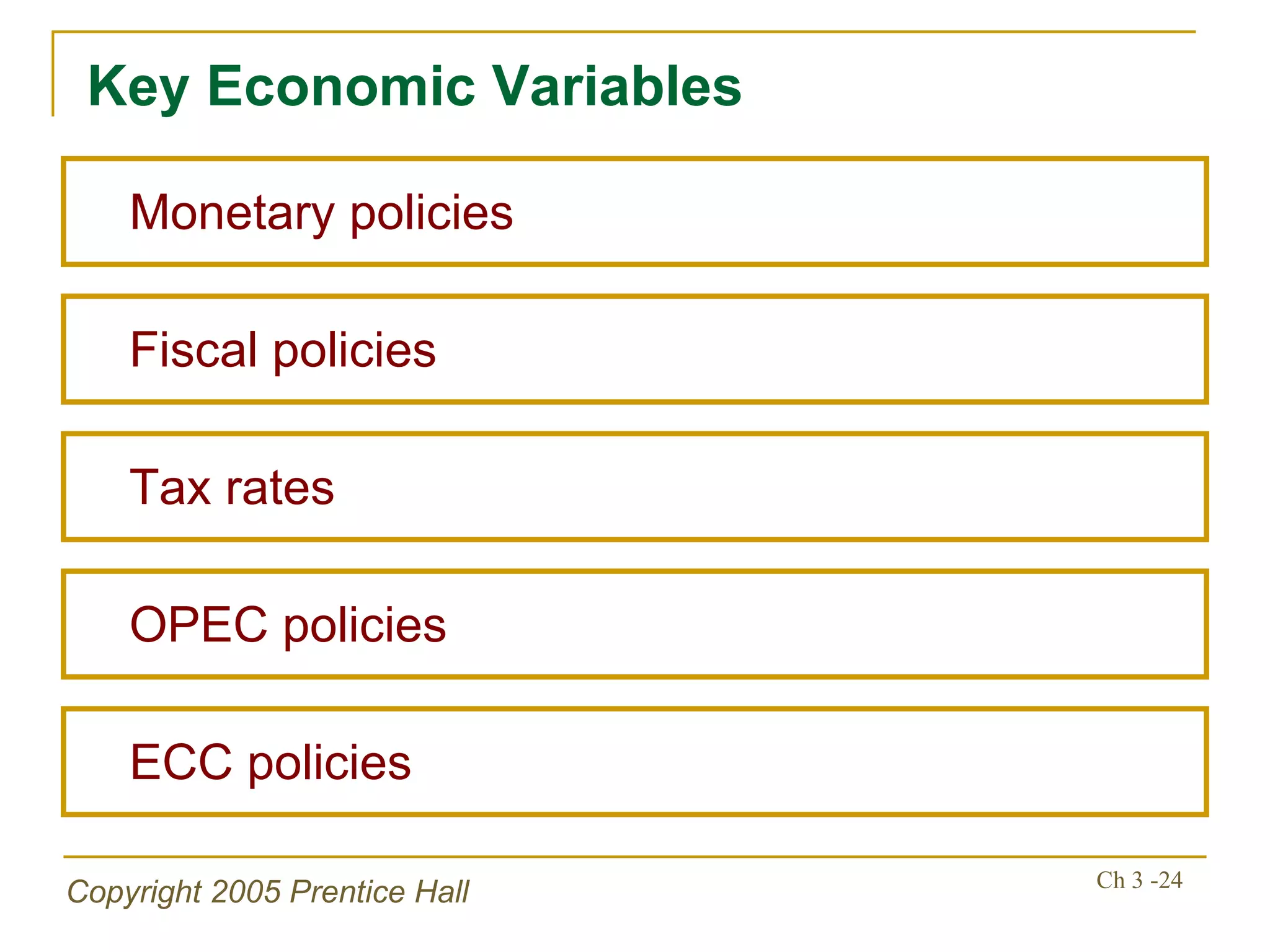
Key Economic Variables Tax rates Fiscal policies OPEC policies ECC policies Monetary policies
Social, Cultural, Demographic & Environmental Forces Major Impact – Products Services Markets Customers
Social, Cultural, Demographic & Environmental Forces U.S. Facts Aging population Less Caucasian Widening gap between rich & poor 2025 = 18.5% population >65 years 2075 = no ethnic or racial majority
Social, Cultural, Demographic & Environmental Forces Facts World population > 6 billion U.S. population < 300 million
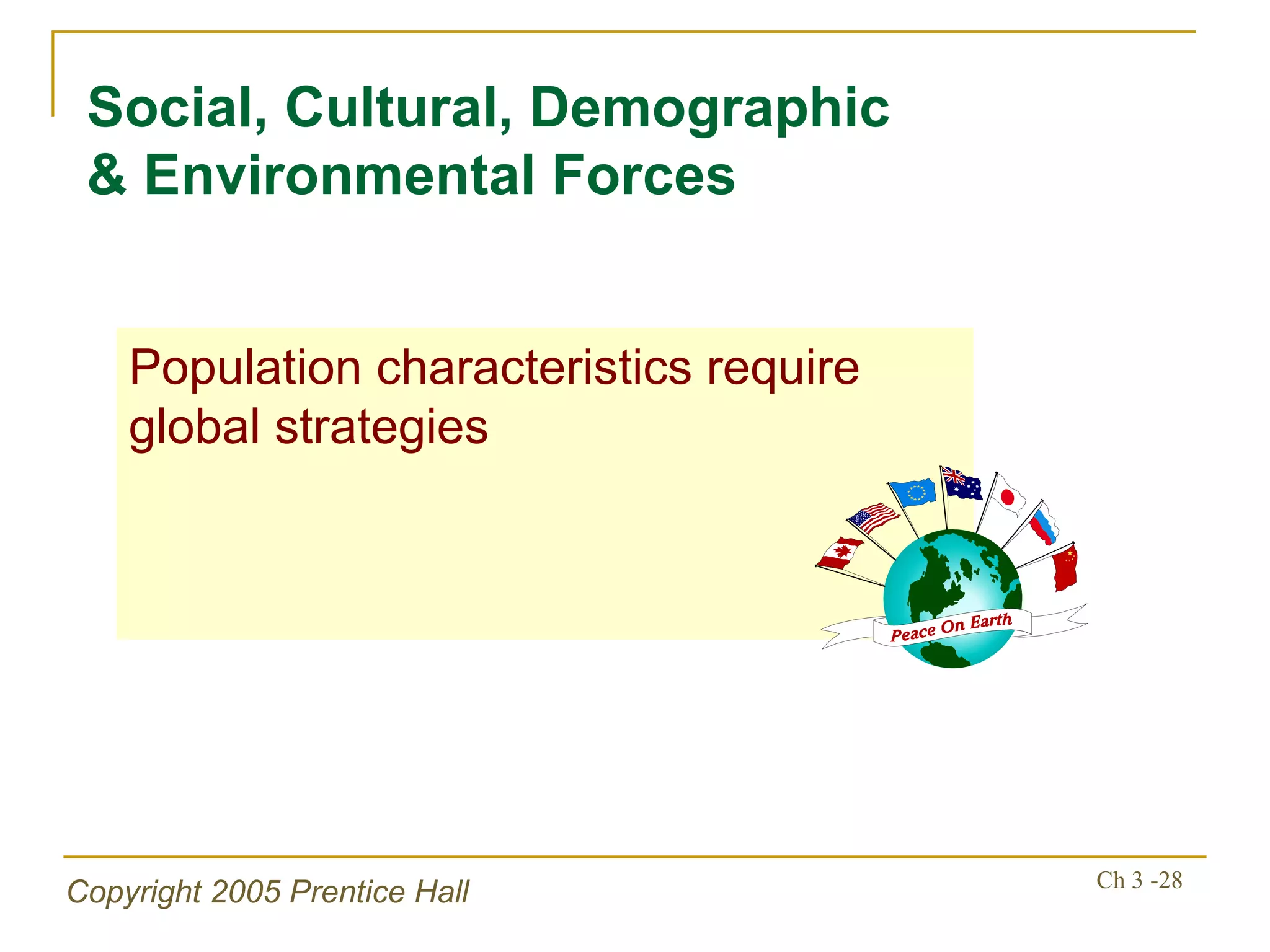
Social, Cultural, Demographic & Environmental Forces Population characteristics require global strategies
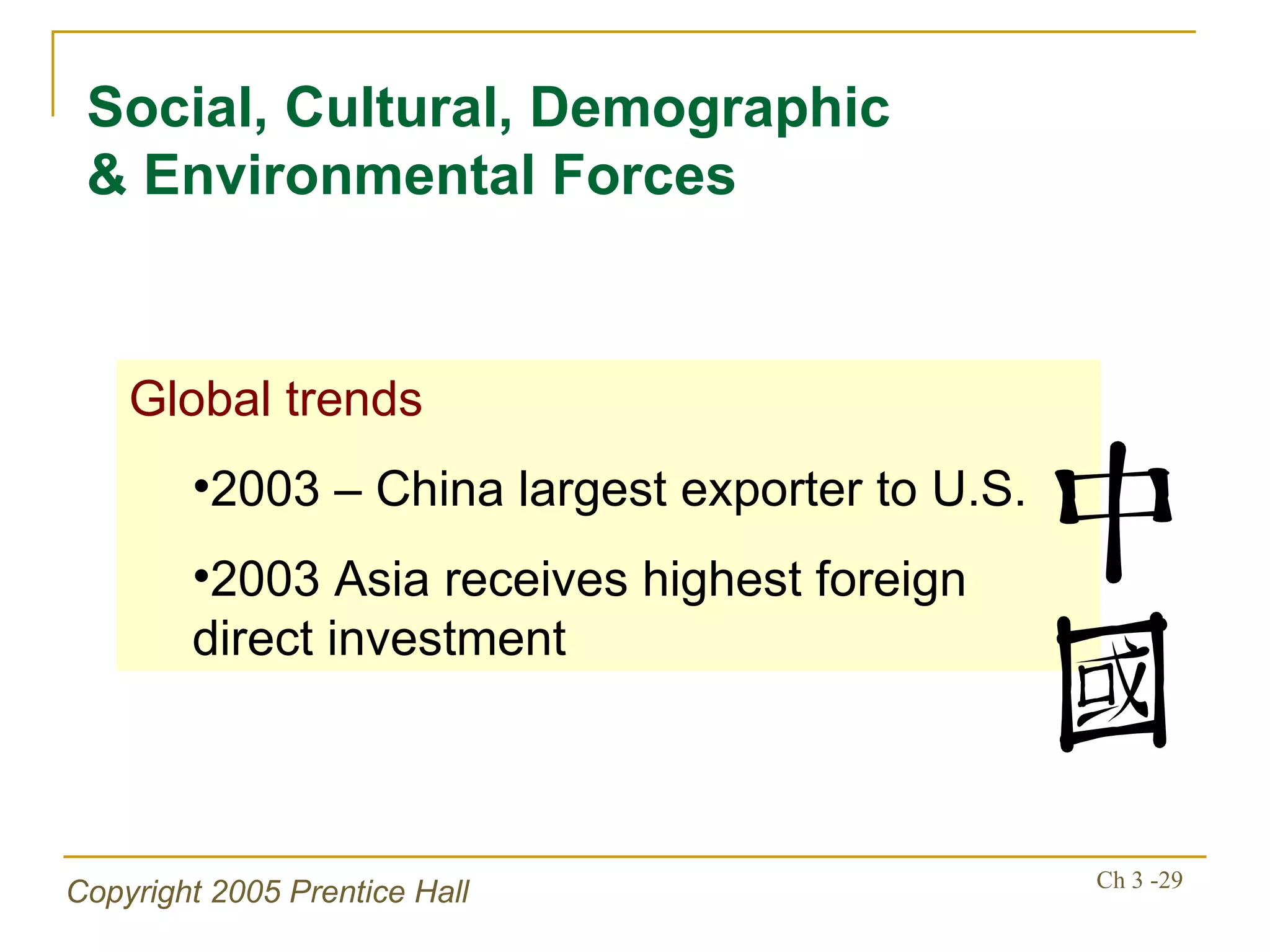
Social, Cultural, Demographic & Environmental Forces Global trends 2003 – China largest exporter to U.S. 2003 Asia receives highest foreign direct investment
Global trends China’s labor rates less than Mexico China provides more site location incentives than Mexico Social, Cultural, Demographic & Environmental Forces
Export Trends Mexico-exports to U.S. 1.2% growth (2002) China-exports to U.S. 19% growth (2002) Social, Cultural, Demographic & Environmental Forces
Export Trends Mexico-corporate income tax rate 34% China-corporate income tax rate 17% Social, Cultural, Demographic & Environmental Forces
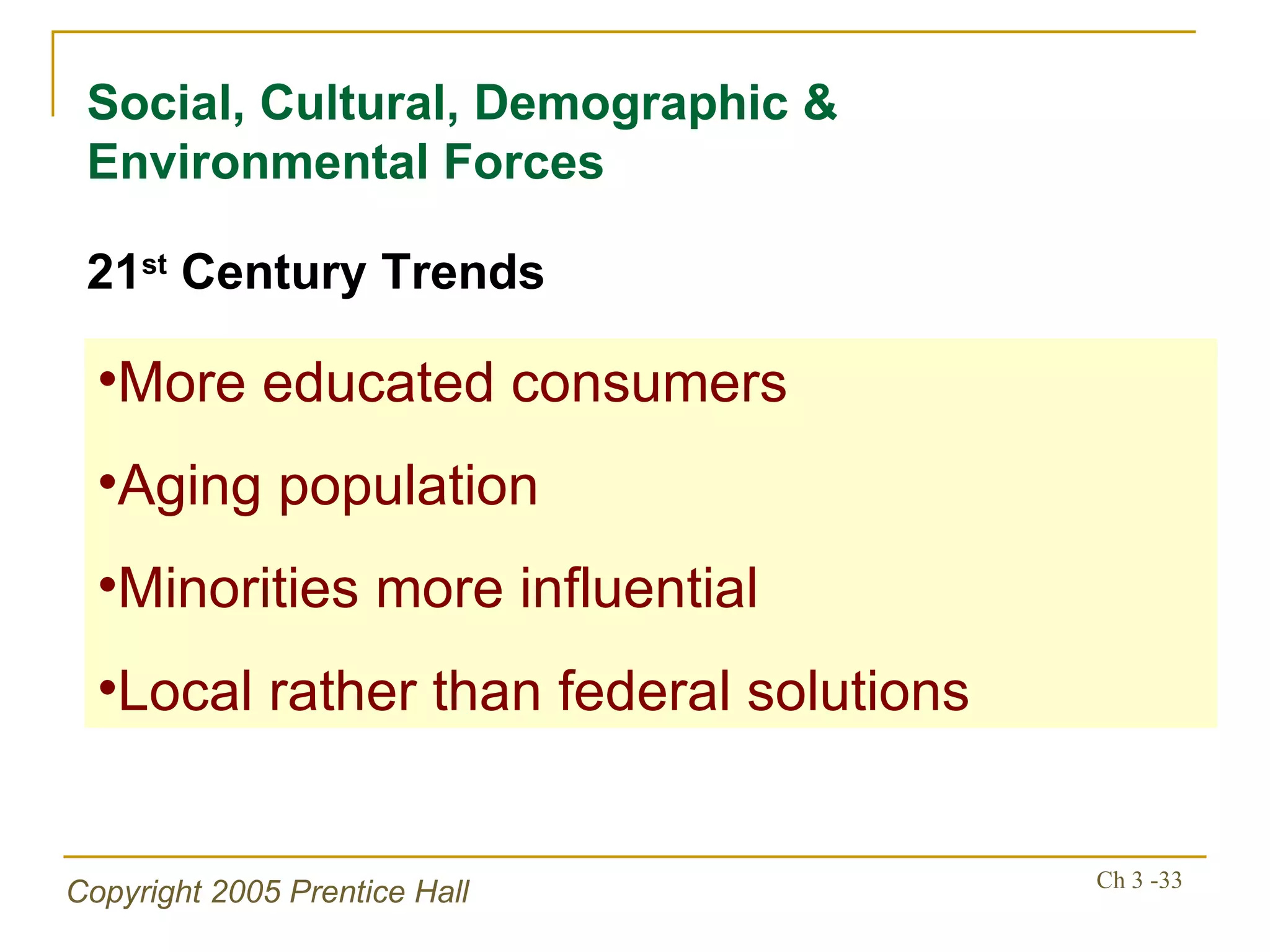
Social, Cultural, Demographic & Environmental Forces More educated consumers Aging population Minorities more influential Local rather than federal solutions 21 st  Century Trends
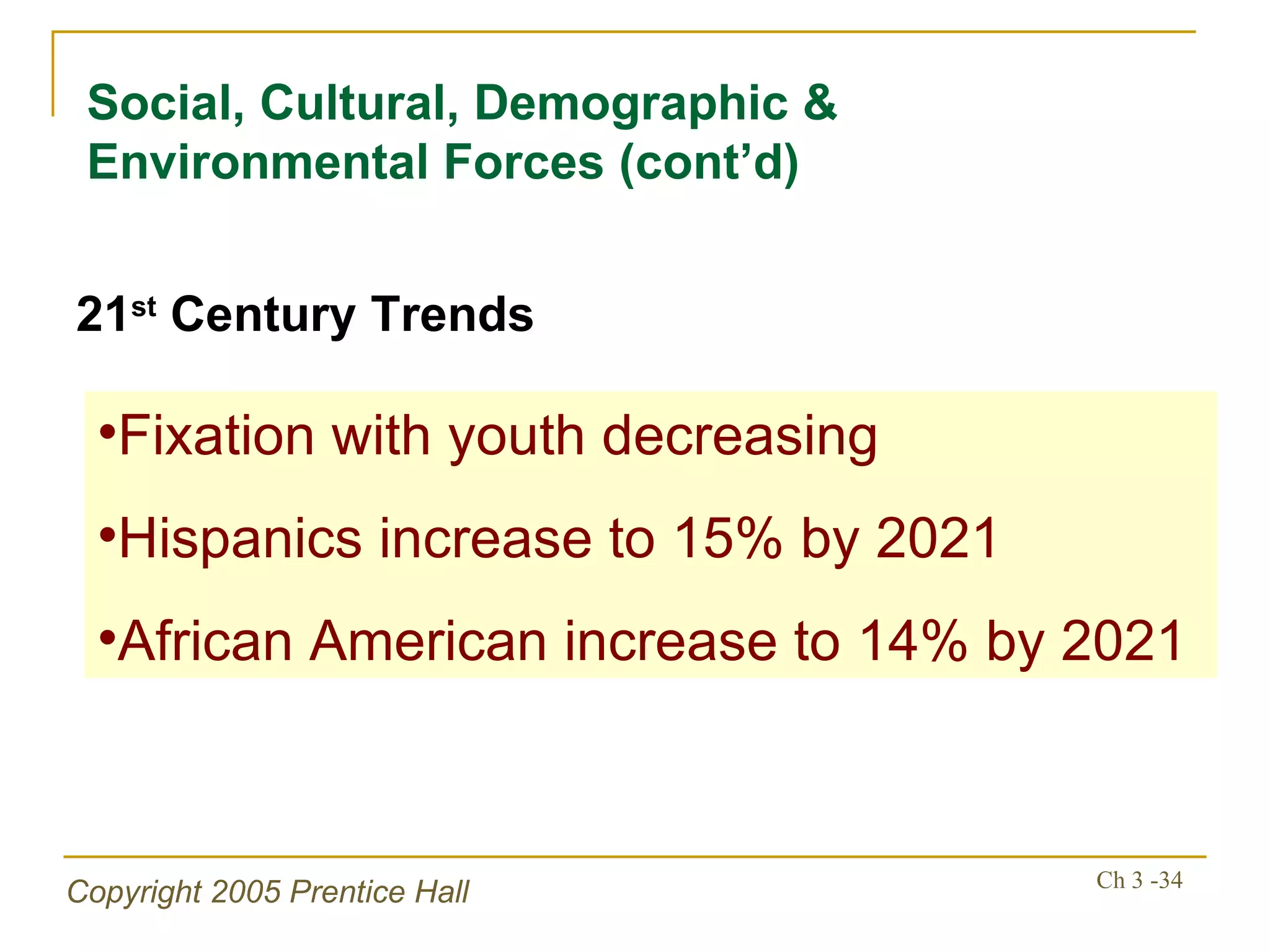
Social, Cultural, Demographic & Environmental Forces (cont’d) Fixation with youth decreasing Hispanics increase to 15% by 2021 African American increase to 14% by 2021 21 st  Century Trends
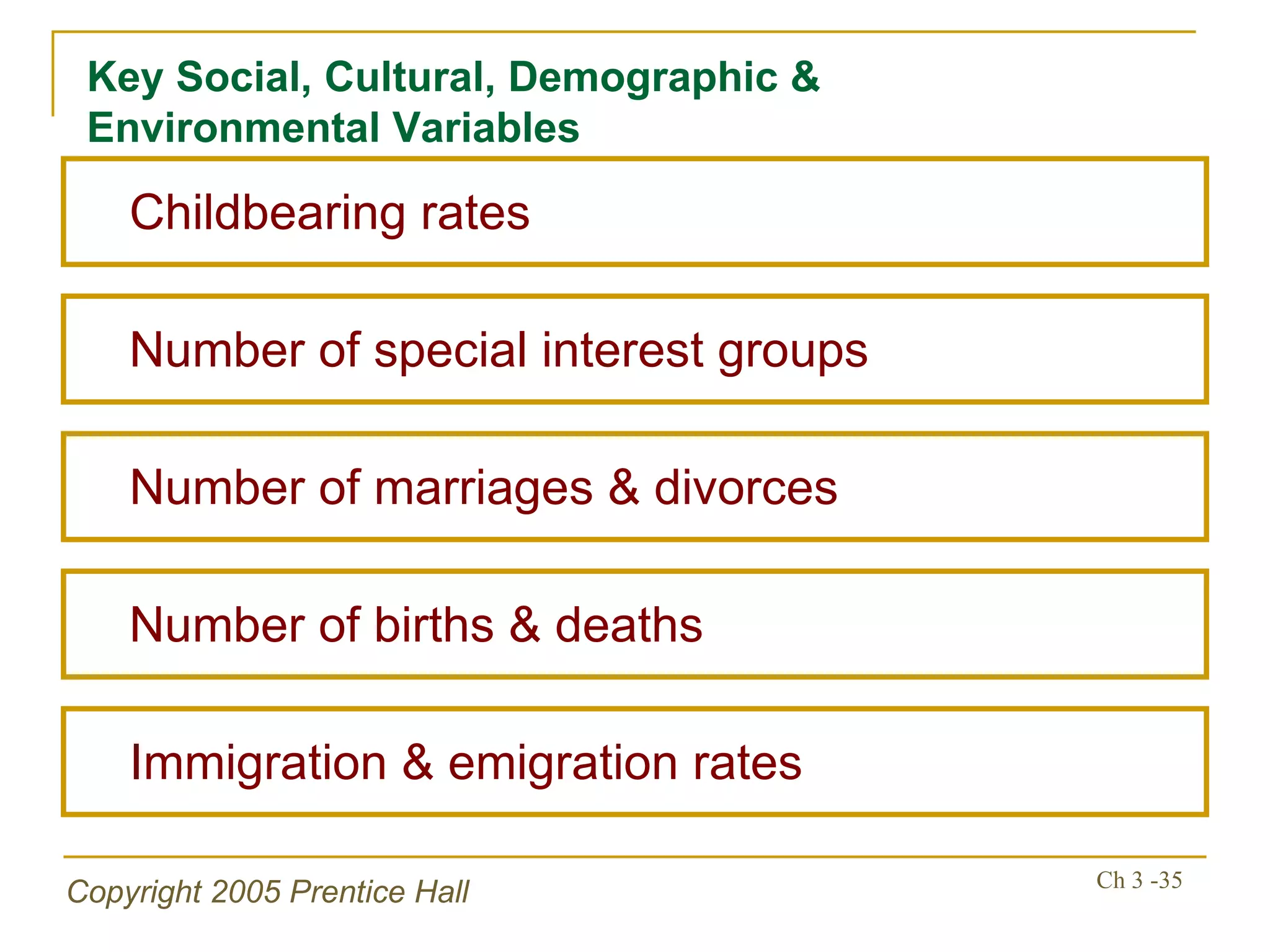
Key Social, Cultural, Demographic & Environmental Variables Number of marriages & divorces Number of special interest groups Number of births & deaths Immigration & emigration rates Childbearing rates
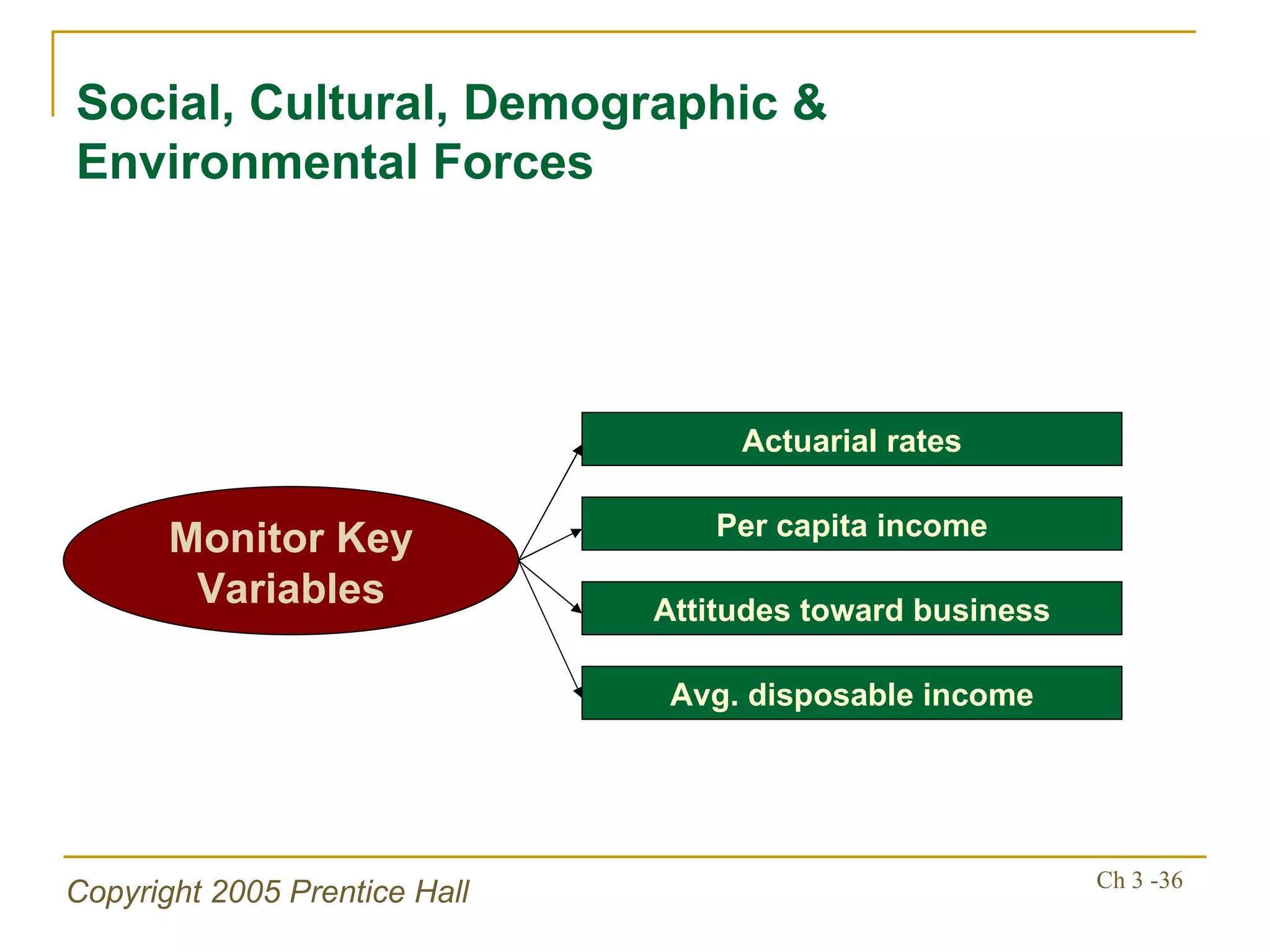
Actuarial rates Monitor Key Variables Per capita income Attitudes toward business Avg. disposable income Social, Cultural, Demographic & Environmental Forces
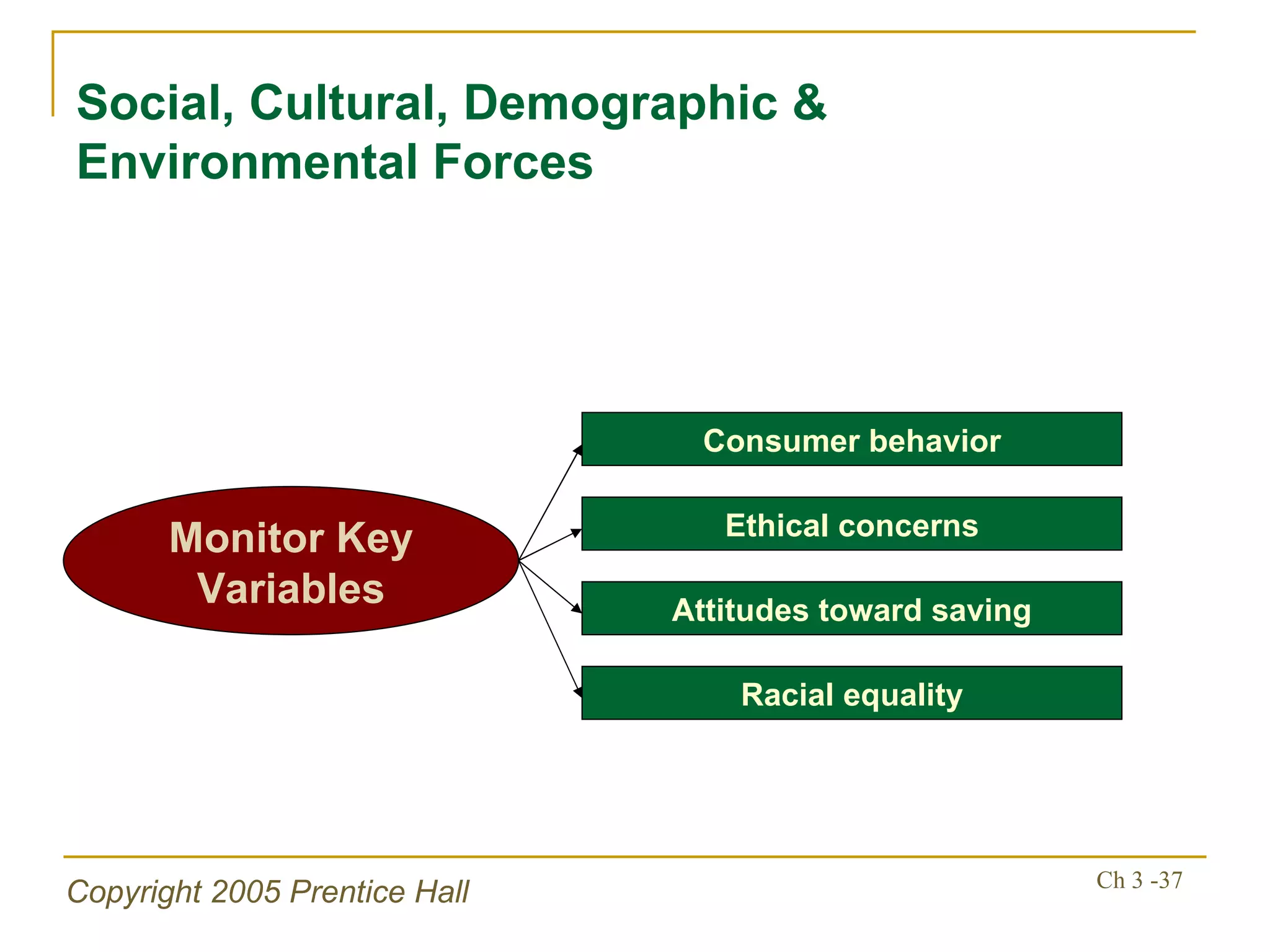
Consumer behavior Monitor Key Variables Ethical concerns Attitudes toward saving Racial equality Social, Cultural, Demographic & Environmental Forces
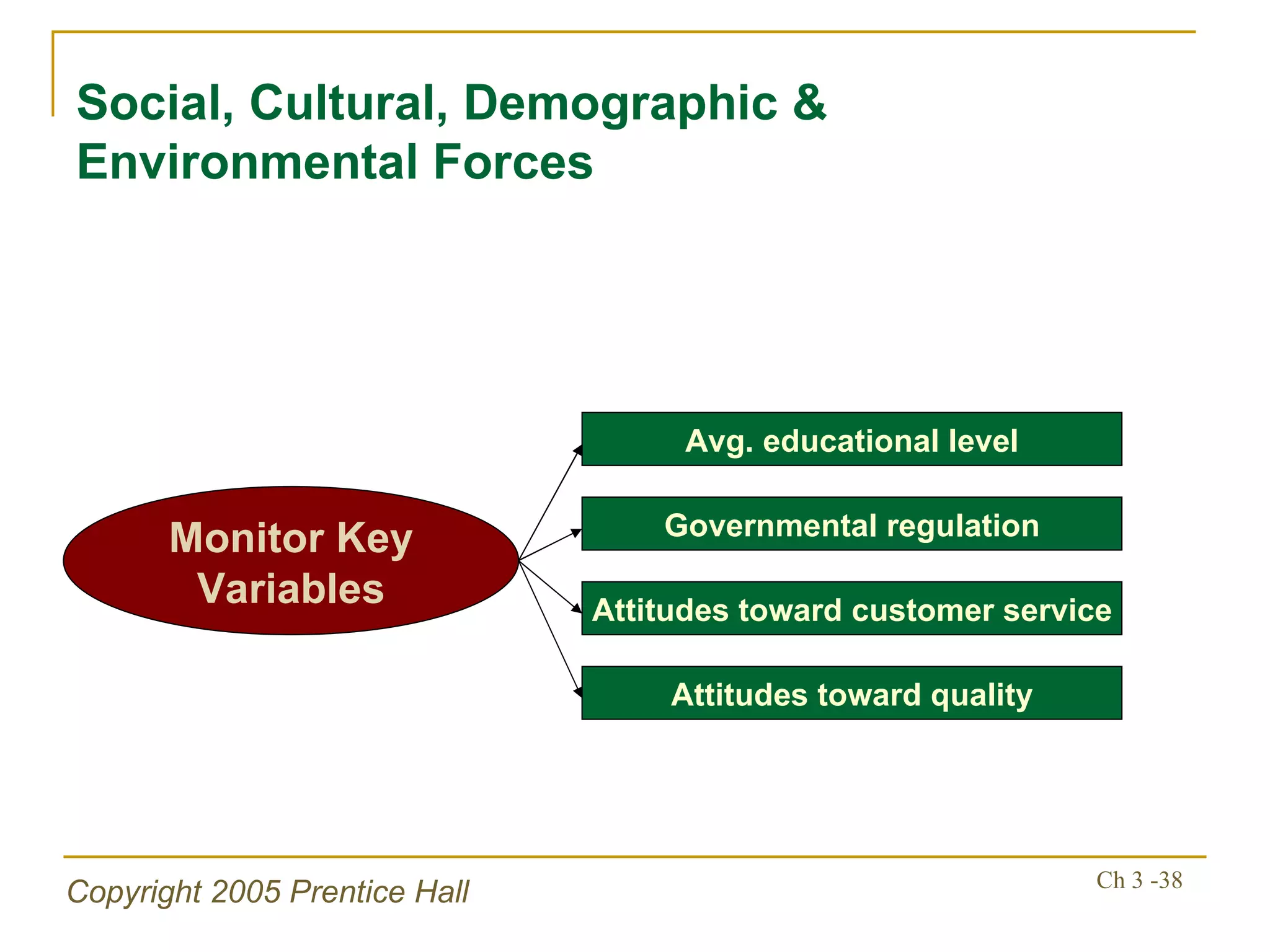
Avg. educational level Monitor Key Variables Governmental regulation Attitudes toward customer service Attitudes toward quality Social, Cultural, Demographic & Environmental Forces
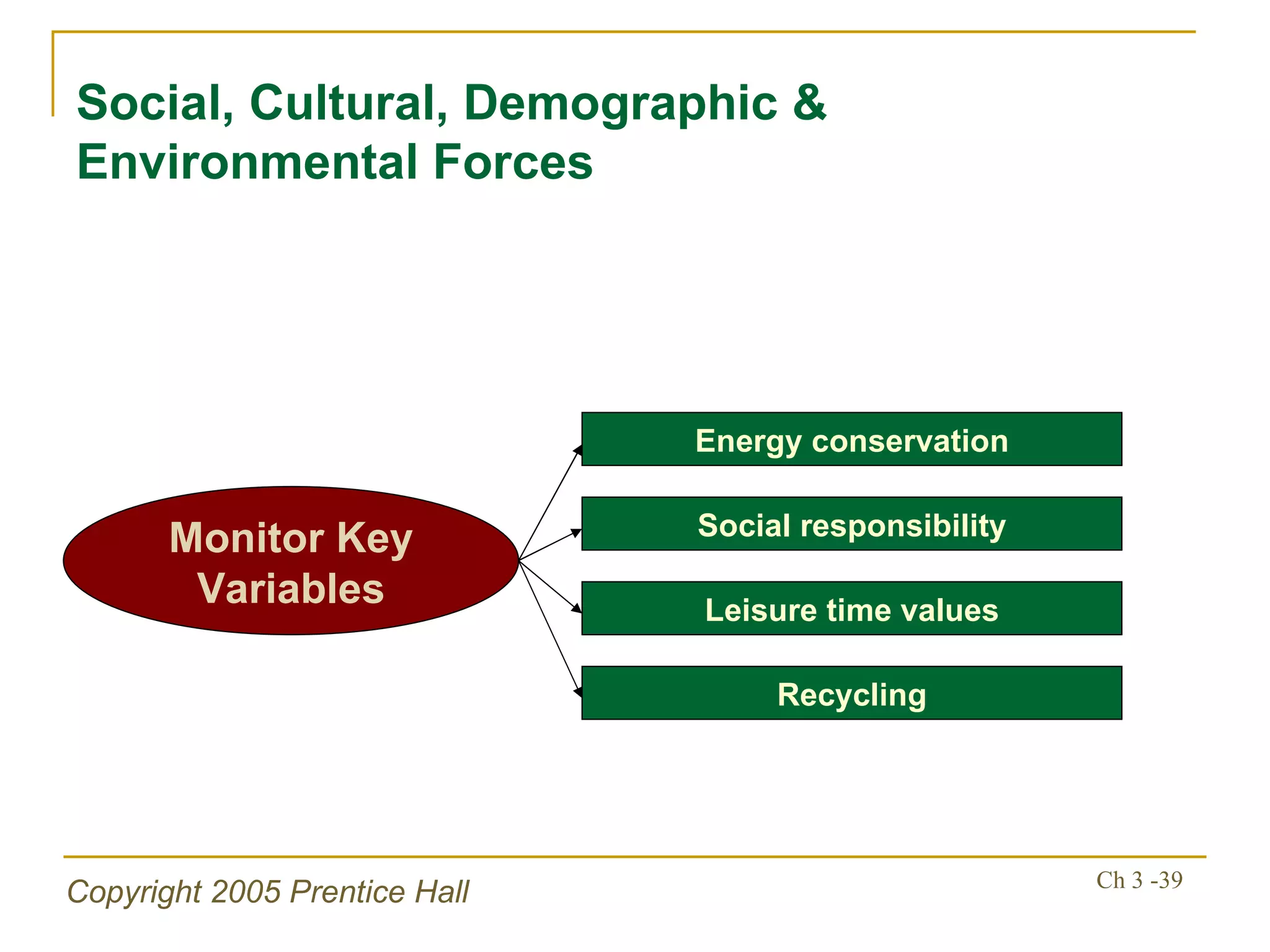
Energy conservation Monitor Key Variables Social responsibility Leisure time values Recycling Social, Cultural, Demographic & Environmental Forces
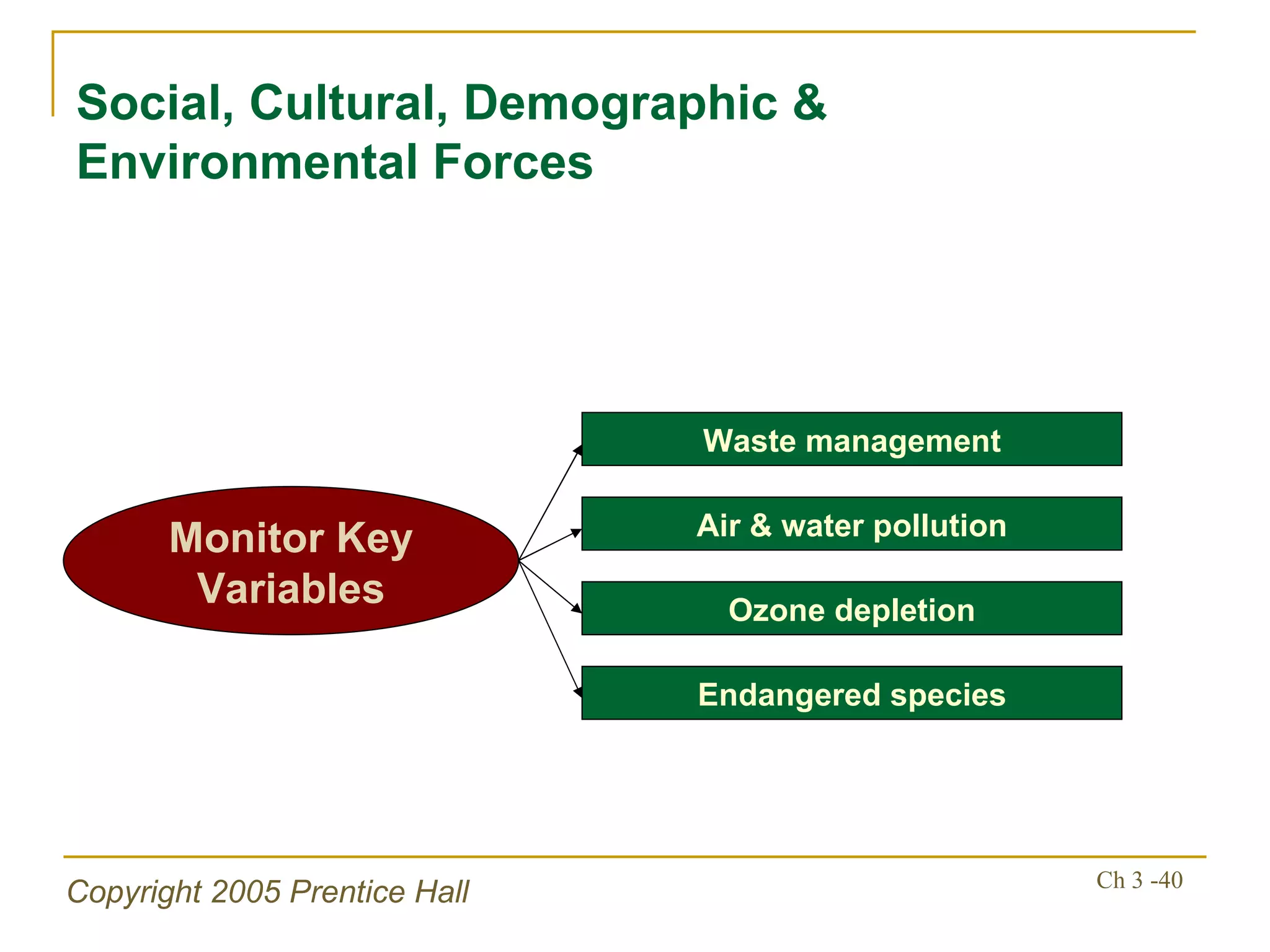
Waste management Monitor Key Variables Air & water pollution Ozone depletion Endangered species Social, Cultural, Demographic & Environmental Forces
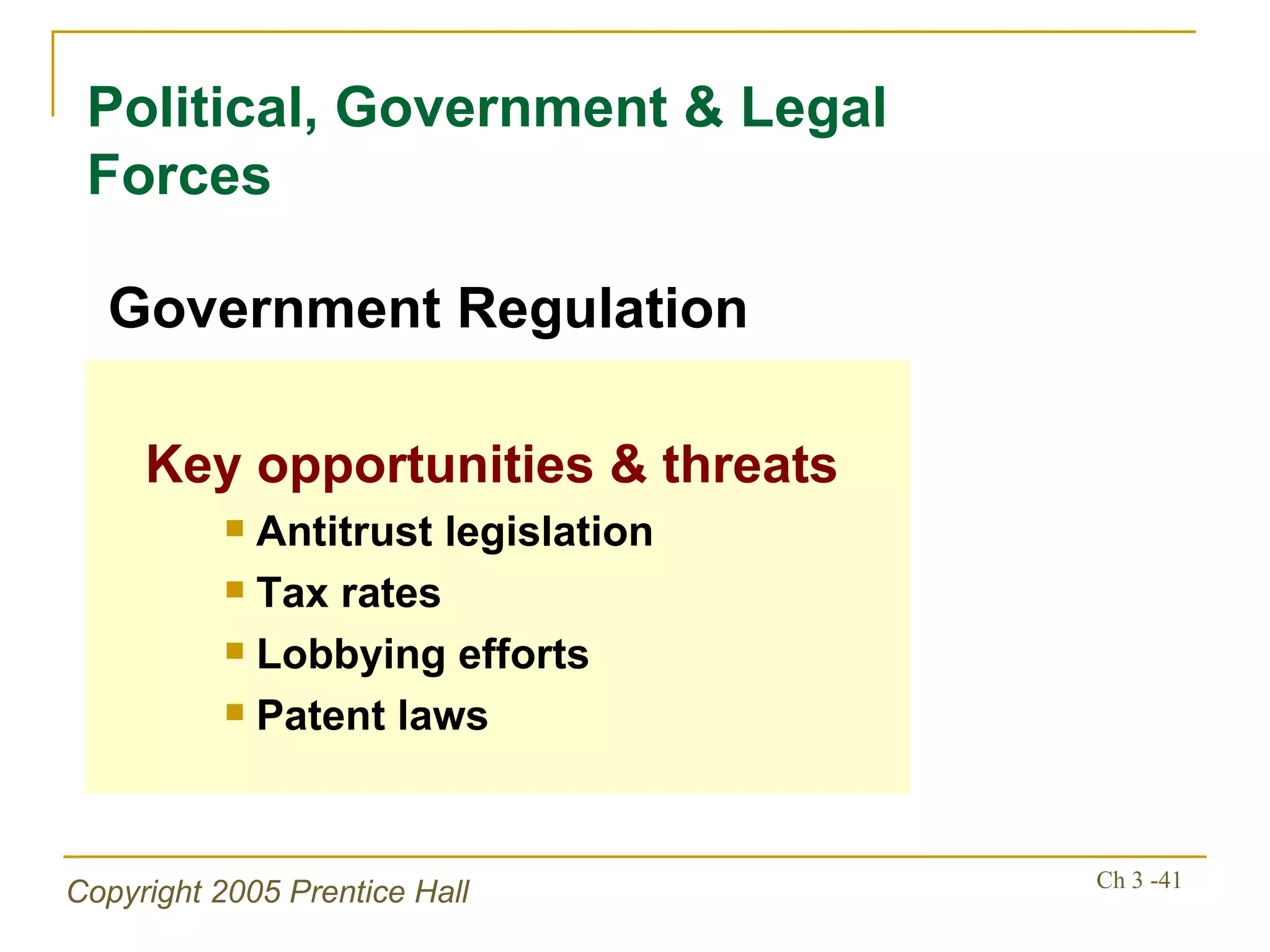
Political, Government & Legal Forces Key opportunities & threats Antitrust legislation Tax rates Lobbying efforts Patent laws Government Regulation
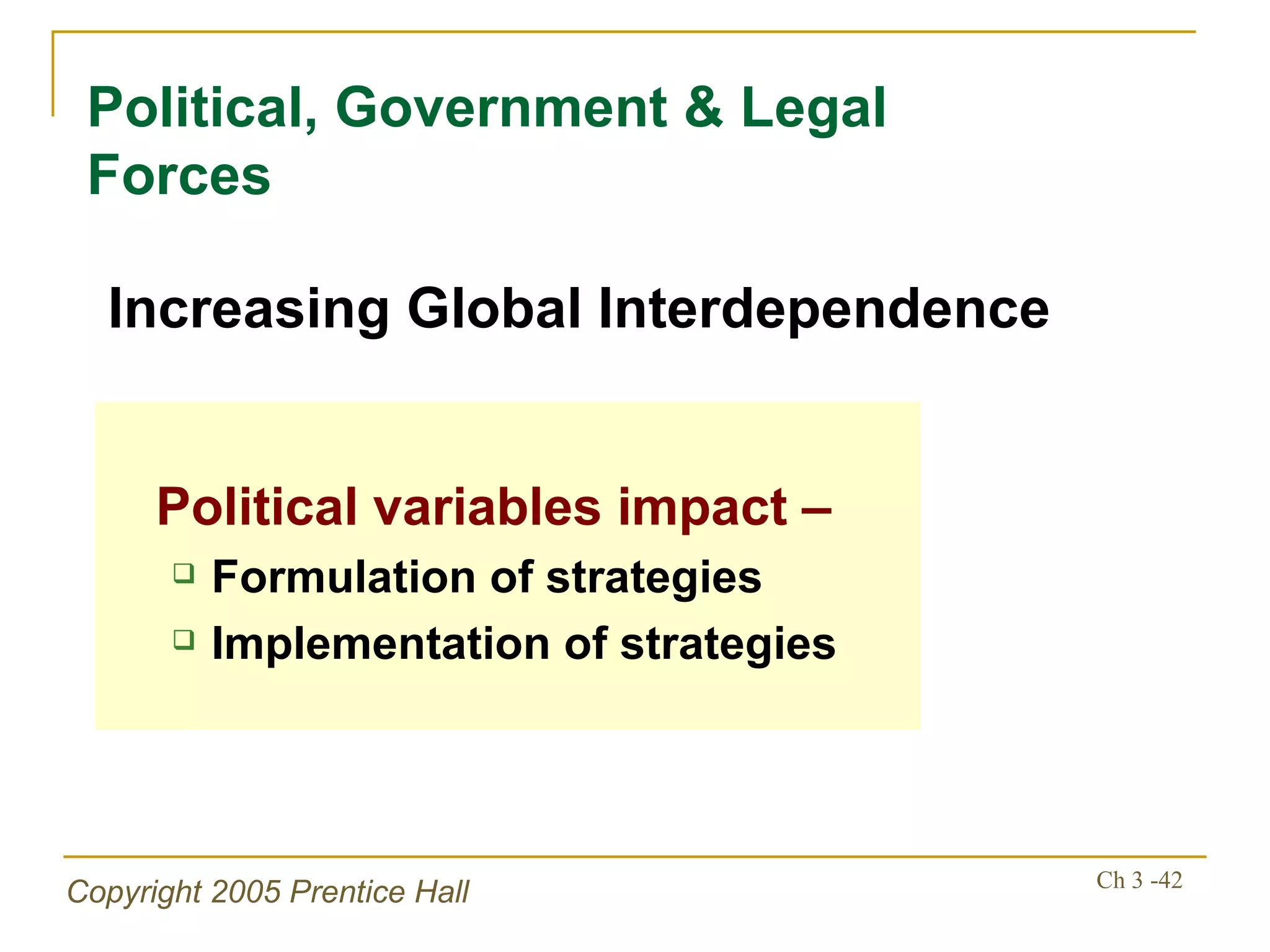
Political, Government & Legal Forces Political variables impact – Formulation of strategies Implementation of strategies Increasing Global Interdependence
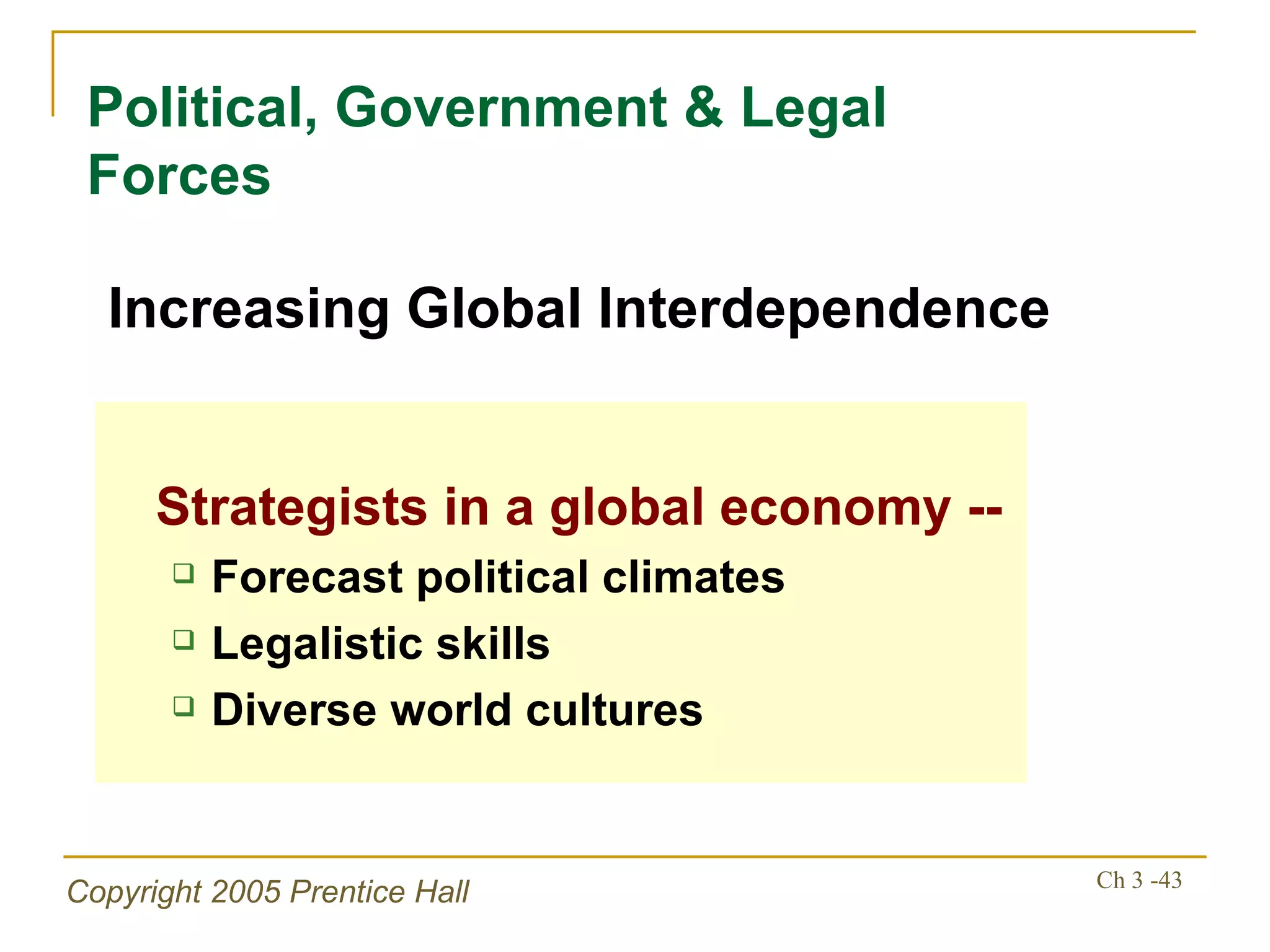
Political, Government & Legal Forces Strategists in a global economy -- Forecast political climates Legalistic skills Diverse world cultures Increasing Global Interdependence
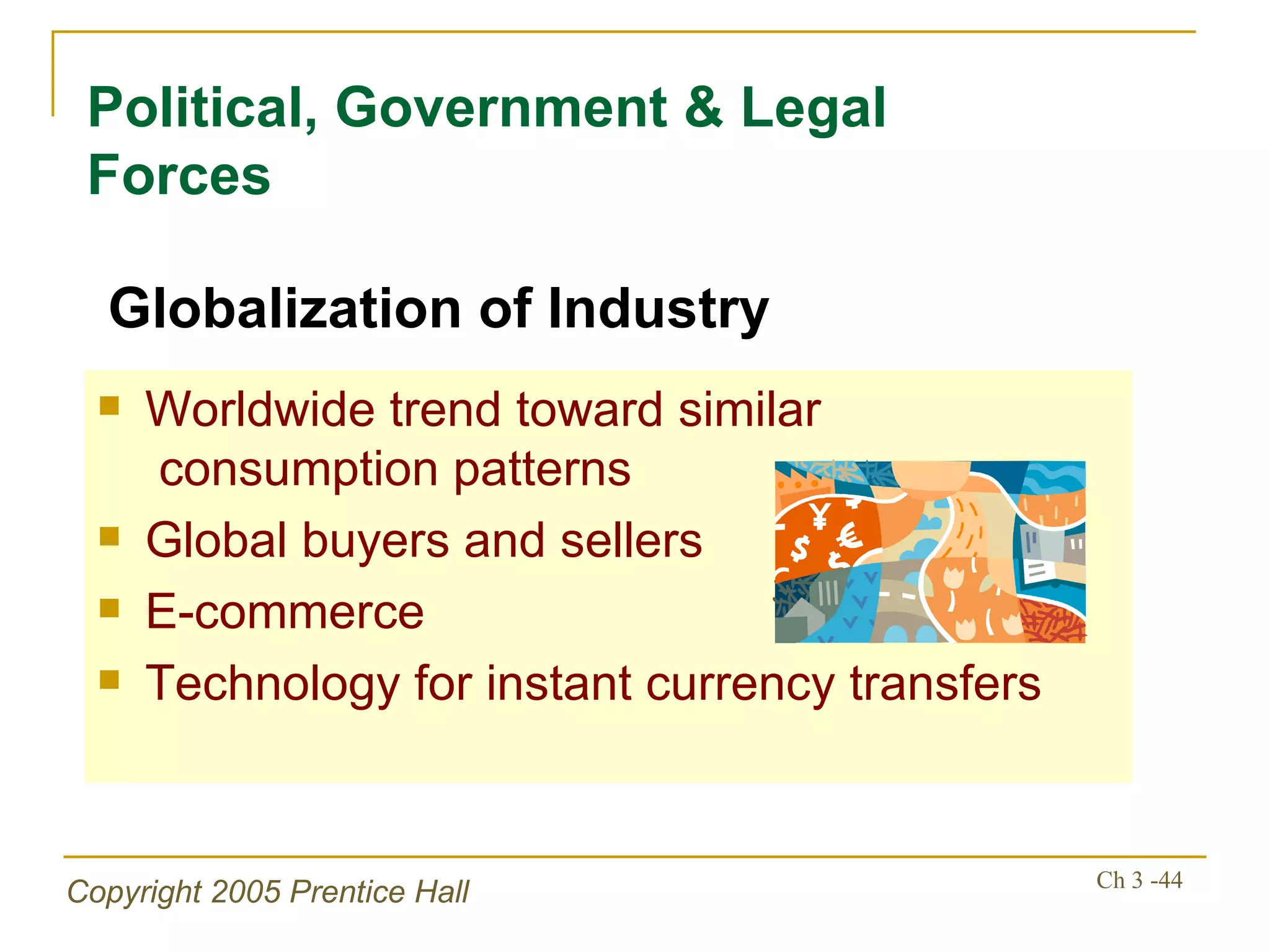
Political, Government & Legal Forces Worldwide trend toward similar  consumption patterns Global buyers and sellers E-commerce Technology for instant currency transfers Globalization of Industry
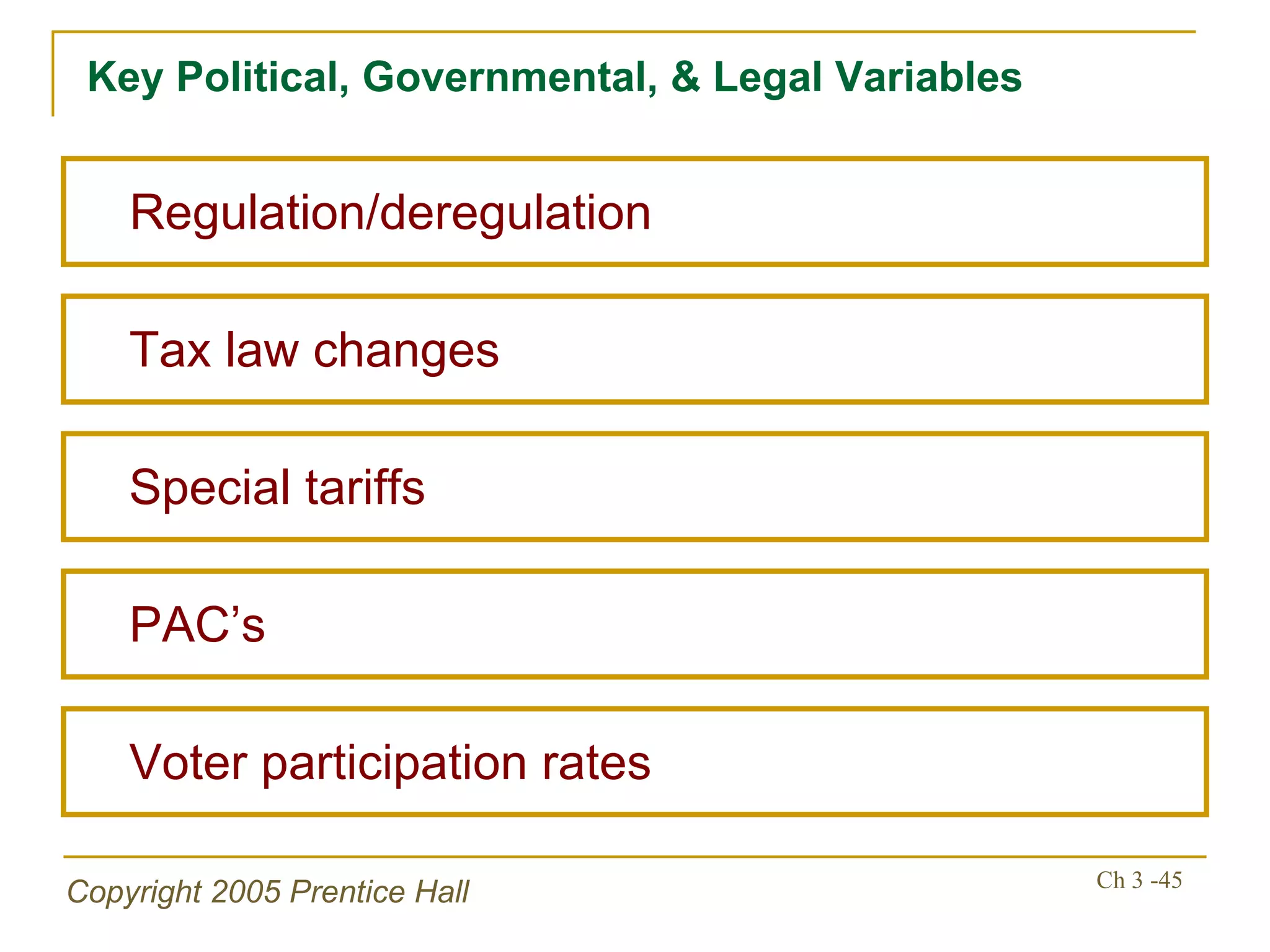
Key Political, Governmental, & Legal Variables Special tariffs Tax law changes PAC’s Voter participation rates Regulation/deregulation
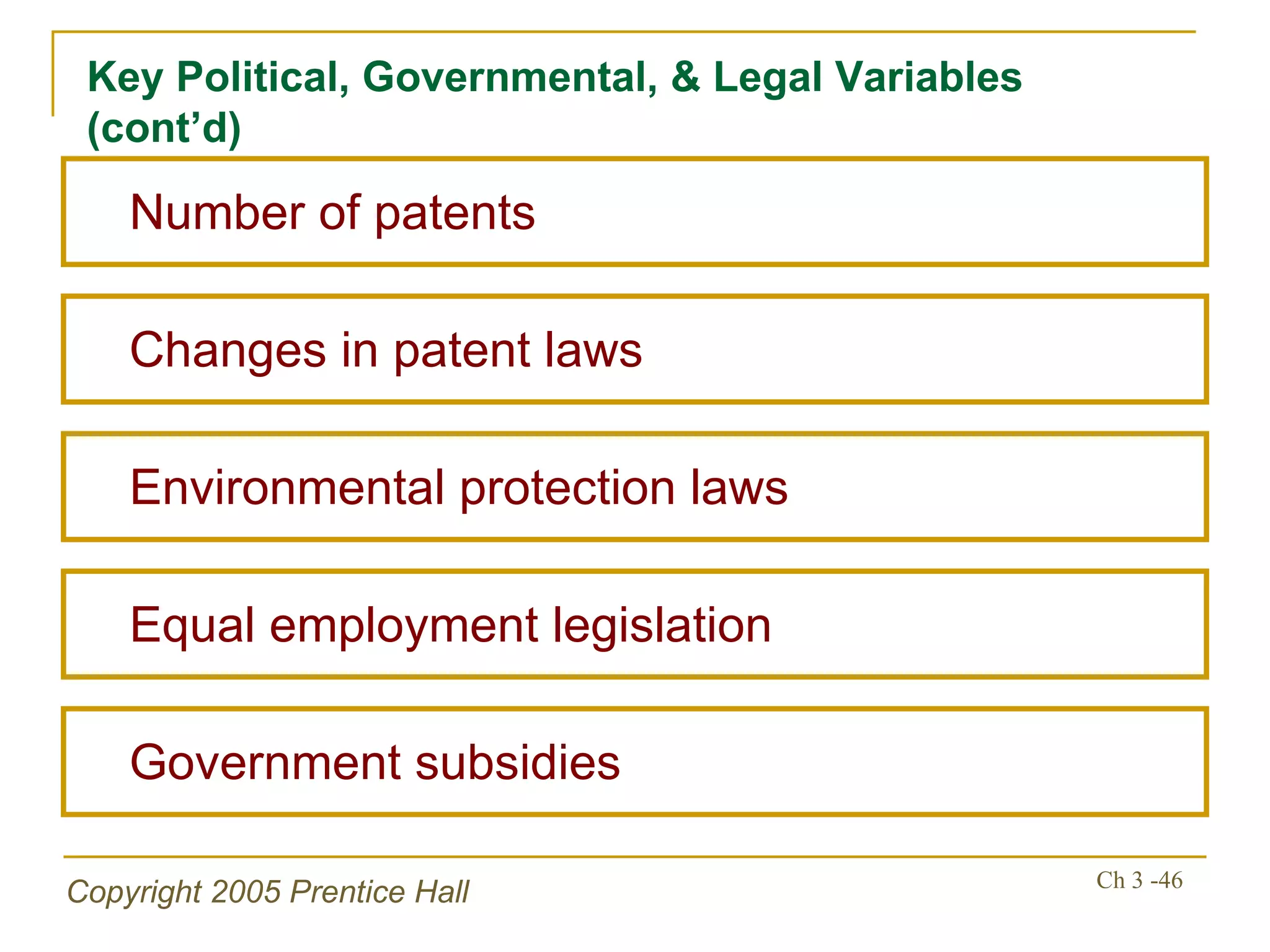
Key Political, Governmental, & Legal Variables (cont’d) Environmental protection laws Changes in patent laws Equal employment legislation Government subsidies Number of patents
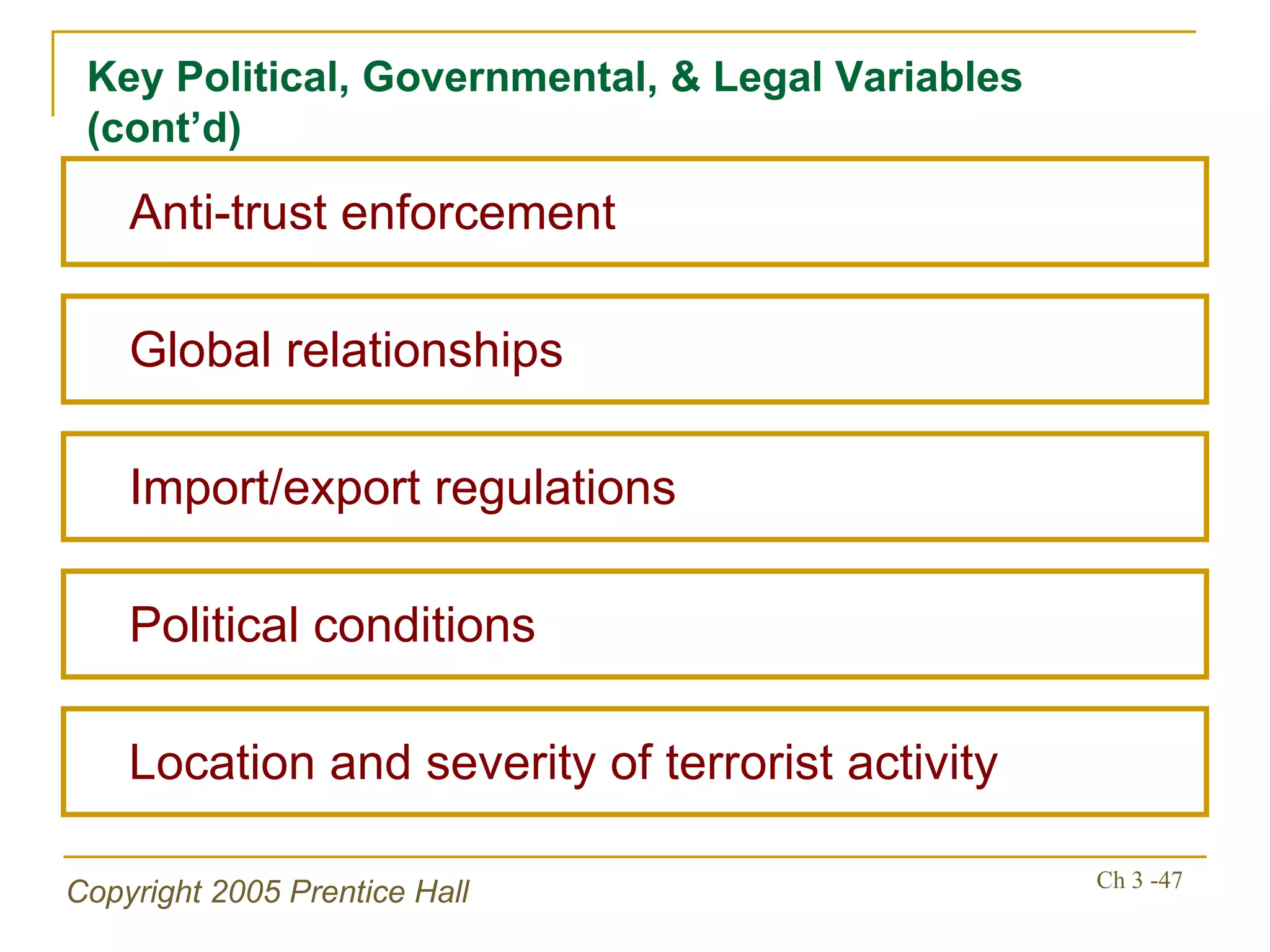
Key Political, Governmental, & Legal Variables (cont’d) Import/export regulations Global relationships Political conditions  Location and severity of terrorist activity Anti-trust enforcement
Technological Forces Major Impact – Internet Communications Semiconductors
Technological Forces Significance of IT Chief Information Officer (CIO) Chief Technology Officer (CTO)
Technological Forces Essential for nearly every strategic decision Technology-based issues
Competitive Forces Collection & evaluation of data on competitors is essential for successful strategy formulation
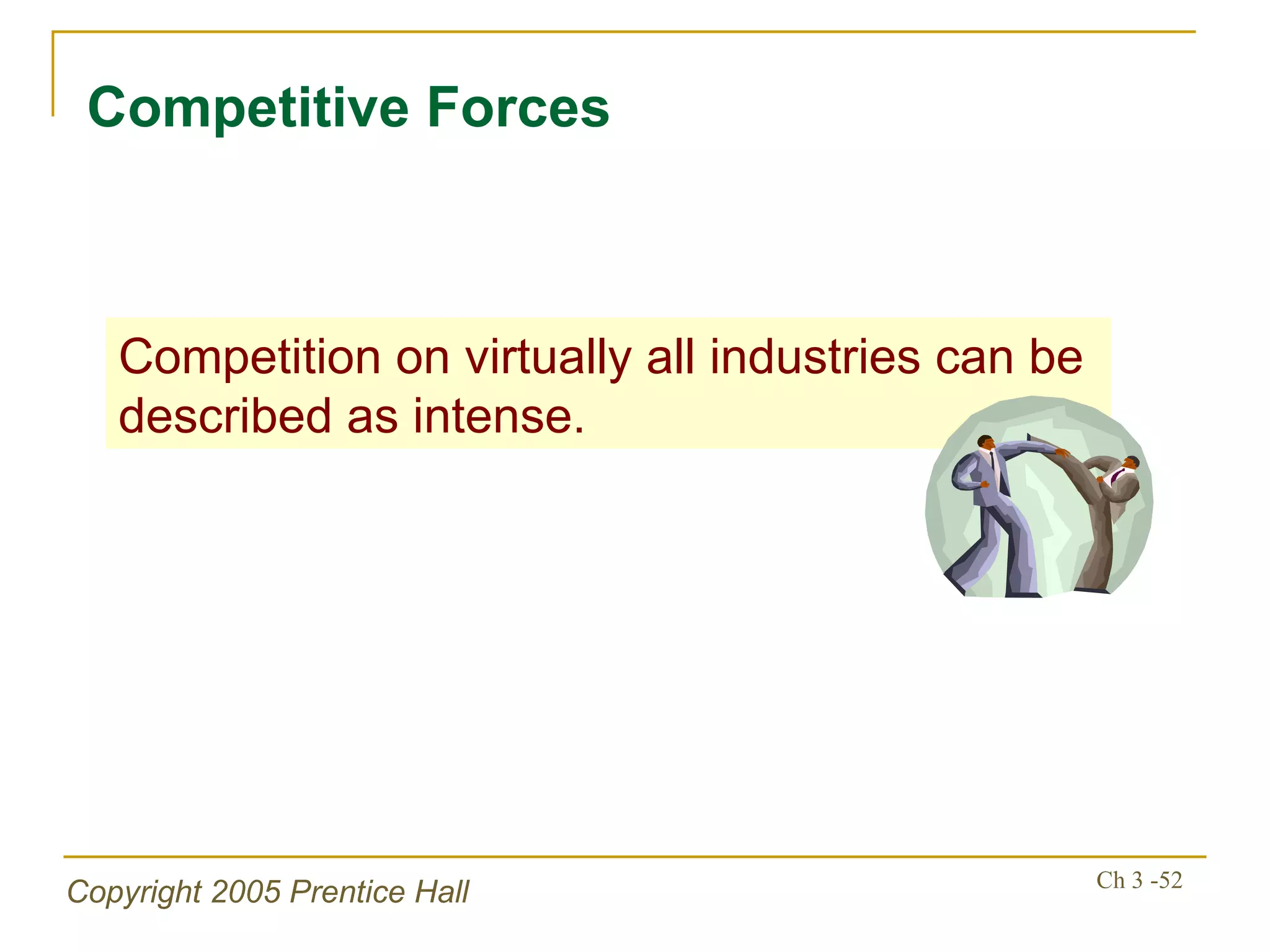
Competitive Forces Competition on virtually all industries can be described as intense.
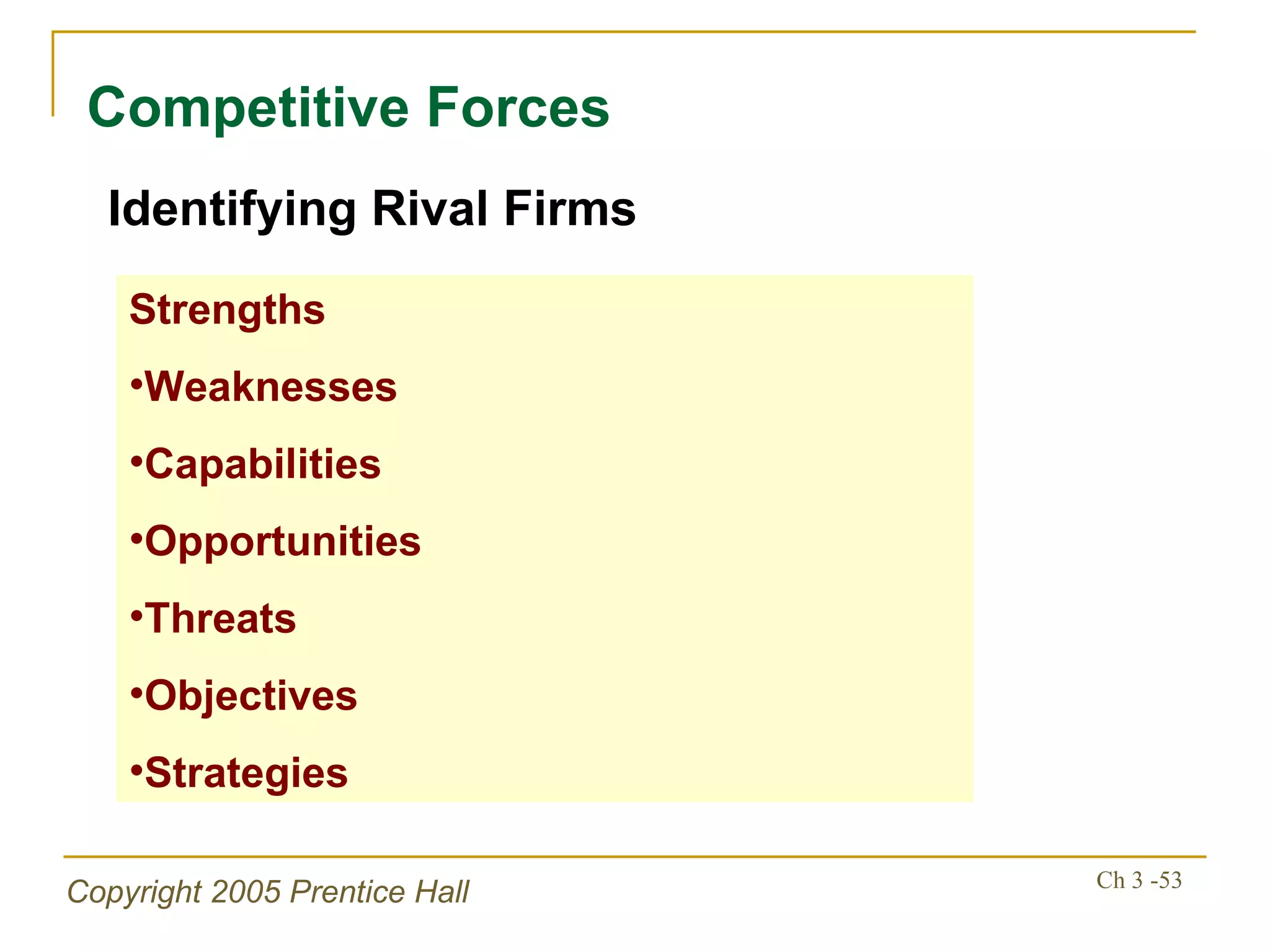
Competitive Forces Strengths Weaknesses Capabilities Opportunities Threats Objectives Strategies Identifying Rival Firms
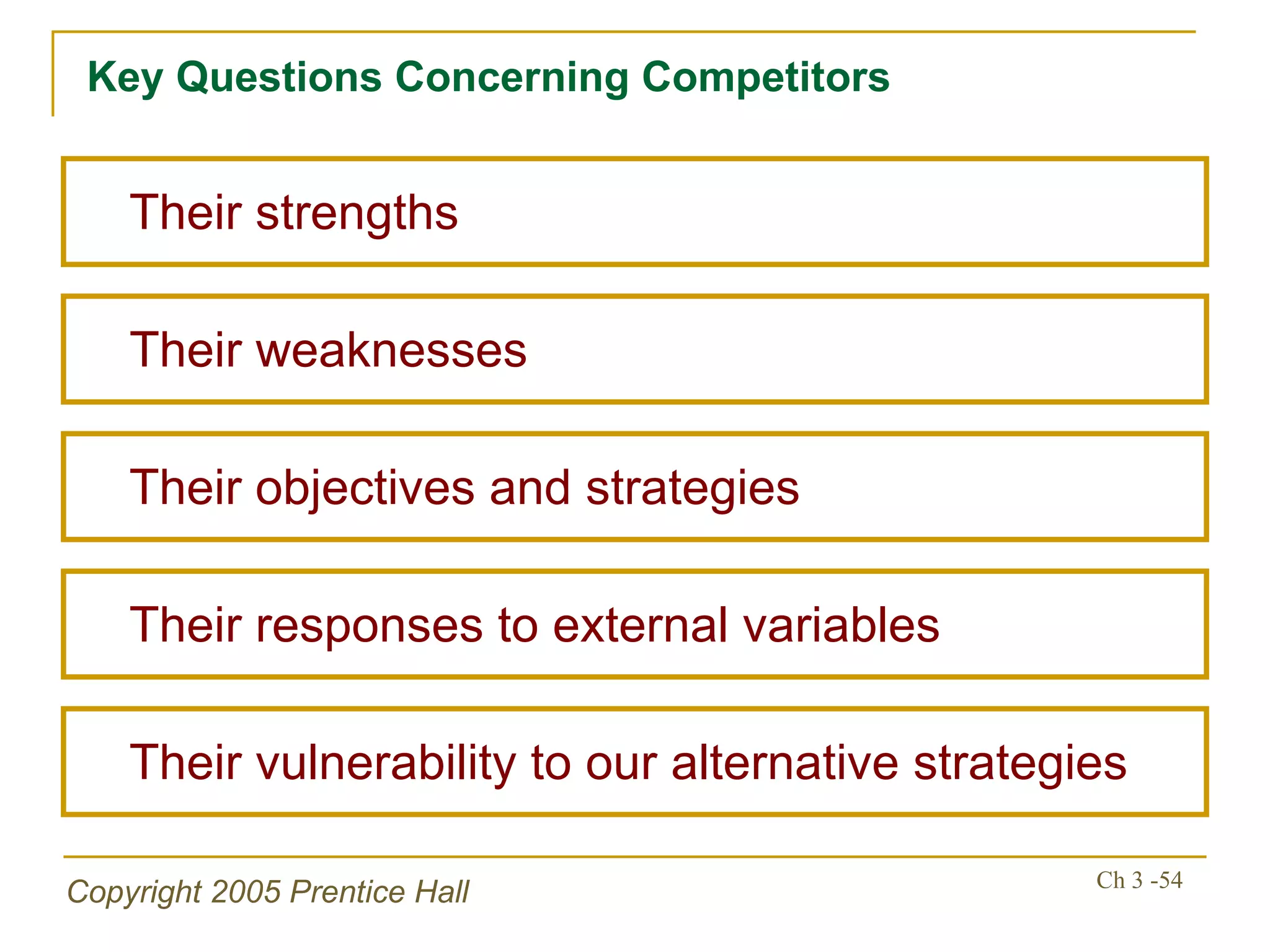
Key Questions Concerning Competitors Their objectives and strategies Their weaknesses Their responses to external variables  Their vulnerability to our alternative strategies Their strengths
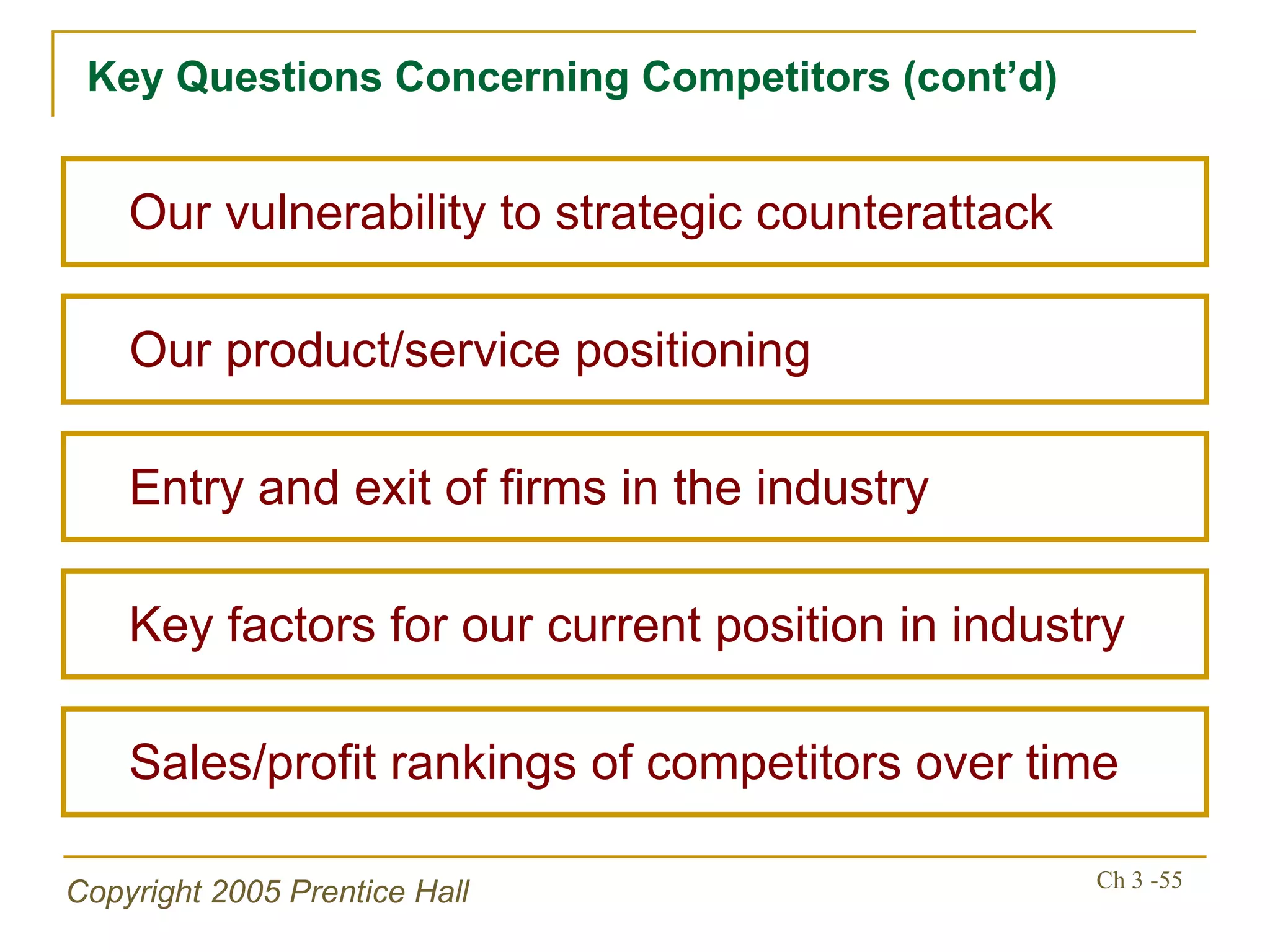
Key Questions Concerning Competitors (cont’d) Entry and exit of firms in the industry Our product/service positioning Key factors for our current position in industry Sales/profit rankings of competitors over time Our vulnerability to strategic counterattack
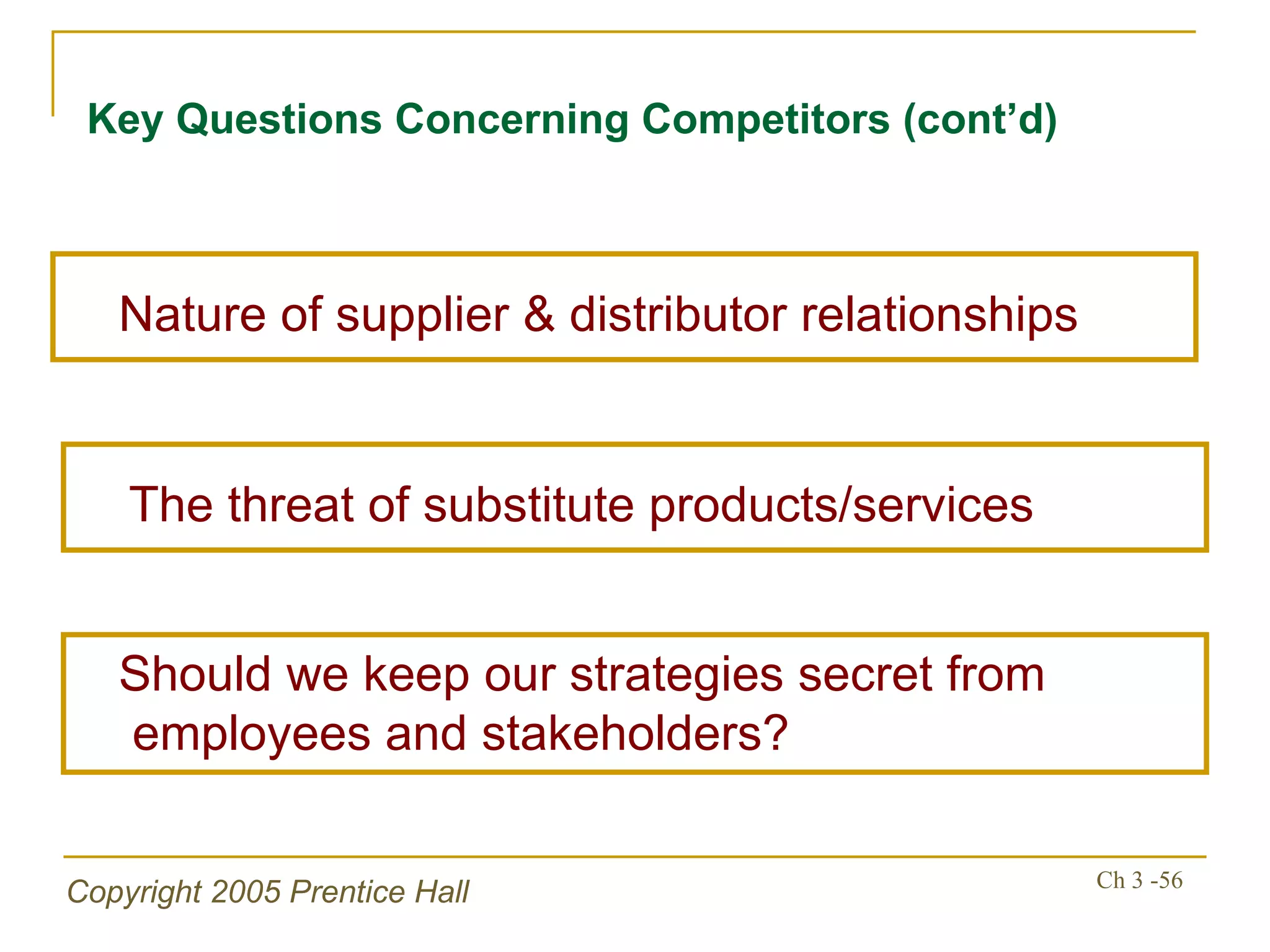
Key Questions Concerning Competitors (cont’d) The threat of substitute products/services Nature of supplier & distributor relationships Should we keep our strategies secret from  employees and stakeholders?
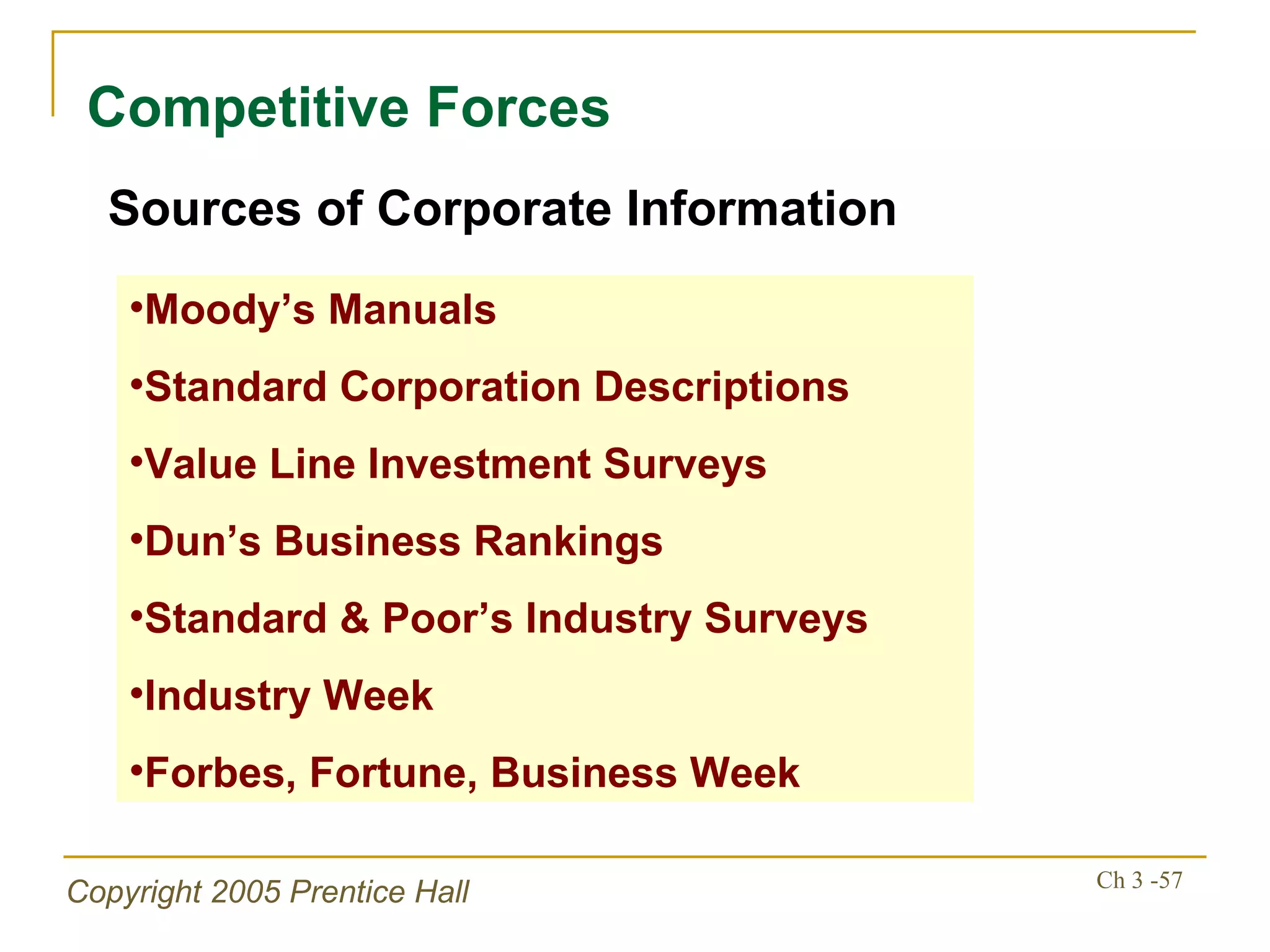
Competitive Forces Moody’s Manuals Standard Corporation Descriptions Value Line Investment Surveys Dun’s Business Rankings Standard & Poor’s Industry Surveys Industry Week Forbes, Fortune, Business Week Sources of Corporate Information
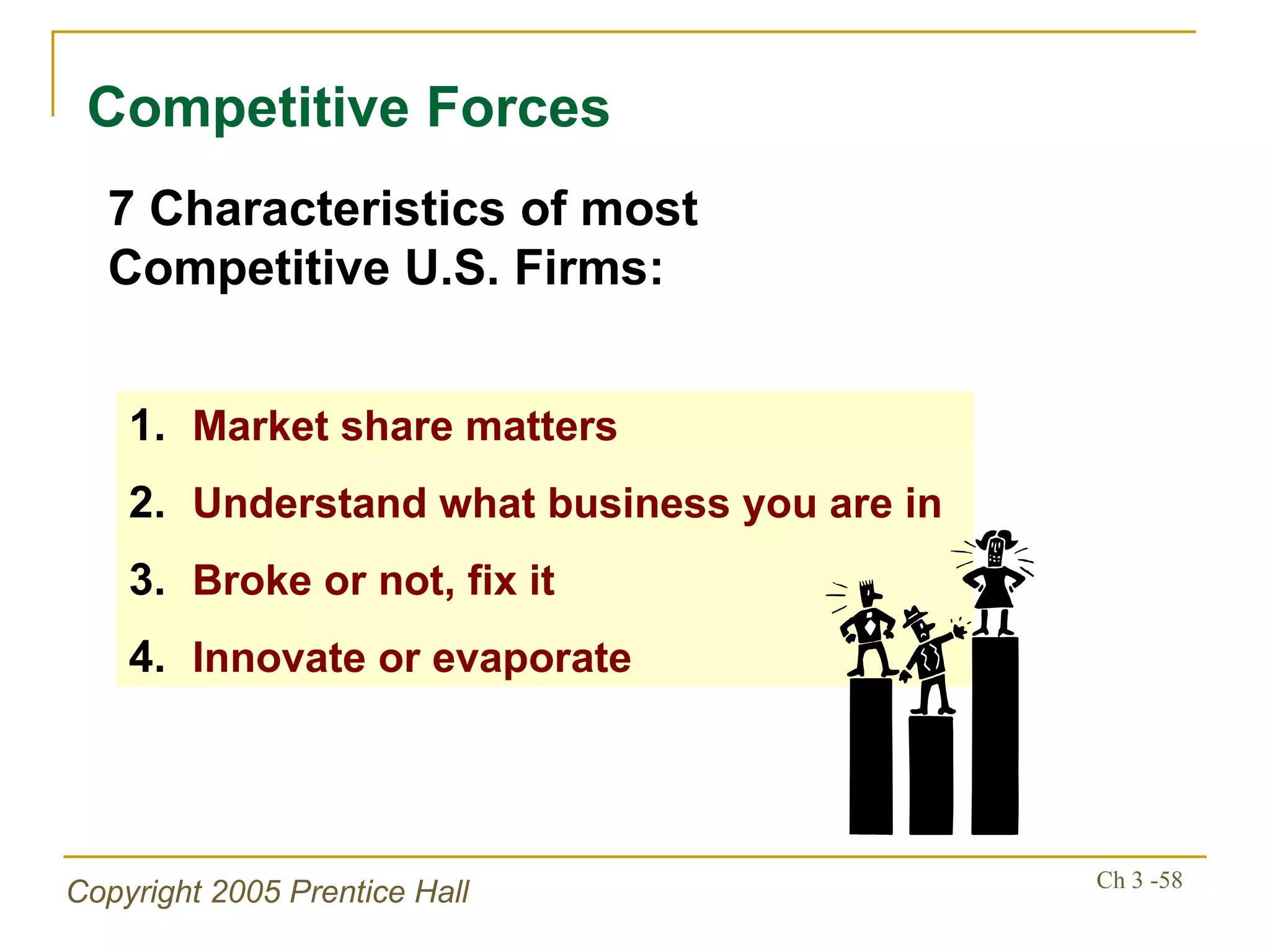
Competitive Forces Market share matters Understand what business you are in Broke or not, fix it Innovate or evaporate 7 Characteristics of most Competitive U.S. Firms:
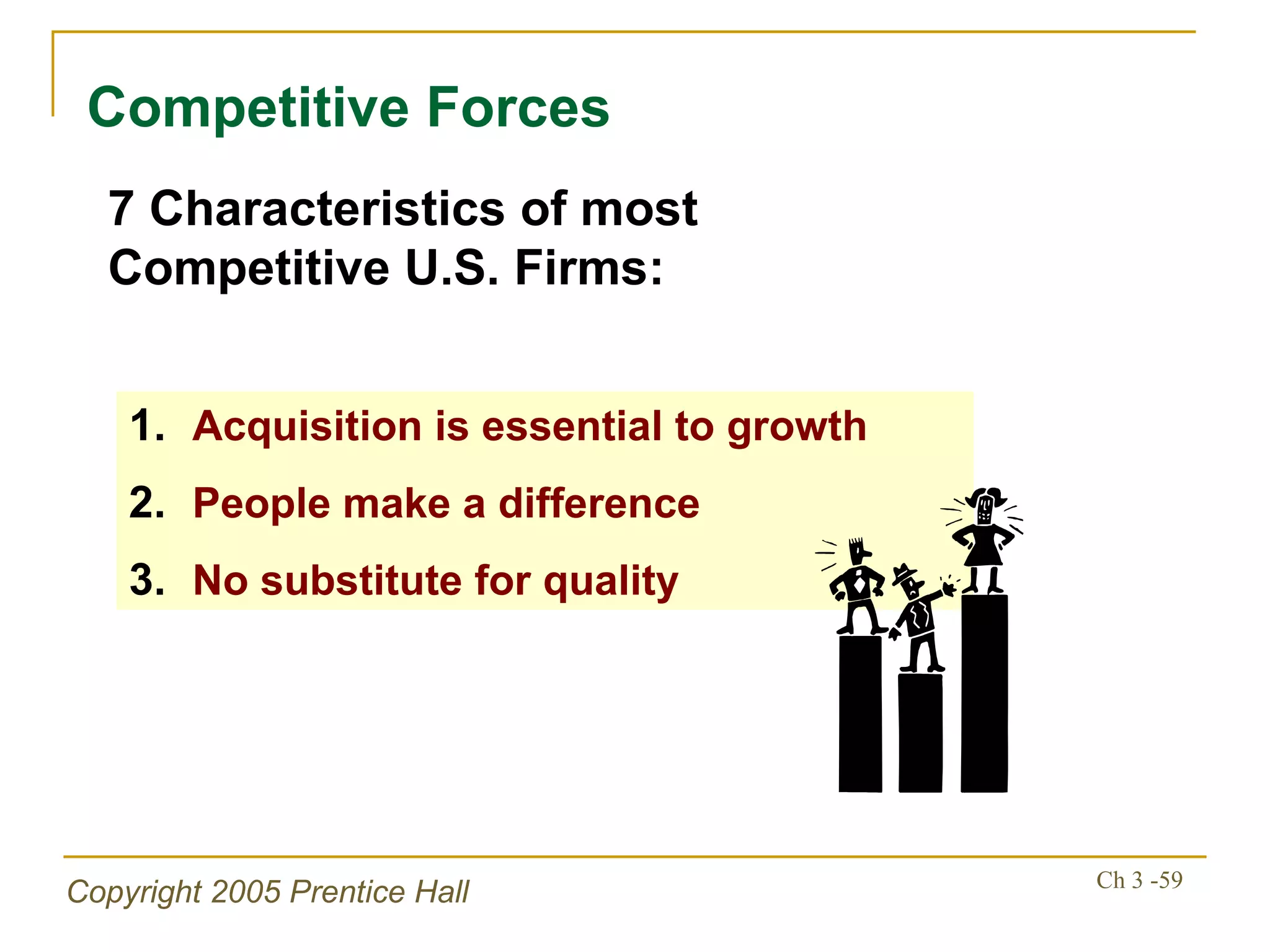
Competitive Forces Acquisition is essential to growth People make a difference No substitute for quality 7 Characteristics of most Competitive U.S. Firms:
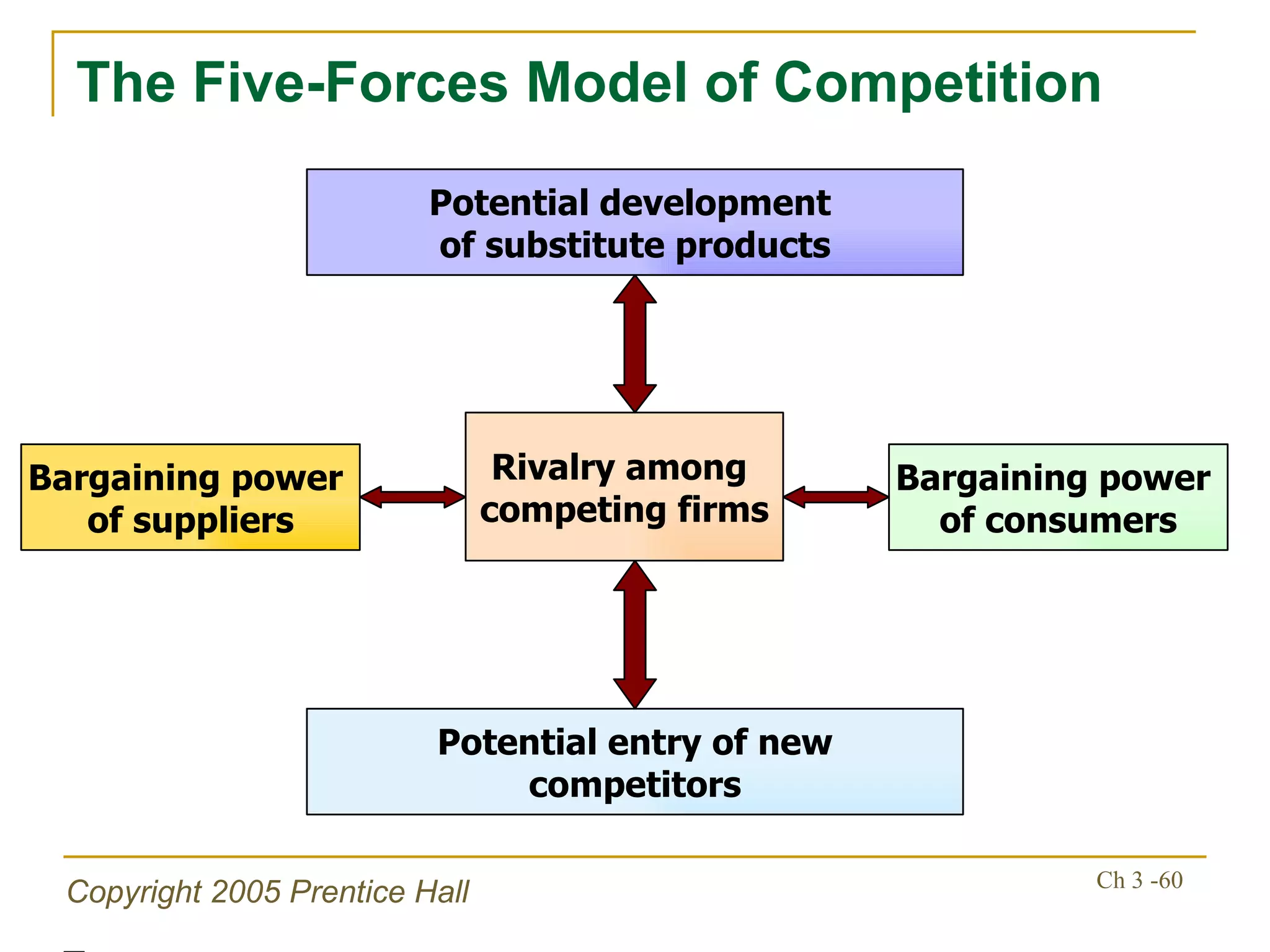
The Five-Forces Model of Competition Potential development  of substitute products Rivalry among  competing firms Bargaining power  of suppliers Potential entry of new competitors Bargaining power  of consumers
The Five-Forces Model Most powerful of the five forces Focus on competitive advantage of strategies Rivalry Among Competing Firms
The Five-Forces Model Barriers to entry are important Quality, pricing, and marketing can overcome barriers Potential Entry of New Competitors
The Five-Forces Model Pressures increase when consumer’s switching costs decrease Firm’s plans for increased capacity & market penetration Potential Development of Substitute Products
The Five-Forces Model Large number of suppliers & few substitutes affects intensity of competition Backward integration can gain control or ownership of suppliers Bargaining Power of Suppliers
The Five-Forces Model Customers concentrated or buy in volume affects intensity of competition Consumer power is higher where products are standard or undifferentiated Bargaining Power of Consumers
The Global Challenge Faced by U.S. Firms -- Gain & maintain exports to other nations Defend domestic markets against imported goods
The Global Challenge Simultaneously globally competitive & nationally responsive Multinational Corporations (MNC’s)
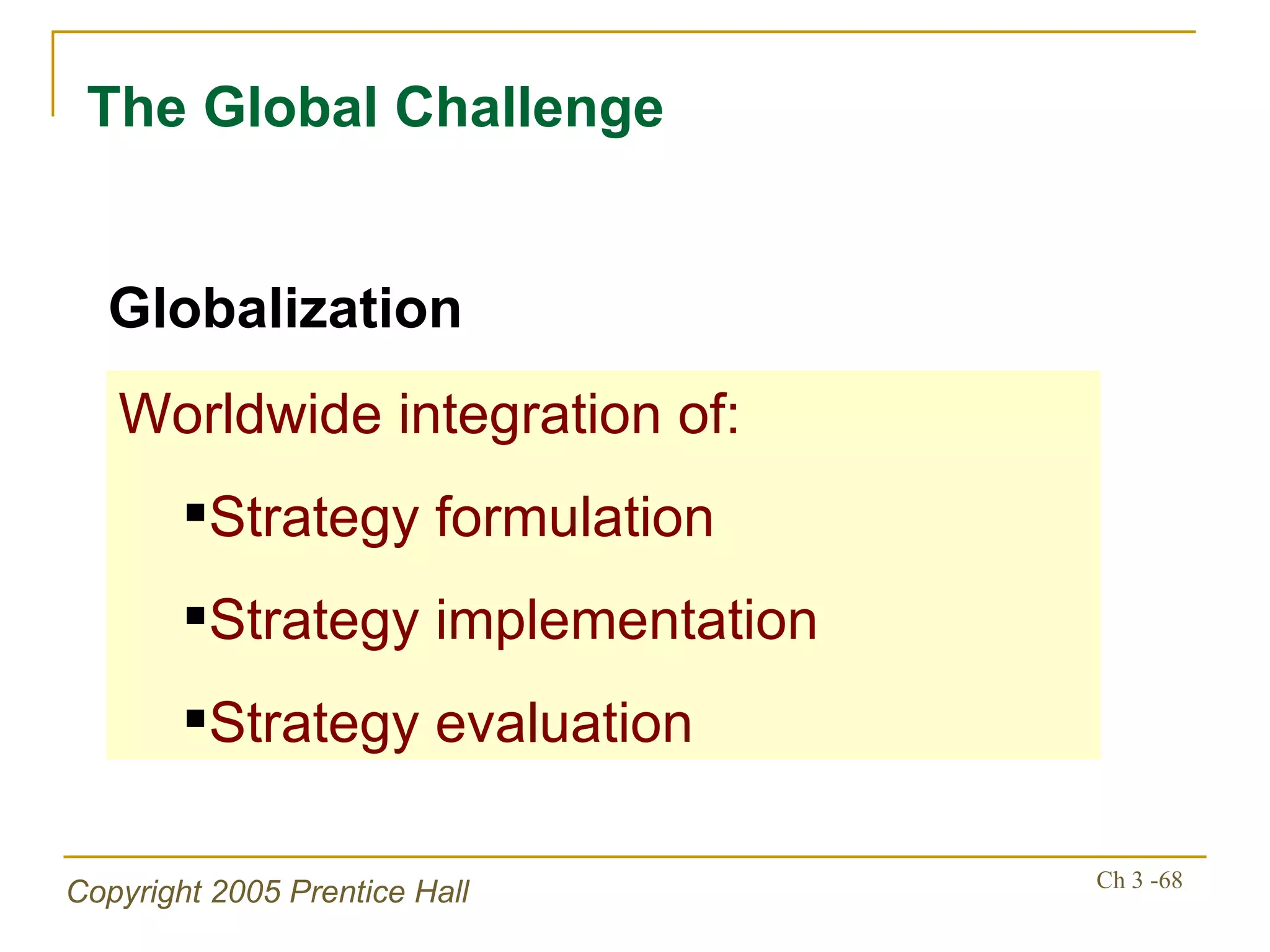
The Global Challenge Worldwide integration of: Strategy formulation Strategy implementation Strategy evaluation Globalization
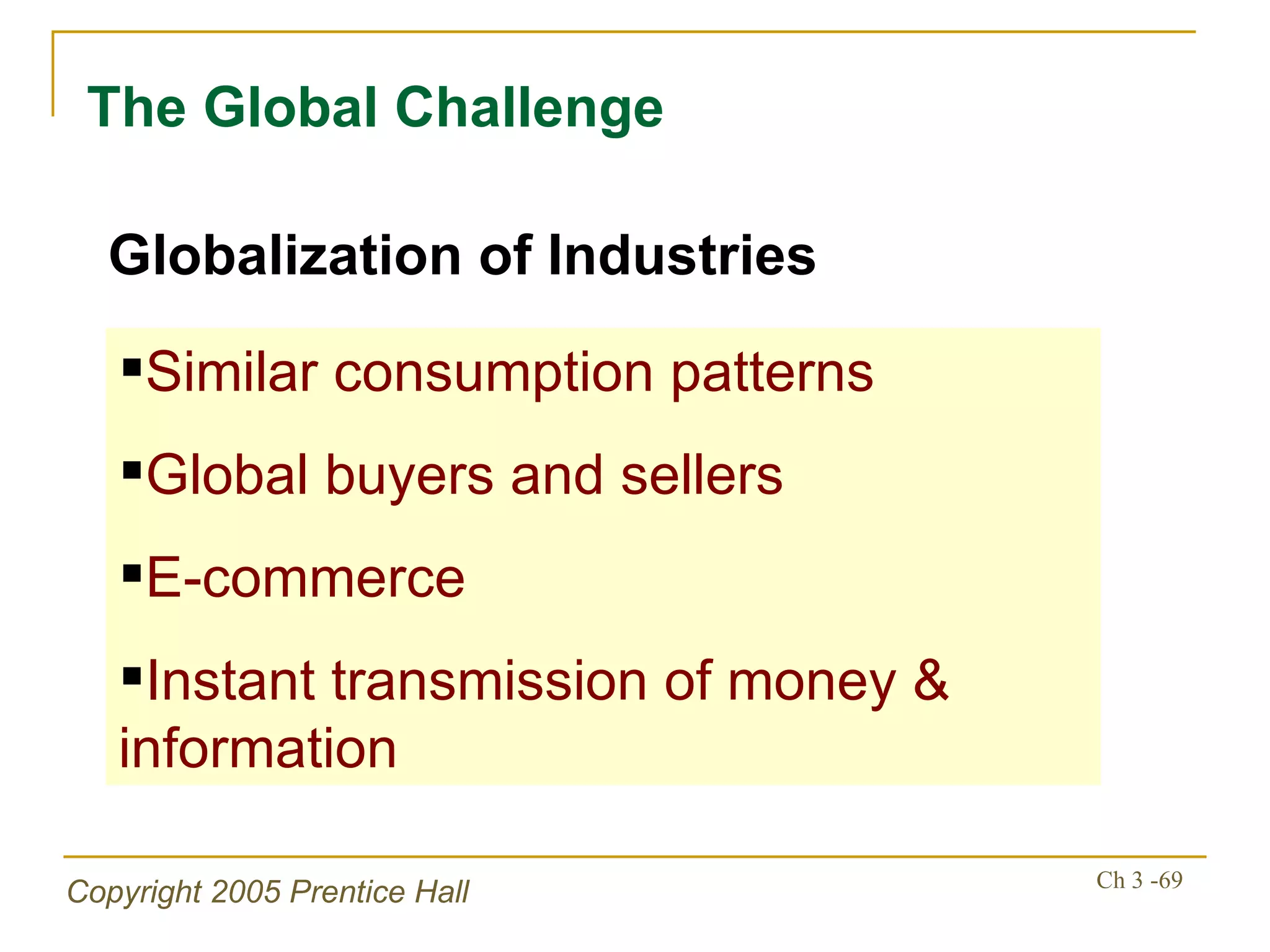
The Global Challenge Similar consumption patterns Global buyers and sellers E-commerce Instant transmission of money & information Globalization of Industries
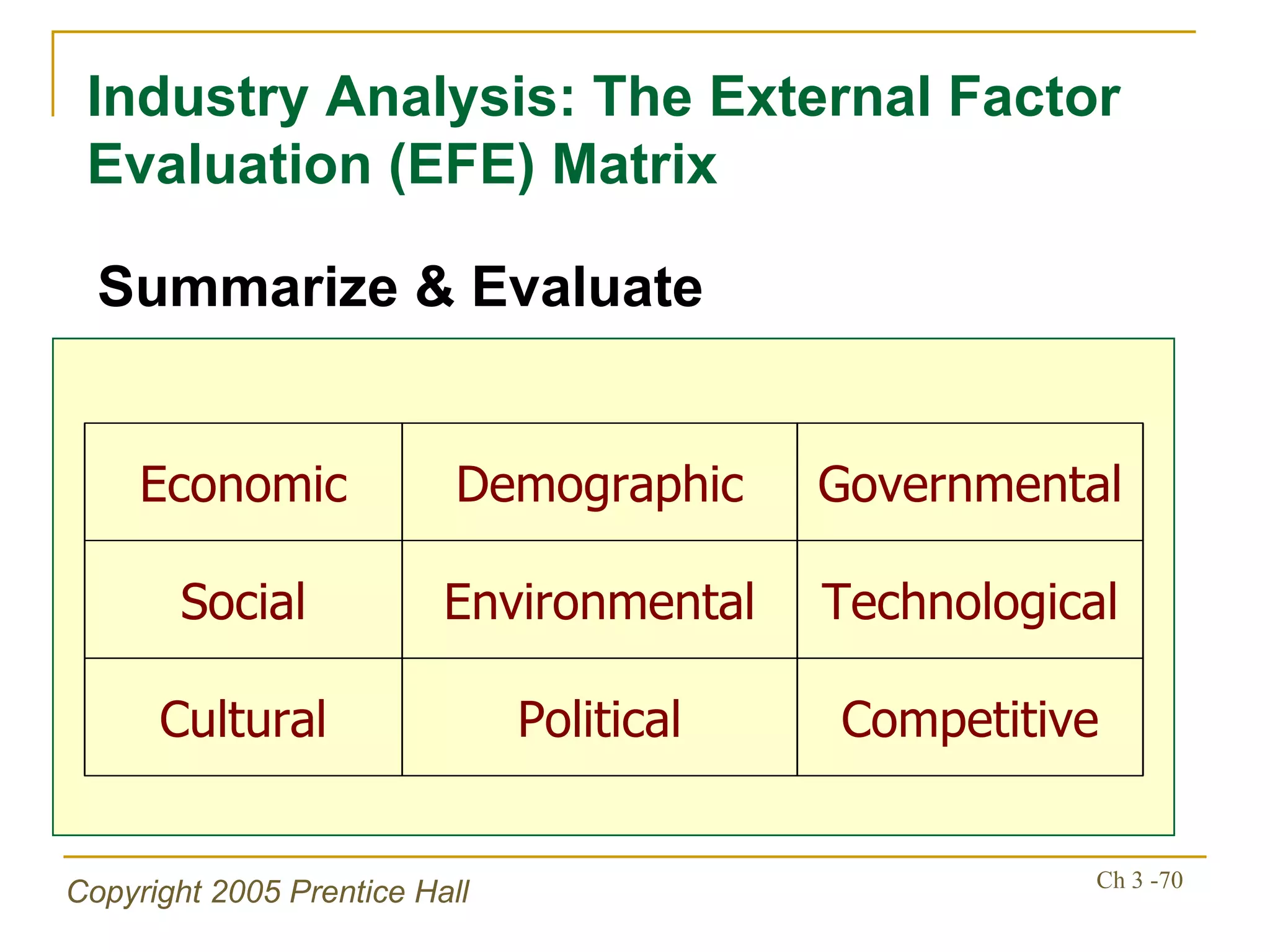
Industry Analysis: The External Factor Evaluation (EFE) Matrix Summarize & Evaluate Competitive Political Cultural Technological Environmental Social Governmental Demographic Economic
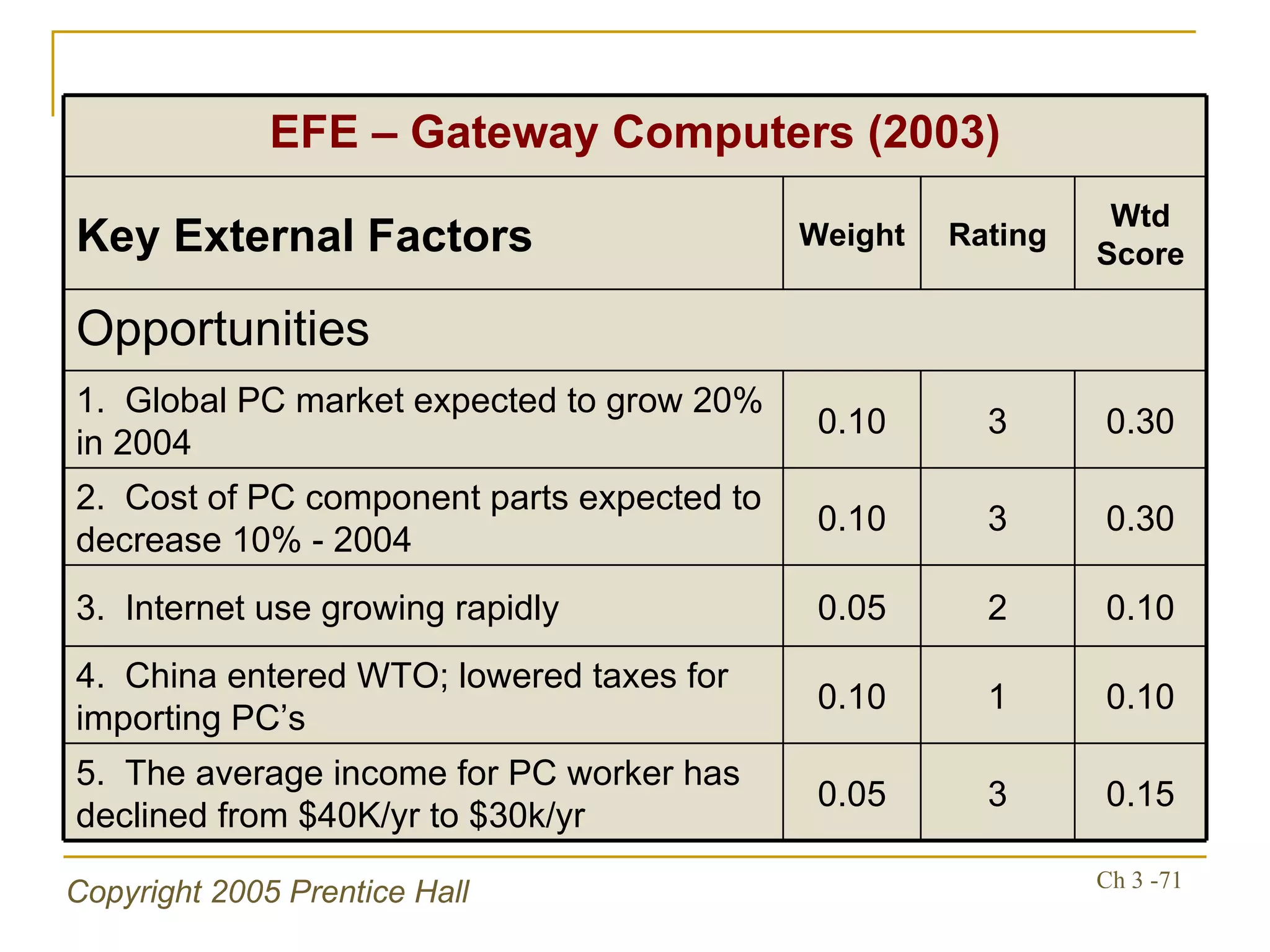
0.15 3 0.05 5.  The average income for PC worker has declined from $40K/yr to $30k/yr 0.10 1 0.10 4.  China entered WTO; lowered taxes for importing PC’s 0.10 2 0.05 3.  Internet use growing rapidly 0.30 3 0.10 2.  Cost of PC component parts expected to decrease 10% - 2004 0.30 3 0.10 1.  Global PC market expected to grow 20% in 2004 Opportunities Wtd Score Rating Weight Key External Factors EFE – Gateway Computers (2003)
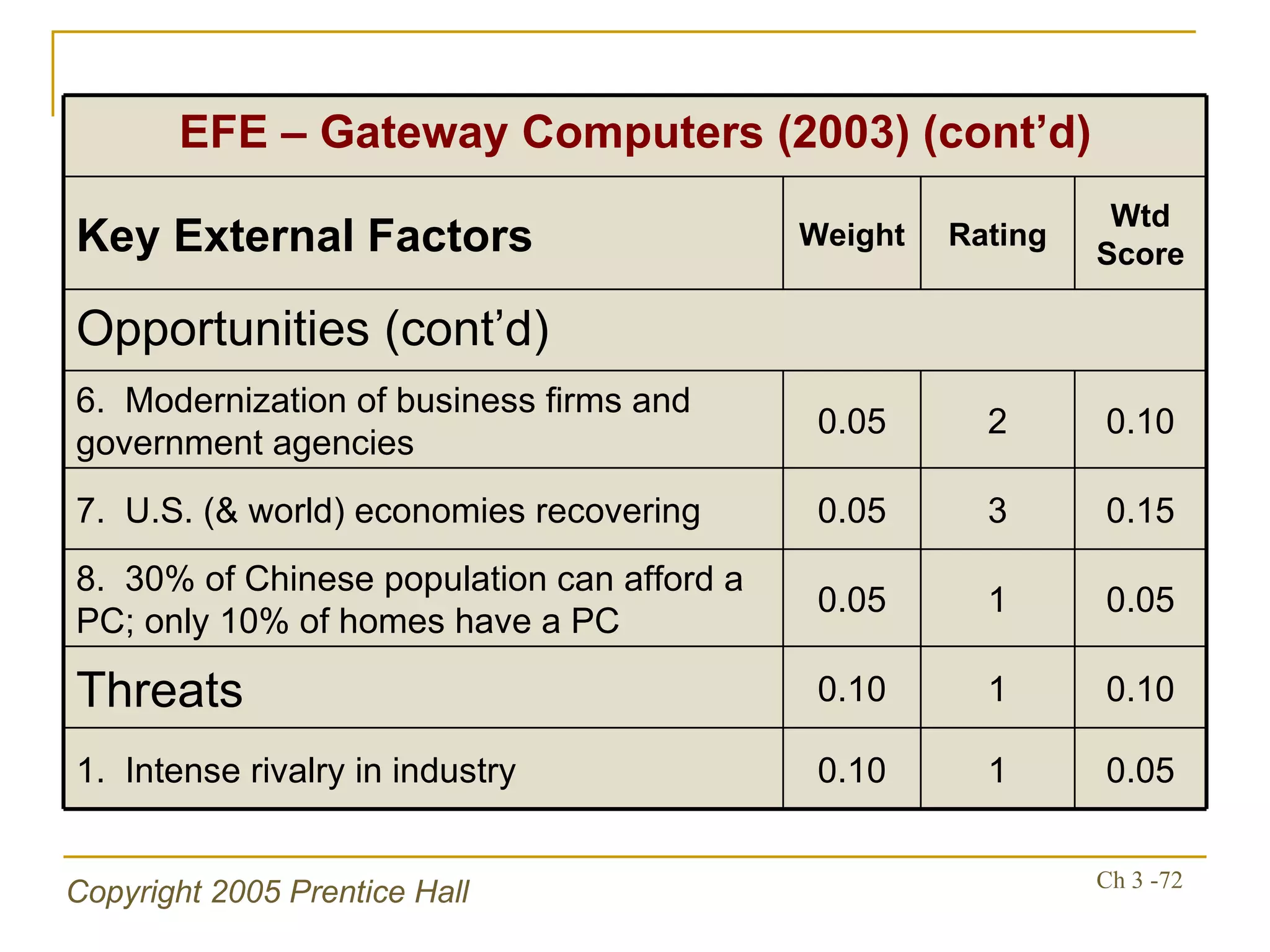
0.05 1 0.10 1.  Intense rivalry in industry 0.10 1 0.10 Threats 0.05 1 0.05 8.  30% of Chinese population can afford a PC; only 10% of homes have a PC 0.15 3 0.05 7.  U.S. (& world) economies recovering 0.10 2 0.05 6.  Modernization of business firms and government agencies Opportunities (cont’d) Wtd Score Rating Weight Key External Factors EFE – Gateway Computers (2003) (cont’d)
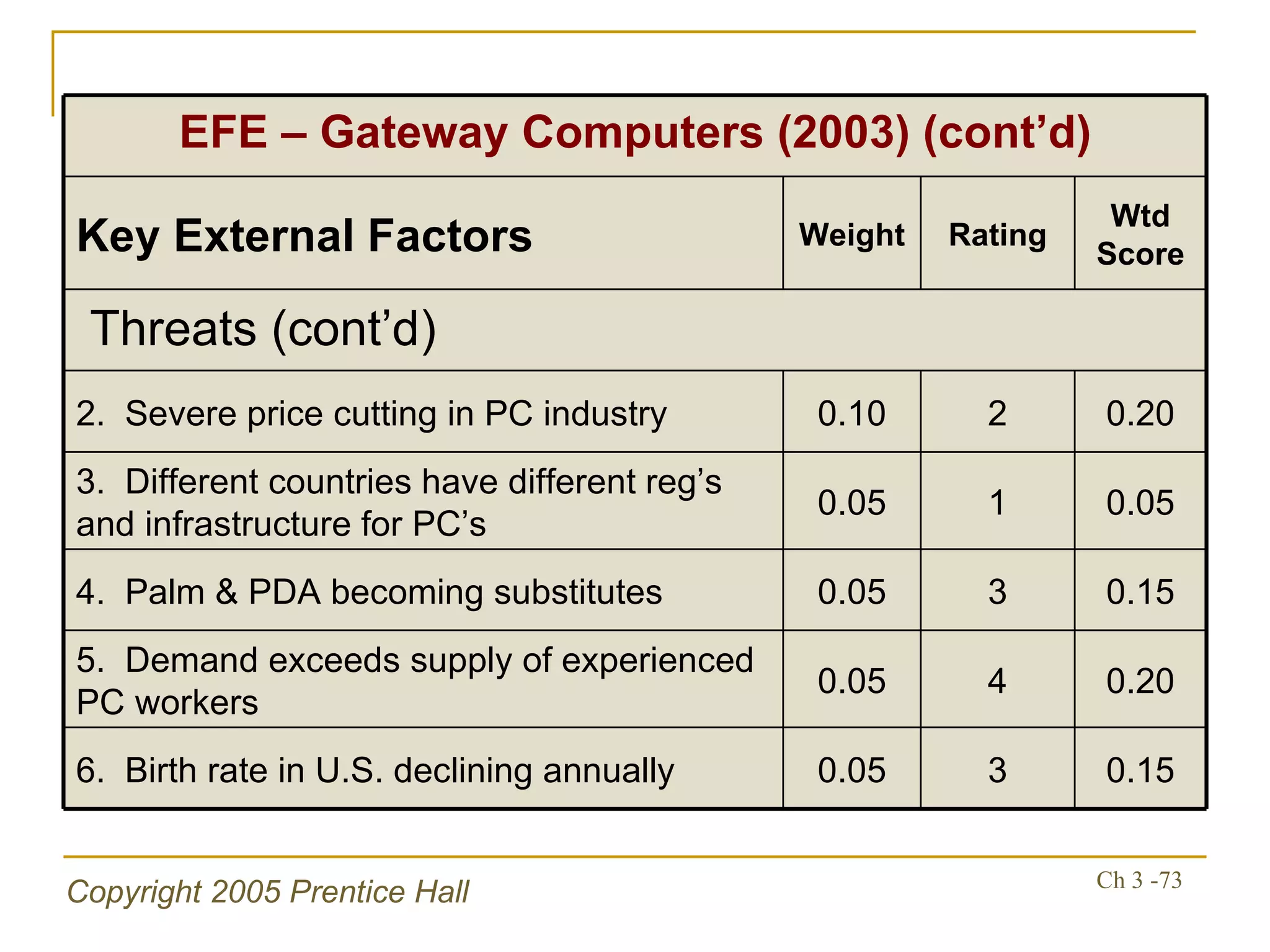
0.15 3 0.05 6.  Birth rate in U.S. declining annually 0.20 4 0.05 5.  Demand exceeds supply of experienced PC workers 0.15 3 0.05 4.  Palm & PDA becoming substitutes 0.05 1 0.05 3.  Different countries have different reg’s and infrastructure for PC’s 0.20 2 0.10 2.  Severe price cutting in PC industry Threats (cont’d) Wtd Score Rating Weight Key External Factors EFE – Gateway Computers (2003) (cont’d)
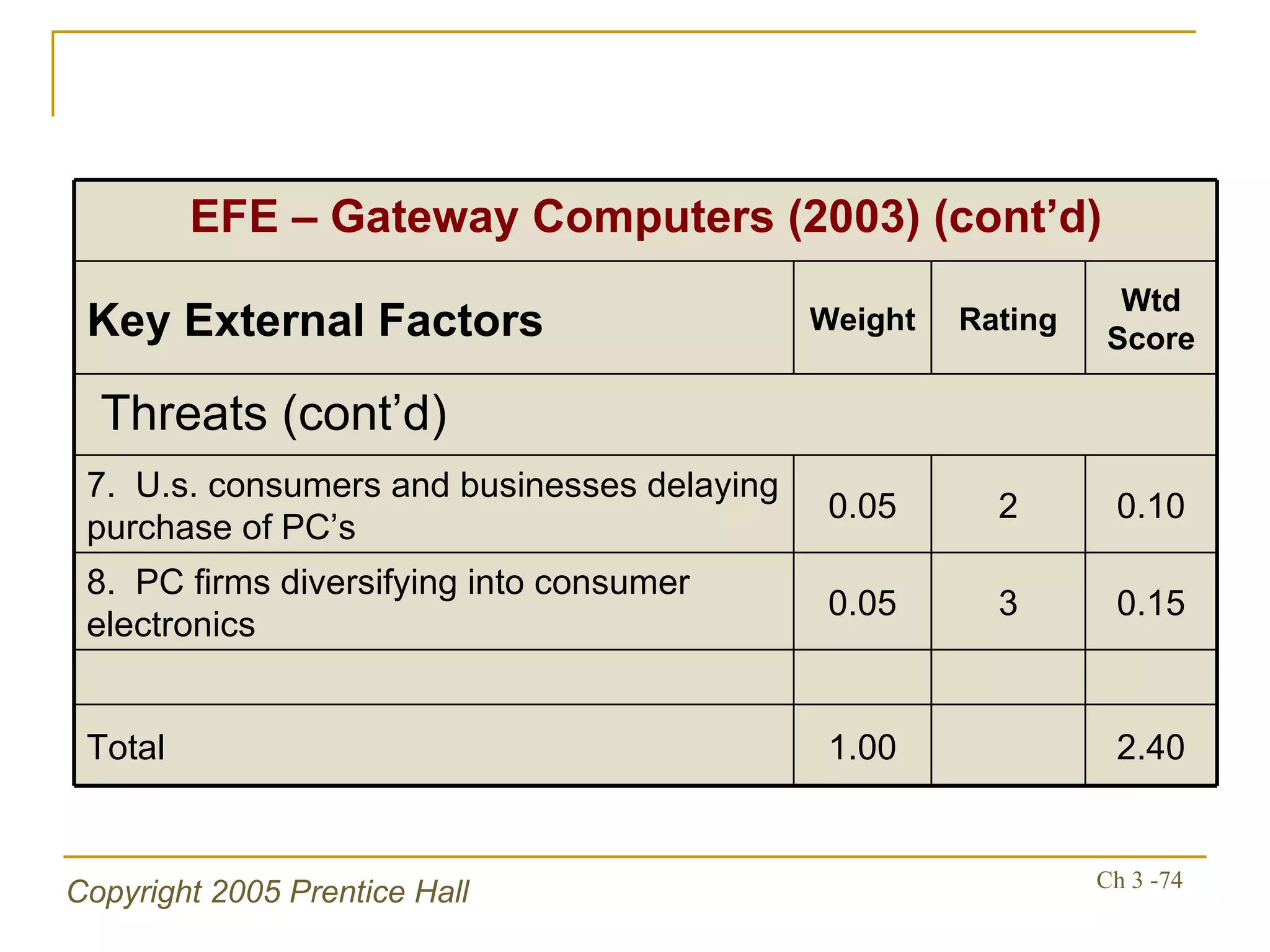
2.40 1.00 Total 0.15 3 0.05 8.  PC firms diversifying into consumer electronics 0.10 2 0.05 7.  U.s. consumers and businesses delaying purchase of PC’s Threats (cont’d) Wtd Score Rating Weight Key External Factors EFE – Gateway Computers (2003) (cont’d)
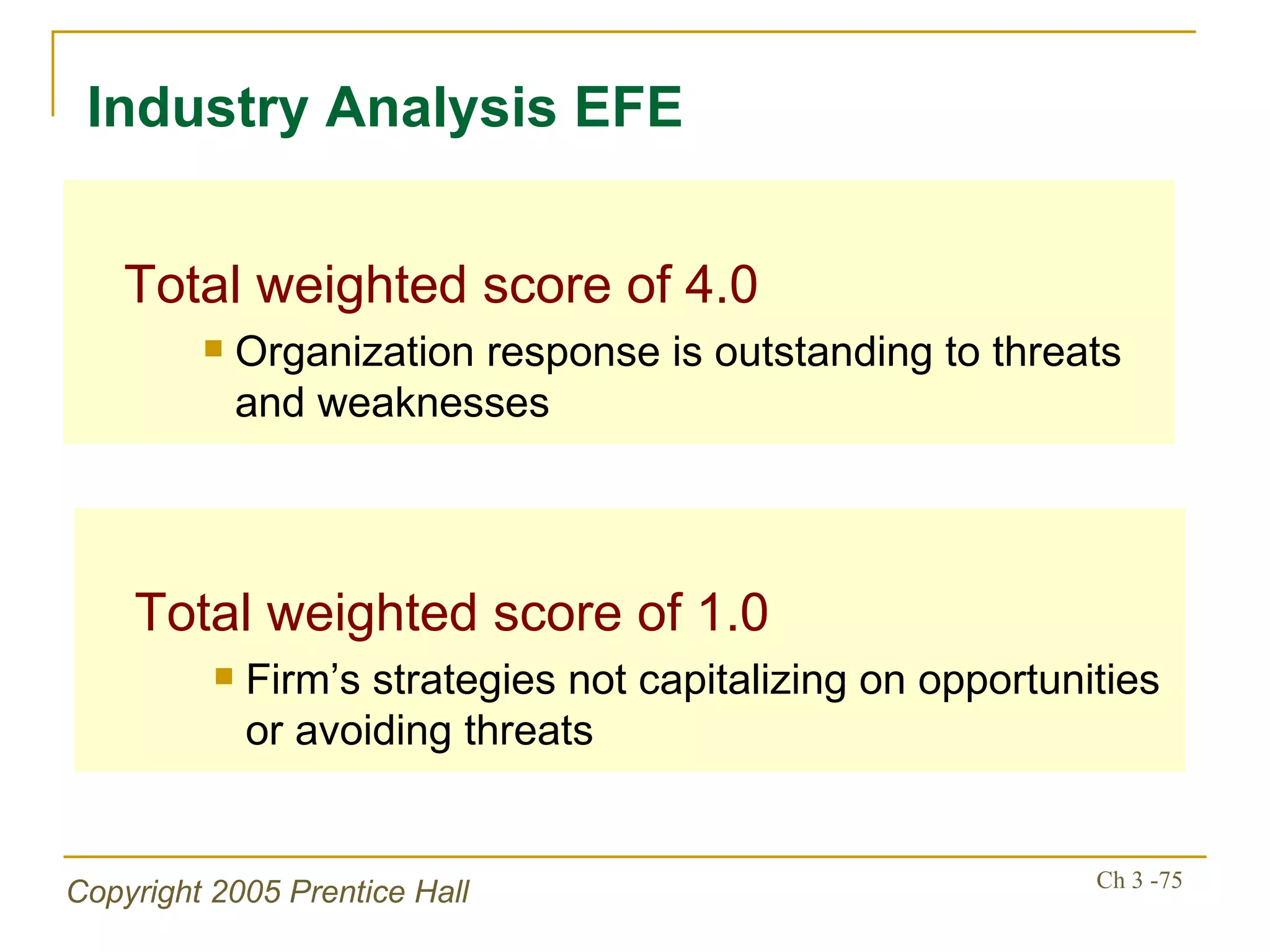
Total weighted score of 4.0 Organization response is outstanding to threats and weaknesses Industry Analysis EFE Total weighted score of 1.0 Firm’s strategies not capitalizing on opportunities or avoiding threats
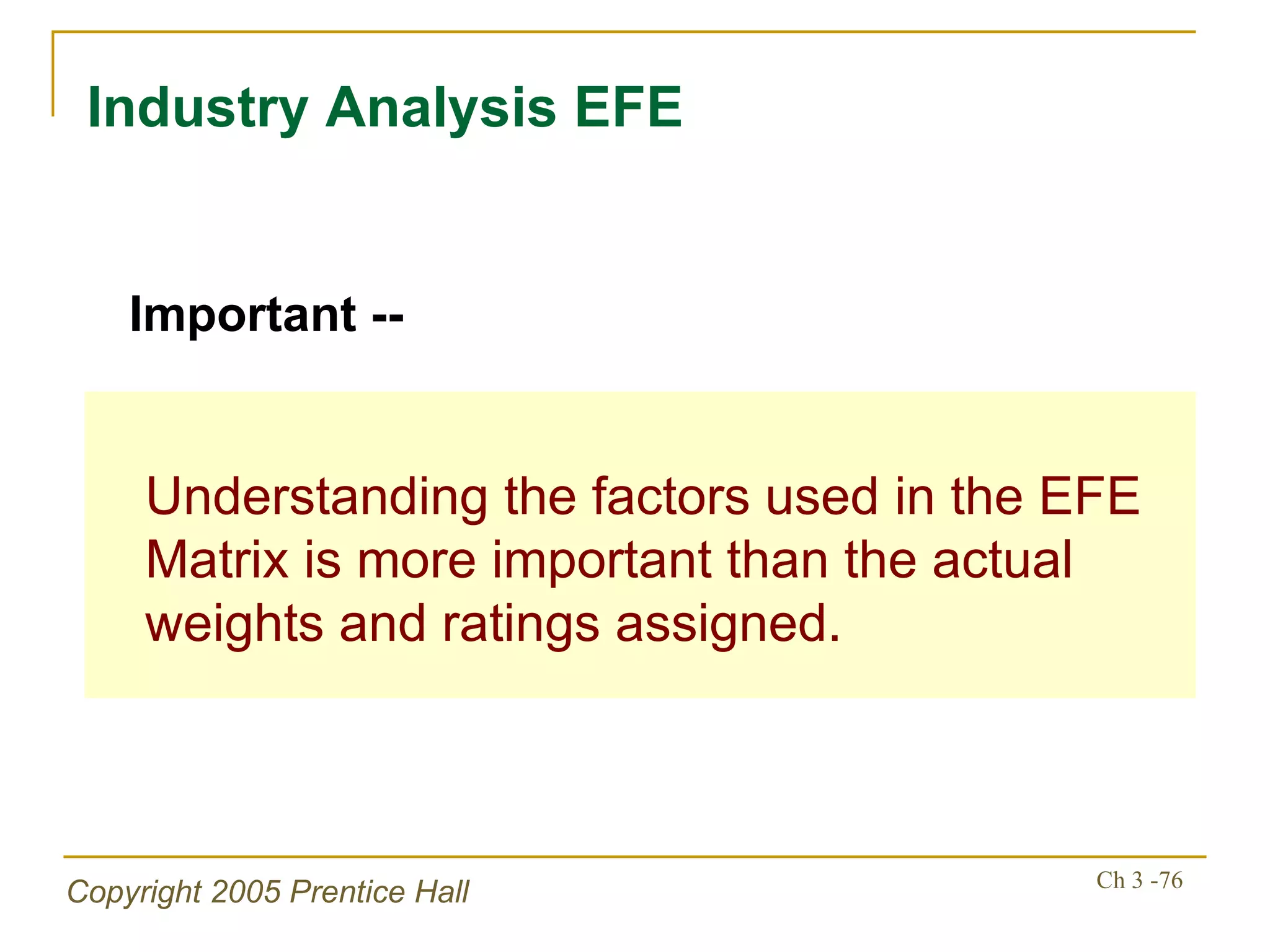
Industry Analysis EFE Understanding the factors used in the EFE Matrix is more important than the actual weights and ratings assigned. Important --
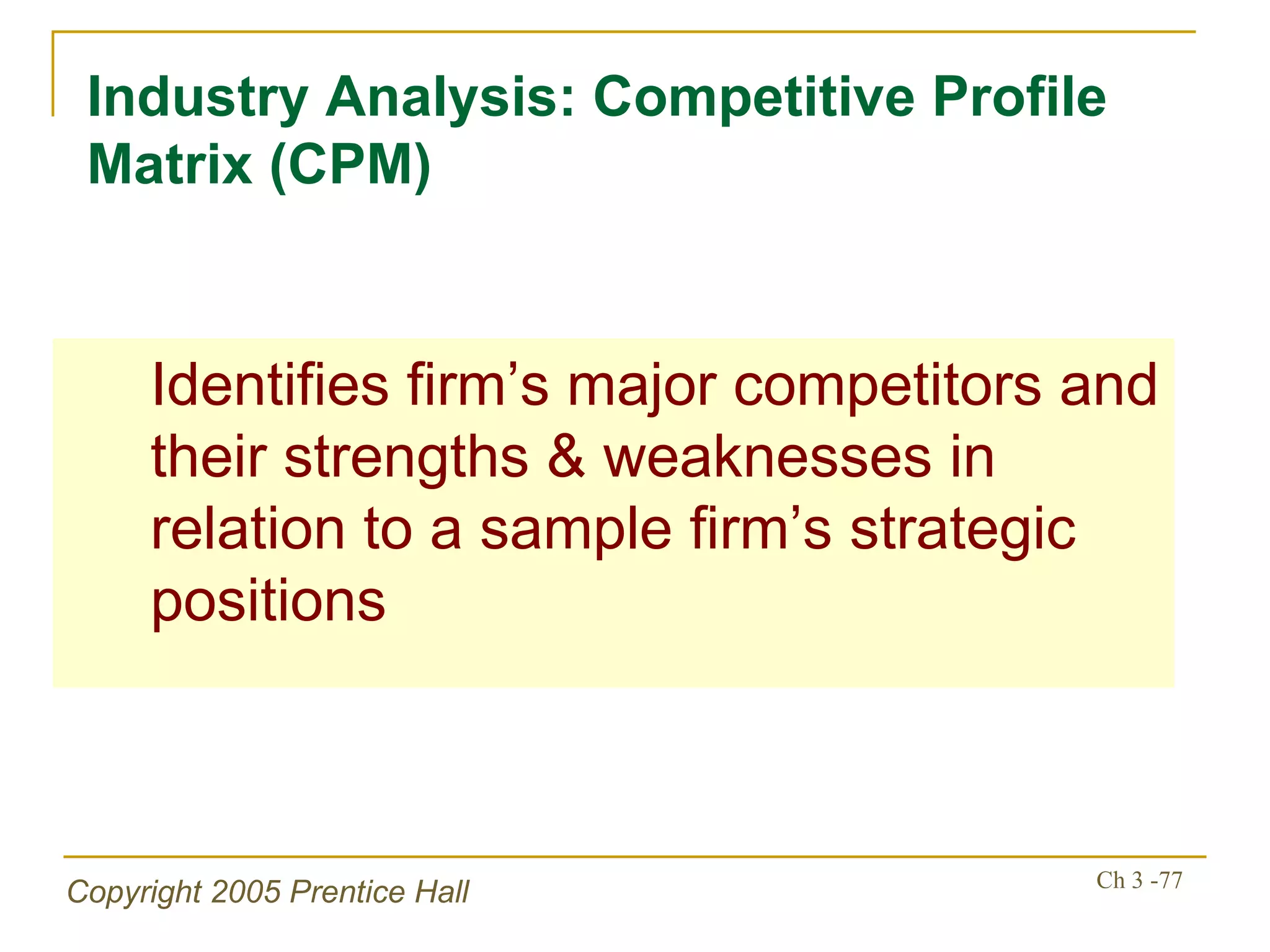
Industry Analysis: Competitive Profile Matrix (CPM) Identifies firm’s major competitors and their strengths & weaknesses in relation to a sample firm’s strategic positions
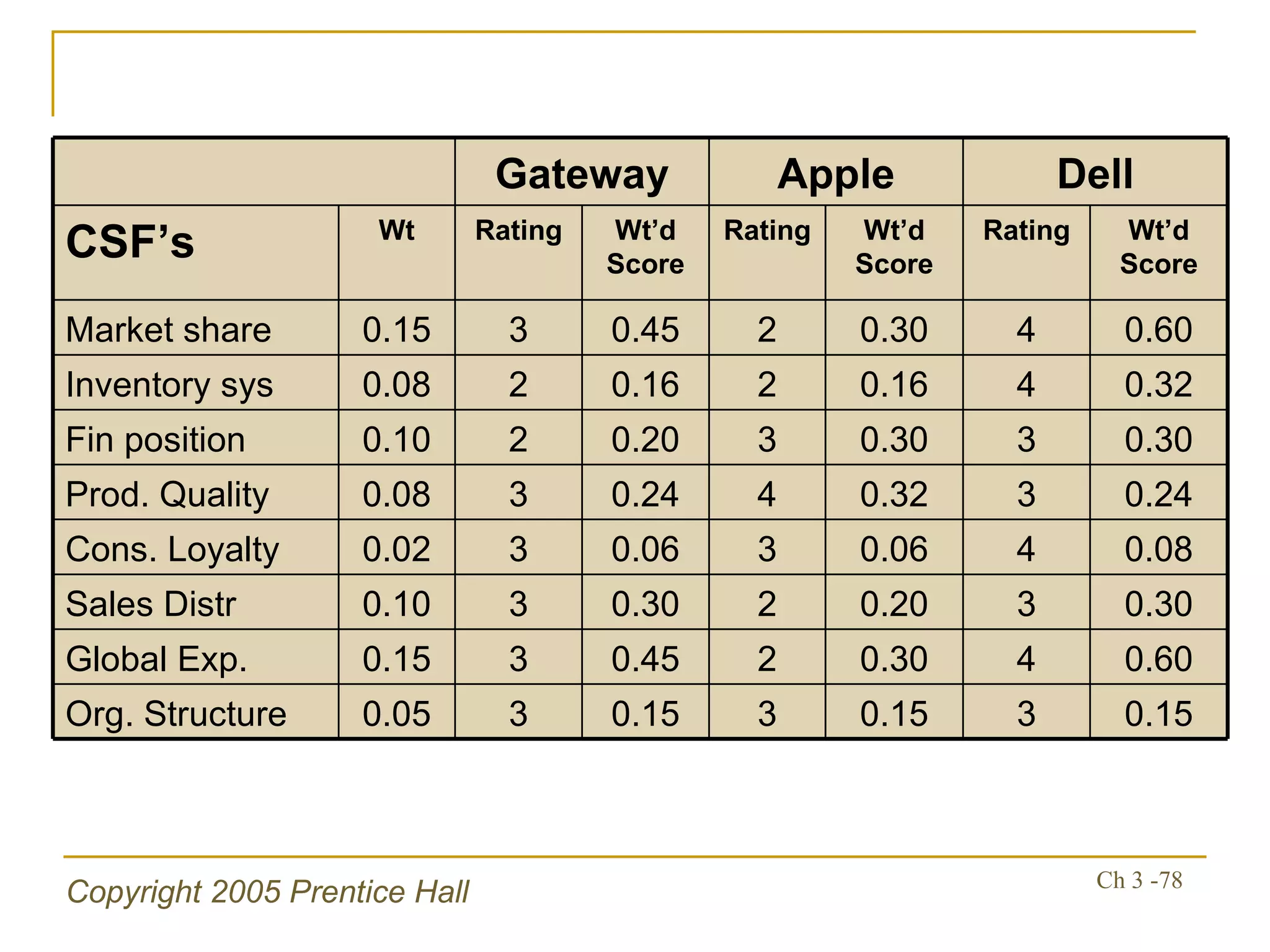
0.15 3 0.15 3 0.15 3 0.05 Org. Structure 0.60 4 0.30 2 0.45 3 0.15 Global Exp. 0.30 3 0.20 2 0.30 3 0.10 Sales Distr 0.08 4 0.06 3 0.06 3 0.02 Cons. Loyalty 0.24 3 0.32 4 0.24 3 0.08 Prod. Quality 0.30 3 0.30 3 0.20 2 0.10 Fin position 0.32 4 0.16 2 0.16 2 0.08 Inventory sys 0.60 4 0.30 2 0.45 3 0.15 Market share Wt’d Score Rating Wt’d Score Rating Wt’d Score Rating Wt CSF’s Dell Apple Gateway
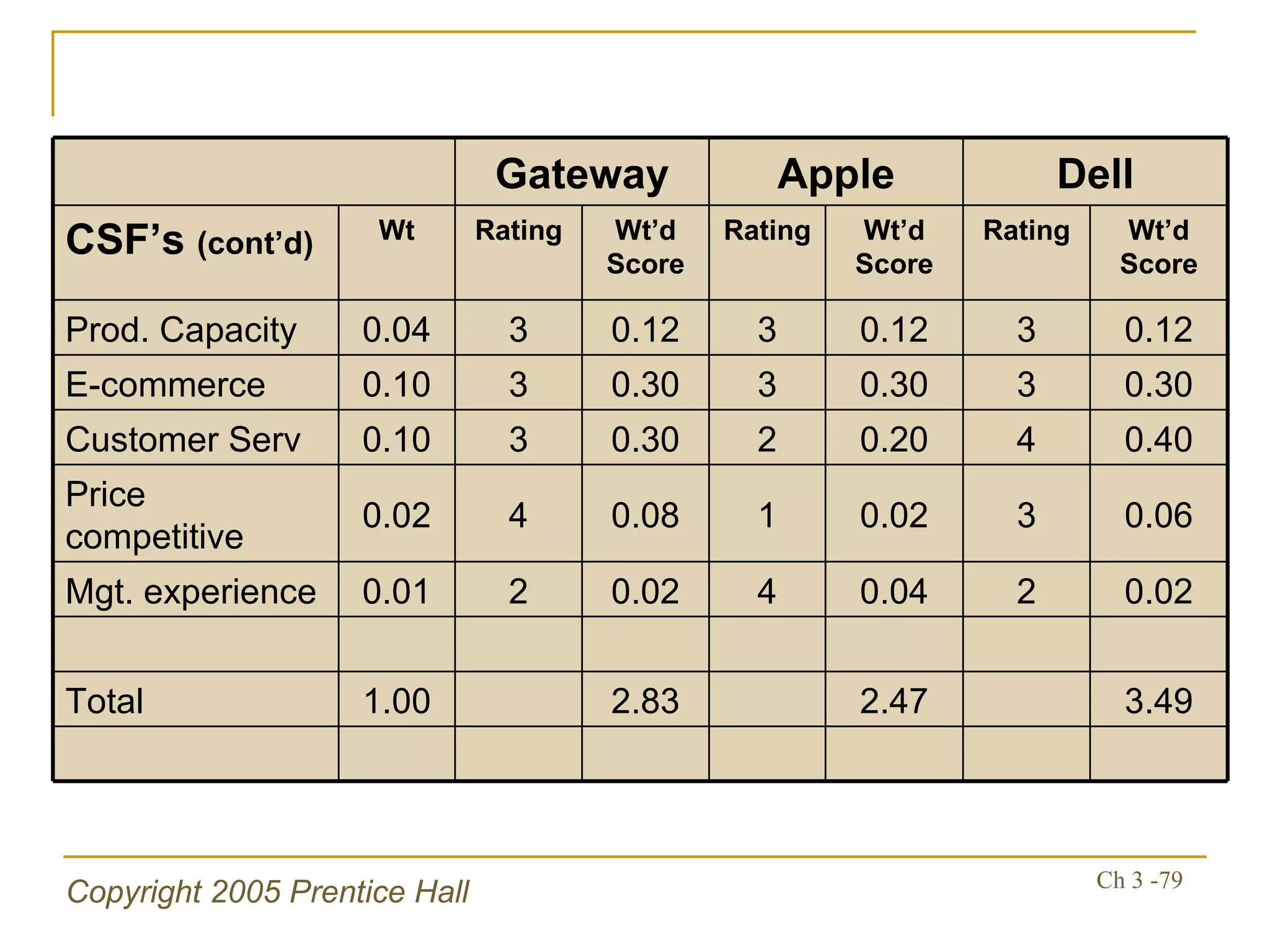
3.49 2.47 2.83 1.00 Total 0.02 2 0.04 4 0.02 2 0.01 Mgt. experience 0.06 3 0.02 1 0.08 4 0.02 Price competitive 0.40 4 0.20 2 0.30 3 0.10 Customer Serv 0.30 3 0.30 3 0.30 3 0.10 E-commerce 0.12 3 0.12 3 0.12 3 0.04 Prod. Capacity Wt’d Score Rating Wt’d Score Rating Wt’d Score Rating Wt CSF’s  (cont’d) Dell Apple Gateway
Industry Analysis CPM Just because one firm receives a 3.2 rating and another receives a 2.8 rating, it does not follow that the first firm is 20 percent better than the second.  Important --
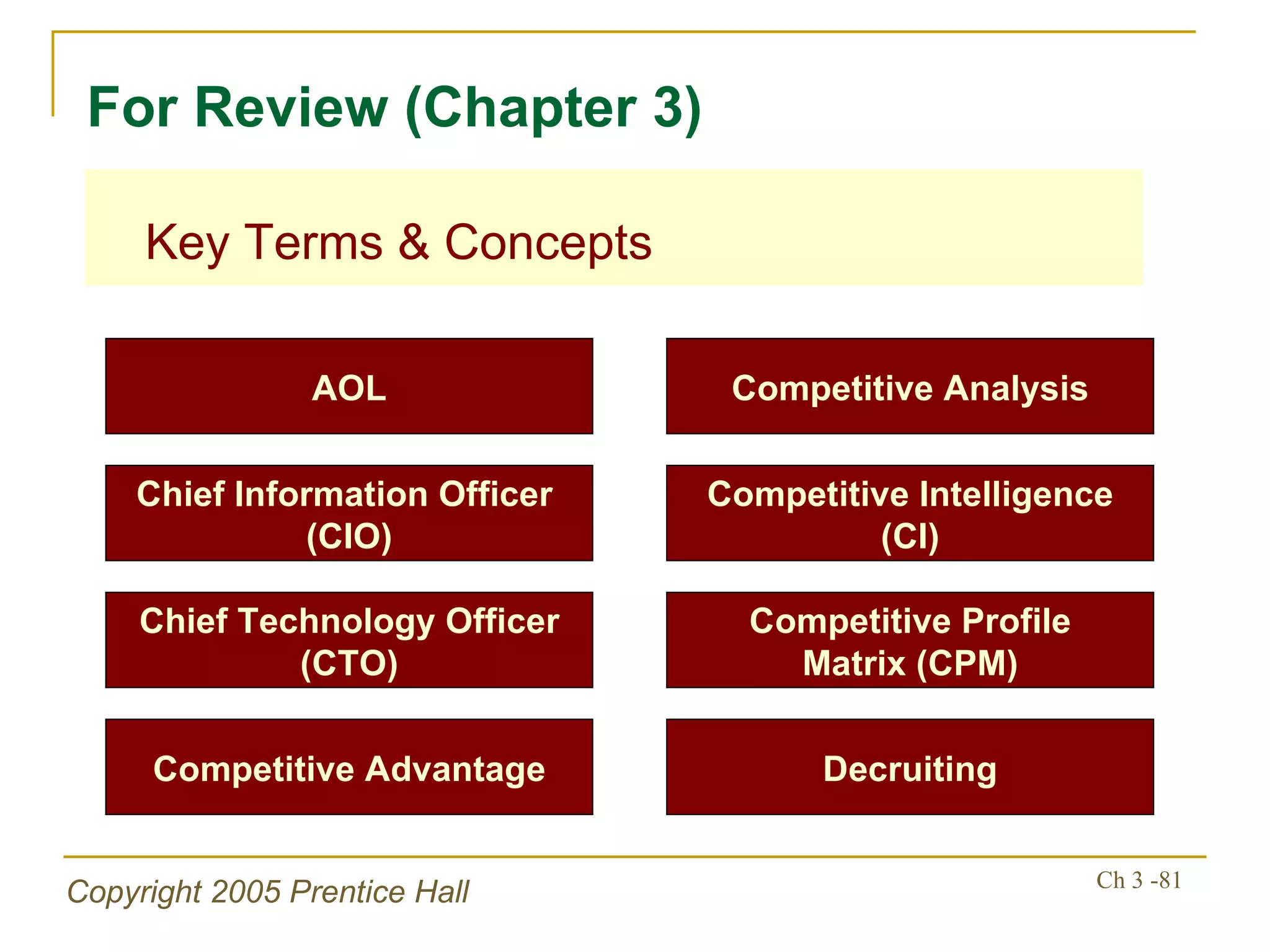
Key Terms & Concepts For Review (Chapter 3) AOL Competitive Analysis Chief Information Officer  (CIO) Competitive Intelligence (CI) Chief Technology Officer (CTO) Competitive Profile Matrix (CPM) Competitive Advantage Decruiting
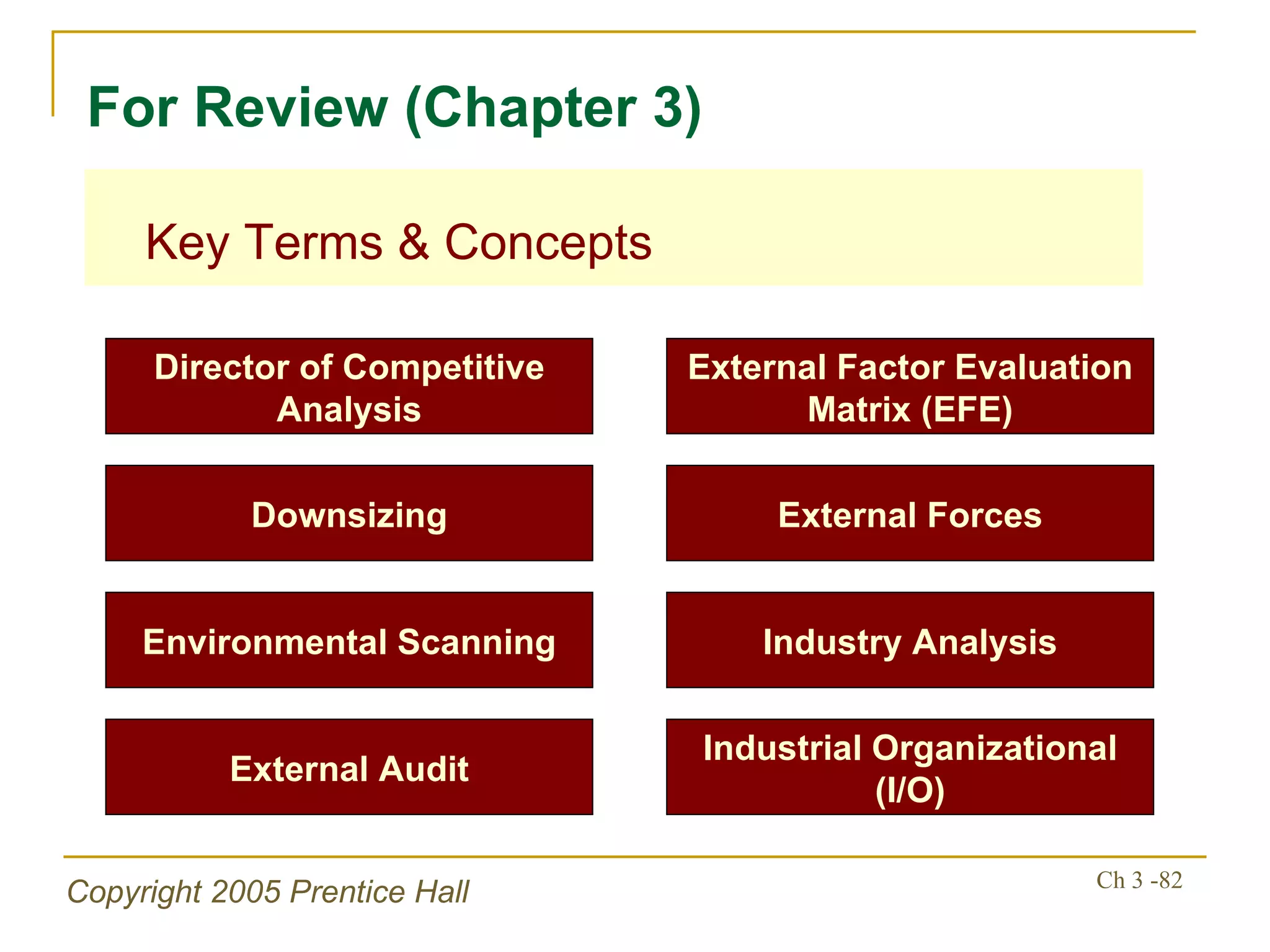
Key Terms & Concepts For Review (Chapter 3) Director of Competitive Analysis External Factor Evaluation Matrix (EFE) Downsizing External Forces Environmental Scanning Industry Analysis External Audit Industrial Organizational (I/O)
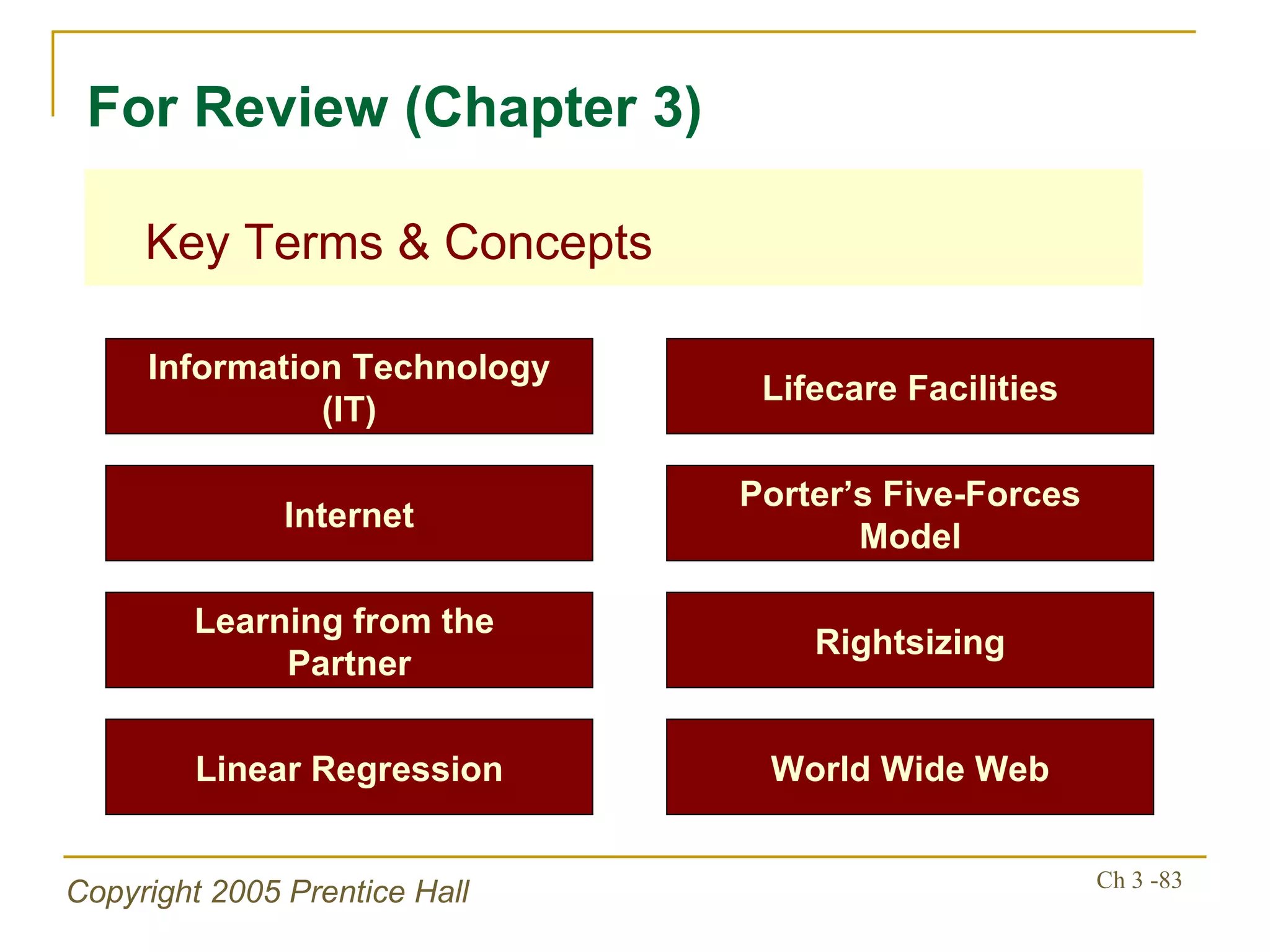
Key Terms & Concepts For Review (Chapter 3) Information Technology (IT) Lifecare Facilities Internet Porter’s Five-Forces Model Learning from the  Partner Rightsizing Linear Regression World Wide Web
Key Terms & Concepts For Review (Chapter 3) Tax Harmonization Foreign Direct Investment

The External Assessment

  • 1.
    Chapter 3 The External Assessment Strategic Management: Concepts & Cases 10 th Edition Fred David PowerPoint Slides by Anthony F. Chelte Western New England College
  • 2.
    Chapter Outline TheNature of the External Audit The Industrial Organization (I/O) View Social, Cultural, Demographic & Environmental Forces
  • 3.
    Chapter Outline (cont’d ) Political, Governmental, and Legal Forces Technological Forces Competitive Forces
  • 4.
    Chapter Outline (cont’d ) Porter’s Five-Forces Model Sources of External Information Forecasting Tools & Techniques
  • 5.
    Chapter Outline (cont’d ) Global Challenge The External Factor Evaluation (EFE) Matrix Competitive Profile Matrix (CPM)
  • 6.
    It is notthe strongest of the species that survive, nor the most intelligent, but the one most responsive to change. – Charles Darwin External Assessment Nothing focuses the mind better than the constant sight of a competitor who wants to wipe you off the map. – Wayne Calloway, Former CEO, PepsiCo
  • 7.
    -- Environmental Scanning-- Industry Analysis External Strategic Management Audit
  • 8.
    Identify & Evaluatefactors beyond the control of a single firm Increased foreign competition Population shifts Information technology External Strategic Management Audit
  • 9.
    Purpose of ExternalAudit Identify Opportunities Threats External Strategic Management Audit
  • 10.
    Key External ForcesEconomic forces Social, cultural, demographic & environmental forces Political, governmental & legal forces Technological forces Competitive forces
  • 11.
    Competitors Suppliers DistributorsCreditors Customers Employees Communities Managers Stockholders Labor Unions Special Interest Groups Products Services Key External Forces Opportunities & Threats Key External Forces & the Organization
  • 12.
    Gather competitive intelligence– Social Cultural Demographic Environmental Economic Political, legal governmental Technological External Audit
  • 13.
    External Audit –Sources of Information Internet Libraries Suppliers Distributors Customers Competition
  • 14.
    -- Key FactorsVary over time Vary by industry Performing External Audit
  • 15.
    Performing External Audit-- Variables Market share Breadth of competing products World economies Foreign affiliates Proprietary account advantages
  • 16.
    Performing External Audit-- Variables Price competitiveness Technological advancements Interest rates Pollution abatement
  • 17.
    Performing External AuditExternal Factors Measurable Long-term orientation Applicable to competing firms Hierarchical
  • 18.
    Industrial Organization (I/O)View -- Industry factors more important than internal factors Performance determined by industry forces
  • 19.
    Economies of ScaleIndustry Properties Barriers to market entry Product differentiation Level of competitiveness I/O Perspective Firm Performance
  • 20.
    Economic Forces Availabilityof credit Level of disposable income Interest rtes Inflation rates
  • 21.
    Economic Forces Moneymarket rates Fed Gov’t deficits GDP trend Consumption patterns
  • 22.
    Key Economic VariablesValue of the dollar in world markets Worker productivity levels Stock market trends Foreign economic conditions Unemployment trends
  • 23.
    Key Economic VariablesIncome differences by region/customer Demand shifts for goods/services Price fluctuations Exportation of labor and capital Import/Export factors
  • 24.
    Key Economic VariablesTax rates Fiscal policies OPEC policies ECC policies Monetary policies
  • 25.
    Social, Cultural, Demographic& Environmental Forces Major Impact – Products Services Markets Customers
  • 26.
    Social, Cultural, Demographic& Environmental Forces U.S. Facts Aging population Less Caucasian Widening gap between rich & poor 2025 = 18.5% population >65 years 2075 = no ethnic or racial majority
  • 27.
    Social, Cultural, Demographic& Environmental Forces Facts World population > 6 billion U.S. population < 300 million
  • 28.
    Social, Cultural, Demographic& Environmental Forces Population characteristics require global strategies
  • 29.
    Social, Cultural, Demographic& Environmental Forces Global trends 2003 – China largest exporter to U.S. 2003 Asia receives highest foreign direct investment
  • 30.
    Global trends China’slabor rates less than Mexico China provides more site location incentives than Mexico Social, Cultural, Demographic & Environmental Forces
  • 31.
    Export Trends Mexico-exportsto U.S. 1.2% growth (2002) China-exports to U.S. 19% growth (2002) Social, Cultural, Demographic & Environmental Forces
  • 32.
    Export Trends Mexico-corporateincome tax rate 34% China-corporate income tax rate 17% Social, Cultural, Demographic & Environmental Forces
  • 33.
    Social, Cultural, Demographic& Environmental Forces More educated consumers Aging population Minorities more influential Local rather than federal solutions 21 st Century Trends
  • 34.
    Social, Cultural, Demographic& Environmental Forces (cont’d) Fixation with youth decreasing Hispanics increase to 15% by 2021 African American increase to 14% by 2021 21 st Century Trends
  • 35.
    Key Social, Cultural,Demographic & Environmental Variables Number of marriages & divorces Number of special interest groups Number of births & deaths Immigration & emigration rates Childbearing rates
  • 36.
    Actuarial rates MonitorKey Variables Per capita income Attitudes toward business Avg. disposable income Social, Cultural, Demographic & Environmental Forces
  • 37.
    Consumer behavior MonitorKey Variables Ethical concerns Attitudes toward saving Racial equality Social, Cultural, Demographic & Environmental Forces
  • 38.
    Avg. educational levelMonitor Key Variables Governmental regulation Attitudes toward customer service Attitudes toward quality Social, Cultural, Demographic & Environmental Forces
  • 39.
    Energy conservation MonitorKey Variables Social responsibility Leisure time values Recycling Social, Cultural, Demographic & Environmental Forces
  • 40.
    Waste management MonitorKey Variables Air & water pollution Ozone depletion Endangered species Social, Cultural, Demographic & Environmental Forces
  • 41.
    Political, Government &Legal Forces Key opportunities & threats Antitrust legislation Tax rates Lobbying efforts Patent laws Government Regulation
  • 42.
    Political, Government &Legal Forces Political variables impact – Formulation of strategies Implementation of strategies Increasing Global Interdependence
  • 43.
    Political, Government &Legal Forces Strategists in a global economy -- Forecast political climates Legalistic skills Diverse world cultures Increasing Global Interdependence
  • 44.
    Political, Government &Legal Forces Worldwide trend toward similar consumption patterns Global buyers and sellers E-commerce Technology for instant currency transfers Globalization of Industry
  • 45.
    Key Political, Governmental,& Legal Variables Special tariffs Tax law changes PAC’s Voter participation rates Regulation/deregulation
  • 46.
    Key Political, Governmental,& Legal Variables (cont’d) Environmental protection laws Changes in patent laws Equal employment legislation Government subsidies Number of patents
  • 47.
    Key Political, Governmental,& Legal Variables (cont’d) Import/export regulations Global relationships Political conditions Location and severity of terrorist activity Anti-trust enforcement
  • 48.
    Technological Forces MajorImpact – Internet Communications Semiconductors
  • 49.
    Technological Forces Significanceof IT Chief Information Officer (CIO) Chief Technology Officer (CTO)
  • 50.
    Technological Forces Essentialfor nearly every strategic decision Technology-based issues
  • 51.
    Competitive Forces Collection& evaluation of data on competitors is essential for successful strategy formulation
  • 52.
    Competitive Forces Competitionon virtually all industries can be described as intense.
  • 53.
    Competitive Forces StrengthsWeaknesses Capabilities Opportunities Threats Objectives Strategies Identifying Rival Firms
  • 54.
    Key Questions ConcerningCompetitors Their objectives and strategies Their weaknesses Their responses to external variables Their vulnerability to our alternative strategies Their strengths
  • 55.
    Key Questions ConcerningCompetitors (cont’d) Entry and exit of firms in the industry Our product/service positioning Key factors for our current position in industry Sales/profit rankings of competitors over time Our vulnerability to strategic counterattack
  • 56.
    Key Questions ConcerningCompetitors (cont’d) The threat of substitute products/services Nature of supplier & distributor relationships Should we keep our strategies secret from employees and stakeholders?
  • 57.
    Competitive Forces Moody’sManuals Standard Corporation Descriptions Value Line Investment Surveys Dun’s Business Rankings Standard & Poor’s Industry Surveys Industry Week Forbes, Fortune, Business Week Sources of Corporate Information
  • 58.
    Competitive Forces Marketshare matters Understand what business you are in Broke or not, fix it Innovate or evaporate 7 Characteristics of most Competitive U.S. Firms:
  • 59.
    Competitive Forces Acquisitionis essential to growth People make a difference No substitute for quality 7 Characteristics of most Competitive U.S. Firms:
  • 60.
    The Five-Forces Modelof Competition Potential development of substitute products Rivalry among competing firms Bargaining power of suppliers Potential entry of new competitors Bargaining power of consumers
  • 61.
    The Five-Forces ModelMost powerful of the five forces Focus on competitive advantage of strategies Rivalry Among Competing Firms
  • 62.
    The Five-Forces ModelBarriers to entry are important Quality, pricing, and marketing can overcome barriers Potential Entry of New Competitors
  • 63.
    The Five-Forces ModelPressures increase when consumer’s switching costs decrease Firm’s plans for increased capacity & market penetration Potential Development of Substitute Products
  • 64.
    The Five-Forces ModelLarge number of suppliers & few substitutes affects intensity of competition Backward integration can gain control or ownership of suppliers Bargaining Power of Suppliers
  • 65.
    The Five-Forces ModelCustomers concentrated or buy in volume affects intensity of competition Consumer power is higher where products are standard or undifferentiated Bargaining Power of Consumers
  • 66.
    The Global ChallengeFaced by U.S. Firms -- Gain & maintain exports to other nations Defend domestic markets against imported goods
  • 67.
    The Global ChallengeSimultaneously globally competitive & nationally responsive Multinational Corporations (MNC’s)
  • 68.
    The Global ChallengeWorldwide integration of: Strategy formulation Strategy implementation Strategy evaluation Globalization
  • 69.
    The Global ChallengeSimilar consumption patterns Global buyers and sellers E-commerce Instant transmission of money & information Globalization of Industries
  • 70.
    Industry Analysis: TheExternal Factor Evaluation (EFE) Matrix Summarize & Evaluate Competitive Political Cultural Technological Environmental Social Governmental Demographic Economic
  • 71.
    0.15 3 0.055. The average income for PC worker has declined from $40K/yr to $30k/yr 0.10 1 0.10 4. China entered WTO; lowered taxes for importing PC’s 0.10 2 0.05 3. Internet use growing rapidly 0.30 3 0.10 2. Cost of PC component parts expected to decrease 10% - 2004 0.30 3 0.10 1. Global PC market expected to grow 20% in 2004 Opportunities Wtd Score Rating Weight Key External Factors EFE – Gateway Computers (2003)
  • 72.
    0.05 1 0.101. Intense rivalry in industry 0.10 1 0.10 Threats 0.05 1 0.05 8. 30% of Chinese population can afford a PC; only 10% of homes have a PC 0.15 3 0.05 7. U.S. (& world) economies recovering 0.10 2 0.05 6. Modernization of business firms and government agencies Opportunities (cont’d) Wtd Score Rating Weight Key External Factors EFE – Gateway Computers (2003) (cont’d)
  • 73.
    0.15 3 0.056. Birth rate in U.S. declining annually 0.20 4 0.05 5. Demand exceeds supply of experienced PC workers 0.15 3 0.05 4. Palm & PDA becoming substitutes 0.05 1 0.05 3. Different countries have different reg’s and infrastructure for PC’s 0.20 2 0.10 2. Severe price cutting in PC industry Threats (cont’d) Wtd Score Rating Weight Key External Factors EFE – Gateway Computers (2003) (cont’d)
  • 74.
    2.40 1.00 Total0.15 3 0.05 8. PC firms diversifying into consumer electronics 0.10 2 0.05 7. U.s. consumers and businesses delaying purchase of PC’s Threats (cont’d) Wtd Score Rating Weight Key External Factors EFE – Gateway Computers (2003) (cont’d)
  • 75.
    Total weighted scoreof 4.0 Organization response is outstanding to threats and weaknesses Industry Analysis EFE Total weighted score of 1.0 Firm’s strategies not capitalizing on opportunities or avoiding threats
  • 76.
    Industry Analysis EFEUnderstanding the factors used in the EFE Matrix is more important than the actual weights and ratings assigned. Important --
  • 77.
    Industry Analysis: CompetitiveProfile Matrix (CPM) Identifies firm’s major competitors and their strengths & weaknesses in relation to a sample firm’s strategic positions
  • 78.
    0.15 3 0.153 0.15 3 0.05 Org. Structure 0.60 4 0.30 2 0.45 3 0.15 Global Exp. 0.30 3 0.20 2 0.30 3 0.10 Sales Distr 0.08 4 0.06 3 0.06 3 0.02 Cons. Loyalty 0.24 3 0.32 4 0.24 3 0.08 Prod. Quality 0.30 3 0.30 3 0.20 2 0.10 Fin position 0.32 4 0.16 2 0.16 2 0.08 Inventory sys 0.60 4 0.30 2 0.45 3 0.15 Market share Wt’d Score Rating Wt’d Score Rating Wt’d Score Rating Wt CSF’s Dell Apple Gateway
  • 79.
    3.49 2.47 2.831.00 Total 0.02 2 0.04 4 0.02 2 0.01 Mgt. experience 0.06 3 0.02 1 0.08 4 0.02 Price competitive 0.40 4 0.20 2 0.30 3 0.10 Customer Serv 0.30 3 0.30 3 0.30 3 0.10 E-commerce 0.12 3 0.12 3 0.12 3 0.04 Prod. Capacity Wt’d Score Rating Wt’d Score Rating Wt’d Score Rating Wt CSF’s (cont’d) Dell Apple Gateway
  • 80.
    Industry Analysis CPMJust because one firm receives a 3.2 rating and another receives a 2.8 rating, it does not follow that the first firm is 20 percent better than the second. Important --
  • 81.
    Key Terms &Concepts For Review (Chapter 3) AOL Competitive Analysis Chief Information Officer (CIO) Competitive Intelligence (CI) Chief Technology Officer (CTO) Competitive Profile Matrix (CPM) Competitive Advantage Decruiting
  • 82.
    Key Terms &Concepts For Review (Chapter 3) Director of Competitive Analysis External Factor Evaluation Matrix (EFE) Downsizing External Forces Environmental Scanning Industry Analysis External Audit Industrial Organizational (I/O)
  • 83.
    Key Terms &Concepts For Review (Chapter 3) Information Technology (IT) Lifecare Facilities Internet Porter’s Five-Forces Model Learning from the Partner Rightsizing Linear Regression World Wide Web
  • 84.
    Key Terms &Concepts For Review (Chapter 3) Tax Harmonization Foreign Direct Investment