Group Members:
Ahmad Rif’at Bin Abdul Rahman
Mohamad Aizuddin Bin Abu Bakar
2011778845
Muhamad Zikrullah Bin Bahrunnizam
2011789027
Muhamad Shakir Bin Mohd Samsuri
2011503187

2011120835

Date of Presentation:
6th Oct 2013
1
3.1 Nature of an External Audit
 Purpose: To develop a finite list of opportunities that could
benefit a firm & threats that should be avoided.
 Not aimed at developing an exhaustive list of every possible
factor that could be influence the business, rather;
 Aimed at identifying key variables that offer actionable
responses.
 Firms should be able to respond either offensively or
defensively to the factors…HOW??
 By formulating strategies that take advantage of external
opportunities or that minimize the impact of potential threats.
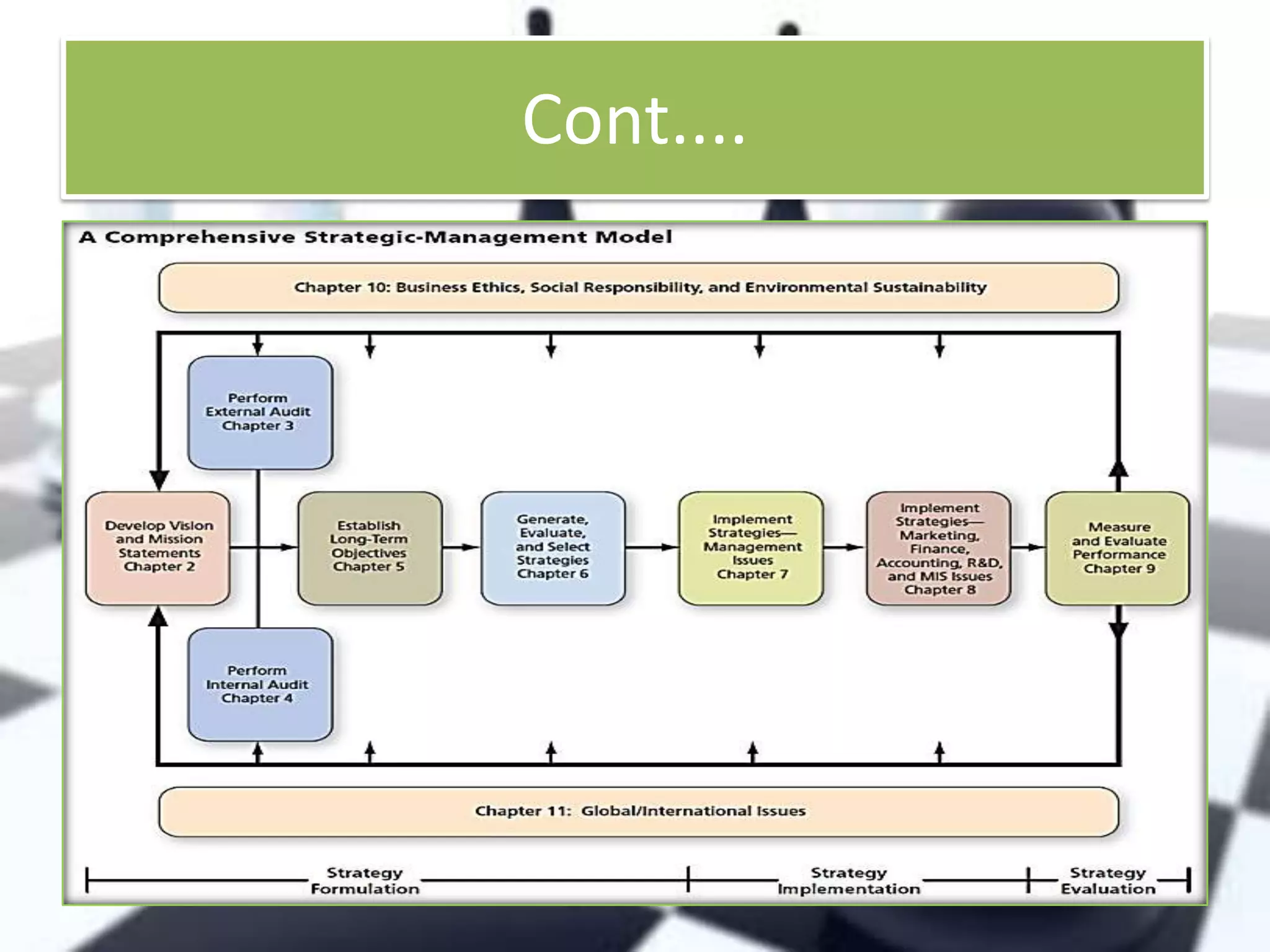
Cont....
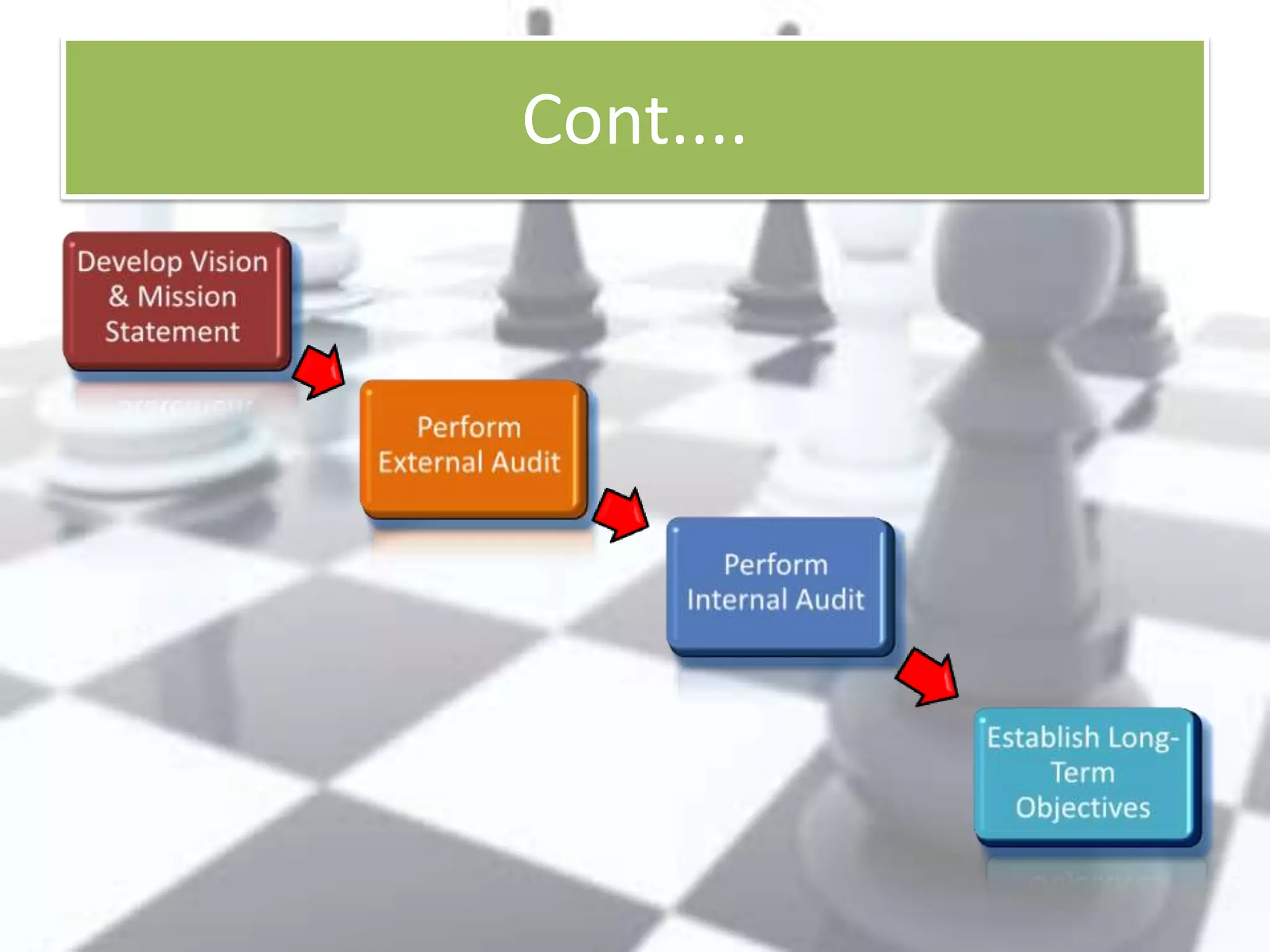
Cont....
3.2 The Process of Performing an
External Audit
Must involves as many managers & employees
WHY ???
o Lead to understanding & commitment from
organizational members
o Appreciate having the opportunity to contribute
ideas
o To gain a better understanding of their firm’s
industry, competitors, and markets
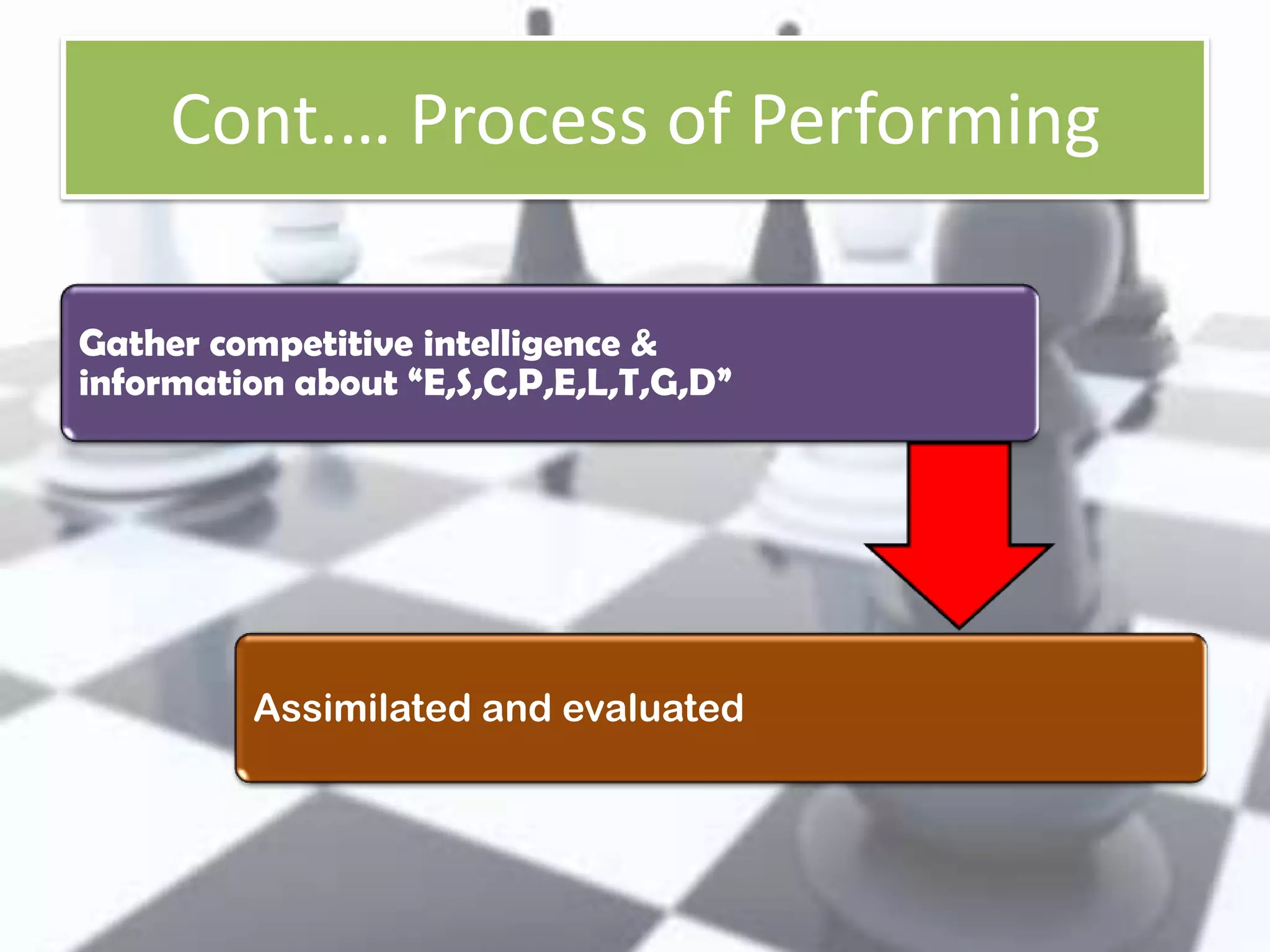
Cont.… Process of Performing
Gather competitive intelligence &
information about “E,S,C,P,E,L,T,G,D”

Assimilated and evaluated
Cont.…
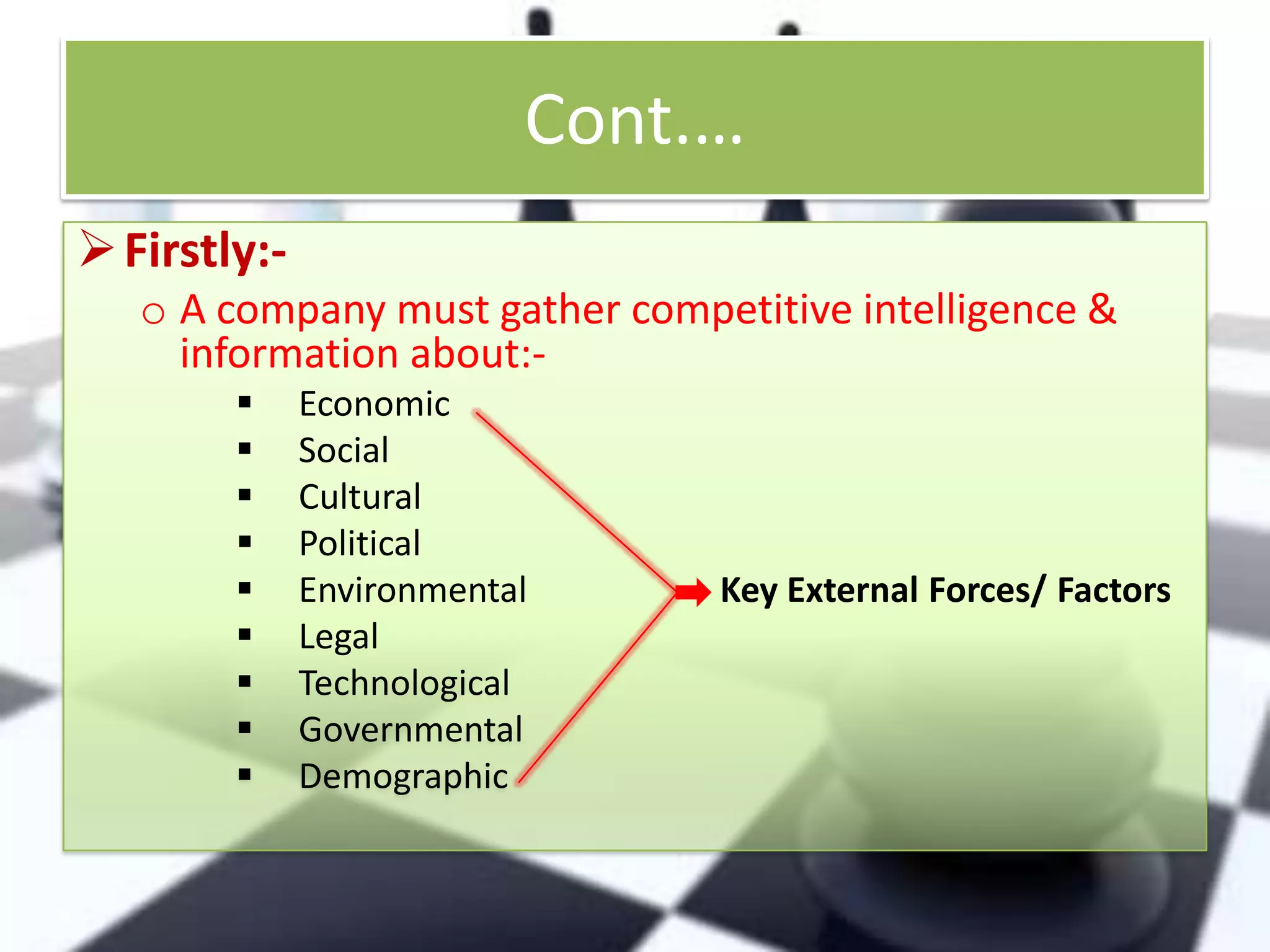
 Firstly:o A company must gather competitive intelligence &
information about:









Economic
Social
Cultural
Political
Environmental
Legal
Technological
Governmental
Demographic

Key External Forces/ Factors
Cont.…
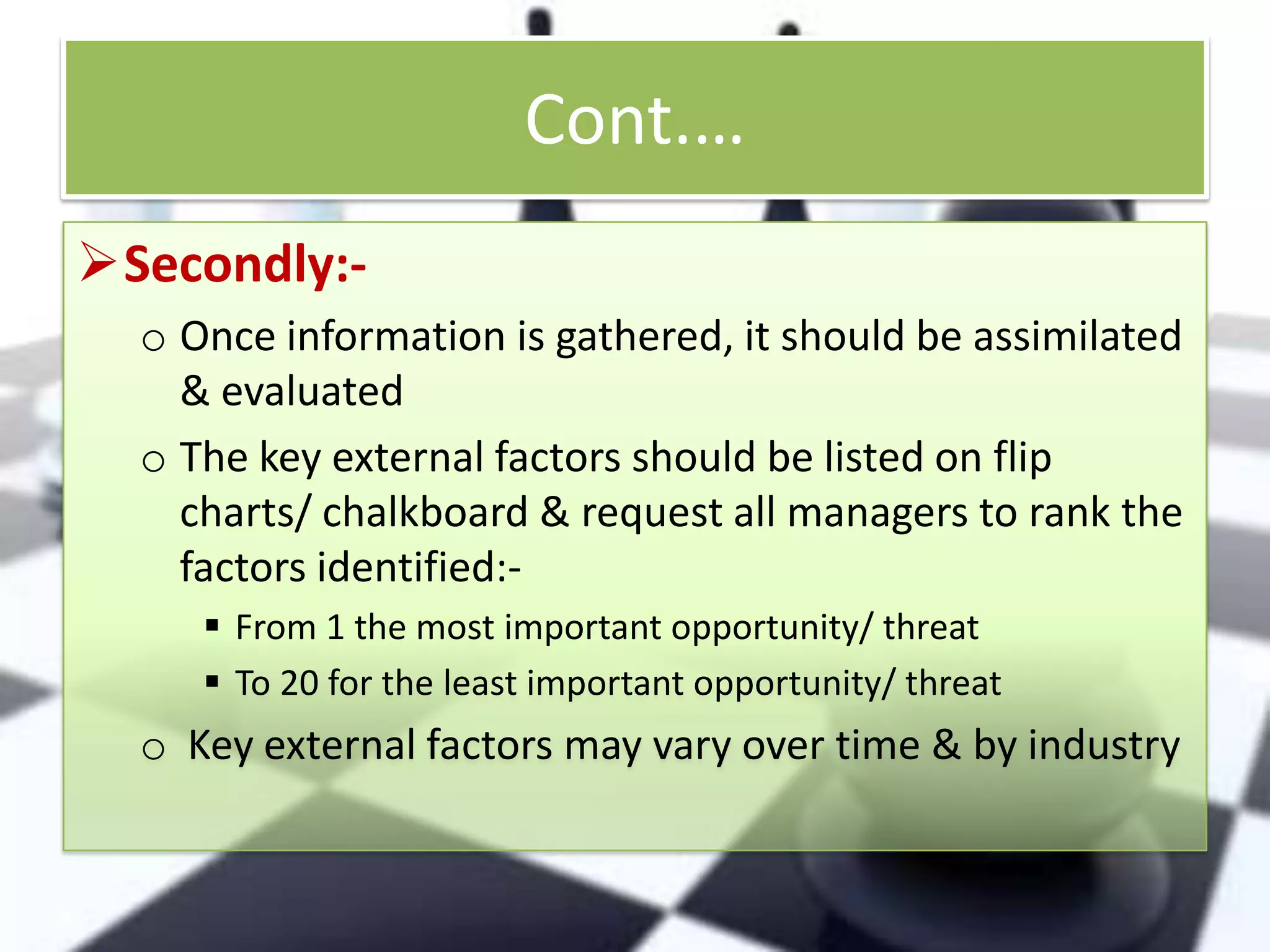
Secondly:o Once information is gathered, it should be assimilated
& evaluated
o The key external factors should be listed on flip
charts/ chalkboard & request all managers to rank the
factors identified: From 1 the most important opportunity/ threat
 To 20 for the least important opportunity/ threat

o Key external factors may vary over time & by industry
Cont.…
o The variables commonly used include:











Market share
Breadth of competitive products
World economies
Foreign affiliates
Proprietary & key account advantages
Price competitiveness
Technological advancement
Population shifts
Interest rates
Pollution abatement but…
The relationship with suppliers/ distributors are often a
critical success factor
Cont.…
o These key external factors should be:




Important to achieving long-term & annual objectives
Measurable
Applicable to all competing firms
Hierarchical in the sense that some will pertain to the overall
company & others will be more narrowly focused on
functional/ divisional areas
 Communicated & distributed widely in the organization
Key External Factors
The Industrial Organization (I/O) View
The Industrial Organization (I/O) approach
to competitive advantage advocates that
external (industry) factors are more
important than internal factors in a firm for
achieving competitive advantage.

3-11
Economic Forces
• Have a direct impact on the potential attractiveness of
various strategies.
• Also cause discretionary income decline and the demand for
discretionary goods falls.
• It is also when the market rises, consumer business wealth
will expands.
• Key Economic Variable To Be Monitored.:
 Interest Rate
 Inflation Rates
 Unemployment Trend
 Import /Export factors
 Fiscal Policy
 Monetary Policy
3-12
Social, Cultural, Demographic, and Natural
Environmental Forces
• Changes in social, culture, demography &
environmental tends are shaping the way
American live, work, produce and
consume.
• When new trends are creating a different
type of consumer and consequently, a
need for different product, services and
strategies.
3-13
Political, Governmental, and Legal
Forces
The increasing global interdependence
among economies, markets, governments,
and organizations makes it imperative that
firms consider the possible impact of political
variables on the formulation and
implementation of competitive strategies.
Represented a key of opportunities or threats
for both small & large organizations.

3-14
Technological Forces
 The Internet has changed the very nature of
opportunities and threats by:
–Transform the life cycles of products,
–increasing the speed of distribution,
–creating new products and services,
–erasing limitations of traditional geographic markets,
–changing the historical trade-off between production
standardization and flexibility.

 The Internet is altering economies of scale, changing
entry barriers, and redefining the relationship between
industries and various suppliers, creditors, customers,
and competitors
3-15
Competitive Forces
 An important part of an external audit is identifying rival firms
and determining their strengths, weaknesses, capabilities,
opportunities, threats, objectives, and strategies
 Characteristics of the most competitive companies:
1.Market share matters
2.Understand and remember precisely what business you are in
3.Whether it’s broke or not, fix it–make it better
4.Innovate or evaporate
5.Acquisition is essential to growth
6.People make a difference
7.There is no substitute for quality

3-16
Competitive Intelligence Programs
• Competitive intelligence (CI)
– a systematic and ethical process for gathering and
analyzing information about the competition’s
activities and general business trends to further a
business’s own goals

The three basic objectives of a CI program are:
1. to provide a general understanding of an industry and its
competitors
2. to identify areas in which competitors are vulnerable and to
assess the impact strategic actions would have on
competitors
3. to identify potential moves that a competitor might
make that would endanger a firm’s position in the
market
3-17
Sources of External Information
• Unpublished sources include customer
surveys, market research, speeches at
professional and shareholders’ meetings,
television programs, interviews, and
conversations with stakeholders.
• Published sources of strategic information
include periodicals, journals, reports,
government documents, abstracts, books,
directories, newspapers, and manuals.

3-18
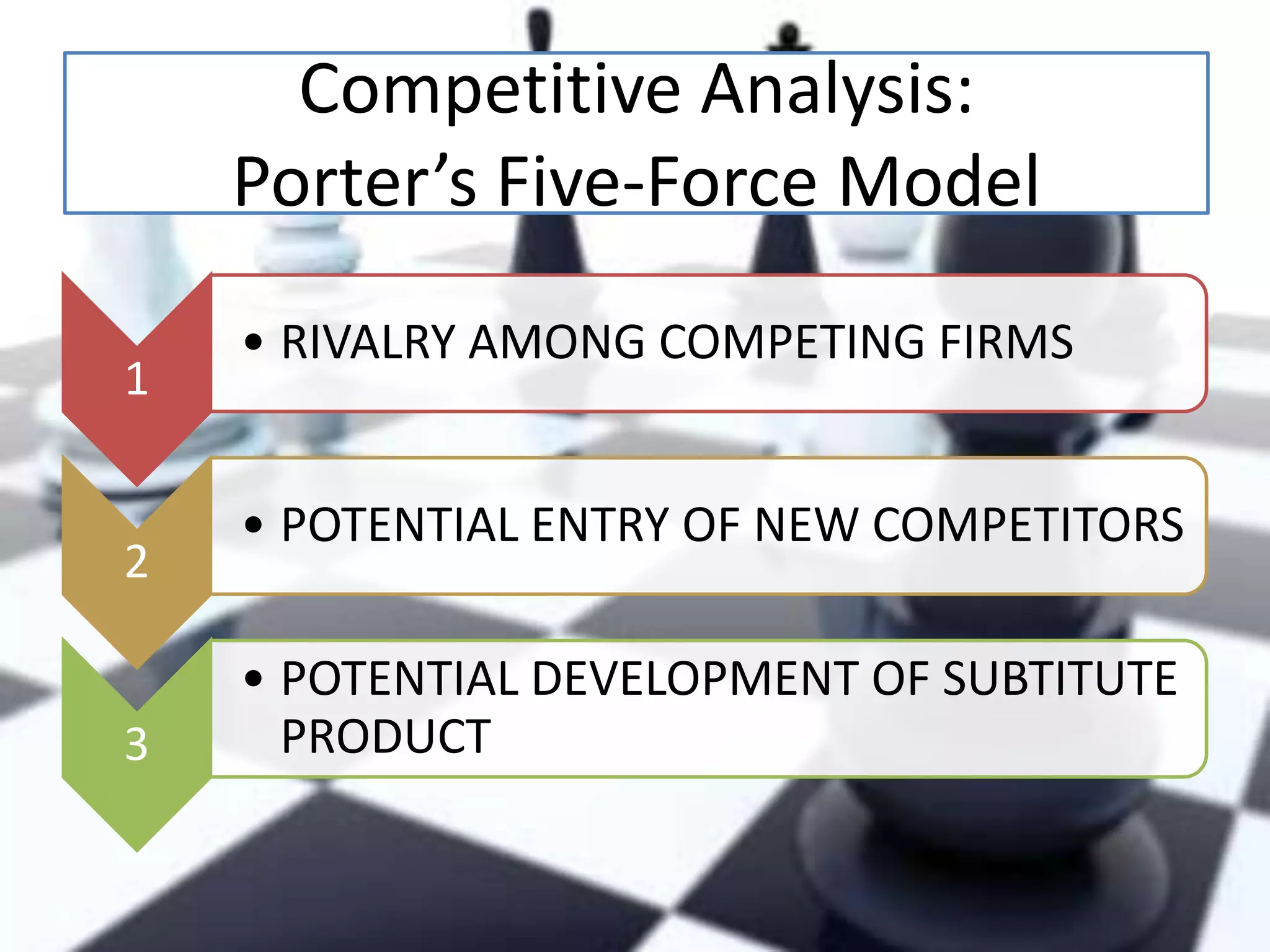
Competitive Analysis:
Porter’s Five-Force Model
1

2

3

• RIVALRY AMONG COMPETING FIRMS
• POTENTIAL ENTRY OF NEW COMPETITORS
• POTENTIAL DEVELOPMENT OF SUBTITUTE
PRODUCT
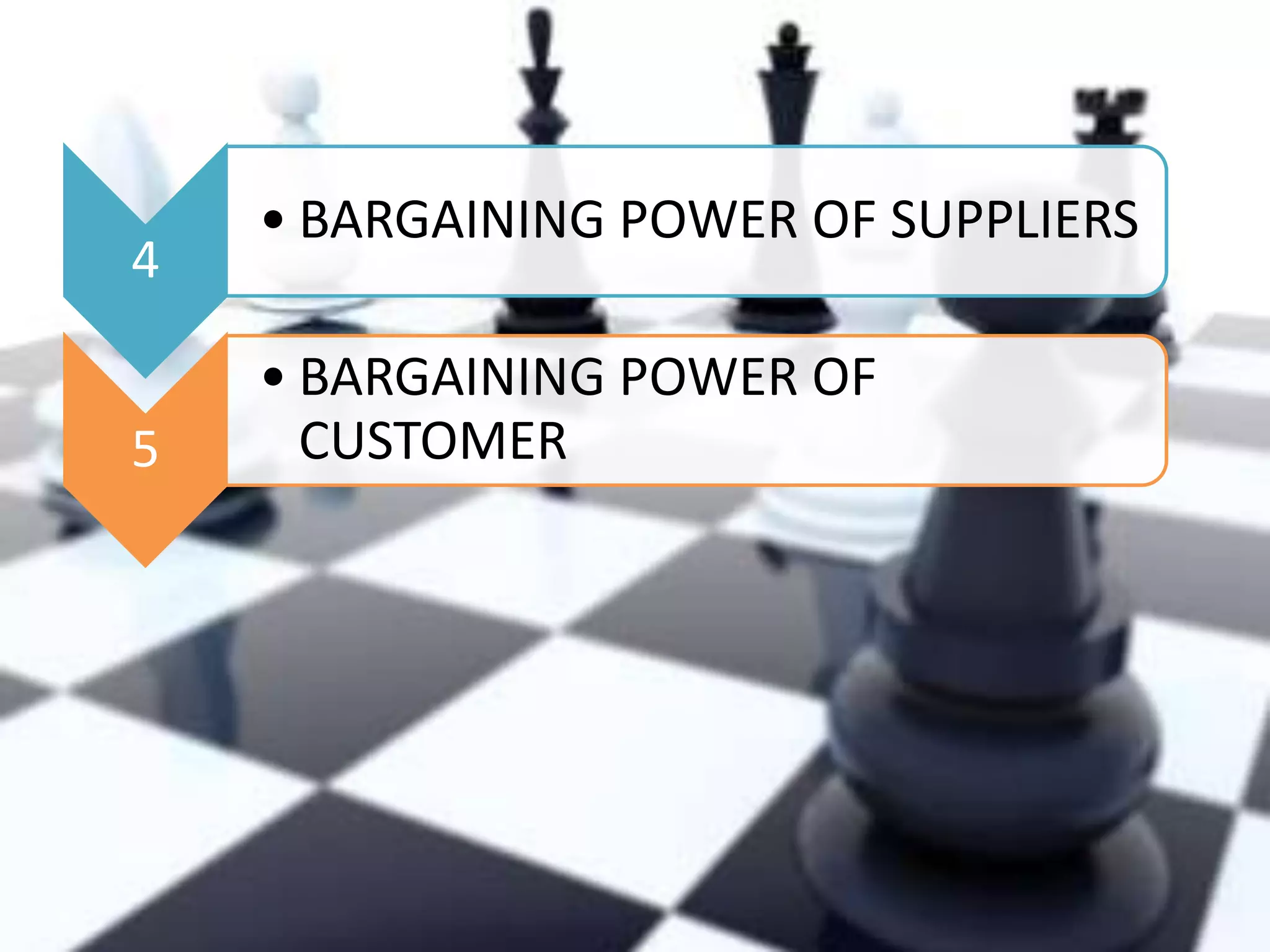
4
5

• BARGAINING POWER OF SUPPLIERS

• BARGAINING POWER OF
CUSTOMER
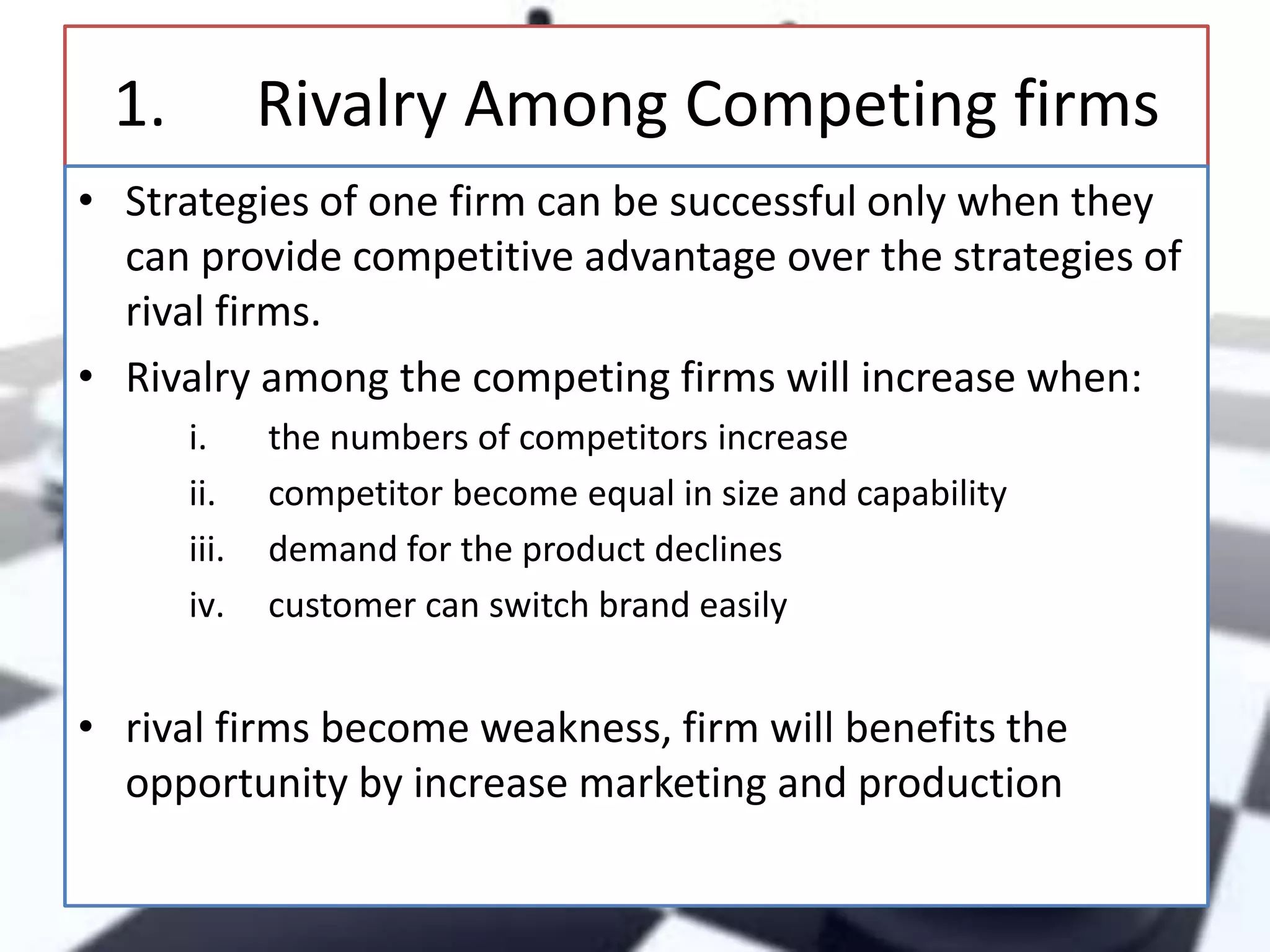
1.

Rivalry Among Competing firms

• Strategies of one firm can be successful only when they
can provide competitive advantage over the strategies of
rival firms.
• Rivalry among the competing firms will increase when:
i.
ii.
iii.
iv.

the numbers of competitors increase
competitor become equal in size and capability
demand for the product declines
customer can switch brand easily

• rival firms become weakness, firm will benefits the
opportunity by increase marketing and production
2.

Potential Entry of New Competitor

• new firms can easily enter a particular industry, will
increase the intensity of competitiveness among the
firms.
• barrier that facing by the new entry:
i.
ii.
iii.
iv.

•

need to gain technology and specialized know-how
lack of experience
strong customer loyalty or strong brand preference
large capital requirement

when new entry has a strong capability, existing firm
will block the new entry
3.

Potential Development of
Substitute Product

• firm are compete with the producer of substitute
products in other industry.
• appearance of substitute products puts a ceiling on the
price that can be charged
• competitive pressure arising from substitute product
increase as the relative price of substitute products
declines and customers cost of switching decrease
• for example, producers of eyeglasses and contact lenses
are face increasing competitive pressures from laser eye
surgery.
4.

Bargaining Power of Suppliers

• Occurs when large number of supplier, only few good
substitute raw materials and cost of switching raw
materials is high
• firms may use a backward integration strategy to gain
control of supplier
• In others industry, seller are use forging strategic
partnership with supplier
5.

Bargaining Power of Customers

• occurs when customers are concentrated or large in
number or buy in volume
• Bargaining power of customer is higher when products
being purchased are standard
• others firm will offer extended warranties or special
services to gain customer loyalty.
• Customer can negotiate selling price, warranty coverage,
and accessory packages to a greater extent
• Its affect the competitive advantage in certain
circumstances:
i. If they can inexpensively switch to competing brands
ii. If they are particularly important to the seller
iii. If seller are struggling in the face of failing consumer
demand
iv. If they are informed about seller’s product, prices and
cost
v. If they have discretion in whether and when they
purchase the product
Forecasting Tools and Techniques
• Forecasts are educated assumption about the future
trends and events.
• need to allocate sufficient time and effort to study the
underlying bases for published forecasts and develop
internal forecasts of their own
• Accurate forecast will provide a major competitive
advantage for organizations
• Forecasting tools divided into two:
a) Quantitative techniques



appropriate when historical data are available and when
the relationships among key variables are expected to remain
the same in the future.

a) Qualitative techniques



forecasting is based on judgments, opinions, intuition,
emotions, or personal experiences and is subjective in nature.
Making Assumptions
• assumption is the best present estimates of the impact of
the major external factors
• give a significant impact on performance or the ability to
achieve desired results.
• Assumptions are needed only for future trends and
events that are most likely to have a significant effect on
the company’s business
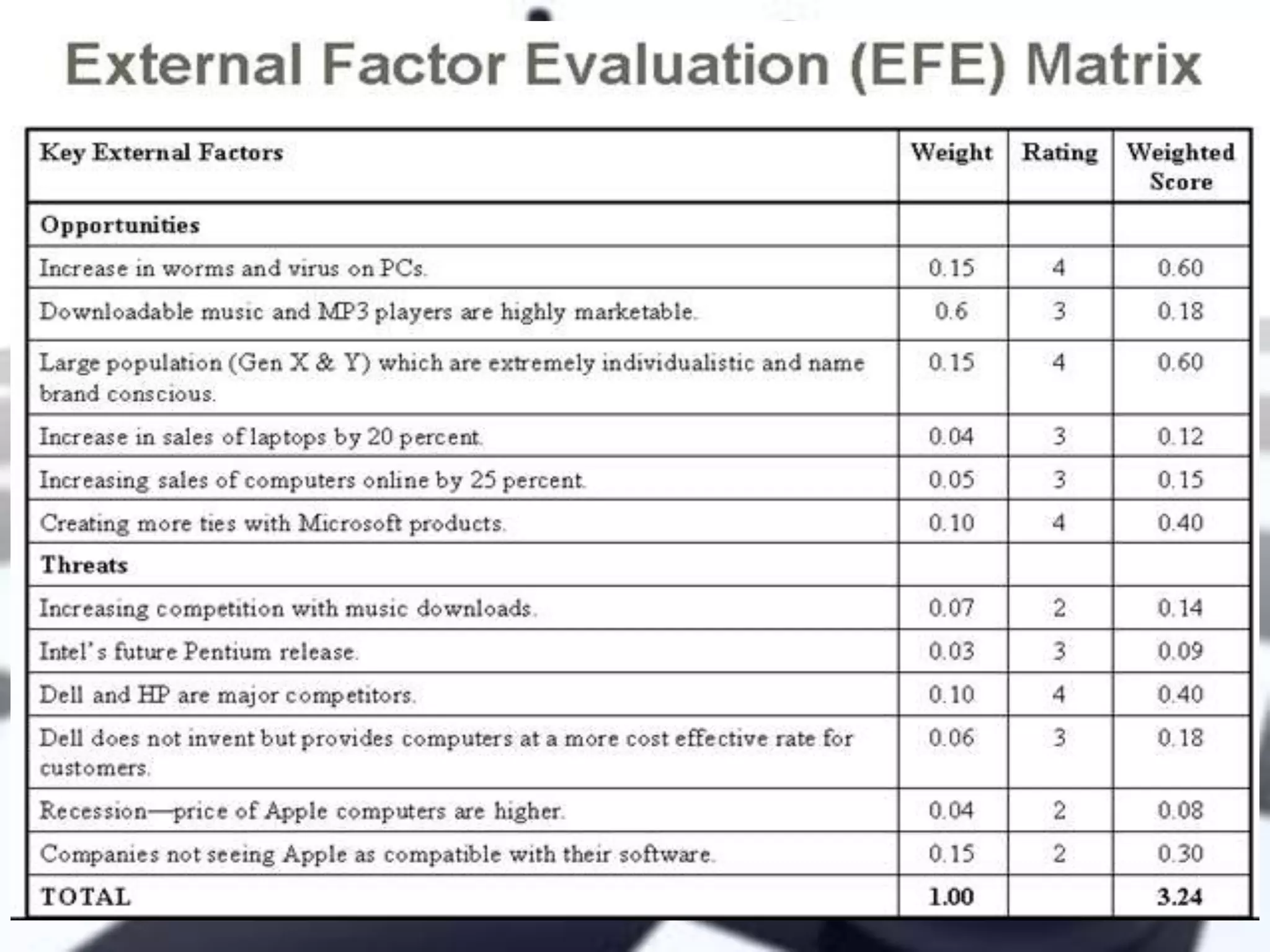
What Is EFE Matrix
Strategies to summarize and evaluate:
Economic
Social
Cultural
Demographic
Environmental
Political
Governmental
Legal
Technological
Competitive information
Steps To Develop EFE Matrix
• Step 1 : (List Key External Factors as Identified in
The External Audit Process).
-list 15 to 20 factors including
opportunities and threats that affect the
firm
-can be in percentage, ratios or number
• Step 2 : Assign To Each Factor a Weight That
Ranges From 0.0 (Not Important) to 1.0 (Very
Important)
- the sum of all weights assigned to the factors
must equal 1.0
• Step 3 : Assign a Rating Between 1 and 4 To Each
Key External Factor
- Ratings are based on effectiveness of the
firm’s strategies
- 4 = superior, 3 = above average, 2 = average,
1 = poor
• Step 4 : Multiply Each Factor’s Weight By Its
Rating To Determine a Weighted Score
• Step 5 : Sum The Weighted Scores For Each
Variable To Determine The Total Weighted Score
For the Organization.
- highest possible total weighted score is 4.0,
lowest possible score is 1.0 and the average
total weighted is 2.5
- score of 4.0 indicates that an organization is
responding in an outstanding way to
existing
opportunities and threats in its industry
The Competitive Profile
Matrix (CPM)
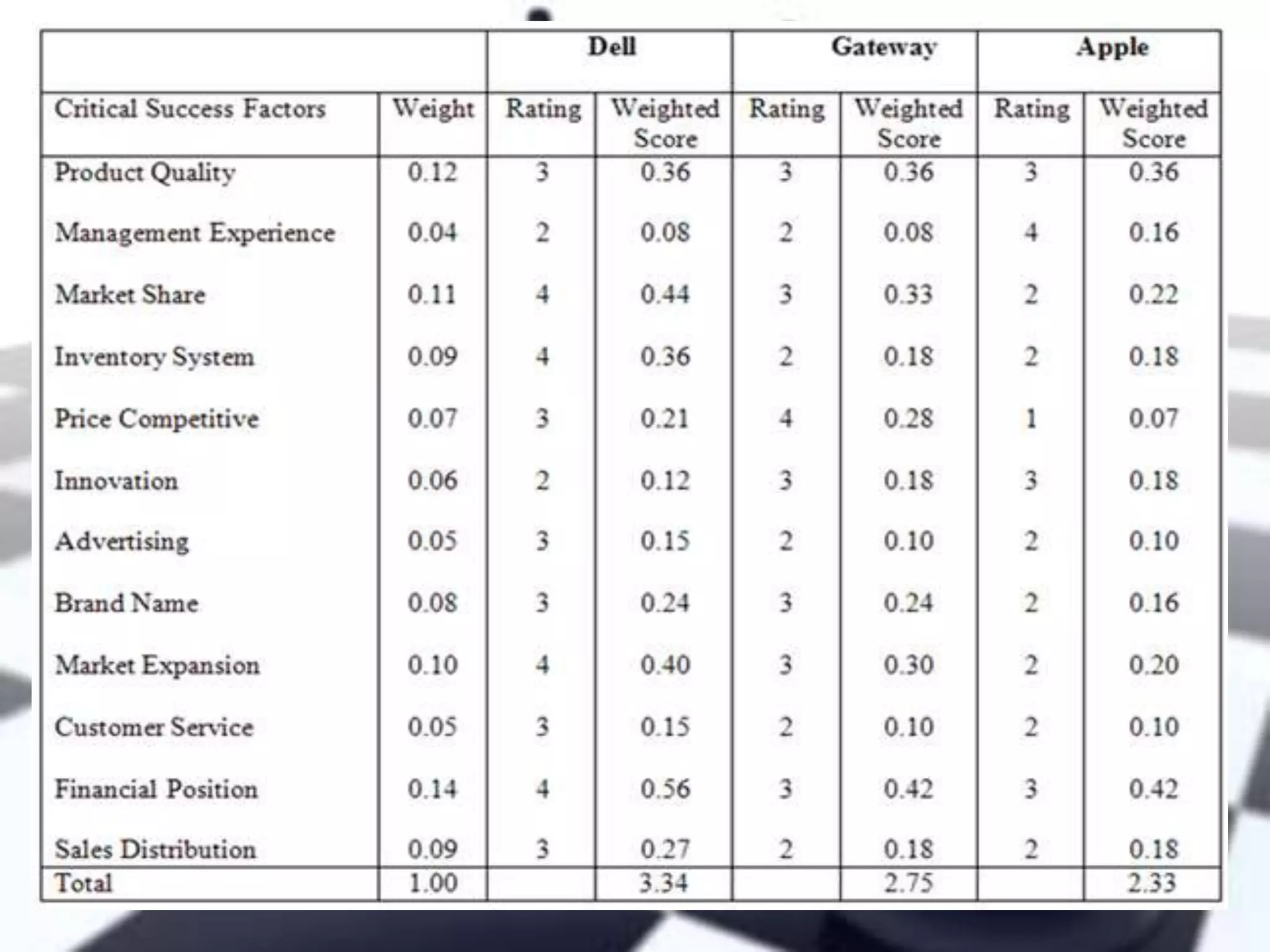
• Function:
- to identifies a firm’s major competitor
and its particular strength & weakness in
relation to a sample firm’s strategies
position
• Critical success factors include internal & external issues.
• Ratings:
4 = major strength, 3 = minor strength,
2 = minor strength, 1 = major weakness
• The ratings and total weighted scores for rival firms can be
compared to the sample firm
THE EXTERNAL ASSESSMENT-Strategic Management chpter 3

THE EXTERNAL ASSESSMENT-Strategic Management chpter 3

  • 1.
    Group Members: Ahmad Rif’atBin Abdul Rahman Mohamad Aizuddin Bin Abu Bakar 2011778845 Muhamad Zikrullah Bin Bahrunnizam 2011789027 Muhamad Shakir Bin Mohd Samsuri 2011503187 2011120835 Date of Presentation: 6th Oct 2013 1
  • 2.
    3.1 Nature ofan External Audit  Purpose: To develop a finite list of opportunities that could benefit a firm & threats that should be avoided.  Not aimed at developing an exhaustive list of every possible factor that could be influence the business, rather;  Aimed at identifying key variables that offer actionable responses.  Firms should be able to respond either offensively or defensively to the factors…HOW??  By formulating strategies that take advantage of external opportunities or that minimize the impact of potential threats.
  • 3.
  • 4.
  • 5.
    3.2 The Processof Performing an External Audit Must involves as many managers & employees WHY ??? o Lead to understanding & commitment from organizational members o Appreciate having the opportunity to contribute ideas o To gain a better understanding of their firm’s industry, competitors, and markets
  • 6.
    Cont.… Process ofPerforming Gather competitive intelligence & information about “E,S,C,P,E,L,T,G,D” Assimilated and evaluated
  • 7.
    Cont.…  Firstly:o Acompany must gather competitive intelligence & information about:         Economic Social Cultural Political Environmental Legal Technological Governmental Demographic Key External Forces/ Factors
  • 8.
    Cont.… Secondly:o Once informationis gathered, it should be assimilated & evaluated o The key external factors should be listed on flip charts/ chalkboard & request all managers to rank the factors identified: From 1 the most important opportunity/ threat  To 20 for the least important opportunity/ threat o Key external factors may vary over time & by industry
  • 9.
    Cont.… o The variablescommonly used include:           Market share Breadth of competitive products World economies Foreign affiliates Proprietary & key account advantages Price competitiveness Technological advancement Population shifts Interest rates Pollution abatement but… The relationship with suppliers/ distributors are often a critical success factor
  • 10.
    Cont.… o These keyexternal factors should be:    Important to achieving long-term & annual objectives Measurable Applicable to all competing firms Hierarchical in the sense that some will pertain to the overall company & others will be more narrowly focused on functional/ divisional areas  Communicated & distributed widely in the organization
  • 11.
    Key External Factors TheIndustrial Organization (I/O) View The Industrial Organization (I/O) approach to competitive advantage advocates that external (industry) factors are more important than internal factors in a firm for achieving competitive advantage. 3-11
  • 12.
    Economic Forces • Havea direct impact on the potential attractiveness of various strategies. • Also cause discretionary income decline and the demand for discretionary goods falls. • It is also when the market rises, consumer business wealth will expands. • Key Economic Variable To Be Monitored.:  Interest Rate  Inflation Rates  Unemployment Trend  Import /Export factors  Fiscal Policy  Monetary Policy 3-12
  • 13.
    Social, Cultural, Demographic,and Natural Environmental Forces • Changes in social, culture, demography & environmental tends are shaping the way American live, work, produce and consume. • When new trends are creating a different type of consumer and consequently, a need for different product, services and strategies. 3-13
  • 14.
    Political, Governmental, andLegal Forces The increasing global interdependence among economies, markets, governments, and organizations makes it imperative that firms consider the possible impact of political variables on the formulation and implementation of competitive strategies. Represented a key of opportunities or threats for both small & large organizations. 3-14
  • 15.
    Technological Forces  TheInternet has changed the very nature of opportunities and threats by: –Transform the life cycles of products, –increasing the speed of distribution, –creating new products and services, –erasing limitations of traditional geographic markets, –changing the historical trade-off between production standardization and flexibility.  The Internet is altering economies of scale, changing entry barriers, and redefining the relationship between industries and various suppliers, creditors, customers, and competitors 3-15
  • 16.
    Competitive Forces  Animportant part of an external audit is identifying rival firms and determining their strengths, weaknesses, capabilities, opportunities, threats, objectives, and strategies  Characteristics of the most competitive companies: 1.Market share matters 2.Understand and remember precisely what business you are in 3.Whether it’s broke or not, fix it–make it better 4.Innovate or evaporate 5.Acquisition is essential to growth 6.People make a difference 7.There is no substitute for quality 3-16
  • 17.
    Competitive Intelligence Programs •Competitive intelligence (CI) – a systematic and ethical process for gathering and analyzing information about the competition’s activities and general business trends to further a business’s own goals The three basic objectives of a CI program are: 1. to provide a general understanding of an industry and its competitors 2. to identify areas in which competitors are vulnerable and to assess the impact strategic actions would have on competitors 3. to identify potential moves that a competitor might make that would endanger a firm’s position in the market 3-17
  • 18.
    Sources of ExternalInformation • Unpublished sources include customer surveys, market research, speeches at professional and shareholders’ meetings, television programs, interviews, and conversations with stakeholders. • Published sources of strategic information include periodicals, journals, reports, government documents, abstracts, books, directories, newspapers, and manuals. 3-18
  • 19.
    Competitive Analysis: Porter’s Five-ForceModel 1 2 3 • RIVALRY AMONG COMPETING FIRMS • POTENTIAL ENTRY OF NEW COMPETITORS • POTENTIAL DEVELOPMENT OF SUBTITUTE PRODUCT
  • 20.
    4 5 • BARGAINING POWEROF SUPPLIERS • BARGAINING POWER OF CUSTOMER
  • 21.
    1. Rivalry Among Competingfirms • Strategies of one firm can be successful only when they can provide competitive advantage over the strategies of rival firms. • Rivalry among the competing firms will increase when: i. ii. iii. iv. the numbers of competitors increase competitor become equal in size and capability demand for the product declines customer can switch brand easily • rival firms become weakness, firm will benefits the opportunity by increase marketing and production
  • 22.
    2. Potential Entry ofNew Competitor • new firms can easily enter a particular industry, will increase the intensity of competitiveness among the firms. • barrier that facing by the new entry: i. ii. iii. iv. • need to gain technology and specialized know-how lack of experience strong customer loyalty or strong brand preference large capital requirement when new entry has a strong capability, existing firm will block the new entry
  • 23.
    3. Potential Development of SubstituteProduct • firm are compete with the producer of substitute products in other industry. • appearance of substitute products puts a ceiling on the price that can be charged • competitive pressure arising from substitute product increase as the relative price of substitute products declines and customers cost of switching decrease • for example, producers of eyeglasses and contact lenses are face increasing competitive pressures from laser eye surgery.
  • 24.
    4. Bargaining Power ofSuppliers • Occurs when large number of supplier, only few good substitute raw materials and cost of switching raw materials is high • firms may use a backward integration strategy to gain control of supplier • In others industry, seller are use forging strategic partnership with supplier
  • 25.
    5. Bargaining Power ofCustomers • occurs when customers are concentrated or large in number or buy in volume • Bargaining power of customer is higher when products being purchased are standard • others firm will offer extended warranties or special services to gain customer loyalty. • Customer can negotiate selling price, warranty coverage, and accessory packages to a greater extent
  • 26.
    • Its affectthe competitive advantage in certain circumstances: i. If they can inexpensively switch to competing brands ii. If they are particularly important to the seller iii. If seller are struggling in the face of failing consumer demand iv. If they are informed about seller’s product, prices and cost v. If they have discretion in whether and when they purchase the product
  • 27.
    Forecasting Tools andTechniques • Forecasts are educated assumption about the future trends and events. • need to allocate sufficient time and effort to study the underlying bases for published forecasts and develop internal forecasts of their own • Accurate forecast will provide a major competitive advantage for organizations
  • 28.
    • Forecasting toolsdivided into two: a) Quantitative techniques  appropriate when historical data are available and when the relationships among key variables are expected to remain the same in the future. a) Qualitative techniques  forecasting is based on judgments, opinions, intuition, emotions, or personal experiences and is subjective in nature.
  • 29.
    Making Assumptions • assumptionis the best present estimates of the impact of the major external factors • give a significant impact on performance or the ability to achieve desired results. • Assumptions are needed only for future trends and events that are most likely to have a significant effect on the company’s business
  • 30.
    What Is EFEMatrix Strategies to summarize and evaluate: Economic Social Cultural Demographic Environmental Political Governmental Legal Technological Competitive information
  • 31.
    Steps To DevelopEFE Matrix • Step 1 : (List Key External Factors as Identified in The External Audit Process). -list 15 to 20 factors including opportunities and threats that affect the firm -can be in percentage, ratios or number
  • 32.
    • Step 2: Assign To Each Factor a Weight That Ranges From 0.0 (Not Important) to 1.0 (Very Important) - the sum of all weights assigned to the factors must equal 1.0 • Step 3 : Assign a Rating Between 1 and 4 To Each Key External Factor - Ratings are based on effectiveness of the firm’s strategies - 4 = superior, 3 = above average, 2 = average, 1 = poor
  • 33.
    • Step 4: Multiply Each Factor’s Weight By Its Rating To Determine a Weighted Score • Step 5 : Sum The Weighted Scores For Each Variable To Determine The Total Weighted Score For the Organization. - highest possible total weighted score is 4.0, lowest possible score is 1.0 and the average total weighted is 2.5 - score of 4.0 indicates that an organization is responding in an outstanding way to existing opportunities and threats in its industry
  • 35.
    The Competitive Profile Matrix(CPM) • Function: - to identifies a firm’s major competitor and its particular strength & weakness in relation to a sample firm’s strategies position • Critical success factors include internal & external issues. • Ratings: 4 = major strength, 3 = minor strength, 2 = minor strength, 1 = major weakness • The ratings and total weighted scores for rival firms can be compared to the sample firm