Learning Objectives………
• International Strategic Alliances
• Characteristics Of International Strategic Alliances
• Types Of Strategic Alliance
• Activities Involved In The Strategic Alliance
• Scope Of International Strategic Alliances
• Life Cycle Of An International Strategic Alliance
• Key Issues And Success Factors Of Implementation Of Strategic
Alliances
• Risks Associated With International Alliances
• Reasons For Forming Strategic Global Business Alliances /
Advantages Of Strategic Business Alliance
• Disadvantages Of International Strategic Alliance
A. INTERNATIONAL STRATEGIC ALLIANCES
Strategic alliance is an important mode of doing international business. An
alliance is an inter-firm collaboration over a given economic space and time
for the attainment of the participating companies’ goals. The use of strategic
alliance has expanded dramatically over the past decade and it’s use will
continue to increase in future.
Strategic alliances are partnerships in which two or more companies work
together to achieve objectives that are mutually beneficial while parties
remaining independent. Companies may share resources, information,
capabilities and risks to achieve this.
International Strategic Alliance is the combination of two or more firm’s
agreed upon
future objective, which achieved by together practices of the MNCs.
According to Lando Zeppei :
Managing partner of Booz, Allen and Hamilton, defines Strategic Alliance
as a Cooperative arrangement between two or more Companies
where :-
A common strategy is developed in cenison and a win-win attitude is
adopted by all parties.
The Relationship is reciprocal with each partner prepared to share
specific strength with each other, thus lending power to the enterprise.
A pooling of resources, Investment and risks occurs for mutual (rather
than individual) gain.
So in short, A strategic alliance is a business arrangement whereby
two or more firms choose to cooperate for their mutual benefit.
EXAMPLES
Apple
According to "An Overview of Strategic Alliances," Apple has partnered with Sony,
Motorola, Phillips, and AT&T in the past. Apple has also partnered more recently
with Clearwell in order to jointly develop Clearwell's E-Discovery platform for the
Apple iPad. E-Discovery is used by enterprises and legal entities to obtain
documents and information in a "legally defensible" manner,..
Starbucks
According to Rebecca Larson, assistant Professor of Business at Liberty University,
Starbucks partnered with Barnes and Nobles bookstores in 1993 to provide in-
house coffee shops, benefiting both retailers. In 1996, Starbucks partnered with
Pepsico to bottle, distribute and sell the popular coffee-based drink, Frappacino. A
Starbucks-United Airlines alliance has resulted in their coffee being offered on flights
with the Starbucks logo on the cups and a partnership with Kraft foods has resulted
in Starbucks coffee being marketed in grocery stores. In 2006, Starbucks formed an
alliance with the NAACP, the sole purpose of which was to advance the company's
and the NAACP's goals of social and economic justice.
B. CHARACTERISTICS OF INTERNATIONAL
STRATEGIC ALLIANCES
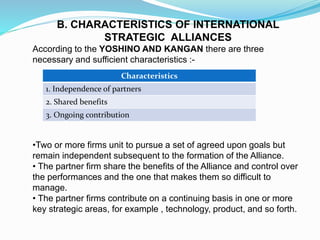
According to the YOSHINO AND KANGAN there are three
necessary and sufficient characteristics :-
•Two or more firms unit to pursue a set of agreed upon goals but
remain independent subsequent to the formation of the Alliance.
• The partner firm share the benefits of the Alliance and control over
the performances and the one that makes them so difficult to
manage.
• The partner firms contribute on a continuing basis in one or more
key strategic areas, for example , technology, product, and so forth.
Characteristics
1. Independence of partners
2. Shared benefits
3. Ongoing contribution
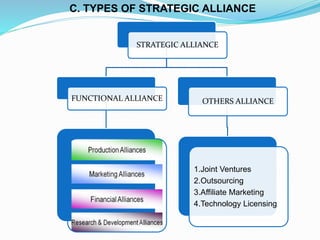
C. TYPES OF STRATEGIC ALLIANCE
STRATEGIC ALLIANCE
FUNCTIONAL ALLIANCE OTHERS ALLIANCE
1.Joint Ventures
2.Outsourcing
3.Affiliate Marketing
4.Technology Licensing
Functional alliance:
A functional alliance integrates certain basic “functions”
between the two parties by pooling efforts to attain specific
objectives.
Types of Functional Alliances:
There are four types of functional alliances. These are –
Production alliances:
Firms each manufacturer products or provide services in a
shared facility.
Marketing alliances:
Firms share marketing services or expertise.
Financial alliances:
Partners of firms share equally in contributing financial
resources to the project or one partner may provides the
majority financing while the other provides expertise.
R & D alliances:
Partners agree to undertake joint research to develop new
product or services.
Other alliances:
Joint Ventures
Joint Ventures are agreements between parties or firms for a particular
purpose or venture. Their formation may be very informal, such as a
handshake and an agreement for two firms to share a booth at a trade
show. Other arrangements can be extremely complex, such as the
consortium of major U.S. electronics firms to develop new microchips,”
says Charles P. Lickson in A Legal Guide for Small Business.
Outsourcing
Outsourcing and globalization of manufacturing allows companies to
reduce costs, benefits consumers with lower cost goods and services,
causes economic expansion that reduces unemployment, and increases
productivity and job creation.
Affiliate Marketing
Affiliate marketing has exploded over recent years, with the most
successful online retailers using it to great effect. The nature of the
internet means that referrals can be accurately tracked right through the
order process.
Technology Licensing
This is a contractual arrangement whereby trade marks, intellectual
property and trade secrets are licensed to an external firm. It’s used
mainly as a low cost way to enter foreign markets.
D. Activities of involved in the Strategic Alliance
 Design Contracts
Technology Transfer agreements
 Joint product development.
 Purchasing Agreement
 Distribution Agreement
 Marketing and Promotional Collaboration
Intellectual Advice.
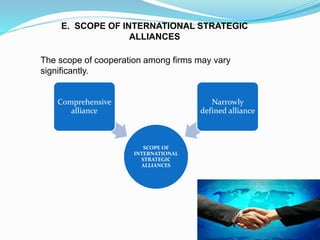
E. SCOPE OF INTERNATIONAL STRATEGIC
ALLIANCES
The scope of cooperation among firms may vary
significantly.
SCOPE OF
INTERNATIONAL
STRATEGIC
ALLIANCES
Comprehensive
alliance
Narrowly
defined alliance
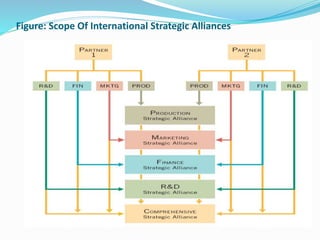
•Comprehensive alliances arise when the participating firms agree to perform
together multiple stages of the process by which goods or services are brought
to the market: R&D, design, production, marketing, and distribution. Because of
the broad scope of such alliances, the firms must establish procedures for
meshing such functional areas as finance, production, and marketing for the
alliance to succeed. Yet integrating the different operating procedures of the
parents over a broad range of functional activities is difficult in the absence of a
formal organizational structure. As a result, most comprehensive alliances are
organized as joint ventures.
•Strategic alliances may also be narrow in scope, involving only a single
functional area of the business. In such cases, integrating the needs of the
parent firms is less complex. Thus, functionally based alliances often do not
take the form of a joint venture, although joint ventures are still the more
common form of organization. Types of functional alliances include production
alliances, marketing alliances, financial alliances, and R&D alliances.
Figure: Scope Of International Strategic Alliances
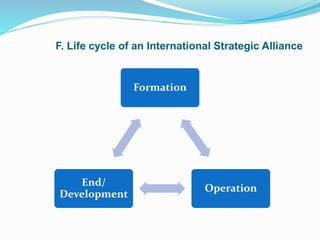
F. Life cycle of an International Strategic Alliance
Formation
End/
Development
Operation
Life cycle of an International Strategic Alliance
Stage 1: Formation
Forming a Strategic Alliance is a process which usually implies some major steps
that are mentioned below:
Strategy Development: In this stage the possibility of a Strategic Alliance is
examined with respect to objectives, major issues, resource strategies for
production, technology and people. It is necessary that objectives of the company
and of the alliance are compatible. Here, the international rules and regulations
of business should be kept in mind.
Partner Assessment: In this phase potential partners for the Strategic Alliance
are analyzed, in order to find an appropriate company to cooperate with. A
company must know the weaknesses and strengths and the motivation for joining
an alliance of another company. Besides that appropriate criteria for the partner
selection are defined and strategies are developed how to accommodate the
partner´s management style. The legal and cultural environment of Potential
partner’s needs to be assessed.
Contract Negotiations: After having selected the right partner for a Strategic
Alliance the contract negotiations start. At first all parties involved discuss if their
goals and objectives are realistic and feasible. Dedicated negotiation teams are
formed which determine each partner´s role in the alliance like contribution and
reward, penalties and retaining companies´ interests.
Stage 2: Operation
In this phase in the life of a Strategic Alliance, an internal
structure occurs under which its functions develop. While
operating it, the alliance becomes an own new organization itself
with members from the origin companies with the aim of meeting
all previously set objectives and improving the overall
performance of the alliance which requires effective structures
and processes and a good, strong and reliable leadership.
Budges have to be linked, as well as resources which are
strategically most important and the performance of the alliance
has to be measured and assessed.
Stage 3: End/ Development
There are several ways how a Strategic Alliance can come to an
end:
Natural End: When the objectives, the Strategic Alliance was
founded for have been achieved, and no further cooperation is
necessary or beneficial for the involved enterprises the alliance
can come to a natural end. An example for such a natural end is
the alliance between Dassault and British Aerospace which was
founded to manufacture the Jaguar fighter aircraft. After the end
of the program no further jets were ordered so the involved
companies ended their cooperation.
Extension: After the end of the actual reason for the alliance,
the cooperating enterprises decide to extend the cooperation for
following generations of a respective product or expand the
alliance to new products or projects. Renault for example worked
together with Matra on three successive generations of their
space minivan, whereas Airbus expanded its cooperation to
include a complete family of airplanes.
Premature Termination: In this case the Strategic Alliance is ended
before the actual objectives of its existence have been achieved. In
1987 Matra-Harris and Intel broke up their Cimatel partnership before
one of the planned VLSI chips was manufactured.
Exclusive Continuation: If one partner decides to get out of the
alliance before the common goals have been achieved, the other
partner can decide to continue the project on its own. This happened
when Saab decided to continue with the designing of a commuter
aircraft (SF-340), after the partner Fairchild had to cancel the alliance
because of internal problems. After Fairchild left the project it was
named Saab 340.
Takeover of Partner: Strong companies sometimes have the
opportunity to take over smaller partners. If one firm acquires another
the strategic alliance comes to an end. After almost ten years of
cooperation in the field of mainframe computers a British computer
manufacturer, named ICL, was taken over by Fujitsu in 1990.
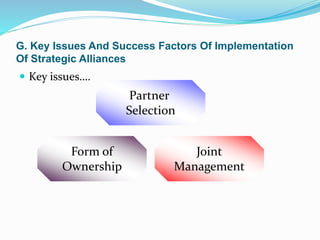
G. Key Issues And Success Factors Of Implementation
Of Strategic Alliances
 Key issues….
Partner
Selection
Joint
Management
Form of
Ownership
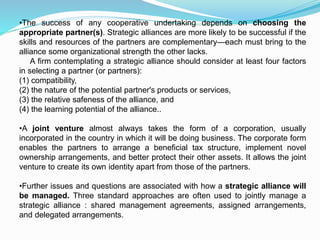
•The success of any cooperative undertaking depends on choosing the
appropriate partner(s). Strategic alliances are more likely to be successful if the
skills and resources of the partners are complementary—each must bring to the
alliance some organizational strength the other lacks.
A firm contemplating a strategic alliance should consider at least four factors
in selecting a partner (or partners):
(1) compatibility,
(2) the nature of the potential partner's products or services,
(3) the relative safeness of the alliance, and
(4) the learning potential of the alliance..
•A joint venture almost always takes the form of a corporation, usually
incorporated in the country in which it will be doing business. The corporate form
enables the partners to arrange a beneficial tax structure, implement novel
ownership arrangements, and better protect their other assets. It allows the joint
venture to create its own identity apart from those of the partners.
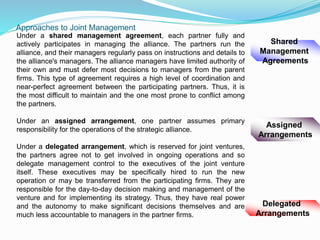
•Further issues and questions are associated with how a strategic alliance will
be managed. Three standard approaches are often used to jointly manage a
strategic alliance : shared management agreements, assigned arrangements,
and delegated arrangements.
Approaches to Joint Management
Shared
Management
Agreements
Delegated
Arrangements
Assigned
Arrangements
Under a shared management agreement, each partner fully and
actively participates in managing the alliance. The partners run the
alliance, and their managers regularly pass on instructions and details to
the alliance's managers. The alliance managers have limited authority of
their own and must defer most decisions to managers from the parent
firms. This type of agreement requires a high level of coordination and
near-perfect agreement between the participating partners. Thus, it is
the most difficult to maintain and the one most prone to conflict among
the partners.
Under an assigned arrangement, one partner assumes primary
responsibility for the operations of the strategic alliance.
Under a delegated arrangement, which is reserved for joint ventures,
the partners agree not to get involved in ongoing operations and so
delegate management control to the executives of the joint venture
itself. These executives may be specifically hired to run the new
operation or may be transferred from the participating firms. They are
responsible for the day-to-day decision making and management of the
venture and for implementing its strategy. Thus, they have real power
and the autonomy to make significant decisions themselves and are
much less accountable to managers in the partner firms.
Further important success factors
The success of any alliance very much depends on how effective the
capabilities of the involved enterprises are matched and weather the full
commitment of each partner to the alliance is achieved.
Some key factors that have to be considered to be able to manage a
successful alliance include:
•Understanding: The cooperating companies need a clear understanding of
the potential partner´s resources and interests and this understanding should
be the base of set the alliance goals.
•No time pressure: During negotiations time pressure must not have an
influence on the outcome of the process. Managers need time to establish a
working relationship with each other, develop a time plan, set milestones, and
design communication channels.
•Limited alliances: Some incompatibilities between enterprises might not be
avoidable, so the number of alliances should be limited to a necessary
amount, which enables the companies to achieve their goals.
•Good connection: Negotiations need experienced managers. The
managers from large firms need to be connected very well so they
have the possibility to integrate different departments and business
areas over internal borders, and they need legitimating and support
from the top management.
•Creation of trust and goodwill: The best basis for a profit-yielding
cooperation between enterprises is the creation of trust and goodwill,
because it increases tolerance, intensity and openness of
communication and makes the common work easier. Further it leads
to equal and satisfied partners.
•Intense Relationship: Intensifying the partnership leads to the fact
that partners get to know each other better, each other's interests and
operating styles and increases trust.
H. Risks Associated With International Alliances
Using and operating strategic alliances does not only bring chances and
benefits. There are also risks and limitations that have to be taken in
consideration. Failures are often attributed to unrealistic expectations, lack
of commitment, cultural differences, strategic goal divergence and
insufficient trust. Some of the risks are listed below:[
•Partner experiences financial difficulties
•Hidden costs
•Inefficient management
•Activities outside scope of original agreement
•Information leakage
•Loss of competencies
•Loss of operational control
•Partner lock-in
•Partner product or service failure
•Partner unable or unwilling to supply key resources
•Partner's quality performance
•Partner takes advantage of its position
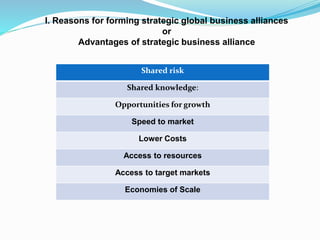
I. Reasons for forming strategic global business alliances
or
Advantages of strategic business alliance
Shared risk
Shared knowledge:
Opportunities for growth
Speed to market
Lower Costs
Access to resources
Access to target markets
Economies of Scale
For companies there are many reasons to enter a Strategic Alliance:
Shared risk: The partnerships allow the involved companies to offset their market
exposure. Strategic Alliances probably work best if the companies´ portfolio
complement each other, but do not directly compete.
Shared knowledge: Sharing skills (distribution, marketing, management),
brands, market knowledge, technical know-how and assets leads to synergistic
effects, which result in pool of resources which is more valuable than the
separated single resources in the particular company.
Opportunities for growth: Using the partner´s distribution networks in
combination with taking advantage of a good brand image can help a company to
grow faster than it would on its own. The organic growth of a company might
often not be sufficient enough to satisfy the strategic requirements of a company,
that means that a firm often cannot grow and extend itself fast enough without
expertise and support from partners
Speed to market: Speed to market is an essential success factor In nowadays
competitive markets and the right partner can help to distinctly improve this.
Lower Costs: Partnerships can help to lower costs, especially in non-profit
areas like research & development.
Access to resources: Partners in a Strategic Alliance can help each other by
giving access to resources, (personnel, finances, technology) which enable the
partner to produce its products in a higher quality or more cost efficient way.
Access to target markets: Sometimes, collaboration with a local partner is the
only way to enter a specific market. Especially developing countries want to
avoid that their resources are exploited, which makes it hard for foreign
companies to enter these markets alone.
Economies of Scale: When companies pool their resources and enable each
other to access manufacturing capabilities, economies of scale can be
achieved. Cooperating with appropriate strategies also allows smaller
enterprises to work together and to compete against large competitors.
Further advantages
•Access to new technology, intellectual property rights,
•Create critical mass, common standards, new
businesses,
•Diversification,
•Improve agility, R&D, material flow, speed to market,
•Reduce administrative costs, R&D costs, cycle time
•Allowing each partner to concentrate on their
competitive advantage.
•Learning from partners and developing competencies
that may be more widely exploited elsewhere.
•To reduce political risk while entering into a new
market
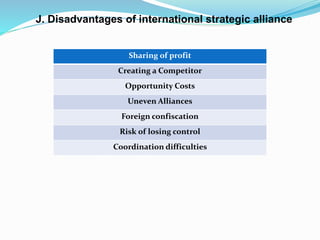
J. Disadvantages of international strategic alliance
Sharing of profit
Creating a Competitor
Opportunity Costs
Uneven Alliances
Foreign confiscation
Risk of losing control
Coordination difficulties
Disadvantages of strategic alliances include:
•Sharing of profit: In a Strategic Alliance the partners must share resources
and profits and often skills and know-how. This can be critical if business
secrets are included in this knowledge. Agreements can protect these secrets
but the partner might not be willing to stick to such an agreement.
•Creating a Competitor: The partner in a strategic alliance might become a
competitor one day, if it profited enough from the alliance and grew enough to
end the partnership and then is able to operate on its own in the same market
segment.
•Opportunity Costs: Focusing and committing is necessary to run a Strategic
Alliance successfully but might discourage from taking other opportunities,
which might be benefitial as well.
•Uneven Alliances: When the decision powers are distributed very uneven,
the weaker partner might be forced to act according to the will of the more
powerful partners even if it is actually not willing to do so.
•Foreign confiscation: If a company is engaged in a foreign country, there is
the risk that the government of this country might try to seize this local
business so that the domestic company can have all the market on its own.
•Risk of losing control over proprietary information, especially regarding
complex transactions requiring extensive coordination and intensive
information sharing.
•Coordination difficulties due to informal cooperation settings and highly
costly dispute resolution.
International Strategic Alliance

International Strategic Alliance

  • 2.
    Learning Objectives……… • InternationalStrategic Alliances • Characteristics Of International Strategic Alliances • Types Of Strategic Alliance • Activities Involved In The Strategic Alliance • Scope Of International Strategic Alliances • Life Cycle Of An International Strategic Alliance • Key Issues And Success Factors Of Implementation Of Strategic Alliances • Risks Associated With International Alliances • Reasons For Forming Strategic Global Business Alliances / Advantages Of Strategic Business Alliance • Disadvantages Of International Strategic Alliance
  • 3.
    A. INTERNATIONAL STRATEGICALLIANCES Strategic alliance is an important mode of doing international business. An alliance is an inter-firm collaboration over a given economic space and time for the attainment of the participating companies’ goals. The use of strategic alliance has expanded dramatically over the past decade and it’s use will continue to increase in future. Strategic alliances are partnerships in which two or more companies work together to achieve objectives that are mutually beneficial while parties remaining independent. Companies may share resources, information, capabilities and risks to achieve this. International Strategic Alliance is the combination of two or more firm’s agreed upon future objective, which achieved by together practices of the MNCs.
  • 4.
    According to LandoZeppei : Managing partner of Booz, Allen and Hamilton, defines Strategic Alliance as a Cooperative arrangement between two or more Companies where :- A common strategy is developed in cenison and a win-win attitude is adopted by all parties. The Relationship is reciprocal with each partner prepared to share specific strength with each other, thus lending power to the enterprise. A pooling of resources, Investment and risks occurs for mutual (rather than individual) gain. So in short, A strategic alliance is a business arrangement whereby two or more firms choose to cooperate for their mutual benefit.
  • 5.
    EXAMPLES Apple According to "AnOverview of Strategic Alliances," Apple has partnered with Sony, Motorola, Phillips, and AT&T in the past. Apple has also partnered more recently with Clearwell in order to jointly develop Clearwell's E-Discovery platform for the Apple iPad. E-Discovery is used by enterprises and legal entities to obtain documents and information in a "legally defensible" manner,.. Starbucks According to Rebecca Larson, assistant Professor of Business at Liberty University, Starbucks partnered with Barnes and Nobles bookstores in 1993 to provide in- house coffee shops, benefiting both retailers. In 1996, Starbucks partnered with Pepsico to bottle, distribute and sell the popular coffee-based drink, Frappacino. A Starbucks-United Airlines alliance has resulted in their coffee being offered on flights with the Starbucks logo on the cups and a partnership with Kraft foods has resulted in Starbucks coffee being marketed in grocery stores. In 2006, Starbucks formed an alliance with the NAACP, the sole purpose of which was to advance the company's and the NAACP's goals of social and economic justice.
  • 6.
    B. CHARACTERISTICS OFINTERNATIONAL STRATEGIC ALLIANCES According to the YOSHINO AND KANGAN there are three necessary and sufficient characteristics :- •Two or more firms unit to pursue a set of agreed upon goals but remain independent subsequent to the formation of the Alliance. • The partner firm share the benefits of the Alliance and control over the performances and the one that makes them so difficult to manage. • The partner firms contribute on a continuing basis in one or more key strategic areas, for example , technology, product, and so forth. Characteristics 1. Independence of partners 2. Shared benefits 3. Ongoing contribution
  • 7.
    C. TYPES OFSTRATEGIC ALLIANCE STRATEGIC ALLIANCE FUNCTIONAL ALLIANCE OTHERS ALLIANCE 1.Joint Ventures 2.Outsourcing 3.Affiliate Marketing 4.Technology Licensing
  • 8.
    Functional alliance: A functionalalliance integrates certain basic “functions” between the two parties by pooling efforts to attain specific objectives. Types of Functional Alliances: There are four types of functional alliances. These are – Production alliances: Firms each manufacturer products or provide services in a shared facility. Marketing alliances: Firms share marketing services or expertise. Financial alliances: Partners of firms share equally in contributing financial resources to the project or one partner may provides the majority financing while the other provides expertise. R & D alliances: Partners agree to undertake joint research to develop new product or services.
  • 9.
    Other alliances: Joint Ventures JointVentures are agreements between parties or firms for a particular purpose or venture. Their formation may be very informal, such as a handshake and an agreement for two firms to share a booth at a trade show. Other arrangements can be extremely complex, such as the consortium of major U.S. electronics firms to develop new microchips,” says Charles P. Lickson in A Legal Guide for Small Business. Outsourcing Outsourcing and globalization of manufacturing allows companies to reduce costs, benefits consumers with lower cost goods and services, causes economic expansion that reduces unemployment, and increases productivity and job creation. Affiliate Marketing Affiliate marketing has exploded over recent years, with the most successful online retailers using it to great effect. The nature of the internet means that referrals can be accurately tracked right through the order process. Technology Licensing This is a contractual arrangement whereby trade marks, intellectual property and trade secrets are licensed to an external firm. It’s used mainly as a low cost way to enter foreign markets.
  • 10.
    D. Activities ofinvolved in the Strategic Alliance  Design Contracts Technology Transfer agreements  Joint product development.  Purchasing Agreement  Distribution Agreement  Marketing and Promotional Collaboration Intellectual Advice.
  • 11.
    E. SCOPE OFINTERNATIONAL STRATEGIC ALLIANCES The scope of cooperation among firms may vary significantly. SCOPE OF INTERNATIONAL STRATEGIC ALLIANCES Comprehensive alliance Narrowly defined alliance
  • 12.
    •Comprehensive alliances arisewhen the participating firms agree to perform together multiple stages of the process by which goods or services are brought to the market: R&D, design, production, marketing, and distribution. Because of the broad scope of such alliances, the firms must establish procedures for meshing such functional areas as finance, production, and marketing for the alliance to succeed. Yet integrating the different operating procedures of the parents over a broad range of functional activities is difficult in the absence of a formal organizational structure. As a result, most comprehensive alliances are organized as joint ventures. •Strategic alliances may also be narrow in scope, involving only a single functional area of the business. In such cases, integrating the needs of the parent firms is less complex. Thus, functionally based alliances often do not take the form of a joint venture, although joint ventures are still the more common form of organization. Types of functional alliances include production alliances, marketing alliances, financial alliances, and R&D alliances.
  • 13.
    Figure: Scope OfInternational Strategic Alliances
  • 14.
    F. Life cycleof an International Strategic Alliance Formation End/ Development Operation
  • 15.
    Life cycle ofan International Strategic Alliance Stage 1: Formation Forming a Strategic Alliance is a process which usually implies some major steps that are mentioned below: Strategy Development: In this stage the possibility of a Strategic Alliance is examined with respect to objectives, major issues, resource strategies for production, technology and people. It is necessary that objectives of the company and of the alliance are compatible. Here, the international rules and regulations of business should be kept in mind. Partner Assessment: In this phase potential partners for the Strategic Alliance are analyzed, in order to find an appropriate company to cooperate with. A company must know the weaknesses and strengths and the motivation for joining an alliance of another company. Besides that appropriate criteria for the partner selection are defined and strategies are developed how to accommodate the partner´s management style. The legal and cultural environment of Potential partner’s needs to be assessed. Contract Negotiations: After having selected the right partner for a Strategic Alliance the contract negotiations start. At first all parties involved discuss if their goals and objectives are realistic and feasible. Dedicated negotiation teams are formed which determine each partner´s role in the alliance like contribution and reward, penalties and retaining companies´ interests.
  • 16.
    Stage 2: Operation Inthis phase in the life of a Strategic Alliance, an internal structure occurs under which its functions develop. While operating it, the alliance becomes an own new organization itself with members from the origin companies with the aim of meeting all previously set objectives and improving the overall performance of the alliance which requires effective structures and processes and a good, strong and reliable leadership. Budges have to be linked, as well as resources which are strategically most important and the performance of the alliance has to be measured and assessed.
  • 17.
    Stage 3: End/Development There are several ways how a Strategic Alliance can come to an end: Natural End: When the objectives, the Strategic Alliance was founded for have been achieved, and no further cooperation is necessary or beneficial for the involved enterprises the alliance can come to a natural end. An example for such a natural end is the alliance between Dassault and British Aerospace which was founded to manufacture the Jaguar fighter aircraft. After the end of the program no further jets were ordered so the involved companies ended their cooperation. Extension: After the end of the actual reason for the alliance, the cooperating enterprises decide to extend the cooperation for following generations of a respective product or expand the alliance to new products or projects. Renault for example worked together with Matra on three successive generations of their space minivan, whereas Airbus expanded its cooperation to include a complete family of airplanes.
  • 18.
    Premature Termination: Inthis case the Strategic Alliance is ended before the actual objectives of its existence have been achieved. In 1987 Matra-Harris and Intel broke up their Cimatel partnership before one of the planned VLSI chips was manufactured. Exclusive Continuation: If one partner decides to get out of the alliance before the common goals have been achieved, the other partner can decide to continue the project on its own. This happened when Saab decided to continue with the designing of a commuter aircraft (SF-340), after the partner Fairchild had to cancel the alliance because of internal problems. After Fairchild left the project it was named Saab 340. Takeover of Partner: Strong companies sometimes have the opportunity to take over smaller partners. If one firm acquires another the strategic alliance comes to an end. After almost ten years of cooperation in the field of mainframe computers a British computer manufacturer, named ICL, was taken over by Fujitsu in 1990.
  • 19.
    G. Key IssuesAnd Success Factors Of Implementation Of Strategic Alliances  Key issues…. Partner Selection Joint Management Form of Ownership
  • 20.
    •The success ofany cooperative undertaking depends on choosing the appropriate partner(s). Strategic alliances are more likely to be successful if the skills and resources of the partners are complementary—each must bring to the alliance some organizational strength the other lacks. A firm contemplating a strategic alliance should consider at least four factors in selecting a partner (or partners): (1) compatibility, (2) the nature of the potential partner's products or services, (3) the relative safeness of the alliance, and (4) the learning potential of the alliance.. •A joint venture almost always takes the form of a corporation, usually incorporated in the country in which it will be doing business. The corporate form enables the partners to arrange a beneficial tax structure, implement novel ownership arrangements, and better protect their other assets. It allows the joint venture to create its own identity apart from those of the partners. •Further issues and questions are associated with how a strategic alliance will be managed. Three standard approaches are often used to jointly manage a strategic alliance : shared management agreements, assigned arrangements, and delegated arrangements.
  • 21.
    Approaches to JointManagement Shared Management Agreements Delegated Arrangements Assigned Arrangements Under a shared management agreement, each partner fully and actively participates in managing the alliance. The partners run the alliance, and their managers regularly pass on instructions and details to the alliance's managers. The alliance managers have limited authority of their own and must defer most decisions to managers from the parent firms. This type of agreement requires a high level of coordination and near-perfect agreement between the participating partners. Thus, it is the most difficult to maintain and the one most prone to conflict among the partners. Under an assigned arrangement, one partner assumes primary responsibility for the operations of the strategic alliance. Under a delegated arrangement, which is reserved for joint ventures, the partners agree not to get involved in ongoing operations and so delegate management control to the executives of the joint venture itself. These executives may be specifically hired to run the new operation or may be transferred from the participating firms. They are responsible for the day-to-day decision making and management of the venture and for implementing its strategy. Thus, they have real power and the autonomy to make significant decisions themselves and are much less accountable to managers in the partner firms.
  • 22.
    Further important successfactors The success of any alliance very much depends on how effective the capabilities of the involved enterprises are matched and weather the full commitment of each partner to the alliance is achieved. Some key factors that have to be considered to be able to manage a successful alliance include: •Understanding: The cooperating companies need a clear understanding of the potential partner´s resources and interests and this understanding should be the base of set the alliance goals. •No time pressure: During negotiations time pressure must not have an influence on the outcome of the process. Managers need time to establish a working relationship with each other, develop a time plan, set milestones, and design communication channels. •Limited alliances: Some incompatibilities between enterprises might not be avoidable, so the number of alliances should be limited to a necessary amount, which enables the companies to achieve their goals.
  • 23.
    •Good connection: Negotiationsneed experienced managers. The managers from large firms need to be connected very well so they have the possibility to integrate different departments and business areas over internal borders, and they need legitimating and support from the top management. •Creation of trust and goodwill: The best basis for a profit-yielding cooperation between enterprises is the creation of trust and goodwill, because it increases tolerance, intensity and openness of communication and makes the common work easier. Further it leads to equal and satisfied partners. •Intense Relationship: Intensifying the partnership leads to the fact that partners get to know each other better, each other's interests and operating styles and increases trust.
  • 24.
    H. Risks AssociatedWith International Alliances Using and operating strategic alliances does not only bring chances and benefits. There are also risks and limitations that have to be taken in consideration. Failures are often attributed to unrealistic expectations, lack of commitment, cultural differences, strategic goal divergence and insufficient trust. Some of the risks are listed below:[ •Partner experiences financial difficulties •Hidden costs •Inefficient management •Activities outside scope of original agreement •Information leakage •Loss of competencies •Loss of operational control •Partner lock-in •Partner product or service failure •Partner unable or unwilling to supply key resources •Partner's quality performance •Partner takes advantage of its position
  • 25.
    I. Reasons forforming strategic global business alliances or Advantages of strategic business alliance Shared risk Shared knowledge: Opportunities for growth Speed to market Lower Costs Access to resources Access to target markets Economies of Scale
  • 26.
    For companies thereare many reasons to enter a Strategic Alliance: Shared risk: The partnerships allow the involved companies to offset their market exposure. Strategic Alliances probably work best if the companies´ portfolio complement each other, but do not directly compete. Shared knowledge: Sharing skills (distribution, marketing, management), brands, market knowledge, technical know-how and assets leads to synergistic effects, which result in pool of resources which is more valuable than the separated single resources in the particular company. Opportunities for growth: Using the partner´s distribution networks in combination with taking advantage of a good brand image can help a company to grow faster than it would on its own. The organic growth of a company might often not be sufficient enough to satisfy the strategic requirements of a company, that means that a firm often cannot grow and extend itself fast enough without expertise and support from partners
  • 27.
    Speed to market:Speed to market is an essential success factor In nowadays competitive markets and the right partner can help to distinctly improve this. Lower Costs: Partnerships can help to lower costs, especially in non-profit areas like research & development. Access to resources: Partners in a Strategic Alliance can help each other by giving access to resources, (personnel, finances, technology) which enable the partner to produce its products in a higher quality or more cost efficient way. Access to target markets: Sometimes, collaboration with a local partner is the only way to enter a specific market. Especially developing countries want to avoid that their resources are exploited, which makes it hard for foreign companies to enter these markets alone. Economies of Scale: When companies pool their resources and enable each other to access manufacturing capabilities, economies of scale can be achieved. Cooperating with appropriate strategies also allows smaller enterprises to work together and to compete against large competitors.
  • 28.
    Further advantages •Access tonew technology, intellectual property rights, •Create critical mass, common standards, new businesses, •Diversification, •Improve agility, R&D, material flow, speed to market, •Reduce administrative costs, R&D costs, cycle time •Allowing each partner to concentrate on their competitive advantage. •Learning from partners and developing competencies that may be more widely exploited elsewhere. •To reduce political risk while entering into a new market
  • 29.
    J. Disadvantages ofinternational strategic alliance Sharing of profit Creating a Competitor Opportunity Costs Uneven Alliances Foreign confiscation Risk of losing control Coordination difficulties
  • 30.
    Disadvantages of strategicalliances include: •Sharing of profit: In a Strategic Alliance the partners must share resources and profits and often skills and know-how. This can be critical if business secrets are included in this knowledge. Agreements can protect these secrets but the partner might not be willing to stick to such an agreement. •Creating a Competitor: The partner in a strategic alliance might become a competitor one day, if it profited enough from the alliance and grew enough to end the partnership and then is able to operate on its own in the same market segment. •Opportunity Costs: Focusing and committing is necessary to run a Strategic Alliance successfully but might discourage from taking other opportunities, which might be benefitial as well. •Uneven Alliances: When the decision powers are distributed very uneven, the weaker partner might be forced to act according to the will of the more powerful partners even if it is actually not willing to do so. •Foreign confiscation: If a company is engaged in a foreign country, there is the risk that the government of this country might try to seize this local business so that the domestic company can have all the market on its own. •Risk of losing control over proprietary information, especially regarding complex transactions requiring extensive coordination and intensive information sharing. •Coordination difficulties due to informal cooperation settings and highly costly dispute resolution.