CATEGORIES OF BUSINESS ORGANIZATIONS
SINGLE PROPRIETORSHIP
PARTNERSHIP
CORPORATION
COOPERATIVE
Group of Companies
Parent Company
Subsidiaries
NATURE OF CORPORATE LEVEL
STRATEGY
• CORPORATE LEVEL STRATEGY
• CORPORATE STRATEGY
4 E’s to Addressing Corporate Strategy
1.Extend
2.Expand
3.Exit
4.Enhance
Figure 16. Ways that a Business Strategy can Evolve
EXPANDE
X
I
T
ENHANCE
EXTEND
ENHANCEMENT
Add functionality or
improve a product or
service that is currently
offered.
EXTENSION
Adopt new business model
or enter new business.
EXPANSION
Add products and
services within an
existing business.
EXIT
Drop a product or
service line or exit a
business.
Key Issues is Corporate Level Strategy
a)Directional Strategy
b)Portfolio Strategy
c)Parenting Strategy
Strategic Choices at Corporate Level
a.Business Closure
b.Business Disposal
c.Business Acquisition
d.Business Reorganization
e.Business Start up
f. The impact of doing nothing different
Figure 18. Basic Model for Integration and Diversification Options
I
N
D
I
R
E
C
T
C
O
M
P
E
T
I
T
O
R
S
D
I
R
E
C
T
C
O
M
P
E
T
I
T
O
R
S
V
E
R
T
I
C
A
L
I
N
T
E
G
R
A
T
I
O
N
The
Company
Horizontal
integration
Forward integration
Backward integration
Horizontal
diversification
Horizontal integration/diversification
Customers/End Users
Suppliers
Vertical integration
- is the degree to which a firm owns its
upstream suppliers and its downstream buyers.
- the term VI describes a style of management control
Three (3) varieties:
 backward (upstream) vertical integration
 forward (downstream) vertical integration
 balanced (both upstream and downstream) vertical integration
a.Full Integration
b.Taper Integration
c.Quasi- Integration
d.Long-term Contracts
Horizontal integration
- is a strategy where a company acquires, mergers or takes
over another company in the same industry value chain.
 Merger is the joining of two similar sizes, independent
companies to make one joint entity.
 Acquisition is the purchase of another company.
 Hostile takeover is the acquisition of the company,
which does not want to be acquired.
Horizontal Diversification
Generally perceived as a strategy that evolves
around the idea of seeking ownership or
increased control over the direct and indirect
competitors of the business.
Direct and Indirect competitors
Direct competitors can be classified as:
 Offering the same products and/or services as you are offering to
your clients and/or customers.
 Having the same targeted field of clients, customers and/or
demographics.
 Using the same tactics in advertising or bringing news/informations
of products/services to your targeted demographics.
Indirect competitors can be classified as “wanting to have a share
of the pie”
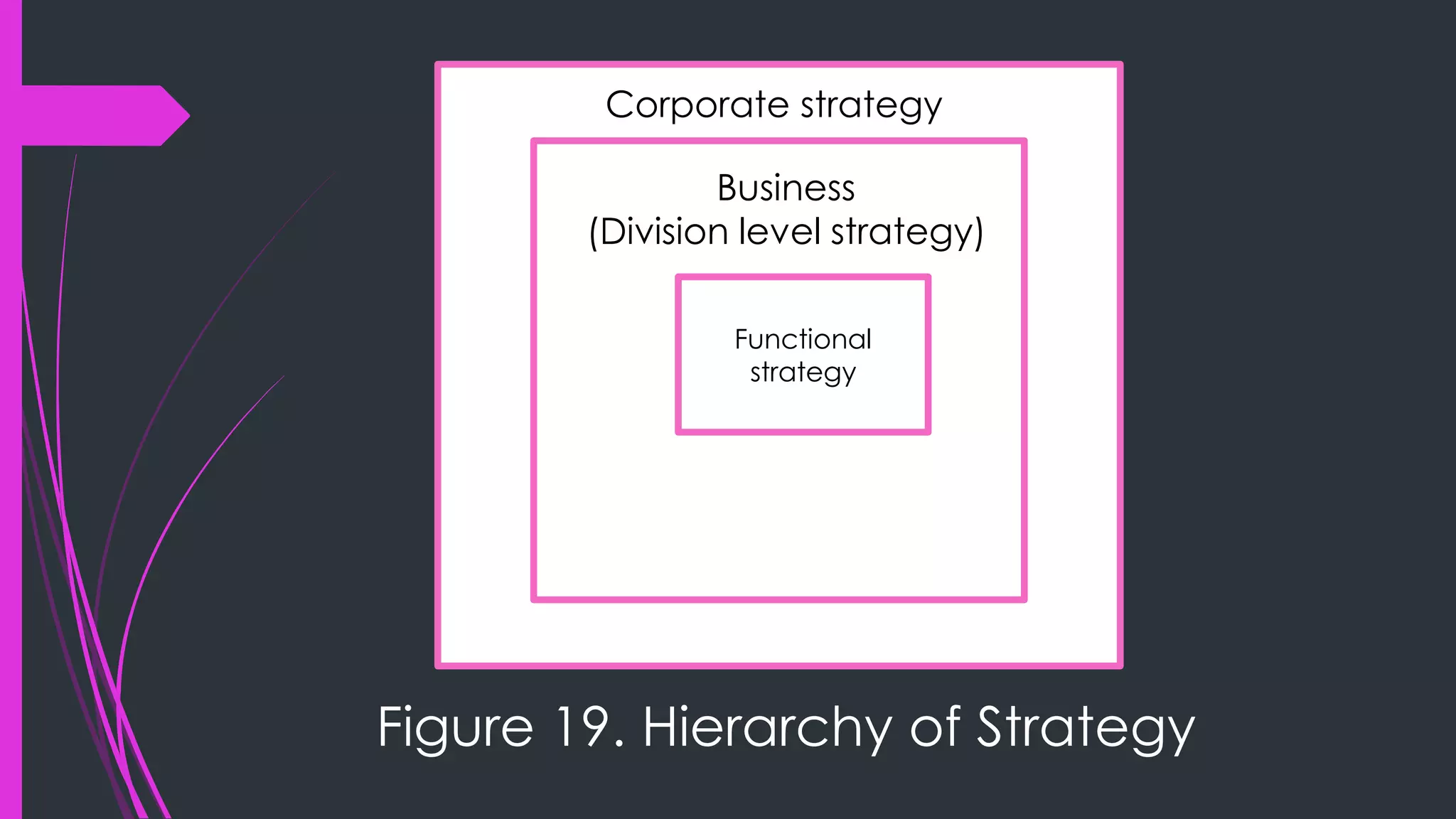
Figure 19. Hierarchy of Strategy
Functional
strategy
Corporate strategy
Business
(Division level strategy)
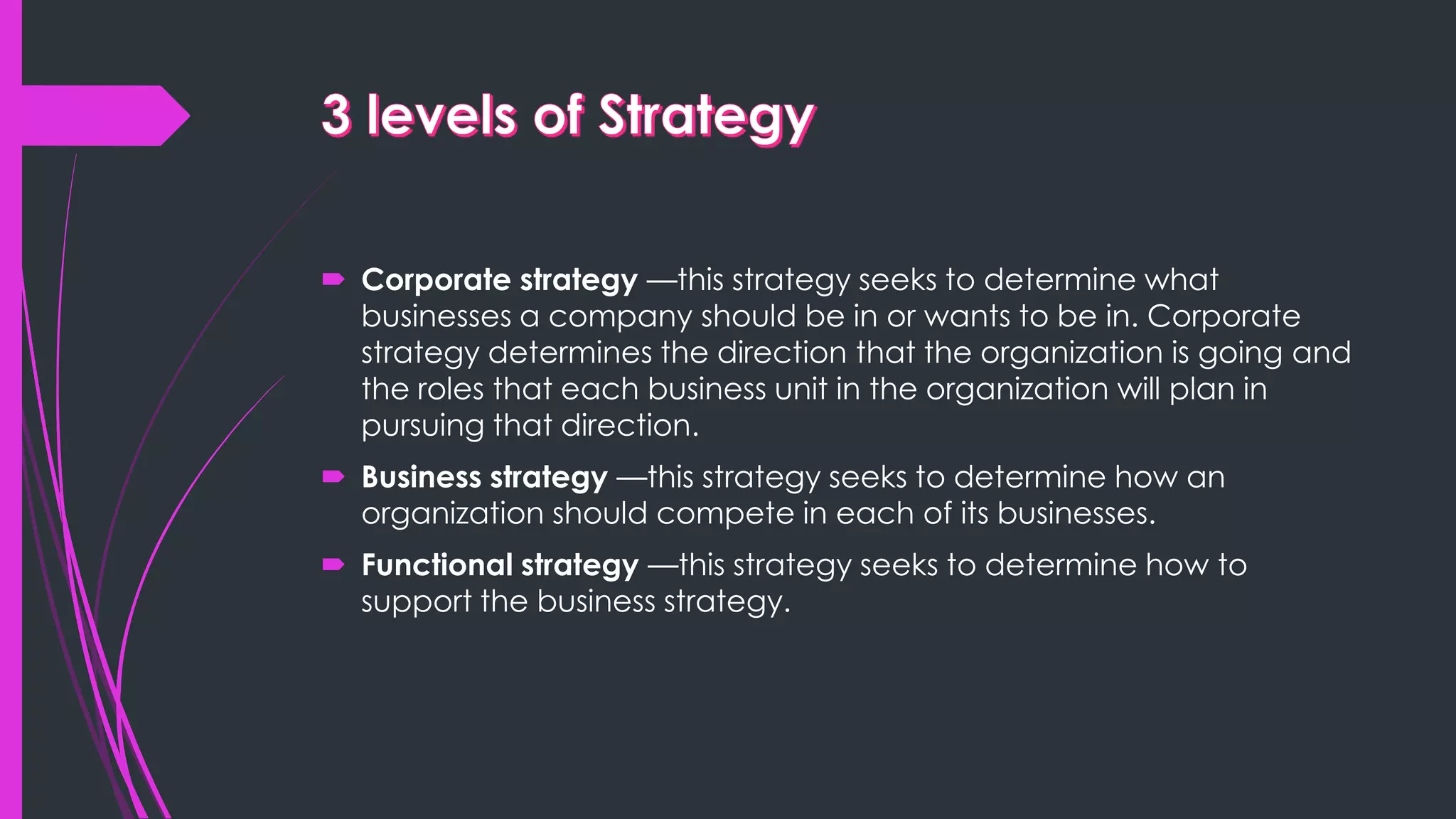
 Corporate strategy —this strategy seeks to determine what
businesses a company should be in or wants to be in. Corporate
strategy determines the direction that the organization is going and
the roles that each business unit in the organization will plan in
pursuing that direction.
 Business strategy —this strategy seeks to determine how an
organization should compete in each of its businesses.
 Functional strategy —this strategy seeks to determine how to
support the business strategy.
• Conglomerate Diversification
• Unrelated Diversification
In an effort to extend growth beyond its turf, large companies dream of
expanding their image beyond profit objectives . Fame and corporate image
beyond the boundaries of the industry or sector they are known for are among
the motivations that drive corporate giants to go into conglomerate
diversification.
 Is a corporate diversification option that involves engaging or
dealing with products or services that are somehow related to or
associated with what the firm is presently handling.
 When an organization competes in a no-growth or a
slow-growth industry;
 When adding new, but related products significantly
would enhance the sales of current products;
 When new, but related, products could be offered at
highly competitive prices;
 When new, but related, products have seasonal sales
levels that counterbalance an organization’s existing
peaks and valley;
 When an organization’s products are currently in the
decline stage of the product life cycle; and
 When an organization has a strong management
team.
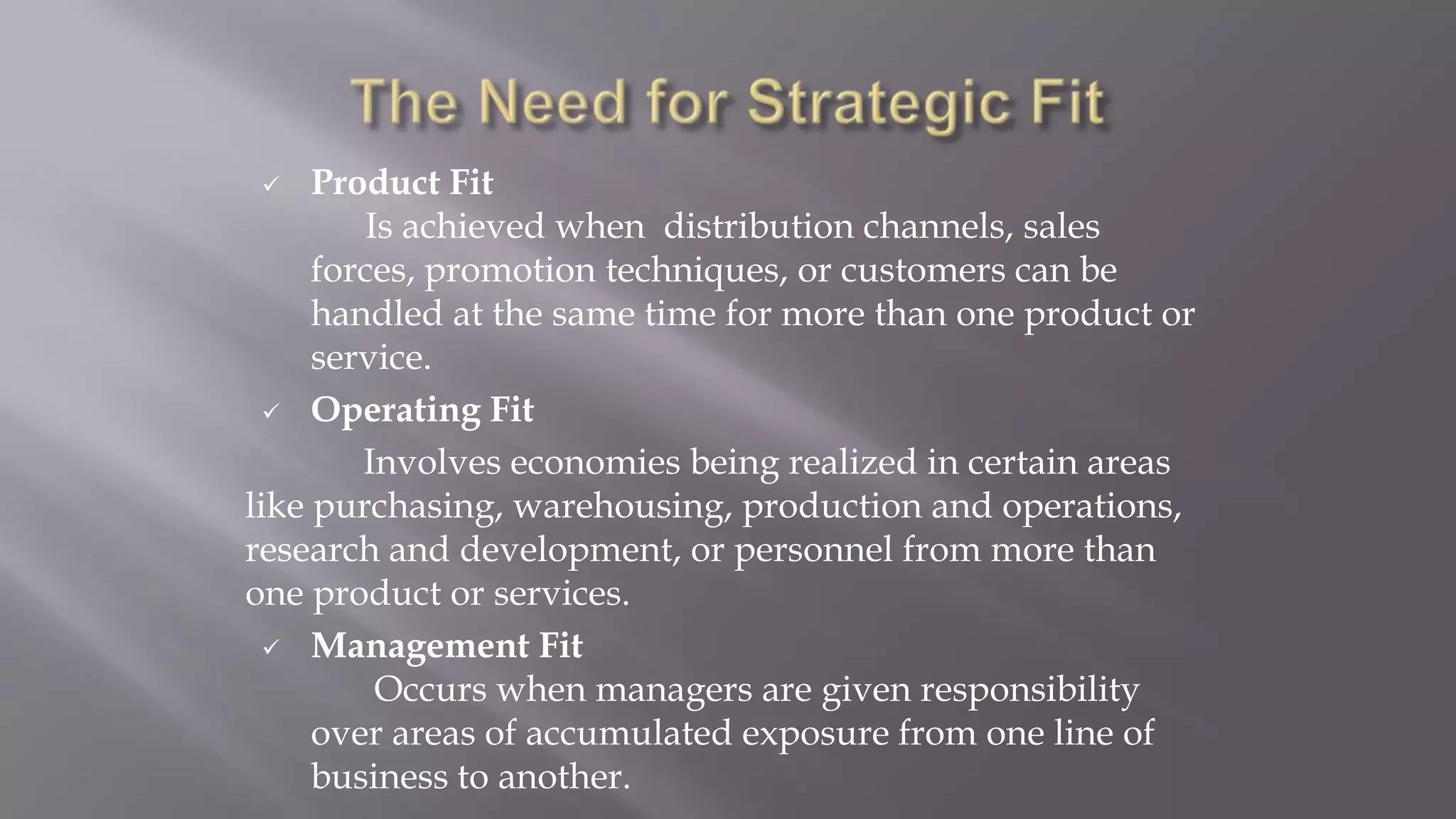
 Product Fit
Is achieved when distribution channels, sales
forces, promotion techniques, or customers can be
handled at the same time for more than one product or
service.
 Operating Fit
Involves economies being realized in certain areas
like purchasing, warehousing, production and operations,
research and development, or personnel from more than
one product or services.
 Management Fit
Occurs when managers are given responsibility
over areas of accumulated exposure from one line of
business to another.
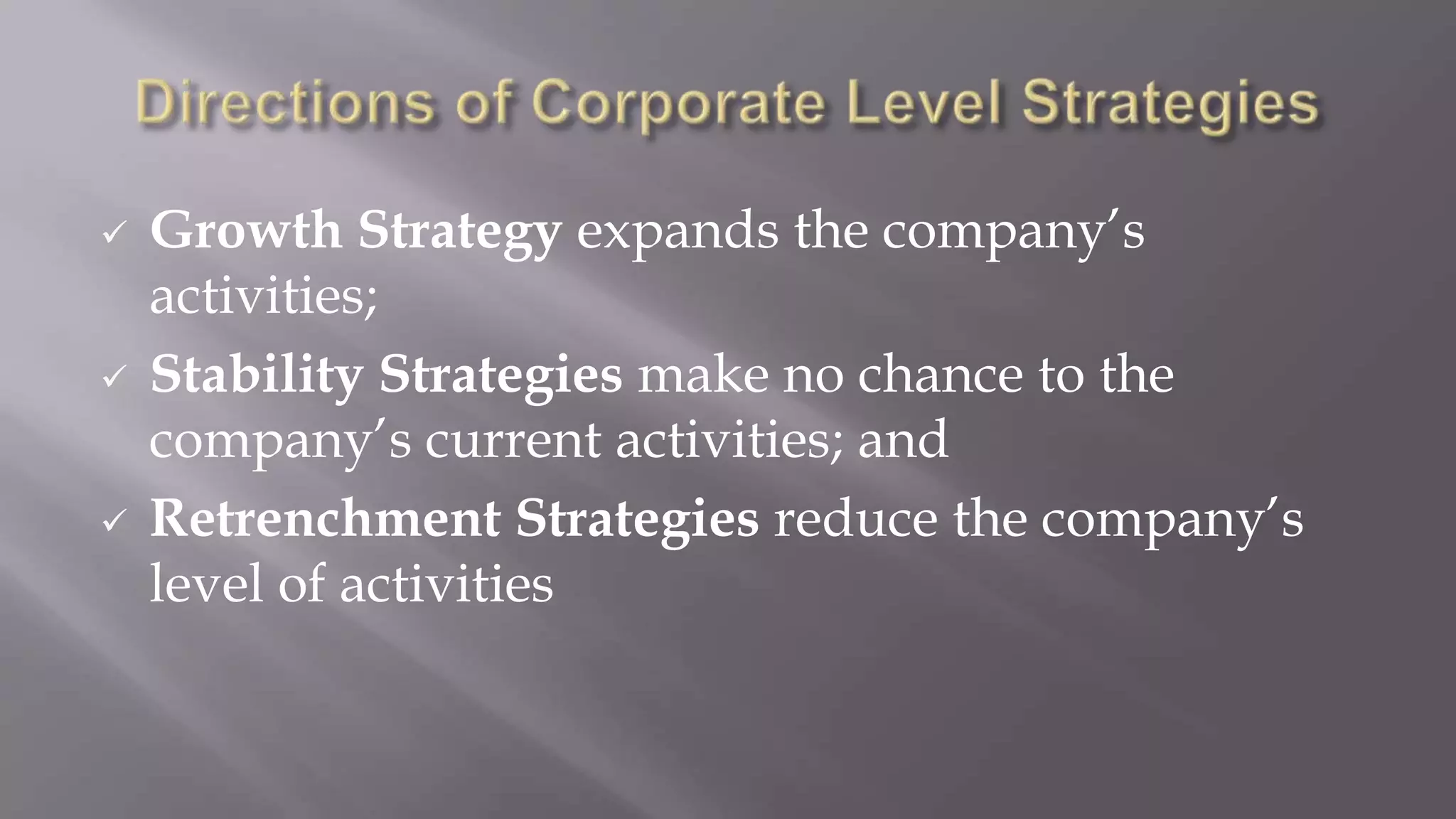
 Growth Strategy expands the company’s
activities;
 Stability Strategies make no chance to the
company’s current activities; and
 Retrenchment Strategies reduce the company’s
level of activities
 Merger- Involves a transaction involving two or more
corporations in which a stock is exchanged or swapped among
independent business organizations from which only one
company services
 Acquisition- Is an option that involves the purchase of a
company then completely absorbed as in operating subsidiary or
division of the acquiring corporation.
 Strategic alliance- is another option involving a partnership
among two or more corporations or business units to achieved
strategically significant objectives that are mutually beneficial.
 Pause/proceed with caution.
This is in effect, a sort of time out. It is an opportunity to
rest before continuing a growth or retrenchment strategy.
 No change strategy.
It involves a decision to do nothing new.
 Profit strategy.
It involves a decision to do nothing new in a worsening
situation and instead, to act as though the company’s problems are
only temporary.
 Turnaround strategy.
This strategy emphasizes on the improvement of operational efficiency and is
probably most appropriate when a corporation’s problems are pervasive but not
yet critical.
-Contraction
-Consolidation
 Sell-out/Divestment strategy.
This strategy is resorted to when a company has a weak competitive position
in its industry.
 Bankruptcy strategy.
Involves giving up management of the firm to the courts in return for some
settlement of the corporation’s obligations.
 Liquidation strategy.
Is the termination of the firm’s business operation.
• Shipping goods to other country.
Exporting
• Grants rights tp another firm in thr host cou0ntry to
prudce or sell prodcut or services.
Licensing
• Grants rights to another company to open a
business.
Franchising
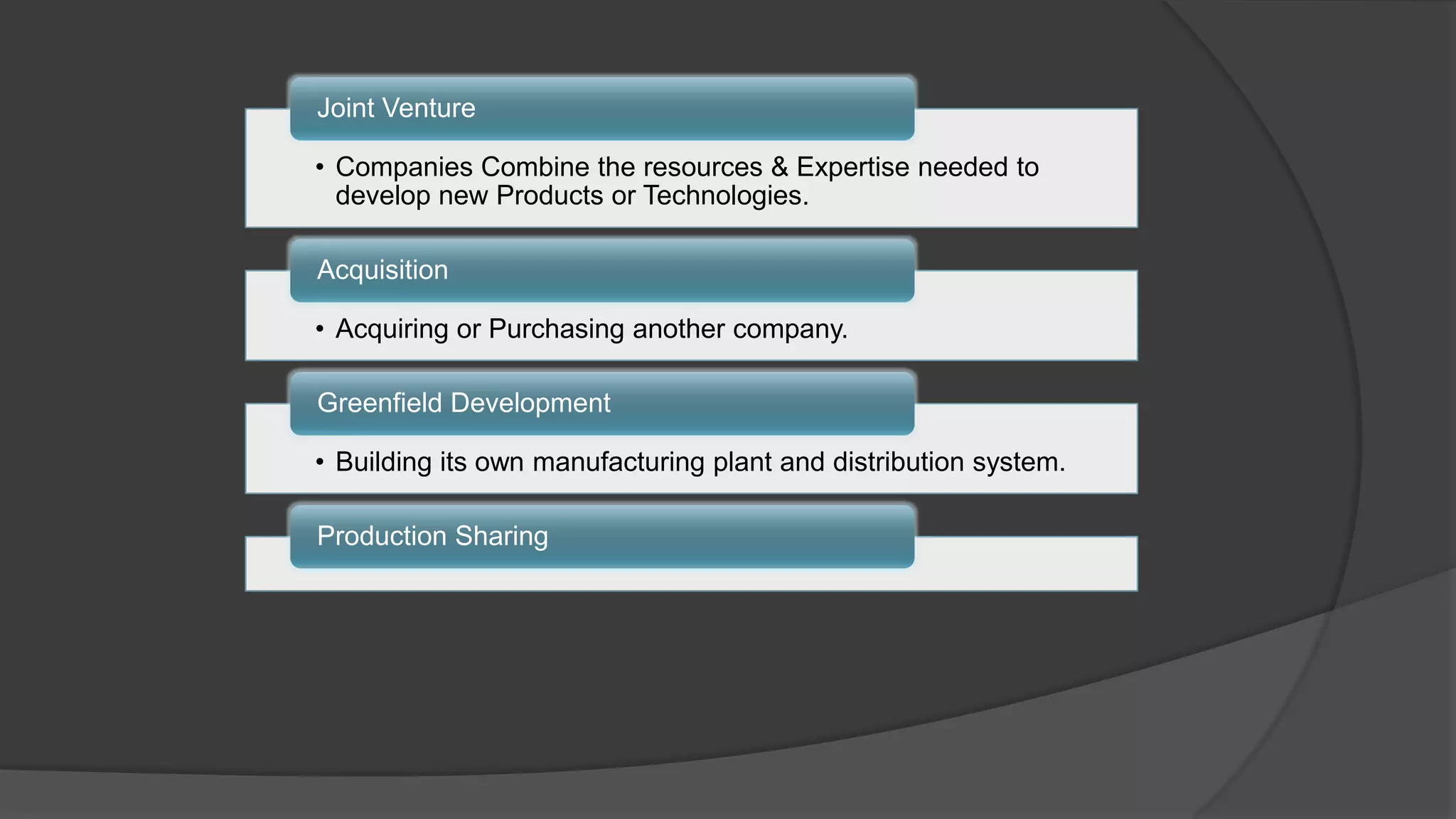
• Companies Combine the resources & Expertise needed to
develop new Products or Technologies.
Joint Venture
• Acquiring or Purchasing another company.
Acquisition
• Building its own manufacturing plant and distribution system.
Greenfield Development
Production Sharing
• Construction of Operating facilities in exchange for fee.
Turnkey Operations
• A corporation may use its personnel to assist a firm in a
host country for a specified fee & period of time.
Management Contract
Build-Operate-Transfer / BOT Concept
Outsourcing
Corporate level strategies

Corporate level strategies

  • 2.
    CATEGORIES OF BUSINESSORGANIZATIONS SINGLE PROPRIETORSHIP PARTNERSHIP CORPORATION COOPERATIVE
  • 3.
    Group of Companies ParentCompany Subsidiaries
  • 4.
    NATURE OF CORPORATELEVEL STRATEGY • CORPORATE LEVEL STRATEGY • CORPORATE STRATEGY
  • 5.
    4 E’s toAddressing Corporate Strategy 1.Extend 2.Expand 3.Exit 4.Enhance
  • 6.
    Figure 16. Waysthat a Business Strategy can Evolve EXPANDE X I T ENHANCE EXTEND ENHANCEMENT Add functionality or improve a product or service that is currently offered. EXTENSION Adopt new business model or enter new business. EXPANSION Add products and services within an existing business. EXIT Drop a product or service line or exit a business.
  • 7.
    Key Issues isCorporate Level Strategy a)Directional Strategy b)Portfolio Strategy c)Parenting Strategy
  • 8.
    Strategic Choices atCorporate Level a.Business Closure b.Business Disposal c.Business Acquisition d.Business Reorganization e.Business Start up f. The impact of doing nothing different
  • 9.
    Figure 18. BasicModel for Integration and Diversification Options I N D I R E C T C O M P E T I T O R S D I R E C T C O M P E T I T O R S V E R T I C A L I N T E G R A T I O N The Company Horizontal integration Forward integration Backward integration Horizontal diversification Horizontal integration/diversification Customers/End Users Suppliers
  • 10.
    Vertical integration - isthe degree to which a firm owns its upstream suppliers and its downstream buyers. - the term VI describes a style of management control Three (3) varieties:  backward (upstream) vertical integration  forward (downstream) vertical integration  balanced (both upstream and downstream) vertical integration
  • 11.
    a.Full Integration b.Taper Integration c.Quasi-Integration d.Long-term Contracts
  • 12.
    Horizontal integration - isa strategy where a company acquires, mergers or takes over another company in the same industry value chain.  Merger is the joining of two similar sizes, independent companies to make one joint entity.  Acquisition is the purchase of another company.  Hostile takeover is the acquisition of the company, which does not want to be acquired.
  • 13.
    Horizontal Diversification Generally perceivedas a strategy that evolves around the idea of seeking ownership or increased control over the direct and indirect competitors of the business.
  • 14.
    Direct and Indirectcompetitors Direct competitors can be classified as:  Offering the same products and/or services as you are offering to your clients and/or customers.  Having the same targeted field of clients, customers and/or demographics.  Using the same tactics in advertising or bringing news/informations of products/services to your targeted demographics. Indirect competitors can be classified as “wanting to have a share of the pie”
  • 15.
    Figure 19. Hierarchyof Strategy Functional strategy Corporate strategy Business (Division level strategy)
  • 16.
     Corporate strategy—this strategy seeks to determine what businesses a company should be in or wants to be in. Corporate strategy determines the direction that the organization is going and the roles that each business unit in the organization will plan in pursuing that direction.  Business strategy —this strategy seeks to determine how an organization should compete in each of its businesses.  Functional strategy —this strategy seeks to determine how to support the business strategy.
  • 17.
    • Conglomerate Diversification •Unrelated Diversification
  • 18.
    In an effortto extend growth beyond its turf, large companies dream of expanding their image beyond profit objectives . Fame and corporate image beyond the boundaries of the industry or sector they are known for are among the motivations that drive corporate giants to go into conglomerate diversification.
  • 19.
     Is acorporate diversification option that involves engaging or dealing with products or services that are somehow related to or associated with what the firm is presently handling.
  • 20.
     When anorganization competes in a no-growth or a slow-growth industry;  When adding new, but related products significantly would enhance the sales of current products;  When new, but related, products could be offered at highly competitive prices;  When new, but related, products have seasonal sales levels that counterbalance an organization’s existing peaks and valley;  When an organization’s products are currently in the decline stage of the product life cycle; and  When an organization has a strong management team.
  • 21.
     Product Fit Isachieved when distribution channels, sales forces, promotion techniques, or customers can be handled at the same time for more than one product or service.  Operating Fit Involves economies being realized in certain areas like purchasing, warehousing, production and operations, research and development, or personnel from more than one product or services.  Management Fit Occurs when managers are given responsibility over areas of accumulated exposure from one line of business to another.
  • 22.
     Growth Strategyexpands the company’s activities;  Stability Strategies make no chance to the company’s current activities; and  Retrenchment Strategies reduce the company’s level of activities
  • 23.
     Merger- Involvesa transaction involving two or more corporations in which a stock is exchanged or swapped among independent business organizations from which only one company services  Acquisition- Is an option that involves the purchase of a company then completely absorbed as in operating subsidiary or division of the acquiring corporation.  Strategic alliance- is another option involving a partnership among two or more corporations or business units to achieved strategically significant objectives that are mutually beneficial.
  • 24.
     Pause/proceed withcaution. This is in effect, a sort of time out. It is an opportunity to rest before continuing a growth or retrenchment strategy.  No change strategy. It involves a decision to do nothing new.  Profit strategy. It involves a decision to do nothing new in a worsening situation and instead, to act as though the company’s problems are only temporary.
  • 25.
     Turnaround strategy. Thisstrategy emphasizes on the improvement of operational efficiency and is probably most appropriate when a corporation’s problems are pervasive but not yet critical. -Contraction -Consolidation  Sell-out/Divestment strategy. This strategy is resorted to when a company has a weak competitive position in its industry.  Bankruptcy strategy. Involves giving up management of the firm to the courts in return for some settlement of the corporation’s obligations.  Liquidation strategy. Is the termination of the firm’s business operation.
  • 27.
    • Shipping goodsto other country. Exporting • Grants rights tp another firm in thr host cou0ntry to prudce or sell prodcut or services. Licensing • Grants rights to another company to open a business. Franchising
  • 28.
    • Companies Combinethe resources & Expertise needed to develop new Products or Technologies. Joint Venture • Acquiring or Purchasing another company. Acquisition • Building its own manufacturing plant and distribution system. Greenfield Development Production Sharing
  • 29.
    • Construction ofOperating facilities in exchange for fee. Turnkey Operations • A corporation may use its personnel to assist a firm in a host country for a specified fee & period of time. Management Contract Build-Operate-Transfer / BOT Concept Outsourcing