Perspective Management 
- Jasiya Syed
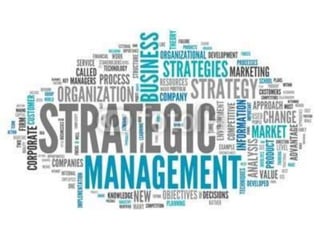
What is Strategic Management ? 
• It is the continuous planning, monitoring, analysis 
and assessment of all that is necessary for an 
organization to meet its goals and objectives. 
• The strategic management process involves 
analyzing cross-functional business decisions prior 
to implementing them. 
• There are 3 steps in Strategic Management: 
Planning, Execution And Monitoring.
Classes of Decision
Classes of Decision
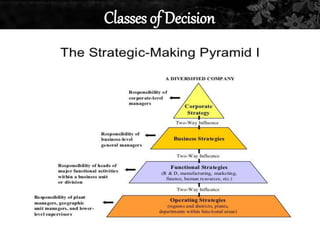
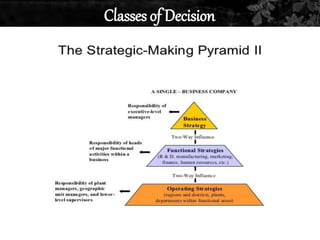
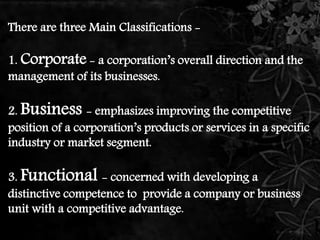
There are three Main Classifications - 
1. Corporate - a corporation’s overall direction and the 
management of its businesses. 
2. Business - emphasizes improving the competitive 
position of a corporation’s products or services in a specific 
industry or market segment. 
3. Functional - concerned with developing a 
distinctive competence to provide a company or business 
unit with a competitive advantage.
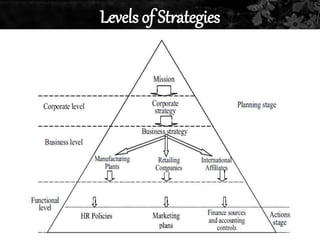
Levels of Strategies
What is Strategy ? 
• A method or plan chosen to bring about a desired 
future, such as achievement of a goal or solution to 
a problem. 
• The art and science of planning and 
marshalling resources for their most efficient 
and effective use. The term is derived from the 
Greek word for general ship or leading an army.
Types of Strategies 
1. Growth strategies - seek an increase in size and the 
expansion of current operations. 
2. Concentration strategies - growth occurs through 
expansion in the same business area. 
3. Diversification strategies - growth occurs through 
acquisition of or investment in new and/or different 
business areas. 
4. Intensification Strategy - Intensification is the 
development of land at a higher density than currently 
exists through redevelopment, reuse of former industrial 
and commercial sites
5. Restructuring and divestiture strategies 
• Liquidation 
• Restructuring 
• Divestiture 
6. Cooperative strategies - strategic alliances of two or more 
organizations partner to pursue an area of mutual interest. 
7. E-business strategies 
8. Stability strategy - It implies continuing the correct 
activities of the firm without any significant change in 
direction. 
• Pause process with certain strategy 
• No change strategy 
• Profit strategy
Porter’s Model 
Generic strategies for gaining competitive 
advantage: 
• Differentiation strategy 
• Cost leadership strategy 
• Focused differentiation strategy 
• Focused cost leadership strategy
Role of a Strategist
Strategist & Their Role 
1. Entrepreneur 
The entrepreneur always searches for change, 
responds to it and exploits it. 
2.Board of Directors 
• Directions to managers + Operational matters of 
significance, 
• Formal and informal functions, 
• Vital link between the company and the 
environment.
3. CEO’s 
• The Role Modelling Approaches 
• Chief architect of organizational purpose, 
strategist or planner 
• Organizational leader, organizer, or organizational 
builder 
• Chief administrator, implementer, or coordinator 
• opportunity. 
Communicator of organizational purpose, 
motivator, personal leader or mentor. 
4. Strategic Business Units (SBU’s) 
• The executive head of each SBU is responsible for 
the framing of strategies for that SBU and for the 
coordination with the other SBUs in the 
organization.
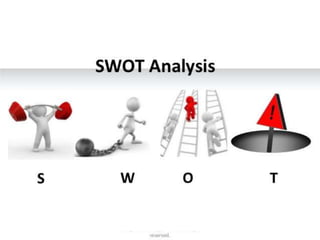
What is SWOT Analysis ? 
• “SWOT Analysis is a strategic planning tool that 
separates influences on a business’s future success 
into internal and external factors” 
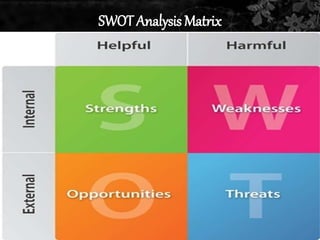
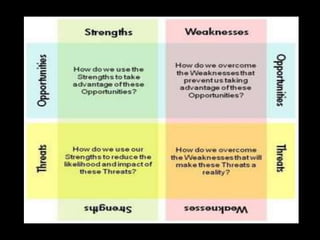
• “SWOT analysis (alternatively SWOT Matrix) is a 
structured planning method used to evaluate the 
Strengths, Weaknesses, Opportunities, and Threats 
involved in a project or in a business”
SWOT Analysis Matrix
How it Works…. 
1. STRENGHTS 
• What advantages does the company have? 
• What makes company standout from its competitors? 
• What positive aspects does the company enjoy in the 
current environment ? 
2. WEAKNESSES 
• Which areas are causing concerns? 
• Which issues can be avoided? 
• Company’s reputation among its customers
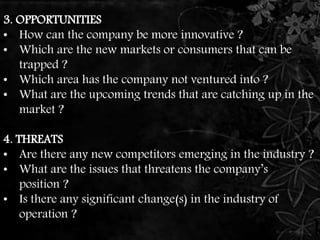
3. OPPORTUNITIES 
• How can the company be more innovative ? 
• Which are the new markets or consumers that can be 
trapped ? 
• Which area has the company not ventured into ? 
• What are the upcoming trends that are catching up in the 
market ? 
4. THREATS 
• Are there any new competitors emerging in the industry ? 
• What are the issues that threatens the company’s 
position ? 
• Is there any significant change(s) in the industry of 
operation ?
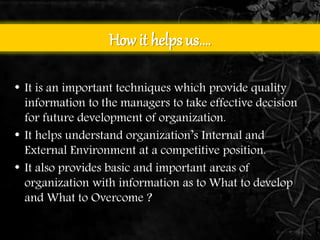
How it helps us…. 
• It is an important techniques which provide quality 
information to the managers to take effective decision 
for future development of organization. 
• It helps understand organization’s Internal and 
External Environment at a competitive position. 
• It also provides basic and important areas of 
organization with information as to What to develop 
and What to Overcome ?
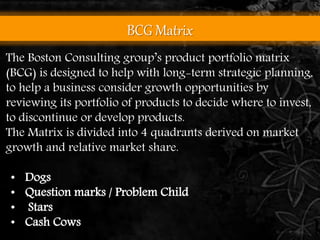
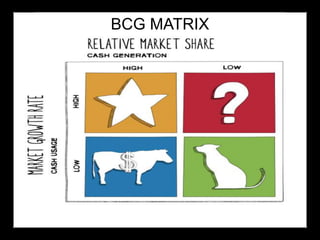
BCG Matrix 
The Boston Consulting group’s product portfolio matrix 
(BCG) is designed to help with long-term strategic planning, 
to help a business consider growth opportunities by 
reviewing its portfolio of products to decide where to invest, 
to discontinue or develop products. 
The Matrix is divided into 4 quadrants derived on market 
growth and relative market share. 
• Dogs 
• Question marks / Problem Child 
• Stars 
• Cash Cows
BCG MATRIX
Limitations of BCG 
• High market share is not the only success factor 
• Market growth is not the only indicator for 
attractiveness of market. 
• Sometimes Dogs can earn even more cash as Cash 
Cows. 
• The BCG Model is seen as simplistic and it can be 
difficult to classify products in smaller businesses 
where the relative market share is too small to 
quantify. 
• It’s also based on the concept that market share can be 
achieved by spending more on the marketing budget.
Strategic Management 
Model
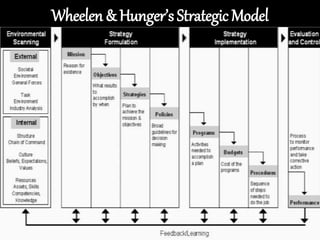
Wheelen & Hunger’s Strategic Model
How to work on it…… 
1. Monitoring, evaluating and disseminating information 
from the environment to key people within the 
corporation. 
2. Scan via SWOT analysis: 
• Look for opportunities/threats in the external 
environment 
• Look for strengths/weaknesses in the internal 
environment
Strategy Formulation 
The process of developing long-range plans to 
deal effectively with environmental 
opportunities and threats in light of corporate 
strengths and weaknesses. 
Composed of: 
• Vision and Mission 
• Objectives 
• Strategies 
• Policies
• Vision : 
It is a statement about what an organization ultimately 
wants to accomplish. It captures the company’s aspiration. 
• Mission : 
The purpose or reason for the corporation’s existence. It 
tells who the company is, what they do as well as what 
they’d like to become. 
• Objectives : 
The end results of planned activity. They state WHAT is to 
be accomplished by WHEN. They should be quantified, if 
possible. Should be specific, measurable and obtainable.
• Policies – 
It is a broad guideline for decision making that 
links the formulation of a strategy with its 
implementation. 
E.g. - 3M’s policy requiring researchers to 
spend 15% of their time working on something 
other than their primary project.
Strategies 
It states how the corporation will achieve its mission and 
objectives. 
Types of adaptive strategies 
• Prospector strategy - Appropriate in dynamic, high-potential 
environments 
• Defender strategy - Appropriate in stable or declining 
environments 
• Reactor strategy - Following competitors as a last 
resort regardless of environment
Strategy Implementation 
The process of putting strategies and policies into action 
through the development of: 
• Programs - statements of activities or steps needed to 
accomplish a single-use plan. 
• Budgets - statements of a corporation’s programs in 
money terms. 
• Procedures - systems of sequential steps or techniques 
that describe in detail how to perform particular tasks 
or jobs.
• Evaluation & Control – 
The process of monitoring corporate 
activities and performance results so 
that actual performance can be 
compared with desired performance.
Benefits of Strategic Management 
“Strategic management allows and 
organization to be more proactive than 
reactive in shaping its own future.” 
• Non-Financial Benefits 
• Financial Benefits
Non-Financial Benefits 
• Improved understanding of 
competitor’s strategies. 
• Enhanced awareness of threats. 
• Reduced resistance to change. 
• Enhanced problem-prevention 
capabilities.
Financial Benefits 
• Improvement in sales. 
• Improvement in profitability. 
• Improvement in productivity
Example 
Konkan Rail project 
• Estimated Cost – Around 3000 Cr. 
• Final Approximate Cost -2980 cr. 
• Time required to Complete - 7 years 
• Time estimated to Complete – 8 years 
Mumbai Sea Link 
• Estimated cost - Rs300 cr. 
• But the bridge was delayed by five years 
• Final approximate Cost - Rs1,634 crore.
BW Sea-Link Konkan Railway
Thank You For Your 
Patience!!!

Strategic Management & Planning

  • 1.
  • 4.
    What is StrategicManagement ? • It is the continuous planning, monitoring, analysis and assessment of all that is necessary for an organization to meet its goals and objectives. • The strategic management process involves analyzing cross-functional business decisions prior to implementing them. • There are 3 steps in Strategic Management: Planning, Execution And Monitoring.
  • 5.
  • 6.
  • 7.
    There are threeMain Classifications - 1. Corporate - a corporation’s overall direction and the management of its businesses. 2. Business - emphasizes improving the competitive position of a corporation’s products or services in a specific industry or market segment. 3. Functional - concerned with developing a distinctive competence to provide a company or business unit with a competitive advantage.
  • 8.
  • 10.
    What is Strategy? • A method or plan chosen to bring about a desired future, such as achievement of a goal or solution to a problem. • The art and science of planning and marshalling resources for their most efficient and effective use. The term is derived from the Greek word for general ship or leading an army.
  • 11.
    Types of Strategies 1. Growth strategies - seek an increase in size and the expansion of current operations. 2. Concentration strategies - growth occurs through expansion in the same business area. 3. Diversification strategies - growth occurs through acquisition of or investment in new and/or different business areas. 4. Intensification Strategy - Intensification is the development of land at a higher density than currently exists through redevelopment, reuse of former industrial and commercial sites
  • 12.
    5. Restructuring anddivestiture strategies • Liquidation • Restructuring • Divestiture 6. Cooperative strategies - strategic alliances of two or more organizations partner to pursue an area of mutual interest. 7. E-business strategies 8. Stability strategy - It implies continuing the correct activities of the firm without any significant change in direction. • Pause process with certain strategy • No change strategy • Profit strategy
  • 13.
    Porter’s Model Genericstrategies for gaining competitive advantage: • Differentiation strategy • Cost leadership strategy • Focused differentiation strategy • Focused cost leadership strategy
  • 14.
    Role of aStrategist
  • 15.
    Strategist & TheirRole 1. Entrepreneur The entrepreneur always searches for change, responds to it and exploits it. 2.Board of Directors • Directions to managers + Operational matters of significance, • Formal and informal functions, • Vital link between the company and the environment.
  • 16.
    3. CEO’s •The Role Modelling Approaches • Chief architect of organizational purpose, strategist or planner • Organizational leader, organizer, or organizational builder • Chief administrator, implementer, or coordinator • opportunity. Communicator of organizational purpose, motivator, personal leader or mentor. 4. Strategic Business Units (SBU’s) • The executive head of each SBU is responsible for the framing of strategies for that SBU and for the coordination with the other SBUs in the organization.
  • 18.
    What is SWOTAnalysis ? • “SWOT Analysis is a strategic planning tool that separates influences on a business’s future success into internal and external factors” • “SWOT analysis (alternatively SWOT Matrix) is a structured planning method used to evaluate the Strengths, Weaknesses, Opportunities, and Threats involved in a project or in a business”
  • 19.
  • 20.
    How it Works…. 1. STRENGHTS • What advantages does the company have? • What makes company standout from its competitors? • What positive aspects does the company enjoy in the current environment ? 2. WEAKNESSES • Which areas are causing concerns? • Which issues can be avoided? • Company’s reputation among its customers
  • 21.
    3. OPPORTUNITIES •How can the company be more innovative ? • Which are the new markets or consumers that can be trapped ? • Which area has the company not ventured into ? • What are the upcoming trends that are catching up in the market ? 4. THREATS • Are there any new competitors emerging in the industry ? • What are the issues that threatens the company’s position ? • Is there any significant change(s) in the industry of operation ?
  • 23.
    How it helpsus…. • It is an important techniques which provide quality information to the managers to take effective decision for future development of organization. • It helps understand organization’s Internal and External Environment at a competitive position. • It also provides basic and important areas of organization with information as to What to develop and What to Overcome ?
  • 24.
    BCG Matrix TheBoston Consulting group’s product portfolio matrix (BCG) is designed to help with long-term strategic planning, to help a business consider growth opportunities by reviewing its portfolio of products to decide where to invest, to discontinue or develop products. The Matrix is divided into 4 quadrants derived on market growth and relative market share. • Dogs • Question marks / Problem Child • Stars • Cash Cows
  • 25.
  • 26.
    Limitations of BCG • High market share is not the only success factor • Market growth is not the only indicator for attractiveness of market. • Sometimes Dogs can earn even more cash as Cash Cows. • The BCG Model is seen as simplistic and it can be difficult to classify products in smaller businesses where the relative market share is too small to quantify. • It’s also based on the concept that market share can be achieved by spending more on the marketing budget.
  • 27.
  • 28.
    Wheelen & Hunger’sStrategic Model
  • 29.
    How to workon it…… 1. Monitoring, evaluating and disseminating information from the environment to key people within the corporation. 2. Scan via SWOT analysis: • Look for opportunities/threats in the external environment • Look for strengths/weaknesses in the internal environment
  • 30.
    Strategy Formulation Theprocess of developing long-range plans to deal effectively with environmental opportunities and threats in light of corporate strengths and weaknesses. Composed of: • Vision and Mission • Objectives • Strategies • Policies
  • 31.
    • Vision : It is a statement about what an organization ultimately wants to accomplish. It captures the company’s aspiration. • Mission : The purpose or reason for the corporation’s existence. It tells who the company is, what they do as well as what they’d like to become. • Objectives : The end results of planned activity. They state WHAT is to be accomplished by WHEN. They should be quantified, if possible. Should be specific, measurable and obtainable.
  • 32.
    • Policies – It is a broad guideline for decision making that links the formulation of a strategy with its implementation. E.g. - 3M’s policy requiring researchers to spend 15% of their time working on something other than their primary project.
  • 33.
    Strategies It stateshow the corporation will achieve its mission and objectives. Types of adaptive strategies • Prospector strategy - Appropriate in dynamic, high-potential environments • Defender strategy - Appropriate in stable or declining environments • Reactor strategy - Following competitors as a last resort regardless of environment
  • 34.
    Strategy Implementation Theprocess of putting strategies and policies into action through the development of: • Programs - statements of activities or steps needed to accomplish a single-use plan. • Budgets - statements of a corporation’s programs in money terms. • Procedures - systems of sequential steps or techniques that describe in detail how to perform particular tasks or jobs.
  • 35.
    • Evaluation &Control – The process of monitoring corporate activities and performance results so that actual performance can be compared with desired performance.
  • 37.
    Benefits of StrategicManagement “Strategic management allows and organization to be more proactive than reactive in shaping its own future.” • Non-Financial Benefits • Financial Benefits
  • 38.
    Non-Financial Benefits •Improved understanding of competitor’s strategies. • Enhanced awareness of threats. • Reduced resistance to change. • Enhanced problem-prevention capabilities.
  • 39.
    Financial Benefits •Improvement in sales. • Improvement in profitability. • Improvement in productivity
  • 40.
    Example Konkan Railproject • Estimated Cost – Around 3000 Cr. • Final Approximate Cost -2980 cr. • Time required to Complete - 7 years • Time estimated to Complete – 8 years Mumbai Sea Link • Estimated cost - Rs300 cr. • But the bridge was delayed by five years • Final approximate Cost - Rs1,634 crore.
  • 41.
  • 42.
    Thank You ForYour Patience!!!

Editor's Notes

  • #25 1. Dogs: These are products with low growth or market share. 2. Question marks or Problem Child: Products in high growth markets with low market share. 3. Stars: Products in high growth markets with high market share. 4. Cash cows: Products in low growth markets with high market share