Strategic
Management
Model
Presented by-
Akriti Gupta(IMB2015001)
Sarthak Sengupta(IMP2015001)
Aman Chadha(IMP2015002)
What is Strategy Management?
• Managerial process
• It is Second generation planning.
• “Strategic management is a stream of decisions and actions which
leads to the development of an effective strategy or strategies to help
achieve corporate objectives.”
• The Strategic Management process is the way in which strategists
determine objectives and make strategic decisions.
Pros and Cons
• Allows firms to
anticipate changing
conditions.
• Provides clear objectives
and direction for
employees.
• Research in strategic
management is
advancing so that the
process can help
managers.
• Businesses which
perform strategic
management are more
effective.
• Conditions change so
fast, managers can’t do
any planning,
especially long-term
planning.
• Objectives must often
be vague and general.
• Managers pay little
attention to research
and studies.
• There are many
reasons for success.
Strategic
Management
Model
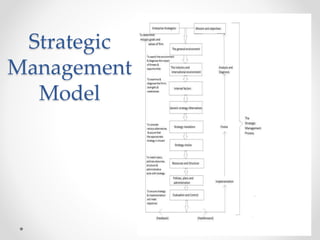
Process of Strategy
1.STRATEGIC MANAGEMENT ELEMENTS
I. Enterprise Strategists
• The Strategists who are involved in the process, the mission and
objectives of the enterprise.
• The General Managers: Executives at the pinnacle of the enterprise
or SBUs who are responsible for the survival and success of the
corporation.
• Types of Strategists:
a) Corporate level Strategists
b) Business level Strategists
II. Mission And Objectives
• Starting point of Strategy formulation.
• Organizations strive for achieving the end results which are ‘vision’,
‘mission’, ‘purpose’, ‘objective’, ‘goals’, ‘targets’ etc.
 Vision
Statement that communicates both the purposes and values of the
organization.
 Mission
Statement that guides the actions of the organization .
 Objectives
Organizations performance targets.
 Goals
Close-ended attributes.
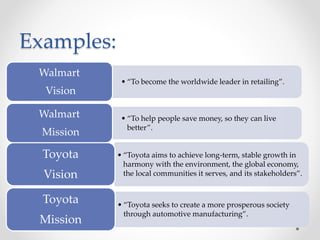
• “To become the worldwide leader in retailing”.
Walmart
Vision
• “To help people save money, so they can live
better”.
Walmart
Mission
Examples:
• “Toyota aims to achieve long-term, stable growth in
harmony with the environment, the global economy,
the local communities it serves, and its stakeholders”.
Toyota
Vision
• “Toyota seeks to create a more prosperous society
through automotive manufacturing”.
Toyota
Mission
2.ENVIRONMENTAL AND ORGANIZATIONAL ANALYSIS
• Every organization operates within an environment.
• Environment may be internal or external.
• Also known as “environmental scanning or appraisal”.
• There are two aspects involved in environmental analysis:
Ø Monitoring the environment i.e. environmental search and
Ø Identifying opportunities and threats based on environmental monitoring
i.e. environmental diagnosis.
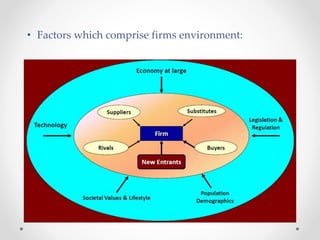
• Factors which comprise firms environment:
3. IDENTIFICATION OF STRATEGIC
ALTERNATIVES
• The next step is to identify the various strategic alternatives.
• After the identification of strategic alternatives they have to be evaluated
to match them with the environmental analysis.
• According to Glueck & Jauch, “Strategic alternatives revolve around the
question whether to continue or change the business, the enterprise is
currently improving the efficiency or effectiveness with which the firm
achieves its corporate objectives in its chosen business sector”.
• There are basically four grand strategic alternatives:
a) Stability
b) Expansion
c) Retrenchment
d) Combination
• Stability: In this, the company does not go beyond what it is doing
now. The company serves with same product, in same market and
with the existing technology.
• Expansion: This is adopted when environment demands increase in
pace of activity. Company broadens its customer groups, customer
functions and the technology.
• Retrenchment: If the organization is going for this strategy, then it
has to reduce its scope in terms of customer group, customer
function or alternative technology.
• Combination: When all the three strategies are taken together, this is
known as combination strategy.
• Apart from these four grand strategies, different strategies which are used
commonly are as follows:
a) Modernisation
b) Integration
c) Diversification
d) Joint ventures
e) Strategic alliance
f) Mergers
g) Takeovers
h) Acquisitions
i) Divestment
j) Turnaround strategy
4. CHOICE OF STRATEGY
• For a business group, it may be possible to choose all strategic
alternatives but for a single company it is quite difficult.
• The strategic alternatives has to be matched with the problem.
• While making a choice, two types of factors have to be considered:
a) Objective factors: are the ones which can be quantified.
b) Subjective factors: are the ones which cannot be quantified.
• There are three objective ways to make a choice:
a) Corporate Portfolio Analysis
When the company is in more than one business, it can select more than
one strategic alternative depending upon demand of the situation prevailing in
the different portfolios.
b) Competitor Analysis
In this analysis, we try to assess what the competitor has and what he does
not have. We explore everything with respect to the competitor.
c) Industry Analysis
In industry analysis, all the competitors belonging to the particular
industry with which the organization is associated are looked at. All the
members of the industry are considered as a whole.
5. IMPLEMENTATION OF STRATEGY
• Choice now needs to be implemented i.e. strategy is now put into
action.
• Strategy implementation requires a person with administrative ability.
• The stage requires looking at the problems and eliminating them.
• In strategy implementation, one has to pass through different steps:
1. Project Implementation
2. Procedural Implementation
3. Resource Allocation
4. Structural Implementation
5. Functional Implementation
6. Behavioural Implementation
6. EVALUATION AND CONTROL
• This is an ongoing process and evaluation and control have to be done
for future course of action as well.
• May involve any kind of corrective measures concerned with any of
the steps involved in the whole process be it choice for setting mission
or objectives.
• Evaluation of strategy is done by the top managers to determine
whether their strategic choice is implemented in a manner that it is
meeting the organization’s objectives.
• Evaluation emphasizes measurement of results of a strategic action.
• Control emphasizes on taking necessary action in the light of gap that
exists between intended results and actual results in the strategic
action.
• When evaluation and control is carried out efficiently, it contributes
in three basic areas:
a) Measurement of organizational process,
b) Feedback for future actions, and
c) Linking performance and rewards.
• Control can be of three types:
1. Control of inputs that are required in an action, known as feed
forward control.
2. Control at different stages of action process, known as concurrent
control.
3. Past action control based on feedback from completed action
known as feedback control.
References
1. www.management4all.org
2. Business policy and strategic management by Jauch and Glueck

Strategic management

  • 1.
  • 2.
    What is StrategyManagement? • Managerial process • It is Second generation planning. • “Strategic management is a stream of decisions and actions which leads to the development of an effective strategy or strategies to help achieve corporate objectives.” • The Strategic Management process is the way in which strategists determine objectives and make strategic decisions.
  • 3.
    Pros and Cons •Allows firms to anticipate changing conditions. • Provides clear objectives and direction for employees. • Research in strategic management is advancing so that the process can help managers. • Businesses which perform strategic management are more effective. • Conditions change so fast, managers can’t do any planning, especially long-term planning. • Objectives must often be vague and general. • Managers pay little attention to research and studies. • There are many reasons for success.
  • 4.
  • 5.
    Process of Strategy 1.STRATEGICMANAGEMENT ELEMENTS I. Enterprise Strategists • The Strategists who are involved in the process, the mission and objectives of the enterprise. • The General Managers: Executives at the pinnacle of the enterprise or SBUs who are responsible for the survival and success of the corporation. • Types of Strategists: a) Corporate level Strategists b) Business level Strategists
  • 6.
    II. Mission AndObjectives • Starting point of Strategy formulation. • Organizations strive for achieving the end results which are ‘vision’, ‘mission’, ‘purpose’, ‘objective’, ‘goals’, ‘targets’ etc.  Vision Statement that communicates both the purposes and values of the organization.  Mission Statement that guides the actions of the organization .  Objectives Organizations performance targets.  Goals Close-ended attributes.
  • 7.
    • “To becomethe worldwide leader in retailing”. Walmart Vision • “To help people save money, so they can live better”. Walmart Mission Examples: • “Toyota aims to achieve long-term, stable growth in harmony with the environment, the global economy, the local communities it serves, and its stakeholders”. Toyota Vision • “Toyota seeks to create a more prosperous society through automotive manufacturing”. Toyota Mission
  • 8.
    2.ENVIRONMENTAL AND ORGANIZATIONALANALYSIS • Every organization operates within an environment. • Environment may be internal or external. • Also known as “environmental scanning or appraisal”. • There are two aspects involved in environmental analysis: Ø Monitoring the environment i.e. environmental search and Ø Identifying opportunities and threats based on environmental monitoring i.e. environmental diagnosis.
  • 9.
    • Factors whichcomprise firms environment:
  • 10.
    3. IDENTIFICATION OFSTRATEGIC ALTERNATIVES • The next step is to identify the various strategic alternatives. • After the identification of strategic alternatives they have to be evaluated to match them with the environmental analysis. • According to Glueck & Jauch, “Strategic alternatives revolve around the question whether to continue or change the business, the enterprise is currently improving the efficiency or effectiveness with which the firm achieves its corporate objectives in its chosen business sector”. • There are basically four grand strategic alternatives: a) Stability b) Expansion c) Retrenchment d) Combination
  • 11.
    • Stability: Inthis, the company does not go beyond what it is doing now. The company serves with same product, in same market and with the existing technology. • Expansion: This is adopted when environment demands increase in pace of activity. Company broadens its customer groups, customer functions and the technology. • Retrenchment: If the organization is going for this strategy, then it has to reduce its scope in terms of customer group, customer function or alternative technology. • Combination: When all the three strategies are taken together, this is known as combination strategy.
  • 12.
    • Apart fromthese four grand strategies, different strategies which are used commonly are as follows: a) Modernisation b) Integration c) Diversification d) Joint ventures e) Strategic alliance f) Mergers g) Takeovers h) Acquisitions i) Divestment j) Turnaround strategy
  • 13.
    4. CHOICE OFSTRATEGY • For a business group, it may be possible to choose all strategic alternatives but for a single company it is quite difficult. • The strategic alternatives has to be matched with the problem. • While making a choice, two types of factors have to be considered: a) Objective factors: are the ones which can be quantified. b) Subjective factors: are the ones which cannot be quantified.
  • 14.
    • There arethree objective ways to make a choice: a) Corporate Portfolio Analysis When the company is in more than one business, it can select more than one strategic alternative depending upon demand of the situation prevailing in the different portfolios. b) Competitor Analysis In this analysis, we try to assess what the competitor has and what he does not have. We explore everything with respect to the competitor. c) Industry Analysis In industry analysis, all the competitors belonging to the particular industry with which the organization is associated are looked at. All the members of the industry are considered as a whole.
  • 15.
    5. IMPLEMENTATION OFSTRATEGY • Choice now needs to be implemented i.e. strategy is now put into action. • Strategy implementation requires a person with administrative ability. • The stage requires looking at the problems and eliminating them. • In strategy implementation, one has to pass through different steps: 1. Project Implementation 2. Procedural Implementation 3. Resource Allocation 4. Structural Implementation 5. Functional Implementation 6. Behavioural Implementation
  • 16.
    6. EVALUATION ANDCONTROL • This is an ongoing process and evaluation and control have to be done for future course of action as well. • May involve any kind of corrective measures concerned with any of the steps involved in the whole process be it choice for setting mission or objectives. • Evaluation of strategy is done by the top managers to determine whether their strategic choice is implemented in a manner that it is meeting the organization’s objectives. • Evaluation emphasizes measurement of results of a strategic action. • Control emphasizes on taking necessary action in the light of gap that exists between intended results and actual results in the strategic action.
  • 17.
    • When evaluationand control is carried out efficiently, it contributes in three basic areas: a) Measurement of organizational process, b) Feedback for future actions, and c) Linking performance and rewards. • Control can be of three types: 1. Control of inputs that are required in an action, known as feed forward control. 2. Control at different stages of action process, known as concurrent control. 3. Past action control based on feedback from completed action known as feedback control.
  • 18.
    References 1. www.management4all.org 2. Businesspolicy and strategic management by Jauch and Glueck