Dr.B.Selvaraj MS;MCh;FICS
“ Surgical Educator”
Melaka Malaysia 75150
STOMA CARE
FOR SURGEONS
STOMA CARE
Sites: occiput, scapula, ischium, sacrum, heel
 Definition and Types
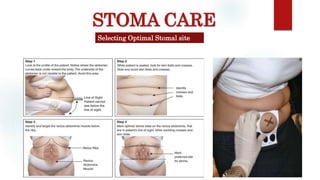
 Preparation and Counselling of patients for stoma
 Postoperative care for the stoma
 Complications
 Stoma Appliances
 General care and advice
STOMA CARE
Sites: occiput, scapula, ischium, sacrum, heel
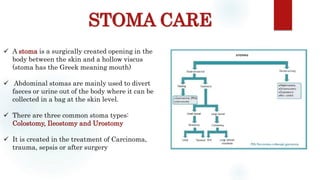
 A stoma is a surgically created opening in the
body between the skin and a hollow viscus
(stoma has the Greek meaning mouth)
 Abdominal stomas are mainly used to divert
faeces or urine out of the body where it can be
collected in a bag at the skin level.
 There are three common stoma types:
Colostomy, Ileostomy and Urostomy
 It is created in the treatment of Carcinoma,
trauma, sepsis or after surgery
STOMA CARE- TYPES
Sites: occiput, scapula, ischium, sacrum, heel
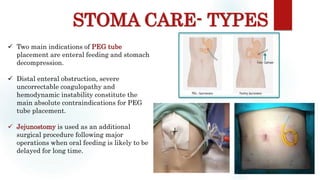
 Two main indications of PEG tube
placement are enteral feeding and stomach
decompression.
 Distal enteral obstruction, severe
uncorrectable coagulopathy and
hemodynamic instability constitute the
main absolute contraindications for PEG
tube placement.
 Jejunostomy is used as an additional
surgical procedure following major
operations when oral feeding is likely to be
delayed for long time.
STOMA CARE- TYPES
Sites: occiput, scapula, ischium, sacrum, heel
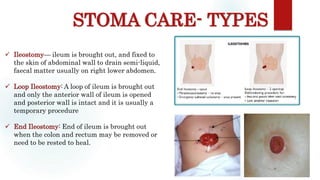
 Ileostomy— ileum is brought out, and fixed to
the skin of abdominal wall to drain semi-liquid,
faecal matter usually on right lower abdomen.
 Loop Ileostomy: A loop of ileum is brought out
and only the anterior wall of ileum is opened
and posterior wall is intact and it is usually a
temporary procedure
 End Ileostomy: End of ileum is brought out
when the colon and rectum may be removed or
need to be rested to heal.
STOMA CARE- TYPES
Sites: occiput, scapula, ischium, sacrum, heel
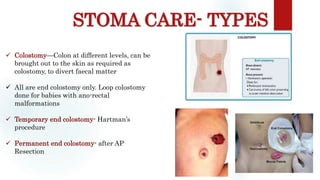
 Colostomy—Colon at different levels, can be
brought out to the skin as required as
colostomy, to divert faecal matter
 All are end colostomy only. Loop colostomy
done for babies with ano-rectal
malformations
 Temporary end colostomy- Hartman’s
procedure
 Permanent end colostomy- after AP
Resection
STOMA CARE
Sites: occiput, scapula, ischium, sacrum, heelUrostomy:
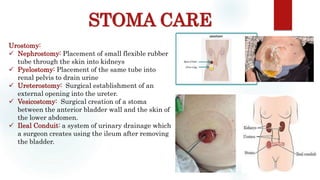
 Nephrostomy: Placement of small flexible rubber
tube through the skin into kidneys
 Pyelostomy: Placement of the same tube into
renal pelvis to drain urine
 Ureterostomy: Surgical establishment of an
external opening into the ureter.
 Vesicostomy: Surgical creation of a stoma
between the anterior bladder wall and the skin of
the lower abdomen.
 Ileal Conduit: a system of urinary drainage which
a surgeon creates using the ileum after removing
the bladder.
STOMA CARE
Preparation and Counselling of patients for stoma
 Patient should be explained about the procedure
and should be convinced and consoled about the
stoma.
 Detailed meaning, explanation and after care of
the stoma should be discussed
 Indication for the stoma and consent for the
same should be taken.
 Reassurance about the stoma, its care, and its
position should be diagrammatically explained to
the patient and his/her close relative.
 Proper bowel preparation by bowel wash, gut
irrigation is required before surgery.
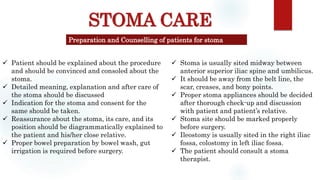
 Stoma is usually sited midway between
anterior superior iliac spine and umbilicus.
 It should be away from the belt line, the
scar, creases, and bony points.
 Proper stoma appliances should be decided
after thorough check-up and discussion
with patient and patient’s relative.
 Stoma site should be marked properly
before surgery.
 Ileostomy is usually sited in the right iliac
fossa, colostomy in left iliac fossa.
 The patient should consult a stoma
therapist.
STOMA CARE
Selecting Optimal Stomal site
STOMA CARE
Sites: occiput, scapula, ischium, sacrum, heelPostoperative care for the Stoma
 Stitches are removed in 6–10 days.
 Dressing should be done first over the stoma
and after placement of appliance, laparotomy
wound is dressed otherwise stoma appliance
will not sit properly.
 Patient should be observed for any
complications.
 Patient should be taught about the stoma care
and its appliances.
 Once wound has healed patient can take bath
by removing the appliances. After bath skin is
dried up and stoma appliances can be fitted
again.
 Care and prevention of skin excoriation due to
leak is also looked into.
 Skin should be absolutely dry prior to placing
the stoma appliances
 Psychotherapy is given for the patient
STOMA CARE
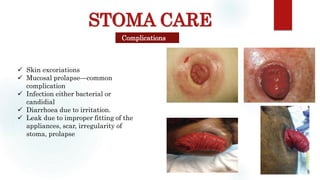
Complications
 Skin excoriations
 Mucosal prolapse—common
complication
 Infection either bacterial or
candidial
 Diarrhoea due to irritation.
 Leak due to improper fitting of the
appliances, scar, irregularity of
stoma, prolapse
STOMA CARE
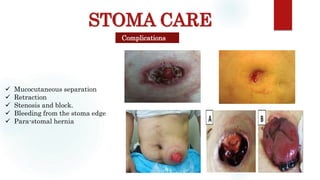
Complications
 Mucocutaneous separation
 Retraction
 Stenosis and block.
 Bleeding from the stoma edge
 Para-stomal hernia
STOMA CARE
Stoma Appliances
 Stoma appliances are devices, which are used to collect and dispose the effluent materials
which come out of the stoma
 Ideal stoma appliance is:
-Leak proof
™™ -Should not damage the stoma and surrounding skin
™™ -Should prevent odour
™™ -Should be easily available
™™ -Easier to use
 the stoma.
STOMA CARE
Stoma Appliances- Types
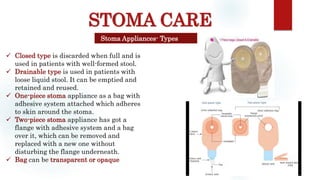
 Closed type is discarded when full and is
used in patients with well-formed stool.
 Drainable type is used in patients with
loose liquid stool. It can be emptied and
retained and reused.
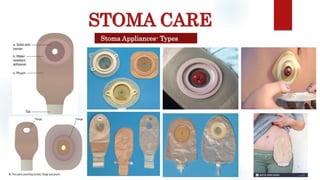
 One-piece stoma appliance as a bag with
adhesive system attached which adheres
to skin around the stoma.
 Two-piece stoma appliance has got a
flange with adhesive system and a bag
over it, which can be removed and
replaced with a new one without
disturbing the flange underneath.
 Bag can be transparent or opaque
STOMA CARE
Stoma Appliances- Types
STOMA CARE
General care and advice
 Patient can have normal diet which
regulates the bowel action. Plenty of water is
advisable.
 Patient can go for normal work, exercise like
sports, swimming, tennis. Stoma appliances
suitable for these works are available.
 Antidepressants, anticholinergics might
cause constipation. So these drugs should be
taken carefully.
 Patient can have normal sexual activity.
 Shouldn’t use irritant solutions near stoma
that may lead to dangerous complications
 Patient should have additional stoma bags in
hand so as to use if required urgently
 Patient should be aware of different appliances
available and should be well-versed with its
use. He can take the help of the stoma societies
LIKE
SHARE
SUBSCRIBE

Stoma care / for surgeons

  • 1.
    Dr.B.Selvaraj MS;MCh;FICS “ SurgicalEducator” Melaka Malaysia 75150 STOMA CARE FOR SURGEONS
  • 2.
    STOMA CARE Sites: occiput,scapula, ischium, sacrum, heel  Definition and Types  Preparation and Counselling of patients for stoma  Postoperative care for the stoma  Complications  Stoma Appliances  General care and advice
  • 3.
    STOMA CARE Sites: occiput,scapula, ischium, sacrum, heel  A stoma is a surgically created opening in the body between the skin and a hollow viscus (stoma has the Greek meaning mouth)  Abdominal stomas are mainly used to divert faeces or urine out of the body where it can be collected in a bag at the skin level.  There are three common stoma types: Colostomy, Ileostomy and Urostomy  It is created in the treatment of Carcinoma, trauma, sepsis or after surgery
  • 4.
    STOMA CARE- TYPES Sites:occiput, scapula, ischium, sacrum, heel  Two main indications of PEG tube placement are enteral feeding and stomach decompression.  Distal enteral obstruction, severe uncorrectable coagulopathy and hemodynamic instability constitute the main absolute contraindications for PEG tube placement.  Jejunostomy is used as an additional surgical procedure following major operations when oral feeding is likely to be delayed for long time.
  • 5.
    STOMA CARE- TYPES Sites:occiput, scapula, ischium, sacrum, heel  Ileostomy— ileum is brought out, and fixed to the skin of abdominal wall to drain semi-liquid, faecal matter usually on right lower abdomen.  Loop Ileostomy: A loop of ileum is brought out and only the anterior wall of ileum is opened and posterior wall is intact and it is usually a temporary procedure  End Ileostomy: End of ileum is brought out when the colon and rectum may be removed or need to be rested to heal.
  • 6.
    STOMA CARE- TYPES Sites:occiput, scapula, ischium, sacrum, heel  Colostomy—Colon at different levels, can be brought out to the skin as required as colostomy, to divert faecal matter  All are end colostomy only. Loop colostomy done for babies with ano-rectal malformations  Temporary end colostomy- Hartman’s procedure  Permanent end colostomy- after AP Resection
  • 7.
    STOMA CARE Sites: occiput,scapula, ischium, sacrum, heelUrostomy:  Nephrostomy: Placement of small flexible rubber tube through the skin into kidneys  Pyelostomy: Placement of the same tube into renal pelvis to drain urine  Ureterostomy: Surgical establishment of an external opening into the ureter.  Vesicostomy: Surgical creation of a stoma between the anterior bladder wall and the skin of the lower abdomen.  Ileal Conduit: a system of urinary drainage which a surgeon creates using the ileum after removing the bladder.
  • 8.
    STOMA CARE Preparation andCounselling of patients for stoma  Patient should be explained about the procedure and should be convinced and consoled about the stoma.  Detailed meaning, explanation and after care of the stoma should be discussed  Indication for the stoma and consent for the same should be taken.  Reassurance about the stoma, its care, and its position should be diagrammatically explained to the patient and his/her close relative.  Proper bowel preparation by bowel wash, gut irrigation is required before surgery.  Stoma is usually sited midway between anterior superior iliac spine and umbilicus.  It should be away from the belt line, the scar, creases, and bony points.  Proper stoma appliances should be decided after thorough check-up and discussion with patient and patient’s relative.  Stoma site should be marked properly before surgery.  Ileostomy is usually sited in the right iliac fossa, colostomy in left iliac fossa.  The patient should consult a stoma therapist.
  • 9.
  • 10.
    STOMA CARE Sites: occiput,scapula, ischium, sacrum, heelPostoperative care for the Stoma  Stitches are removed in 6–10 days.  Dressing should be done first over the stoma and after placement of appliance, laparotomy wound is dressed otherwise stoma appliance will not sit properly.  Patient should be observed for any complications.  Patient should be taught about the stoma care and its appliances.  Once wound has healed patient can take bath by removing the appliances. After bath skin is dried up and stoma appliances can be fitted again.  Care and prevention of skin excoriation due to leak is also looked into.  Skin should be absolutely dry prior to placing the stoma appliances  Psychotherapy is given for the patient
  • 11.
    STOMA CARE Complications  Skinexcoriations  Mucosal prolapse—common complication  Infection either bacterial or candidial  Diarrhoea due to irritation.  Leak due to improper fitting of the appliances, scar, irregularity of stoma, prolapse
  • 12.
    STOMA CARE Complications  Mucocutaneousseparation  Retraction  Stenosis and block.  Bleeding from the stoma edge  Para-stomal hernia
  • 13.
    STOMA CARE Stoma Appliances Stoma appliances are devices, which are used to collect and dispose the effluent materials which come out of the stoma  Ideal stoma appliance is: -Leak proof ™™ -Should not damage the stoma and surrounding skin ™™ -Should prevent odour ™™ -Should be easily available ™™ -Easier to use  the stoma.
  • 14.
    STOMA CARE Stoma Appliances-Types  Closed type is discarded when full and is used in patients with well-formed stool.  Drainable type is used in patients with loose liquid stool. It can be emptied and retained and reused.  One-piece stoma appliance as a bag with adhesive system attached which adheres to skin around the stoma.  Two-piece stoma appliance has got a flange with adhesive system and a bag over it, which can be removed and replaced with a new one without disturbing the flange underneath.  Bag can be transparent or opaque
  • 15.
  • 16.
    STOMA CARE General careand advice  Patient can have normal diet which regulates the bowel action. Plenty of water is advisable.  Patient can go for normal work, exercise like sports, swimming, tennis. Stoma appliances suitable for these works are available.  Antidepressants, anticholinergics might cause constipation. So these drugs should be taken carefully.  Patient can have normal sexual activity.  Shouldn’t use irritant solutions near stoma that may lead to dangerous complications  Patient should have additional stoma bags in hand so as to use if required urgently  Patient should be aware of different appliances available and should be well-versed with its use. He can take the help of the stoma societies
  • 17.