OSTOMY & ITS CARE
• Ms. Deepsikha kakoty
• Dept of Medical Surgical Nursing
• College of Nursing, NEIGRIHMS
DEFINITION
An ostomy is an opening in the small
intestine or large intestine that is surgically
created as an outlet through the anterior
abdominal wall in order to pass fecal
matter into a bag.
PURPOSE OF A STOMA
• It reduces pain and discomfort
• Allows systematic defecation
• May help relieve symptoms of intestinal
disease
INDICATIONS OF AN OSTOMY
• Inflammatory bowel disease
• Ulcerative colitis
• Cancer
• Perforated or complicated diverticulitis
• Bowel obstruction
• Crohn’s disease
• Hirschsprung disease
• Accidental injury
• Congenital deformities of anus or rectum
TYPES OF OSTOMIES
• According to the location:
Colostomy, Ileostomy and Urostomy
• Major types of intestinal stoma can be:
End stoma, Loop stoma and Double-Barreled
stoma
• According to duration:
Temporary ostomy and Permanent ostomy
END STOMA
• Surgically
constructed stoma
by dividing the
bowel and bringing
out the proximal
end as a single
stoma.
LOOP STOMA
• It is constructed by
bringing a loop of
bowel to the
abdominal surface
and then opening
the anterior wall of
the bowel to
provide fecal
diversion.
DOUBLE-BARRELED STOMA
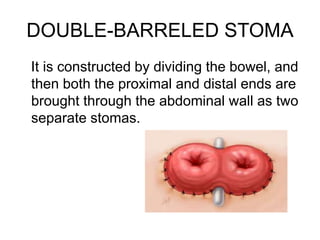
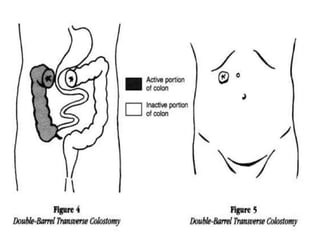
It is constructed by dividing the bowel, and
then both the proximal and distal ends are
brought through the abdominal wall as two
separate stomas.
 Colostomy
 Ileostomy
 Urostomy
Indications for a Colostomy:
 Trauma
 Cancer
 Diverticular disease
 Crohn’s disease
 Ulcerative colitis
 Obstruction
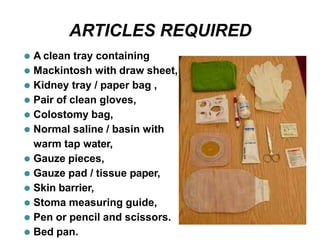
ARTICLES REQUIRED
⚫ A clean tray containing
⚫ Mackintosh with draw sheet,
⚫ Kidney tray / paper bag ,
⚫ Pair of clean gloves,
⚫ Colostomy bag,
⚫ Normal saline / basin with
warm tap water,
⚫ Gauze pieces,
⚫ Gauze pad / tissue paper,
⚫ Skin barrier,
⚫ Stoma measuring guide,
⚫ Pen or pencil and scissors.
⚫ Bed pan.
GUIDELINES:
⚫Keep odour as free of odors as possible.
⚫Ostomy bag should be emptied frequently.
⚫Check the stoma regularly, the colour
should be dark pink to red and moist.
⚫Pale colour indicates anaemia,
⚫Dark or purple blue indicates
compromised circulation.
Size of the stoma stablizes 6-8 weeks.
If dressing, check frequently for drainage and
bleeding.
Keep the skin around the stoma (peristomal
area) site clean and dry.
If not it causes skin irritation and infection.
Intake and out put chart must be recorded for
every 4 hours.
Encourage the patient to participate in care
and to look at the ostomy.
Can help the patient by listening, explaining,
being available and supportive.
⚫Encourage the patient to avoid fibre
rich diets.
⚫Encourage the patient to drink fluids.
⚫Educate the patient about the various
methods of odor control measures.
⚫Chlorophyll rich diet will deodorise the
feces.
⚫Direct contact sports and heavy lifting
must be avoided.
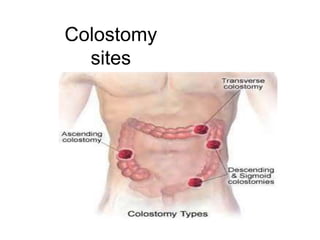
Colostomy
sites
New Stoma
Hard to pouch stoma
Measure
stoma
 They can change in size
 After surgery
 Weight gain
 Weight loss
Cut to fit wafer
Stretch to fit appliance
Types of Stomas
Budded
Flush Inverted
Peristomal skin breakdown
Crusting technique
 Clean dry (if possible) skin
 Apply stomahesive powder; sprinkle
 Dust off with gauze, paper towel etc
 Dab with no sting barrier wipe/lollipop
 Repeat process 3 times
 Keep effluent off peristomal skin while
applying the crusting technique
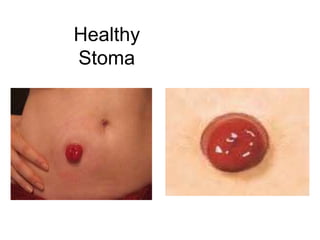
Healthy
Stoma
Paste/barrier rings
 Paste has alcohol; if needed let dry for
1 minute for evaporation of alcohol
before applying to skin
 Barrier rings preferred; warm first apply
to skin, can fill in crevices and provide
protection of peristomal skin
 Fit right next to stoma
Barrier ring application
Stomahesive
Paste
Perfumes for Colostomy
1 or 2 piece, matter of preference
Drainable or
closed
 Urostomy pouch has to be drainable
 Ileostomy pouch has to be drainage
 Colostomy pouch can be closed end or
drainable
Pouche
s
 Closed end  Drainable
Two piece
One
piece
Ileostomy
 Stoma that comes from the ileum
 Usually on the lower right of abdomen
 Effluent is loose to liquid with enzymes
 More issues with leaking and break
down in peristomal skin
 More diet restrictions
 Blockage problems
Ileostomy site
Ileostomy stoma
Ileostomy is from the ileum
 The entire colon, rectum and anus are
removed or bypassed.
 The small intestine (ileum) is brought
through the abdominal wall creating the
stoma, most often on the right lower site
 The stoma is smaller in diameter
Ileostomy diet
 Drink much more water/liquids; 10-12
glasses a day
 Avoid nuts, popcorn, seeds, celery, corn
 Raw crunchy vegetables must be
chewed very well!
 Eat slowly and chew all food well
 Avoid time release/enteric coated pills
 For blockage-go to ER
Ileostomy tips
 For difficulty/constantly draining stoma
 Have patient/client eat 2 Tablespoons
of peanut butter
 OR eat 6 large marshmellows
 30 minutes before changing appliance
 This will slow down the drainage so you
can get a good seal
Urostom
y
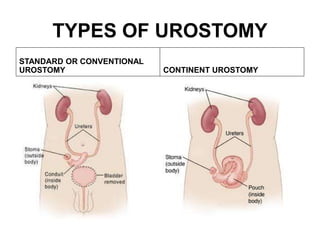
 The bladder is removed or bypassed
 A conduit is made of small intestine
tissue
 Ureters are implanted into the ileum
and on to the urostomy stoma
 The urine flows from the stoma into the
pouching appliance
TYPES OF UROSTOMY
STANDARD OR CONVENTIONAL
UROSTOMY CONTINENT UROSTOMY
Ileal Conduit
Urostomy tidbits
 The intestine produces mucous, therefore
the urine will have a cloudy appearance and
the mucous will need to be cleaned off the
stoma during appliance changes
 Adequate fluid intake, 8-10 glasses a day, is
very important
 Need to connect to a over night
drainage system at night.
Urine
crystals
 White, gritty deposits on and around
stoma
 Clean with peristomal skin with 1:1
vinegar and water
 Clean over night container with vinegar
and water
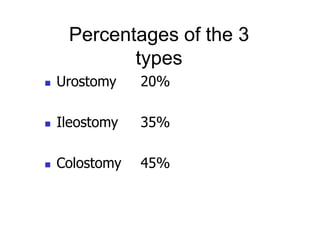
Percentages of the 3
types
 Urostomy 20%
 Ileostomy 35%
 Colostomy 45%
OSTOMY CARE
PRE -OPERTATIVE CARE:
Psychological preparation:
• Emotional support for altered body image, the lose of
control over elimination and the odors.
Selection of site:
• A flat, crease-free surface, in the patient’s visual field
and within the rectus muscle.
• A flat site create a good seal and avoid leakage from
the bag.
• Usually in the right lower quadrant about 2 inches
below the waist.
• Marking of the area before surgery
………………………..CONT’
Preoperative teaching:
• Provide thorough understanding of the
surgery
• Management of drainage from the stoma
• The nature of drainage
• Care of skin surface and ostomy
• Diet
………………………..CONT’
Bowel preparation:
• Emptying the intestine before surgery
• Neomycin and erythromycin are given
orally
• Low residue diet
POST OPERATIVE CARE
• Assessment of the stoma
Color, edema, bleeding
• Provision of appropriate
pouching system
• Managing skin and stoma care
• Colostomy/Ileostomy irrigation
• Managing dietary and fluid needs
• Encouraging for early ambulation
COLOTOMY/ILEOSTOMY
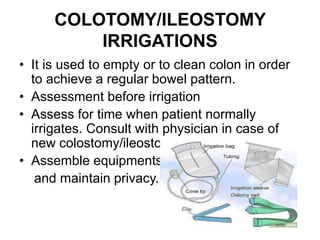
IRRIGATIONS
• It is used to empty or to clean colon in order
to achieve a regular bowel pattern.
• Assessment before irrigation
• Assess for time when patient normally
irrigates. Consult with physician in case of
new colostomy/ileostomy.
• Assemble equipments
and maintain privacy.
PROCEDURE OF IRRIGATION
COLOSTOMY/ILEOSTOMY
IRRIGATIONS
DOCUMENTATION
⚫ Record the procedure
with following details
(with date & time ).
⚫ Amount,
⚫ colour,
⚫ and consistency of the
fecal matter in the
pouch.
Questions???
?
Resources:
 United Ostomy Associations of America,
Inc. (UOAA) 1-800-826-0826
www.ostomy.org
 Wound, Ostomy, Continence Nurses
Society (WOCN) www.wocn.org
 WCC-www.nawccb.org
 www.phoenixuoaa.org
 ABQ Ostomy support group
 505 830-2135

ostomy-care.pptx

  • 1.
    OSTOMY & ITSCARE • Ms. Deepsikha kakoty • Dept of Medical Surgical Nursing • College of Nursing, NEIGRIHMS
  • 2.
    DEFINITION An ostomy isan opening in the small intestine or large intestine that is surgically created as an outlet through the anterior abdominal wall in order to pass fecal matter into a bag.
  • 3.
    PURPOSE OF ASTOMA • It reduces pain and discomfort • Allows systematic defecation • May help relieve symptoms of intestinal disease
  • 4.
    INDICATIONS OF ANOSTOMY • Inflammatory bowel disease • Ulcerative colitis • Cancer • Perforated or complicated diverticulitis • Bowel obstruction • Crohn’s disease • Hirschsprung disease • Accidental injury • Congenital deformities of anus or rectum
  • 5.
    TYPES OF OSTOMIES •According to the location: Colostomy, Ileostomy and Urostomy • Major types of intestinal stoma can be: End stoma, Loop stoma and Double-Barreled stoma • According to duration: Temporary ostomy and Permanent ostomy
  • 6.
    END STOMA • Surgically constructedstoma by dividing the bowel and bringing out the proximal end as a single stoma. LOOP STOMA • It is constructed by bringing a loop of bowel to the abdominal surface and then opening the anterior wall of the bowel to provide fecal diversion.
  • 7.
    DOUBLE-BARRELED STOMA It isconstructed by dividing the bowel, and then both the proximal and distal ends are brought through the abdominal wall as two separate stomas.
  • 8.
  • 11.
    Indications for aColostomy:  Trauma  Cancer  Diverticular disease  Crohn’s disease  Ulcerative colitis  Obstruction
  • 12.
    ARTICLES REQUIRED ⚫ Aclean tray containing ⚫ Mackintosh with draw sheet, ⚫ Kidney tray / paper bag , ⚫ Pair of clean gloves, ⚫ Colostomy bag, ⚫ Normal saline / basin with warm tap water, ⚫ Gauze pieces, ⚫ Gauze pad / tissue paper, ⚫ Skin barrier, ⚫ Stoma measuring guide, ⚫ Pen or pencil and scissors. ⚫ Bed pan.
  • 13.
    GUIDELINES: ⚫Keep odour asfree of odors as possible. ⚫Ostomy bag should be emptied frequently. ⚫Check the stoma regularly, the colour should be dark pink to red and moist. ⚫Pale colour indicates anaemia, ⚫Dark or purple blue indicates compromised circulation.
  • 14.
    Size of thestoma stablizes 6-8 weeks. If dressing, check frequently for drainage and bleeding. Keep the skin around the stoma (peristomal area) site clean and dry. If not it causes skin irritation and infection. Intake and out put chart must be recorded for every 4 hours. Encourage the patient to participate in care and to look at the ostomy. Can help the patient by listening, explaining, being available and supportive.
  • 15.
    ⚫Encourage the patientto avoid fibre rich diets. ⚫Encourage the patient to drink fluids. ⚫Educate the patient about the various methods of odor control measures. ⚫Chlorophyll rich diet will deodorise the feces. ⚫Direct contact sports and heavy lifting must be avoided.
  • 18.
  • 19.
  • 20.
  • 21.
    Measure stoma  They canchange in size  After surgery  Weight gain  Weight loss
  • 22.
  • 23.
    Stretch to fitappliance
  • 24.
  • 25.
  • 26.
    Crusting technique  Cleandry (if possible) skin  Apply stomahesive powder; sprinkle  Dust off with gauze, paper towel etc  Dab with no sting barrier wipe/lollipop  Repeat process 3 times  Keep effluent off peristomal skin while applying the crusting technique
  • 27.
  • 28.
    Paste/barrier rings  Pastehas alcohol; if needed let dry for 1 minute for evaporation of alcohol before applying to skin  Barrier rings preferred; warm first apply to skin, can fill in crevices and provide protection of peristomal skin  Fit right next to stoma
  • 29.
  • 30.
  • 31.
  • 32.
    1 or 2piece, matter of preference
  • 33.
    Drainable or closed  Urostomypouch has to be drainable  Ileostomy pouch has to be drainage  Colostomy pouch can be closed end or drainable
  • 34.
  • 35.
  • 36.
  • 37.
    Ileostomy  Stoma thatcomes from the ileum  Usually on the lower right of abdomen  Effluent is loose to liquid with enzymes  More issues with leaking and break down in peristomal skin  More diet restrictions  Blockage problems
  • 38.
  • 39.
  • 40.
    Ileostomy is fromthe ileum  The entire colon, rectum and anus are removed or bypassed.  The small intestine (ileum) is brought through the abdominal wall creating the stoma, most often on the right lower site  The stoma is smaller in diameter
  • 41.
    Ileostomy diet  Drinkmuch more water/liquids; 10-12 glasses a day  Avoid nuts, popcorn, seeds, celery, corn  Raw crunchy vegetables must be chewed very well!  Eat slowly and chew all food well  Avoid time release/enteric coated pills  For blockage-go to ER
  • 42.
    Ileostomy tips  Fordifficulty/constantly draining stoma  Have patient/client eat 2 Tablespoons of peanut butter  OR eat 6 large marshmellows  30 minutes before changing appliance  This will slow down the drainage so you can get a good seal
  • 43.
    Urostom y  The bladderis removed or bypassed  A conduit is made of small intestine tissue  Ureters are implanted into the ileum and on to the urostomy stoma  The urine flows from the stoma into the pouching appliance
  • 44.
    TYPES OF UROSTOMY STANDARDOR CONVENTIONAL UROSTOMY CONTINENT UROSTOMY
  • 45.
  • 46.
    Urostomy tidbits  Theintestine produces mucous, therefore the urine will have a cloudy appearance and the mucous will need to be cleaned off the stoma during appliance changes  Adequate fluid intake, 8-10 glasses a day, is very important  Need to connect to a over night drainage system at night.
  • 47.
    Urine crystals  White, grittydeposits on and around stoma  Clean with peristomal skin with 1:1 vinegar and water  Clean over night container with vinegar and water
  • 48.
    Percentages of the3 types  Urostomy 20%  Ileostomy 35%  Colostomy 45%
  • 49.
    OSTOMY CARE PRE -OPERTATIVECARE: Psychological preparation: • Emotional support for altered body image, the lose of control over elimination and the odors. Selection of site: • A flat, crease-free surface, in the patient’s visual field and within the rectus muscle. • A flat site create a good seal and avoid leakage from the bag. • Usually in the right lower quadrant about 2 inches below the waist. • Marking of the area before surgery
  • 50.
    ………………………..CONT’ Preoperative teaching: • Providethorough understanding of the surgery • Management of drainage from the stoma • The nature of drainage • Care of skin surface and ostomy • Diet
  • 51.
    ………………………..CONT’ Bowel preparation: • Emptyingthe intestine before surgery • Neomycin and erythromycin are given orally • Low residue diet
  • 52.
    POST OPERATIVE CARE •Assessment of the stoma Color, edema, bleeding • Provision of appropriate pouching system • Managing skin and stoma care • Colostomy/Ileostomy irrigation • Managing dietary and fluid needs • Encouraging for early ambulation
  • 53.
    COLOTOMY/ILEOSTOMY IRRIGATIONS • It isused to empty or to clean colon in order to achieve a regular bowel pattern. • Assessment before irrigation • Assess for time when patient normally irrigates. Consult with physician in case of new colostomy/ileostomy. • Assemble equipments and maintain privacy.
  • 54.
  • 55.
  • 56.
    DOCUMENTATION ⚫ Record theprocedure with following details (with date & time ). ⚫ Amount, ⚫ colour, ⚫ and consistency of the fecal matter in the pouch.
  • 57.
  • 58.
    Resources:  United OstomyAssociations of America, Inc. (UOAA) 1-800-826-0826 www.ostomy.org  Wound, Ostomy, Continence Nurses Society (WOCN) www.wocn.org  WCC-www.nawccb.org  www.phoenixuoaa.org  ABQ Ostomy support group  505 830-2135

Editor's Notes

  • #3 For individuals suffering from such conditions, ostomy surgery is both life- saving and life-changing
  • #47 Medicare provides 20 wafers and 20 drainable pouches per month OR 60 closed end pouches
  • #54 Effulent is loose to thin and more difficult to contain