PYELONEPHRITIS
Presented by-
PANKAJ SINGH RANA
NURSE PRACTITIONER IN
CRITICAL CARE
INTRODUCTION
• PYELONEPHRITIS (Greek means “pyelum”-renal
pelvis,”nephros”-kidney &”itis”-inflammation) is an
ascending urinary tract infection that has reached
the pelvis of the kidney.
DEFINITION
It is the inflammation of the kidney & upper urinary
tract that usually results from the bacterial infection
of the bladder.
TYPES OF
PYELONEPHRITIS
• Pyelonephritis can be classified in several different
catagories:
• -acute pyelonephritis
• -chronic pyelonephritis
• -xanthogranulomatous pyelonephritis
ACUTE
PYELONEPHRITIS
ACUTE PYELONEPHRITIS
• Acute pyelonephritis is an sudden development of
kidney inflammation.it can be severe in elderly &
people who have cancer or AIDS.
CAUSES
• (Vesicourethral reflux) backward flow of infected
urin e from the bladder to the upper urinary tract
• Kidney stones
• Urinary tract catheterization
• Pregnancy
• Neurogenic bladder (spina bifida)
• Benign prostatic hyperplasia
• Diabetes mellitus
MORPHOLOGY
• GROSS ANATOMY
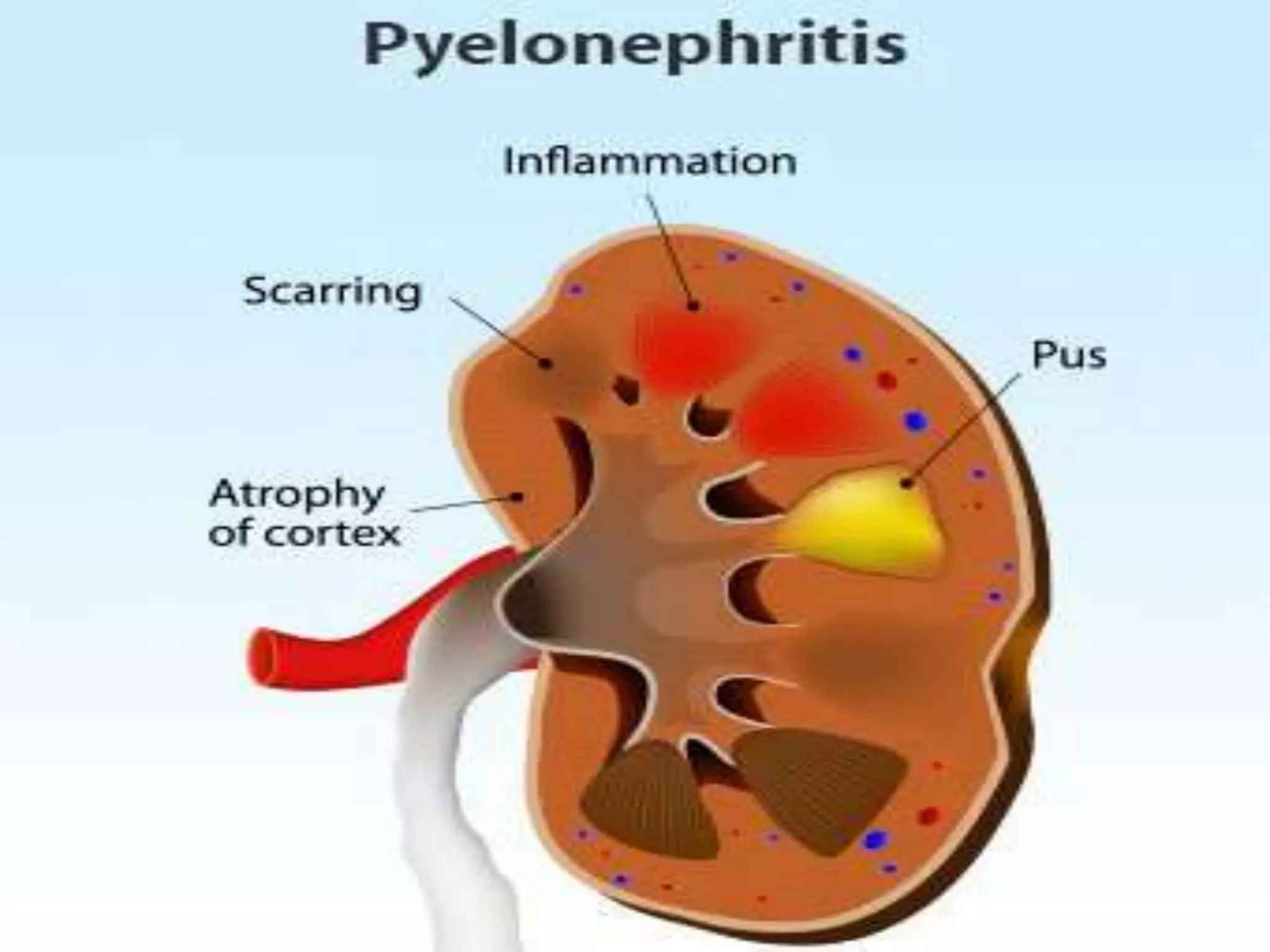
• It show enlarged & swollen kidney that bulges on
section.
• Yellowish raised abscesses are seen on renal surface
on histology.
• MICROSCOPIC EXAMINATION
• It involve the interstitium & causing destruction of the
tubules.
• The renal blood vessels show considerable resistance
to infection & are spared.
CLINICAL FEATURES
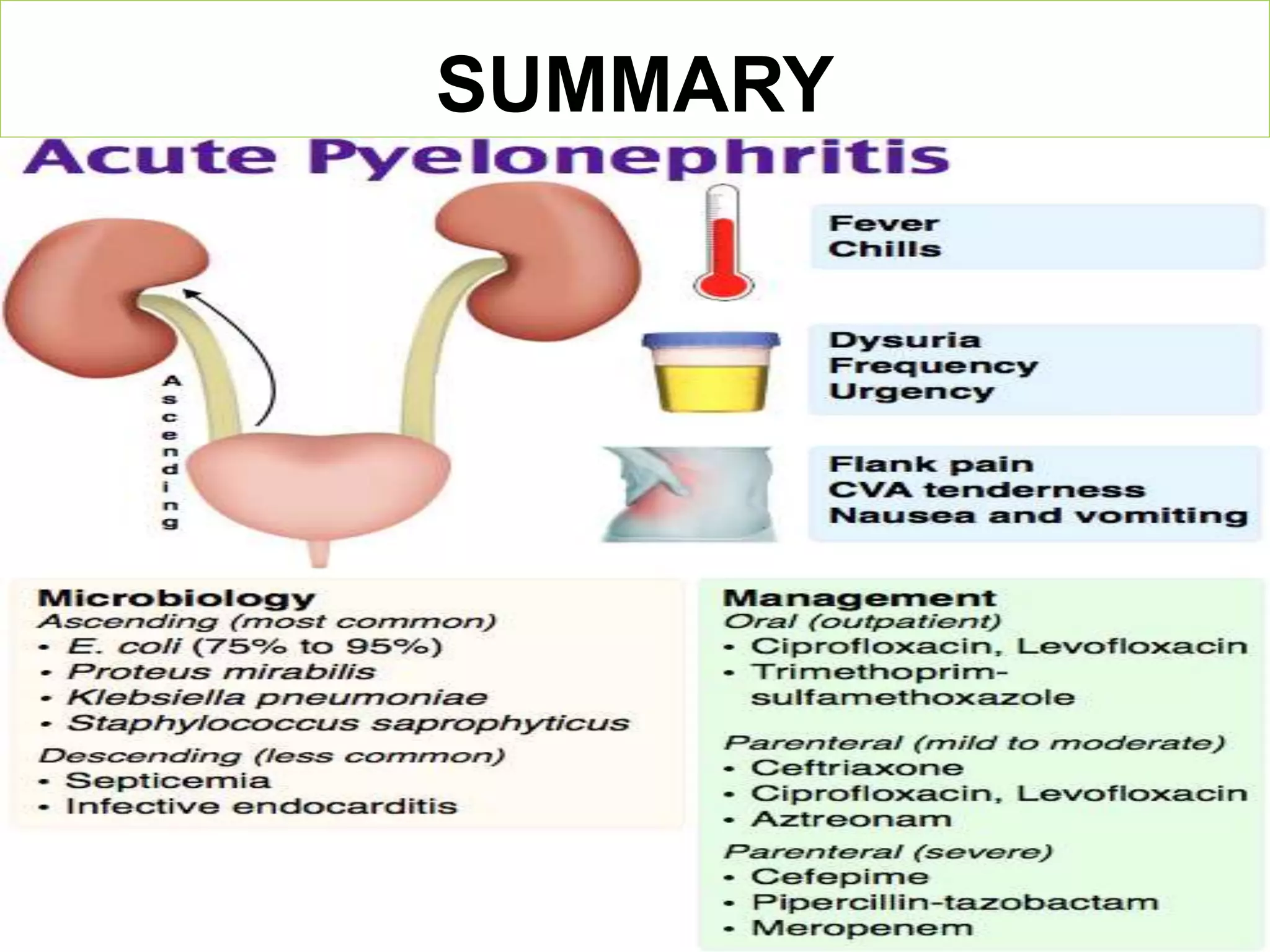
• Acute onset of pain
• Fiver with chills
• Lumbar tenderness
• Dysuria
• Frequency of micturition
• On examination urine will show bacteria in excess of
100,000/ml,pus cells .
COMPLICATIONS
• Papillary necrosis
• Pyonephrosis
• Perinephric abscess
CHRONIC
PYELONEPHRITIS
CHRONIC
PYELONEPHRITIS
• It implies kidney infection & chronic tubulointerstitial
disease resulting in repeated attacks of
inflammation & scarring.
ETIOPATHOGENESIS
• It can be of two types
• CHRONIC OBSTRUCTIVE PYELONEPHRITIS
Obstruction to the outflow of urine at different levels
predisposes the kidney to infection.
• REFLUX PYELONEPHRITIS
Reflux of urine from the bladder into one or both the
ureters during micturition is the major cause of chronic
pyelonephritis .
CAUSES
• Flank pain
• Abdominal pain
• Blood in urine
• Signs of infection
• Fiver
• Unintentional weight loss
• Malaise
• Decreased appetite
MORPHOLOGY
• GROSS ANATOMY
• Kidney is small & contracted.they show unequal
contraction at various places & this differentiates it from
symmetrical contracted kidneys seen in benign
nephrosclerosis.the scars cause adhesion of capsule of
kidney to cortex.
• MICROSCOPY EXAMINATION
• The changes are seen in interstitium & tubules,there is
chronic interstitial inflammatory reaction composed of
lymphocytes ,plasma cells & macrophafes tubules show
atophy &dilation.
CLINICAL FEATURES
• fever
• Lumber tenderness
• Dysuria
• Pyouria
• Hypertension
• Frequency of micturition
• Bacteriuria
XANTHOGRANULOMATOUS
PYELONEPHRITIS
XANTHOGRANULOMATOU
S PYELONEPHRITIS
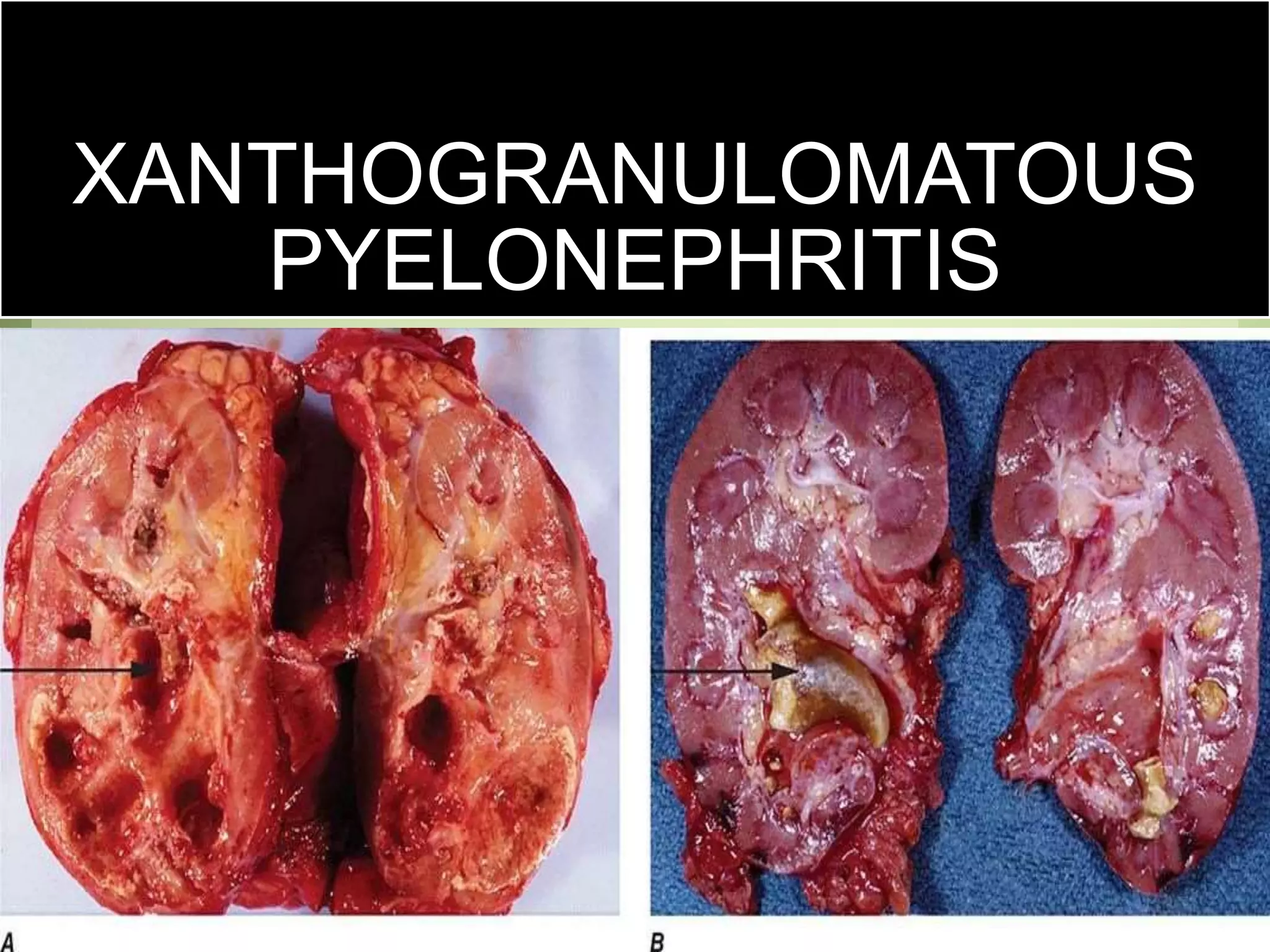
• It is an unusual form of chronic pyelonephritis
characterized by granulomatous abscess
formation,severe kidney distruction & clinical
pictures that may resemble renal cell carcinoma &
other inflammatory renal parenchymal diseases.
CLINICAL MANIFESTATION
• Urosepsis
• Anemia
• Painful renal mass
• Kidney stones
• Loss of function of the affected kidney
MORPHOLOGY
• There are granulomas & lipid laden macrophages.It
is found roughly 20% of specimens from surgically
managed cases of pyelonephritis.
DIAGNOSIS
• LABORATORY EXAMINATION
• Urinalysis may show sign of UTI
• Blood test
• Antibiotic sensitivity testing
• Intra venous pyelography
The Urine DipstickTest:
• Rapid diagnostic test
• Appearance ofWBC in urine
• test for nitrite & leukocyte esterase ( family
Enterobacteriaceae, in detected in urine PMN )
• Negative outcome ,it s not sufficient for pregnancy
women
Urinalysis:
• WBC in Cast shape due to of pyelonephritis
• No WBC ,No Infection
Urine Culture:
• It is positve with colony count equal or more than 10
power 2 In women with dysuria & pyuria
• It is positve with colony count > 10 power 3 In Men
MANAGEMENT
• To control the infection & reduce the symptoms.
• Urine culture & antibiotic sensitivity test is performed
on the basis of infecting agents .
• Use antibiotics
• Like-aminoglycosides,cephalosporin &
sulphamethoxazole etc.
Risk for Infection related to the
presence of bacteria in the kidneys
Nursing Intervention:
Assess the patient's temperature every 4 hours and report if the
temperature is above 38.50 C
Rational:
Vital signs indicate a change in the body
• Record the characteristics of urine
Rational:
To find out / identify indications of progress or deviations from
expected results.
• Instruct the patient to drink 2-3 liters if no contraindications
Rational:
To prevent urine stasis
• Monitor re-examination of the urine culture and sensitivity to
determine response to therapy.
Rational:
Knowing how far the effect of treatment on patient
circumstances.
• Instruct the patient to empty the bladder completely each time
the bladder.
Rational:
To prevent bladder distension
• Give perineal care, maintain to keep them clean and dry.
Rational:
To maintain cleanliness and avoid bacterial infection of the
urethra making.
Pain related to infections of the
kidney.
Nursing Intervention:
Assess the intensity, location, and factors that
aggravate or relieve pain.
Rational:
Extreme pain indicates an infection.
• Provide adequate rest periods and activity levels
that can be tolerant.
Rational:
Clients can rest in peace and to relax the muscles.
• Encourage drinking plenty of 2-3 liters if no
contraindications
Rational:
To assist clients in micturition.
• Give appropriate analgesic drugs with therapy
programs.
Rational:
Analgesic block the path of pain.
PREVENTION
• If pyelonephritis is not treated immediately
,permanent kidney damage can occur.
• Increasing fluid intake ,consuming blueberry juice &
fermented milk products containing probiotic
bacteria have all been shown to inhibit adherence of
bacteria to the epithelial cells of urinary tract &
reduce the recurrence of UTI.
SUMMARY
Pyelonephritis, ACUTE PYELONEPHRITIS, CHRONIC PYELONEPHRITIS,

Pyelonephritis, ACUTE PYELONEPHRITIS, CHRONIC PYELONEPHRITIS,

  • 1.
    PYELONEPHRITIS Presented by- PANKAJ SINGHRANA NURSE PRACTITIONER IN CRITICAL CARE
  • 2.
    INTRODUCTION • PYELONEPHRITIS (Greekmeans “pyelum”-renal pelvis,”nephros”-kidney &”itis”-inflammation) is an ascending urinary tract infection that has reached the pelvis of the kidney.
  • 3.
    DEFINITION It is theinflammation of the kidney & upper urinary tract that usually results from the bacterial infection of the bladder.
  • 5.
    TYPES OF PYELONEPHRITIS • Pyelonephritiscan be classified in several different catagories: • -acute pyelonephritis • -chronic pyelonephritis • -xanthogranulomatous pyelonephritis
  • 6.
  • 7.
    ACUTE PYELONEPHRITIS • Acutepyelonephritis is an sudden development of kidney inflammation.it can be severe in elderly & people who have cancer or AIDS.
  • 8.
    CAUSES • (Vesicourethral reflux)backward flow of infected urin e from the bladder to the upper urinary tract • Kidney stones • Urinary tract catheterization • Pregnancy • Neurogenic bladder (spina bifida) • Benign prostatic hyperplasia • Diabetes mellitus
  • 9.
    MORPHOLOGY • GROSS ANATOMY •It show enlarged & swollen kidney that bulges on section. • Yellowish raised abscesses are seen on renal surface on histology. • MICROSCOPIC EXAMINATION • It involve the interstitium & causing destruction of the tubules. • The renal blood vessels show considerable resistance to infection & are spared.
  • 10.
    CLINICAL FEATURES • Acuteonset of pain • Fiver with chills • Lumbar tenderness • Dysuria • Frequency of micturition • On examination urine will show bacteria in excess of 100,000/ml,pus cells .
  • 11.
    COMPLICATIONS • Papillary necrosis •Pyonephrosis • Perinephric abscess
  • 12.
  • 13.
    CHRONIC PYELONEPHRITIS • It implieskidney infection & chronic tubulointerstitial disease resulting in repeated attacks of inflammation & scarring.
  • 14.
    ETIOPATHOGENESIS • It canbe of two types • CHRONIC OBSTRUCTIVE PYELONEPHRITIS Obstruction to the outflow of urine at different levels predisposes the kidney to infection. • REFLUX PYELONEPHRITIS Reflux of urine from the bladder into one or both the ureters during micturition is the major cause of chronic pyelonephritis .
  • 15.
    CAUSES • Flank pain •Abdominal pain • Blood in urine • Signs of infection • Fiver • Unintentional weight loss • Malaise • Decreased appetite
  • 16.
    MORPHOLOGY • GROSS ANATOMY •Kidney is small & contracted.they show unequal contraction at various places & this differentiates it from symmetrical contracted kidneys seen in benign nephrosclerosis.the scars cause adhesion of capsule of kidney to cortex. • MICROSCOPY EXAMINATION • The changes are seen in interstitium & tubules,there is chronic interstitial inflammatory reaction composed of lymphocytes ,plasma cells & macrophafes tubules show atophy &dilation.
  • 17.
    CLINICAL FEATURES • fever •Lumber tenderness • Dysuria • Pyouria • Hypertension • Frequency of micturition • Bacteriuria
  • 18.
  • 19.
    XANTHOGRANULOMATOU S PYELONEPHRITIS • Itis an unusual form of chronic pyelonephritis characterized by granulomatous abscess formation,severe kidney distruction & clinical pictures that may resemble renal cell carcinoma & other inflammatory renal parenchymal diseases.
  • 20.
    CLINICAL MANIFESTATION • Urosepsis •Anemia • Painful renal mass • Kidney stones • Loss of function of the affected kidney
  • 21.
    MORPHOLOGY • There aregranulomas & lipid laden macrophages.It is found roughly 20% of specimens from surgically managed cases of pyelonephritis.
  • 22.
    DIAGNOSIS • LABORATORY EXAMINATION •Urinalysis may show sign of UTI • Blood test • Antibiotic sensitivity testing • Intra venous pyelography
  • 23.
    The Urine DipstickTest: •Rapid diagnostic test • Appearance ofWBC in urine • test for nitrite & leukocyte esterase ( family Enterobacteriaceae, in detected in urine PMN ) • Negative outcome ,it s not sufficient for pregnancy women
  • 24.
    Urinalysis: • WBC inCast shape due to of pyelonephritis • No WBC ,No Infection Urine Culture: • It is positve with colony count equal or more than 10 power 2 In women with dysuria & pyuria • It is positve with colony count > 10 power 3 In Men
  • 25.
    MANAGEMENT • To controlthe infection & reduce the symptoms. • Urine culture & antibiotic sensitivity test is performed on the basis of infecting agents . • Use antibiotics • Like-aminoglycosides,cephalosporin & sulphamethoxazole etc.
  • 26.
    Risk for Infectionrelated to the presence of bacteria in the kidneys Nursing Intervention: Assess the patient's temperature every 4 hours and report if the temperature is above 38.50 C Rational: Vital signs indicate a change in the body • Record the characteristics of urine Rational: To find out / identify indications of progress or deviations from expected results. • Instruct the patient to drink 2-3 liters if no contraindications Rational: To prevent urine stasis
  • 27.
    • Monitor re-examinationof the urine culture and sensitivity to determine response to therapy. Rational: Knowing how far the effect of treatment on patient circumstances. • Instruct the patient to empty the bladder completely each time the bladder. Rational: To prevent bladder distension • Give perineal care, maintain to keep them clean and dry. Rational: To maintain cleanliness and avoid bacterial infection of the urethra making.
  • 28.
    Pain related toinfections of the kidney. Nursing Intervention: Assess the intensity, location, and factors that aggravate or relieve pain. Rational: Extreme pain indicates an infection. • Provide adequate rest periods and activity levels that can be tolerant. Rational: Clients can rest in peace and to relax the muscles.
  • 29.
    • Encourage drinkingplenty of 2-3 liters if no contraindications Rational: To assist clients in micturition. • Give appropriate analgesic drugs with therapy programs. Rational: Analgesic block the path of pain.
  • 30.
    PREVENTION • If pyelonephritisis not treated immediately ,permanent kidney damage can occur. • Increasing fluid intake ,consuming blueberry juice & fermented milk products containing probiotic bacteria have all been shown to inhibit adherence of bacteria to the epithelial cells of urinary tract & reduce the recurrence of UTI.
  • 31.