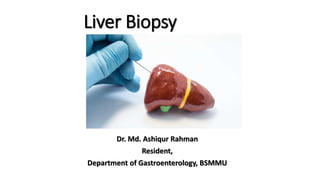
Liver Biopsy
Dr. Md. Ashiqur Rahman
Resident,
Department of Gastroenterology, BSMMU
What is liver biopsy?
It is a procedure where small piece of liver tissue is removed and
examine to
• Confirm clinical Dx
• Asses the severity, progression
• Rx response of the disease
• First performed by German physician Paul Ehrlich in 1883.
Preparation
• Consent
• Absence of followings
• Ascites
• Significant extrahepatic biliary obstruction
• Encephalopathy
• Coagulopathy- PT > 4sec and PC < 60k
• Renal failure
• CCF
• Cystic lesion in liver- Hydatid cyst
• Pre-biopsy USG for anatomical abnormalities- Chilaiditi syndrome, IH GB
Methods
• Percutaneous blind
• Percutaneous image guided
• Transvenous-TJ
• Laparoscopic
What are the Needle used?
• Suction needle- Menghini, Jamshidi, Klatskin
• Cutting needle- Tru-cut, spring loaded needle
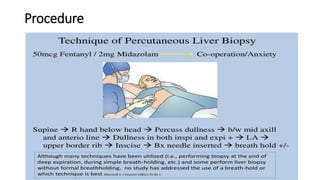
Procedure
Indications
• Drug-induced hepatitis
• Chronic hepatitis B or C
• Discordance in NIT and clinical feature
• Suspected concomitant liver disease
• Post-antiviral therapy
• Chonic cholestatic liver disease
• MRCP negative biliary obstruction
• PBC- staging and progression
• Small duct PSC
Continued..
• Fatty liver- steatohepatitis
• Steatosis
• Ballooning
• Lobular inflammation
• Before LT
• Occult fibrosis
• Steatosis
• Inflammation
• SOL in liver- indistinguishable from primary vs secondary
Continued..
• Unexplained hepatomegaly
• Unexplained liver enzyme elevation
• Storage disease
Special application
• Immuno-histochemical study for tumor marker
• HCC vs CC
• Early HCC vs Dysplastic nodule
• HCC vs Metastatic adenocarcinoma
• HCC- Hep-par1, pCEA, CD10, CD34
• CC- cytokeratin7,19
• Early HCC- glypican-3, HSP-70
Interpretations
• Specimen 2 to 3cm long and contain at least 11 portal tract.
• Finding are
• Portal inflammation
• Lobular inflammation
• Ductal reaction- ductopenia >50%
• Steatosis
• fibrosis
Scoring system
• Knodell
• Modified knodell/ Ishak
• Metavir
• Ludwig system- PBC
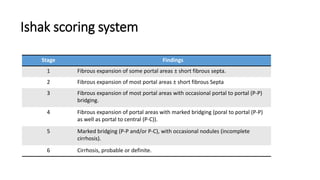
Ishak scoring system
Stage Findings
1 Fibrous expansion of some portal areas ± short fibrous septa.
2 Fibrous expansion of most portal areas ± short fibrous Septa
3 Fibrous expansion of most portal areas with occasional portal to portal (P-P)
bridging.
4 Fibrous expansion of portal areas with marked bridging (poral to portal (P-P)
as well as portal to central (P-C)).
5 Marked bridging (P-P and/or P-C), with occasional nodules (incomplete
cirrhosis).
6 Cirrhosis, probable or definite.
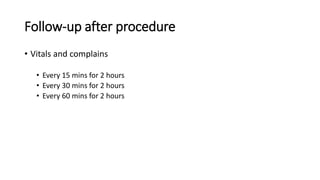
Follow-up after procedure
• Vitals and complains
• Every 15 mins for 2 hours
• Every 30 mins for 2 hours
• Every 60 mins for 2 hours
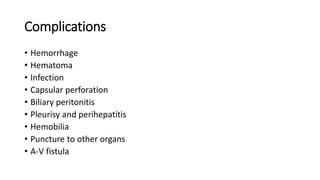
Complications
• Hemorrhage
• Hematoma
• Infection
• Capsular perforation
• Biliary peritonitis
• Pleurisy and perihepatitis
• Hemobilia
• Puncture to other organs
• A-V fistula
Thank You
Liver biopsy and procedure

Liver biopsy and procedure

  • 1.
    Liver Biopsy Dr. Md.Ashiqur Rahman Resident, Department of Gastroenterology, BSMMU
  • 2.
    What is liverbiopsy? It is a procedure where small piece of liver tissue is removed and examine to • Confirm clinical Dx • Asses the severity, progression • Rx response of the disease • First performed by German physician Paul Ehrlich in 1883.
  • 3.
    Preparation • Consent • Absenceof followings • Ascites • Significant extrahepatic biliary obstruction • Encephalopathy • Coagulopathy- PT > 4sec and PC < 60k • Renal failure • CCF • Cystic lesion in liver- Hydatid cyst • Pre-biopsy USG for anatomical abnormalities- Chilaiditi syndrome, IH GB
  • 4.
    Methods • Percutaneous blind •Percutaneous image guided • Transvenous-TJ • Laparoscopic
  • 5.
    What are theNeedle used? • Suction needle- Menghini, Jamshidi, Klatskin • Cutting needle- Tru-cut, spring loaded needle
  • 9.
  • 10.
    Indications • Drug-induced hepatitis •Chronic hepatitis B or C • Discordance in NIT and clinical feature • Suspected concomitant liver disease • Post-antiviral therapy • Chonic cholestatic liver disease • MRCP negative biliary obstruction • PBC- staging and progression • Small duct PSC
  • 11.
    Continued.. • Fatty liver-steatohepatitis • Steatosis • Ballooning • Lobular inflammation • Before LT • Occult fibrosis • Steatosis • Inflammation • SOL in liver- indistinguishable from primary vs secondary
  • 12.
    Continued.. • Unexplained hepatomegaly •Unexplained liver enzyme elevation • Storage disease
  • 13.
    Special application • Immuno-histochemicalstudy for tumor marker • HCC vs CC • Early HCC vs Dysplastic nodule • HCC vs Metastatic adenocarcinoma • HCC- Hep-par1, pCEA, CD10, CD34 • CC- cytokeratin7,19 • Early HCC- glypican-3, HSP-70
  • 14.
    Interpretations • Specimen 2to 3cm long and contain at least 11 portal tract. • Finding are • Portal inflammation • Lobular inflammation • Ductal reaction- ductopenia >50% • Steatosis • fibrosis
  • 15.
    Scoring system • Knodell •Modified knodell/ Ishak • Metavir • Ludwig system- PBC
  • 16.
    Ishak scoring system StageFindings 1 Fibrous expansion of some portal areas ± short fibrous septa. 2 Fibrous expansion of most portal areas ± short fibrous Septa 3 Fibrous expansion of most portal areas with occasional portal to portal (P-P) bridging. 4 Fibrous expansion of portal areas with marked bridging (poral to portal (P-P) as well as portal to central (P-C)). 5 Marked bridging (P-P and/or P-C), with occasional nodules (incomplete cirrhosis). 6 Cirrhosis, probable or definite.
  • 17.
    Follow-up after procedure •Vitals and complains • Every 15 mins for 2 hours • Every 30 mins for 2 hours • Every 60 mins for 2 hours
  • 18.
    Complications • Hemorrhage • Hematoma •Infection • Capsular perforation • Biliary peritonitis • Pleurisy and perihepatitis • Hemobilia • Puncture to other organs • A-V fistula
  • 19.