Types of Mutual Funds
Financial Markets
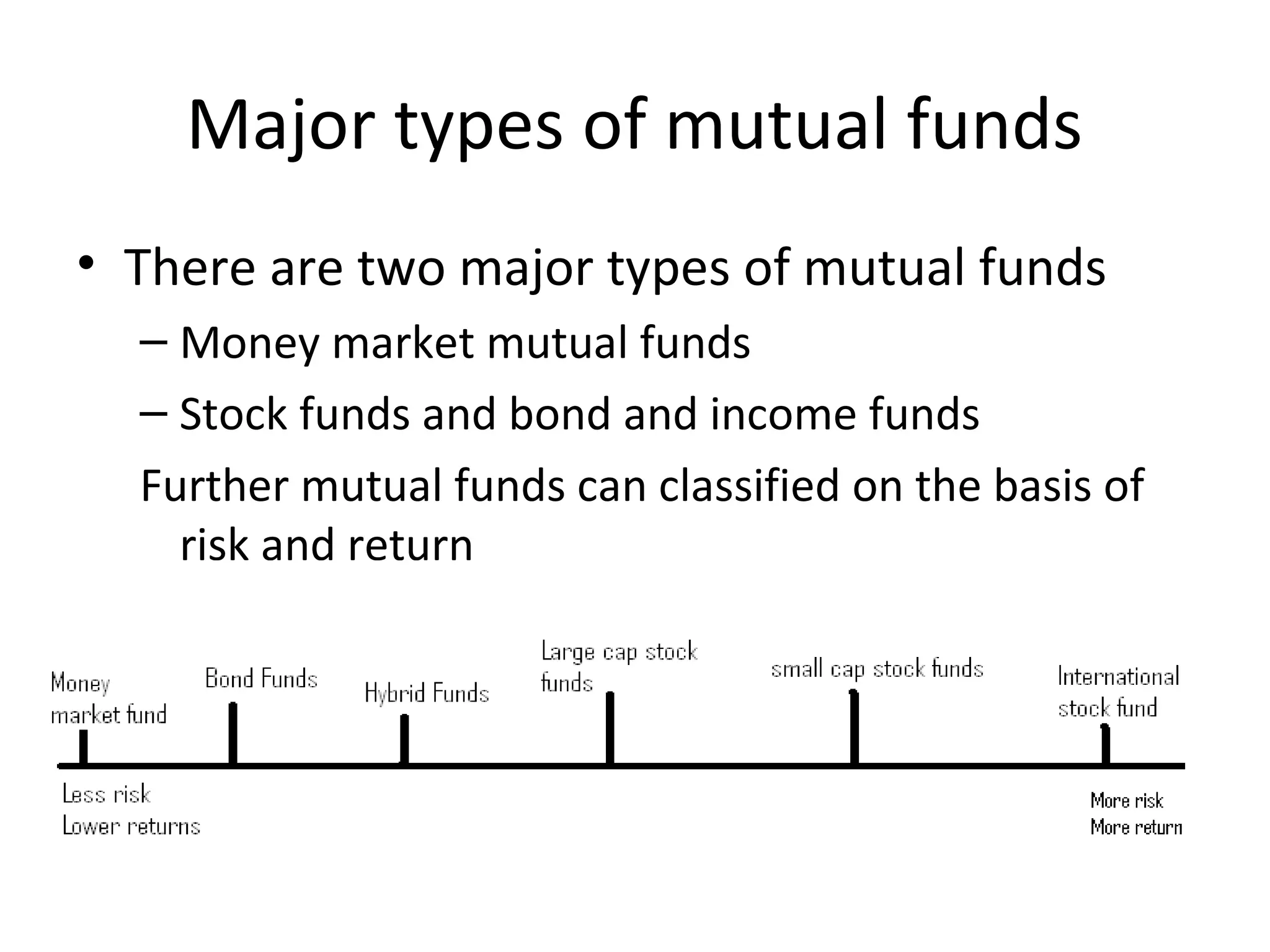
Major types of mutual funds
• There are two major types of mutual funds
– Money market mutual funds
– Stock funds and bond and income funds
Further mutual funds can classified on the basis of
risk and return
Types of mutual funds
• 1. Money market funds
– These funds invest in money market securities
– They are low risk and low return funds
– They provide the chance to earn the going rate in
the money market with diversification advantage
• 2. Bond Funds
– These fund specialize in fixed income sector
– Within bond funds, there exists many categories
– Funds may specialize in government bonds, or
corporate bonds
– Or they specialize in bonds of different maturities
• 3. Hybrid Funds (Balanced Funds)
• Includes both bonds and equity funds
• They are also called balanced funds
• The main objective is to preserve capital and
earn a return
• Have a bit higher risk than the bond funds
because of investment in equity
• 4. Equity funds
• All investment is made in common stocks
• Within equity funds, there can be growth funds
or income funds
• Growth funds have investment in stocks that
have good growth potential (usually small firms)
• Income funds have investment in stocks that
provide consistent flow of income(usually large
firms)
• 5. Sector funds
• Some industries perform well in one stage of
business cycle and others perform well in the
other stages of business cycle
• An investment company may have a mutual
fund that specialize in any one sector
• For example, a mutual fund may invest only in
oil stocks
• 6. Index funds
• An index fund tries to match the performance
of a broad market index
• The fund buys shares in securities in the
proportion to the security’s representation in
the index
• It is an unmanaged fund and hence a low cost
• Investors following passive strategy will invest
in index fund
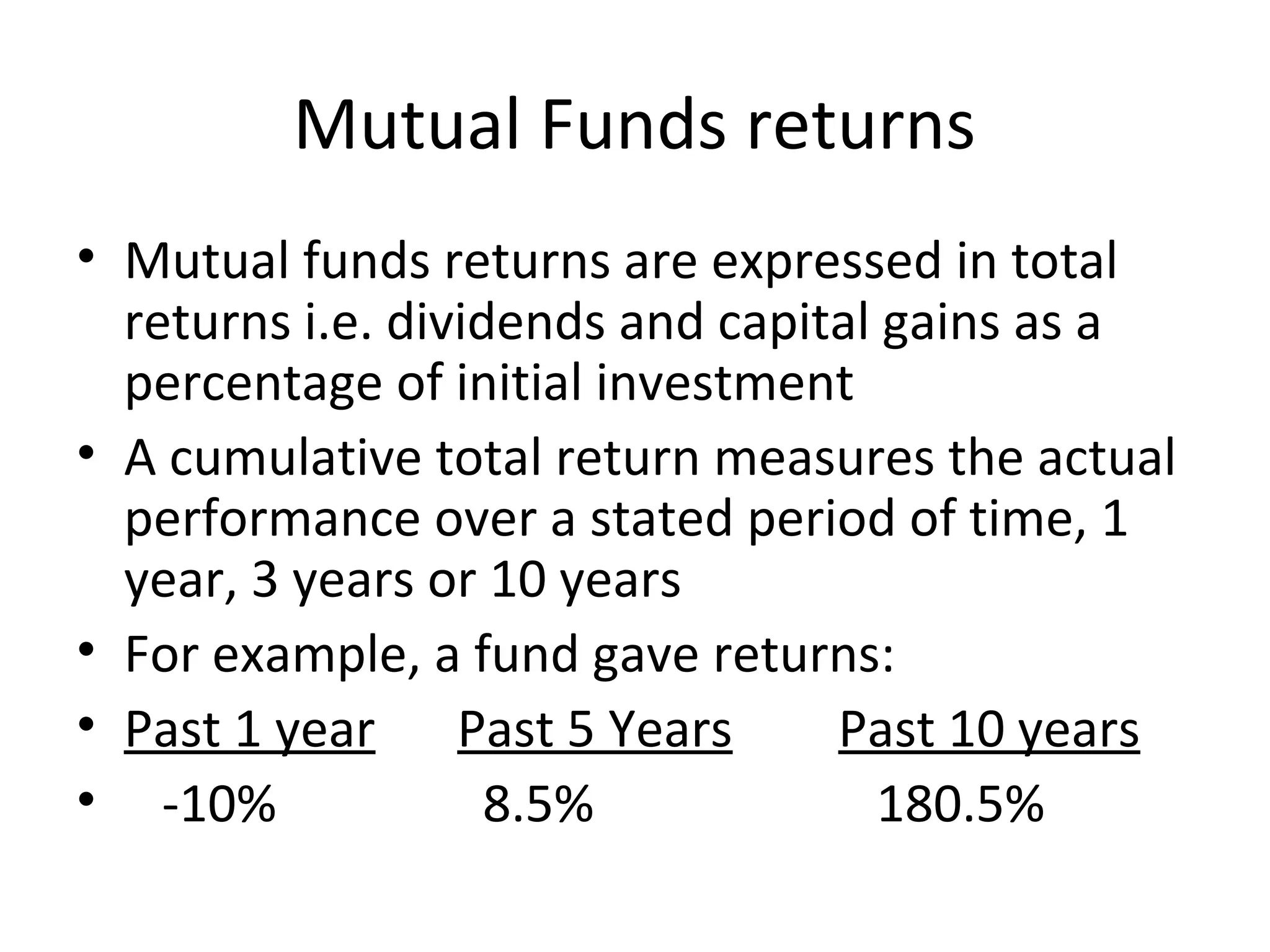
Mutual Funds returns
• Mutual funds returns are expressed in total
returns i.e. dividends and capital gains as a
percentage of initial investment
• A cumulative total return measures the actual
performance over a stated period of time, 1
year, 3 years or 10 years
• For example, a fund gave returns:
• Past 1 year Past 5 Years Past 10 years
• -10% 8.5% 180.5%
Mutual Fund Regulations
• An Asset Management Company for every
open-end & closed-end mutual fund shall
appoint a trustee.
• A trustee shall be a schedule bank, a foreign
bank, an Investment company having
minimum A+ rating from credit rating agency
registered with the commission.
• A central depository company approved by
the commission can also be appointed as
trustee.
• The trustee should be independent of the
AMC.
• The trustee should carry out the instructions
of AMC in respect of investment unless they
are in conflict with the any provision of the
rules issued by the commission.
• Units or certificates of an open-end or closed-
end mutual fund shall not be offered to the
public unless the schemes approved by the
commission.
• Sale, purchase, issue and transfer of units
certificates affected by the open-end or closed
end schemes are carried out in accordance
with the provisions of constitutive documents.
• Open-end or closed-end mutual fund schemes
should meet the minimum investment criteria
specified by the commission under regulation
44(3)(e).
• Should maintain proper books of accounts.

Type of Mutual Funds

  • 1.
    Types of MutualFunds Financial Markets
  • 2.
    Major types ofmutual funds • There are two major types of mutual funds – Money market mutual funds – Stock funds and bond and income funds Further mutual funds can classified on the basis of risk and return
  • 3.
    Types of mutualfunds • 1. Money market funds – These funds invest in money market securities – They are low risk and low return funds – They provide the chance to earn the going rate in the money market with diversification advantage
  • 4.
    • 2. BondFunds – These fund specialize in fixed income sector – Within bond funds, there exists many categories – Funds may specialize in government bonds, or corporate bonds – Or they specialize in bonds of different maturities
  • 5.
    • 3. HybridFunds (Balanced Funds) • Includes both bonds and equity funds • They are also called balanced funds • The main objective is to preserve capital and earn a return • Have a bit higher risk than the bond funds because of investment in equity
  • 6.
    • 4. Equityfunds • All investment is made in common stocks • Within equity funds, there can be growth funds or income funds • Growth funds have investment in stocks that have good growth potential (usually small firms) • Income funds have investment in stocks that provide consistent flow of income(usually large firms)
  • 7.
    • 5. Sectorfunds • Some industries perform well in one stage of business cycle and others perform well in the other stages of business cycle • An investment company may have a mutual fund that specialize in any one sector • For example, a mutual fund may invest only in oil stocks
  • 8.
    • 6. Indexfunds • An index fund tries to match the performance of a broad market index • The fund buys shares in securities in the proportion to the security’s representation in the index • It is an unmanaged fund and hence a low cost • Investors following passive strategy will invest in index fund
  • 9.
    Mutual Funds returns •Mutual funds returns are expressed in total returns i.e. dividends and capital gains as a percentage of initial investment • A cumulative total return measures the actual performance over a stated period of time, 1 year, 3 years or 10 years • For example, a fund gave returns: • Past 1 year Past 5 Years Past 10 years • -10% 8.5% 180.5%
  • 10.
    Mutual Fund Regulations •An Asset Management Company for every open-end & closed-end mutual fund shall appoint a trustee. • A trustee shall be a schedule bank, a foreign bank, an Investment company having minimum A+ rating from credit rating agency registered with the commission. • A central depository company approved by the commission can also be appointed as trustee.
  • 11.
    • The trusteeshould be independent of the AMC. • The trustee should carry out the instructions of AMC in respect of investment unless they are in conflict with the any provision of the rules issued by the commission. • Units or certificates of an open-end or closed- end mutual fund shall not be offered to the public unless the schemes approved by the commission.
  • 12.
    • Sale, purchase,issue and transfer of units certificates affected by the open-end or closed end schemes are carried out in accordance with the provisions of constitutive documents. • Open-end or closed-end mutual fund schemes should meet the minimum investment criteria specified by the commission under regulation 44(3)(e). • Should maintain proper books of accounts.