Part Four Financial Markets
Chapter 9 The Money Markets
Now that’s a lot! In its 2006 annual report, Microsoft listed $27 billion in short-term securities on its balance sheet.  This is essentially cash, but Microsoft does not keep this in its local bank.  But where? This is, of course, this topic of chapter 9 – Money Markets.
Chapter Preview We review the money markets and the securities that are traded there.  In addition, we discuss why the money markets are important in our financial system.  Topics include: The Money Markets Defined The Purpose of Money Markets Who Participates in Money Markets? Money Market Instruments Comparing Money Market Securities
The Money Markets Defined The term “money market” is a misnomer. Money (currency) is not actually traded in the money markets.  The securities in the money market are short term with high liquidity; therefore, they are close to  being money.
The Money Markets Defined Money Markets Defined Money market securities are usually sold in large denominations ($1,000,000 or more) They have low default risk They mature in one year or less from their issue date
The Money Markets Defined:  Why Do We Need Money Markets? In theory, the banking industry should handle the needs for short-term loans and accept short-term deposits.  Banks also have an information advantage on the credit-worthiness of participants. Banks do mediate between savers and borrowers; however, they are heavily regulated.  This creates a distinct cost advantage for money markets over banks.
The Money Markets Defined:  Cost Advantages Reserve requirements create additional expense for banks that money markets do not have Regulations on the level of interest banks could offer depositors lead to a significant growth in money markets, especially in the 1970s and 1980s.  When interest rates rose, depositors moved their money from banks to money markets to earn a higher interest rate.
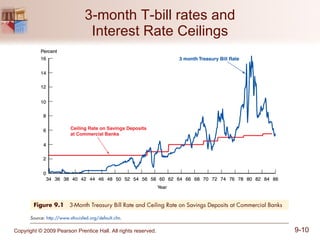
The Money Markets Defined:  Cost Advantages Even today, the cost structure of banks limits their competitiveness to situations where their informational advantages outweighs their regulatory costs. Figure 1 shows that limits on interest banks could offer was not relevant until the 1950s.  But in the decades that followed, the problem became apparent.
3-month T-bill rates and Interest Rate Ceilings
The Purpose of Money Markets Investors in Money Market: Provides a place for warehousing surplus funds for short periods of time Borrowers from money market provide low-cost source of temporary funds
The Purpose of Money Markets Corporations and U.S. government use these markets because the timing of cash inflows and outflows are not well synchronized.  Money markets provide a way to solve these cash-timing problems.
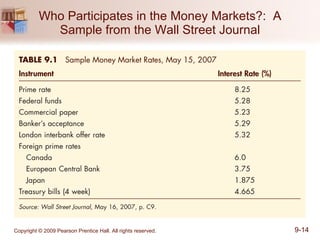
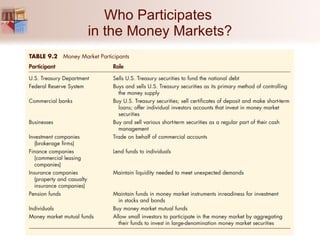
Who Participates  in the Money Markets? We will discuss, in turn, each of the  major borrowers and lenders in the  money market. Before we do that, let’s examine some of the current rates offered in the U.S. money markets.  Some of these rates have been discussed in previous chapters.  Other rates will be explored throughout  this chapter.
Who Participates in the Money Markets?:  A Sample from the Wall Street Journal
Who Participates  in the Money Markets?
Money Market Instruments We will examine each of these in the following slides: Treasury Bills Federal Funds Repurchase Agreements Negotiable Certificates of Deposit
Money Market Instruments (cont.) We will examine each of these in the following slides (continued): Commercial Paper Banker’s Acceptance Eurodollars
Money Market Instruments:  Treasury Bills T-bills have 28-day maturities through 12- month maturities.  Discounting :  When an investor pays less for the security than it will be worth when it matures, and the increase in price provides a return. This is common to short-term securities because they often mature before the issuer can mail out interest checks.
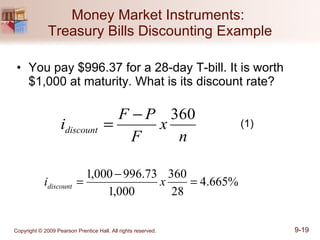
Money Market Instruments:  Treasury Bills Discounting Example You pay $996.37 for a 28-day T-bill. It is worth $1,000 at maturity. What is its discount rate? (1)
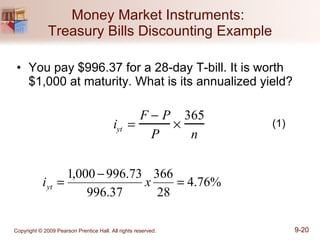
Money Market Instruments:  Treasury Bills Discounting Example You pay $996.37 for a 28-day T-bill. It is worth $1,000 at maturity. What is its annualized yield? (1)
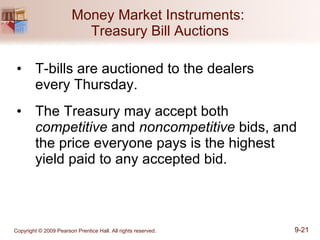
Money Market Instruments:  Treasury Bill Auctions T-bills are auctioned to the dealers  every Thursday. The Treasury may accept both  competitive  and  noncompetitive  bids, and the price everyone pays is the highest yield paid to any accepted bid.
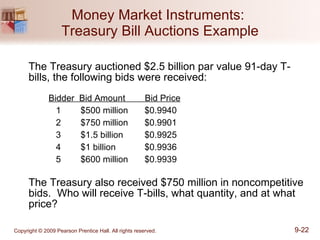
Money Market Instruments:  Treasury Bill Auctions Example The Treasury auctioned $2.5 billion par value 91-day T-bills, the following bids were received: Bidder  Bid Amount  Bid Price   1 $500 million $0.9940   2 $750 million $0.9901   3 $1.5 billion $0.9925   4 $1 billion $0.9936   5 $600 million $0.9939 The Treasury also received $750 million in noncompetitive bids.  Who will receive T-bills, what quantity, and at what price?
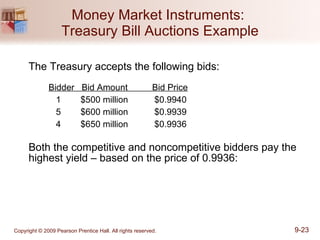
Money Market Instruments:  Treasury Bill Auctions Example The Treasury accepts the following bids: Bidder  Bid Amount  Bid Price   1 $500 million   $0.9940   5 $600 million   $0.9939   4 $650 million    $0.9936 Both the competitive and noncompetitive bidders pay the highest yield – based on the price of 0.9936:
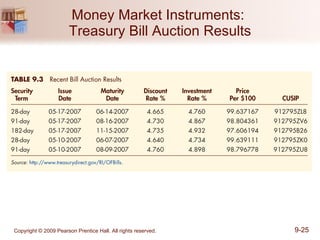
Money Market Instruments:  Treasury Bill Rates The next slide shows the results of several Treasury bill auctions, from 2007. It also shows some other data about each auction.  Do you know what each term means?
Money Market Instruments:  Treasury Bill Auction Results
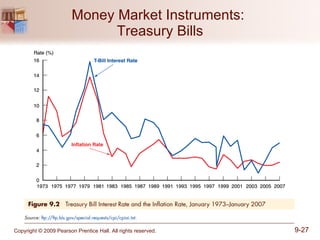
Money Market Instruments:  Treasury Bill Rates The next slide shows actual T-bill rates and the annual rate of inflation from 1973 through 2007. Notice that the inflation rate  exceeds  the rate on T-bills in several on the years.  This indicates a  negative  real return for  T-bill investors during these periods.
Money Market Instruments:  Treasury Bills
Money Market Instruments:  Fed Funds Short-term funds transferred (loaned or borrowed) between financial institutions, usually for a period of one day. Used by banks to meet short-term needs to meet reserve requirements.
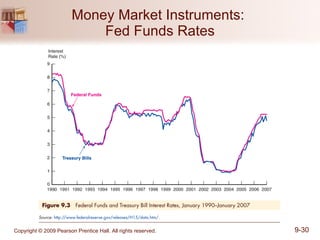
Money Market Instruments:  Fed Funds Rates The next slide shows actual fed funds rates and T-bill rates 1990 through 2006. Notice that the two rates track fairly closely.  What does this suggest about  the market for T-bills and the market for  fed funds?
Money Market Instruments:  Fed Funds Rates
Money Market Instruments: Repurchase Agreements These work similar to the market for fed funds, but nonbanks can participate. A firm sells Treasury securities, but agrees to buy them back at a certain date (usually 3–14 days later) for a certain price.
Money Market Instruments: Repurchase Agreements This set-up makes a repo agreements essentially a short-term collateralized loan. This is one market the Fed may use to conduct its monetary policy, whereby the Fed purchases/sells Treasury securities in the repo market.
Money Market Instruments: Negotiable Certificates of Deposit A bank-issued security that documents a deposit and specifies the interest rate and the maturity date Denominations range from $100,000  to $10 million
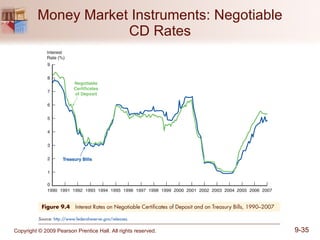
Money Market Instruments: Negotiable Certificates of Deposit The next slide shows actual CD rates and T-bill rates 1990 through 2007. Again, notice that the two rates track fairly closely.  What does this suggest about the market for T-bills and the market for CDs?
Money Market Instruments: Negotiable CD Rates
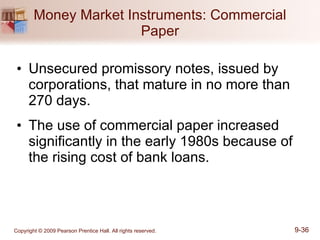
Money Market Instruments: Commercial Paper Unsecured promissory notes, issued by corporations, that mature in no more than  270 days. The use of commercial paper increased significantly in the early 1980s because of the rising cost of bank loans.
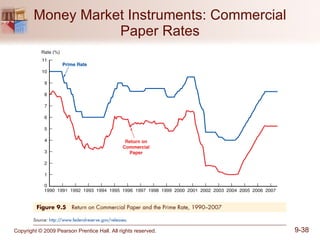
Money Market Instruments: Commercial Paper The next slide shows actual commercial paper rates and the prime rates 1990 through 2007.  Although the two track closely in terms of movements, notice that difference between the two remains roughly 200 basis points.
Money Market Instruments: Commercial Paper Rates
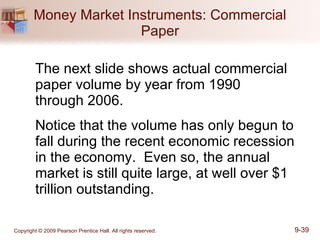
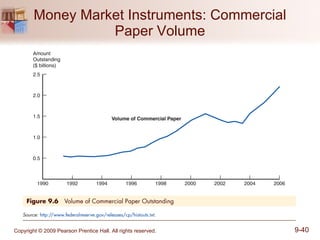
Money Market Instruments: Commercial Paper The next slide shows actual commercial paper volume by year from 1990  through 2006.  Notice that the volume has only begun to fall during the recent economic recession in the economy.  Even so, the annual market is still quite large, at well over $1 trillion outstanding.
Money Market Instruments: Commercial Paper Volume
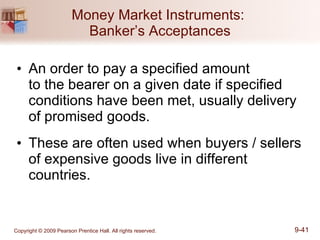
Money Market Instruments:  Banker’s Acceptances An order to pay a specified amount  to the bearer on a given date if specified conditions have been met, usually delivery  of promised goods. These are often used when buyers / sellers of expensive goods live in different countries.
Money Market Instruments:  Banker’s Acceptances Advantages Exporter paid immediately Exporter shielded from foreign  exchange risk Exporter does not have to assess the financial security of the importer Importer’s bank guarantees payment Crucial to international trade
Money Market Instruments:  Banker’s Acceptances As seen, banker’s acceptances avoid the need to establish the credit-worthiness of a customer living abroad. There is also an active secondary market for banker’s acceptances until they mature.  The terms of note indicate that the bearer, whoever that is, will be paid upon maturity.
Money Market Instruments: Eurodollars Eurodollars represent Dollar denominated deposits held in foreign banks. The market is essential since many foreign contracts call for payment is U.S. dollars due to the stability of the dollar, relative to other currencies.
Money Market Instruments: Eurodollars The Eurodollar market has continued to grow rapidly because depositors receive a higher rate of return on a dollar deposit in the Eurodollar market than in the domestic market.  Multinational banks are not subject to the same regulations restricting U.S. banks and because they are willing to accept narrower spreads between the interest paid on deposits and the interest earned on loans.
Money Market Instruments: Eurodollars Rates London interbank bid rate (LIBID) The rate paid by banks buying funds London interbank offer rate (LIBOR) The rate offered for sale of the funds Time deposits with fixed maturities Largest short term security in the world
Global: Birth of the Eurodollar The Eurodollar market is one of the most important financial markets, but oddly enough, it was fathered by the Soviet Union. In the 1950s, the USSR had accumulated large dollar deposits, but all were in US banks.  They feared the US might seize them, but still wanted dollars.  So, the USSR transferred the dollars to European banks, creating the Eurodollar market.
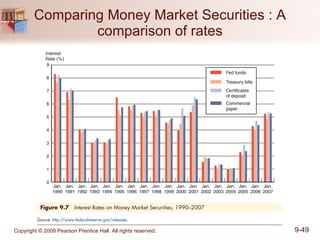
Comparing Money Market Securities The next slide shows a comparison of various money market rates from 1990 through 2007. Notice that no real pattern is present among the rates, indicating that investor preferences to the features on the instruments fluctuates.
Comparing Money Market Securities : A comparison of rates
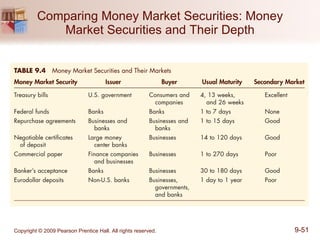
Comparing Money Market Securities The next slide summarizes the types of securities, issuers, buyers, maturity, and secondary market characteristics.
Comparing Money Market Securities: Money Market Securities and Their Depth
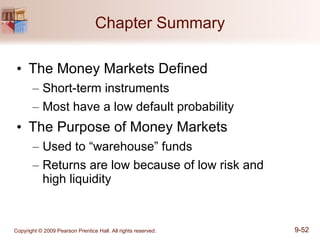
Chapter Summary The Money Markets Defined Short-term instruments Most have a low default probability The Purpose of Money Markets Used to “warehouse” funds Returns are low because of low risk and  high liquidity
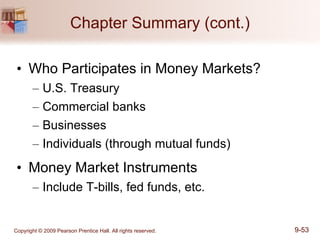
Chapter Summary (cont.) Who Participates in Money Markets? U.S. Treasury Commercial banks Businesses Individuals (through mutual funds) Money Market Instruments Include T-bills, fed funds, etc.
Comparing Money Market Securities Issuers range from the US government to banks to large corporations Mature in as little as 1 day to as long as 1 year The secondary market liquidity  varies substantially Chapter Summary (cont.)

Chapter 09_The Money Markets

  • 1.
  • 2.
    Chapter 9 TheMoney Markets
  • 3.
    Now that’s alot! In its 2006 annual report, Microsoft listed $27 billion in short-term securities on its balance sheet. This is essentially cash, but Microsoft does not keep this in its local bank. But where? This is, of course, this topic of chapter 9 – Money Markets.
  • 4.
    Chapter Preview Wereview the money markets and the securities that are traded there. In addition, we discuss why the money markets are important in our financial system. Topics include: The Money Markets Defined The Purpose of Money Markets Who Participates in Money Markets? Money Market Instruments Comparing Money Market Securities
  • 5.
    The Money MarketsDefined The term “money market” is a misnomer. Money (currency) is not actually traded in the money markets. The securities in the money market are short term with high liquidity; therefore, they are close to being money.
  • 6.
    The Money MarketsDefined Money Markets Defined Money market securities are usually sold in large denominations ($1,000,000 or more) They have low default risk They mature in one year or less from their issue date
  • 7.
    The Money MarketsDefined: Why Do We Need Money Markets? In theory, the banking industry should handle the needs for short-term loans and accept short-term deposits. Banks also have an information advantage on the credit-worthiness of participants. Banks do mediate between savers and borrowers; however, they are heavily regulated. This creates a distinct cost advantage for money markets over banks.
  • 8.
    The Money MarketsDefined: Cost Advantages Reserve requirements create additional expense for banks that money markets do not have Regulations on the level of interest banks could offer depositors lead to a significant growth in money markets, especially in the 1970s and 1980s. When interest rates rose, depositors moved their money from banks to money markets to earn a higher interest rate.
  • 9.
    The Money MarketsDefined: Cost Advantages Even today, the cost structure of banks limits their competitiveness to situations where their informational advantages outweighs their regulatory costs. Figure 1 shows that limits on interest banks could offer was not relevant until the 1950s. But in the decades that followed, the problem became apparent.
  • 10.
    3-month T-bill ratesand Interest Rate Ceilings
  • 11.
    The Purpose ofMoney Markets Investors in Money Market: Provides a place for warehousing surplus funds for short periods of time Borrowers from money market provide low-cost source of temporary funds
  • 12.
    The Purpose ofMoney Markets Corporations and U.S. government use these markets because the timing of cash inflows and outflows are not well synchronized. Money markets provide a way to solve these cash-timing problems.
  • 13.
    Who Participates in the Money Markets? We will discuss, in turn, each of the major borrowers and lenders in the money market. Before we do that, let’s examine some of the current rates offered in the U.S. money markets. Some of these rates have been discussed in previous chapters. Other rates will be explored throughout this chapter.
  • 14.
    Who Participates inthe Money Markets?: A Sample from the Wall Street Journal
  • 15.
    Who Participates in the Money Markets?
  • 16.
    Money Market InstrumentsWe will examine each of these in the following slides: Treasury Bills Federal Funds Repurchase Agreements Negotiable Certificates of Deposit
  • 17.
    Money Market Instruments(cont.) We will examine each of these in the following slides (continued): Commercial Paper Banker’s Acceptance Eurodollars
  • 18.
    Money Market Instruments: Treasury Bills T-bills have 28-day maturities through 12- month maturities. Discounting : When an investor pays less for the security than it will be worth when it matures, and the increase in price provides a return. This is common to short-term securities because they often mature before the issuer can mail out interest checks.
  • 19.
    Money Market Instruments: Treasury Bills Discounting Example You pay $996.37 for a 28-day T-bill. It is worth $1,000 at maturity. What is its discount rate? (1)
  • 20.
    Money Market Instruments: Treasury Bills Discounting Example You pay $996.37 for a 28-day T-bill. It is worth $1,000 at maturity. What is its annualized yield? (1)
  • 21.
    Money Market Instruments: Treasury Bill Auctions T-bills are auctioned to the dealers every Thursday. The Treasury may accept both competitive and noncompetitive bids, and the price everyone pays is the highest yield paid to any accepted bid.
  • 22.
    Money Market Instruments: Treasury Bill Auctions Example The Treasury auctioned $2.5 billion par value 91-day T-bills, the following bids were received: Bidder Bid Amount Bid Price 1 $500 million $0.9940 2 $750 million $0.9901 3 $1.5 billion $0.9925 4 $1 billion $0.9936 5 $600 million $0.9939 The Treasury also received $750 million in noncompetitive bids. Who will receive T-bills, what quantity, and at what price?
  • 23.
    Money Market Instruments: Treasury Bill Auctions Example The Treasury accepts the following bids: Bidder Bid Amount Bid Price 1 $500 million $0.9940 5 $600 million $0.9939 4 $650 million $0.9936 Both the competitive and noncompetitive bidders pay the highest yield – based on the price of 0.9936:
  • 24.
    Money Market Instruments: Treasury Bill Rates The next slide shows the results of several Treasury bill auctions, from 2007. It also shows some other data about each auction. Do you know what each term means?
  • 25.
    Money Market Instruments: Treasury Bill Auction Results
  • 26.
    Money Market Instruments: Treasury Bill Rates The next slide shows actual T-bill rates and the annual rate of inflation from 1973 through 2007. Notice that the inflation rate exceeds the rate on T-bills in several on the years. This indicates a negative real return for T-bill investors during these periods.
  • 27.
  • 28.
    Money Market Instruments: Fed Funds Short-term funds transferred (loaned or borrowed) between financial institutions, usually for a period of one day. Used by banks to meet short-term needs to meet reserve requirements.
  • 29.
    Money Market Instruments: Fed Funds Rates The next slide shows actual fed funds rates and T-bill rates 1990 through 2006. Notice that the two rates track fairly closely. What does this suggest about the market for T-bills and the market for fed funds?
  • 30.
    Money Market Instruments: Fed Funds Rates
  • 31.
    Money Market Instruments:Repurchase Agreements These work similar to the market for fed funds, but nonbanks can participate. A firm sells Treasury securities, but agrees to buy them back at a certain date (usually 3–14 days later) for a certain price.
  • 32.
    Money Market Instruments:Repurchase Agreements This set-up makes a repo agreements essentially a short-term collateralized loan. This is one market the Fed may use to conduct its monetary policy, whereby the Fed purchases/sells Treasury securities in the repo market.
  • 33.
    Money Market Instruments:Negotiable Certificates of Deposit A bank-issued security that documents a deposit and specifies the interest rate and the maturity date Denominations range from $100,000 to $10 million
  • 34.
    Money Market Instruments:Negotiable Certificates of Deposit The next slide shows actual CD rates and T-bill rates 1990 through 2007. Again, notice that the two rates track fairly closely. What does this suggest about the market for T-bills and the market for CDs?
  • 35.
    Money Market Instruments:Negotiable CD Rates
  • 36.
    Money Market Instruments:Commercial Paper Unsecured promissory notes, issued by corporations, that mature in no more than 270 days. The use of commercial paper increased significantly in the early 1980s because of the rising cost of bank loans.
  • 37.
    Money Market Instruments:Commercial Paper The next slide shows actual commercial paper rates and the prime rates 1990 through 2007. Although the two track closely in terms of movements, notice that difference between the two remains roughly 200 basis points.
  • 38.
    Money Market Instruments:Commercial Paper Rates
  • 39.
    Money Market Instruments:Commercial Paper The next slide shows actual commercial paper volume by year from 1990 through 2006. Notice that the volume has only begun to fall during the recent economic recession in the economy. Even so, the annual market is still quite large, at well over $1 trillion outstanding.
  • 40.
    Money Market Instruments:Commercial Paper Volume
  • 41.
    Money Market Instruments: Banker’s Acceptances An order to pay a specified amount to the bearer on a given date if specified conditions have been met, usually delivery of promised goods. These are often used when buyers / sellers of expensive goods live in different countries.
  • 42.
    Money Market Instruments: Banker’s Acceptances Advantages Exporter paid immediately Exporter shielded from foreign exchange risk Exporter does not have to assess the financial security of the importer Importer’s bank guarantees payment Crucial to international trade
  • 43.
    Money Market Instruments: Banker’s Acceptances As seen, banker’s acceptances avoid the need to establish the credit-worthiness of a customer living abroad. There is also an active secondary market for banker’s acceptances until they mature. The terms of note indicate that the bearer, whoever that is, will be paid upon maturity.
  • 44.
    Money Market Instruments:Eurodollars Eurodollars represent Dollar denominated deposits held in foreign banks. The market is essential since many foreign contracts call for payment is U.S. dollars due to the stability of the dollar, relative to other currencies.
  • 45.
    Money Market Instruments:Eurodollars The Eurodollar market has continued to grow rapidly because depositors receive a higher rate of return on a dollar deposit in the Eurodollar market than in the domestic market. Multinational banks are not subject to the same regulations restricting U.S. banks and because they are willing to accept narrower spreads between the interest paid on deposits and the interest earned on loans.
  • 46.
    Money Market Instruments:Eurodollars Rates London interbank bid rate (LIBID) The rate paid by banks buying funds London interbank offer rate (LIBOR) The rate offered for sale of the funds Time deposits with fixed maturities Largest short term security in the world
  • 47.
    Global: Birth ofthe Eurodollar The Eurodollar market is one of the most important financial markets, but oddly enough, it was fathered by the Soviet Union. In the 1950s, the USSR had accumulated large dollar deposits, but all were in US banks. They feared the US might seize them, but still wanted dollars. So, the USSR transferred the dollars to European banks, creating the Eurodollar market.
  • 48.
    Comparing Money MarketSecurities The next slide shows a comparison of various money market rates from 1990 through 2007. Notice that no real pattern is present among the rates, indicating that investor preferences to the features on the instruments fluctuates.
  • 49.
    Comparing Money MarketSecurities : A comparison of rates
  • 50.
    Comparing Money MarketSecurities The next slide summarizes the types of securities, issuers, buyers, maturity, and secondary market characteristics.
  • 51.
    Comparing Money MarketSecurities: Money Market Securities and Their Depth
  • 52.
    Chapter Summary TheMoney Markets Defined Short-term instruments Most have a low default probability The Purpose of Money Markets Used to “warehouse” funds Returns are low because of low risk and high liquidity
  • 53.
    Chapter Summary (cont.)Who Participates in Money Markets? U.S. Treasury Commercial banks Businesses Individuals (through mutual funds) Money Market Instruments Include T-bills, fed funds, etc.
  • 54.
    Comparing Money MarketSecurities Issuers range from the US government to banks to large corporations Mature in as little as 1 day to as long as 1 year The secondary market liquidity varies substantially Chapter Summary (cont.)