Quantum computing in practice
& applications to cryptography
Renaud Lifchitz
OPPIDA
Sthack, March 27, 2015
Renaud Lifchitz Sthack, March 27, 2015 1 / 67
Quantum computing in practice
Speaker’s bio
French senior security engineer working at Oppida
(http://www.oppida.fr), France
Main activities:
Penetration testing & security audits
Security research
Security trainings
Main interests:
Security of protocols (authentication, cryptography,
information leakage, zero-knowledge proofs...)
Number theory (integer factorization, primality
testing, elliptic curves...)
Renaud Lifchitz Sthack, March 27, 2015 2 / 67
Quantum computing in practice
Goals of this talk
Introduce quantum physics basics to newcomers
Give “state-of-the-art” results in quantum computing &
cryptography
Explain principles and basic blocks to build quantum circuits
Give people ideas, tools and hardware access to practice
quantum computing
Renaud Lifchitz Sthack, March 27, 2015 3 / 67
Quantum computing in practice
Outline
1 Basics of quantum computing
2 Quantum gates and circuits
3 Fundamental quantum algorithms
4 Attacks against cryptography
5 Quantum computing simulations & tools
6 Computing on adiabatic quantum computers
7 Computing on real quantum computers
8 The future of cryptography: post-quantum cryptography
9 Conclusion
Renaud Lifchitz Sthack, March 27, 2015 4 / 67
Quantum computing in practice
Basics of quantum computing
Section 1
Basics of quantum computing
Renaud Lifchitz Sthack, March 27, 2015 5 / 67
Quantum computing in practice
Basics of quantum computing
Quantum principles
1. Small-scale physical objects (atom, molecule, photon, electron, ...) both
behave as particles and as waves during experiments (quantum duality
principle)
2. Main characteristics of these objects (position, spin, polarization, ...) are
not determined, have multiple values according to a probabilistic
distribution (quantum superposition principle / Heisenberg’s uncertainty
principle)
3. Further interaction or measurement will collapse this probability
distribution into a single, steady state (quantum decoherence principle)
4. Consequently, copying a quantum state is not possible (no-cloning
theorem)
We can take advantage of the first 3 principles to do powerful
non-classical computations
Renaud Lifchitz Sthack, March 27, 2015 6 / 67
Quantum computing in practice
Basics of quantum computing
Quantum principles
Figure : Position of an atom under quantum conditions across time,
sometimes it is 100% determined, sometimes 50% - Image created by
Thomas Fogarty, graduate student from University College Cork in Ireland
Renaud Lifchitz Sthack, March 27, 2015 7 / 67
Quantum computing in practice
Basics of quantum computing
Recent quantum experiments
Instant interaction of entangled qubits - EPR Paradox: Summer
2008, University of Geneva, Nicolas Gisin and his colleagues
determined that the speed of the quantum interaction is at least
10000 times the speed of light using correlated photons at a
18-km distance (http://arxiv.org/abs/0808.3316)
Quantum teleportation: September 2014, same team of scientists
successfully achieved a 25-km quantum teleportation
Renaud Lifchitz Sthack, March 27, 2015 8 / 67
Quantum computing in practice
Basics of quantum computing
Schr¨odinger’s cat though experiment
Paradox, though experiment, designed by Austrian
physicist Erwin Schr¨odinger in 1935
A cat, a bottle of poison, a radioactive source, and
a radioactivity detector are placed in a sealed box
If the detector detects radioactivity, the bottle is
broken, killing the cat
Until we open the box, the cat may be both alive
AND dead!
Renaud Lifchitz Sthack, March 27, 2015 9 / 67
Quantum computing in practice
Basics of quantum computing
Current freely available quantum systems
Quantum number generator:
Commercial ID Quantique “Quantis” provides 4 Mbits/s to 16 MBits/s of true quantum
randomness:
Online “Quantum Random Bit Generator” (QRBG121) service: http://random.irb.hr/
Quantum encryption system:
Commercial ID Quantique “Cerberis” & “Centauris” allow Quantum Key Distribution (QKD) and
encryption up to 100 Gbps and 100 km:
Renaud Lifchitz Sthack, March 27, 2015 10 / 67
Quantum computing in practice
Basics of quantum computing
Quantum cryptography
Unbreakable cryptography, even with a quantum computer
Doesn’t rely on math problems we don’t know how to solve, but on laws
of physics we can’t get around
Uses QKD (Quantum Key Distribution) to exchange a symmetric key of
the same size as the message (one-time pad) over a quantum channel
(optical fiber for instance)
The encrypted message is sent classically
Interception is useless: the attacker will alter half of the key bits on
average, and the receiver will detect the snooping thanks to quantum
error correction codes
Quantum Key Distribution networks exist in Geneva (Switzerland),
Vienna (Austria), Massachusetts (USA), Tokyo (Japan) for banking or
academic purposes
Max distance is about 100 kms
Renaud Lifchitz Sthack, March 27, 2015 11 / 67
Quantum computing in practice
Basics of quantum computing
Current coherence times of qubits
Qubit type Coherence time
Silicon nuclear spin 25 s.
Trapped ion 15 s.
Trapped neutral atom 10 s.
Phosphorus in silicon 10 s.
NMR molecule nuclear spin 2 s.
Photon (infrared photon in optical fibre) 0.1 ms.
Superconducting qubit 4 µs.
Quantum dot 3 µs.
Figure : Current sorted coherence times of qubits (source: Institute Of
Physics Publishing 2011, U.K.)
Renaud Lifchitz Sthack, March 27, 2015 12 / 67
Quantum computing in practice
Quantum gates and circuits
Section 2
Quantum gates and circuits
Renaud Lifchitz Sthack, March 27, 2015 13 / 67
Quantum computing in practice
Quantum gates and circuits
Qubit representations
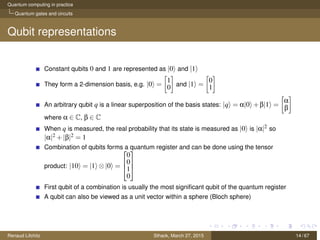
Constant qubits 0 and 1 are represented as |0 and |1
They form a 2-dimension basis, e.g. |0 =
1
0 and |1 =
0
1
An arbitrary qubit q is a linear superposition of the basis states: |q = α|0 +β|1 =
α
β
where α ∈ C, β ∈ C
When q is measured, the real probability that its state is measured as |0 is |α|2 so
|α|2 +|β|2 = 1
Combination of qubits forms a quantum register and can be done using the tensor
product: |10 = |1 ⊗|0 =



0
0
1
0



First qubit of a combination is usually the most significant qubit of the quantum register
A qubit can also be viewed as a unit vector within a sphere (Bloch sphere)
Renaud Lifchitz Sthack, March 27, 2015 14 / 67
Quantum computing in practice
Quantum gates and circuits
Basics of quantum gates
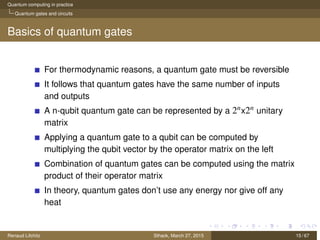
For thermodynamic reasons, a quantum gate must be reversible
It follows that quantum gates have the same number of inputs
and outputs
A n-qubit quantum gate can be represented by a 2nx2n unitary
matrix
Applying a quantum gate to a qubit can be computed by
multiplying the qubit vector by the operator matrix on the left
Combination of quantum gates can be computed using the matrix
product of their operator matrix
In theory, quantum gates don’t use any energy nor give off any
heat
Renaud Lifchitz Sthack, March 27, 2015 15 / 67
Quantum computing in practice
Quantum gates and circuits
Pauli-X gate
Pauli-X gate Number of qubits: 1
Symbol:
Description: Quantum equivalent of a NOT gate. Rotates qubit around
the X-axis by Π radians. X.X = I.
Operator matrix: X =
0 1
1 0
Renaud Lifchitz Sthack, March 27, 2015 16 / 67
Quantum computing in practice
Quantum gates and circuits
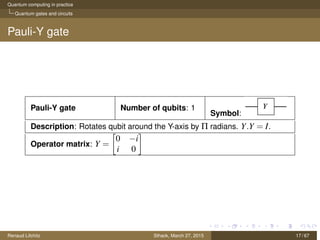
Pauli-Y gate
Pauli-Y gate Number of qubits: 1
Symbol:
Description: Rotates qubit around the Y-axis by Π radians. Y.Y = I.
Operator matrix: Y =
0 −i
i 0
Renaud Lifchitz Sthack, March 27, 2015 17 / 67
Quantum computing in practice
Quantum gates and circuits
Pauli-Z gate
Pauli-Z gate Number of qubits: 1
Symbol:
Description: Rotates qubit around the Z-axis by Π radians. Z.Z = I.
Operator matrix: Z =
1 0
0 −1
Renaud Lifchitz Sthack, March 27, 2015 18 / 67
Quantum computing in practice
Quantum gates and circuits
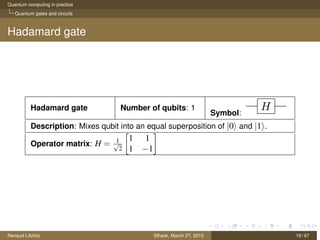
Hadamard gate
Hadamard gate Number of qubits: 1
Symbol:
Description: Mixes qubit into an equal superposition of |0 and |1 .
Operator matrix: H = 1√
2
1 1
1 −1
Renaud Lifchitz Sthack, March 27, 2015 19 / 67
Quantum computing in practice
Quantum gates and circuits
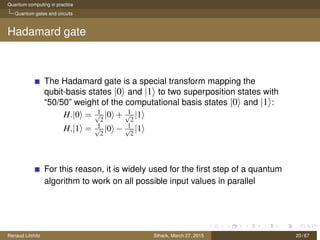
Hadamard gate
The Hadamard gate is a special transform mapping the
qubit-basis states |0 and |1 to two superposition states with
“50/50” weight of the computational basis states |0 and |1 :
H.|0 = 1√
2
|0 + 1√
2
|1
H.|1 = 1√
2
|0 − 1√
2
|1
For this reason, it is widely used for the first step of a quantum
algorithm to work on all possible input values in parallel
Renaud Lifchitz Sthack, March 27, 2015 20 / 67
Quantum computing in practice
Quantum gates and circuits
CNOT gate
CNOT gate Number of qubits: 2
Symbol:
Description: Controlled NOT gate. First qubit is control qubit, second is
target qubit. Leaves control qubit unchanged and flips target qubit if control
qubit is true.
Operator matrix: CNOT =




1 0 0 0
0 1 0 0
0 0 0 1
0 0 1 0




Renaud Lifchitz Sthack, March 27, 2015 21 / 67
Quantum computing in practice
Quantum gates and circuits
SWAP gate
SWAP gate Number of qubits: 2
Symbol:
Description: Swaps the 2 input qubits.
Operator matrix: SWAP =




1 0 0 0
0 0 1 0
0 1 0 0
0 0 0 1




Renaud Lifchitz Sthack, March 27, 2015 22 / 67
Quantum computing in practice
Quantum gates and circuits
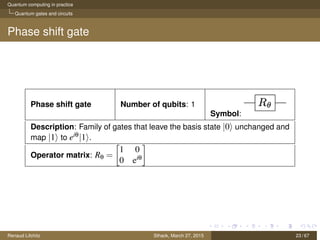
Phase shift gate
Phase shift gate Number of qubits: 1
Symbol:
Description: Family of gates that leave the basis state |0 unchanged and
map |1 to eiθ|1 .
Operator matrix: Rθ =
1 0
0 eiθ
Renaud Lifchitz Sthack, March 27, 2015 23 / 67
Quantum computing in practice
Quantum gates and circuits
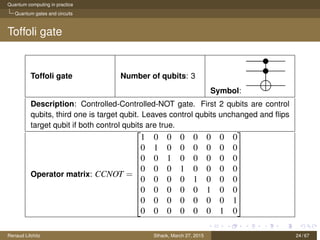
Toffoli gate
Toffoli gate Number of qubits: 3
Symbol:
Description: Controlled-Controlled-NOT gate. First 2 qubits are control
qubits, third one is target qubit. Leaves control qubits unchanged and flips
target qubit if both control qubits are true.
Operator matrix: CCNOT =












1 0 0 0 0 0 0 0
0 1 0 0 0 0 0 0
0 0 1 0 0 0 0 0
0 0 0 1 0 0 0 0
0 0 0 0 1 0 0 0
0 0 0 0 0 1 0 0
0 0 0 0 0 0 0 1
0 0 0 0 0 0 1 0












Renaud Lifchitz Sthack, March 27, 2015 24 / 67
Quantum computing in practice
Quantum gates and circuits
Universal gates
A set of quantum gates is called universal if any classical logic
operation can be made with only this set of gates. Examples of
universal sets of gates:
Hadamard gate, Phase shift gate (with θ = Π
4 and θ = Π
2 ) and
Controlled NOT gate
Toffoli gate only
Renaud Lifchitz Sthack, March 27, 2015 25 / 67
Quantum computing in practice
Quantum gates and circuits
Circuit designing challenges
Qubits and qubit registers cannot be copied in any way
In simulation like in reality, number of used qubits must be limited
(qubit reuse wherever possible)
Qubit registers shifts are costly, moving gates “reading heads” is
somehow easier
In reality, quantum error codes should be used to avoid partial
decoherence during computation
Renaud Lifchitz Sthack, March 27, 2015 26 / 67
Quantum computing in practice
Fundamental quantum algorithms
Section 3
Fundamental quantum algorithms
Renaud Lifchitz Sthack, March 27, 2015 27 / 67
Quantum computing in practice
Fundamental quantum algorithms
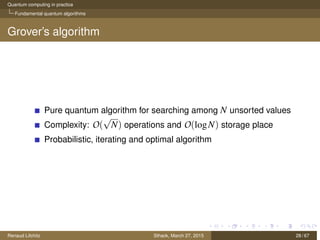
Grover’s algorithm
Pure quantum algorithm for searching among N unsorted values
Complexity: O(
√
N) operations and O(logN) storage place
Probabilistic, iterating and optimal algorithm
Renaud Lifchitz Sthack, March 27, 2015 28 / 67
Quantum computing in practice
Fundamental quantum algorithms
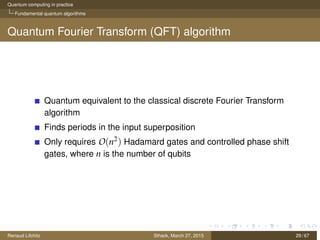
Quantum Fourier Transform (QFT) algorithm
Quantum equivalent to the classical discrete Fourier Transform
algorithm
Finds periods in the input superposition
Only requires O(n2) Hadamard gates and controlled phase shift
gates, where n is the number of qubits
Renaud Lifchitz Sthack, March 27, 2015 29 / 67
Quantum computing in practice
Fundamental quantum algorithms
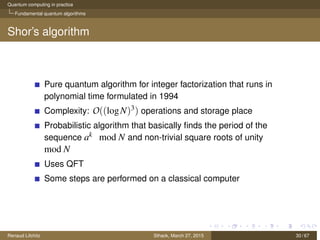
Shor’s algorithm
Pure quantum algorithm for integer factorization that runs in
polynomial time formulated in 1994
Complexity: O((logN)3) operations and storage place
Probabilistic algorithm that basically finds the period of the
sequence ak mod N and non-trivial square roots of unity
mod N
Uses QFT
Some steps are performed on a classical computer
Renaud Lifchitz Sthack, March 27, 2015 30 / 67
Quantum computing in practice
Attacks against cryptography
Section 4
Attacks against cryptography
Renaud Lifchitz Sthack, March 27, 2015 31 / 67
Quantum computing in practice
Attacks against cryptography
Breaking asymmetric cryptography
Most asymmetric cryptosystems rely on the integer factorization
difficulty
Shor’s algorithm is able to factor integers efficiently and similar
algorithms exist for solving discrete logarithms
RSA and Diffie–Hellman key exchange are quite easily broken
HTTPS, SSL, SSH, VPNs and certificates security will be
seriously threatened
Current records are RSA factorization of 21 in October 2012 (real
quantum computation), and factorization of 143 in April 2012
(adiabatic quantum computation).
Renaud Lifchitz Sthack, March 27, 2015 32 / 67
Quantum computing in practice
Attacks against cryptography
Breaking symmetric cryptography
It is possible to test multiple symmetric keys in parallel with a
quantum algorithm
More precisely, using Grover’s algorithm, we can test N keys in√
N steps
This divides at least all current keylength strengths by 2
Renaud Lifchitz Sthack, March 27, 2015 33 / 67
Quantum computing in practice
Attacks against cryptography
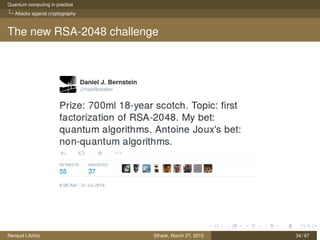
The new RSA-2048 challenge
Renaud Lifchitz Sthack, March 27, 2015 34 / 67
Quantum computing in practice
Quantum computing simulations & tools
Section 5
Quantum computing simulations & tools
Renaud Lifchitz Sthack, March 27, 2015 35 / 67
Quantum computing in practice
Quantum computing simulations & tools
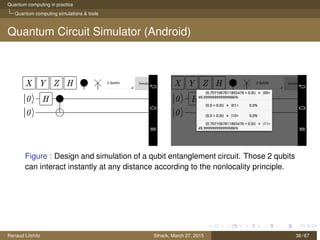
Quantum Circuit Simulator (Android)
Figure : Design and simulation of a qubit entanglement circuit. Those 2 qubits
can interact instantly at any distance according to the nonlocality principle.
Renaud Lifchitz Sthack, March 27, 2015 36 / 67
Quantum computing in practice
Quantum computing simulations & tools
QCL
Figure : Shor’s algorithm running in QCL
(http://tph.tuwien.ac.at/˜oemer/qcl.html)
Renaud Lifchitz Sthack, March 27, 2015 37 / 67
Quantum computing in practice
Quantum computing simulations & tools
Python & Sympy
Figure : Simple 1-qubit adder with Sympy
(http://docs.sympy.org/dev/modules/physics/quantum/)
Renaud Lifchitz Sthack, March 27, 2015 38 / 67
Quantum computing in practice
Quantum computing simulations & tools
Python & Sympy
Figure : A quantum CRC-8 circuit with only CNOT gates
Renaud Lifchitz Sthack, March 27, 2015 39 / 67
Quantum computing in practice
Quantum computing simulations & tools
Quantum Computing Playground (Web)
Figure : QFT on http://www.quantumplayground.net/
Renaud Lifchitz Sthack, March 27, 2015 40 / 67
Quantum computing in practice
Quantum computing simulations & tools
Quantum Circuit Simulator (Web) by Davy Wybiral
Figure : Simple 1-qubit adder on http://www.davyw.com/quantum/
Renaud Lifchitz Sthack, March 27, 2015 41 / 67
Quantum computing in practice
Computing on adiabatic quantum computers
Section 6
Computing on adiabatic quantum computers
Renaud Lifchitz Sthack, March 27, 2015 42 / 67
Quantum computing in practice
Computing on adiabatic quantum computers
D-Wave adiabatic computers
D-Wave is a Canadian quantum computing company
They have built some controversial quantum computers, D-Wave One &
D-Wave Two
D-Wave computers have been sold to Lockeed Martin and Google (shared with
Nasa) for 10-15 million US dollars
They plan to double their qubit capacity every year in the next decade
Renaud Lifchitz Sthack, March 27, 2015 43 / 67
Quantum computing in practice
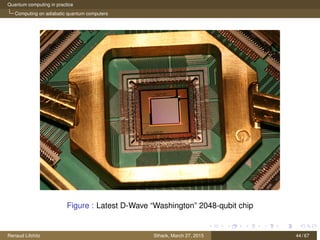
Computing on adiabatic quantum computers
Figure : Latest D-Wave “Washington” 2048-qubit chip
Renaud Lifchitz Sthack, March 27, 2015 44 / 67
Quantum computing in practice
Computing on adiabatic quantum computers
How do they work?
Probabilistic, iterating & convergent system
A quantum state represents the solutions to the problem
An ordinary computer will measure and rank a solution with the problem
generating function G and influences the quantum state
The quantum state will converge to a pretty good solution thanks to its
thermal equilibrium and the Boltzmann probability distribution:
P(x1,x2,...,xN) =
1
Z
e−G(x1,x2,...,xN)/kT
with Z =
N
∑
k=1
∑
xk=0,1
e−G(x1,x2,...,xN)/kT
I was able to factor the RSA integer 1609337 (21 bits) in 1 minute
using a home-made simulation model framework (no noise).
Renaud Lifchitz Sthack, March 27, 2015 45 / 67
Quantum computing in practice
Computing on adiabatic quantum computers
Current limitations
Limited to optimization problems
Limited to problems with solutions you can rank
Personal opinion: better when generating function is everywhere
continuous and differentiable (not the case with discrete problems
like factorization)
In conclusion, adiabatic computers are specific and need to be more
peer-reviewed and extensively tested to prove their real advantage.
Renaud Lifchitz Sthack, March 27, 2015 46 / 67
Quantum computing in practice
Computing on real quantum computers
Section 7
Computing on real quantum computers
Renaud Lifchitz Sthack, March 27, 2015 47 / 67
Quantum computing in practice
Computing on real quantum computers
“Quantum in the Cloud” project
Project of the University of Bristol (U.K.), Centre for Quantum Photonics
Full, universal, quantum computer
Remote access (JSON/HTTP) to a 2-qubit photonic chip available upon request, 4-qubit
chip available for local researchers
Online chip simulator available for training
Homepage: http://www.bristol.ac.uk/physics/research/quantum/qcloud/
Renaud Lifchitz Sthack, March 27, 2015 48 / 67
Quantum computing in practice
Computing on real quantum computers
“Quantum in the Cloud” project
Figure : An optoelectronic quantum chip from Bristol Centre for Quantum
Photonics
Renaud Lifchitz Sthack, March 27, 2015 49 / 67
Quantum computing in practice
Computing on real quantum computers
“Quantum in the Cloud” project
Parts of the chips
Representation Description
Photon input path: The beginning of a fiber path
where you can inject photons
Photon output path: The end of a fiber path where
you can detect photons
Photon beam splitter: A device which lets a certain
fraction of light pass through it, while the rest of the
light is reflected from the surface. All of the beam
splitters on the CNOT-MZ chip are “50/50” beam
splitters, apart from the three down the middle, which
let 2/3 of the light pass through them
Photon phase changer: A variable phase changer
in Π radians varying from 0 to 2. In reality, a little
heater that changes speed of photons.
Renaud Lifchitz Sthack, March 27, 2015 50 / 67
Quantum computing in practice
Computing on real quantum computers
“Quantum in the Cloud” project
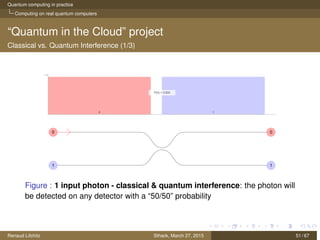
Classical vs. Quantum Interference (1/3)
Figure : 1 input photon - classical & quantum interference: the photon will
be detected on any detector with a “50/50” probability
Renaud Lifchitz Sthack, March 27, 2015 51 / 67
Quantum computing in practice
Computing on real quantum computers
“Quantum in the Cloud” project
Classical vs. Quantum Interference (2/3)
Figure : 2 input photons - classical interference: half of the time, each
detector clicks once. The other half of the time, one of the detectors clicks
twice (split equally between this happening at detector 1 and detector 0)
Renaud Lifchitz Sthack, March 27, 2015 52 / 67
Quantum computing in practice
Computing on real quantum computers
“Quantum in the Cloud” project
Classical vs. Quantum Interference (3/3)
Figure : 2 input photons - quantum interference: Both photons will
“cooperate” and will always end up in the same path, causing one of the
detectors to click twice. This is a purely quantum mechanical effect.
Renaud Lifchitz Sthack, March 27, 2015 53 / 67
Quantum computing in practice
Computing on real quantum computers
“Quantum in the Cloud” project
The CNOT-MZ chip
6 injection paths for a maximum of 4 photons
13 beam splitters
8 variable phase shifters
Renaud Lifchitz Sthack, March 27, 2015 54 / 67
Quantum computing in practice
Computing on real quantum computers
“Quantum in the Cloud” project
Postselection step
After each experiment, some outcomes must be cancelled as
their probability is not real
Postselection is the act of restricting outcomes of a process or
experiment, based on certain conditions being satisfied
As each input qubit is coded with 2 input paths, output paths must
correspond
Outcomes with non-corresponding output paths are cancelled
Renaud Lifchitz Sthack, March 27, 2015 55 / 67
Quantum computing in practice
Computing on real quantum computers
“Quantum in the Cloud” project
Designing reversible logic gates with the CNOT-MZ chip
I have computed a set of possibilities for possible paths for some
1-qubit and 2-qubit gates:
q1
f 0 1
id 0 1
NOT 3 4
Figure : 1-qubit gates
q1 q2
f 0 1 0 1
id 0 1 2 5
SWAP 0 3 2 4
CNOT 1 2 3 4
CMP 0 1 3 4
Figure : 2-qubit gates
Renaud Lifchitz Sthack, March 27, 2015 56 / 67
Quantum computing in practice
Computing on real quantum computers
“Quantum in the Cloud” project
Demo on real hardware
NOT gate
SWAP gate
Quantum adder with a mixed qubit
Renaud Lifchitz Sthack, March 27, 2015 57 / 67
Quantum computing in practice
Computing on real quantum computers
“Quantum in the Cloud” project
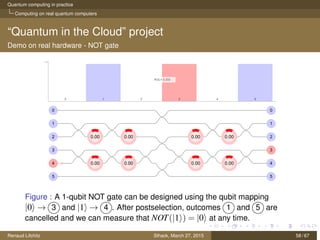
Demo on real hardware - NOT gate
Figure : A 1-qubit NOT gate can be designed using the qubit mapping
|0 → 3 and |1 → 4 . After postselection, outcomes 1 and 5 are
cancelled and we can measure that NOT(|1 ) = |0 at any time.
Renaud Lifchitz Sthack, March 27, 2015 58 / 67
Quantum computing in practice
Computing on real quantum computers
“Quantum in the Cloud” project
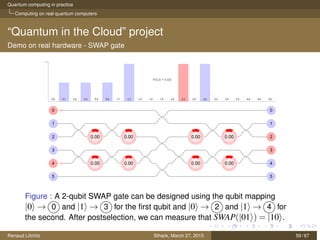
Demo on real hardware - SWAP gate
Figure : A 2-qubit SWAP gate can be designed using the qubit mapping
|0 → 0 and |1 → 3 for the first qubit and |0 → 2 and |1 → 4 for
the second. After postselection, we can measure that SWAP(|01 ) = |10 .
Renaud Lifchitz Sthack, March 27, 2015 59 / 67
Quantum computing in practice
Computing on real quantum computers
“Quantum in the Cloud” project
Demo on real hardware - Quantum adder with a mixed qubit
Figure : A 1-qubit+1-qubit adder can be designed using the CNOT gate and
its qubit mapping |0 → 1 and |1 → 2 for the first qubit (control qubit)
and |0 → 3 and |1 → 4 for the second (target qubit). A Π
2 -phase shifter
is used to mix the control qubit. After postselection, we can measure that
0+1 = 1 and 1+1 = 0 (outcomes 1,4 and 2,3 ), carry bit is dropped.
Renaud Lifchitz Sthack, March 27, 2015 60 / 67
Quantum computing in practice
Computing on real quantum computers
“
If quantum mechanics hasn’t profoundly shocked you,
you haven’t understood it yet.
”
Niels Bohr, Atomic Physics and Human Knowledge, 1958
Renaud Lifchitz Sthack, March 27, 2015 61 / 67
Quantum computing in practice
The future of cryptography: post-quantum cryptography
Section 8
The future of cryptography: post-quantum
cryptography
Renaud Lifchitz Sthack, March 27, 2015 62 / 67
Quantum computing in practice
The future of cryptography: post-quantum cryptography
Quantum Resistant Cryptography
Currently there are 6 main different approaches:
Lattice-based cryptography
Multivariate cryptography
Hash-based cryptography
Code-based cryptography
Supersingular Elliptic Curve Isogeny cryptography
Symmetric Key Quantum Resistance
Annual event about PQC: PQCrypto conference (6th edition this year)
Renaud Lifchitz Sthack, March 27, 2015 63 / 67
Quantum computing in practice
Conclusion
Section 9
Conclusion
Renaud Lifchitz Sthack, March 27, 2015 64 / 67
Quantum computing in practice
Conclusion
Results & challenges
Quantum computing provides a new approach to thinking &
computing
Main surprising results of the quantum mechanics theory have
been verified experimentally for decades now
A lot of progress has been made in building quantum systems
suitable for computations
Efforts are now focused on finding better qubits candidates
(decoherence time), enhancing scalability of quantum chips and
improving quantum error correction codes
Absolutely nothing prevents us to increase scalabity of quantum
computers
Current asymmetric cryptosystems will probably be broken in 10
to 25 years
Renaud Lifchitz Sthack, March 27, 2015 65 / 67
Quantum computing in practice
Conclusion
Bibliography
The age of the qubit - A new era of quantum information in
science and technology, IOP Institute of Physics, 2011.
Jonathan P. Dowling, Schr¨odinger’s Killer App - Race to Build the
World’s First Quantum Computer, CRC Press, 2013.
Noson S. Yanofsky & Mirco A. Mannucci, Quantum computing for
computer scientists, Cambridge University Press, 2008.
Tzvetan S. Metodi & Arvin I. Faruque & Frederic T. Chong,
Quantum computing for Computer Architects, Mark D. Hill - Series
Editor, Second Edition 2011.
Michael A. Nielsen & Isaac L. Chuang, Quantum Computation
and Quantum Information, Cambridge University Press, 10th
Anniversary Edition 2010.
Renaud Lifchitz Sthack, March 27, 2015 66 / 67
Quantum computing in practice
Conclusion
Thanks for your attention!
Any questions?
renaud.lifchitz@oppida.fr
Renaud Lifchitz Sthack, March 27, 2015 67 / 67

Sthack 2015 - Renaud "@nono2357" Lifchitz - Quantum computing in practice

  • 1.
    Quantum computing inpractice Quantum computing in practice & applications to cryptography Renaud Lifchitz OPPIDA Sthack, March 27, 2015 Renaud Lifchitz Sthack, March 27, 2015 1 / 67
  • 2.
    Quantum computing inpractice Speaker’s bio French senior security engineer working at Oppida (http://www.oppida.fr), France Main activities: Penetration testing & security audits Security research Security trainings Main interests: Security of protocols (authentication, cryptography, information leakage, zero-knowledge proofs...) Number theory (integer factorization, primality testing, elliptic curves...) Renaud Lifchitz Sthack, March 27, 2015 2 / 67
  • 3.
    Quantum computing inpractice Goals of this talk Introduce quantum physics basics to newcomers Give “state-of-the-art” results in quantum computing & cryptography Explain principles and basic blocks to build quantum circuits Give people ideas, tools and hardware access to practice quantum computing Renaud Lifchitz Sthack, March 27, 2015 3 / 67
  • 4.
    Quantum computing inpractice Outline 1 Basics of quantum computing 2 Quantum gates and circuits 3 Fundamental quantum algorithms 4 Attacks against cryptography 5 Quantum computing simulations & tools 6 Computing on adiabatic quantum computers 7 Computing on real quantum computers 8 The future of cryptography: post-quantum cryptography 9 Conclusion Renaud Lifchitz Sthack, March 27, 2015 4 / 67
  • 5.
    Quantum computing inpractice Basics of quantum computing Section 1 Basics of quantum computing Renaud Lifchitz Sthack, March 27, 2015 5 / 67
  • 6.
    Quantum computing inpractice Basics of quantum computing Quantum principles 1. Small-scale physical objects (atom, molecule, photon, electron, ...) both behave as particles and as waves during experiments (quantum duality principle) 2. Main characteristics of these objects (position, spin, polarization, ...) are not determined, have multiple values according to a probabilistic distribution (quantum superposition principle / Heisenberg’s uncertainty principle) 3. Further interaction or measurement will collapse this probability distribution into a single, steady state (quantum decoherence principle) 4. Consequently, copying a quantum state is not possible (no-cloning theorem) We can take advantage of the first 3 principles to do powerful non-classical computations Renaud Lifchitz Sthack, March 27, 2015 6 / 67
  • 7.
    Quantum computing inpractice Basics of quantum computing Quantum principles Figure : Position of an atom under quantum conditions across time, sometimes it is 100% determined, sometimes 50% - Image created by Thomas Fogarty, graduate student from University College Cork in Ireland Renaud Lifchitz Sthack, March 27, 2015 7 / 67
  • 8.
    Quantum computing inpractice Basics of quantum computing Recent quantum experiments Instant interaction of entangled qubits - EPR Paradox: Summer 2008, University of Geneva, Nicolas Gisin and his colleagues determined that the speed of the quantum interaction is at least 10000 times the speed of light using correlated photons at a 18-km distance (http://arxiv.org/abs/0808.3316) Quantum teleportation: September 2014, same team of scientists successfully achieved a 25-km quantum teleportation Renaud Lifchitz Sthack, March 27, 2015 8 / 67
  • 9.
    Quantum computing inpractice Basics of quantum computing Schr¨odinger’s cat though experiment Paradox, though experiment, designed by Austrian physicist Erwin Schr¨odinger in 1935 A cat, a bottle of poison, a radioactive source, and a radioactivity detector are placed in a sealed box If the detector detects radioactivity, the bottle is broken, killing the cat Until we open the box, the cat may be both alive AND dead! Renaud Lifchitz Sthack, March 27, 2015 9 / 67
  • 10.
    Quantum computing inpractice Basics of quantum computing Current freely available quantum systems Quantum number generator: Commercial ID Quantique “Quantis” provides 4 Mbits/s to 16 MBits/s of true quantum randomness: Online “Quantum Random Bit Generator” (QRBG121) service: http://random.irb.hr/ Quantum encryption system: Commercial ID Quantique “Cerberis” & “Centauris” allow Quantum Key Distribution (QKD) and encryption up to 100 Gbps and 100 km: Renaud Lifchitz Sthack, March 27, 2015 10 / 67
  • 11.
    Quantum computing inpractice Basics of quantum computing Quantum cryptography Unbreakable cryptography, even with a quantum computer Doesn’t rely on math problems we don’t know how to solve, but on laws of physics we can’t get around Uses QKD (Quantum Key Distribution) to exchange a symmetric key of the same size as the message (one-time pad) over a quantum channel (optical fiber for instance) The encrypted message is sent classically Interception is useless: the attacker will alter half of the key bits on average, and the receiver will detect the snooping thanks to quantum error correction codes Quantum Key Distribution networks exist in Geneva (Switzerland), Vienna (Austria), Massachusetts (USA), Tokyo (Japan) for banking or academic purposes Max distance is about 100 kms Renaud Lifchitz Sthack, March 27, 2015 11 / 67
  • 12.
    Quantum computing inpractice Basics of quantum computing Current coherence times of qubits Qubit type Coherence time Silicon nuclear spin 25 s. Trapped ion 15 s. Trapped neutral atom 10 s. Phosphorus in silicon 10 s. NMR molecule nuclear spin 2 s. Photon (infrared photon in optical fibre) 0.1 ms. Superconducting qubit 4 µs. Quantum dot 3 µs. Figure : Current sorted coherence times of qubits (source: Institute Of Physics Publishing 2011, U.K.) Renaud Lifchitz Sthack, March 27, 2015 12 / 67
  • 13.
    Quantum computing inpractice Quantum gates and circuits Section 2 Quantum gates and circuits Renaud Lifchitz Sthack, March 27, 2015 13 / 67
  • 14.
    Quantum computing inpractice Quantum gates and circuits Qubit representations Constant qubits 0 and 1 are represented as |0 and |1 They form a 2-dimension basis, e.g. |0 = 1 0 and |1 = 0 1 An arbitrary qubit q is a linear superposition of the basis states: |q = α|0 +β|1 = α β where α ∈ C, β ∈ C When q is measured, the real probability that its state is measured as |0 is |α|2 so |α|2 +|β|2 = 1 Combination of qubits forms a quantum register and can be done using the tensor product: |10 = |1 ⊗|0 =    0 0 1 0    First qubit of a combination is usually the most significant qubit of the quantum register A qubit can also be viewed as a unit vector within a sphere (Bloch sphere) Renaud Lifchitz Sthack, March 27, 2015 14 / 67
  • 15.
    Quantum computing inpractice Quantum gates and circuits Basics of quantum gates For thermodynamic reasons, a quantum gate must be reversible It follows that quantum gates have the same number of inputs and outputs A n-qubit quantum gate can be represented by a 2nx2n unitary matrix Applying a quantum gate to a qubit can be computed by multiplying the qubit vector by the operator matrix on the left Combination of quantum gates can be computed using the matrix product of their operator matrix In theory, quantum gates don’t use any energy nor give off any heat Renaud Lifchitz Sthack, March 27, 2015 15 / 67
  • 16.
    Quantum computing inpractice Quantum gates and circuits Pauli-X gate Pauli-X gate Number of qubits: 1 Symbol: Description: Quantum equivalent of a NOT gate. Rotates qubit around the X-axis by Π radians. X.X = I. Operator matrix: X = 0 1 1 0 Renaud Lifchitz Sthack, March 27, 2015 16 / 67
  • 17.
    Quantum computing inpractice Quantum gates and circuits Pauli-Y gate Pauli-Y gate Number of qubits: 1 Symbol: Description: Rotates qubit around the Y-axis by Π radians. Y.Y = I. Operator matrix: Y = 0 −i i 0 Renaud Lifchitz Sthack, March 27, 2015 17 / 67
  • 18.
    Quantum computing inpractice Quantum gates and circuits Pauli-Z gate Pauli-Z gate Number of qubits: 1 Symbol: Description: Rotates qubit around the Z-axis by Π radians. Z.Z = I. Operator matrix: Z = 1 0 0 −1 Renaud Lifchitz Sthack, March 27, 2015 18 / 67
  • 19.
    Quantum computing inpractice Quantum gates and circuits Hadamard gate Hadamard gate Number of qubits: 1 Symbol: Description: Mixes qubit into an equal superposition of |0 and |1 . Operator matrix: H = 1√ 2 1 1 1 −1 Renaud Lifchitz Sthack, March 27, 2015 19 / 67
  • 20.
    Quantum computing inpractice Quantum gates and circuits Hadamard gate The Hadamard gate is a special transform mapping the qubit-basis states |0 and |1 to two superposition states with “50/50” weight of the computational basis states |0 and |1 : H.|0 = 1√ 2 |0 + 1√ 2 |1 H.|1 = 1√ 2 |0 − 1√ 2 |1 For this reason, it is widely used for the first step of a quantum algorithm to work on all possible input values in parallel Renaud Lifchitz Sthack, March 27, 2015 20 / 67
  • 21.
    Quantum computing inpractice Quantum gates and circuits CNOT gate CNOT gate Number of qubits: 2 Symbol: Description: Controlled NOT gate. First qubit is control qubit, second is target qubit. Leaves control qubit unchanged and flips target qubit if control qubit is true. Operator matrix: CNOT =     1 0 0 0 0 1 0 0 0 0 0 1 0 0 1 0     Renaud Lifchitz Sthack, March 27, 2015 21 / 67
  • 22.
    Quantum computing inpractice Quantum gates and circuits SWAP gate SWAP gate Number of qubits: 2 Symbol: Description: Swaps the 2 input qubits. Operator matrix: SWAP =     1 0 0 0 0 0 1 0 0 1 0 0 0 0 0 1     Renaud Lifchitz Sthack, March 27, 2015 22 / 67
  • 23.
    Quantum computing inpractice Quantum gates and circuits Phase shift gate Phase shift gate Number of qubits: 1 Symbol: Description: Family of gates that leave the basis state |0 unchanged and map |1 to eiθ|1 . Operator matrix: Rθ = 1 0 0 eiθ Renaud Lifchitz Sthack, March 27, 2015 23 / 67
  • 24.
    Quantum computing inpractice Quantum gates and circuits Toffoli gate Toffoli gate Number of qubits: 3 Symbol: Description: Controlled-Controlled-NOT gate. First 2 qubits are control qubits, third one is target qubit. Leaves control qubits unchanged and flips target qubit if both control qubits are true. Operator matrix: CCNOT =             1 0 0 0 0 0 0 0 0 1 0 0 0 0 0 0 0 0 1 0 0 0 0 0 0 0 0 1 0 0 0 0 0 0 0 0 1 0 0 0 0 0 0 0 0 1 0 0 0 0 0 0 0 0 0 1 0 0 0 0 0 0 1 0             Renaud Lifchitz Sthack, March 27, 2015 24 / 67
  • 25.
    Quantum computing inpractice Quantum gates and circuits Universal gates A set of quantum gates is called universal if any classical logic operation can be made with only this set of gates. Examples of universal sets of gates: Hadamard gate, Phase shift gate (with θ = Π 4 and θ = Π 2 ) and Controlled NOT gate Toffoli gate only Renaud Lifchitz Sthack, March 27, 2015 25 / 67
  • 26.
    Quantum computing inpractice Quantum gates and circuits Circuit designing challenges Qubits and qubit registers cannot be copied in any way In simulation like in reality, number of used qubits must be limited (qubit reuse wherever possible) Qubit registers shifts are costly, moving gates “reading heads” is somehow easier In reality, quantum error codes should be used to avoid partial decoherence during computation Renaud Lifchitz Sthack, March 27, 2015 26 / 67
  • 27.
    Quantum computing inpractice Fundamental quantum algorithms Section 3 Fundamental quantum algorithms Renaud Lifchitz Sthack, March 27, 2015 27 / 67
  • 28.
    Quantum computing inpractice Fundamental quantum algorithms Grover’s algorithm Pure quantum algorithm for searching among N unsorted values Complexity: O( √ N) operations and O(logN) storage place Probabilistic, iterating and optimal algorithm Renaud Lifchitz Sthack, March 27, 2015 28 / 67
  • 29.
    Quantum computing inpractice Fundamental quantum algorithms Quantum Fourier Transform (QFT) algorithm Quantum equivalent to the classical discrete Fourier Transform algorithm Finds periods in the input superposition Only requires O(n2) Hadamard gates and controlled phase shift gates, where n is the number of qubits Renaud Lifchitz Sthack, March 27, 2015 29 / 67
  • 30.
    Quantum computing inpractice Fundamental quantum algorithms Shor’s algorithm Pure quantum algorithm for integer factorization that runs in polynomial time formulated in 1994 Complexity: O((logN)3) operations and storage place Probabilistic algorithm that basically finds the period of the sequence ak mod N and non-trivial square roots of unity mod N Uses QFT Some steps are performed on a classical computer Renaud Lifchitz Sthack, March 27, 2015 30 / 67
  • 31.
    Quantum computing inpractice Attacks against cryptography Section 4 Attacks against cryptography Renaud Lifchitz Sthack, March 27, 2015 31 / 67
  • 32.
    Quantum computing inpractice Attacks against cryptography Breaking asymmetric cryptography Most asymmetric cryptosystems rely on the integer factorization difficulty Shor’s algorithm is able to factor integers efficiently and similar algorithms exist for solving discrete logarithms RSA and Diffie–Hellman key exchange are quite easily broken HTTPS, SSL, SSH, VPNs and certificates security will be seriously threatened Current records are RSA factorization of 21 in October 2012 (real quantum computation), and factorization of 143 in April 2012 (adiabatic quantum computation). Renaud Lifchitz Sthack, March 27, 2015 32 / 67
  • 33.
    Quantum computing inpractice Attacks against cryptography Breaking symmetric cryptography It is possible to test multiple symmetric keys in parallel with a quantum algorithm More precisely, using Grover’s algorithm, we can test N keys in√ N steps This divides at least all current keylength strengths by 2 Renaud Lifchitz Sthack, March 27, 2015 33 / 67
  • 34.
    Quantum computing inpractice Attacks against cryptography The new RSA-2048 challenge Renaud Lifchitz Sthack, March 27, 2015 34 / 67
  • 35.
    Quantum computing inpractice Quantum computing simulations & tools Section 5 Quantum computing simulations & tools Renaud Lifchitz Sthack, March 27, 2015 35 / 67
  • 36.
    Quantum computing inpractice Quantum computing simulations & tools Quantum Circuit Simulator (Android) Figure : Design and simulation of a qubit entanglement circuit. Those 2 qubits can interact instantly at any distance according to the nonlocality principle. Renaud Lifchitz Sthack, March 27, 2015 36 / 67
  • 37.
    Quantum computing inpractice Quantum computing simulations & tools QCL Figure : Shor’s algorithm running in QCL (http://tph.tuwien.ac.at/˜oemer/qcl.html) Renaud Lifchitz Sthack, March 27, 2015 37 / 67
  • 38.
    Quantum computing inpractice Quantum computing simulations & tools Python & Sympy Figure : Simple 1-qubit adder with Sympy (http://docs.sympy.org/dev/modules/physics/quantum/) Renaud Lifchitz Sthack, March 27, 2015 38 / 67
  • 39.
    Quantum computing inpractice Quantum computing simulations & tools Python & Sympy Figure : A quantum CRC-8 circuit with only CNOT gates Renaud Lifchitz Sthack, March 27, 2015 39 / 67
  • 40.
    Quantum computing inpractice Quantum computing simulations & tools Quantum Computing Playground (Web) Figure : QFT on http://www.quantumplayground.net/ Renaud Lifchitz Sthack, March 27, 2015 40 / 67
  • 41.
    Quantum computing inpractice Quantum computing simulations & tools Quantum Circuit Simulator (Web) by Davy Wybiral Figure : Simple 1-qubit adder on http://www.davyw.com/quantum/ Renaud Lifchitz Sthack, March 27, 2015 41 / 67
  • 42.
    Quantum computing inpractice Computing on adiabatic quantum computers Section 6 Computing on adiabatic quantum computers Renaud Lifchitz Sthack, March 27, 2015 42 / 67
  • 43.
    Quantum computing inpractice Computing on adiabatic quantum computers D-Wave adiabatic computers D-Wave is a Canadian quantum computing company They have built some controversial quantum computers, D-Wave One & D-Wave Two D-Wave computers have been sold to Lockeed Martin and Google (shared with Nasa) for 10-15 million US dollars They plan to double their qubit capacity every year in the next decade Renaud Lifchitz Sthack, March 27, 2015 43 / 67
  • 44.
    Quantum computing inpractice Computing on adiabatic quantum computers Figure : Latest D-Wave “Washington” 2048-qubit chip Renaud Lifchitz Sthack, March 27, 2015 44 / 67
  • 45.
    Quantum computing inpractice Computing on adiabatic quantum computers How do they work? Probabilistic, iterating & convergent system A quantum state represents the solutions to the problem An ordinary computer will measure and rank a solution with the problem generating function G and influences the quantum state The quantum state will converge to a pretty good solution thanks to its thermal equilibrium and the Boltzmann probability distribution: P(x1,x2,...,xN) = 1 Z e−G(x1,x2,...,xN)/kT with Z = N ∑ k=1 ∑ xk=0,1 e−G(x1,x2,...,xN)/kT I was able to factor the RSA integer 1609337 (21 bits) in 1 minute using a home-made simulation model framework (no noise). Renaud Lifchitz Sthack, March 27, 2015 45 / 67
  • 46.
    Quantum computing inpractice Computing on adiabatic quantum computers Current limitations Limited to optimization problems Limited to problems with solutions you can rank Personal opinion: better when generating function is everywhere continuous and differentiable (not the case with discrete problems like factorization) In conclusion, adiabatic computers are specific and need to be more peer-reviewed and extensively tested to prove their real advantage. Renaud Lifchitz Sthack, March 27, 2015 46 / 67
  • 47.
    Quantum computing inpractice Computing on real quantum computers Section 7 Computing on real quantum computers Renaud Lifchitz Sthack, March 27, 2015 47 / 67
  • 48.
    Quantum computing inpractice Computing on real quantum computers “Quantum in the Cloud” project Project of the University of Bristol (U.K.), Centre for Quantum Photonics Full, universal, quantum computer Remote access (JSON/HTTP) to a 2-qubit photonic chip available upon request, 4-qubit chip available for local researchers Online chip simulator available for training Homepage: http://www.bristol.ac.uk/physics/research/quantum/qcloud/ Renaud Lifchitz Sthack, March 27, 2015 48 / 67
  • 49.
    Quantum computing inpractice Computing on real quantum computers “Quantum in the Cloud” project Figure : An optoelectronic quantum chip from Bristol Centre for Quantum Photonics Renaud Lifchitz Sthack, March 27, 2015 49 / 67
  • 50.
    Quantum computing inpractice Computing on real quantum computers “Quantum in the Cloud” project Parts of the chips Representation Description Photon input path: The beginning of a fiber path where you can inject photons Photon output path: The end of a fiber path where you can detect photons Photon beam splitter: A device which lets a certain fraction of light pass through it, while the rest of the light is reflected from the surface. All of the beam splitters on the CNOT-MZ chip are “50/50” beam splitters, apart from the three down the middle, which let 2/3 of the light pass through them Photon phase changer: A variable phase changer in Π radians varying from 0 to 2. In reality, a little heater that changes speed of photons. Renaud Lifchitz Sthack, March 27, 2015 50 / 67
  • 51.
    Quantum computing inpractice Computing on real quantum computers “Quantum in the Cloud” project Classical vs. Quantum Interference (1/3) Figure : 1 input photon - classical & quantum interference: the photon will be detected on any detector with a “50/50” probability Renaud Lifchitz Sthack, March 27, 2015 51 / 67
  • 52.
    Quantum computing inpractice Computing on real quantum computers “Quantum in the Cloud” project Classical vs. Quantum Interference (2/3) Figure : 2 input photons - classical interference: half of the time, each detector clicks once. The other half of the time, one of the detectors clicks twice (split equally between this happening at detector 1 and detector 0) Renaud Lifchitz Sthack, March 27, 2015 52 / 67
  • 53.
    Quantum computing inpractice Computing on real quantum computers “Quantum in the Cloud” project Classical vs. Quantum Interference (3/3) Figure : 2 input photons - quantum interference: Both photons will “cooperate” and will always end up in the same path, causing one of the detectors to click twice. This is a purely quantum mechanical effect. Renaud Lifchitz Sthack, March 27, 2015 53 / 67
  • 54.
    Quantum computing inpractice Computing on real quantum computers “Quantum in the Cloud” project The CNOT-MZ chip 6 injection paths for a maximum of 4 photons 13 beam splitters 8 variable phase shifters Renaud Lifchitz Sthack, March 27, 2015 54 / 67
  • 55.
    Quantum computing inpractice Computing on real quantum computers “Quantum in the Cloud” project Postselection step After each experiment, some outcomes must be cancelled as their probability is not real Postselection is the act of restricting outcomes of a process or experiment, based on certain conditions being satisfied As each input qubit is coded with 2 input paths, output paths must correspond Outcomes with non-corresponding output paths are cancelled Renaud Lifchitz Sthack, March 27, 2015 55 / 67
  • 56.
    Quantum computing inpractice Computing on real quantum computers “Quantum in the Cloud” project Designing reversible logic gates with the CNOT-MZ chip I have computed a set of possibilities for possible paths for some 1-qubit and 2-qubit gates: q1 f 0 1 id 0 1 NOT 3 4 Figure : 1-qubit gates q1 q2 f 0 1 0 1 id 0 1 2 5 SWAP 0 3 2 4 CNOT 1 2 3 4 CMP 0 1 3 4 Figure : 2-qubit gates Renaud Lifchitz Sthack, March 27, 2015 56 / 67
  • 57.
    Quantum computing inpractice Computing on real quantum computers “Quantum in the Cloud” project Demo on real hardware NOT gate SWAP gate Quantum adder with a mixed qubit Renaud Lifchitz Sthack, March 27, 2015 57 / 67
  • 58.
    Quantum computing inpractice Computing on real quantum computers “Quantum in the Cloud” project Demo on real hardware - NOT gate Figure : A 1-qubit NOT gate can be designed using the qubit mapping |0 → 3 and |1 → 4 . After postselection, outcomes 1 and 5 are cancelled and we can measure that NOT(|1 ) = |0 at any time. Renaud Lifchitz Sthack, March 27, 2015 58 / 67
  • 59.
    Quantum computing inpractice Computing on real quantum computers “Quantum in the Cloud” project Demo on real hardware - SWAP gate Figure : A 2-qubit SWAP gate can be designed using the qubit mapping |0 → 0 and |1 → 3 for the first qubit and |0 → 2 and |1 → 4 for the second. After postselection, we can measure that SWAP(|01 ) = |10 . Renaud Lifchitz Sthack, March 27, 2015 59 / 67
  • 60.
    Quantum computing inpractice Computing on real quantum computers “Quantum in the Cloud” project Demo on real hardware - Quantum adder with a mixed qubit Figure : A 1-qubit+1-qubit adder can be designed using the CNOT gate and its qubit mapping |0 → 1 and |1 → 2 for the first qubit (control qubit) and |0 → 3 and |1 → 4 for the second (target qubit). A Π 2 -phase shifter is used to mix the control qubit. After postselection, we can measure that 0+1 = 1 and 1+1 = 0 (outcomes 1,4 and 2,3 ), carry bit is dropped. Renaud Lifchitz Sthack, March 27, 2015 60 / 67
  • 61.
    Quantum computing inpractice Computing on real quantum computers “ If quantum mechanics hasn’t profoundly shocked you, you haven’t understood it yet. ” Niels Bohr, Atomic Physics and Human Knowledge, 1958 Renaud Lifchitz Sthack, March 27, 2015 61 / 67
  • 62.
    Quantum computing inpractice The future of cryptography: post-quantum cryptography Section 8 The future of cryptography: post-quantum cryptography Renaud Lifchitz Sthack, March 27, 2015 62 / 67
  • 63.
    Quantum computing inpractice The future of cryptography: post-quantum cryptography Quantum Resistant Cryptography Currently there are 6 main different approaches: Lattice-based cryptography Multivariate cryptography Hash-based cryptography Code-based cryptography Supersingular Elliptic Curve Isogeny cryptography Symmetric Key Quantum Resistance Annual event about PQC: PQCrypto conference (6th edition this year) Renaud Lifchitz Sthack, March 27, 2015 63 / 67
  • 64.
    Quantum computing inpractice Conclusion Section 9 Conclusion Renaud Lifchitz Sthack, March 27, 2015 64 / 67
  • 65.
    Quantum computing inpractice Conclusion Results & challenges Quantum computing provides a new approach to thinking & computing Main surprising results of the quantum mechanics theory have been verified experimentally for decades now A lot of progress has been made in building quantum systems suitable for computations Efforts are now focused on finding better qubits candidates (decoherence time), enhancing scalability of quantum chips and improving quantum error correction codes Absolutely nothing prevents us to increase scalabity of quantum computers Current asymmetric cryptosystems will probably be broken in 10 to 25 years Renaud Lifchitz Sthack, March 27, 2015 65 / 67
  • 66.
    Quantum computing inpractice Conclusion Bibliography The age of the qubit - A new era of quantum information in science and technology, IOP Institute of Physics, 2011. Jonathan P. Dowling, Schr¨odinger’s Killer App - Race to Build the World’s First Quantum Computer, CRC Press, 2013. Noson S. Yanofsky & Mirco A. Mannucci, Quantum computing for computer scientists, Cambridge University Press, 2008. Tzvetan S. Metodi & Arvin I. Faruque & Frederic T. Chong, Quantum computing for Computer Architects, Mark D. Hill - Series Editor, Second Edition 2011. Michael A. Nielsen & Isaac L. Chuang, Quantum Computation and Quantum Information, Cambridge University Press, 10th Anniversary Edition 2010. Renaud Lifchitz Sthack, March 27, 2015 66 / 67
  • 67.
    Quantum computing inpractice Conclusion Thanks for your attention! Any questions? renaud.lifchitz@oppida.fr Renaud Lifchitz Sthack, March 27, 2015 67 / 67