1
Tim Ellison
Senior Technical Staff Member
IBM Hursley Laboratories
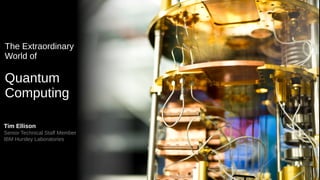
The Extraordinary
World of
Quantum
Computing
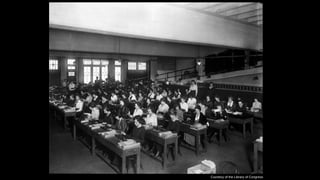
Courtesy of the Library of Congress
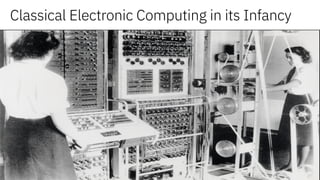
Classical Electronic Computing in its Infancy
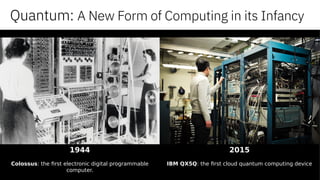
Quantum: A New Form of Computing in its Infancy
1944
Colossus: the first electronic digital programmable
computer.
2015
IBM QX5Q: the first cloud quantum computing device
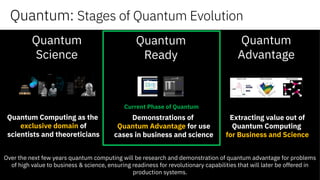
Quantum Computing as the
exclusive domain of
scientists and theoreticians
Quantum
Science
Demonstrations of
Quantum Advantage for use
cases in business and science
Quantum
Ready
Extracting value out of
Quantum Computing
for Business and Science
Quantum
Advantage
Reaction rates Reaction pathways Moleculegeometry
Over the next few years quantum computing will be research and demonstration of quantum advantage for problems
of high value to business & science, ensuring readiness for revolutionary capabilities that will later be offered in
production systems.
Current Phase of Quantum
Quantum: Stages of Quantum Evolution
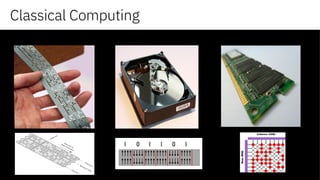
Classical Computing
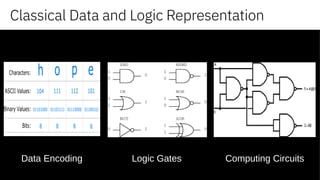
Classical Data and Logic Representation
Data Encoding Logic Gates Computing Circuits
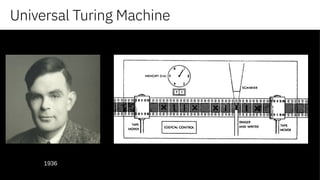
Universal Turing Machine
1936
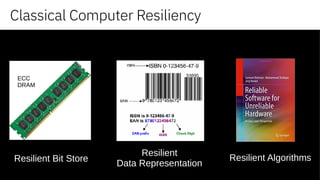
Classical Computer Resiliency
ECC
DRAM
Resilient Bit Store
Resilient
Data Representation
Resilient Algorithms
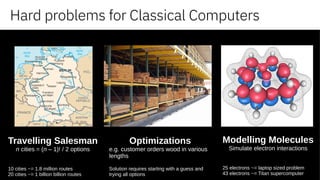
Hard problems for Classical Computers
Travelling Salesman
n cities = (n – 1)! / 2 options
10 cities ~= 1.8 million routes
20 cities ~= 1 billion billion routes
Optimizations
e.g. customer orders wood in various
lengths
Solution requires starting with a guess and
trying all options
Modelling Molecules
Simulate electron interactions
25 electrons ~= laptop sized problem
43 electrons ~= Titan supercomputer
General Hard Problem
80 20 8 73 65 54 39 74 30 4 93 67 79 77 12 10 38 51 88 50 56 5 ...
Find an element matching a value in an unordered set.
boolean found = element[x] == 74;
e.g. java.lang.String#indexof(char)
Best case:
Characters compared = 1
Worst case:
Characters compared = length
Average case:
Characters compared = length / 2
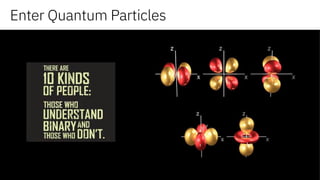
Enter Quantum Particles
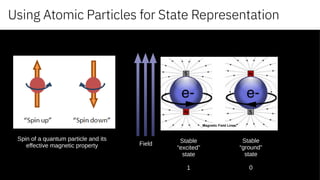
Using Atomic Particles for State Representation
Stable
“excited”
state
1
Stable
“ground”
state
0
Field
Spin of a quantum particle and its
effective magnetic property
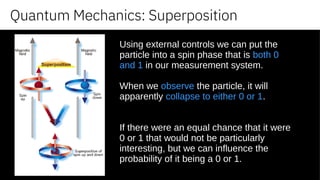
Quantum Mechanics: Superposition
Using external controls we can put the
particle into a spin phase that is both 0
and 1 in our measurement system.
When we observe the particle, it will
apparently collapse to either 0 or 1.
If there were an equal chance that it were
0 or 1 that would not be particularly
interesting, but we can influence the
probability of it being a 0 or 1.
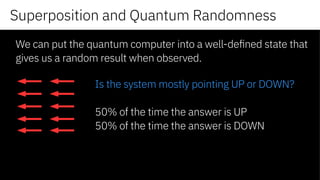
Superposition and Quantum Randomness
We can put the quantum computer into a well-defined state that
gives us a random result when observed.
Is the system mostly pointing UP or DOWN?
50% of the time the answer is UP
50% of the time the answer is DOWN
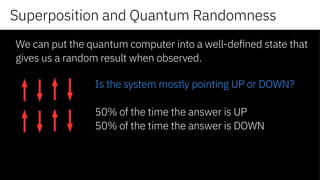
Superposition and Quantum Randomness
We can put the quantum computer into a well-defined state that
gives us a random result when observed.
Is the system mostly pointing UP or DOWN?
50% of the time the answer is UP
50% of the time the answer is DOWN
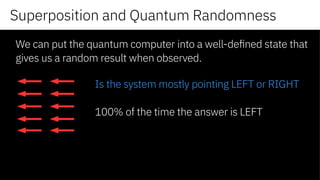
Superposition and Quantum Randomness
We can put the quantum computer into a well-defined state that
gives us a random result when observed.
Is the system mostly pointing LEFT or RIGHT
100% of the time the answer is LEFT
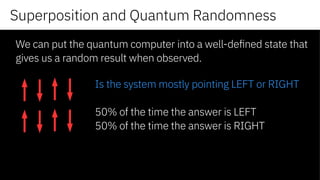
Superposition and Quantum Randomness
We can put the quantum computer into a well-defined state that
gives us a random result when observed.
Is the system mostly pointing LEFT or RIGHT
50% of the time the answer is LEFT
50% of the time the answer is RIGHT
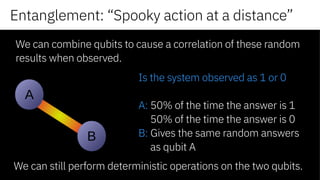
Entanglement: “Spooky action at a distance”
We can combine qubits to cause a correlation of these random
results when observed.
Is the system observed as 1 or 0
A: 50% of the time the answer is 1
50% of the time the answer is 0
B: Gives the same random answers
as qubit A
B
A
We can still perform deterministic operations on the two qubits.
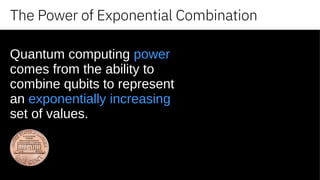
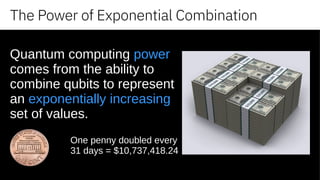
The Power of Exponential Combination
Quantum computing power
comes from the ability to
combine qubits to represent
an exponentially increasing
set of values.
The Power of Exponential Combination
Quantum computing power
comes from the ability to
combine qubits to represent
an exponentially increasing
set of values.
One penny doubled every
31 days = $10,737,418.24
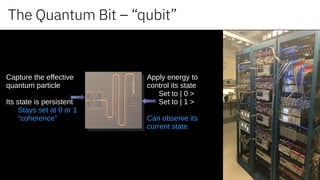
The Quantum Bit – “qubit”
Capture the effective
quantum particle
Its state is persistent
Stays set at 0 or 1
“coherence”
Apply energy to
control its state
Set to | 0 >
Set to | 1 >
Can observe its
current state
+
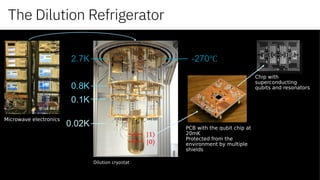
Chip with
superconducting
qubits and resonators
PCB with the qubit chip at
20mK
Protected from the
environment by multiple
shields
Microwave electronics
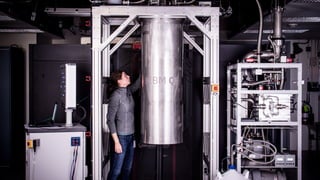
The Dilution Refrigerator
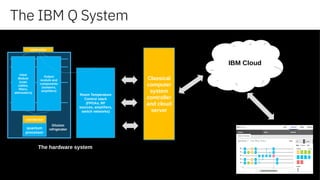
quantum
processor
connector
Input
Module
(coax
cables,
filters,
attenuators)
Output
module and
components
(isolators,
amplifiers)
Room Temperature
Control stack
(FPGAs, RF
sources, amplifiers,
switch networks)
connector
The hardware system
Dilution
refrigerator
Classical
computer
system
controller
and cloud
server
IBM Cloud
The IBM Q System
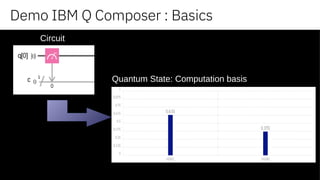
Demo IBM Q Composer : Basics
Circuit
Quantum State: Computation basis
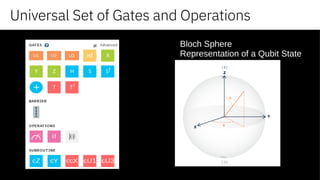
Universal Set of Gates and Operations
Bloch Sphere
Representation of a Qubit State
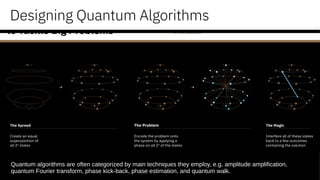
Designing Quantum Algorithms
Quantum algorithms are often categorized by main techniques they employ, e.g. amplitude amplification,
quantum Fourier transform, phase kick-back, phase estimation, and quantum walk.
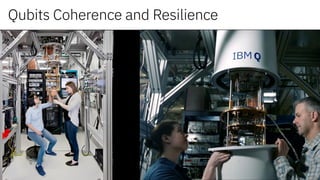
Qubits Coherence and Resilience
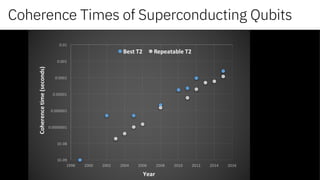
Coherence Times of Superconducting Qubits
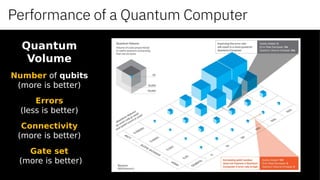
Quantum
Volume
Number of qubits
(more is better)
Errors
(less is better)
Connectivity
(more is better)
Gate set
(more is better)
Performance of a Quantum Computer
33
reaction ratesmolecular structure
Sign problem: Monte-Carlo simulations of fermions are NP-hard [Troyer &Wiese, PRL 170201 (2015)]
Solving interacting fermionic problems is at the core of most challenges in computational
physics and high-performance computing:
What can quantum computers do?
Map fermions (electrons) to qubits and compute
First Demonstrations:
144 pauli terms, 36 sets
A. Kandala, et al. Nature 549 (2017)
Quantum Chemistry: The Problem
34
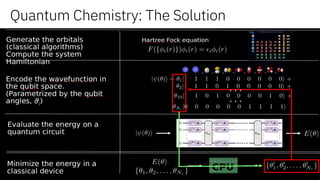
Quantum Chemistry: The Solution
Grover's Algorithm
80 20 8 73 65 54 39 74 30 4 93 67 79 77 12 10 38 51 88 50 56 5 ...
Find an element matching a value in an unordered set.
boolean found = element[x] == 74;
“oracle”
Revisit: search unordered set of values
Pseudo-code
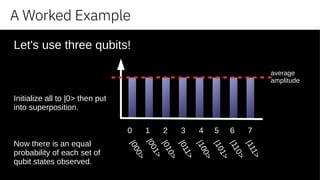
- put qubits into superposition of all 2n states, with equal amplitude and equal probability,
- amplify the answer based upon our “oracle” function,
- expect the answer to form observed resulting state with highest probability.
A Worked Example
Let's use three qubits!
0 1 2 3 4 5 6 7
average
amplitude
|000>
|001>
|010>
|011>
|100>
|101>
|110>
|111>
Now there is an equal
probability of each set of
qubit states observed.
Initialize all to |0> then put
into superposition.
A Worked Example
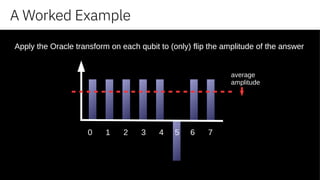
Apply the Oracle transform on each qubit to (only) flip the amplitude of the answer
0 1 2 3 4 5 6 7
average
amplitude
Apply the Oracle transform on each qubit to (only) flip the amplitude of the answer
A Worked Example
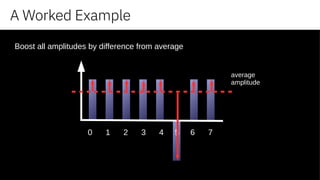
Boost all amplitudes by difference from average
0 1 2 3 4 5 6 7
average
amplitude
A Worked Example
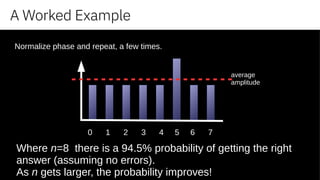
Normalize phase and repeat, a few times.
0 1 2 3 4 5 6 7
average
amplitude
Where n=8 there is a 94.5% probability of getting the right
answer (assuming no errors).
As n gets larger, the probability improves!
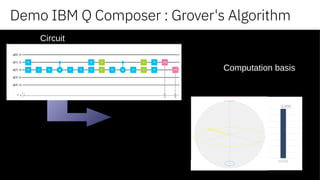
Demo IBM Q Composer : Grover's Algorithm
Circuit
Sphere Computation basis
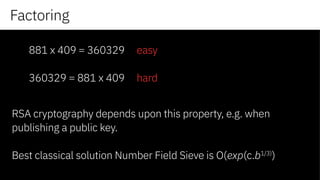
Factoring
881 x 409 = 360329 easy
360329 = 881 x 409 hard
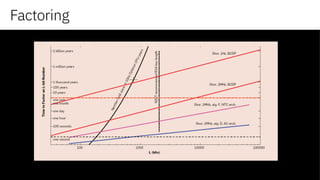
RSA cryptography depends upon this property, e.g. when
publishing a public key.
Best classical solution Number Field Sieve is O(exp(c.b1/3)
)
Factoring
A New Computing Stack
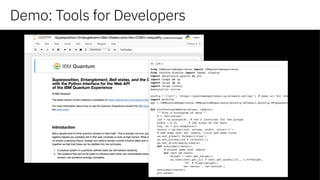
Demo: Tools for Developers
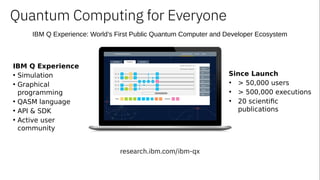
Since Launch
• > 50,000 users
• > 500,000 executions
• 20 scientific
publications
IBM Q Experience
• Simulation
• Graphical
programming
• QASM language
• API & SDK
• Active user
community
IBM Q Experience: World’s First Public Quantum Computer and Developer Ecosystem
Quantum Computing for Everyone
The Extraordinary World of Quantum Computing

The Extraordinary World of Quantum Computing

  • 1.
    1 Tim Ellison Senior TechnicalStaff Member IBM Hursley Laboratories The Extraordinary World of Quantum Computing
  • 2.
    Courtesy of theLibrary of Congress
  • 3.
  • 4.
    Quantum: A NewForm of Computing in its Infancy 1944 Colossus: the first electronic digital programmable computer. 2015 IBM QX5Q: the first cloud quantum computing device
  • 5.
    Quantum Computing asthe exclusive domain of scientists and theoreticians Quantum Science Demonstrations of Quantum Advantage for use cases in business and science Quantum Ready Extracting value out of Quantum Computing for Business and Science Quantum Advantage Reaction rates Reaction pathways Moleculegeometry Over the next few years quantum computing will be research and demonstration of quantum advantage for problems of high value to business & science, ensuring readiness for revolutionary capabilities that will later be offered in production systems. Current Phase of Quantum Quantum: Stages of Quantum Evolution
  • 7.
  • 8.
    Classical Data andLogic Representation Data Encoding Logic Gates Computing Circuits
  • 9.
  • 10.
    Classical Computer Resiliency ECC DRAM ResilientBit Store Resilient Data Representation Resilient Algorithms
  • 11.
    Hard problems forClassical Computers Travelling Salesman n cities = (n – 1)! / 2 options 10 cities ~= 1.8 million routes 20 cities ~= 1 billion billion routes Optimizations e.g. customer orders wood in various lengths Solution requires starting with a guess and trying all options Modelling Molecules Simulate electron interactions 25 electrons ~= laptop sized problem 43 electrons ~= Titan supercomputer
  • 12.
    General Hard Problem 8020 8 73 65 54 39 74 30 4 93 67 79 77 12 10 38 51 88 50 56 5 ... Find an element matching a value in an unordered set. boolean found = element[x] == 74; e.g. java.lang.String#indexof(char) Best case: Characters compared = 1 Worst case: Characters compared = length Average case: Characters compared = length / 2
  • 13.
  • 14.
    Using Atomic Particlesfor State Representation Stable “excited” state 1 Stable “ground” state 0 Field Spin of a quantum particle and its effective magnetic property
  • 15.
    Quantum Mechanics: Superposition Usingexternal controls we can put the particle into a spin phase that is both 0 and 1 in our measurement system. When we observe the particle, it will apparently collapse to either 0 or 1. If there were an equal chance that it were 0 or 1 that would not be particularly interesting, but we can influence the probability of it being a 0 or 1.
  • 16.
    Superposition and QuantumRandomness We can put the quantum computer into a well-defined state that gives us a random result when observed. Is the system mostly pointing UP or DOWN? 50% of the time the answer is UP 50% of the time the answer is DOWN
  • 17.
    Superposition and QuantumRandomness We can put the quantum computer into a well-defined state that gives us a random result when observed. Is the system mostly pointing UP or DOWN? 50% of the time the answer is UP 50% of the time the answer is DOWN
  • 18.
    Superposition and QuantumRandomness We can put the quantum computer into a well-defined state that gives us a random result when observed. Is the system mostly pointing LEFT or RIGHT 100% of the time the answer is LEFT
  • 19.
    Superposition and QuantumRandomness We can put the quantum computer into a well-defined state that gives us a random result when observed. Is the system mostly pointing LEFT or RIGHT 50% of the time the answer is LEFT 50% of the time the answer is RIGHT
  • 20.
    Entanglement: “Spooky actionat a distance” We can combine qubits to cause a correlation of these random results when observed. Is the system observed as 1 or 0 A: 50% of the time the answer is 1 50% of the time the answer is 0 B: Gives the same random answers as qubit A B A We can still perform deterministic operations on the two qubits.
  • 21.
    The Power ofExponential Combination Quantum computing power comes from the ability to combine qubits to represent an exponentially increasing set of values.
  • 22.
    The Power ofExponential Combination Quantum computing power comes from the ability to combine qubits to represent an exponentially increasing set of values. One penny doubled every 31 days = $10,737,418.24
  • 23.
    The Quantum Bit– “qubit” Capture the effective quantum particle Its state is persistent Stays set at 0 or 1 “coherence” Apply energy to control its state Set to | 0 > Set to | 1 > Can observe its current state
  • 24.
    + Chip with superconducting qubits andresonators PCB with the qubit chip at 20mK Protected from the environment by multiple shields Microwave electronics The Dilution Refrigerator
  • 25.
    quantum processor connector Input Module (coax cables, filters, attenuators) Output module and components (isolators, amplifiers) Room Temperature Controlstack (FPGAs, RF sources, amplifiers, switch networks) connector The hardware system Dilution refrigerator Classical computer system controller and cloud server IBM Cloud The IBM Q System
  • 26.
    Demo IBM QComposer : Basics Circuit Quantum State: Computation basis
  • 27.
    Universal Set ofGates and Operations Bloch Sphere Representation of a Qubit State
  • 28.
    Designing Quantum Algorithms Quantumalgorithms are often categorized by main techniques they employ, e.g. amplitude amplification, quantum Fourier transform, phase kick-back, phase estimation, and quantum walk.
  • 29.
  • 30.
    Coherence Times ofSuperconducting Qubits
  • 31.
    Quantum Volume Number of qubits (moreis better) Errors (less is better) Connectivity (more is better) Gate set (more is better) Performance of a Quantum Computer
  • 33.
    33 reaction ratesmolecular structure Signproblem: Monte-Carlo simulations of fermions are NP-hard [Troyer &Wiese, PRL 170201 (2015)] Solving interacting fermionic problems is at the core of most challenges in computational physics and high-performance computing: What can quantum computers do? Map fermions (electrons) to qubits and compute First Demonstrations: 144 pauli terms, 36 sets A. Kandala, et al. Nature 549 (2017) Quantum Chemistry: The Problem
  • 34.
  • 35.
    Grover's Algorithm 80 208 73 65 54 39 74 30 4 93 67 79 77 12 10 38 51 88 50 56 5 ... Find an element matching a value in an unordered set. boolean found = element[x] == 74; “oracle” Revisit: search unordered set of values Pseudo-code - put qubits into superposition of all 2n states, with equal amplitude and equal probability, - amplify the answer based upon our “oracle” function, - expect the answer to form observed resulting state with highest probability.
  • 36.
    A Worked Example Let'suse three qubits! 0 1 2 3 4 5 6 7 average amplitude |000> |001> |010> |011> |100> |101> |110> |111> Now there is an equal probability of each set of qubit states observed. Initialize all to |0> then put into superposition.
  • 37.
    A Worked Example Applythe Oracle transform on each qubit to (only) flip the amplitude of the answer 0 1 2 3 4 5 6 7 average amplitude Apply the Oracle transform on each qubit to (only) flip the amplitude of the answer
  • 38.
    A Worked Example Boostall amplitudes by difference from average 0 1 2 3 4 5 6 7 average amplitude
  • 39.
    A Worked Example Normalizephase and repeat, a few times. 0 1 2 3 4 5 6 7 average amplitude Where n=8 there is a 94.5% probability of getting the right answer (assuming no errors). As n gets larger, the probability improves!
  • 40.
    Demo IBM QComposer : Grover's Algorithm Circuit Sphere Computation basis
  • 41.
    Factoring 881 x 409= 360329 easy 360329 = 881 x 409 hard RSA cryptography depends upon this property, e.g. when publishing a public key. Best classical solution Number Field Sieve is O(exp(c.b1/3) )
  • 42.
  • 43.
  • 44.
    Demo: Tools forDevelopers
  • 45.
    Since Launch • >50,000 users • > 500,000 executions • 20 scientific publications IBM Q Experience • Simulation • Graphical programming • QASM language • API & SDK • Active user community IBM Q Experience: World’s First Public Quantum Computer and Developer Ecosystem Quantum Computing for Everyone