OPTICAL
QUANTUM
COMPUTING
Nandu P
S7,IT
QUANTUM
COMPUTING
COMPUTING
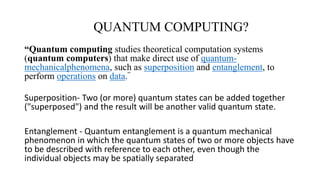
QUANTUM COMPUTING?
“Quantum computing studies theoretical computation systems
(quantum computers) that make direct use of quantum-
mechanicalphenomena, such as superposition and entanglement, to
perform operations on data.”
Superposition- Two (or more) quantum states can be added together
("superposed") and the result will be another valid quantum state.
Entanglement - Quantum entanglement is a quantum mechanical
phenomenon in which the quantum states of two or more objects have
to be described with reference to each other, even though the
individual objects may be spatially separated
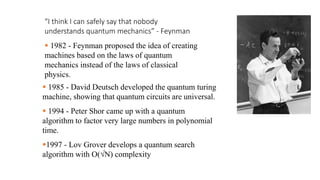
“I think I can safely say that nobody
understands quantum mechanics” - Feynman
 1982 - Feynman proposed the idea of creating
machines based on the laws of quantum
mechanics instead of the laws of classical
physics.
 1985 - David Deutsch developed the quantum turing
machine, showing that quantum circuits are universal.
 1994 - Peter Shor came up with a quantum
algorithm to factor very large numbers in polynomial
time.
1997 - Lov Grover develops a quantum search
algorithm with O(√N) complexity
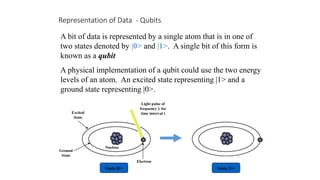
Representation of Data - Qubits
A bit of data is represented by a single atom that is in one of
two states denoted by |0> and |1>. A single bit of this form is
known as a qubit
A physical implementation of a qubit could use the two energy
levels of an atom. An excited state representing |1> and a
ground state representing |0>.
Excited
State
Ground
State
Nucleus
Light pulse of
frequency  for
time interval t
Electron
State |0> State |1>
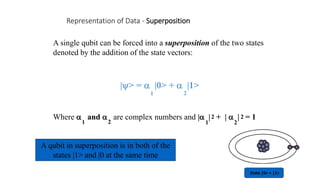
Representation of Data - Superposition
A single qubit can be forced into a superposition of the two states
denoted by the addition of the state vectors:
|> =  |0> +  |1>
Where  and  are complex numbers and | | + |  | = 1
1 2
1 2 1 2
2 2
A qubit in superposition is in both of the
states |1> and |0 at the same time
State |0> + |1>
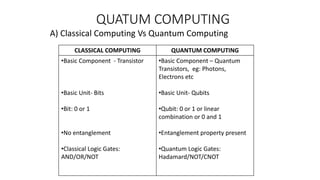
CLASSICAL COMPUTING QUANTUM COMPUTING
•Basic Component - Transistor
•Basic Unit- Bits
•Bit: 0 or 1
•No entanglement
•Classical Logic Gates:
AND/OR/NOT
•Basic Component – Quantum
Transistors, eg: Photons,
Electrons etc
•Basic Unit- Qubits
•Qubit: 0 or 1 or linear
combination or 0 and 1
•Entanglement property present
•Quantum Logic Gates:
Hadamard/NOT/CNOT
QUATUM COMPUTING
A) Classical Computing Vs Quantum Computing
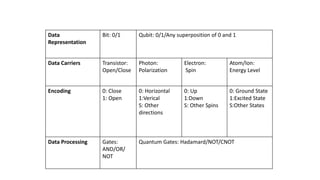
Data
Representation
Bit: 0/1 Qubit: 0/1/Any superposition of 0 and 1
Data Carriers Transistor:
Open/Close
Photon:
Polarization
Electron:
Spin
Atom/Ion:
Energy Level
Encoding 0: Close
1: Open
0: Horizontal
1:Verical
S: Other
directions
0: Up
1:Down
S: Other Spins
0: Ground State
1:Excited State
S:Other States
Data Processing Gates:
AND/OR/
NOT
Quantum Gates: Hadamard/NOT/CNOT
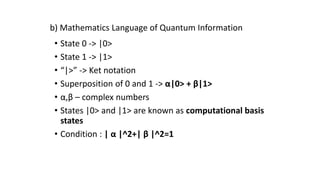
• State 0 -> |0>
• State 1 -> |1>
• “|>” -> Ket notation
• Superposition of 0 and 1 -> α|0> + β|1>
• α,β – complex numbers
• States |0> and |1> are known as computational basis
states
• Condition : | α |^2+| β |^2=1
b) Mathematics Language of Quantum Information
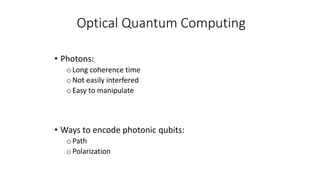
Optical Quantum Computing
• Photons:
oLong coherence time
oNot easily interfered
oEasy to manipulate
• Ways to encode photonic qubits:
oPath
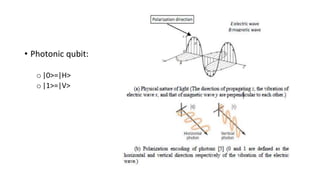
oPolarization
• Photonic qubit:
o|0>=|H>
o|1>=|V>
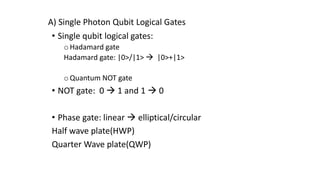
• Single qubit logical gates:
oHadamard gate
Hadamard gate: |0>/|1>  |0>+|1>
oQuantum NOT gate
• NOT gate: 0  1 and 1  0
• Phase gate: linear  elliptical/circular
Half wave plate(HWP)
Quarter Wave plate(QWP)
A) Single Photon Qubit Logical Gates
Quantum Gates
 Quantum Gates are similar to classical gates, but do not have
a degenerate output. i.e. their original input state can be derived
from their output state, uniquely. They must be reversible.
This means that a deterministic computation can be performed
on a quantum computer only if it is reversible. Luckily, it has
been shown that any deterministic computation can be made
reversible.(Charles Bennet, 1973)
Quantum Gates - Hadamard
Simplest gate involves one qubit and is called a Hadamard
Gate (also known as a square-root of NOT gate.) Used to put
qubits into superposition.
H
State
|0>
State
|0> + |1>
H
State
|1>
Note: Two Hadamard gates used in
succession can be used as a NOT gate
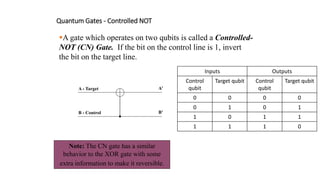
Quantum Gates - Controlled NOT
A gate which operates on two qubits is called a Controlled-
NOT (CN) Gate. If the bit on the control line is 1, invert
the bit on the target line.
A - Target
B - Control
Note: The CN gate has a similar
behavior to the XOR gate with some
extra information to make it reversible.
A’
B’
Inputs Outputs
Control
qubit
Target qubit Control
qubit
Target qubit
0 0 0 0
0 1 0 1
1 0 1 1
1 1 1 0
• The realization of CNOT gate for two qubits is a difficult point, since it
calls for the interaction between the control qubit and target qubit,
which cannot be obtained easily for common light.
eg: two beams of light from two flashlights cannot
interact with each other.
Solution : the method of nonlinear interaction is to use other particles
e.g. ions, atoms or electrons as a medium along with photons, since
photons can interact with them.
Its efficiency is limited as the interactions are not strong enough.
LINEAR OPTICAL QUANTUM COMPUTING
In 2001, Knill, Laflamme, and Milburn (KLM) put forward a method to
realize quantum gates with linear optical elements. This method needs
the photons to be correlated at the input ports, which can be achieved
by focusing the laser on crystals to generate correlated photons.
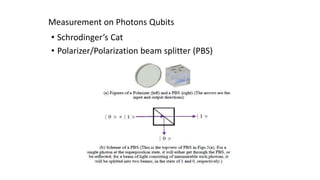
• Schrodinger’s Cat
• Polarizer/Polarization beam splitter (PBS)
Measurement on Photons Qubits
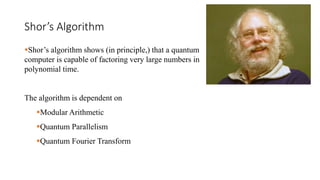
Shor’s Algorithm
Shor’s algorithm shows (in principle,) that a quantum
computer is capable of factoring very large numbers in
polynomial time.
The algorithm is dependent on
Modular Arithmetic
Quantum Parallelism
Quantum Fourier Transform
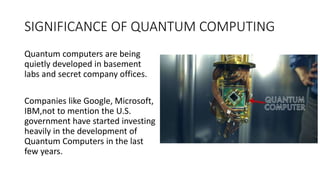
SIGNIFICANCE OF QUANTUM COMPUTING
Quantum computers are being
quietly developed in basement
labs and secret company offices.
Companies like Google, Microsoft,
IBM,not to mention the U.S.
government have started investing
heavily in the development of
Quantum Computers in the last
few years.
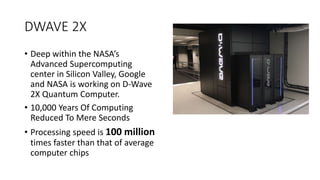
DWAVE 2X
• Deep within the NASA’s
Advanced Supercomputing
center in Silicon Valley, Google
and NASA is working on D-Wave
2X Quantum Computer.
• 10,000 Years Of Computing
Reduced To Mere Seconds
• Processing speed is 100 million
times faster than that of average
computer chips
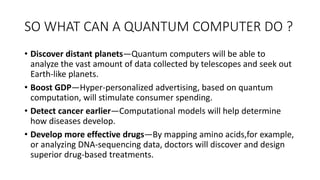
SO WHAT CAN A QUANTUM COMPUTER DO ?
• Discover distant planets—Quantum computers will be able to
analyze the vast amount of data collected by telescopes and seek out
Earth-like planets.
• Boost GDP—Hyper-personalized advertising, based on quantum
computation, will stimulate consumer spending.
• Detect cancer earlier—Computational models will help determine
how diseases develop.
• Develop more effective drugs—By mapping amino acids,for example,
or analyzing DNA-sequencing data, doctors will discover and design
superior drug-based treatments.
hopes for a
“New Hope”
Post quantum encryption algorithm to prevent future attacks!
hopes for a
“New Hope”
THANKYOU

OPTICALQuantum

  • 1.
  • 2.
  • 3.
  • 5.
    QUANTUM COMPUTING? “Quantum computingstudies theoretical computation systems (quantum computers) that make direct use of quantum- mechanicalphenomena, such as superposition and entanglement, to perform operations on data.” Superposition- Two (or more) quantum states can be added together ("superposed") and the result will be another valid quantum state. Entanglement - Quantum entanglement is a quantum mechanical phenomenon in which the quantum states of two or more objects have to be described with reference to each other, even though the individual objects may be spatially separated
  • 6.
    “I think Ican safely say that nobody understands quantum mechanics” - Feynman  1982 - Feynman proposed the idea of creating machines based on the laws of quantum mechanics instead of the laws of classical physics.  1985 - David Deutsch developed the quantum turing machine, showing that quantum circuits are universal.  1994 - Peter Shor came up with a quantum algorithm to factor very large numbers in polynomial time. 1997 - Lov Grover develops a quantum search algorithm with O(√N) complexity
  • 7.
    Representation of Data- Qubits A bit of data is represented by a single atom that is in one of two states denoted by |0> and |1>. A single bit of this form is known as a qubit A physical implementation of a qubit could use the two energy levels of an atom. An excited state representing |1> and a ground state representing |0>. Excited State Ground State Nucleus Light pulse of frequency  for time interval t Electron State |0> State |1>
  • 8.
    Representation of Data- Superposition A single qubit can be forced into a superposition of the two states denoted by the addition of the state vectors: |> =  |0> +  |1> Where  and  are complex numbers and | | + |  | = 1 1 2 1 2 1 2 2 2 A qubit in superposition is in both of the states |1> and |0 at the same time State |0> + |1>
  • 9.
    CLASSICAL COMPUTING QUANTUMCOMPUTING •Basic Component - Transistor •Basic Unit- Bits •Bit: 0 or 1 •No entanglement •Classical Logic Gates: AND/OR/NOT •Basic Component – Quantum Transistors, eg: Photons, Electrons etc •Basic Unit- Qubits •Qubit: 0 or 1 or linear combination or 0 and 1 •Entanglement property present •Quantum Logic Gates: Hadamard/NOT/CNOT QUATUM COMPUTING A) Classical Computing Vs Quantum Computing
  • 10.
    Data Representation Bit: 0/1 Qubit:0/1/Any superposition of 0 and 1 Data Carriers Transistor: Open/Close Photon: Polarization Electron: Spin Atom/Ion: Energy Level Encoding 0: Close 1: Open 0: Horizontal 1:Verical S: Other directions 0: Up 1:Down S: Other Spins 0: Ground State 1:Excited State S:Other States Data Processing Gates: AND/OR/ NOT Quantum Gates: Hadamard/NOT/CNOT
  • 11.
    • State 0-> |0> • State 1 -> |1> • “|>” -> Ket notation • Superposition of 0 and 1 -> α|0> + β|1> • α,β – complex numbers • States |0> and |1> are known as computational basis states • Condition : | α |^2+| β |^2=1 b) Mathematics Language of Quantum Information
  • 13.
    Optical Quantum Computing •Photons: oLong coherence time oNot easily interfered oEasy to manipulate • Ways to encode photonic qubits: oPath oPolarization
  • 14.
  • 15.
    • Single qubitlogical gates: oHadamard gate Hadamard gate: |0>/|1>  |0>+|1> oQuantum NOT gate • NOT gate: 0  1 and 1  0 • Phase gate: linear  elliptical/circular Half wave plate(HWP) Quarter Wave plate(QWP) A) Single Photon Qubit Logical Gates
  • 16.
    Quantum Gates  QuantumGates are similar to classical gates, but do not have a degenerate output. i.e. their original input state can be derived from their output state, uniquely. They must be reversible. This means that a deterministic computation can be performed on a quantum computer only if it is reversible. Luckily, it has been shown that any deterministic computation can be made reversible.(Charles Bennet, 1973)
  • 17.
    Quantum Gates -Hadamard Simplest gate involves one qubit and is called a Hadamard Gate (also known as a square-root of NOT gate.) Used to put qubits into superposition. H State |0> State |0> + |1> H State |1> Note: Two Hadamard gates used in succession can be used as a NOT gate
  • 18.
    Quantum Gates -Controlled NOT A gate which operates on two qubits is called a Controlled- NOT (CN) Gate. If the bit on the control line is 1, invert the bit on the target line. A - Target B - Control Note: The CN gate has a similar behavior to the XOR gate with some extra information to make it reversible. A’ B’ Inputs Outputs Control qubit Target qubit Control qubit Target qubit 0 0 0 0 0 1 0 1 1 0 1 1 1 1 1 0
  • 19.
    • The realizationof CNOT gate for two qubits is a difficult point, since it calls for the interaction between the control qubit and target qubit, which cannot be obtained easily for common light. eg: two beams of light from two flashlights cannot interact with each other. Solution : the method of nonlinear interaction is to use other particles e.g. ions, atoms or electrons as a medium along with photons, since photons can interact with them. Its efficiency is limited as the interactions are not strong enough.
  • 20.
    LINEAR OPTICAL QUANTUMCOMPUTING In 2001, Knill, Laflamme, and Milburn (KLM) put forward a method to realize quantum gates with linear optical elements. This method needs the photons to be correlated at the input ports, which can be achieved by focusing the laser on crystals to generate correlated photons.
  • 21.
    • Schrodinger’s Cat •Polarizer/Polarization beam splitter (PBS) Measurement on Photons Qubits
  • 22.
    Shor’s Algorithm Shor’s algorithmshows (in principle,) that a quantum computer is capable of factoring very large numbers in polynomial time. The algorithm is dependent on Modular Arithmetic Quantum Parallelism Quantum Fourier Transform
  • 23.
    SIGNIFICANCE OF QUANTUMCOMPUTING Quantum computers are being quietly developed in basement labs and secret company offices. Companies like Google, Microsoft, IBM,not to mention the U.S. government have started investing heavily in the development of Quantum Computers in the last few years.
  • 24.
    DWAVE 2X • Deepwithin the NASA’s Advanced Supercomputing center in Silicon Valley, Google and NASA is working on D-Wave 2X Quantum Computer. • 10,000 Years Of Computing Reduced To Mere Seconds • Processing speed is 100 million times faster than that of average computer chips
  • 25.
    SO WHAT CANA QUANTUM COMPUTER DO ? • Discover distant planets—Quantum computers will be able to analyze the vast amount of data collected by telescopes and seek out Earth-like planets. • Boost GDP—Hyper-personalized advertising, based on quantum computation, will stimulate consumer spending. • Detect cancer earlier—Computational models will help determine how diseases develop. • Develop more effective drugs—By mapping amino acids,for example, or analyzing DNA-sequencing data, doctors will discover and design superior drug-based treatments.
  • 26.
  • 27.
    Post quantum encryptionalgorithm to prevent future attacks! hopes for a “New Hope”
  • 28.