



Presents…
101000010
1010011001010101
11101001
1101010101010101
10100010101
1000100011111
Encrypting…
Seminar on
quantum computing
Guided by:
Dr.Ravi Kishore(TIFR)
Presented by:
D.V.V.Saikumar
What is
quantum
computing?
4
• uantum computing is a method of computation using quantum
mechanical phenomenon like entanglement and superposition
Note: quantum computing is not a faster or better classical computing
but it is altogether different way of computing.
Still in early stages but gaining momentum very fast.
History
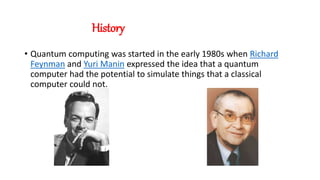
• Quantum computing was started in the early 1980s when Richard
Feynman and Yuri Manin expressed the idea that a quantum
computer had the potential to simulate things that a classical
computer could not.
History
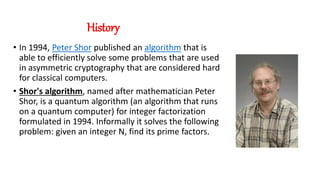
• In 1994, Peter Shor published an algorithm that is
able to efficiently solve some problems that are used
in asymmetric cryptography that are considered hard
for classical computers.
• Shor's algorithm, named after mathematician Peter
Shor, is a quantum algorithm (an algorithm that runs
on a quantum computer) for integer factorization
formulated in 1994. Informally it solves the following
problem: given an integer N, find its prime factors.
Why quantum computing?
• For solving world’s most fundamental problems like…
…inventing new drugs
…making brand new materials
…creating more precise climate models
…strong encryption and easy decryption
(which is too hard a nut to crack)*
• It could solve some problems in seconds which would take current
super computers thousands of years
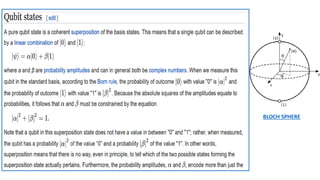
QUBITS
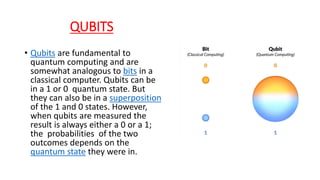
• Qubits are fundamental to
quantum computing and are
somewhat analogous to bits in a
classical computer. Qubits can be
in a 1 or 0 quantum state. But
they can also be in a superposition
of the 1 and 0 states. However,
when qubits are measured the
result is always either a 0 or a 1;
the probabilities of the two
outcomes depends on the
quantum state they were in.
BLOCH SPHERE
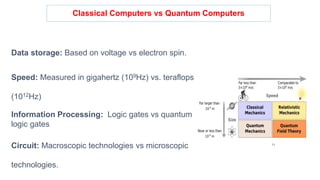
Classical Computers vs Quantum Computers
Data storage: Based on voltage vs electron spin.
Speed: Measured in gigahertz (109Hz) vs. teraflops
(1012Hz)
Information Processing: Logic gates vs quantum
logic gates
Circuit: Macroscopic technologies vs microscopic
technologies.
11
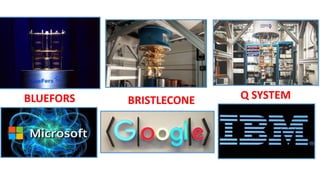
BRISTLECONE Q SYSTEMBLUEFORS
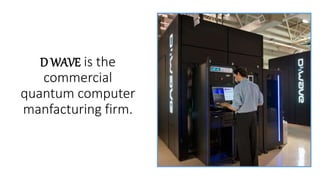
D WAVE is the
commercial
quantum computer
manfacturing firm.
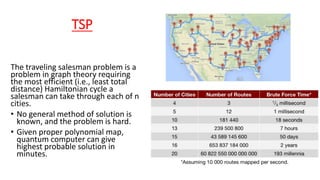
The traveling salesman problem is a
problem in graph theory requiring
the most efficient (i.e., least total
distance) Hamiltonian cycle a
salesman can take through each of n
cities.
• No general method of solution is
known, and the problem is hard.
• Given proper polynomial map,
quantum computer can give
highest probable solution in
minutes.
TSP
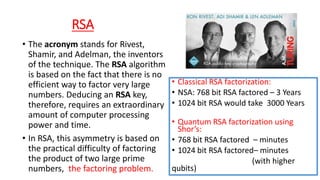
RSA
• The acronym stands for Rivest,
Shamir, and Adelman, the inventors
of the technique. The RSA algorithm
is based on the fact that there is no
efficient way to factor very large
numbers. Deducing an RSA key,
therefore, requires an extraordinary
amount of computer processing
power and time.
• In RSA, this asymmetry is based on
the practical difficulty of factoring
the product of two large prime
numbers, the factoring problem.
• Classical RSA factorization:
• NSA: 768 bit RSA factored – 3 Years
• 1024 bit RSA would take 3000 Years
• Quantum RSA factorization using
Shor’s:
• 768 bit RSA factored – minutes
• 1024 bit RSA factored– minutes
(with higher
qubits)
RSA Key Decryption
is assumed to take
40,000,000,000,000,000
years
BUT IT IS CRACKED
IN JUST 17 YEARS
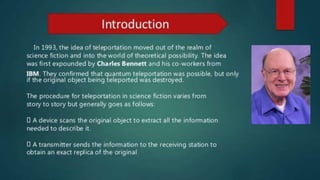
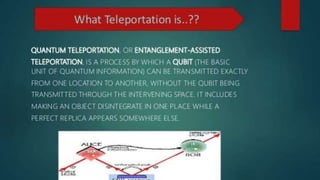
Quantum teleportation
17
Quantum encryption
What?
Why?
How?
Advantages
Advantages of Quantum Computers
1. Information Storage Pattern - Flexibility on storage
2. Speed - Perform multiple task simultaneously
3. Security - Provides unbreakable security features
4. Power Efficient - Quantum computers reduces power consumption by 100 up to
1000 times because of quantum tunneling (By increasing the drive current, the
team was able to operate the Tunnel FET at reduced voltage, 300 milliVolt
compared to one V, thereby offering considerable power savings.)
5. AI - Making exponentially fast connections for machine learning operations
6. Problem solving - Can solve unsolvable problems such as the traveling salesman
problem and bounded-error quantum polynomial time (BQP) which are decision
based problems
25
Disadvantages to Quantum
Computing
1. Difficult to build - Quantum Computers need stability because of the
atoms, any interference will cause the computer to be disrupted and
cause the quantum particles to behave in a strange behavior
2. Temperature - Quantum Computers need to be in a cold
environment (-460 degrees Fahrenheit)(temperatures colder than
deep space)
3. Incompatibility - Quantum algorithms do not apply to most classical
computing applications
4. Sensitivity - Quantum Computers are sensitive
5. Security - Quantum Computers will be able to decrypt and encrypt
security that is much more difficult to break and/or encode.
6. Operational difficulty – needs good number of Ph.D scholars to
operate.
Quantum computing