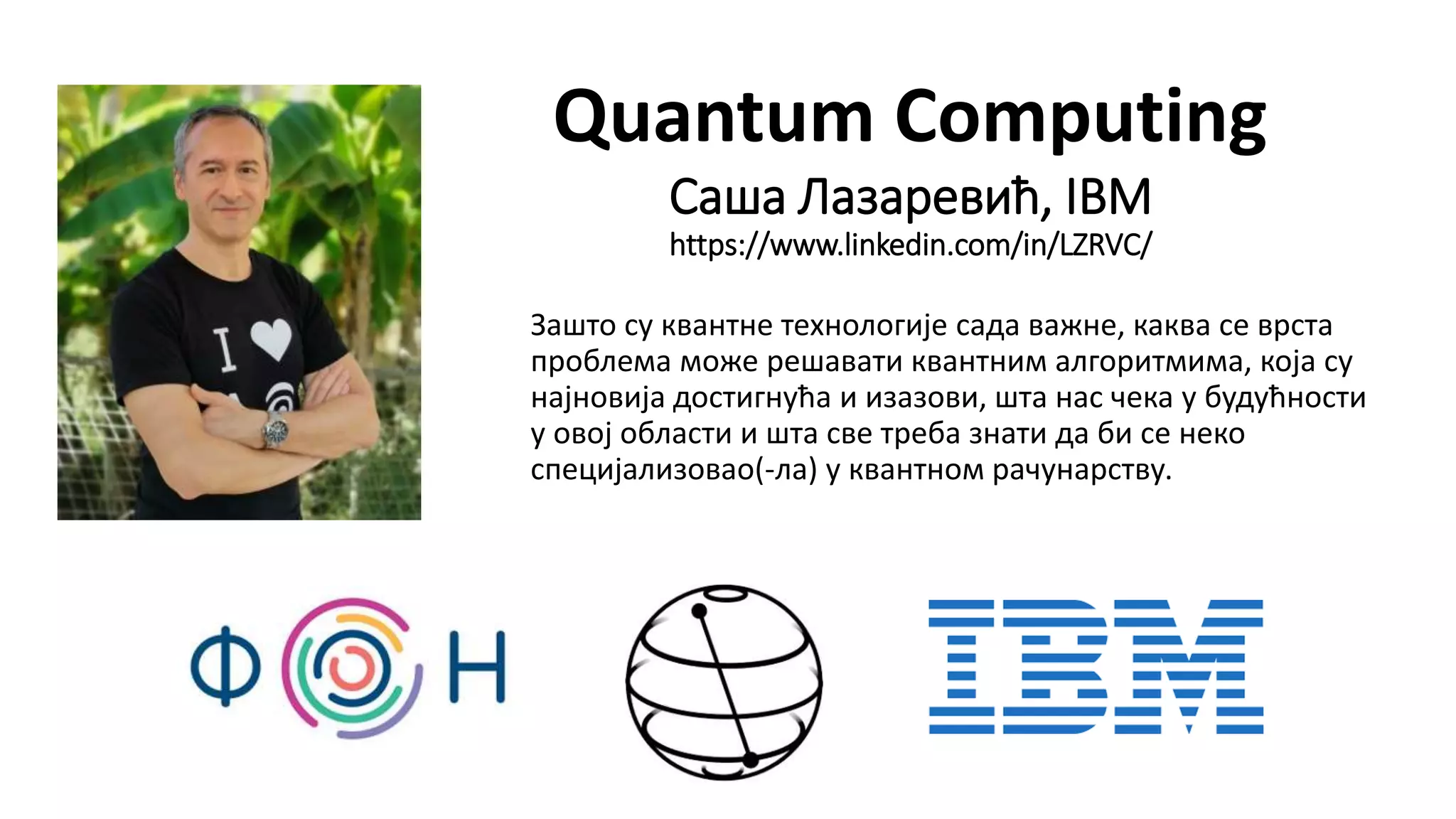
Саша Лазаревић, IBM
https://www.linkedin.com/in/LZRVC/
Quantum Computing
Зашто су квантне технологије сада важне, каква се врста
проблема може решавати квантним алгоритмима, која су
најновија достигнућа и изазови, шта нас чека у будућности
у овој области и шта све треба знати да би се неко
специјализовао(-ла) у квантном рачунарству.
Генерација ’88
3
We must study through reading, listening, discussing, observing and thinking. We must not
neglect any of these ways of studying. The trouble with most of us is that we fall down on the latter
– thinking, because it is hard work for people to think. And as Nicolas Murray Buttler said recently:
“All of the world’s problems could be solved easily if people would be willing to think”
Thomas J Watson
4
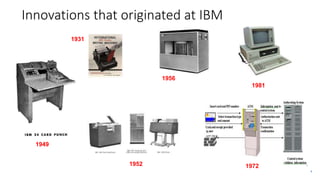
1972
1949
1931
1956
1952
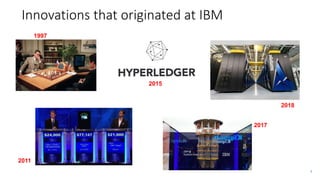
Innovations that originated at IBM
1981
5
2011
2017
2018
2015
Innovations that originated at IBM
1997
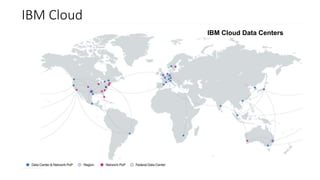
IBM Cloud Data Centers
IBM Cloud
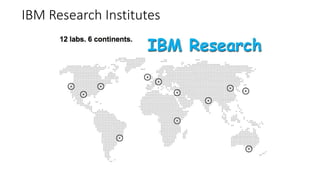
IBM Research Institutes
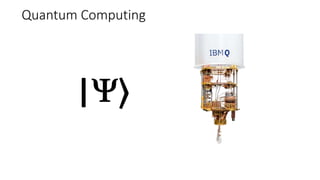
Quantum Computing
|Y⟩
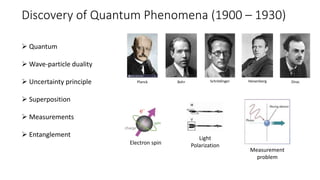
Discovery of Quantum Phenomena (1900 – 1930)
 Quantum
 Wave-particle duality
 Uncertainty principle
 Superposition
 Measurements
 Entanglement
Electron spin
Measurement
problem
Planck Bohr Schrödinger Heisenberg Dirac
Light
Polarization
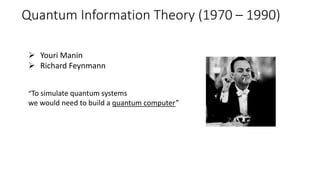
Quantum Information Theory (1970 – 1990)
 Youri Manin
 Richard Feynmann
“To simulate quantum systems
we would need to build a quantum computer”
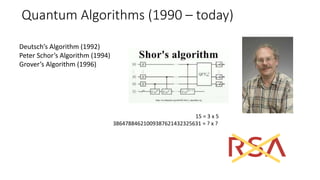
Quantum Algorithms (1990 – today)
Deutsch’s Algorithm (1992)
Peter Schor’s Algorithm (1994)
Grover’s Algorithm (1996)
15 = 3 x 5
38647884621009387621432325631 = ? x ?
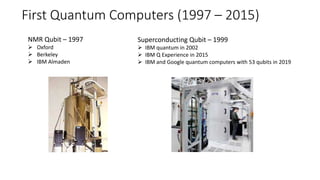
First Quantum Computers (1997 – 2015)
NMR Qubit – 1997
 Oxford
 Berkeley
 IBM Almaden
Superconducting Qubit – 1999
 IBM quantum in 2002
 IBM Q Experience in 2015
 IBM and Google quantum computers with 53 qubits in 2019
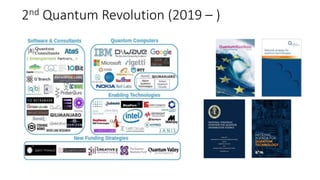
2nd Quantum Revolution (2019 – )
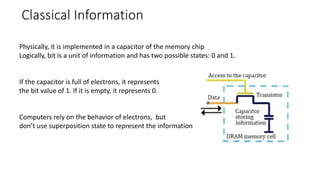
Classical Information
Physically, it is implemented in a capacitor of the memory chip
Logically, bit is a unit of information and has two possible states: 0 and 1.
If the capacitor is full of electrons, it represents
the bit value of 1. If it is empty, it represents 0.
Computers rely on the behavior of electrons, but
don’t use superposition state to represent the information
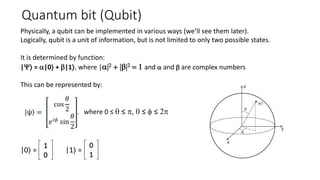
Quantum bit (Qubit)
Physically, a qubit can be implemented in various ways (we’ll see them later).
Logically, qubit is a unit of information, but is not limited to only two possible states.
It is determined by function:
|Y⟩ = a|0⟩ + b|1⟩, where |a|2 + |b|2 = 1 and a and b are complex numbers
This can be represented by:
, where 0 ≤ q ≤ p, 0 ≤ f ≤ 2p
|0⟩ = |1⟩ =
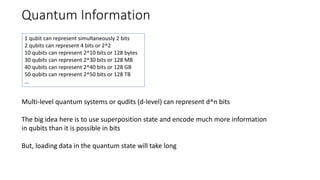
Quantum Information
Multi-level quantum systems or qudits (d-level) can represent d^n bits
The big idea here is to use superposition state and encode much more information
in qubits than it is possible in bits
But, loading data in the quantum state will take long
1 qubit can represent simultaneously 2 bits
2 qubits can represent 4 bits or 2^2
10 qubits can represent 2^10 bits or 128 bytes
30 qubits can represent 2^30 bits or 128 MB
40 qubits can represent 2^40 bits or 128 GB
50 qubits can represent 2^50 bits or 128 TB
…
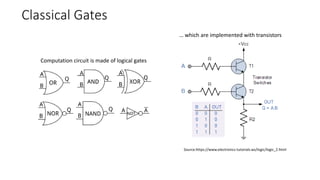
Classical Gates
Source:https://www.electronics-tutorials.ws/logic/logic_2.html
Computation circuit is made of logical gates
… which are implemented with transistors
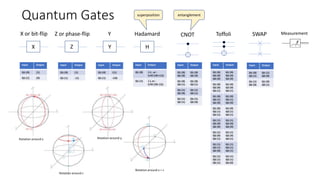
Quantum Gates
Input Output
Q1:|0⟩
Q2:|0⟩
Q1:|0⟩
Q2:|0⟩
Q1:|0⟩
Q2:|1⟩
Q1:|0⟩
Q2:|1⟩
Q1:|1⟩
Q2:|0⟩
Q1:|1⟩
Q2:|1⟩
Q1:|1⟩
Q2:|1⟩
Q1:|1⟩
Q2:|0⟩
CNOT Toffoli
Input Output
Q1:|0⟩
Q2:|0⟩
Q3:|0⟩
Q1:|0⟩
Q2:|0⟩
Q2:|0⟩
Q1:|0⟩
Q2:|0⟩
Q2:|1⟩
Q1:|0⟩
Q2:|0⟩
Q2:|1⟩
Q1:|0⟩
Q2:|1⟩
Q2:|0⟩
Q1:|0⟩
Q2:|1⟩
Q2:|0⟩
Q1:|0⟩
Q2:|1⟩
Q2:|1⟩
Q1:|0⟩
Q2:|1⟩
Q2:|1⟩
Q1:|1⟩
Q2:|0⟩
Q2:|0⟩
Q1:|1⟩
Q2:|0⟩
Q2:|0⟩
Q1:|1⟩
Q2:|0⟩
Q2:|1⟩
Q1:|1⟩
Q2:|0⟩
Q2:|1⟩
Q1:|1⟩
Q2:|1⟩
Q2:|0⟩
Q1:|1⟩
Q2:|1⟩
Q2:|1⟩
Q1:|1⟩
Q2:|1⟩
Q2:|1⟩
Q1:|1⟩
Q2:|1⟩
Q2:|0⟩
H
Hadamard
X
Input Output
Q1:|0⟩ |1⟩
Q1:|1⟩ |0⟩
X or bit-flip
Z
Input Output
Q1:|0⟩ |1⟩
Q1:|1⟩ -|1⟩
Z or phase-flip
Y
Input Output
Q1:|0⟩ i|1⟩
Q1:|1⟩ -i|0⟩
Y SWAP
Input Output
Q1:|0⟩
Q2:|1⟩
Q1:|1⟩
Q2:|0⟩
Q1:|1⟩
Q2:|0⟩
Q1:|0⟩
Q2:|1⟩
Measurement
Rotation around x
Rotation around z
Rotation around y
Rotation around x + z
Input Output
Q1:|0⟩ |+⟩ , or :
1/√2 (|0⟩+|1⟩)
Q1:|1⟩ |-⟩, or :
1/√2 (|0⟩-|1⟩)
superposition entanglement
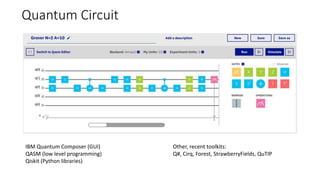
Quantum Circuit
IBM Quantum Composer (GUI)
QASM (low level programming)
Qiskit (Python libraries)
Other, recent toolkits:
Q#, Cirq, Forest, StrawberryFields, QuTIP
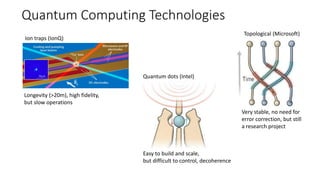
Quantum Computing Technologies
Ion traps (IonQ)
Longevity (>20m), high fidelity,
but slow operations
Quantum dots (Intel)
Easy to build and scale,
but difficult to control, decoherence
Topological (Microsoft)
Very stable, no need for
error correction, but still
a research project
Quantum Computing Technologies
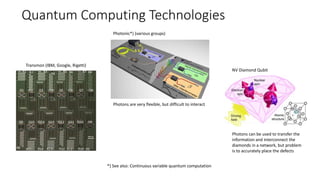
Transmon (IBM, Google, Rigetti)
Photonic*) (various groups)
*) See also: Continuous variable quantum computation
NV Diamond Qubit
Photons can be used to transfer the
information and interconnect the
diamonds in a network, but problem
is to accurately place the defects
Photons are very flexible, but difficult to interact
Adiabatic Quantum Computing
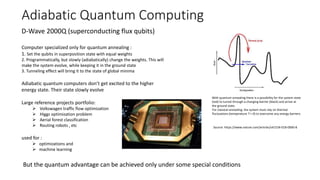
With quantum annealing there is a possibility for the system state
(red) to tunnel through a changing barrier (black) and arrive at
the ground state.
For classical annealing, the system must rely on thermal
fluctuations (temperature T > 0) to overcome any energy barriers.
Source: https://www.nature.com/articles/s41534-018-0060-8
D-Wave 2000Q (superconducting flux qubits)
Computer specialized only for quantum annealing :
1. Set the qubits in superposition state with equal weights
2. Programmatically, but slowly (adiabatically) change the weights. This will
make the system evolve, while keeping it in the ground state
3. Tunneling effect will bring it to the state of global minima
Adiabatic quantum computers don’t get excited to the higher
energy state. Their state slowly evolve
Large reference projects portfolio:
 Volkswagen traffic flow optimization
 Higgs optimization problem
 Aerial forest classification
 Routing robots , etc
used for :
 optimizations and
 machine learning
But the quantum advantage can be achieved only under some special conditions
Superconducting Qubits
p/2 pulse
-p/2 pulse
Josephson Junction
(equivalent to transistor)
E0 or |0⟩
E1 or |1⟩
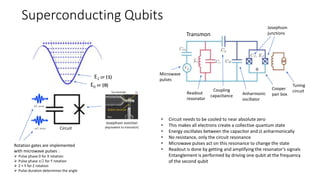
Rotation gates are implemented
with microwave pulses :
 Pulse phase 0 for X rotation
 Pulse phase p/2 for Y rotation
 Z + Y for Z rotation
 Pulse duration determines the angle
Circuit
Transmon
Anharmonic
oscillator
Josephson
junctions
Cooper
pair box
Tuning
circuit
Microwave
pulses
Readout
resonator
Coupling
capacitance
• Circuit needs to be cooled to near absolute zero
• This makes all electrons create a collective quantum state
• Energy oscillates between the capacitor and JJ anharmonically
• No resistance, only the circuit resonance
• Microwave pulses act on this resonance to change the state
• Readout is done by getting and amplifying the resonator’s signals
Entanglement is performed by driving one qubit at the frequency
of the second qubit
Understanding IBM QX Architecture
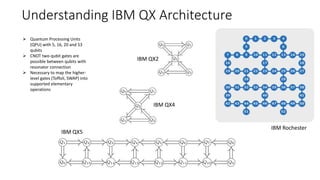
IBM QX2
IBM QX4
IBM QX5
 Quantum Processing Units
(QPU) with 5, 16, 20 and 53
qubits
 CNOT two-qubit gates are
possible between qubits with
resonator connection
 Necessary to map the higher-
level gates (Toffoli, SWAP) into
supported elementary
operations
IBM Rochester
Some well-known quantum algorithms
 Schor’s algorithm for prime factorization
 Grover’s algorithm for database search
 Constraint satisfaction problems (3-SAT)
 Quantum algorithm for linear systems of equations (HHL)
 Quantum algorithm for SVM
 Quantum Approximation Optimization Algorithm (QAOA)
 Variational Quantum Eigensolver (VQE)
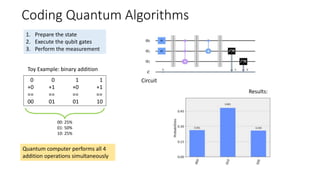
Coding Quantum Algorithms
1. Prepare the state
2. Execute the qubit gates
3. Perform the measurement
Toy Example: binary addition
0 0 1 1
+0 +1 +0 +1
== == == ==
00 01 01 10
00: 25%
01: 50%
10: 25%
Quantum computer performs all 4
addition operations simultaneously
Circuit
Results:
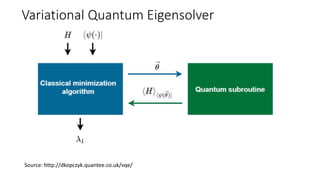
Variational Quantum Eigensolver
Source: http://dkopczyk.quantee.co.uk/vqe/
Use cases
 Search of unstructured data
 Factoring large numbers and cryptography
 Quantum chemistry
 Machine learning
 Optimization problems
 Generating random numbers
 Risk modeling
 Quantum networking
 Recommender system
Building large-scale quantum computer
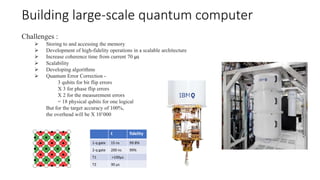
Challenges :
 Storing to and accessing the memory
 Development of high-fidelity operations in a scalable architecture
 Increase coherence time from current 70 µs
 Scalability
 Developing algorithms
 Quantum Error Correction -
3 qubits for bit flip errors
X 3 for phase flip errors
X 2 for the measurement errors
= 18 physical qubits for one logical
But for the target accuracy of 100%,
the overhead will be X 10’000
t fidelity
1-q gate 15 ns 99.8%
2-q gate 200 ns 99%
T1 >100µs
T2 30 µs
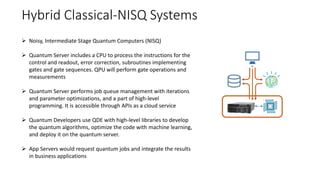
Hybrid Classical-NISQ Systems
 Noisy, Intermediate Stage Quantum Computers (NISQ)
 Quantum Server includes a CPU to process the instructions for the
control and readout, error correction, subroutines implementing
gates and gate sequences. QPU will perform gate operations and
measurements
 Quantum Server performs job queue management with iterations
and parameter optimizations, and a part of high-level
programming. It is accessible through APIs as a cloud service
 Quantum Developers use QDE with high-level libraries to develop
the quantum algorithms, optimize the code with machine learning,
and deploy it on the quantum server.
 App Servers would request quantum jobs and integrate the results
in business applications
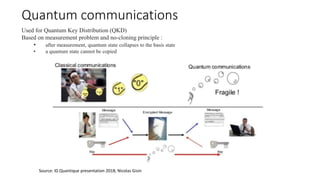
Quantum communications
Used for Quantum Key Distribution (QKD)
Based on measurement problem and no-cloning principle :
• after measurement, quantum state collapses to the basis state
• a quantum state cannot be copied
Source: ID Quantique presentation 2018, Nicolas Gisin
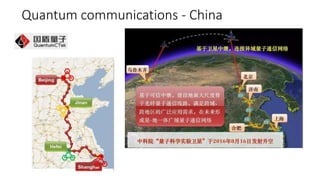
Quantum communications - China
Quantum Internet
 Secure quantum communications based on QKD
 Quantum entanglement over a distance
 Interfaces between stationary qubits and photons based on entanglement
 Quantum cloud computing
Питања ?
Домаћи задатак
 Install ‘Hello Quantum’ video game on your smartphone
 Learn Quantum Chess with Chris Cantwell and Anna Rudolf
https://www.youtube.com/watch?v=LikdmXfWO2A&t=1223s
 Read a book on Linear Algebra
 Learn Computational Complexity
http://fuuu.be/polytech/INFOF408/Introduction-To-The-Theory-Of-Computation-Michael-Sipser.pdf (Part Three)
 Review these slides
For those more ambitious:
• https://www.futurelearn.com/courses/intro-to-quantum-computing
• http://michaelnielsen.org/blog/quantum-computing-for-the-determined/
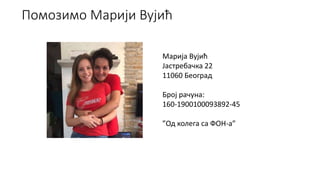
Помозимо Марији Вујић
Марија Вујић
Јастребачка 22
11060 Београд
Број рачуна:
160-1900100093892-45
”Од колега са ФОН-а”

What is Quantum Computing and Why it is Important

  • 1.
    Саша Лазаревић, IBM https://www.linkedin.com/in/LZRVC/ QuantumComputing Зашто су квантне технологије сада важне, каква се врста проблема може решавати квантним алгоритмима, која су најновија достигнућа и изазови, шта нас чека у будућности у овој области и шта све треба знати да би се неко специјализовао(-ла) у квантном рачунарству.
  • 2.
  • 3.
    3 We must studythrough reading, listening, discussing, observing and thinking. We must not neglect any of these ways of studying. The trouble with most of us is that we fall down on the latter – thinking, because it is hard work for people to think. And as Nicolas Murray Buttler said recently: “All of the world’s problems could be solved easily if people would be willing to think” Thomas J Watson
  • 4.
  • 5.
  • 6.
    IBM Cloud DataCenters IBM Cloud
  • 7.
  • 8.
  • 9.
    Discovery of QuantumPhenomena (1900 – 1930)  Quantum  Wave-particle duality  Uncertainty principle  Superposition  Measurements  Entanglement Electron spin Measurement problem Planck Bohr Schrödinger Heisenberg Dirac Light Polarization
  • 10.
    Quantum Information Theory(1970 – 1990)  Youri Manin  Richard Feynmann “To simulate quantum systems we would need to build a quantum computer”
  • 11.
    Quantum Algorithms (1990– today) Deutsch’s Algorithm (1992) Peter Schor’s Algorithm (1994) Grover’s Algorithm (1996) 15 = 3 x 5 38647884621009387621432325631 = ? x ?
  • 12.
    First Quantum Computers(1997 – 2015) NMR Qubit – 1997  Oxford  Berkeley  IBM Almaden Superconducting Qubit – 1999  IBM quantum in 2002  IBM Q Experience in 2015  IBM and Google quantum computers with 53 qubits in 2019
  • 13.
  • 14.
    Classical Information Physically, itis implemented in a capacitor of the memory chip Logically, bit is a unit of information and has two possible states: 0 and 1. If the capacitor is full of electrons, it represents the bit value of 1. If it is empty, it represents 0. Computers rely on the behavior of electrons, but don’t use superposition state to represent the information
  • 15.
    Quantum bit (Qubit) Physically,a qubit can be implemented in various ways (we’ll see them later). Logically, qubit is a unit of information, but is not limited to only two possible states. It is determined by function: |Y⟩ = a|0⟩ + b|1⟩, where |a|2 + |b|2 = 1 and a and b are complex numbers This can be represented by: , where 0 ≤ q ≤ p, 0 ≤ f ≤ 2p |0⟩ = |1⟩ =
  • 16.
    Quantum Information Multi-level quantumsystems or qudits (d-level) can represent d^n bits The big idea here is to use superposition state and encode much more information in qubits than it is possible in bits But, loading data in the quantum state will take long 1 qubit can represent simultaneously 2 bits 2 qubits can represent 4 bits or 2^2 10 qubits can represent 2^10 bits or 128 bytes 30 qubits can represent 2^30 bits or 128 MB 40 qubits can represent 2^40 bits or 128 GB 50 qubits can represent 2^50 bits or 128 TB …
  • 17.
    Classical Gates Source:https://www.electronics-tutorials.ws/logic/logic_2.html Computation circuitis made of logical gates … which are implemented with transistors
  • 18.
    Quantum Gates Input Output Q1:|0⟩ Q2:|0⟩ Q1:|0⟩ Q2:|0⟩ Q1:|0⟩ Q2:|1⟩ Q1:|0⟩ Q2:|1⟩ Q1:|1⟩ Q2:|0⟩ Q1:|1⟩ Q2:|1⟩ Q1:|1⟩ Q2:|1⟩ Q1:|1⟩ Q2:|0⟩ CNOTToffoli Input Output Q1:|0⟩ Q2:|0⟩ Q3:|0⟩ Q1:|0⟩ Q2:|0⟩ Q2:|0⟩ Q1:|0⟩ Q2:|0⟩ Q2:|1⟩ Q1:|0⟩ Q2:|0⟩ Q2:|1⟩ Q1:|0⟩ Q2:|1⟩ Q2:|0⟩ Q1:|0⟩ Q2:|1⟩ Q2:|0⟩ Q1:|0⟩ Q2:|1⟩ Q2:|1⟩ Q1:|0⟩ Q2:|1⟩ Q2:|1⟩ Q1:|1⟩ Q2:|0⟩ Q2:|0⟩ Q1:|1⟩ Q2:|0⟩ Q2:|0⟩ Q1:|1⟩ Q2:|0⟩ Q2:|1⟩ Q1:|1⟩ Q2:|0⟩ Q2:|1⟩ Q1:|1⟩ Q2:|1⟩ Q2:|0⟩ Q1:|1⟩ Q2:|1⟩ Q2:|1⟩ Q1:|1⟩ Q2:|1⟩ Q2:|1⟩ Q1:|1⟩ Q2:|1⟩ Q2:|0⟩ H Hadamard X Input Output Q1:|0⟩ |1⟩ Q1:|1⟩ |0⟩ X or bit-flip Z Input Output Q1:|0⟩ |1⟩ Q1:|1⟩ -|1⟩ Z or phase-flip Y Input Output Q1:|0⟩ i|1⟩ Q1:|1⟩ -i|0⟩ Y SWAP Input Output Q1:|0⟩ Q2:|1⟩ Q1:|1⟩ Q2:|0⟩ Q1:|1⟩ Q2:|0⟩ Q1:|0⟩ Q2:|1⟩ Measurement Rotation around x Rotation around z Rotation around y Rotation around x + z Input Output Q1:|0⟩ |+⟩ , or : 1/√2 (|0⟩+|1⟩) Q1:|1⟩ |-⟩, or : 1/√2 (|0⟩-|1⟩) superposition entanglement
  • 19.
    Quantum Circuit IBM QuantumComposer (GUI) QASM (low level programming) Qiskit (Python libraries) Other, recent toolkits: Q#, Cirq, Forest, StrawberryFields, QuTIP
  • 20.
    Quantum Computing Technologies Iontraps (IonQ) Longevity (>20m), high fidelity, but slow operations Quantum dots (Intel) Easy to build and scale, but difficult to control, decoherence Topological (Microsoft) Very stable, no need for error correction, but still a research project
  • 21.
    Quantum Computing Technologies Transmon(IBM, Google, Rigetti) Photonic*) (various groups) *) See also: Continuous variable quantum computation NV Diamond Qubit Photons can be used to transfer the information and interconnect the diamonds in a network, but problem is to accurately place the defects Photons are very flexible, but difficult to interact
  • 22.
    Adiabatic Quantum Computing Withquantum annealing there is a possibility for the system state (red) to tunnel through a changing barrier (black) and arrive at the ground state. For classical annealing, the system must rely on thermal fluctuations (temperature T > 0) to overcome any energy barriers. Source: https://www.nature.com/articles/s41534-018-0060-8 D-Wave 2000Q (superconducting flux qubits) Computer specialized only for quantum annealing : 1. Set the qubits in superposition state with equal weights 2. Programmatically, but slowly (adiabatically) change the weights. This will make the system evolve, while keeping it in the ground state 3. Tunneling effect will bring it to the state of global minima Adiabatic quantum computers don’t get excited to the higher energy state. Their state slowly evolve Large reference projects portfolio:  Volkswagen traffic flow optimization  Higgs optimization problem  Aerial forest classification  Routing robots , etc used for :  optimizations and  machine learning But the quantum advantage can be achieved only under some special conditions
  • 23.
    Superconducting Qubits p/2 pulse -p/2pulse Josephson Junction (equivalent to transistor) E0 or |0⟩ E1 or |1⟩ Rotation gates are implemented with microwave pulses :  Pulse phase 0 for X rotation  Pulse phase p/2 for Y rotation  Z + Y for Z rotation  Pulse duration determines the angle Circuit Transmon Anharmonic oscillator Josephson junctions Cooper pair box Tuning circuit Microwave pulses Readout resonator Coupling capacitance • Circuit needs to be cooled to near absolute zero • This makes all electrons create a collective quantum state • Energy oscillates between the capacitor and JJ anharmonically • No resistance, only the circuit resonance • Microwave pulses act on this resonance to change the state • Readout is done by getting and amplifying the resonator’s signals Entanglement is performed by driving one qubit at the frequency of the second qubit
  • 24.
    Understanding IBM QXArchitecture IBM QX2 IBM QX4 IBM QX5  Quantum Processing Units (QPU) with 5, 16, 20 and 53 qubits  CNOT two-qubit gates are possible between qubits with resonator connection  Necessary to map the higher- level gates (Toffoli, SWAP) into supported elementary operations IBM Rochester
  • 25.
    Some well-known quantumalgorithms  Schor’s algorithm for prime factorization  Grover’s algorithm for database search  Constraint satisfaction problems (3-SAT)  Quantum algorithm for linear systems of equations (HHL)  Quantum algorithm for SVM  Quantum Approximation Optimization Algorithm (QAOA)  Variational Quantum Eigensolver (VQE)
  • 26.
    Coding Quantum Algorithms 1.Prepare the state 2. Execute the qubit gates 3. Perform the measurement Toy Example: binary addition 0 0 1 1 +0 +1 +0 +1 == == == == 00 01 01 10 00: 25% 01: 50% 10: 25% Quantum computer performs all 4 addition operations simultaneously Circuit Results:
  • 27.
    Variational Quantum Eigensolver Source:http://dkopczyk.quantee.co.uk/vqe/
  • 28.
    Use cases  Searchof unstructured data  Factoring large numbers and cryptography  Quantum chemistry  Machine learning  Optimization problems  Generating random numbers  Risk modeling  Quantum networking  Recommender system
  • 29.
    Building large-scale quantumcomputer Challenges :  Storing to and accessing the memory  Development of high-fidelity operations in a scalable architecture  Increase coherence time from current 70 µs  Scalability  Developing algorithms  Quantum Error Correction - 3 qubits for bit flip errors X 3 for phase flip errors X 2 for the measurement errors = 18 physical qubits for one logical But for the target accuracy of 100%, the overhead will be X 10’000 t fidelity 1-q gate 15 ns 99.8% 2-q gate 200 ns 99% T1 >100µs T2 30 µs
  • 30.
    Hybrid Classical-NISQ Systems Noisy, Intermediate Stage Quantum Computers (NISQ)  Quantum Server includes a CPU to process the instructions for the control and readout, error correction, subroutines implementing gates and gate sequences. QPU will perform gate operations and measurements  Quantum Server performs job queue management with iterations and parameter optimizations, and a part of high-level programming. It is accessible through APIs as a cloud service  Quantum Developers use QDE with high-level libraries to develop the quantum algorithms, optimize the code with machine learning, and deploy it on the quantum server.  App Servers would request quantum jobs and integrate the results in business applications
  • 31.
    Quantum communications Used forQuantum Key Distribution (QKD) Based on measurement problem and no-cloning principle : • after measurement, quantum state collapses to the basis state • a quantum state cannot be copied Source: ID Quantique presentation 2018, Nicolas Gisin
  • 32.
  • 33.
    Quantum Internet  Securequantum communications based on QKD  Quantum entanglement over a distance  Interfaces between stationary qubits and photons based on entanglement  Quantum cloud computing
  • 34.
  • 35.
    Домаћи задатак  Install‘Hello Quantum’ video game on your smartphone  Learn Quantum Chess with Chris Cantwell and Anna Rudolf https://www.youtube.com/watch?v=LikdmXfWO2A&t=1223s  Read a book on Linear Algebra  Learn Computational Complexity http://fuuu.be/polytech/INFOF408/Introduction-To-The-Theory-Of-Computation-Michael-Sipser.pdf (Part Three)  Review these slides For those more ambitious: • https://www.futurelearn.com/courses/intro-to-quantum-computing • http://michaelnielsen.org/blog/quantum-computing-for-the-determined/
  • 36.
    Помозимо Марији Вујић МаријаВујић Јастребачка 22 11060 Београд Број рачуна: 160-1900100093892-45 ”Од колега са ФОН-а”

Editor's Notes

  • #10 Correlation travels faster than light, but correlation itself is useless. We still need classical communication to be able to qualify the states Entanglement is natural: electron shell of atoms always consists of entangled electrons molecule’s lowest energy state, in which it is most usually found, is a highly entangled state of its electrons and nuclei photosynthesis , as the mechanism for converting optical energy to kinetic and then chemical energy Protein in the migratory birds eyes have nuclear spins that get entangled with electrons under influence of the earth's magnetic field and this helps the birds orientate durng their flight Speculated entanglement between bacteria and quantized light
  • #16 When we measure it, it is always 0 or 1. Before measurement, it can be in one of the basis states, but it can also be in the superposition state
  • #19 The big idea here is to use entanglement to parallelize the operations on all qubits simultaneously, and then the constructive and destructive interference to obtain the correct results of the computation
  • #21 State of the art : superconducting
  • #22 State of the art : superconducting. Superconducting circuit as macroscopic quantum system
  • #23 State of the art : superconducting. Superconducting circuit as macroscopic quantum system
  • #24 Charge – based superconducting qubit
  • #29 But not suitable for problems requiring big data. This is more a case for HPC that can read petabytes of data as they process them. Used for weather simulations, airplane design and similar
  • #30 Current fidelity of 1-q gate operations on superconducting qubit is 99.8%, 2-q gate operation is 99% For Shor’s algorithm to factor 1024-bit numbers, we need in total 5-6000 high quality logical qubits Goal of QEC is to Preserve the state of the logical qubit even if the errors occur Various schemas, for surface code, it requires 4 physical for one logical
  • #31 Convergence of paradigms
  • #32 Used for QKD
  • #33 Quantum backbone long 2’000 km, with repeaters every 100km. Currently working on quantum repeaters Single photon transmission between satellite and ground at the distance of 400km Used by ICBC bank Implemented by Anhui Quantum Ctek (GuoDun Liangzi)
  • #34 Quantum entanglement over a distance was created by Delft university long enough to be able to create entanglement with third qubit Their next objective is to create a network of multiple entangled nodes