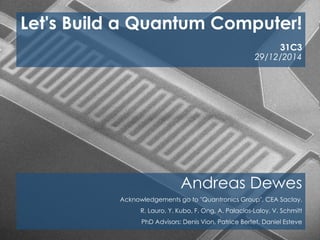
Andreas Dewes
Acknowledgements go to "Quantronics Group", CEA Saclay.
R. Lauro, Y. Kubo, F. Ong, A. Palacios-Laloy, V. Schmitt
PhD Advisors: Denis Vion, Patrice Bertet, Daniel Esteve
Let's Build a Quantum Computer!
31C3
29/12/2014
Motivation
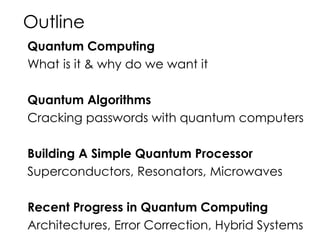
Outline
Quantum Computing
What is it & why do we want it
Quantum Algorithms
Cracking passwords with quantum computers
Building A Simple Quantum Processor
Superconductors, Resonators, Microwaves
Recent Progress in Quantum Computing
Architectures, Error Correction, Hybrid Systems
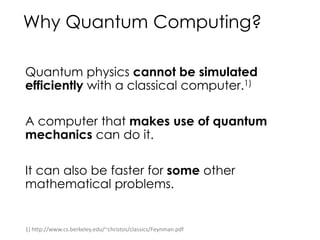
Why Quantum Computing?
Quantum physics cannot be simulated
efficiently with a classical computer.1)
A computer that makes use of quantum
mechanics can do it.
It can also be faster for some other
mathematical problems.
1) http://www.cs.berkeley.edu/~christos/classics/Feynman.pdf
Classical Computing
http://commons.wikimedia.org/wiki/File:Abacus_1_(PSF).png
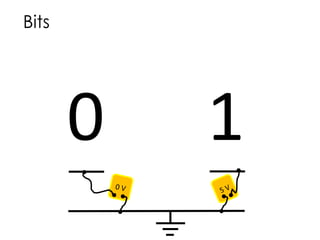
Bits
0 1
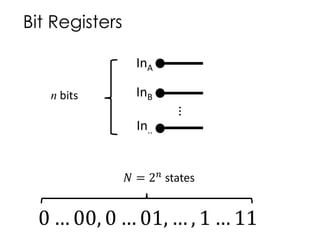
Bit Registers
InA
0 … 00, 0 … 01, … , 1 … 11
...
InB
In..
n bits
𝑁 = 2 𝑛 states
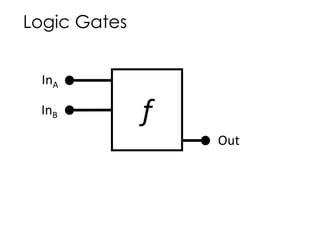
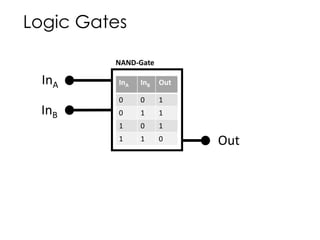
Logic Gates
InA
InB
Out
f
Logic Gates
InA
InB
Out
f
InA InB Out
0 0 1
0 1 1
1 0 1
1 1 0
NAND-Gate
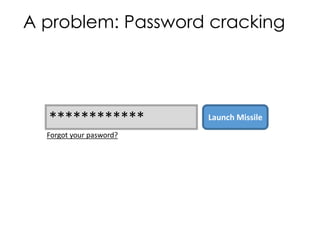
A problem: Password cracking
************ Launch Missile
Forgot your pasword?
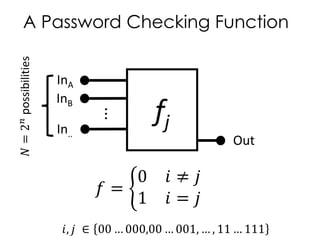
A Password Checking Function
InA
InB
Out
fj
𝑓 =
0 𝑖 ≠ 𝑗
1 𝑖 = 𝑗
𝑖, 𝑗 ∈ 00 … 000,00 … 001, … , 11 … 111
In..
...
𝑁=2𝑛possibilities
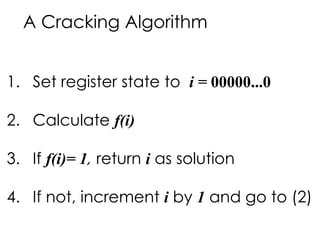
A Cracking Algorithm
1. Set register state to i = 00000...0
2. Calculate f(i)
3. If f(i)= 1, return i as solution
4. If not, increment i by 1 and go to (2)
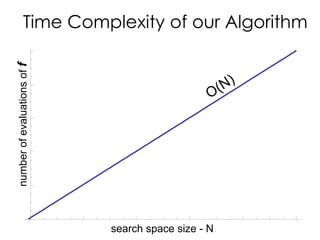
Time Complexity of our Algorithm
search space size - N
numberofevaluationsoff
Quantum Computing
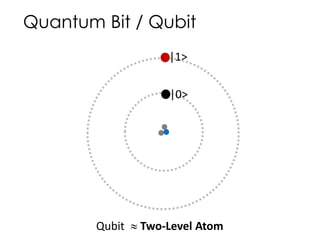
Quantum Bit / Qubit
|0>
Qubit  Two-Level Atom
|1>
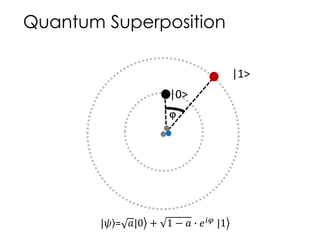
Quantum Superposition
|0>
|1>

|𝜓 = 𝑎|0 + 1 − 𝑎 ∙ 𝑒 𝑖𝜑 |1
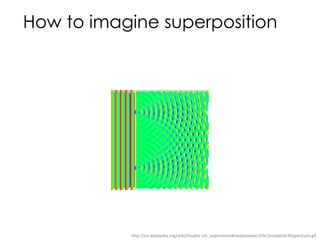
How to imagine superposition
http://en.wikipedia.org/wiki/Double-slit_experiment#mediaviewer/File:Doubleslit3Dspectrum.gif
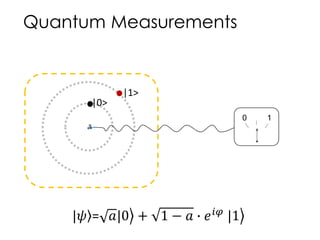
Quantum Measurements
|0>
|1>
|𝜓 = 𝑎|0 + 1 − 𝑎 ∙ 𝑒 𝑖𝜑
|1
0 1
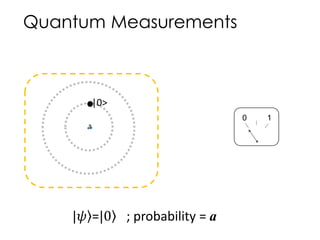
Quantum Measurements
0 1
|0>
|𝜓 =|0 ; probability = a
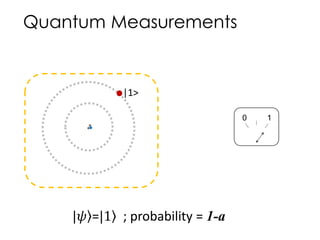
Quantum Measurements
0 1
|1>
|𝜓 =|1 ; probability = 1-a
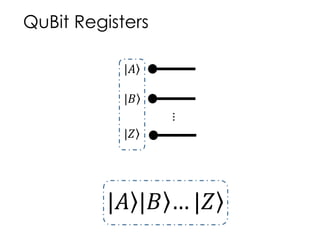
QuBit Registers
...
|𝐴
|𝐵
|𝑍
|𝐴 |𝐵 … |𝑍
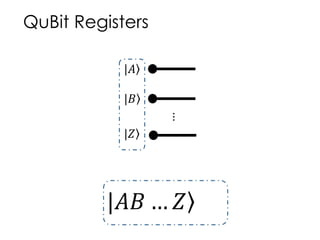
QuBit Registers
...
|𝐴
|𝐵
|𝑍
|𝐴𝐵 … 𝑍
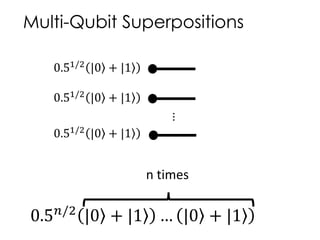
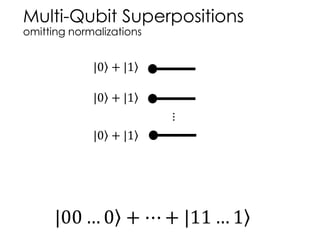
Multi-Qubit Superpositions
...
0.51/2 |0 + |1
0.51/2
|0 + |1
0.51/2
|0 + |1
0.5 𝑛/2
|0 + |1 … |0 + |1
n times
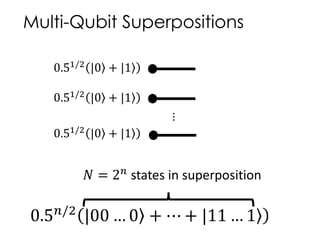
Multi-Qubit Superpositions
...
0.51/2 |0 + |1
0.51/2
|0 + |1
0.51/2
|0 + |1
𝑁 = 2 𝑛
states in superposition
0.5 𝑛/2
|00 … 0 + ⋯ + |11 … 1
Multi-Qubit Superpositions
omitting normalizations
...
|0 + |1
|0 + |1
|0 + |1
|00 … 0 + ⋯ + |11 … 1
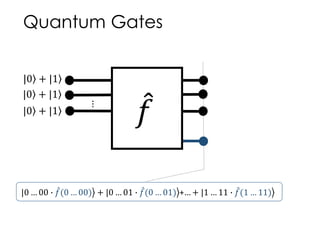
Quantum Gates
𝑓
...
|0 … 00 ∙ 𝑓(0 … 00) + |0 … 01 ∙ 𝑓(0 … 01) +… + |1 … 11 ∙ 𝑓(1 … 11)
|0 + |1
|0 + |1
|0 + |1
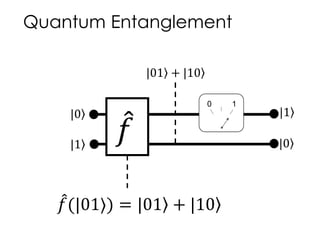
Quantum Entanglement
0 1
|0
|01 + |10
𝑓
𝑓(|01 ) = |01 + |10
|1
|0|1
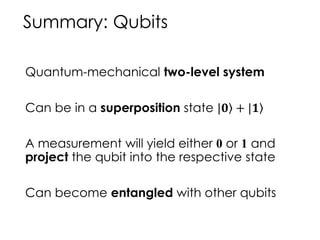
Summary: Qubits
Quantum-mechanical two-level system
Can be in a superposition state |𝟎 + |𝟏
A measurement will yield either 0 or 1 and
project the qubit into the respective state
Can become entangled with other qubits
Back to business...
************ Launch Missile
Wrong password!
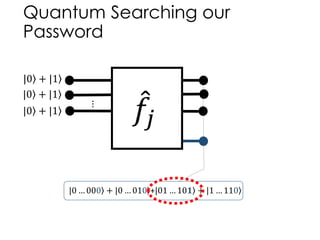
Quantum Searching our
Password
|0 … 000 + |0 … 010 +|01 … 10𝟏 + |1 … 110
𝑓𝑗
...
|0 + |1
|0 + |1
|0 + |1
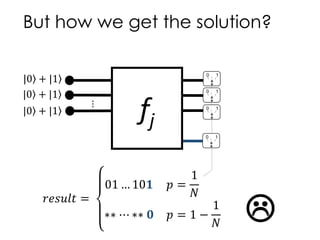
But how we get the solution?
𝑟𝑒𝑠𝑢𝑙𝑡 =
01 … 10𝟏 𝑝 =
1
𝑁
∗∗ ⋯ ∗∗ 𝟎 𝑝 = 1 −
1
𝑁
fj
...
|0 + |1
|0 + |1
|0 + |1
0 1
0 1
0 1
0 1

|0 + |1
|0 + |1
|0 + |1
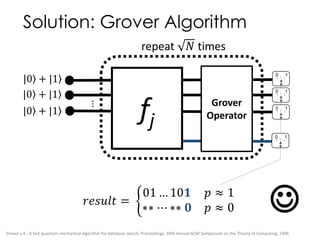
Solution: Grover Algorithm
fj
Grover
Operator
...
0 1
0 1
0 1
0 1
repeat 𝑁 times
𝑟𝑒𝑠𝑢𝑙𝑡 =
01 … 10𝟏 𝑝 ≈ 1
∗∗ ⋯ ∗∗ 𝟎 𝑝 ≈ 0 
Grover L.K.: A fast quantum mechanical algorithm for database search, Proceedings, 28th Annual ACM Symposium on the Theory of Computing, 1996
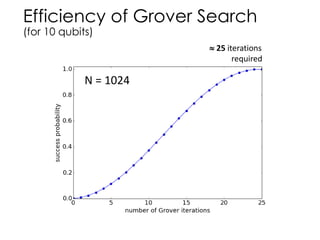
Efficiency of Grover Search
(for 10 qubits)
N = 1024
 25 iterations
required
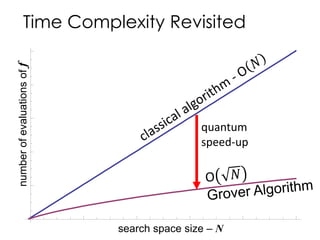
Time Complexity Revisited
search space size – N
numberofevaluationsoff
quantum
speed-up
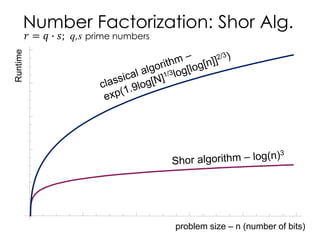
Number Factorization: Shor Alg.
problem size – n (number of bits)
Runtime
𝑟 = 𝑞 ∙ 𝑠; q,s prime numbers
How to Build a
Quantum Processor?
photo not CC-licensed photo not CC-licensed
University of Innsbruck (http://www.quantumoptics.at/) University of Santa Barbara (http://web.physics.ucsb.edu/~martinisgroup/)
...and many more technologies:
Nuclar magnetic resonance,
photonic qubits, quantum dots,
electrons on superfluid helium,
Bose-Einstein condensates...
Ion Trap Quantum Processors Superconducting Quantum Processors
a)
100 m
1 mm
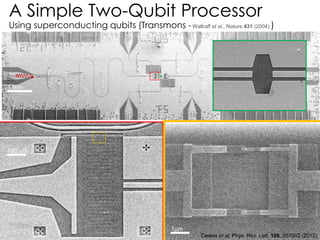
A Simple Two-Qubit Processor
Using superconducting qubits (Transmons - Wallraff et al., Nature 431 (2004) )
1m
38
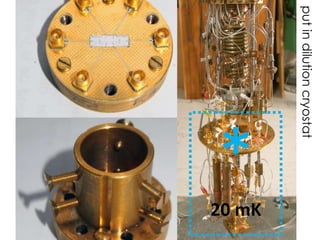
Dewes et al. Phys. Rev. Lett. 108, 057002 (2012)
thermally anchor and
shield from EM fields
mount on microwave
PCB and wirebond
39
*
20 mK
putindilutioncryostat
|0>
|0>
Y/2
Y/2
iSWAP
Z-/2
Z-/2
iSWAP
X/2
X/2
Readout
0 1
0 1
Y(/2)
readout
50 100 150 200 ns
f01[f(t)],a(t)
0
iSWAP iSWAP
Z(/2)
X(/2)
Running Grover-Search for 2 Qubits
Calculate fj Apply Grover operator
40
Prepare superposition
Dewes et. al., PRB Rapid Comm 85 (2012)
|0>
|0>
Y/2
Y/2
iSWAP
Z±/2
Z±/2
iSWAP
X/2
X/2
0 1
0 1
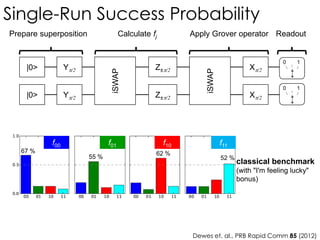
67 %
55 %
62 %
52 %
f00 f01 f10 f11
Single-Run Success Probability
41
classical benchmark
(with "I'm feeling lucky"
bonus)
ReadoutCalculate fj Apply Grover operatorPrepare superposition
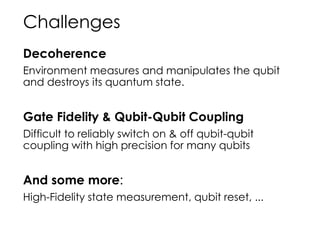
Challenges
Decoherence
Environment measures and manipulates the qubit
and destroys its quantum state.
Gate Fidelity & Qubit-Qubit Coupling
Difficult to reliably switch on & off qubit-qubit
coupling with high precision for many qubits
And some more:
High-Fidelity state measurement, qubit reset, ...
Recent Trends in
Superconducting
Quantum Computing
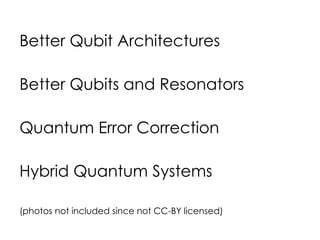
Better Qubit Architectures
Better Qubits and Resonators
Quantum Error Correction
Hybrid Quantum Systems
(photos not included since not CC-BY licensed)
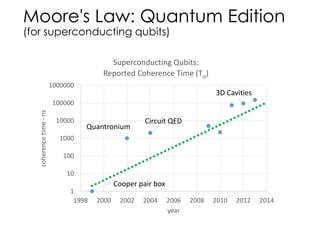
Moore's Law: Quantum Edition
(for superconducting qubits)
1
10
100
1000
10000
100000
1000000
1998 2000 2002 2004 2006 2008 2010 2012 2014
coherencetime-ns
year
Superconducting Qubits:
Reported Coherence Time (T)
Cooper pair box
Quantronium
Circuit QED
3D Cavities
Summary
Quantum computers are coming!
...but still there are many engineering
challenges to overcome...
Bad News
Likely that governments and big corporations
will be in control of QC in the short term.
Thanks!
More "quantum information":
Diamonds are a quantum computer’s best friend –
Tomorrow, 30.12 at 12:45h in Hall 6 by Nicolas Wöhrl
Get in touch with me:
ich@andreas-dewes.de // @japh44

Let's build a quantum computer!

Editor's Notes

  • #39 We realize this processor on a silicon chip, shown here. The two readout resonators and the fast flux lines are realized as coplanar waveguides by optically patterning a thin Niobium film. The two qubits with the coupling capacitor are located in the center of the chip. The Josephson junctions and qubit capacitance, shown here, are fabricated by double-angle evaporation of Aluminium through a resist mask patterned by electron-beam lithography.
  • #40 To perform measurements, this chip is first glued to a custom-made microwave PCB, which is itself attached to a sample holder made of Copper, which is in turn attached to the 20 mK stage of a dilution cryostat and connected to room-temperature electronics using cryogenic wiring. Each qubit possesses its own drive and readout circuit, which is shown for one of the qubits here. Besides a common magnetic coil, each qubit possesses its own filtered and attenuated fast flux line, shown in red. Single-qubit drive signals are generated by mixing the continous output of a microwave source with fast control pulses. The resulting signal then gets filtered and attenuated on its way to the qubit chip. Readout signals are generated by the same method and sent to the qubit chip through the same input line. The reflected microwave signals get amplified and filtered at 4 K and room temperature, where the reflected readout signal gets demodulated and digitized.
  • #41 So, instead of measuring the density matrix of the resulting output state by tomography, we now directly measure the result of the algorithm without correcting any readout errors, just performing a 1->2 qubit transition to increase readout fidelity. Doing this for Oracles implementing all four possible search functions f and averaging the obtained results in each case over many identical runs of the algorithm, we obtain the success probabilities of the different implementations of the search algorithm.
  • #42 Here I show you these probabilities together with the corresponding error rates for the four possible search functions, as indicated above. Comparing the success probabilities, which range between 52 and 67 % to those of the classical benchmark algorithms of 25 and 50 % respectively, demonstrates thus that we are indeed able to achieve quantum speed-up with our processor for this simple algorithm.