Department of Pharmaceutical Chemistry
Presenting by ,
Mr. PURUSHOTHAM K N
Assistant Professor
Department of Ph. Chemistry
SACCP
B. G. Nagar
2021-2022
OECD guidelines
1
CONTENTS
• Introduction
• Objectives of OECD
• Purpose
• Important OECD guidelines
• Toxicity study
• Acute oral toxicity
2
OECD(Organisation for Economic Co-operation
and Development) GUIDELINES
OECD Guidelines for the Testing of Chemicals (OECD
TG) are a set of internationally accepted specifications for
the testing of chemicals decided on by the Organization
for Economic Co-operation and Development (OECD).
They were first published in 1981.
3
OBJECTIVE OF OECD:
• Government and industry are concerned about the
quality of non-clinical health and environmental safety
studies .
• In 1995&1996new group of experts have revised and
updated the principles.
• These principles of should be applied to the non
clinical safety testing of test items contained in
pharmaceutical products cosmetics.
4
Purpose
Hundreds of new chemicals, such as industrial
chemicals, pesticides, food additives, biotechnology
products and pharmaceuticals, flood the world market
each year and may require safety testing in most parts of
the world.
Purpose:
• To enhance the validity and international acceptance
of test data
• Make the best use of available resources in both
government and industry
• Avoid the unnecessary use of laboratory animals
5
• They are split into five sections
• Section 1: Physical Chemical Properties
• Section2: Effects on Biotic Systems
• Section3: Environmental Fate and Behavior
• Section4: Health Effects
• Section5: Other Test Guidelines
Guidelines are numbered with three digit numbers, the
section number being the first number.
Sometimes guidelines are suffixed with a letter.
6
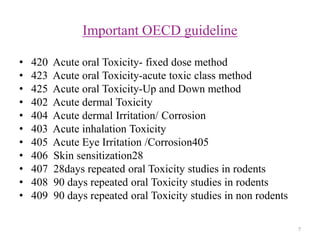
Important OECD guideline
• 420 Acute oral Toxicity- fixed dose method
• 423 Acute oral Toxicity-acute toxic class method
• 425 Acute oral Toxicity-Up and Down method
• 402 Acute dermal Toxicity
• 404 Acute dermal Irritation/ Corrosion
• 403 Acute inhalation Toxicity
• 405 Acute Eye Irritation /Corrosion405
• 406 Skin sensitization28
• 407 28days repeated oral Toxicity studies in rodents
• 408 90 days repeated oral Toxicity studies in rodents
• 409 90 days repeated oral Toxicity studies in non rodents
7
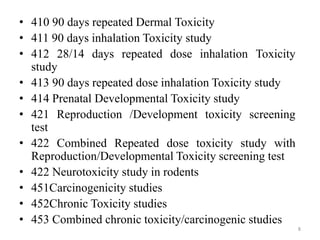
• 410 90 days repeated Dermal Toxicity
• 411 90 days inhalation Toxicity study
• 412 28/14 days repeated dose inhalation Toxicity
study
• 413 90 days repeated dose inhalation Toxicity study
• 414 Prenatal Developmental Toxicity study
• 421 Reproduction /Development toxicity screening
test
• 422 Combined Repeated dose toxicity study with
Reproduction/Developmental Toxicity screening test
• 422 Neurotoxicity study in rodents
• 451Carcinogenicity studies
• 452Chronic Toxicity studies
• 453 Combined chronic toxicity/carcinogenic studies
8
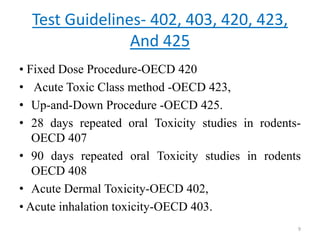
Test Guidelines- 402, 403, 420, 423,
And 425
• Fixed Dose Procedure-OECD 420
• Acute Toxic Class method -OECD 423,
• Up-and-Down Procedure -OECD 425.
• 28 days repeated oral Toxicity studies in rodents-
OECD 407
• 90 days repeated oral Toxicity studies in rodents
OECD 408
• Acute Dermal Toxicity-OECD 402,
• Acute inhalation toxicity-OECD 403.
9
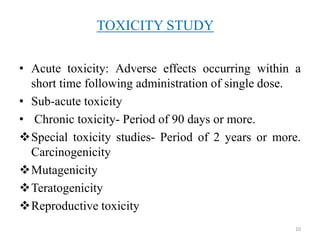
TOXICITY STUDY
• Acute toxicity: Adverse effects occurring within a
short time following administration of single dose.
• Sub-acute toxicity
• Chronic toxicity- Period of 90 days or more.
Special toxicity studies- Period of 2 years or more.
Carcinogenicity
Mutagenicity
Teratogenicity
Reproductive toxicity
10
ACUTETOXICITYSTUDIES
11
Acute Oral Toxicity:
Purpose & scope:
Acute oral toxicity:
• It is the adverse effects occurring within a short time
of oral administration of a single dose of a substance
or multiple doses given within 24 hours.
 It is used in the assessment and evaluation of the
toxic characteristics of a substance.
• Determination of acute oral toxicity is usually an
initial step.
12
Principle(according to 401 guideline):
• The test substance is administerde orally by gavage
in graduated doses to several groups
• The doses chosen may be based on the results of a
range finding test. Observations of effects and deaths
are made.
• This guideline is directed primarily to studies in
rodent.
• Species but may be adapted for studies in non-
rodents. Animals showing severe signs of distress and
pain may need to be humanely killed.
13
Principle(according to 420)
• FIXED DOSE PROCEDURE:
• In this method only moderately toxic doses are used.
• Moribund animals, or animals obviously in pain or
showing signs of severe and distress shall be
humanely killed.
• Interpretation of the results in the way as animals that
died on test.
• Criteria for making the decision to kill moribund or
severely suffering animals, recognition of predictable
or impending death, are the subject of a separate
Guidance Document. 14
Principle according to 423 guideline:
• It is, based on a stepwise procedure with the use of a
minimum
• number of animals per step.
• The substance is administered orally to a group of
experimental animals at one of the defined doses.
• In each step 3 animals are used of single sex(usually
females).
• Absence or presence of compound-related mortality of the
animals dosed at
• one step will determine the next step, i.e.;
1)no further testing is needed,
2) dosing of three additional animals, with the same dose
dosing of three additional animals at the next higher or the
next lower dose level. 15
Principle according to 425:
• UP&DOWN PROCEDURE:
• It is a single ordered dose progression program. In this animals are
dosed in an interval of 48 hrs.
• The first animal receives a dose a step below the level of the best
• estimate of the LD50.
• If the animal survives, the dose for the next animal is increased by
[a factor of] 3.2 times the original dose.
• If it dies, the dose for the next animal is decreased by a similar dose
progression.
• (Note: 3.2 is the default factor corresponding to a dose progression
of one half log unit.
• Each animal should be observed carefully for up to 48 hours before
making a decision on whether and how much to dose the next
animal.
16
Procedure
• Preparation of the test substance:
• Healthy young animals are selected 5 days prior to
treatment.
• Where necessary, the test substance is dissolved or
suspended in a suitable vehicle.
• For non-aqueous vehicles the toxic characteristics of
the vehicle should be known, and if not known should
be determined before the test.
• In rodents the maximum dose is 1ml/kg &in case of
aqueous vehicles it can be 2ml/kg.
17
Selection of species:
• Although several animals are available mostly rats are
selected &the weight variation should be in between
+_20 % of the mean.
• Number and sex
• At least 5 rodents are used at each dose level. They
should all be of the same sex. If females are used they
should be nulliparous and non-pregnant.
18
Housing and feeding conditions:
• The temperature of the experimental animal room should be
22°C (± 3°) and the humidity 30-70 %.
• Animals may be group-caged by sex.
• It should be kept at 12 hours light, 12 hours dark.
• P r o c e d u r e:
• Animals should be fasted prior to substance administration. the
test substance administered in a single dose to animals by
groups by gavage .
• If a single dose is not possible, the dose may be given in
smaller fractions over a period not exceeding 24 hours.
• After the substance has been administered, food may be
withheld for a further 3-4 hours. Where a dose is administered
in fractions over a period, it may be necessary to provide the
animals with food and water 19
Evaluation of results:
• The LD50 value should always be considered in
conjunction with the observed toxic effects and any
necropsy findings.
• The LD50 value is a relatively useful only as a
reference value for classification and labelling
purposes, and for an expression of the lethal potential
of the test substance by the ingestion route.
• Reference should always be made to the experimental
animal species in which the LD50 value was
obtained.
20
ORAL TOXICITY
(OECD 407)
SUB CHRONIC
TOXICITY
21
PURPOSE OF THE STUDY:
In the assessment and evaluation of the toxic characteristics of a
chemical, the determination of oral toxicity using repeated doses
may be carried out after initial information on toxicity has been
obtained by acute testing.
PRINCIPLE OF THE STUDY:
The test substance is orally administered daily in graduated doses to
several groups of experimental animals, one dose level per group for
a period of 28 days.
During the period of administration the animals are observed
closely, each day for signs of toxicity.
Animals which die or are killed during the test are necropsied and at
the conclusion of the test surviving animals are killed
and necropsied.
22
DETAILS OECD-407
1. Age of animals After weaning not more than 8 weeks.
2. Acclimatization At least 5 days
3. No. of animals 10/sex/group
4. Body weight range ± 20% of the mean weight
5. No. of groups At least 2dose group
1 control/vehicle, 1 high dose recovery group
6. Recovery period Not less than 28 days
7.Clinical observations Once a day
8.Physical examination Not mentioned
9. Body weight, Feed, Water Weekly
10. Functional observation Not mentioned
11. Haematology 1. Haemotocrit
2. Red Blood Corpuscles
3. Haemoglobin
4. White Blood Corpuscles
5. Differential Leucocyte Count
6. Clotting time
7. Prothrombine time
8. Thromboplastine time
9. Platelet Count
28-DAYS TOXICITY STUDY
23
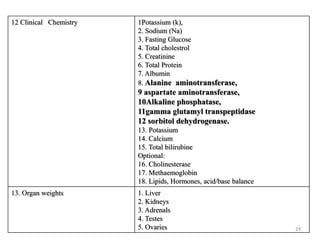
12 Clinical Chemistry 1Potassium (k),
2. Sodium (Na)
3. Fasting Glucose
4. Total cholestrol
5. Creatinine
6. Total Protein
7. Albumin
8. Alanine aminotransferase,
9 aspartate aminotransferase,
10Alkaline phosphatase,
11gamma glutamyl transpeptidase
12 sorbitol dehydrogenase.
13. Potassium
14. Calcium
15. Total bilirubine
Optional:
16. Cholinesterase
17. Methaemoglobin
18. Lipids, Hormones, acid/base balance
13. Organ weights 1. Liver
2. Kidneys
3. Adrenals
4. Testes
5. Ovaries 24
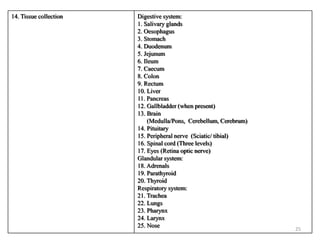
14. Tissue collection Digestive system:
1. Salivary glands
2. Oesophagus
3. Stomach
4. Duodenum
5. Jejunum
6. Ileum
7. Caecum
8. Colon
9. Rectum
10. Liver
11. Pancreas
12. Gallbladder (when present)
13. Brain
(Medulla/Pons, Cerebellum, Cerebrum)
14. Pituitary
15. Peripheral nerve (Sciatic/ tibial)
16. Spinal cord (Three levels)
17. Eyes (Retina optic nerve)
Glandular system:
18. Adrenals
19. Parathyroid
20. Thyroid
Respiratory system:
21. Trachea
22. Lungs
23. Pharynx
24. Larynx
25. Nose
25
15. Tissue collection contd. Cardiovascular/ hemopoietic system:
26. Aorta
27. Heart
28. Bone marrow
29. Lymph nodes
30. Spleen
31. Thymus
Urogenital system:
32. Kidneys,
33. Urinary bladder
34. Prostate
35. Testes
36. Epididymises
37. Seminal vesicle(s)
38. Uterus
39. Ovaries
40. Female mammary glands
Others :
All gross lesions &
Masses skin
16. Histopathology Gross lesions
Control & high dose
Lungs in low and mid dose
Liver & Kidney in low and mid dose
26
27
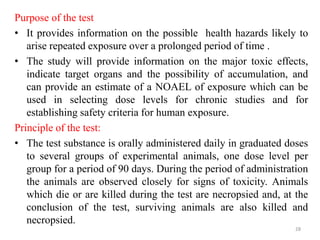
Purpose of the test
• It provides information on the possible health hazards likely to
arise repeated exposure over a prolonged period of time .
• The study will provide information on the major toxic effects,
indicate target organs and the possibility of accumulation, and
can provide an estimate of a NOAEL of exposure which can be
used in selecting dose levels for chronic studies and for
establishing safety criteria for human exposure.
Principle of the test:
• The test substance is orally administered daily in graduated doses
to several groups of experimental animals, one dose level per
group for a period of 90 days. During the period of administration
the animals are observed closely for signs of toxicity. Animals
which die or are killed during the test are necropsied and, at the
conclusion of the test, surviving animals are also killed and
necropsied.
28
DETAILS OECD-408 (12.05.1981)
1. Age of animals After weaning not more than 9 weeks.
2. Acclimatization At least 5 days
3. No. of animals 20 animals (10 male 10 female)
4. Body weight range ± 20% of the mean weight
5. No. of groups At least 3dose group
1 control/vehicle, 1 high dose recovery group ,
concurrent control
7.Clinical observations Once a day
8.Physical examination Not mentioned
9. Body weight, Feed, Water Weekly
10. Functional observation Not mentioned
12. Haematology 1. Haemotocrit
2 . Haemoglobin concentration
3 .erythrocyte count
4.Total and differential leukocyte count
5.Platelet count
6.Blood clotting time
90-DAYS TOXICITY STUDY
29
13. Clinical Chemistry 1. Potassium (k),2. Sodium (Na)
3. Fasting Glucose
4. Blood Urea Nitrogen
5. Creatinine
6. Total Protein
7. Albumin
8. Aspartate aminotransferase
9. Alanine aminotransferase
10. Gamma Glutamyl ranspeptidase
11.Sorbitol dehydrogenase
12. Potassium
13. Calcium
14. Total bilirubine
Optional:
15. Cholinesterase
16. Methaemoglobin
14. Urinalysis Optional
15. Organ weights 1. Liver
2. Kidneys
3. Adrenals
4. Testes
5. Ovaries 30
16. Tissue collection Digestive system:
1. Salivary glands
2. Oesophagus
3. Stomach
4. Duodenum
5. Jejunum
6. Ileum
7. Cecum
8. Colon
9. Rectum
10. Liver
11. Pancreas
12. Gallbladder (when present)
13. Brain
(Medulla/Pons, Cerebellum, Cerebrum)
14. Pituitary
15. Peripheral nerve (Sciatic/ tibial)
16. Spinal cord (Three levels)
17. Eyes (Retina optic nerve)
Glandular system:
18. Adrenals
19. Parathyroid
20. Thyroid
Respiratory system:
21. Trachea
22. Lungs
23. Pharynx
24. Larynx
25. Nose
31
16. Tissue collection contd. Cardiovascular/ hemopoietic system:
26. Aorta
27. Heart
28. Bone marrow
29. Lymph nodes
30. Spleen
31. Thymus
Urogenital system:
32. Kidneys,
33. Urinary bladder
34. Prostate
35. Testes
36. Epididymises
37. Seminal vesicle(s)
38. Uterus
39. Ovaries
40. Female mammary glands
Others :
All gross lesions &
Masses skin
17. Histopathology Gross lesions
Control & high dose
Lungs in low and mid dose
Liver & Kidney in low and mid dose
32
• References
1. Wikipedia OECD GUIDELINES
2. https://mneguidelines.oecd.org/about.htm
33
34

OECD GUIDELINES.pptx

  • 1.
    Department of PharmaceuticalChemistry Presenting by , Mr. PURUSHOTHAM K N Assistant Professor Department of Ph. Chemistry SACCP B. G. Nagar 2021-2022 OECD guidelines 1
  • 2.
    CONTENTS • Introduction • Objectivesof OECD • Purpose • Important OECD guidelines • Toxicity study • Acute oral toxicity 2
  • 3.
    OECD(Organisation for EconomicCo-operation and Development) GUIDELINES OECD Guidelines for the Testing of Chemicals (OECD TG) are a set of internationally accepted specifications for the testing of chemicals decided on by the Organization for Economic Co-operation and Development (OECD). They were first published in 1981. 3
  • 4.
    OBJECTIVE OF OECD: •Government and industry are concerned about the quality of non-clinical health and environmental safety studies . • In 1995&1996new group of experts have revised and updated the principles. • These principles of should be applied to the non clinical safety testing of test items contained in pharmaceutical products cosmetics. 4
  • 5.
    Purpose Hundreds of newchemicals, such as industrial chemicals, pesticides, food additives, biotechnology products and pharmaceuticals, flood the world market each year and may require safety testing in most parts of the world. Purpose: • To enhance the validity and international acceptance of test data • Make the best use of available resources in both government and industry • Avoid the unnecessary use of laboratory animals 5
  • 6.
    • They aresplit into five sections • Section 1: Physical Chemical Properties • Section2: Effects on Biotic Systems • Section3: Environmental Fate and Behavior • Section4: Health Effects • Section5: Other Test Guidelines Guidelines are numbered with three digit numbers, the section number being the first number. Sometimes guidelines are suffixed with a letter. 6
  • 7.
    Important OECD guideline •420 Acute oral Toxicity- fixed dose method • 423 Acute oral Toxicity-acute toxic class method • 425 Acute oral Toxicity-Up and Down method • 402 Acute dermal Toxicity • 404 Acute dermal Irritation/ Corrosion • 403 Acute inhalation Toxicity • 405 Acute Eye Irritation /Corrosion405 • 406 Skin sensitization28 • 407 28days repeated oral Toxicity studies in rodents • 408 90 days repeated oral Toxicity studies in rodents • 409 90 days repeated oral Toxicity studies in non rodents 7
  • 8.
    • 410 90days repeated Dermal Toxicity • 411 90 days inhalation Toxicity study • 412 28/14 days repeated dose inhalation Toxicity study • 413 90 days repeated dose inhalation Toxicity study • 414 Prenatal Developmental Toxicity study • 421 Reproduction /Development toxicity screening test • 422 Combined Repeated dose toxicity study with Reproduction/Developmental Toxicity screening test • 422 Neurotoxicity study in rodents • 451Carcinogenicity studies • 452Chronic Toxicity studies • 453 Combined chronic toxicity/carcinogenic studies 8
  • 9.
    Test Guidelines- 402,403, 420, 423, And 425 • Fixed Dose Procedure-OECD 420 • Acute Toxic Class method -OECD 423, • Up-and-Down Procedure -OECD 425. • 28 days repeated oral Toxicity studies in rodents- OECD 407 • 90 days repeated oral Toxicity studies in rodents OECD 408 • Acute Dermal Toxicity-OECD 402, • Acute inhalation toxicity-OECD 403. 9
  • 10.
    TOXICITY STUDY • Acutetoxicity: Adverse effects occurring within a short time following administration of single dose. • Sub-acute toxicity • Chronic toxicity- Period of 90 days or more. Special toxicity studies- Period of 2 years or more. Carcinogenicity Mutagenicity Teratogenicity Reproductive toxicity 10
  • 11.
  • 12.
    Acute Oral Toxicity: Purpose& scope: Acute oral toxicity: • It is the adverse effects occurring within a short time of oral administration of a single dose of a substance or multiple doses given within 24 hours.  It is used in the assessment and evaluation of the toxic characteristics of a substance. • Determination of acute oral toxicity is usually an initial step. 12
  • 13.
    Principle(according to 401guideline): • The test substance is administerde orally by gavage in graduated doses to several groups • The doses chosen may be based on the results of a range finding test. Observations of effects and deaths are made. • This guideline is directed primarily to studies in rodent. • Species but may be adapted for studies in non- rodents. Animals showing severe signs of distress and pain may need to be humanely killed. 13
  • 14.
    Principle(according to 420) •FIXED DOSE PROCEDURE: • In this method only moderately toxic doses are used. • Moribund animals, or animals obviously in pain or showing signs of severe and distress shall be humanely killed. • Interpretation of the results in the way as animals that died on test. • Criteria for making the decision to kill moribund or severely suffering animals, recognition of predictable or impending death, are the subject of a separate Guidance Document. 14
  • 15.
    Principle according to423 guideline: • It is, based on a stepwise procedure with the use of a minimum • number of animals per step. • The substance is administered orally to a group of experimental animals at one of the defined doses. • In each step 3 animals are used of single sex(usually females). • Absence or presence of compound-related mortality of the animals dosed at • one step will determine the next step, i.e.; 1)no further testing is needed, 2) dosing of three additional animals, with the same dose dosing of three additional animals at the next higher or the next lower dose level. 15
  • 16.
    Principle according to425: • UP&DOWN PROCEDURE: • It is a single ordered dose progression program. In this animals are dosed in an interval of 48 hrs. • The first animal receives a dose a step below the level of the best • estimate of the LD50. • If the animal survives, the dose for the next animal is increased by [a factor of] 3.2 times the original dose. • If it dies, the dose for the next animal is decreased by a similar dose progression. • (Note: 3.2 is the default factor corresponding to a dose progression of one half log unit. • Each animal should be observed carefully for up to 48 hours before making a decision on whether and how much to dose the next animal. 16
  • 17.
    Procedure • Preparation ofthe test substance: • Healthy young animals are selected 5 days prior to treatment. • Where necessary, the test substance is dissolved or suspended in a suitable vehicle. • For non-aqueous vehicles the toxic characteristics of the vehicle should be known, and if not known should be determined before the test. • In rodents the maximum dose is 1ml/kg &in case of aqueous vehicles it can be 2ml/kg. 17
  • 18.
    Selection of species: •Although several animals are available mostly rats are selected &the weight variation should be in between +_20 % of the mean. • Number and sex • At least 5 rodents are used at each dose level. They should all be of the same sex. If females are used they should be nulliparous and non-pregnant. 18
  • 19.
    Housing and feedingconditions: • The temperature of the experimental animal room should be 22°C (± 3°) and the humidity 30-70 %. • Animals may be group-caged by sex. • It should be kept at 12 hours light, 12 hours dark. • P r o c e d u r e: • Animals should be fasted prior to substance administration. the test substance administered in a single dose to animals by groups by gavage . • If a single dose is not possible, the dose may be given in smaller fractions over a period not exceeding 24 hours. • After the substance has been administered, food may be withheld for a further 3-4 hours. Where a dose is administered in fractions over a period, it may be necessary to provide the animals with food and water 19
  • 20.
    Evaluation of results: •The LD50 value should always be considered in conjunction with the observed toxic effects and any necropsy findings. • The LD50 value is a relatively useful only as a reference value for classification and labelling purposes, and for an expression of the lethal potential of the test substance by the ingestion route. • Reference should always be made to the experimental animal species in which the LD50 value was obtained. 20
  • 21.
    ORAL TOXICITY (OECD 407) SUBCHRONIC TOXICITY 21
  • 22.
    PURPOSE OF THESTUDY: In the assessment and evaluation of the toxic characteristics of a chemical, the determination of oral toxicity using repeated doses may be carried out after initial information on toxicity has been obtained by acute testing. PRINCIPLE OF THE STUDY: The test substance is orally administered daily in graduated doses to several groups of experimental animals, one dose level per group for a period of 28 days. During the period of administration the animals are observed closely, each day for signs of toxicity. Animals which die or are killed during the test are necropsied and at the conclusion of the test surviving animals are killed and necropsied. 22
  • 23.
    DETAILS OECD-407 1. Ageof animals After weaning not more than 8 weeks. 2. Acclimatization At least 5 days 3. No. of animals 10/sex/group 4. Body weight range ± 20% of the mean weight 5. No. of groups At least 2dose group 1 control/vehicle, 1 high dose recovery group 6. Recovery period Not less than 28 days 7.Clinical observations Once a day 8.Physical examination Not mentioned 9. Body weight, Feed, Water Weekly 10. Functional observation Not mentioned 11. Haematology 1. Haemotocrit 2. Red Blood Corpuscles 3. Haemoglobin 4. White Blood Corpuscles 5. Differential Leucocyte Count 6. Clotting time 7. Prothrombine time 8. Thromboplastine time 9. Platelet Count 28-DAYS TOXICITY STUDY 23
  • 24.
    12 Clinical Chemistry1Potassium (k), 2. Sodium (Na) 3. Fasting Glucose 4. Total cholestrol 5. Creatinine 6. Total Protein 7. Albumin 8. Alanine aminotransferase, 9 aspartate aminotransferase, 10Alkaline phosphatase, 11gamma glutamyl transpeptidase 12 sorbitol dehydrogenase. 13. Potassium 14. Calcium 15. Total bilirubine Optional: 16. Cholinesterase 17. Methaemoglobin 18. Lipids, Hormones, acid/base balance 13. Organ weights 1. Liver 2. Kidneys 3. Adrenals 4. Testes 5. Ovaries 24
  • 25.
    14. Tissue collectionDigestive system: 1. Salivary glands 2. Oesophagus 3. Stomach 4. Duodenum 5. Jejunum 6. Ileum 7. Caecum 8. Colon 9. Rectum 10. Liver 11. Pancreas 12. Gallbladder (when present) 13. Brain (Medulla/Pons, Cerebellum, Cerebrum) 14. Pituitary 15. Peripheral nerve (Sciatic/ tibial) 16. Spinal cord (Three levels) 17. Eyes (Retina optic nerve) Glandular system: 18. Adrenals 19. Parathyroid 20. Thyroid Respiratory system: 21. Trachea 22. Lungs 23. Pharynx 24. Larynx 25. Nose 25
  • 26.
    15. Tissue collectioncontd. Cardiovascular/ hemopoietic system: 26. Aorta 27. Heart 28. Bone marrow 29. Lymph nodes 30. Spleen 31. Thymus Urogenital system: 32. Kidneys, 33. Urinary bladder 34. Prostate 35. Testes 36. Epididymises 37. Seminal vesicle(s) 38. Uterus 39. Ovaries 40. Female mammary glands Others : All gross lesions & Masses skin 16. Histopathology Gross lesions Control & high dose Lungs in low and mid dose Liver & Kidney in low and mid dose 26
  • 27.
  • 28.
    Purpose of thetest • It provides information on the possible health hazards likely to arise repeated exposure over a prolonged period of time . • The study will provide information on the major toxic effects, indicate target organs and the possibility of accumulation, and can provide an estimate of a NOAEL of exposure which can be used in selecting dose levels for chronic studies and for establishing safety criteria for human exposure. Principle of the test: • The test substance is orally administered daily in graduated doses to several groups of experimental animals, one dose level per group for a period of 90 days. During the period of administration the animals are observed closely for signs of toxicity. Animals which die or are killed during the test are necropsied and, at the conclusion of the test, surviving animals are also killed and necropsied. 28
  • 29.
    DETAILS OECD-408 (12.05.1981) 1.Age of animals After weaning not more than 9 weeks. 2. Acclimatization At least 5 days 3. No. of animals 20 animals (10 male 10 female) 4. Body weight range ± 20% of the mean weight 5. No. of groups At least 3dose group 1 control/vehicle, 1 high dose recovery group , concurrent control 7.Clinical observations Once a day 8.Physical examination Not mentioned 9. Body weight, Feed, Water Weekly 10. Functional observation Not mentioned 12. Haematology 1. Haemotocrit 2 . Haemoglobin concentration 3 .erythrocyte count 4.Total and differential leukocyte count 5.Platelet count 6.Blood clotting time 90-DAYS TOXICITY STUDY 29
  • 30.
    13. Clinical Chemistry1. Potassium (k),2. Sodium (Na) 3. Fasting Glucose 4. Blood Urea Nitrogen 5. Creatinine 6. Total Protein 7. Albumin 8. Aspartate aminotransferase 9. Alanine aminotransferase 10. Gamma Glutamyl ranspeptidase 11.Sorbitol dehydrogenase 12. Potassium 13. Calcium 14. Total bilirubine Optional: 15. Cholinesterase 16. Methaemoglobin 14. Urinalysis Optional 15. Organ weights 1. Liver 2. Kidneys 3. Adrenals 4. Testes 5. Ovaries 30
  • 31.
    16. Tissue collectionDigestive system: 1. Salivary glands 2. Oesophagus 3. Stomach 4. Duodenum 5. Jejunum 6. Ileum 7. Cecum 8. Colon 9. Rectum 10. Liver 11. Pancreas 12. Gallbladder (when present) 13. Brain (Medulla/Pons, Cerebellum, Cerebrum) 14. Pituitary 15. Peripheral nerve (Sciatic/ tibial) 16. Spinal cord (Three levels) 17. Eyes (Retina optic nerve) Glandular system: 18. Adrenals 19. Parathyroid 20. Thyroid Respiratory system: 21. Trachea 22. Lungs 23. Pharynx 24. Larynx 25. Nose 31
  • 32.
    16. Tissue collectioncontd. Cardiovascular/ hemopoietic system: 26. Aorta 27. Heart 28. Bone marrow 29. Lymph nodes 30. Spleen 31. Thymus Urogenital system: 32. Kidneys, 33. Urinary bladder 34. Prostate 35. Testes 36. Epididymises 37. Seminal vesicle(s) 38. Uterus 39. Ovaries 40. Female mammary glands Others : All gross lesions & Masses skin 17. Histopathology Gross lesions Control & high dose Lungs in low and mid dose Liver & Kidney in low and mid dose 32
  • 33.
    • References 1. WikipediaOECD GUIDELINES 2. https://mneguidelines.oecd.org/about.htm 33
  • 34.