SYNTHETIC REAGENTS
& APPLICATIONS
Presented by:
Mohd Shafeeque
M. Pharm.(Pharm. Chemistry)
Jamia Hamdard
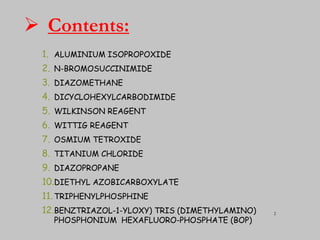
 Contents:
1. ALUMINIUM ISOPROPOXIDE
2. N-BROMOSUCCINIMIDE
3. DIAZOMETHANE
4. DICYCLOHEXYLCARBODIMIDE
5. WILKINSON REAGENT
6. WITTIG REAGENT
7. OSMIUM TETROXIDE
8. TITANIUM CHLORIDE
9. DIAZOPROPANE
10.DIETHYL AZOBICARBOXYLATE
11. TRIPHENYLPHOSPHINE
12.BENZTRIAZOL-1-YLOXY) TRIS (DIMETHYLAMINO)
PHOSPHONIUM HEXAFLUORO-PHOSPHATE (BOP)
2
ALUMINIUM ISOPROPOXIDE
 It is the chemical compound usually described with the formula
Al(O-i-Pr)3, where i-Pr is the isopropyl group [–CH(CH3)2].
 This belongs to aluminium alkoxide group.
 It is used as a catalyst and an intermediate in different
reactions.
 It is a very useful reducing agent. Its importance lies in its
specific reducing property for carbonyl group without affecting
other reducible groups such as double bonds, nitro group etc.
 Description:
• Structure: Al
O
O
O
C
H3
CH3
C
H3
C
H3
CH3
C
H3
3
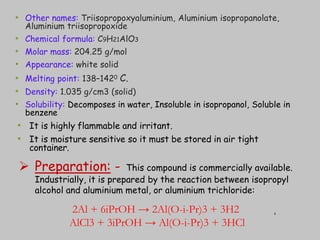
 Preparation: - This compound is commercially available.
Industrially, it is prepared by the reaction between isopropyl
alcohol and aluminium metal, or aluminium trichloride:
• Other names: Triisopropoxyaluminium, Aluminium isopropanolate,
Aluminium triisopropoxide
• Chemical formula: C9H21AlO3
• Molar mass: 204.25 g/mol
• Appearance: white solid
• Melting point: 138–1420 C.
• Density: 1.035 g/cm3 (solid)
• Solubility: Decomposes in water, Insoluble in isopropanol, Soluble in
benzene
• It is highly flammable and irritant.
• It is moisture sensitive so it must be stored in air tight
container.
2Al + 6iPrOH → 2Al(O-i-Pr)3 + 3H2
AlCl3 + 3iPrOH → Al(O-i-Pr)3 + 3HCl
4
 Applications:
• Meerwein-Ponndorf-Verley Reduction: In a MPV reduction,
ketones and aldehydes are reduced to alcohols concomitant with
the formation of acetone.
• Hydrolysis of Oximes: Oximes can be converted into parent
carbonyl compounds by aluminum isopropoxide followed by acid
hydrolysis. Yields are generally high in the case of ketones, but
are lower for regeneration of aldehydes.
R
1
R
2
OH
R
3
R
4
O
R
1
R
2
O
R
3
R
4
OH
+ +
Al[OCH(CH 3)2]3
R
1
R
2
N OH
R
1
R
2
O
1-
Al(O-
i-
Pr)3
2-
HCl, H2O 5
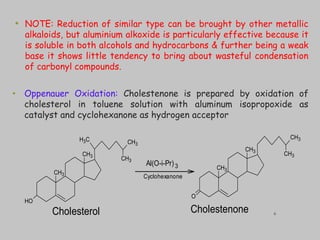
• Oppenauer Oxidation: Cholestenone is prepared by oxidation of
cholesterol in toluene solution with aluminum isopropoxide as
catalyst and cyclohexanone as hydrogen acceptor
• NOTE: Reduction of similar type can be brought by other metallic
alkaloids, but aluminium alkoxide is particularly effective because it
is soluble in both alcohols and hydrocarbons & further being a weak
base it shows little tendency to bring about wasteful condensation
of carbonyl compounds.
Al(O-i-Pr) 3
Cyclohexanone
Cholesterol Cholestenone
C
H3 CH3
CH3
CH3
CH3
O
H
CH3
CH3
CH3
CH3
O
6
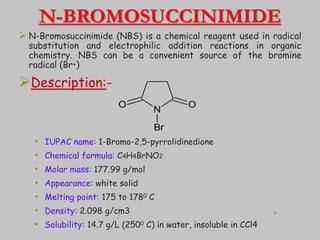
N-BROMOSUCCINIMIDE
 N-Bromosuccinimide (NBS) is a chemical reagent used in radical
substitution and electrophilic addition reactions in organic
chemistry. NBS can be a convenient source of the bromine
radical (Br•)
Description:-
• IUPAC name: 1-Bromo-2,5-pyrrolidinedione
• Chemical formula: C4H4BrNO2
• Molar mass: 177.99 g/mol
• Appearance: white solid
• Melting point: 175 to 1780 C
• Density: 2.098 g/cm3
• Solubility: 14.7 g/L (2500 C) in water, insoluble in CCl4
N
O
O
Br
7
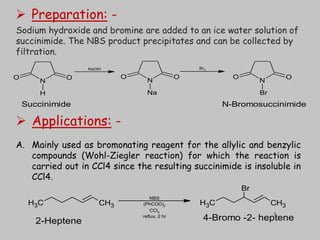
 Preparation: -
Sodium hydroxide and bromine are added to an ice water solution of
succinimide. The NBS product precipitates and can be collected by
filtration.
N
O
O
Br
N
O
O
H
N
O
O
Na
NaOH Br2
Succinimide N-Bromosuccinimide
 Applications: -
A. Mainly used as bromonating reagent for the allylic and benzylic
compounds (Wohl-Ziegler reaction) for which the reaction is
carried out in CCl4 since the resulting succinimide is insoluble in
CCl4.
C
H3 CH3 C
H3 CH3
Br
NBS
(PhCOO)2
CCl4
reflux, 2 hr
2-Heptene 4-Bromo -2- heptene
8
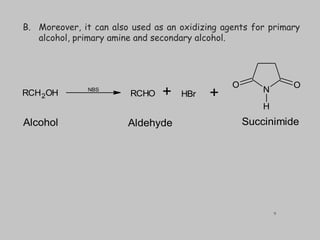
B. Moreover, it can also used as an oxidizing agents for primary
alcohol, primary amine and secondary alcohol.
RCH2OH RCHO HBr
N
O
O
H
Succinimide
NBS
+ +
Alcohol Aldehyde
9
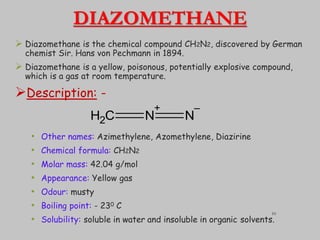
DIAZOMETHANE
 Diazomethane is the chemical compound CH2N2, discovered by German
chemist Sir. Hans von Pechmann in 1894.
 Diazomethane is a yellow, poisonous, potentially explosive compound,
which is a gas at room temperature.
Description: -
• Other names: Azimethylene, Azomethylene, Diazirine
• Chemical formula: CH2N2
• Molar mass: 42.04 g/mol
• Appearance: Yellow gas
• Odour: musty
• Boiling point: - 230 C
• Solubility: soluble in water and insoluble in organic solvents.
C
H2 N
+
N
–
10
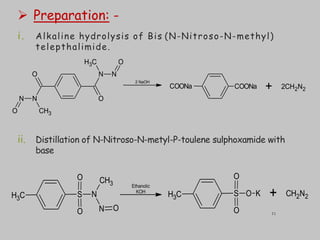
 Preparation: -
i. Alkaline hydrolysis of Bis (N-Nitroso-N-methyl)
telepthalimide.
ii. Distillation of N-Nitroso-N-metyl-P-toulene sulphoxamide with
base
O
N
N
O CH3
O
N N
O
C
H3
COONa COONa 2CH2N2
2 NaOH
+
S
O
N
N O
CH3
O
C
H3
CH2N2
+
S
O
O
C
H3 O K
Ethanolic
KOH
11
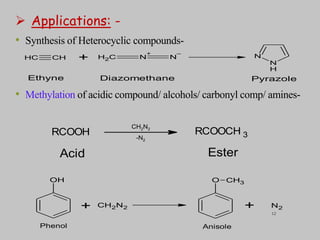
 Applications: -
• Synthesis of Heterocyclic compounds-
• Methylation of acidic compound/ alcohols/ carbonyl comp/ amines-
C
H CH C
H2 N
+
N
–
N
N
H
+
Ethyne Diazomethane Pyrazole
Acid Ester
RCOOH RCOOCH 3
CH2N2
-N2
Phenol
OH O CH3
CH2N2
+ N2
+
Anisole
12
DICYCLOHEXYLCARBODIMIDE
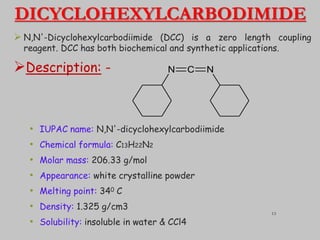
 N,N'-Dicyclohexylcarbodiimide (DCC) is a zero length coupling
reagent. DCC has both biochemical and synthetic applications.
Description: -
• IUPAC name: N,N'-dicyclohexylcarbodiimide
• Chemical formula: C13H22N2
• Molar mass: 206.33 g/mol
• Appearance: white crystalline powder
• Melting point: 340 C
• Density: 1.325 g/cm3
• Solubility: insoluble in water & CCl4
N C N
13
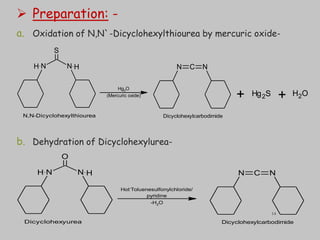
 Preparation: -
a. Oxidation of N,N`-Dicyclohexylthiourea by mercuric oxide-
b. Dehydration of Dicyclohexylurea-
N C N
N N
H H
S
Hg2O
(Mercuric oxide)
N,N-Dicyclohexylthiourea Dicyclohexylcarbodimide
Hg2S H2O
+ +
N C N
N N
H H
O
Dicyclohexyurea Dicyclohexylcarbodimide
Hot-
Toluenesulfonylchloride/
pyridine
-H2O
14
 Applications: -
• DCC is mainly used in amikacin, glutathione dehydrants, as well as in
synthesis of acid anhydride, ketone, isocyanate; when it is used as
dehydrating condensing agent.
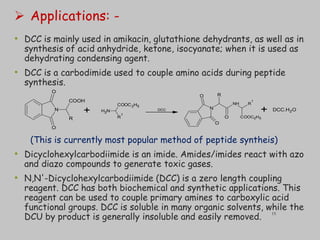
• DCC is a carbodimide used to couple amino acids during peptide
synthesis.
(This is currently most popular method of peptide syntheis)
• Dicyclohexylcarbodiimide is an imide. Amides/imides react with azo
and diazo compounds to generate toxic gases.
• N,N'-Dicyclohexylcarbodiimide (DCC) is a zero length coupling
reagent. DCC has both biochemical and synthetic applications. This
reagent can be used to couple primary amines to carboxylic acid
functional groups. DCC is soluble in many organic solvents, while the
DCU by product is generally insoluble and easily removed.
N
O
O
R
COOH
N
H2
COOC2H5
R
1
DCC N
O
O
R
O
NH
COOC2H5
R
1
+ + DCC.H2O
15
WILKINSON REAGENT
• Wilkinson’s Catalyst [IUPAC Name: chloridotris(triphenyl-
phosphine)rhodium(I)] is a coordination compound whose
coordination centre is rhodium.
• It is extensively used as a catalyst in the hydrogenation of
alkenes. The chemical formula of Wilkinson’s catalyst can be
written as [RhCl(PPh3)3] where ‘Ph’ denotes a phenyl group. At
ambient temperatures, this coordination complex exists as a
reddish-brown solid.
• Wilkinson’s catalyst is named after the English chemist Sir
Geoffrey Wilkinson.
• The structure adopted by Wilkinson’s Catalyst is square planar
(slightly distorted). The rhodium centre is bound to four ligands in
this compound.
16
 Description: -
• The molar mass of Wilkinson’s catalyst is 925.22 grams/mole
• It’s melting point ranges from 518 to 523 K
• It is insoluble in water. However, it is soluble in many hydrocarbon-
based solvents such as benzene and tetrahydrofuran.
Preparation: -
• Wilkinson’s catalyst can be prepared by reacting hydrated
rhodium(III) chloride with excess triphenylphosphine in the
presence of ethanol (which acts as a refluxing agent). Here, the
triphenylphosphine (denoted by the chemical formula P(C6H5)3)
acts as a reducing agent which has the ability to oxidize itself
from an oxidation state of +3 to an oxidation state of +5.
• During the synthesis of Wilkinson’s catalyst, one equivalent of
triphenylphosphine reduces rhodium(III) to rhodium(I) while
three other equivalents bind themselves to the metal as ligands in
the final product.
4P(C6H5)3 RhCl3(H2O)3 RhCl[P(C6H5)3]3 OP(C6H5)3 2HCl 2H2O
+ + + +
17
 Applications: -
• Wilkinson’s catalyst can be employed for the hydro acylation of
alkenes.
• The hydroboration and hydrosilylation of olefins can also be achieved
with the help of this coordination complex.
• Functionalized tri-substituted alkenes and internal alkynes can be
subjected to hydrogenation with the help of Wilkinson’s catalyst in the
presence of hydrogen and a strong base. Here, a highly reactive Rh(I)
species having relatively superior catalytic activity is formed
• This catalyst is highly effective in the selective reduction of the least
hindered olefin when there are several olefins present
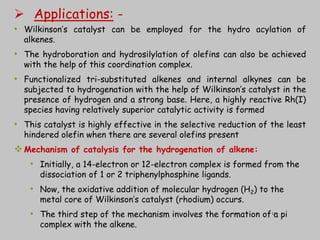
Mechanism of catalysis for the hydrogenation of alkene:
• Initially, a 14-electron or 12-electron complex is formed from the
dissociation of 1 or 2 triphenylphosphine ligands.
• Now, the oxidative addition of molecular hydrogen (H2) to the
metal core of Wilkinson’s catalyst (rhodium) occurs.
• The third step of the mechanism involves the formation of a pi
complex with the alkene.
18
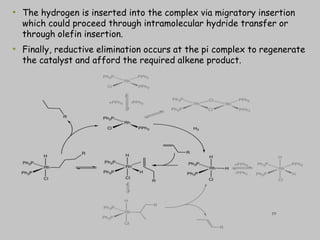
• The hydrogen is inserted into the complex via migratory insertion
which could proceed through intramolecular hydride transfer or
through olefin insertion.
• Finally, reductive elimination occurs at the pi complex to regenerate
the catalyst and afford the required alkene product.
19
WITTIG REAGENT
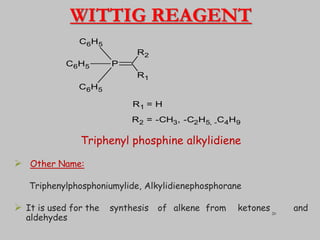
Triphenyl phosphine alkylidiene
 Other Name:
Triphenylphosphoniumylide, Alkylidienephosphorane
 It is used for the synthesis of alkene from ketones and
aldehydes
P
C6H5
C6H5
C6H5
R1
R2
R1 = H
R2 = -CH3, -C2H5, -C4H9
20
 Preparation: -
• Wittig reagents are usually prepared from a phosphonium salt,
which is in turn prepared by the quaternization of
triphenylphosphine with an alkyl halide. The alkylphosphonium salt
is deprotonated with a strong base such as n-butyllithium.
[Ph3P+CH2R]X
-
C4H9Li Ph3P=CHR LiX C4H10
+ + +
P
C6H5
C6H5
C6H5
R1
R2
P
+
C6H5
C6H5
C6H5
C
–
R1
R2
Phosphorane ylide
Forms of Wittig Reagent
21
 Applications: -
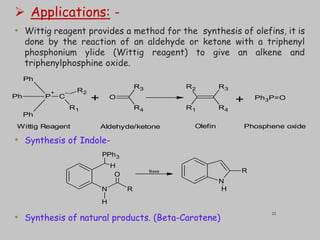
• Wittig reagent provides a method for the synthesis of olefins, it is
done by the reaction of an aldehyde or ketone with a triphenyl
phosphonium ylide (Wittig reagent) to give an alkene and
triphenylphosphine oxide.
• Synthesis of Indole-
• Synthesis of natural products. (Beta-Carotene)
P
+
Ph
Ph
Ph
C
–
R1
R2
O
R3
R4
R3
R4
R2
R1
Ph3P=O
+ +
Wittig Reagent Aldehyde/ketone Olefin Phosphene oxide
PPh3
N R
H
O
H
N
R
H
Base
22
OSMIUM TETROXIDE
• Osmium tetroxide [also osmium (VIII) oxide] is the chemical
compound with the formula OsO4.
Description: -
• Other names: Tetraoxoosmium, Osmium(VIII) oxide
• Chemical formula: OsO4
• Molar mass: 254.23 g/mol
• Appearance: white volatile solid
• Melting point: 40.250 C
• Density: 4.9 g/cm3
• Solubility: soluble in most organic solvents, ammonium hydroxide,
phosphorus oxychloride
23
 Preparation:
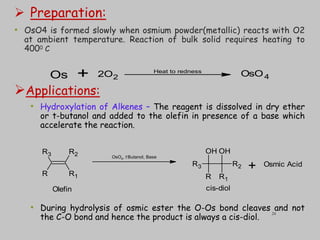
• OsO4 is formed slowly when osmium powder(metallic) reacts with O2
at ambient temperature. Reaction of bulk solid requires heating to
4000 C
Applications:
• Hydroxylation of Alkenes – The reagent is dissolved in dry ether
or t-butanol and added to the olefin in presence of a base which
accelerate the reaction.
• During hydrolysis of osmic ester the O-Os bond cleaves and not
the C-O bond and hence the product is always a cis-diol.
Os 2O2 OsO4
Heat to redness
+
R3
R
R2
R1
R3
R
OH
R1
R2
OH
OsO4, t-
Butanol, Base
Osmic Acid
+
Olefin cis-diol
24
• Coordination chemistry - OsO4 is a Lewis acid and a mild oxidant.
It reacts with alkaline aqueous solution to give the perosmate
anion OsO4(OH)2 2− . This species is easily reduced to osmate
anion, OsO2(OH)4 4− .
 With tert-BuNH2, the imido derivative is produced:
 Similarly, with NH3 one obtains the nitrido complex:
• Biological staining - OsO4 is a widely used staining agent used in
transmission electron microscopy (TEM) to provide contrast to
the image.
• Polymer staining
• Osmium ore refining
OsO4 + NH3 + KOH K[Os(N)O3] + 2H2O
OsO4 + Me3CNH2 OsO3(NCMe3) + 2H2O
25
TITANIUM CHLORIDE
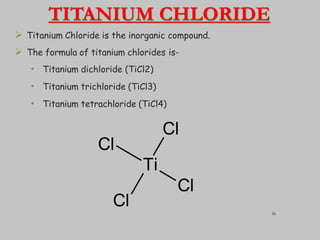
 Titanium Chloride is the inorganic compound.
 The formula of titanium chlorides is-
• Titanium dichloride (TiCl2)
• Titanium trichloride (TiCl3)
• Titanium tetrachloride (TiCl4)
Ti
Cl
Cl
Cl
Cl 26
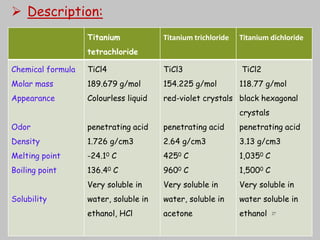
 Description:
Titanium
tetrachloride
Titanium trichloride Titanium dichloride
Chemical formula
Molar mass
Appearance
Odor
Density
Melting point
Boiling point
Solubility
TiCl4
189.679 g/mol
Colourless liquid
penetrating acid
1.726 g/cm3
-24.10 C
136.40 C
Very soluble in
water, soluble in
ethanol, HCl
TiCl3
154.225 g/mol
red-violet crystals
penetrating acid
2.64 g/cm3
4250 C
9600 C
Very soluble in
water, soluble in
acetone
TiCl2
118.77 g/mol
black hexagonal
crystals
penetrating acid
3.13 g/cm3
1,0350 C
1,5000 C
Very soluble in
water soluble in
ethanol 27
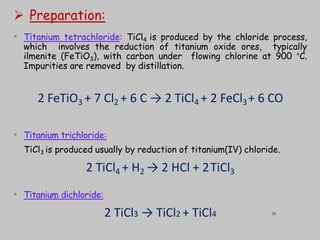
 Preparation:
• Titanium tetrachloride: TiCl4 is produced by the chloride process,
which involves the reduction of titanium oxide ores, typically
ilmenite (FeTiO3), with carbon under flowing chlorine at 900 °C.
Impurities are removed by distillation.
2 FeTiO3 + 7 Cl2 + 6 C → 2 TiCl4 + 2 FeCl3+ 6 CO
• Titanium trichloride:
TiCl3 is produced usually by reduction of titanium(IV) chloride.
2 TiCl4 + H2 → 2 HCl + 2TiCl3
• Titanium dichloride:
2 TiCl3 → TiCl2 + TiCl4 28
 Application of titanium tetrachloride:
• Production of titanium metal: The conversion involves the reduction of
the tetrachloride with magnesium metal. This procedure is known as
the Kroll process.
2 Mg + TiCl4 → 2 MgCl2 +Ti
• Production of titanium dioxide: Around 90% of the TiCl4 production is
used to make the pigment titanium dioxide (TiO2). The conversion
involves hydrolysis of TiCl4, a process that forms hydrogen chloride.
TiCl4 + 2 H2O → TiO2 + 4HCl
In some cases, TiCl4 is oxidised directly with oxygen.
TiCl4 + O2 → TiO2 + 2 Cl2
• TiCl4 finds occasional use in organic synthesis, capitalizing on its Lewis
acidity, its oxophilicity, and the electron-transfer properties of its
reduced titanium halides.
• It is used in the Lewis acid catalysed aldol addition. 29
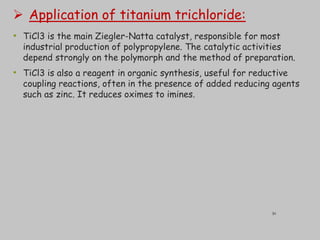
 Application of titanium trichloride:
• TiCl3 is the main Ziegler-Natta catalyst, responsible for most
industrial production of polypropylene. The catalytic activities
depend strongly on the polymorph and the method of preparation.
• TiCl3 is also a reagent in organic synthesis, useful for reductive
coupling reactions, often in the presence of added reducing agents
such as zinc. It reduces oximes to imines.
30
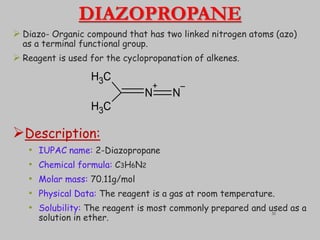
DIAZOPROPANE
 Diazo- Organic compound that has two linked nitrogen atoms (azo)
as a terminal functional group.
 Reagent is used for the cyclopropanation of alkenes.
Description:
• IUPAC name: 2-Diazopropane
• Chemical formula: C3H6N2
• Molar mass: 70.11g/mol
• Physical Data: The reagent is a gas at room temperature.
• Solubility: The reagent is most commonly prepared and used as a
solution in ether.
C
H3
C
H3
N
+
N
–
31
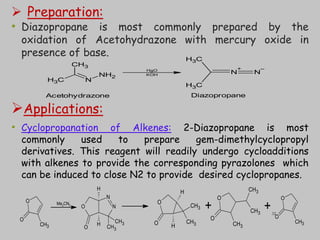
 Preparation:
• Diazopropane is most commonly prepared by the
oxidation of Acetohydrazone with mercury oxide in
presence of base.
Applications:
• Cyclopropanation of Alkenes: 2-Diazopropane is most
commonly used to prepare gem-dimethylcyclopropyl
derivatives. This reagent will readily undergo cycloadditions
with alkenes to provide the corresponding pyrazolones which
can be induced to close N2 to provide desired cyclopropanes.
C
H3
CH3
N
NH2
C
H3
C
H3
N
+
N
–
HgO
KOH
Acetohydrazone Diazopropane
O
O
CH3
O
N
N
O
H
H CH3
CH3
O
O H
CH3
CH3
H
O
O
CH3
CH3
CH3
O
O
CH3
+ +
Me2CN2
32
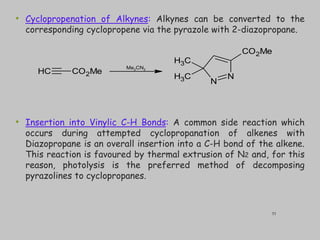
• Cyclopropenation of Alkynes: Alkynes can be converted to the
corresponding cyclopropene via the pyrazole with 2-diazopropane.
• Insertion into Vinylic C-H Bonds: A common side reaction which
occurs during attempted cyclopropanation of alkenes with
Diazopropane is an overall insertion into a C-H bond of the alkene.
This reaction is favoured by thermal extrusion of N2 and, for this
reason, photolysis is the preferred method of decomposing
pyrazolines to cyclopropanes.
C
H CO2Me
N
N
C
H3
C
H3
CO2Me
Me2CN2
33
DIETHYL AZOBICARBOXYLATE
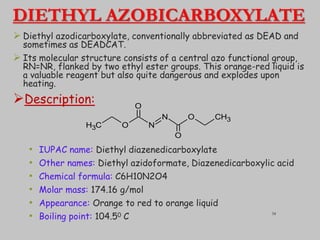
 Diethyl azodicarboxylate, conventionally abbreviated as DEAD and
sometimes as DEADCAT.
 Its molecular structure consists of a central azo functional group,
RN=NR, flanked by two ethyl ester groups. This orange-red liquid is
a valuable reagent but also quite dangerous and explodes upon
heating.
Description:
• IUPAC name: Diethyl diazenedicarboxylate
• Other names: Diethyl azidoformate, Diazenedicarboxylic acid
• Chemical formula: C6H10N2O4
• Molar mass: 174.16 g/mol
• Appearance: Orange to red to orange liquid
• Boiling point: 104.50 C
C
H3 O N
N O CH3
O
O
34
 Preparation:
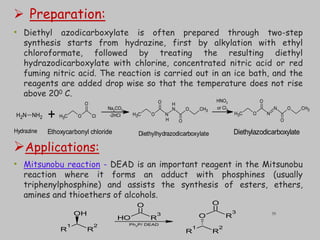
• Diethyl azodicarboxylate is often prepared through two-step
synthesis starts from hydrazine, first by alkylation with ethyl
chloroformate, followed by treating the resulting diethyl
hydrazodicarboxylate with chlorine, concentrated nitric acid or red
fuming nitric acid. The reaction is carried out in an ice bath, and the
reagents are added drop wise so that the temperature does not rise
above 200 C.
Applications:
• Mitsunobu reaction - DEAD is an important reagent in the Mitsunobu
reaction where it forms an adduct with phosphines (usually
triphenylphosphine) and assists the synthesis of esters, ethers,
amines and thioethers of alcohols.
C
H3 O N
N O CH3
O
O
C
H3 O N
N O CH3
O
O
H
H
N
H2 NH2 C
H3 O Cl
O
+
Hydrazine Ethoxycarbonyl chloride Diethylhydrazodicarboxylate Diethylazodicarboxylate
Na2CO3
-2HCl
HNO3
or Cl2
R
1
R
2
OH
R
1
R
2
O R
3
O
O
H R
3
O
Ph3P/ DEAD
35
• Michael reaction: - The azo group in DEAD is a Michael acceptor.
In the presence of a copper(II) catalyst, DEAD assists conversion
of β-keto esters to the corresponding hydrazine derivatives
• DEAD can be used for synthesis of heterocyclic compounds. Thus,
pyrazoline derivatives convert by condensation to α,β-unsaturated
ketones.
O CH3
O O
OEt
O O
N NH
COOEt
EtOOC
DEAD, Cu(II)
Toluol, RT
36
TRIPHENYLPHOSPHINE
 Triphenylphosphine is a common organophosphorus compound with
the formula [P(C6H5)3] often abbreviated to PPh3 or Ph3P. It is
widely used in the synthesis of organic and organometallic
compounds.
 Description:
• Chemical formula: C18H15P
• Molar mass: 262.29 g/mol
• Appearance: white solid
• Melting point: 800 C
• Density: 1.1 g/cm3
• Solubility: Insoluble in water, Soluble in organic solvent
P
37
 Preparation:
• Triphenylphosphine is inexpensive substance. It can be prepared in
the laboratory by treatment of phosphorus trichloride with phenyl
magnesium bromide or phenyl lithium.
• The industrial synthesis involves the reaction between phosphorus
trichloride, chlorobenzene, and sodium.
 Applications:
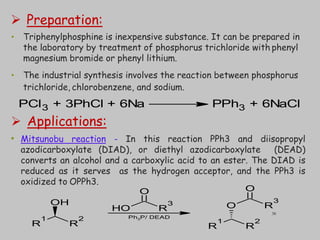
• Mitsunobu reaction - In this reaction PPh3 and diisopropyl
azodicarboxylate (DIAD), or diethyl azodicarboxylate (DEAD)
converts an alcohol and a carboxylic acid to an ester. The DIAD is
reduced as it serves as the hydrogen acceptor, and the PPh3 is
oxidized to OPPh3.
PCl3 + 3PhCl + 6Na PPh3 + 6NaCl
R
1
R
2
OH
R
1
R
2
O R
3
O
O
H R
3
O
Ph3P/ DEAD
38
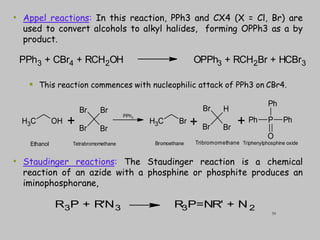
• Appel reactions: In this reaction, PPh3 and CX4 (X = Cl, Br) are
used to convert alcohols to alkyl halides, forming OPPh3 as a by
product.
 This reaction commences with nucleophilic attack of PPh3 on CBr4.
• Staudinger reactions: The Staudinger reaction is a chemical
reaction of an azide with a phosphine or phosphite produces an
iminophosphorane,
PPh3 + CBr4 + RCH2OH OPPh3 + RCH2Br + HCBr3
R3P + R'N3 R
3P=NR' + N 2
C
H3 OH
Br
Br
Br
Br
C
H3 Br
H
Br
Br
Br
P
Ph
Ph Ph
O
+ + +
PPh3
Ethanol Tetrabromomethane Bromoethane Tribromomethane Triphenylphosphine oxide
39
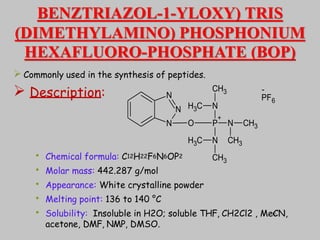
BENZTRIAZOL-1-YLOXY) TRIS
(DIMETHYLAMINO) PHOSPHONIUM
HEXAFLUORO-PHOSPHATE (BOP)
 Commonly used in the synthesis of peptides.
 Description:
• Chemical formula: C12H22F6N6OP2
• Molar mass: 442.287 g/mol
• Appearance: White crystalline powder
• Melting point: 136 to 140 °C
• Solubility: Insoluble in H2O; soluble THF, CH2Cl2 , MeCN,
acetone, DMF, NMP, DMSO.
N
N
N O P
+
N
N
N
CH3
CH3
C
H3
C
H3
CH3
CH3
PF6
-
40
 Application:
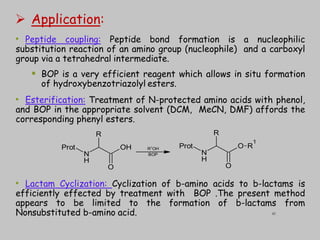
• Peptide coupling: Peptide bond formation is a nucleophilic
substitution reaction of an amino group (nucleophile) and a carboxyl
group via a tetrahedral intermediate.
 BOP is a very efficient reagent which allows in situ formation
of hydroxybenzotriazolyl esters.
• Esterification: Treatment of N-protected amino acids with phenol,
and BOP in the appropriate solvent (DCM, MeCN, DMF) affords the
corresponding phenyl esters.
• Lactam Cyclization: Cyclization of b-amino acids to b-lactams is
efficiently effected by treatment with BOP .The present method
appears to be limited to the formation of b-lactams from
Nonsubstituted b-amino acid.
N
OH
Prot
O
R
H
N
O
Prot
O
R
H
R
1
R1
OH
BOP
41
REFERENCES
• Mundy, BP; Ellerd, MG; Favaloro, fg; “NAME REACTIONS AND
REAGENTS IN ORGANIC SYNTHESIS”, John Wiley & Sons,2nd Ed,
Canada, 2005
• Fieser’s,Reagents for Organic Synthesis, Volume-27
• https://www.researchgate.net/publication/325069368_ADVANCED_
ORGANIC_CHEMISTRY-I_MPC_102T_UNIT-
III_Synthetic_Reagents_Applications
• https://www.slideshare.net/aiswaryampharmppt/synthetic-reagents-
and-applications
• https://www.slideshare.net/binujass1/synthetic-reagents-and-
application
• http://www.authorstream.com/Presentation/khemkartic-3780534-
reagents-used-organic-synthesis/
• https://en.wikipedia.org/wiki/Diethyl_azodicarboxylate; downloaded
on 07/11/2018
• https://en.wikipedia.org/wiki/BOP_reagent; downloaded on
28/11/2018
42
THANK YOU
43

Synthetic Reagent and Its Applications (M. Pharm)

  • 1.
    SYNTHETIC REAGENTS & APPLICATIONS Presentedby: Mohd Shafeeque M. Pharm.(Pharm. Chemistry) Jamia Hamdard
  • 2.
     Contents: 1. ALUMINIUMISOPROPOXIDE 2. N-BROMOSUCCINIMIDE 3. DIAZOMETHANE 4. DICYCLOHEXYLCARBODIMIDE 5. WILKINSON REAGENT 6. WITTIG REAGENT 7. OSMIUM TETROXIDE 8. TITANIUM CHLORIDE 9. DIAZOPROPANE 10.DIETHYL AZOBICARBOXYLATE 11. TRIPHENYLPHOSPHINE 12.BENZTRIAZOL-1-YLOXY) TRIS (DIMETHYLAMINO) PHOSPHONIUM HEXAFLUORO-PHOSPHATE (BOP) 2
  • 3.
    ALUMINIUM ISOPROPOXIDE  Itis the chemical compound usually described with the formula Al(O-i-Pr)3, where i-Pr is the isopropyl group [–CH(CH3)2].  This belongs to aluminium alkoxide group.  It is used as a catalyst and an intermediate in different reactions.  It is a very useful reducing agent. Its importance lies in its specific reducing property for carbonyl group without affecting other reducible groups such as double bonds, nitro group etc.  Description: • Structure: Al O O O C H3 CH3 C H3 C H3 CH3 C H3 3
  • 4.
     Preparation: -This compound is commercially available. Industrially, it is prepared by the reaction between isopropyl alcohol and aluminium metal, or aluminium trichloride: • Other names: Triisopropoxyaluminium, Aluminium isopropanolate, Aluminium triisopropoxide • Chemical formula: C9H21AlO3 • Molar mass: 204.25 g/mol • Appearance: white solid • Melting point: 138–1420 C. • Density: 1.035 g/cm3 (solid) • Solubility: Decomposes in water, Insoluble in isopropanol, Soluble in benzene • It is highly flammable and irritant. • It is moisture sensitive so it must be stored in air tight container. 2Al + 6iPrOH → 2Al(O-i-Pr)3 + 3H2 AlCl3 + 3iPrOH → Al(O-i-Pr)3 + 3HCl 4
  • 5.
     Applications: • Meerwein-Ponndorf-VerleyReduction: In a MPV reduction, ketones and aldehydes are reduced to alcohols concomitant with the formation of acetone. • Hydrolysis of Oximes: Oximes can be converted into parent carbonyl compounds by aluminum isopropoxide followed by acid hydrolysis. Yields are generally high in the case of ketones, but are lower for regeneration of aldehydes. R 1 R 2 OH R 3 R 4 O R 1 R 2 O R 3 R 4 OH + + Al[OCH(CH 3)2]3 R 1 R 2 N OH R 1 R 2 O 1- Al(O- i- Pr)3 2- HCl, H2O 5
  • 6.
    • Oppenauer Oxidation:Cholestenone is prepared by oxidation of cholesterol in toluene solution with aluminum isopropoxide as catalyst and cyclohexanone as hydrogen acceptor • NOTE: Reduction of similar type can be brought by other metallic alkaloids, but aluminium alkoxide is particularly effective because it is soluble in both alcohols and hydrocarbons & further being a weak base it shows little tendency to bring about wasteful condensation of carbonyl compounds. Al(O-i-Pr) 3 Cyclohexanone Cholesterol Cholestenone C H3 CH3 CH3 CH3 CH3 O H CH3 CH3 CH3 CH3 O 6
  • 7.
    N-BROMOSUCCINIMIDE  N-Bromosuccinimide (NBS)is a chemical reagent used in radical substitution and electrophilic addition reactions in organic chemistry. NBS can be a convenient source of the bromine radical (Br•) Description:- • IUPAC name: 1-Bromo-2,5-pyrrolidinedione • Chemical formula: C4H4BrNO2 • Molar mass: 177.99 g/mol • Appearance: white solid • Melting point: 175 to 1780 C • Density: 2.098 g/cm3 • Solubility: 14.7 g/L (2500 C) in water, insoluble in CCl4 N O O Br 7
  • 8.
     Preparation: - Sodiumhydroxide and bromine are added to an ice water solution of succinimide. The NBS product precipitates and can be collected by filtration. N O O Br N O O H N O O Na NaOH Br2 Succinimide N-Bromosuccinimide  Applications: - A. Mainly used as bromonating reagent for the allylic and benzylic compounds (Wohl-Ziegler reaction) for which the reaction is carried out in CCl4 since the resulting succinimide is insoluble in CCl4. C H3 CH3 C H3 CH3 Br NBS (PhCOO)2 CCl4 reflux, 2 hr 2-Heptene 4-Bromo -2- heptene 8
  • 9.
    B. Moreover, itcan also used as an oxidizing agents for primary alcohol, primary amine and secondary alcohol. RCH2OH RCHO HBr N O O H Succinimide NBS + + Alcohol Aldehyde 9
  • 10.
    DIAZOMETHANE  Diazomethane isthe chemical compound CH2N2, discovered by German chemist Sir. Hans von Pechmann in 1894.  Diazomethane is a yellow, poisonous, potentially explosive compound, which is a gas at room temperature. Description: - • Other names: Azimethylene, Azomethylene, Diazirine • Chemical formula: CH2N2 • Molar mass: 42.04 g/mol • Appearance: Yellow gas • Odour: musty • Boiling point: - 230 C • Solubility: soluble in water and insoluble in organic solvents. C H2 N + N – 10
  • 11.
     Preparation: - i.Alkaline hydrolysis of Bis (N-Nitroso-N-methyl) telepthalimide. ii. Distillation of N-Nitroso-N-metyl-P-toulene sulphoxamide with base O N N O CH3 O N N O C H3 COONa COONa 2CH2N2 2 NaOH + S O N N O CH3 O C H3 CH2N2 + S O O C H3 O K Ethanolic KOH 11
  • 12.
     Applications: - •Synthesis of Heterocyclic compounds- • Methylation of acidic compound/ alcohols/ carbonyl comp/ amines- C H CH C H2 N + N – N N H + Ethyne Diazomethane Pyrazole Acid Ester RCOOH RCOOCH 3 CH2N2 -N2 Phenol OH O CH3 CH2N2 + N2 + Anisole 12
  • 13.
    DICYCLOHEXYLCARBODIMIDE  N,N'-Dicyclohexylcarbodiimide (DCC)is a zero length coupling reagent. DCC has both biochemical and synthetic applications. Description: - • IUPAC name: N,N'-dicyclohexylcarbodiimide • Chemical formula: C13H22N2 • Molar mass: 206.33 g/mol • Appearance: white crystalline powder • Melting point: 340 C • Density: 1.325 g/cm3 • Solubility: insoluble in water & CCl4 N C N 13
  • 14.
     Preparation: - a.Oxidation of N,N`-Dicyclohexylthiourea by mercuric oxide- b. Dehydration of Dicyclohexylurea- N C N N N H H S Hg2O (Mercuric oxide) N,N-Dicyclohexylthiourea Dicyclohexylcarbodimide Hg2S H2O + + N C N N N H H O Dicyclohexyurea Dicyclohexylcarbodimide Hot- Toluenesulfonylchloride/ pyridine -H2O 14
  • 15.
     Applications: - •DCC is mainly used in amikacin, glutathione dehydrants, as well as in synthesis of acid anhydride, ketone, isocyanate; when it is used as dehydrating condensing agent. • DCC is a carbodimide used to couple amino acids during peptide synthesis. (This is currently most popular method of peptide syntheis) • Dicyclohexylcarbodiimide is an imide. Amides/imides react with azo and diazo compounds to generate toxic gases. • N,N'-Dicyclohexylcarbodiimide (DCC) is a zero length coupling reagent. DCC has both biochemical and synthetic applications. This reagent can be used to couple primary amines to carboxylic acid functional groups. DCC is soluble in many organic solvents, while the DCU by product is generally insoluble and easily removed. N O O R COOH N H2 COOC2H5 R 1 DCC N O O R O NH COOC2H5 R 1 + + DCC.H2O 15
  • 16.
    WILKINSON REAGENT • Wilkinson’sCatalyst [IUPAC Name: chloridotris(triphenyl- phosphine)rhodium(I)] is a coordination compound whose coordination centre is rhodium. • It is extensively used as a catalyst in the hydrogenation of alkenes. The chemical formula of Wilkinson’s catalyst can be written as [RhCl(PPh3)3] where ‘Ph’ denotes a phenyl group. At ambient temperatures, this coordination complex exists as a reddish-brown solid. • Wilkinson’s catalyst is named after the English chemist Sir Geoffrey Wilkinson. • The structure adopted by Wilkinson’s Catalyst is square planar (slightly distorted). The rhodium centre is bound to four ligands in this compound. 16
  • 17.
     Description: - •The molar mass of Wilkinson’s catalyst is 925.22 grams/mole • It’s melting point ranges from 518 to 523 K • It is insoluble in water. However, it is soluble in many hydrocarbon- based solvents such as benzene and tetrahydrofuran. Preparation: - • Wilkinson’s catalyst can be prepared by reacting hydrated rhodium(III) chloride with excess triphenylphosphine in the presence of ethanol (which acts as a refluxing agent). Here, the triphenylphosphine (denoted by the chemical formula P(C6H5)3) acts as a reducing agent which has the ability to oxidize itself from an oxidation state of +3 to an oxidation state of +5. • During the synthesis of Wilkinson’s catalyst, one equivalent of triphenylphosphine reduces rhodium(III) to rhodium(I) while three other equivalents bind themselves to the metal as ligands in the final product. 4P(C6H5)3 RhCl3(H2O)3 RhCl[P(C6H5)3]3 OP(C6H5)3 2HCl 2H2O + + + + 17
  • 18.
     Applications: - •Wilkinson’s catalyst can be employed for the hydro acylation of alkenes. • The hydroboration and hydrosilylation of olefins can also be achieved with the help of this coordination complex. • Functionalized tri-substituted alkenes and internal alkynes can be subjected to hydrogenation with the help of Wilkinson’s catalyst in the presence of hydrogen and a strong base. Here, a highly reactive Rh(I) species having relatively superior catalytic activity is formed • This catalyst is highly effective in the selective reduction of the least hindered olefin when there are several olefins present Mechanism of catalysis for the hydrogenation of alkene: • Initially, a 14-electron or 12-electron complex is formed from the dissociation of 1 or 2 triphenylphosphine ligands. • Now, the oxidative addition of molecular hydrogen (H2) to the metal core of Wilkinson’s catalyst (rhodium) occurs. • The third step of the mechanism involves the formation of a pi complex with the alkene. 18
  • 19.
    • The hydrogenis inserted into the complex via migratory insertion which could proceed through intramolecular hydride transfer or through olefin insertion. • Finally, reductive elimination occurs at the pi complex to regenerate the catalyst and afford the required alkene product. 19
  • 20.
    WITTIG REAGENT Triphenyl phosphinealkylidiene  Other Name: Triphenylphosphoniumylide, Alkylidienephosphorane  It is used for the synthesis of alkene from ketones and aldehydes P C6H5 C6H5 C6H5 R1 R2 R1 = H R2 = -CH3, -C2H5, -C4H9 20
  • 21.
     Preparation: - •Wittig reagents are usually prepared from a phosphonium salt, which is in turn prepared by the quaternization of triphenylphosphine with an alkyl halide. The alkylphosphonium salt is deprotonated with a strong base such as n-butyllithium. [Ph3P+CH2R]X - C4H9Li Ph3P=CHR LiX C4H10 + + + P C6H5 C6H5 C6H5 R1 R2 P + C6H5 C6H5 C6H5 C – R1 R2 Phosphorane ylide Forms of Wittig Reagent 21
  • 22.
     Applications: - •Wittig reagent provides a method for the synthesis of olefins, it is done by the reaction of an aldehyde or ketone with a triphenyl phosphonium ylide (Wittig reagent) to give an alkene and triphenylphosphine oxide. • Synthesis of Indole- • Synthesis of natural products. (Beta-Carotene) P + Ph Ph Ph C – R1 R2 O R3 R4 R3 R4 R2 R1 Ph3P=O + + Wittig Reagent Aldehyde/ketone Olefin Phosphene oxide PPh3 N R H O H N R H Base 22
  • 23.
    OSMIUM TETROXIDE • Osmiumtetroxide [also osmium (VIII) oxide] is the chemical compound with the formula OsO4. Description: - • Other names: Tetraoxoosmium, Osmium(VIII) oxide • Chemical formula: OsO4 • Molar mass: 254.23 g/mol • Appearance: white volatile solid • Melting point: 40.250 C • Density: 4.9 g/cm3 • Solubility: soluble in most organic solvents, ammonium hydroxide, phosphorus oxychloride 23
  • 24.
     Preparation: • OsO4is formed slowly when osmium powder(metallic) reacts with O2 at ambient temperature. Reaction of bulk solid requires heating to 4000 C Applications: • Hydroxylation of Alkenes – The reagent is dissolved in dry ether or t-butanol and added to the olefin in presence of a base which accelerate the reaction. • During hydrolysis of osmic ester the O-Os bond cleaves and not the C-O bond and hence the product is always a cis-diol. Os 2O2 OsO4 Heat to redness + R3 R R2 R1 R3 R OH R1 R2 OH OsO4, t- Butanol, Base Osmic Acid + Olefin cis-diol 24
  • 25.
    • Coordination chemistry- OsO4 is a Lewis acid and a mild oxidant. It reacts with alkaline aqueous solution to give the perosmate anion OsO4(OH)2 2− . This species is easily reduced to osmate anion, OsO2(OH)4 4− .  With tert-BuNH2, the imido derivative is produced:  Similarly, with NH3 one obtains the nitrido complex: • Biological staining - OsO4 is a widely used staining agent used in transmission electron microscopy (TEM) to provide contrast to the image. • Polymer staining • Osmium ore refining OsO4 + NH3 + KOH K[Os(N)O3] + 2H2O OsO4 + Me3CNH2 OsO3(NCMe3) + 2H2O 25
  • 26.
    TITANIUM CHLORIDE  TitaniumChloride is the inorganic compound.  The formula of titanium chlorides is- • Titanium dichloride (TiCl2) • Titanium trichloride (TiCl3) • Titanium tetrachloride (TiCl4) Ti Cl Cl Cl Cl 26
  • 27.
     Description: Titanium tetrachloride Titanium trichlorideTitanium dichloride Chemical formula Molar mass Appearance Odor Density Melting point Boiling point Solubility TiCl4 189.679 g/mol Colourless liquid penetrating acid 1.726 g/cm3 -24.10 C 136.40 C Very soluble in water, soluble in ethanol, HCl TiCl3 154.225 g/mol red-violet crystals penetrating acid 2.64 g/cm3 4250 C 9600 C Very soluble in water, soluble in acetone TiCl2 118.77 g/mol black hexagonal crystals penetrating acid 3.13 g/cm3 1,0350 C 1,5000 C Very soluble in water soluble in ethanol 27
  • 28.
     Preparation: • Titaniumtetrachloride: TiCl4 is produced by the chloride process, which involves the reduction of titanium oxide ores, typically ilmenite (FeTiO3), with carbon under flowing chlorine at 900 °C. Impurities are removed by distillation. 2 FeTiO3 + 7 Cl2 + 6 C → 2 TiCl4 + 2 FeCl3+ 6 CO • Titanium trichloride: TiCl3 is produced usually by reduction of titanium(IV) chloride. 2 TiCl4 + H2 → 2 HCl + 2TiCl3 • Titanium dichloride: 2 TiCl3 → TiCl2 + TiCl4 28
  • 29.
     Application oftitanium tetrachloride: • Production of titanium metal: The conversion involves the reduction of the tetrachloride with magnesium metal. This procedure is known as the Kroll process. 2 Mg + TiCl4 → 2 MgCl2 +Ti • Production of titanium dioxide: Around 90% of the TiCl4 production is used to make the pigment titanium dioxide (TiO2). The conversion involves hydrolysis of TiCl4, a process that forms hydrogen chloride. TiCl4 + 2 H2O → TiO2 + 4HCl In some cases, TiCl4 is oxidised directly with oxygen. TiCl4 + O2 → TiO2 + 2 Cl2 • TiCl4 finds occasional use in organic synthesis, capitalizing on its Lewis acidity, its oxophilicity, and the electron-transfer properties of its reduced titanium halides. • It is used in the Lewis acid catalysed aldol addition. 29
  • 30.
     Application oftitanium trichloride: • TiCl3 is the main Ziegler-Natta catalyst, responsible for most industrial production of polypropylene. The catalytic activities depend strongly on the polymorph and the method of preparation. • TiCl3 is also a reagent in organic synthesis, useful for reductive coupling reactions, often in the presence of added reducing agents such as zinc. It reduces oximes to imines. 30
  • 31.
    DIAZOPROPANE  Diazo- Organiccompound that has two linked nitrogen atoms (azo) as a terminal functional group.  Reagent is used for the cyclopropanation of alkenes. Description: • IUPAC name: 2-Diazopropane • Chemical formula: C3H6N2 • Molar mass: 70.11g/mol • Physical Data: The reagent is a gas at room temperature. • Solubility: The reagent is most commonly prepared and used as a solution in ether. C H3 C H3 N + N – 31
  • 32.
     Preparation: • Diazopropaneis most commonly prepared by the oxidation of Acetohydrazone with mercury oxide in presence of base. Applications: • Cyclopropanation of Alkenes: 2-Diazopropane is most commonly used to prepare gem-dimethylcyclopropyl derivatives. This reagent will readily undergo cycloadditions with alkenes to provide the corresponding pyrazolones which can be induced to close N2 to provide desired cyclopropanes. C H3 CH3 N NH2 C H3 C H3 N + N – HgO KOH Acetohydrazone Diazopropane O O CH3 O N N O H H CH3 CH3 O O H CH3 CH3 H O O CH3 CH3 CH3 O O CH3 + + Me2CN2 32
  • 33.
    • Cyclopropenation ofAlkynes: Alkynes can be converted to the corresponding cyclopropene via the pyrazole with 2-diazopropane. • Insertion into Vinylic C-H Bonds: A common side reaction which occurs during attempted cyclopropanation of alkenes with Diazopropane is an overall insertion into a C-H bond of the alkene. This reaction is favoured by thermal extrusion of N2 and, for this reason, photolysis is the preferred method of decomposing pyrazolines to cyclopropanes. C H CO2Me N N C H3 C H3 CO2Me Me2CN2 33
  • 34.
    DIETHYL AZOBICARBOXYLATE  Diethylazodicarboxylate, conventionally abbreviated as DEAD and sometimes as DEADCAT.  Its molecular structure consists of a central azo functional group, RN=NR, flanked by two ethyl ester groups. This orange-red liquid is a valuable reagent but also quite dangerous and explodes upon heating. Description: • IUPAC name: Diethyl diazenedicarboxylate • Other names: Diethyl azidoformate, Diazenedicarboxylic acid • Chemical formula: C6H10N2O4 • Molar mass: 174.16 g/mol • Appearance: Orange to red to orange liquid • Boiling point: 104.50 C C H3 O N N O CH3 O O 34
  • 35.
     Preparation: • Diethylazodicarboxylate is often prepared through two-step synthesis starts from hydrazine, first by alkylation with ethyl chloroformate, followed by treating the resulting diethyl hydrazodicarboxylate with chlorine, concentrated nitric acid or red fuming nitric acid. The reaction is carried out in an ice bath, and the reagents are added drop wise so that the temperature does not rise above 200 C. Applications: • Mitsunobu reaction - DEAD is an important reagent in the Mitsunobu reaction where it forms an adduct with phosphines (usually triphenylphosphine) and assists the synthesis of esters, ethers, amines and thioethers of alcohols. C H3 O N N O CH3 O O C H3 O N N O CH3 O O H H N H2 NH2 C H3 O Cl O + Hydrazine Ethoxycarbonyl chloride Diethylhydrazodicarboxylate Diethylazodicarboxylate Na2CO3 -2HCl HNO3 or Cl2 R 1 R 2 OH R 1 R 2 O R 3 O O H R 3 O Ph3P/ DEAD 35
  • 36.
    • Michael reaction:- The azo group in DEAD is a Michael acceptor. In the presence of a copper(II) catalyst, DEAD assists conversion of β-keto esters to the corresponding hydrazine derivatives • DEAD can be used for synthesis of heterocyclic compounds. Thus, pyrazoline derivatives convert by condensation to α,β-unsaturated ketones. O CH3 O O OEt O O N NH COOEt EtOOC DEAD, Cu(II) Toluol, RT 36
  • 37.
    TRIPHENYLPHOSPHINE  Triphenylphosphine isa common organophosphorus compound with the formula [P(C6H5)3] often abbreviated to PPh3 or Ph3P. It is widely used in the synthesis of organic and organometallic compounds.  Description: • Chemical formula: C18H15P • Molar mass: 262.29 g/mol • Appearance: white solid • Melting point: 800 C • Density: 1.1 g/cm3 • Solubility: Insoluble in water, Soluble in organic solvent P 37
  • 38.
     Preparation: • Triphenylphosphineis inexpensive substance. It can be prepared in the laboratory by treatment of phosphorus trichloride with phenyl magnesium bromide or phenyl lithium. • The industrial synthesis involves the reaction between phosphorus trichloride, chlorobenzene, and sodium.  Applications: • Mitsunobu reaction - In this reaction PPh3 and diisopropyl azodicarboxylate (DIAD), or diethyl azodicarboxylate (DEAD) converts an alcohol and a carboxylic acid to an ester. The DIAD is reduced as it serves as the hydrogen acceptor, and the PPh3 is oxidized to OPPh3. PCl3 + 3PhCl + 6Na PPh3 + 6NaCl R 1 R 2 OH R 1 R 2 O R 3 O O H R 3 O Ph3P/ DEAD 38
  • 39.
    • Appel reactions:In this reaction, PPh3 and CX4 (X = Cl, Br) are used to convert alcohols to alkyl halides, forming OPPh3 as a by product.  This reaction commences with nucleophilic attack of PPh3 on CBr4. • Staudinger reactions: The Staudinger reaction is a chemical reaction of an azide with a phosphine or phosphite produces an iminophosphorane, PPh3 + CBr4 + RCH2OH OPPh3 + RCH2Br + HCBr3 R3P + R'N3 R 3P=NR' + N 2 C H3 OH Br Br Br Br C H3 Br H Br Br Br P Ph Ph Ph O + + + PPh3 Ethanol Tetrabromomethane Bromoethane Tribromomethane Triphenylphosphine oxide 39
  • 40.
    BENZTRIAZOL-1-YLOXY) TRIS (DIMETHYLAMINO) PHOSPHONIUM HEXAFLUORO-PHOSPHATE(BOP)  Commonly used in the synthesis of peptides.  Description: • Chemical formula: C12H22F6N6OP2 • Molar mass: 442.287 g/mol • Appearance: White crystalline powder • Melting point: 136 to 140 °C • Solubility: Insoluble in H2O; soluble THF, CH2Cl2 , MeCN, acetone, DMF, NMP, DMSO. N N N O P + N N N CH3 CH3 C H3 C H3 CH3 CH3 PF6 - 40
  • 41.
     Application: • Peptidecoupling: Peptide bond formation is a nucleophilic substitution reaction of an amino group (nucleophile) and a carboxyl group via a tetrahedral intermediate.  BOP is a very efficient reagent which allows in situ formation of hydroxybenzotriazolyl esters. • Esterification: Treatment of N-protected amino acids with phenol, and BOP in the appropriate solvent (DCM, MeCN, DMF) affords the corresponding phenyl esters. • Lactam Cyclization: Cyclization of b-amino acids to b-lactams is efficiently effected by treatment with BOP .The present method appears to be limited to the formation of b-lactams from Nonsubstituted b-amino acid. N OH Prot O R H N O Prot O R H R 1 R1 OH BOP 41
  • 42.
    REFERENCES • Mundy, BP;Ellerd, MG; Favaloro, fg; “NAME REACTIONS AND REAGENTS IN ORGANIC SYNTHESIS”, John Wiley & Sons,2nd Ed, Canada, 2005 • Fieser’s,Reagents for Organic Synthesis, Volume-27 • https://www.researchgate.net/publication/325069368_ADVANCED_ ORGANIC_CHEMISTRY-I_MPC_102T_UNIT- III_Synthetic_Reagents_Applications • https://www.slideshare.net/aiswaryampharmppt/synthetic-reagents- and-applications • https://www.slideshare.net/binujass1/synthetic-reagents-and- application • http://www.authorstream.com/Presentation/khemkartic-3780534- reagents-used-organic-synthesis/ • https://en.wikipedia.org/wiki/Diethyl_azodicarboxylate; downloaded on 07/11/2018 • https://en.wikipedia.org/wiki/BOP_reagent; downloaded on 28/11/2018 42
  • 43.