SterilizationSterilization
Definition
 sterilization (or sterilisation) is a term referring to any process
that eliminates (removes) or kills (deactivates) all forms of life
 and other biological agents
Applications
Medicine and surgery:-
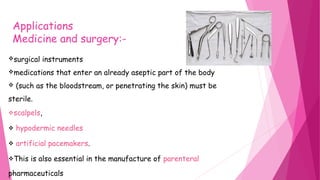
surgical instruments
medications that enter an already aseptic part of the body
 (such as the bloodstream, or penetrating the skin) must be
sterile.
scalpels,
 hypodermic needles 
 artificial pacemakers.
This is also essential in the manufacture of parenteral
pharmaceuticals
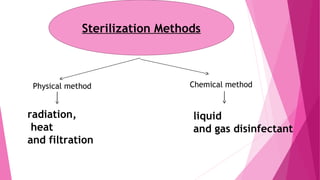
Sterilization Methods
Physical method Chemical method
radiation,
heat
and filtration
liquid
and gas disinfectant
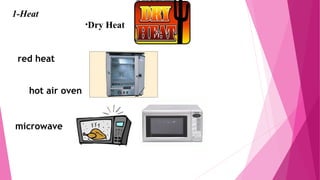
1-Heat
•Dry Heat
red heat
hot air oven
microwave
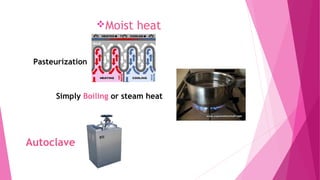
Moist heat
Pasteurization
Simply Boiling or steam heat
Autoclave
2-Radiation
 electron beams, 
 X-rays, 
 gamma rays, or
 irradiation bysubatomic particles.
 Non-ionizing radiation sterilization
 Ultraviolet light irradiation (UV, from a germicidal lamp) is useful for
sterilization of surfaces and some transparent objects. Many objects
that are transparent to visible light absorb UV
 Ionizing radiation sterilization
 Gamma radiation is very penetrating, and is commonly used for
sterilization of disposable medical equipment, such as syringes,
needles, cannulas 
3-Filtration
This method is commonly used for heat
labile pharmaceuticals
and protein solutions in medicinal drug
processing. It can be sterilized by
microfiltration using membrane filters
Chemical sterilization
 Gas: Ethylene oxide (EO or EtO) gas
 Liquid:
 Alcohol 70% Ethyl alcohol used as skin antiseptic
 Phenol as 5% used as disinfectant
 Aldehydes as 2% formaldehyde used as sterilizant
 Surface active agents as anionic surfactant as soap and cationic surfactant as
quaternary ammonium compounds
Steralization

Steralization

  • 1.
  • 2.
    Definition  sterilization (or sterilisation) isa term referring to any process that eliminates (removes) or kills (deactivates) all forms of life  and other biological agents
  • 3.
    Applications Medicine and surgery:- surgicalinstruments medications that enter an already aseptic part of the body  (such as the bloodstream, or penetrating the skin) must be sterile. scalpels,  hypodermic needles   artificial pacemakers. This is also essential in the manufacture of parenteral pharmaceuticals
  • 4.
    Sterilization Methods Physical methodChemical method radiation, heat and filtration liquid and gas disinfectant
  • 5.
  • 6.
  • 7.
    2-Radiation  electron beams,  X-rays,   gamma rays, or  irradiation bysubatomic particles.  Non-ionizing radiation sterilization  Ultraviolet light irradiation (UV, from a germicidal lamp) is useful for sterilization of surfaces and some transparent objects. Many objects that are transparent to visible light absorb UV  Ionizing radiation sterilization  Gamma radiation is very penetrating, and is commonly used for sterilization of disposable medical equipment, such as syringes, needles, cannulas 
  • 8.
    3-Filtration This method iscommonly used for heat labile pharmaceuticals and protein solutions in medicinal drug processing. It can be sterilized by microfiltration using membrane filters
  • 9.
    Chemical sterilization  Gas:Ethylene oxide (EO or EtO) gas  Liquid:  Alcohol 70% Ethyl alcohol used as skin antiseptic  Phenol as 5% used as disinfectant  Aldehydes as 2% formaldehyde used as sterilizant  Surface active agents as anionic surfactant as soap and cationic surfactant as quaternary ammonium compounds