STERILIZATION AND DISINFECTION
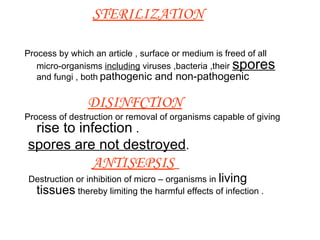
STERILIZATION Process by which an article , surface or medium is freed of all micro-organisms  including  viruses ,bacteria ,their  spores  and fungi , both   pathogenic and non-pathogenic   DISINFCTION Process of destruction or removal of organisms capable of giving   rise to infection  . spores are not destroyed . ANTISEPSIS   Destruction or inhibition of micro – organisms in  living   tissues  thereby limiting the harmful effects of infection .
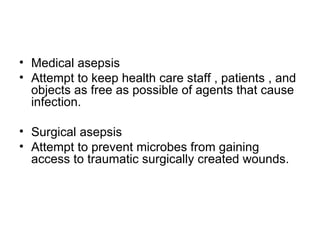
Medical asepsis  Attempt to keep health care staff , patients , and objects as free as possible of agents that cause infection. Surgical asepsis   Attempt to prevent microbes from gaining access to traumatic surgically created wounds.
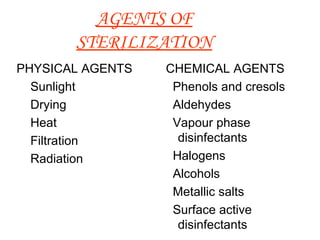
AGENTS OF STERILIZATION PHYSICAL AGENTS Sunlight  Drying  Heat Filtration Radiation CHEMICAL AGENTS Phenols and cresols Aldehydes Vapour phase disinfectants Halogens Alcohols  Metallic salts Surface active disinfectants
Sterilization by Heat   MOST RELIABLE , CERTAIN AND RAPID   TYPES  DRY HEAT  MOIST HEAT
STERILIZATION BY DRY HEAT RED HEAT  FLAMING  INCINERATION HOT AIR OVEN
FLAMING   Auxiliary method of sterilization. Can be sterilized : POINTS OF FORCEPS  CEMENT SPATULAS COTTON PLIERS SILVER CONES  Uses Bunsen burner flame . Used only during the of course of procedure.
INCINERATION Rapidly destroys contaminated materials such as  patient’s dressings  and pathological materials.
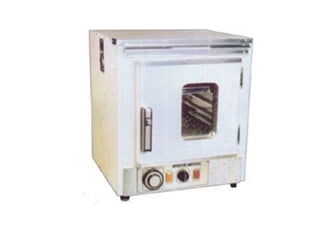
HOT AIR OVEN PRINCIPLE : Hot air causes  oxidation  of microbial contents leading to cell death .
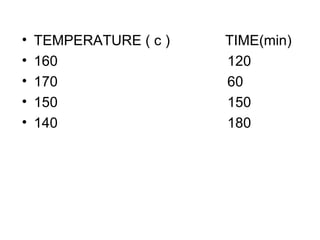
TEMPERATURE ( c )  TIME(min) 160  120  170  60 150  150 140  180
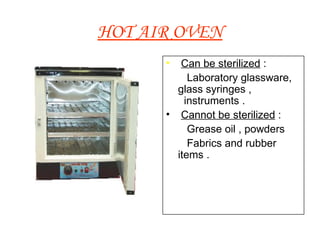
HOT AIR OVEN Can be sterilized  : Laboratory glassware, glass syringes ,  instruments . Cannot be sterilized  : Grease oil , powders Fabrics and rubber items .
. ONLY ADVANTAGE – MAINTENANCE OF SHARP   EDGES  OF CUTTING INSTRUMENTS such as chisels.
Things to note   Instruments must be  clean and dry  prior to wrapping. Wrapping material must be  heat resistant. Aluminum foil, metal , glass container may be used . Instruments must be  loosely wrapped  . It should  not  be  over – loaded  .
Working   Consists of metal cup in which salt is dispensed. To sterilize an instrument properly , immerse it a  quarter a inch   below salt   surface  and in  peripheral area  of sterilizer. Reason – temperature is  hottest  along its  outer rim  and lowest in the centre of surface layer of salt.
Application Used widely in endodontics for sterilization of broaches , reamers, files : 5 secs   Absorbent points  ,  cotton pellets  :  10 secs Burs .
DRY BEAD STERILIZATION Micro tools ,  autoclavable instrument   trays  can be sterilized. Temperature – 320F for 2 hrs  ,  340F for 1 hr
STERILIZATION BY MOIST HEAT   BELOW 100 c    * Pasteurization   * Low temperature steam Formaldehyde  sterilization
PASTURIZATION Done for milk and milk products Procedure holder method   63 c for 30 mins  flash  method 72 c for 20 secs  Followed by rapid cooling to 13 c or lower
Low temperature steam Formaldehyde  sterilization Combination of dry saturated steam and formaldehyde. Requires 127 c to 132 c at 20 to 40 psi for 30 mins . Heat sensitive instruments  can be sterilized .
ADVANTAGES Lack of corrosion  Shorter duration  Low temperature  DISADVANTAGES  Requires provision for ventilation to expel vapours
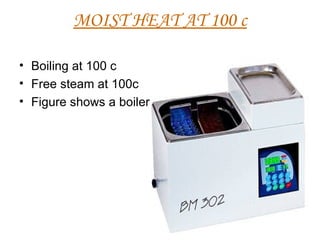
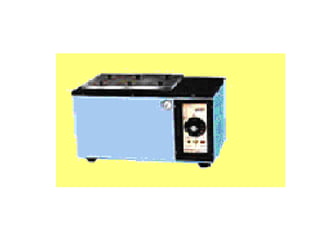
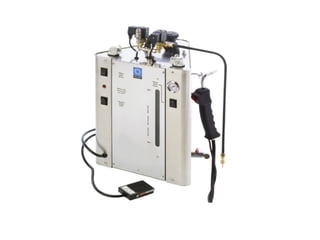
MOIST HEAT AT 100 c Boiling at 100 c Free steam at 100c Figure shows a boiler
 
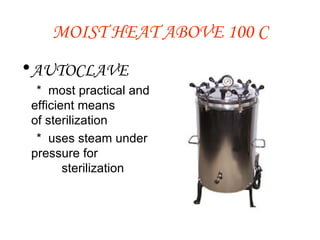
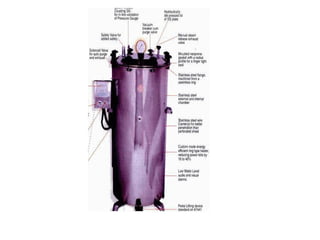
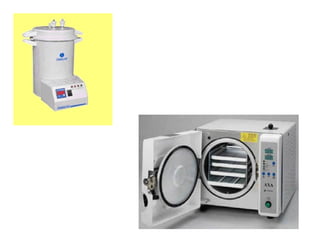
MOIST HEAT ABOVE 100 C AUTOCLAVE *  most practical and efficient means    of sterilization *  uses steam under pressure for      sterilization
PRINCIPLE   Saturated steam is more efficient sterilizing agent than hot air  HIGH Penetration  RAPID effect GREATER lethal action
 
 
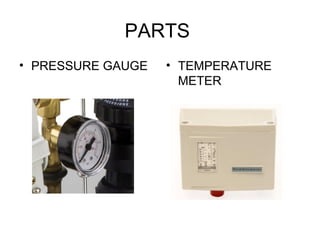
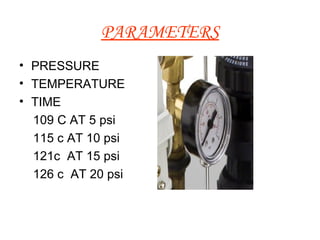
PARTS  PRESSURE GAUGE  TEMPERATURE METER
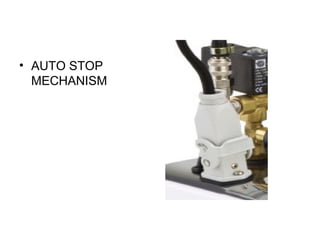
AUTO STOP MECHANISM
 
PARAMETERS PRESSURE TEMPERATURE  TIME  109 C AT 5 psi 115 c AT 10 psi 121c  AT 15 psi  126 c  AT 20 psi
APPLICATIONS STAINLESS STEEL INSTRUMENTS RESTORATIVE BURS  HANDPIECE RUBBER ITEMS
 
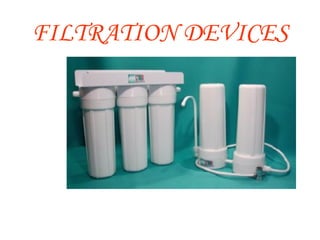
FILTRATION DEVICES
IRRADIATION   IONIZING   RADIATION  NON – IONIZING RADIATION
IONIZING RADIATION Disposable items –  needles  ,  syringes  , swabs , culture plates , catheters in bulk , suture material , cannulas , pharmaceuticals sensitive to heat . Co – 60 used .
NON – IONIZING RADIATION   UV , Infra red Rays  purification of air in  operating rooms .
LASERS Can sterilize infected endo instruments in  3 secs. Micro –organisms including  spores  are destroyed.
CHEMICAL AGENTS
ALCOHALS   Solutions of  70 percent  Ethanol and iso – propyl alcohol used as antiseptics . Used for sterilization of dapen dishes , glass slab ,  gutta percha   cones  thermometers .
AVOID   Instruments containing  carbon steel  should not be soaked in alcohol as corrosive to alcohol . Rubber items  absorbs alcohol – can cause tissue reaction . Alcohols dissolve  cements  holding instruments together and  plastics  may harden in its presence  .
ALDEHYDE COMPOUNDS   Formaldehyde – not used much . Glutaraldehyde
Glutaraldehyde Metal instruments ,  plastics , rubber , porcelain . Effective against  M. TUBERCULOSIS   Hepatitis viruses  HIV viruses  . 2% glutaraldehyde ( cidex ) for 20 mins
ETHYLENE OXIDE GAS STERILIZATION   Heat sensitive items   electric equipment  flexible – fiber endoscopes   photographic equipment  contaminated objects  organic compounds –  bone morphogenetic  proteins extracts * .
ADVANTAGES     Highly penetrative – even    through plastics . Used at low temperatures. Leaves  no residue  . Heat sensitive articles  can be      sterilized .
DISADVANTAGES   High cost   Toxicity of gas  ,    need for  venting  it . Explosive and inflammable  . Long  period of aeration
IODOPHORS   MOST EFFECTIVE ANTISEPTICS  ACTIVITY dependent on release of FREE IODINE 1% IODINE  SOLUTION – BETADIENE , ISODINE
ADVANTAGES     * LOW TOXICITY * PROLONGED  RESIDUAL effect   * INEXPENSIVE * ODOURLESS
Sodium hypochlorite   Gutta percha cones  2.5 % aq for 10 secs followed by      rinsing with hydrogen    peroxide  Complete dentures  2.5 % for 5 min  prevents denture stomatitis
List of disinfectants Ethanol – 70% Glutaraldehyde – 2% activated  cidex , procide ,     omnicide , glutarex  Sodium hypochlorite -1% Hydrogen peroxide – 3%  Iodophors –  1% iodine  betadine , isodine  Others preparations – lysol, savlon, dettol
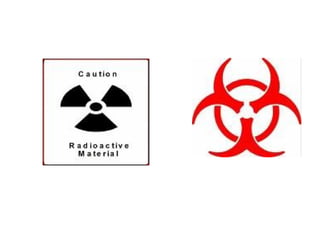
Waste disposal Waste material can be  biohazardous material  non – biohazardous      materials
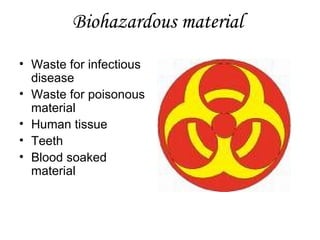
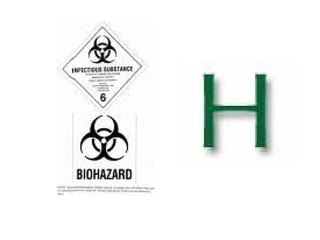
Biohazardous material   Waste for infectious disease Waste for poisonous material Human tissue  Teeth  Blood soaked material
 
 
Non – biohazardous materials Matrix band  Masks  Head caps  Impression material  X – rays packets
WASTES FROM DENTAL MATERIALS MERCURY – AMALGAM  SILVER THIOSULPHATE – X- RAY FIXER  LEAD FOILS
Sources Of material Remaining amalgam after its use  Scrap amalgam Extracted teeth containing amalgam filling  Removal of old amalgam fiiling
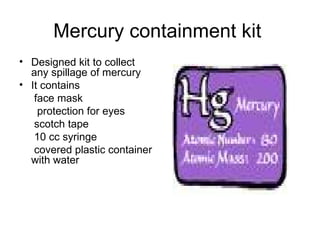
Mercury containment kit  Designed kit to collect any spillage of mercury It contains  face mask  protection for eyes scotch tape 10 cc syringe  covered plastic container with water
STEPS Clear the area around spill Wear all protective gears  Contain the spread of mercury  Use regular syringe to suction out all mercury Pour the contents of syringe into plastic container with 5-10 ml of water  Put scotch tape  Put the used syringe in a separate container Mercury thus collected can be reused
CATEGORIES OF BIO – MEDICAL WASTES   Category – 1 Human tissues , organs, body parts  Category – 2 Body fluids , blood . Category – 3 Lab cultures , live or attenuated vaccines .
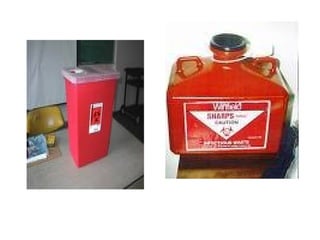
Category – 4  Needles , syringes , scalpels , blades , glass  Category – 5  Discarded medicines , cytotoxic drugs . Category – 6  Items contaminated with blood or fluids ,cotton , dressing , soiled plaster cast , linen .
Category – 7  Disposable items such as tubings , catheters , intravenous sets . Category – 8  Liquid waste – waste from cleaning , disinfection activities .
Category – 9  Incerination ash  Category – 10   Chemical waste – biologicals ,  chemicals used in disinfection
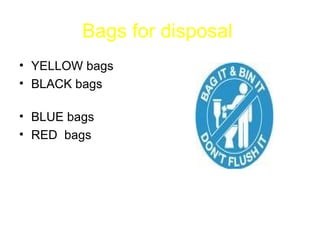
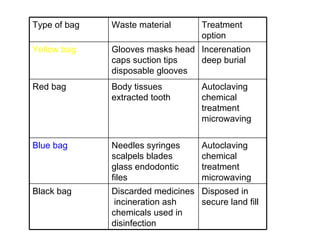
Bags for disposal   YELLOW bags BLACK bags  BLUE bags  RED  bags


Type of bag Waste material  Treatment option  Yellow bag  Glooves masks head caps suction tips disposable glooves Incerenation deep burial Red bag Body tissues extracted tooth  Autoclaving  chemical treatment microwaving  Blue bag Needles syringes scalpels blades glass endodontic files  Autoclaving  chemical treatment microwaving Black bag Discarded medicines  incineration ash chemicals used in disinfection Disposed in secure land fill
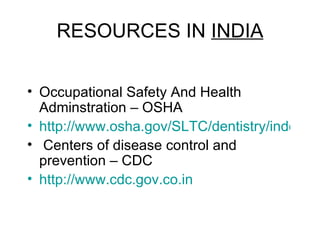
RESOURCES IN  INDIA Occupational Safety And Health Adminstration – OSHA http://www.osha.gov/SLTC/dentistry/index.html Centers of disease control and prevention – CDC http://www.cdc.gov.co.in
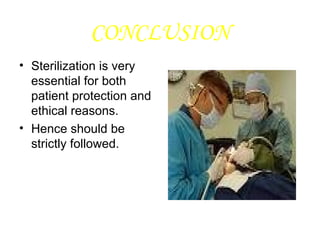
CONCLUSION Sterilization is very essential for both patient protection and ethical reasons. Hence should be strictly followed.
THANK YOU

Steri&disinf

  • 1.
  • 2.
    STERILIZATION Process bywhich an article , surface or medium is freed of all micro-organisms including viruses ,bacteria ,their spores and fungi , both pathogenic and non-pathogenic DISINFCTION Process of destruction or removal of organisms capable of giving rise to infection . spores are not destroyed . ANTISEPSIS Destruction or inhibition of micro – organisms in living tissues thereby limiting the harmful effects of infection .
  • 3.
    Medical asepsis Attempt to keep health care staff , patients , and objects as free as possible of agents that cause infection. Surgical asepsis Attempt to prevent microbes from gaining access to traumatic surgically created wounds.
  • 4.
    AGENTS OF STERILIZATIONPHYSICAL AGENTS Sunlight Drying Heat Filtration Radiation CHEMICAL AGENTS Phenols and cresols Aldehydes Vapour phase disinfectants Halogens Alcohols Metallic salts Surface active disinfectants
  • 5.
    Sterilization by Heat MOST RELIABLE , CERTAIN AND RAPID TYPES DRY HEAT MOIST HEAT
  • 6.
    STERILIZATION BY DRYHEAT RED HEAT FLAMING INCINERATION HOT AIR OVEN
  • 7.
    FLAMING Auxiliary method of sterilization. Can be sterilized : POINTS OF FORCEPS CEMENT SPATULAS COTTON PLIERS SILVER CONES Uses Bunsen burner flame . Used only during the of course of procedure.
  • 8.
    INCINERATION Rapidly destroyscontaminated materials such as patient’s dressings and pathological materials.
  • 9.
    HOT AIR OVENPRINCIPLE : Hot air causes oxidation of microbial contents leading to cell death .
  • 10.
    TEMPERATURE ( c) TIME(min) 160 120 170 60 150 150 140 180
  • 11.
    HOT AIR OVENCan be sterilized : Laboratory glassware, glass syringes , instruments . Cannot be sterilized : Grease oil , powders Fabrics and rubber items .
  • 12.
    . ONLY ADVANTAGE– MAINTENANCE OF SHARP EDGES OF CUTTING INSTRUMENTS such as chisels.
  • 13.
    Things to note Instruments must be clean and dry prior to wrapping. Wrapping material must be heat resistant. Aluminum foil, metal , glass container may be used . Instruments must be loosely wrapped . It should not be over – loaded .
  • 14.
    Working Consists of metal cup in which salt is dispensed. To sterilize an instrument properly , immerse it a quarter a inch below salt surface and in peripheral area of sterilizer. Reason – temperature is hottest along its outer rim and lowest in the centre of surface layer of salt.
  • 15.
    Application Used widelyin endodontics for sterilization of broaches , reamers, files : 5 secs Absorbent points , cotton pellets : 10 secs Burs .
  • 16.
    DRY BEAD STERILIZATIONMicro tools , autoclavable instrument trays can be sterilized. Temperature – 320F for 2 hrs , 340F for 1 hr
  • 17.
    STERILIZATION BY MOISTHEAT BELOW 100 c * Pasteurization * Low temperature steam Formaldehyde sterilization
  • 18.
    PASTURIZATION Done formilk and milk products Procedure holder method 63 c for 30 mins flash method 72 c for 20 secs Followed by rapid cooling to 13 c or lower
  • 19.
    Low temperature steamFormaldehyde sterilization Combination of dry saturated steam and formaldehyde. Requires 127 c to 132 c at 20 to 40 psi for 30 mins . Heat sensitive instruments can be sterilized .
  • 20.
    ADVANTAGES Lack ofcorrosion Shorter duration Low temperature DISADVANTAGES Requires provision for ventilation to expel vapours
  • 21.
    MOIST HEAT AT100 c Boiling at 100 c Free steam at 100c Figure shows a boiler
  • 22.
  • 23.
    MOIST HEAT ABOVE100 C AUTOCLAVE * most practical and efficient means of sterilization * uses steam under pressure for sterilization
  • 24.
    PRINCIPLE Saturated steam is more efficient sterilizing agent than hot air HIGH Penetration RAPID effect GREATER lethal action
  • 25.
  • 26.
  • 27.
    PARTS PRESSUREGAUGE TEMPERATURE METER
  • 28.
  • 29.
  • 30.
    PARAMETERS PRESSURE TEMPERATURE TIME 109 C AT 5 psi 115 c AT 10 psi 121c AT 15 psi 126 c AT 20 psi
  • 31.
    APPLICATIONS STAINLESS STEELINSTRUMENTS RESTORATIVE BURS HANDPIECE RUBBER ITEMS
  • 32.
  • 33.
  • 34.
    IRRADIATION IONIZING RADIATION NON – IONIZING RADIATION
  • 35.
    IONIZING RADIATION Disposableitems – needles , syringes , swabs , culture plates , catheters in bulk , suture material , cannulas , pharmaceuticals sensitive to heat . Co – 60 used .
  • 36.
    NON – IONIZINGRADIATION UV , Infra red Rays purification of air in operating rooms .
  • 37.
    LASERS Can sterilizeinfected endo instruments in 3 secs. Micro –organisms including spores are destroyed.
  • 38.
  • 39.
    ALCOHALS Solutions of 70 percent Ethanol and iso – propyl alcohol used as antiseptics . Used for sterilization of dapen dishes , glass slab , gutta percha cones thermometers .
  • 40.
    AVOID Instruments containing carbon steel should not be soaked in alcohol as corrosive to alcohol . Rubber items absorbs alcohol – can cause tissue reaction . Alcohols dissolve cements holding instruments together and plastics may harden in its presence .
  • 41.
    ALDEHYDE COMPOUNDS Formaldehyde – not used much . Glutaraldehyde
  • 42.
    Glutaraldehyde Metal instruments, plastics , rubber , porcelain . Effective against M. TUBERCULOSIS Hepatitis viruses HIV viruses . 2% glutaraldehyde ( cidex ) for 20 mins
  • 43.
    ETHYLENE OXIDE GASSTERILIZATION Heat sensitive items electric equipment flexible – fiber endoscopes photographic equipment contaminated objects organic compounds – bone morphogenetic proteins extracts * .
  • 44.
    ADVANTAGES Highly penetrative – even through plastics . Used at low temperatures. Leaves no residue . Heat sensitive articles can be sterilized .
  • 45.
    DISADVANTAGES High cost Toxicity of gas , need for venting it . Explosive and inflammable . Long period of aeration
  • 46.
    IODOPHORS MOST EFFECTIVE ANTISEPTICS ACTIVITY dependent on release of FREE IODINE 1% IODINE SOLUTION – BETADIENE , ISODINE
  • 47.
    ADVANTAGES * LOW TOXICITY * PROLONGED RESIDUAL effect * INEXPENSIVE * ODOURLESS
  • 48.
    Sodium hypochlorite Gutta percha cones 2.5 % aq for 10 secs followed by rinsing with hydrogen peroxide Complete dentures 2.5 % for 5 min prevents denture stomatitis
  • 49.
    List of disinfectantsEthanol – 70% Glutaraldehyde – 2% activated cidex , procide , omnicide , glutarex Sodium hypochlorite -1% Hydrogen peroxide – 3% Iodophors – 1% iodine betadine , isodine Others preparations – lysol, savlon, dettol
  • 50.
    Waste disposal Wastematerial can be biohazardous material non – biohazardous materials
  • 51.
    Biohazardous material Waste for infectious disease Waste for poisonous material Human tissue Teeth Blood soaked material
  • 52.
  • 53.
  • 54.
    Non – biohazardousmaterials Matrix band Masks Head caps Impression material X – rays packets
  • 55.
    WASTES FROM DENTALMATERIALS MERCURY – AMALGAM SILVER THIOSULPHATE – X- RAY FIXER LEAD FOILS
  • 56.
    Sources Of materialRemaining amalgam after its use Scrap amalgam Extracted teeth containing amalgam filling Removal of old amalgam fiiling
  • 57.
    Mercury containment kit Designed kit to collect any spillage of mercury It contains face mask protection for eyes scotch tape 10 cc syringe covered plastic container with water
  • 58.
    STEPS Clear thearea around spill Wear all protective gears Contain the spread of mercury Use regular syringe to suction out all mercury Pour the contents of syringe into plastic container with 5-10 ml of water Put scotch tape Put the used syringe in a separate container Mercury thus collected can be reused
  • 59.
    CATEGORIES OF BIO– MEDICAL WASTES Category – 1 Human tissues , organs, body parts Category – 2 Body fluids , blood . Category – 3 Lab cultures , live or attenuated vaccines .
  • 60.
    Category – 4 Needles , syringes , scalpels , blades , glass Category – 5 Discarded medicines , cytotoxic drugs . Category – 6 Items contaminated with blood or fluids ,cotton , dressing , soiled plaster cast , linen .
  • 61.
    Category – 7 Disposable items such as tubings , catheters , intravenous sets . Category – 8 Liquid waste – waste from cleaning , disinfection activities .
  • 62.
    Category – 9 Incerination ash Category – 10 Chemical waste – biologicals , chemicals used in disinfection
  • 63.
    Bags for disposal YELLOW bags BLACK bags BLUE bags RED bags
  • 64.
  • 65.
  • 66.
  • 67.
    Type of bagWaste material Treatment option Yellow bag Glooves masks head caps suction tips disposable glooves Incerenation deep burial Red bag Body tissues extracted tooth Autoclaving chemical treatment microwaving Blue bag Needles syringes scalpels blades glass endodontic files Autoclaving chemical treatment microwaving Black bag Discarded medicines incineration ash chemicals used in disinfection Disposed in secure land fill
  • 68.
    RESOURCES IN INDIA Occupational Safety And Health Adminstration – OSHA http://www.osha.gov/SLTC/dentistry/index.html Centers of disease control and prevention – CDC http://www.cdc.gov.co.in
  • 69.
    CONCLUSION Sterilization isvery essential for both patient protection and ethical reasons. Hence should be strictly followed.
  • 70.