5/1/2014
Smt.Kashibai Navale College Of
Pharmacy,Kondhawa,pune. 2
GAMMA RAYS STERILIZATION
Presented By Guided By
Sagar G. Lingot Dr. G. V. Patil mam
M. PHARM (SEM– I) H.O.D
DEPT. OF PHARMACEUTICS DEPT. OF PHARMACEUTICS
 History
 Definition
 Method of sterilization
 Source of gamma rays
 General aspects of gamma rays
 Effect of gamma rays: on living organism
on human tissue grafts
on food
on medical devices
 Sterilization dose
 Conclusion
 Advantage and disadvantage
 Application
STERIS has provided gamma sterilization
services since 1972. However, the history of gamma
irradiation dates back as far as 1895.
 Gamma Radiation: Timeline of Events
 1895 W.C. Roentgen discovers X-rays
 1896 A.H. Becquerel observes radiation emitted
form uranium
 1897 J. Thompson discovers the electron
 1898 Marie & Pierre Curie discover several
radioactive elements and first use the terms
“radioactive” and “radio activity”
 1963 The first gamma irradiator in the US was
installed in New Jersey for the processing of medical
device
Sterilization is defined as any
process that effectively kills or eliminates
almost all microorganisms like fungi,
bacteria, viruses, spore forms.
There are many different sterilization
methods depending on the purpose of the
sterilization and the material that will be
sterilized.
A) Physical Methods
1) Dry heat sterilization
2) Moist heat sterilization
3) Radiation sterilization
a) use of UV rays
b) Ionizing radiation ( X-rays and Gamma rays)
B) Chemical Methods
1) Sterilization by heating with bactericide
2) Gaseous sterilization
c) Mechanical Methods
1) Ceramic filter
2) seitz filter
3) sintered glass filter
4) sintered metal filter
5) Membrane filter
Gamma radiation sterilization are
mainly used for the sterilization of
pharmaceuticals. Gamma radiation delivers a
certain dose that can take time for a period of
time from minutes to hours depending on the
thickness and the volume of the product.
gamma sterilization requires time,
contact and temperature. The effectiveness of
any method of sterilization is also dependent
upon four other factors like the type of
microorganism present. Some microorganisms
are very difficult to kill. Others die easily the
number of microorganisms present.
 Gamma rays are formed with the self
disintegration of Cobalt-60 (60Co) or
Cesium-137 (137Cs) sources. Among
thousands of gamma emitters only 137Cs and
60Co are indicated for radiation processing.
The energy of gamma rays, as
electromagnetic quantum waves, is similar to
light, but with higher photon energy and
shorter wavelength. The 60Co radionuclide
can be produced in a nuclear power reactor
by the irradiation of 59Co
(metal), with fast neutrons. The radioactive
isotope is formed by neutron capture as
showed equation (Laughlin, 1989).
27Co59+ 0n1→27Co60

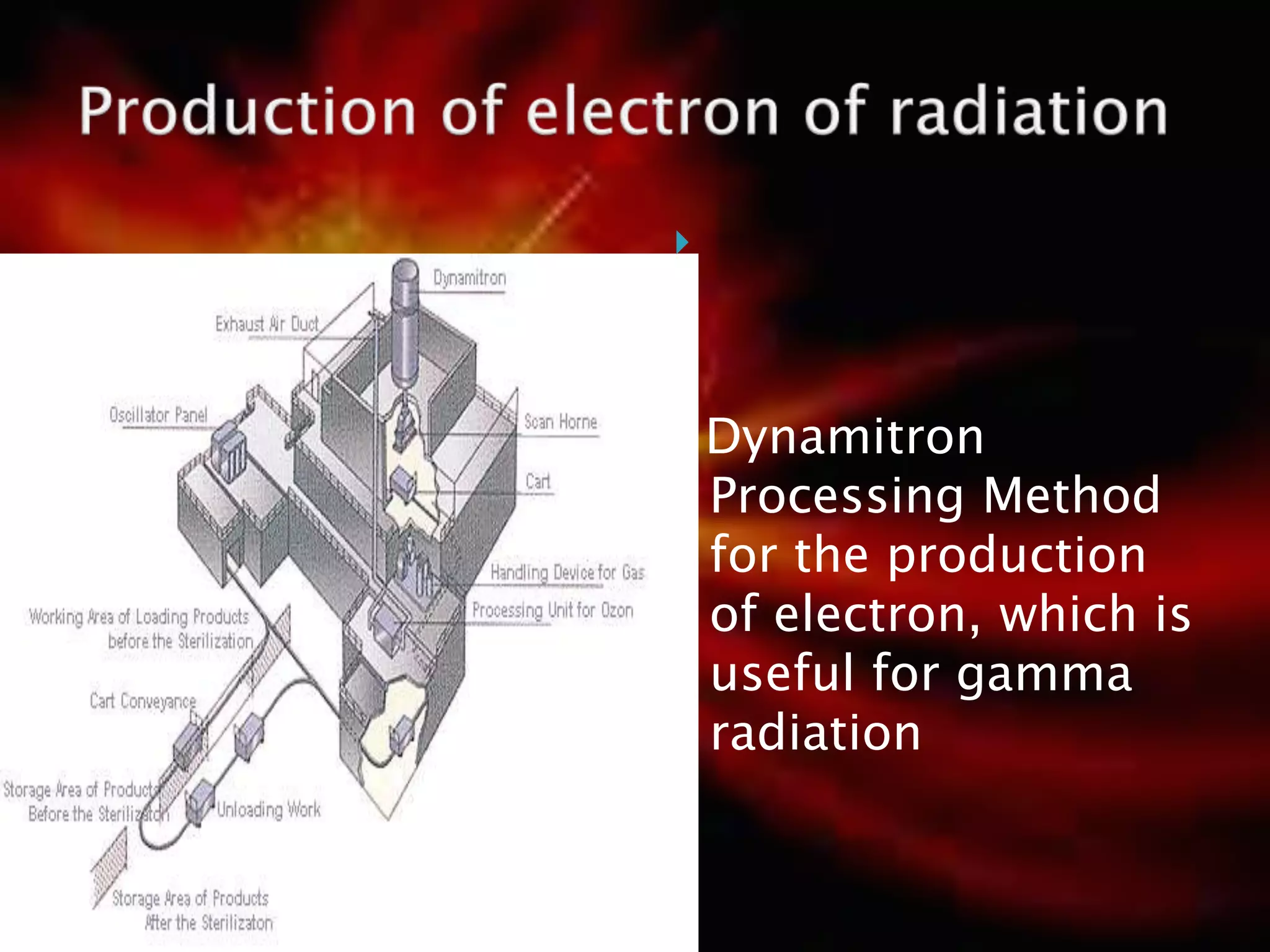
Dynamitron
Processing Method
for the production
of electron, which is
useful for gamma
radiation
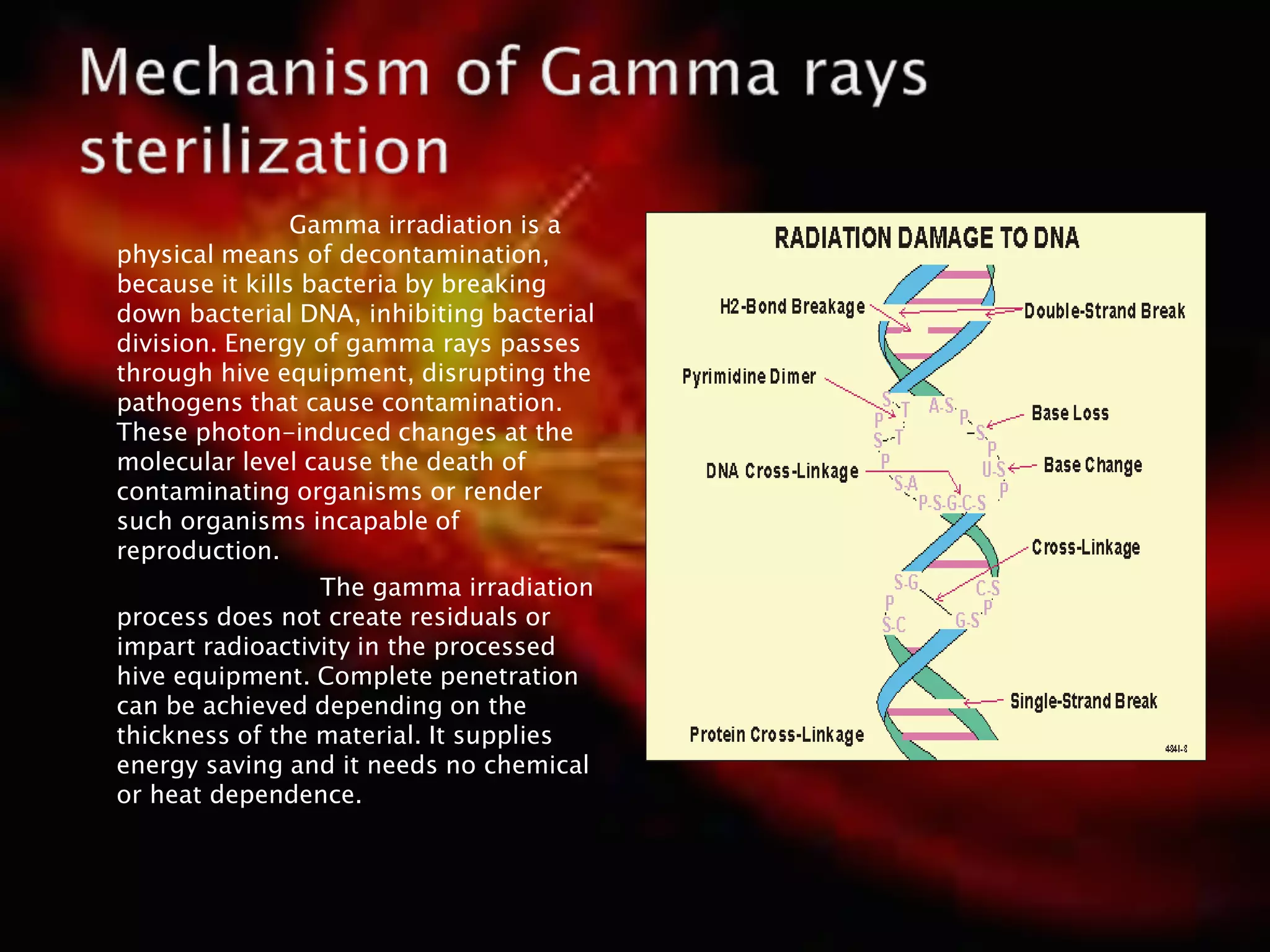
Gamma irradiation is a
physical means of decontamination,
because it kills bacteria by breaking
down bacterial DNA, inhibiting bacterial
division. Energy of gamma rays passes
through hive equipment, disrupting the
pathogens that cause contamination.
These photon-induced changes at the
molecular level cause the death of
contaminating organisms or render
such organisms incapable of
reproduction.
The gamma irradiation
process does not create residuals or
impart radioactivity in the processed
hive equipment. Complete penetration
can be achieved depending on the
thickness of the material. It supplies
energy saving and it needs no chemical
or heat dependence.
The most important
physiological and
environmental parameters are
temperature, moisture content
and oxygen concentration.
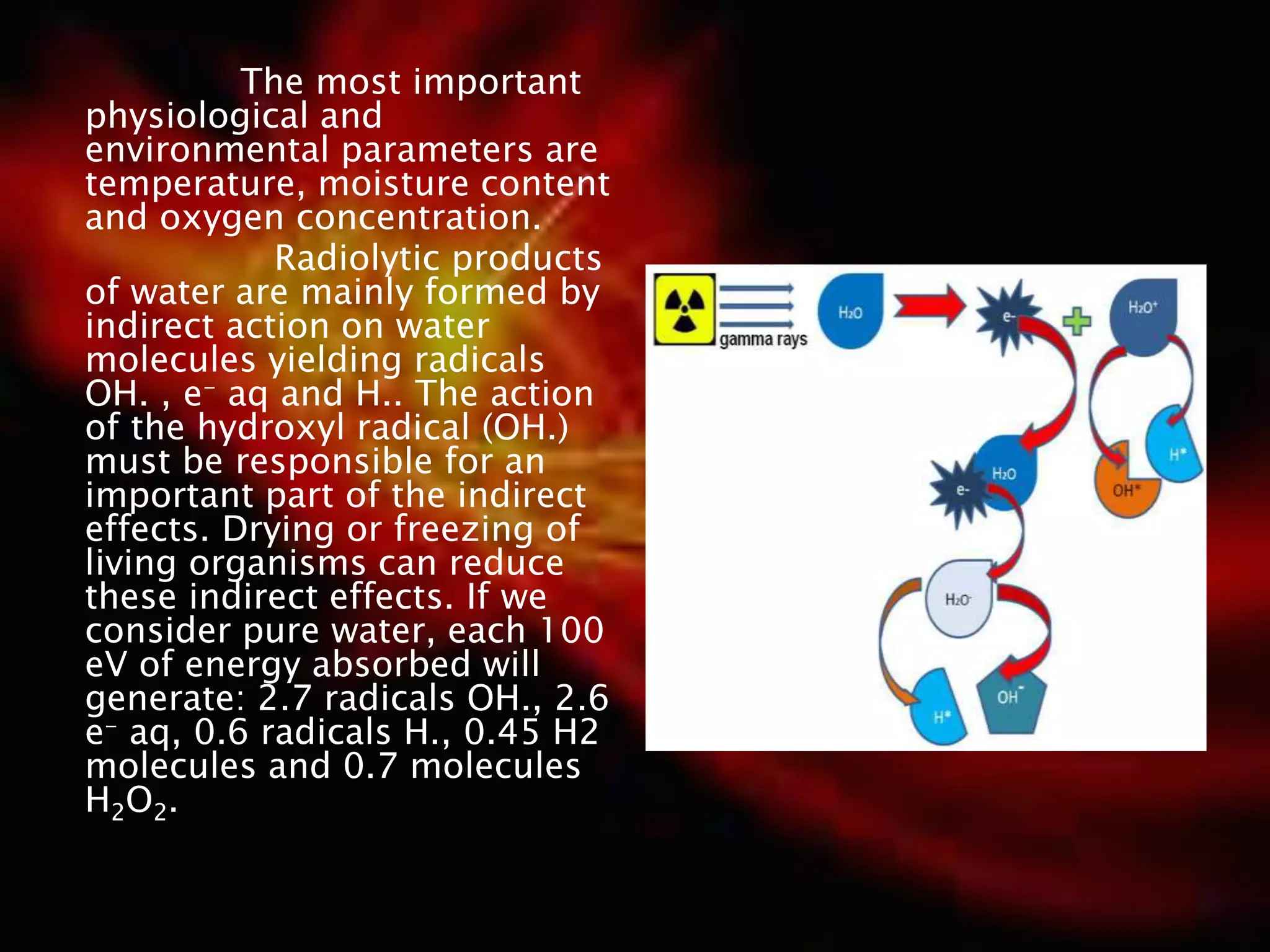
Radiolytic products
of water are mainly formed by
indirect action on water
molecules yielding radicals
OH. , e- aq and H.. The action
of the hydroxyl radical (OH.)
must be responsible for an
important part of the indirect
effects. Drying or freezing of
living organisms can reduce
these indirect effects. If we
consider pure water, each 100
eV of energy absorbed will
generate: 2.7 radicals OH., 2.6
e- aq, 0.6 radicals H., 0.45 H2
molecules and 0.7 molecules
H2O2.
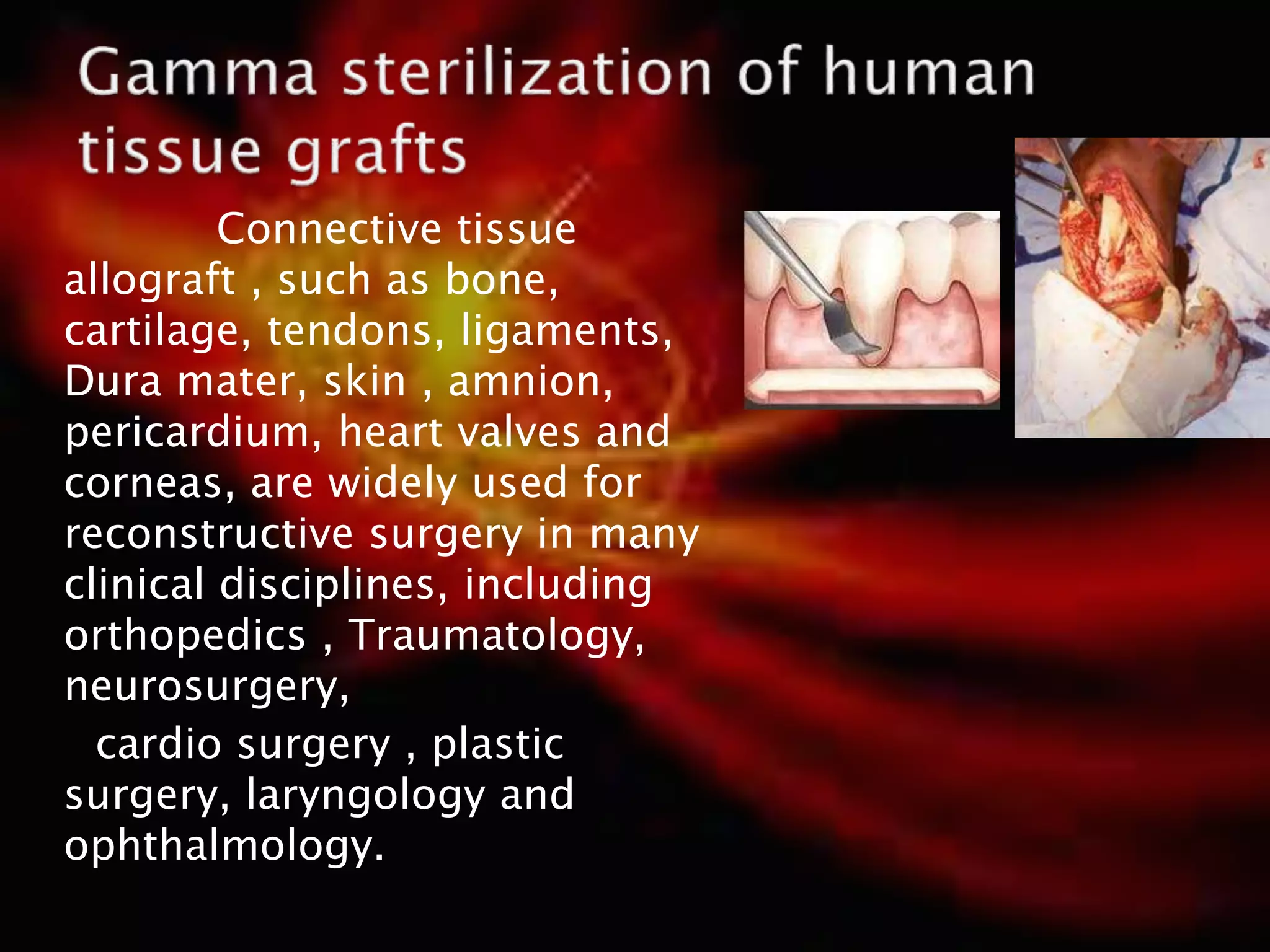
Connective tissue
allograft , such as bone,
cartilage, tendons, ligaments,
Dura mater, skin , amnion,
pericardium, heart valves and
corneas, are widely used for
reconstructive surgery in many
clinical disciplines, including
orthopedics , Traumatology,
neurosurgery,
cardio surgery , plastic
surgery, laryngology and
ophthalmology.
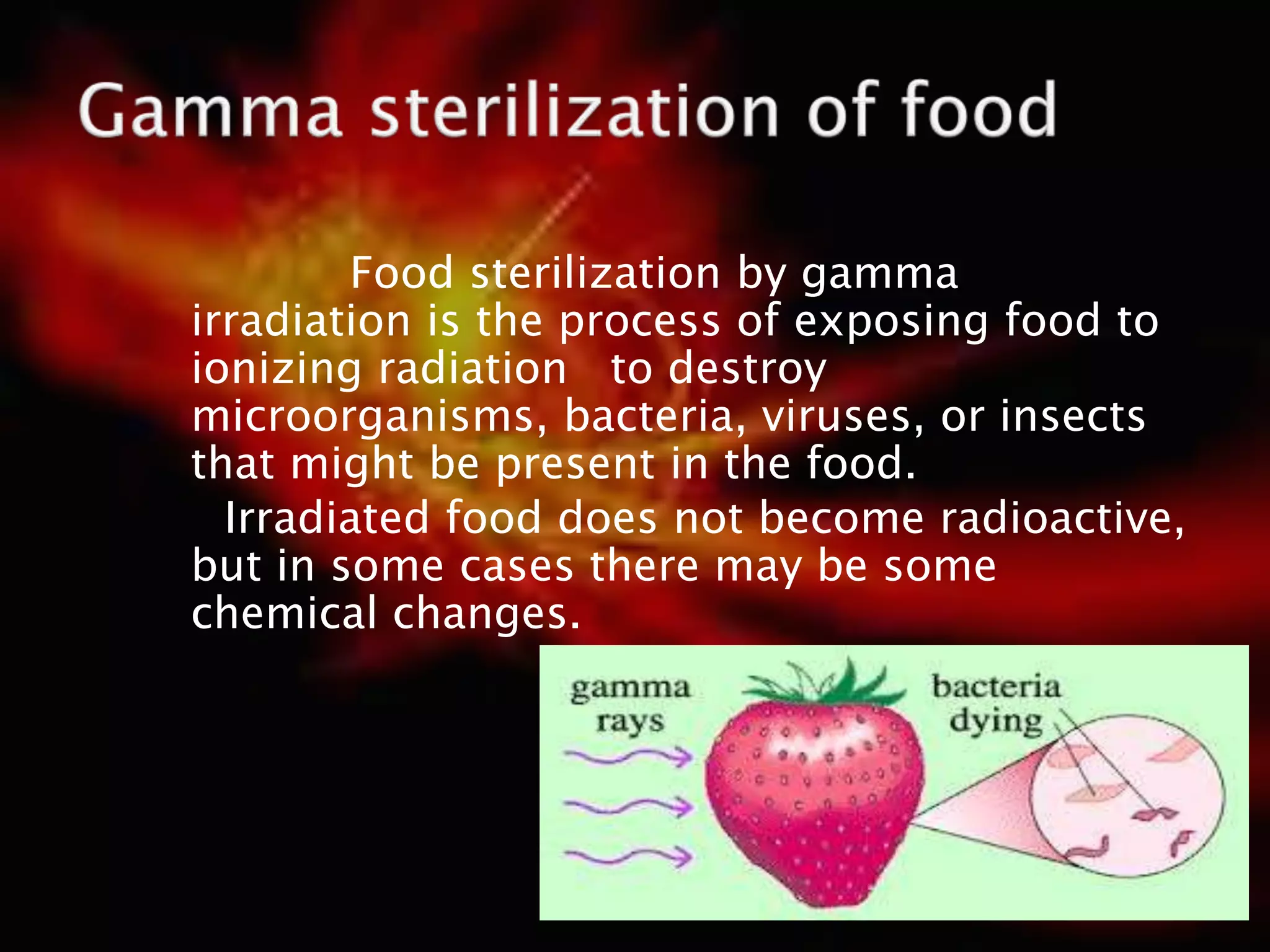
Food sterilization by gamma
irradiation is the process of exposing food to
ionizing radiation to destroy
microorganisms, bacteria, viruses, or insects
that might be present in the food.
Irradiated food does not become radioactive,
but in some cases there may be some
chemical changes.
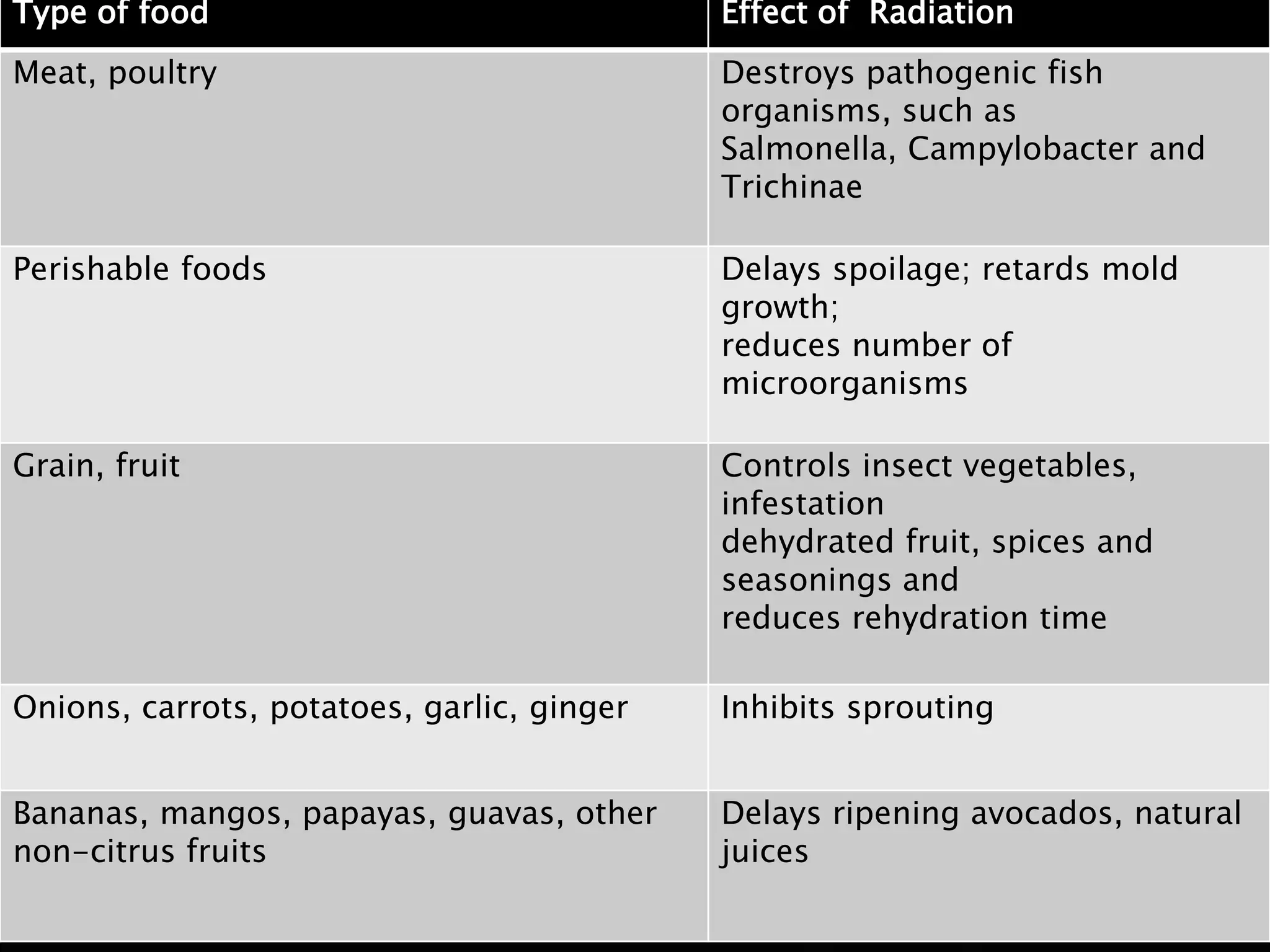
Type of food Effect of Radiation
Meat, poultry Destroys pathogenic fish
organisms, such as
Salmonella, Campylobacter and
Trichinae
Perishable foods Delays spoilage; retards mold
growth;
reduces number of
microorganisms
Grain, fruit Controls insect vegetables,
infestation
dehydrated fruit, spices and
seasonings and
reduces rehydration time
Onions, carrots, potatoes, garlic, ginger Inhibits sprouting
Bananas, mangos, papayas, guavas, other
non-citrus fruits
Delays ripening avocados, natural
juices
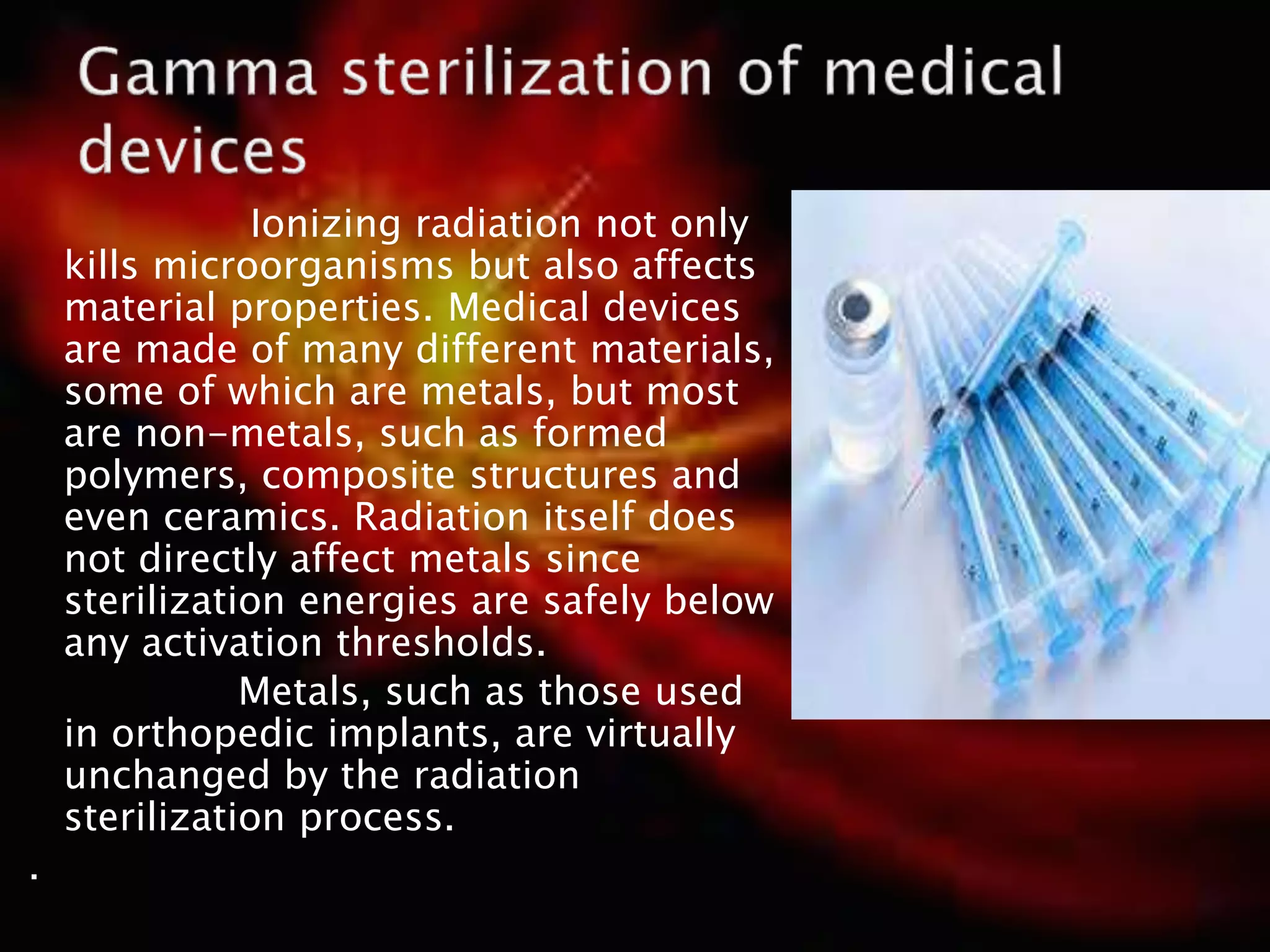
Ionizing radiation not only
kills microorganisms but also affects
material properties. Medical devices
are made of many different materials,
some of which are metals, but most
are non-metals, such as formed
polymers, composite structures and
even ceramics. Radiation itself does
not directly affect metals since
sterilization energies are safely below
any activation thresholds.
Metals, such as those used
in orthopedic implants, are virtually
unchanged by the radiation
sterilization process.
.
Survival fraction of the
microorganisms is reversely proportional with the
absorbed dose. Doses for sterilization should be
chosen according to the initial bio burden, sterility
assurance level (SAL) and the radio sensitivity of
microorganisms. A sterility assurance level (SAL) is
derived mathematically and it defines the probability
of a viable microorganism being present on an
individual product unit after sterilization.
SAL is normally expressed as 10−n. SAL is
generally set at the level of 10−6 microorganisms/ml
or g for the inject able pharmaceuticals, ophthalmic
ointment and ophthalmic drops and is 10-3 for some
products like gloves that are used in the aseptic
conditions.
Advantage
 gamma rays have a high penetration power
so materials can be sterilized after filling them in
the final container
 The method is suitable for all types of material
such as dry, moist and frozen
 The method is reliable and can be accurately
controlled
 Some bacterial and viral vaccines can be
sterilized because the exposure time is very short
Disadvantage
 The radiation are harmful to workers
 It produce undesirable changes in many
medicament such as colour , solubility and
texture of the product
 The method is mainly used for sterilization of
plastic syringes, hypodermic needles,
scalpels, surgical blades and adhesive
dressings.
 It is also used for sterilization of bone and
tissue transplant, plastic tubing , catheteres
and sutures.
 It is used for sterilization of thermolabile
medicaments.
 Remington, volume I, page no. 772
 Sterilization by gamma radiation
by silva aquino, Brazil
 The study of the sterilization efffect of
gamma ray irradiation of immobilized
collagen polpropylene nonwoven fabric
surfaces
Yung-chang tyan, chung univercity
 International organization of standardization
(1995),volume second
Gamma rays sterilization

Gamma rays sterilization

  • 2.
    5/1/2014 Smt.Kashibai Navale CollegeOf Pharmacy,Kondhawa,pune. 2 GAMMA RAYS STERILIZATION Presented By Guided By Sagar G. Lingot Dr. G. V. Patil mam M. PHARM (SEM– I) H.O.D DEPT. OF PHARMACEUTICS DEPT. OF PHARMACEUTICS
  • 3.
     History  Definition Method of sterilization  Source of gamma rays  General aspects of gamma rays  Effect of gamma rays: on living organism on human tissue grafts on food on medical devices  Sterilization dose  Conclusion  Advantage and disadvantage  Application
  • 4.
    STERIS has providedgamma sterilization services since 1972. However, the history of gamma irradiation dates back as far as 1895.  Gamma Radiation: Timeline of Events  1895 W.C. Roentgen discovers X-rays  1896 A.H. Becquerel observes radiation emitted form uranium  1897 J. Thompson discovers the electron  1898 Marie & Pierre Curie discover several radioactive elements and first use the terms “radioactive” and “radio activity”  1963 The first gamma irradiator in the US was installed in New Jersey for the processing of medical device
  • 5.
    Sterilization is definedas any process that effectively kills or eliminates almost all microorganisms like fungi, bacteria, viruses, spore forms. There are many different sterilization methods depending on the purpose of the sterilization and the material that will be sterilized.
  • 6.
    A) Physical Methods 1)Dry heat sterilization 2) Moist heat sterilization 3) Radiation sterilization a) use of UV rays b) Ionizing radiation ( X-rays and Gamma rays) B) Chemical Methods 1) Sterilization by heating with bactericide 2) Gaseous sterilization c) Mechanical Methods 1) Ceramic filter 2) seitz filter 3) sintered glass filter 4) sintered metal filter 5) Membrane filter
  • 8.
    Gamma radiation sterilizationare mainly used for the sterilization of pharmaceuticals. Gamma radiation delivers a certain dose that can take time for a period of time from minutes to hours depending on the thickness and the volume of the product. gamma sterilization requires time, contact and temperature. The effectiveness of any method of sterilization is also dependent upon four other factors like the type of microorganism present. Some microorganisms are very difficult to kill. Others die easily the number of microorganisms present.
  • 9.
     Gamma raysare formed with the self disintegration of Cobalt-60 (60Co) or Cesium-137 (137Cs) sources. Among thousands of gamma emitters only 137Cs and 60Co are indicated for radiation processing. The energy of gamma rays, as electromagnetic quantum waves, is similar to light, but with higher photon energy and shorter wavelength. The 60Co radionuclide can be produced in a nuclear power reactor by the irradiation of 59Co (metal), with fast neutrons. The radioactive isotope is formed by neutron capture as showed equation (Laughlin, 1989). 27Co59+ 0n1→27Co60
  • 10.
     Dynamitron Processing Method for theproduction of electron, which is useful for gamma radiation
  • 11.
    Gamma irradiation isa physical means of decontamination, because it kills bacteria by breaking down bacterial DNA, inhibiting bacterial division. Energy of gamma rays passes through hive equipment, disrupting the pathogens that cause contamination. These photon-induced changes at the molecular level cause the death of contaminating organisms or render such organisms incapable of reproduction. The gamma irradiation process does not create residuals or impart radioactivity in the processed hive equipment. Complete penetration can be achieved depending on the thickness of the material. It supplies energy saving and it needs no chemical or heat dependence.
  • 12.
    The most important physiologicaland environmental parameters are temperature, moisture content and oxygen concentration. Radiolytic products of water are mainly formed by indirect action on water molecules yielding radicals OH. , e- aq and H.. The action of the hydroxyl radical (OH.) must be responsible for an important part of the indirect effects. Drying or freezing of living organisms can reduce these indirect effects. If we consider pure water, each 100 eV of energy absorbed will generate: 2.7 radicals OH., 2.6 e- aq, 0.6 radicals H., 0.45 H2 molecules and 0.7 molecules H2O2.
  • 14.
    Connective tissue allograft ,such as bone, cartilage, tendons, ligaments, Dura mater, skin , amnion, pericardium, heart valves and corneas, are widely used for reconstructive surgery in many clinical disciplines, including orthopedics , Traumatology, neurosurgery, cardio surgery , plastic surgery, laryngology and ophthalmology.
  • 15.
    Food sterilization bygamma irradiation is the process of exposing food to ionizing radiation to destroy microorganisms, bacteria, viruses, or insects that might be present in the food. Irradiated food does not become radioactive, but in some cases there may be some chemical changes.
  • 16.
    Type of foodEffect of Radiation Meat, poultry Destroys pathogenic fish organisms, such as Salmonella, Campylobacter and Trichinae Perishable foods Delays spoilage; retards mold growth; reduces number of microorganisms Grain, fruit Controls insect vegetables, infestation dehydrated fruit, spices and seasonings and reduces rehydration time Onions, carrots, potatoes, garlic, ginger Inhibits sprouting Bananas, mangos, papayas, guavas, other non-citrus fruits Delays ripening avocados, natural juices
  • 17.
    Ionizing radiation notonly kills microorganisms but also affects material properties. Medical devices are made of many different materials, some of which are metals, but most are non-metals, such as formed polymers, composite structures and even ceramics. Radiation itself does not directly affect metals since sterilization energies are safely below any activation thresholds. Metals, such as those used in orthopedic implants, are virtually unchanged by the radiation sterilization process. .
  • 18.
    Survival fraction ofthe microorganisms is reversely proportional with the absorbed dose. Doses for sterilization should be chosen according to the initial bio burden, sterility assurance level (SAL) and the radio sensitivity of microorganisms. A sterility assurance level (SAL) is derived mathematically and it defines the probability of a viable microorganism being present on an individual product unit after sterilization. SAL is normally expressed as 10−n. SAL is generally set at the level of 10−6 microorganisms/ml or g for the inject able pharmaceuticals, ophthalmic ointment and ophthalmic drops and is 10-3 for some products like gloves that are used in the aseptic conditions.
  • 19.
    Advantage  gamma rayshave a high penetration power so materials can be sterilized after filling them in the final container  The method is suitable for all types of material such as dry, moist and frozen  The method is reliable and can be accurately controlled  Some bacterial and viral vaccines can be sterilized because the exposure time is very short Disadvantage  The radiation are harmful to workers  It produce undesirable changes in many medicament such as colour , solubility and texture of the product
  • 20.
     The methodis mainly used for sterilization of plastic syringes, hypodermic needles, scalpels, surgical blades and adhesive dressings.  It is also used for sterilization of bone and tissue transplant, plastic tubing , catheteres and sutures.  It is used for sterilization of thermolabile medicaments.
  • 21.
     Remington, volumeI, page no. 772  Sterilization by gamma radiation by silva aquino, Brazil  The study of the sterilization efffect of gamma ray irradiation of immobilized collagen polpropylene nonwoven fabric surfaces Yung-chang tyan, chung univercity  International organization of standardization (1995),volume second